




Quick view
Shop this guide
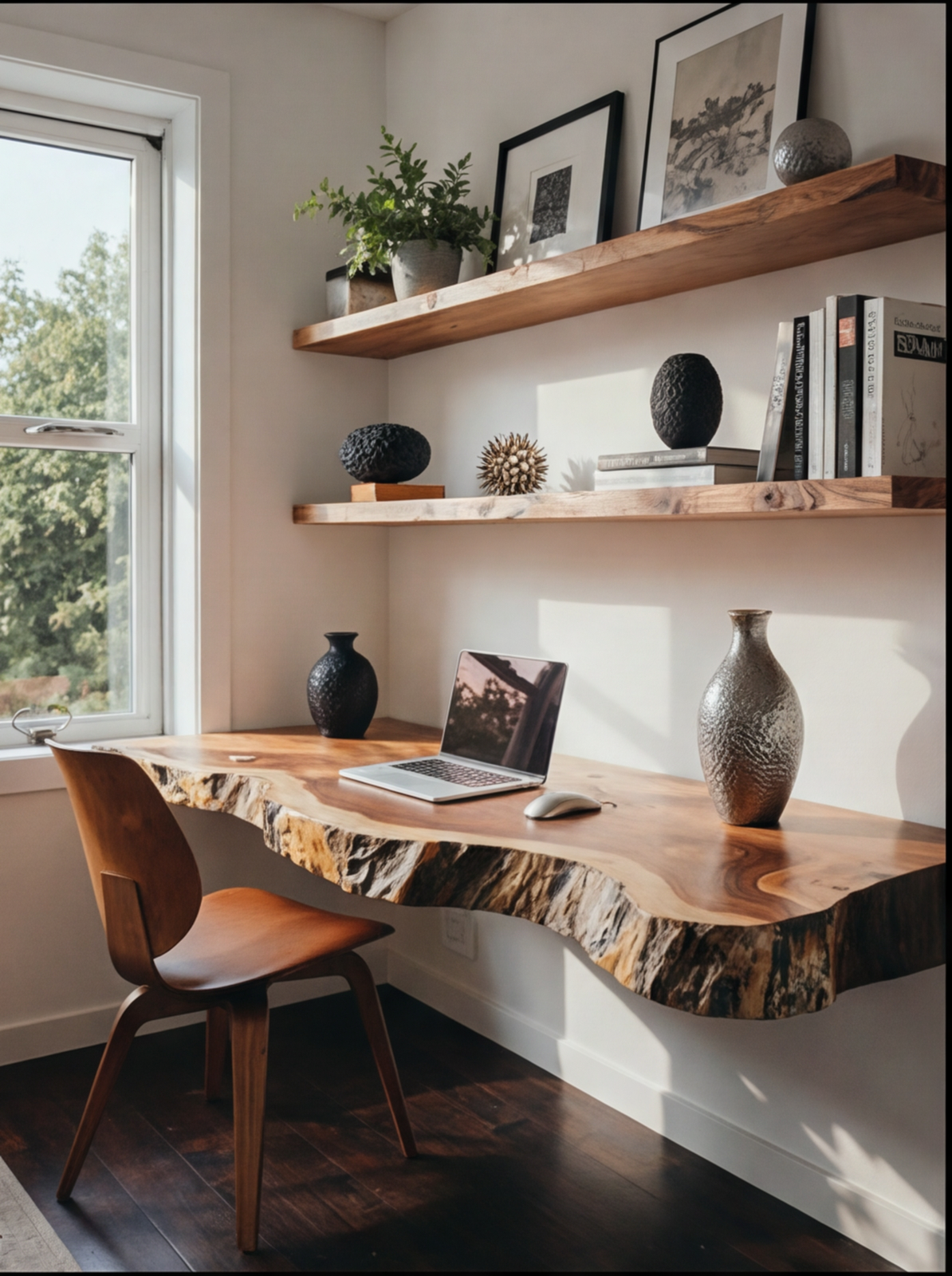
Handcrafted Floating Desk, made to order in solid wood.
 Curved Floating Wall Mounted Secretary Desk Solid Timber Workstation with Built in Hutch and Drawers
From $1,876.00
Curved Floating Wall Mounted Secretary Desk Solid Timber Workstation with Built in Hutch and Drawers
From $1,876.00
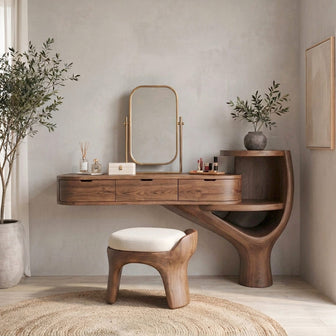
 Floating Executive Desk with Curved Tree Bookshelf and Storage Drawers in Solid Wood
From $1,365.00
Floating Executive Desk with Curved Tree Bookshelf and Storage Drawers in Solid Wood
From $1,365.00
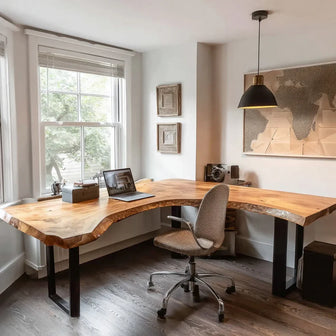
 Wall Mounted Live Edge Study Table with Floating Drawers Handcrafted in Solid Wood
From $2,165.0010% off at checkout
Wall Mounted Live Edge Study Table with Floating Drawers Handcrafted in Solid Wood
From $2,165.0010% off at checkout
 Floating Live Edge Desk with Tree Branch Wall Shelf & Dual Drawers
From $1,800.00
Floating Live Edge Desk with Tree Branch Wall Shelf & Dual Drawers
From $1,800.00
 Modern Handcrafted Solid Wood Floating L-Shaped Corner Desk with Integrated Storage Cubbies & Drawer
From $1,621.00
Modern Handcrafted Solid Wood Floating L-Shaped Corner Desk with Integrated Storage Cubbies & Drawer
From $1,621.00
 Modern Handcrafted Solid Wood Floating L-Shaped Corner Desk with Integrated Pull-Out Drawer & Open Storage Cubby
From $1,643.00
Modern Handcrafted Solid Wood Floating L-Shaped Corner Desk with Integrated Pull-Out Drawer & Open Storage Cubby
From $1,643.00
A floating desk mounts directly to your wall, freeing up every square inch of floor space underneath. No legs, no bulky frame, no dust-collecting base - just a clean work surface that appears to hover. For apartments, small bedrooms, and tight home offices, a wall mounted desk is one of the most impactful furniture upgrades you can make. It creates usable workspace where none existed before. We cover this in more detail in our home office design ideas guide.
This guide breaks down every floating desk style worth considering, walks through installation specifics (including what your wall can actually support), and covers the materials that make the difference between a wobbly shelf and a real desk.
What Exactly Is a Floating Desk?
A floating desk is a wall-mounted work surface with no visible legs or floor supports. It attaches directly to wall studs using concealed brackets, French cleats, or heavy-duty mounting hardware. The result is a desk that cantilevers from the wall, leaving the floor completely open for chairs, storage, or just breathing room.
Floating desks range from simple 12-inch-deep shelves (enough for a laptop) to full 24-inch-deep workstations with built-in cable management and drawer units. The depth you need depends on your work: laptop-only users can get away with 12-15 inches, while monitor setups need 18-24 inches minimum.
Types of Floating Desks
Not all floating desks solve the same problem. The style you choose should match your work habits, room layout, and how permanent you want the installation to be. Here's what's actually available and who each type serves best.
Simple Floating Shelf Desk
The most minimal option: a single thick slab mounted at desk height (28-30 inches from the floor). No drawers, no hutch, no extras - just a clean surface. This works best for laptop users, journaling stations, or kids' homework spots.
Go with a slab at least 1.5 inches thick for visual weight and structural rigidity. Thinner boards flex under forearm pressure, which is distracting during long work sessions.
Fold-Down / Murphy Desk
A fold-down desk hinges against the wall and drops to horizontal when you need it. When folded up, it's essentially a flat panel flush with the wall. This is the ultimate space saver for studio apartments where the "office" needs to disappear at the end of the workday.
The tradeoff: you clear the desk every time you fold it. If your workflow involves leaving projects spread out, a fold-down desk will frustrate you.
Floating Desk with Built-In Storage
These combine a work surface with mounted cubbies, small drawers, or shelf compartments above or below the desktop. They're ideal for craft rooms, bill-paying stations, or small offices where you need supplies within arm's reach but can't fit a separate storage unit.
Weight is a consideration here - a fully loaded desk with storage easily exceeds 80 pounds. Make sure every mounting point hits a stud.
Live Edge Floating Desk
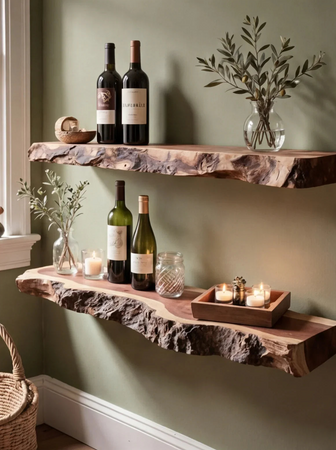
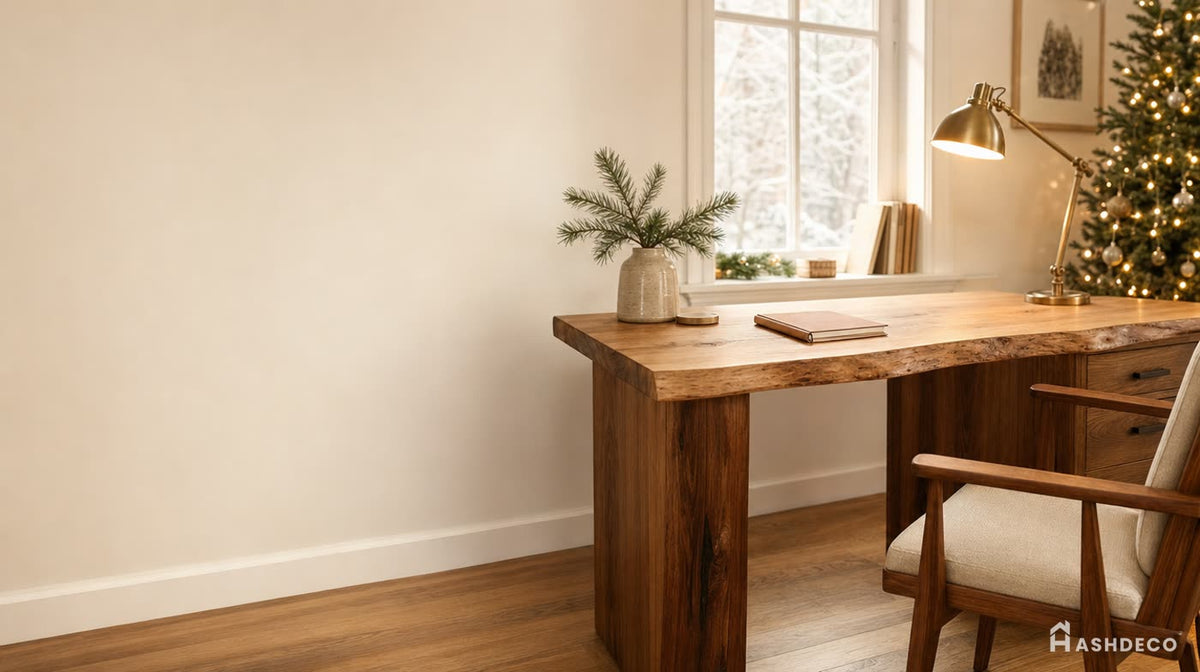
A slab of solid hardwood with one or both edges left in their natural bark-line form, mounted to the wall as a floating desk. The organic edge adds character that no factory-made desk can replicate. Each piece is genuinely one-of-a-kind because every tree grows differently.

Ashdeco's live edge desk collection features slabs hand-finished by Vietnamese artisans who follow the wood's natural grain and shape. These pieces work as both functional desks and wall-mounted art. We've written a full breakdown in our live edge desk ergonomic guide post.
Corner Floating Desk
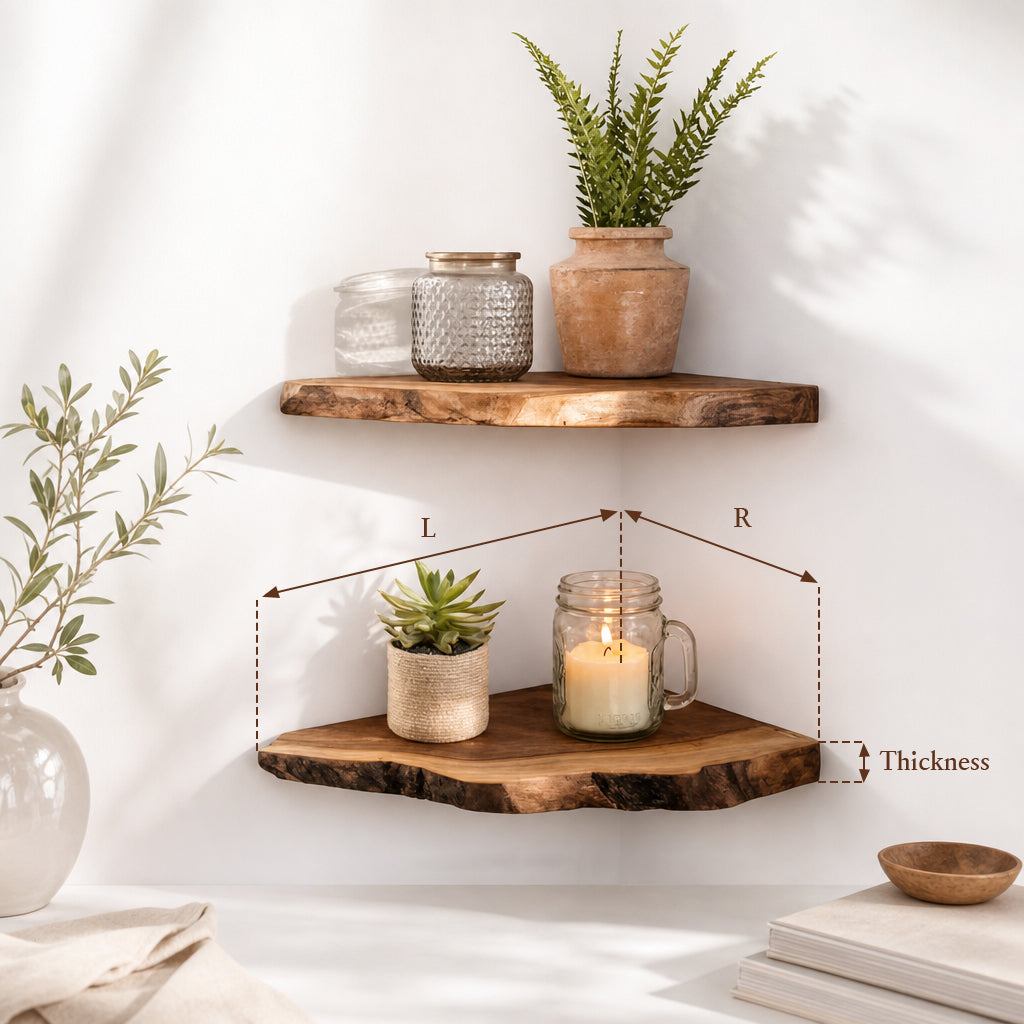
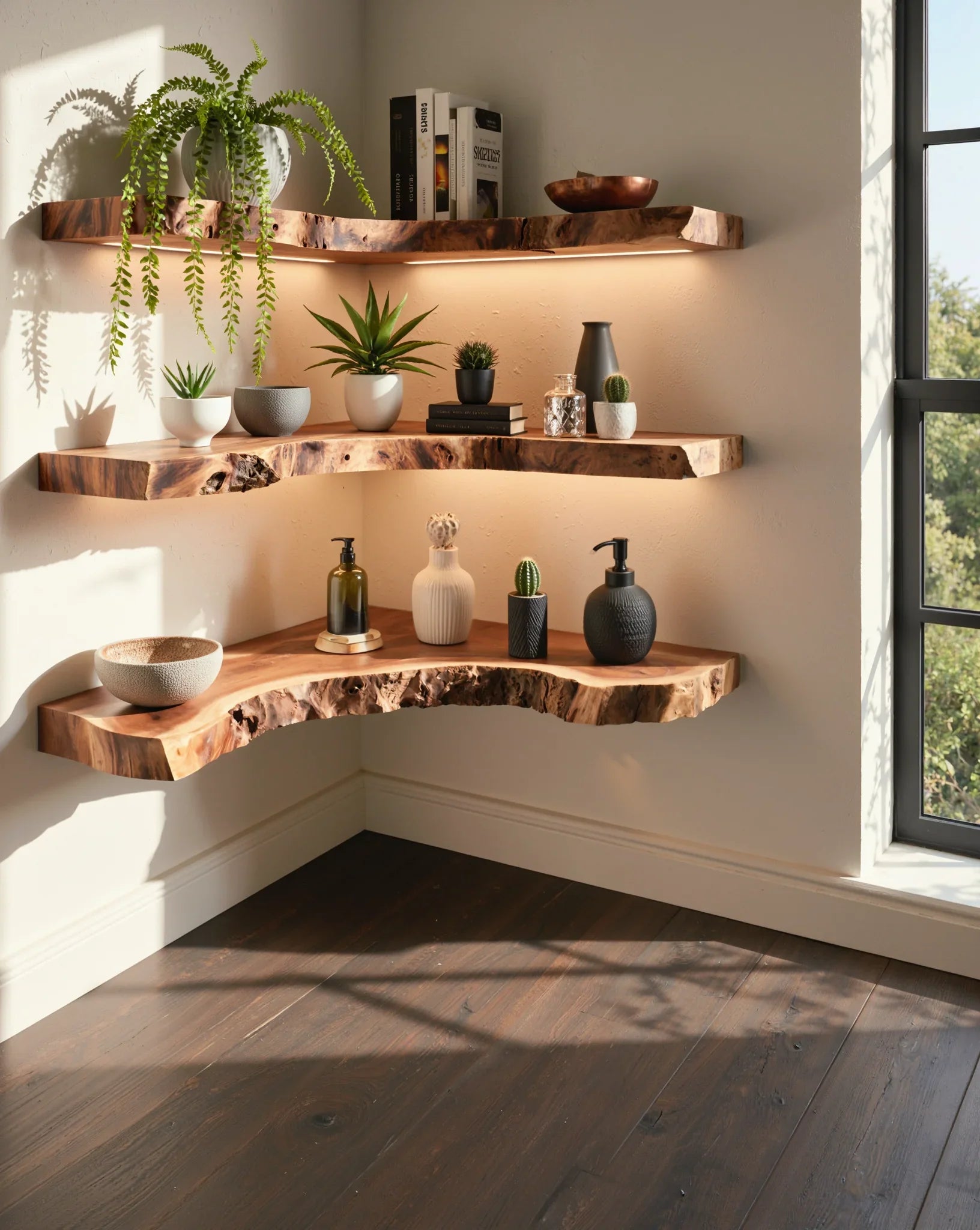
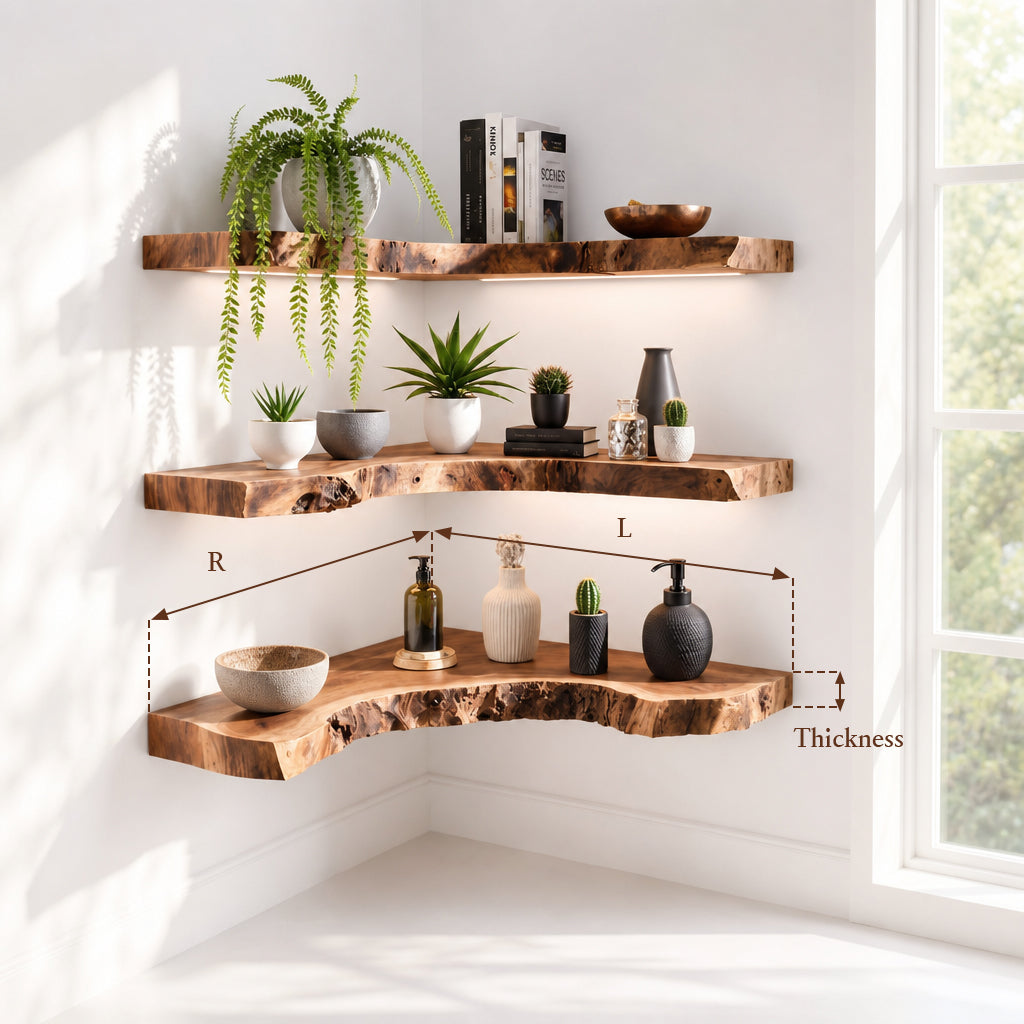
An L-shaped or triangular desk that mounts into a corner, using two walls for support. Corners are the most underused real estate in any room - a floating corner desk turns dead space into a legitimate workstation. The dual-wall mounting also provides more structural support than a single-wall installation.


Best Rooms for a Floating Desk
Floating desks shine in specific situations. Knowing where they work best (and where they don't) saves you from an installation you'll regret. Here are the rooms where a wall mounted desk makes the most practical sense.
Small Bedrooms and Guest Rooms
A floating desk in a bedroom eliminates the need for a separate desk that competes with the bed, dresser, and nightstand for floor space. Mount it along the wall opposite the bed at standard desk height. Add a wall-mounted task light above to keep the surface clear.
In guest rooms, a floating desk serves double duty as a vanity and workspace without making the room feel cramped.
Kitchen Nooks and Hallway Alcoves
That awkward 30-inch gap between the refrigerator and the wall? Perfect for a floating desk. Same with hallway alcoves, under-stair spaces, and the dead zone between two doorways. Measure the width, cut or order a desk to fit, and mount it. Pair with floating shelves above for a complete micro-office.
Living Rooms
In open-plan living rooms where a full desk would disrupt the layout, a floating desk along a side wall or behind the sofa creates a work zone without dedicating a whole room to it. Choose a finish that matches your existing furniture - a floating desk should blend in, not announce itself.
Where Floating Desks Don't Work Well
Skip the floating desk if you need a surface deeper than 24 inches (drafting, large monitors with keyboard trays), if your walls are uninsulated exterior walls prone to condensation, or if you need heavy-duty workspace for equipment over 100 pounds. In those cases, a traditional desk with legs distributes weight to the floor and gives you more flexibility.
Installation Guide: How to Mount a Floating Desk
A floating desk is only as strong as its mounting. Cut corners here and you'll have a desk that pulls away from the wall the first time you lean on it. Follow these steps for a rock-solid installation that holds up to daily use.
Step 1: Find and Mark Your Studs
Use a stud finder to locate wall studs - they're typically 16 inches on center in most US homes. Mark every stud across your planned desk width. You need a minimum of two studs, but three or more is strongly preferred for desks wider than 36 inches.
No studs where you need them? Use toggle bolts rated for at least 50 pounds each in drywall. But understand the limits: drywall anchors are a backup, not a primary mounting strategy for a surface people lean on.
Step 2: Choose Your Mounting Method
French cleat: A beveled strip mounted to the wall that interlocks with a matching strip on the desk. Distributes weight evenly and allows easy removal. Best for heavier desks and live edge slabs. If you're weighing your options, our guide on how to pick a live edge desk breaks it down further.
Concealed brackets: Steel L-brackets or rod-style supports hidden inside the desk slab. Creates the cleanest "floating" look. Requires precise drilling into the desk's underside.
Visible brackets: Decorative steel or iron brackets mounted underneath. Less hidden but often stronger - and industrial-style brackets can be a design feature rather than an eyesore.
Step 3: Level, Drill, and Mount
Use a 4-foot level (not a phone app - they're not accurate enough for furniture). Mark your mounting holes, pre-drill with a bit slightly smaller than your lag screws, and drive 3-inch minimum lag screws into studs. For solid wood desks, attach the cleat or bracket to the desk first, then mount the assembly to the wall with a helper.
Check for level again after tightening all fasteners. Wood walls flex slightly under load, so retighten after 24 hours once everything has settled.
Step 4: Cable Management
Route power and data cables through a desk grommet or along the wall behind the desk using adhesive cable channels. A floating desk loses its visual impact if cables dangle visibly to a floor outlet. Consider installing an outlet directly behind the desk at desktop height - an electrician can add one in about 30 minutes.
Don't miss
These pieces qualify for 10% off orders over $2,000. Applied automatically at checkout.
10% off
Wall Mounted Live Edge Study Table with Floating Drawers Handcrafted in Solid Wood
From $2,165.00
10% off at checkout
 10% off
Sculptural Floating Live Edge Solid Wood Desk with Carved Blossom Branch Wall Unit
From $2,359.00
10% off at checkout
10% off
Sculptural Floating Live Edge Solid Wood Desk with Carved Blossom Branch Wall Unit
From $2,359.00
10% off at checkout
 10% off
Modern Floating Wall Desk with Drawers – Minimalist Solid Wood Home Office Desk
From $2,534.00
10% off at checkout
10% off
Modern Floating Wall Desk with Drawers – Minimalist Solid Wood Home Office Desk
From $2,534.00
10% off at checkout
 10% off
Floating Wooden Desk with Wall Shelves – Minimalist Solid Wood Workstation
From $2,345.00
10% off at checkout
10% off
Floating Wooden Desk with Wall Shelves – Minimalist Solid Wood Workstation
From $2,345.00
10% off at checkout
Materials: What Makes a Floating Desk Last
The material you choose determines how the desk looks, how much weight it holds, and how long it lasts. Cheap materials sag under load within months. Quality materials stay flat and strong for decades. Here's the honest breakdown.
| Material | Weight Capacity | Sag Resistance | Aesthetics | Price Range |
|---|---|---|---|---|
| Solid Hardwood (walnut, oak, maple) | Excellent - 100+ lbs at 24" depth | Excellent | Warm, natural grain, ages beautifully | $$$ |
| Butcher Block | Very Good - laminated grain resists bowing | Very Good | Rustic, visible edge grain | $$ |
| Plywood (Baltic Birch) | Good - cross-grain layers add strength | Good | Exposed plywood edge can look modern | $$ |
| MDF / Particleboard | Poor - sags at 30"+ spans | Poor | Smooth paint finish, no wood character | $ |
| Live Edge Slab | Excellent - thick single piece | Excellent | Unique, organic, statement piece | $$$$ |
The sag test: Any desk material will eventually sag if unsupported across a wide span. For spans over 36 inches without a center support, stick with solid hardwood or butcher block at 1.5 inches thick minimum. MDF desks wider than 30 inches need a center bracket or they'll develop a visible bow within a year.

Ashdeco's live edge floating desks use solid hardwood slabs 1.5-2.5 inches thick - thick enough to span wide distances without sagging and heavy enough to feel substantial, not flimsy.
Floating Desk DIY: Can You Build One Yourself?
A floating desk is one of the more accessible DIY furniture projects. If you own a drill, a level, and a stud finder, you can mount a basic floating desk in an afternoon. Here's the realistic version of what that involves.
The easy version: Buy a pre-made butcher block countertop cut from IKEA or a hardwood supplier ($40-$120 for a 48"x24" piece). Add a French cleat to the wall and a matching cleat to the back of the slab. Total project time: 2-3 hours. Total cost: $60-$180 including hardware.
The intermediate version: Source a rough-sawn hardwood slab from a local sawmill, plane it flat, sand through 220 grit, apply finish (Danish oil or polyurethane), and mount with concealed rod brackets. Total project time: 8-12 hours over a weekend. Total cost: $100-$300.
Where DIY falls short: Achieving a truly concealed mount with no visible hardware requires precision drilling and router work. Live edge slabs need stabilization, bark removal, and careful finishing. If the organic, one-of-a-kind look is what you're after, a handcrafted piece saves you significant time and delivers better results.
Styling Your Floating Desk
A floating desk creates visual breathing room - don't clutter it back up. The styling should emphasize the clean, open feel that makes wall mounted desks appealing in the first place.

Above the desk: Mount one or two floating shelves 18-24 inches above the desk surface for books, plants, or a small speaker. Keep shelves shallower than the desk (8-10 inches deep) so they don't overwhelm the workspace.
On the desk: Limit standing items to three: a lamp, a plant, and one functional object (pen holder, small organizer). Everything else goes in a drawer or on a shelf above.
Below the desk: The open floor is the whole point. Tuck a slim chair underneath when not in use. If you need under-desk storage, use a single wall-mounted file holder - not a floor bin that defeats the purpose of a floating desk.
Lighting: A wall-mounted swing-arm lamp keeps the desk surface clear and directs light exactly where you need it. Avoid table lamps that eat up 25% of a compact floating desk's surface area.
Frequently Asked Questions
How much weight can a floating desk hold?
A properly mounted floating desk into two or more wall studs using lag screws supports 80-150 pounds depending on material thickness, bracket type, and desk depth. Solid hardwood with a French cleat into three studs handles the high end. MDF with drywall anchors is at the low end - around 30-40 pounds maximum. Always verify your bracket's rated load capacity before mounting.
Can I install a floating desk on a plaster wall?
Yes, but you must still anchor into studs behind the plaster. Use a stud finder designed for plaster and lath walls (some cheap magnetic models don't work well through thick plaster). Drill carefully - plaster cracks easily. Use a masonry bit at low speed to get through the plaster layer, then switch to a standard bit for the stud behind it.
What is the best height for a floating desk?
Standard desk height is 28-30 inches from floor to desktop surface. If you're taller than 6 feet, go with 30-32 inches. For standing desk use, mount at 42-48 inches depending on your height. The best test: stand or sit in your desk chair and measure from the floor to your relaxed elbow height - that's your ideal desktop height.
Do floating desks damage walls?
Mounting into studs leaves screw holes that are easily patched with spackle if you remove the desk later. The desk itself doesn't damage the wall during use if properly installed. Drywall anchor installations leave larger holes and may crumble the drywall around the anchor over time, especially under heavy loads. Stud mounting is always cleaner for long-term and removal.
What is the best depth for a floating desk?
For laptop-only use, 12-15 inches is sufficient. For a monitor and keyboard, 20-24 inches gives comfortable depth. Deeper than 24 inches is rarely needed and creates more cantilever stress on the wall mount. If you need extra depth occasionally, consider a pull-out keyboard tray mounted under the desk - it adds 10 inches of usable depth that tucks away when not needed.