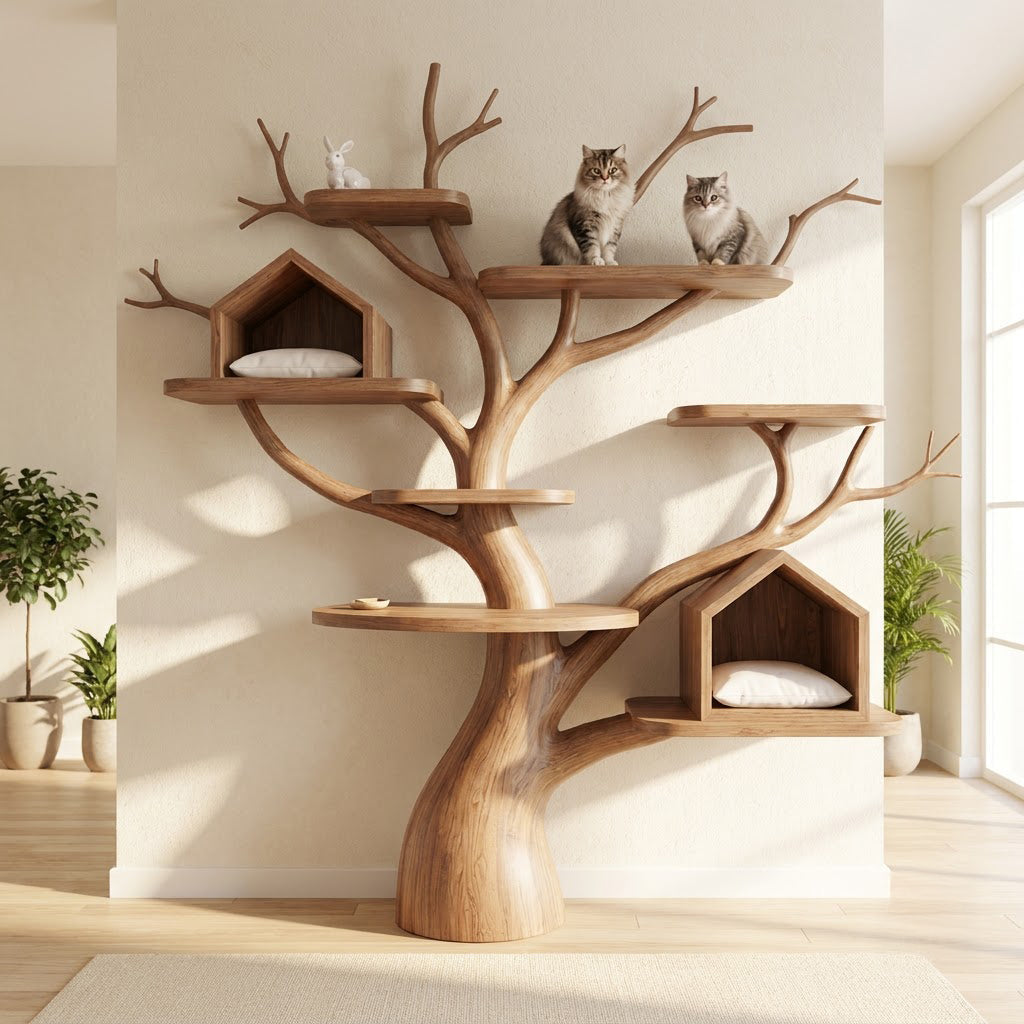
Cat Tower With House: How to Choose One Your Cat Will Actually Use
A cat tower with house is a climbing structure with at least one enclosed hideaway built into it. People search it because a bare platform tower leaves the cat exposed, and cats sleep 14+ hours a day. A cat tree with house only works if the box is sized for the cat that will actually use it and it sits at a height that cat trusts. If either fails, you bought a very expensive shelf and the cat sleeps in a cardboard box.
This is the buying filter. For height vs your ceiling, use the cat tree height guide. For shape, use cat tree vs cat tower. For material, use natural wood cat tower. Then come back here and pick the house.
As a handmade furniture brand, we build solid wood cat towers for living rooms where the piece has to hold a 20-pound Maine Coon and still look like furniture. The ones that fail are not ugly. They are 10-inch condo cubes on a 6-foot tower, sold for a cat that is 14 inches long before the tail.

What Counts as a Cat Tower With House (and What Does Not)
The house is an enclosed or mostly enclosed space the cat can sit inside, with a roof over it.
That includes:
- A cube condo with one or two entry holes
- A tunnel condo built into the base
- A closed box mid-tower with a perch on the roof
- Dual house condos on a wall-mounted climbing unit
- A hollowed sculptural form that reads as a den
That does not include:
- A cupped bed with no roof (that is a perch with walls)
- A hammock slung between posts
- A "cave" of stretched fabric on a wire frame that collapses when a big cat leans
- A basket zip-tied to a platform
If your cat sleeps on top of things and never under them, skip the house and buy platform area instead. A cat tree tower with wide perches beats an unused condo.

Size the House to the Cat, Not the Photo
This is where most cat tower with house purchases go wrong. Listings show the tower height and hide the condo interior dimensions.
An adult cat needs to turn around, curl, and sit up inside without touching the roof. Rules of thumb:
| Cat | Weight | Interior floor | Interior height | Entry hole |
|---|---|---|---|---|
| Small (Siamese, Devon Rex) | 5-10 lb | 12" x 12" | 12-14" | 6-7" |
| Medium (domestic shorthair, Bengal) | 10-15 lb | 14" x 14" | 14-16" | 7-8" |
| Large (Maine Coon, Ragdoll, Norwegian Forest) | 15-25 lb | 18" x 18"+ | 16-18" | 8-9" |
| Two cats sharing | any | 20"+ wide | 16-18" | two exits |
Entry holes matter more than owners expect. A big cat squeezing through a 6-inch hole will stop using the house. Two openings also matter in multi-cat homes: a single-door box is a trap, and the cat lower in the hierarchy will not enter a space with one exit.
If the listing does not publish interior dimensions, assume they are bad.

Height, Ceiling, and Where the House Goes on the Tower
Height rules do not change because there is a house on the tower. You still want at least 12 inches of clearance above the top platform so the cat can sit upright.
Quick version from our height guide:
- 8-foot ceiling: 59-70 inches is the sweet spot. You can push to 80 inches if you want the height, which still leaves 16 inches of headroom above the top platform.
- 9-10 foot ceiling: 80 inches is fine.
- Under 8 feet: 59 inches.
Where the house sits changes behavior:
Base-level house or tunnel: safest for kittens, seniors, and nervous cats. Easy in and out. Also the box that collects toys. Good default for a first cat tree with house.
Mid-tower house: the sweet spot for most adult cats. High enough to feel secure, low enough to enter without a committed jump. Roof becomes a second perch, which is free real estate.
Top-level house: cats love it, and it is the hardest to get right. The box adds weight where the tower is least stable, and older or heavy cats will avoid a climb that ends in a squeeze. If the house is at the top, the tower needs a wide, heavy base and wall anchoring.
Platform spacing still governs the climb: 16 inches or less between levels for cats over 15 pounds, 18-20 inches for average cats. A house you cannot reach comfortably is decoration.

Four Builds, and Who Each One Suits
1. Tunnel Condo in the Base (Best for Nervous and Senior Cats)
An enclosed pass-through at floor level. Two exits by design. Nothing to jump for.
Use it for kittens, seniors, shy cats, and multi-cat homes where the low cat needs a bolt hole. Also the right answer if you already read the senior cat tree guide and want zero-effort access.
Skip it if your cat only sleeps high. Floor level is the least prestigious spot in the house and the confident cat will ignore it.
Example on our side: sculptural solid wood cat tree tower with tunnel condo base.

2. Mid-Tower House With a Roof Perch (The Daily Driver)
One enclosed box partway up, flat platform on top. The cat gets both modes: hide when the vacuum runs, survey when guests arrive.
Use it for one to two adult cats in a living room. This is the configuration most people mean when they search cat tower with house.
Skip it only if the box is undersized. A 12-inch cube on a tower rated for large cats is a mismatch.
See wood cat tree cat tower house and solid wood sculptural cat climbing condo.

3. Dual Houses (Multi-Cat, No Negotiation)
Two enclosed spaces at different heights. Each cat claims one. No queuing, no ambush.
Use it for two or more cats, especially if one bullies the other off the top perch. Our cat tree for multiple cats guide covers the behavior side.
Skip it in a small apartment where the footprint matters more than the second box. A wall-mounted unit solves that: wall-mounted cat climbing tower with dual house condos.

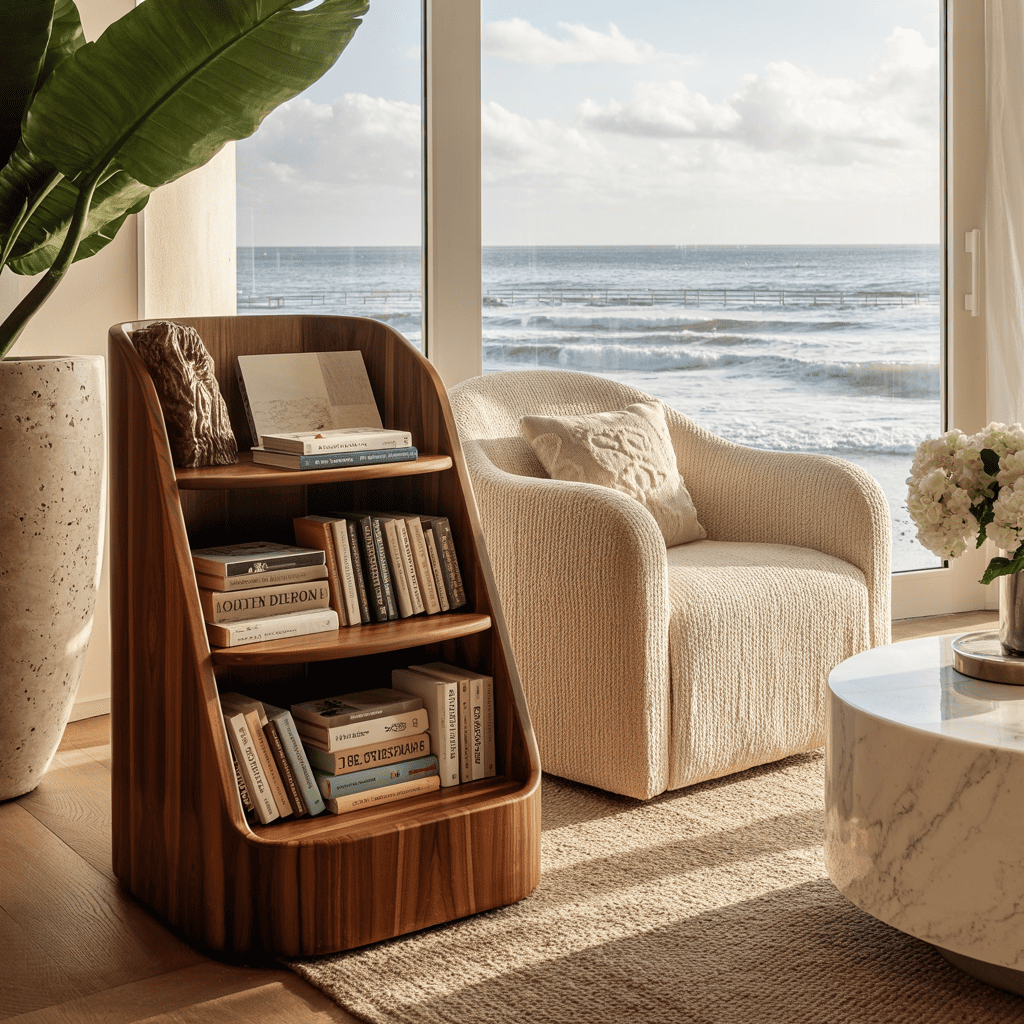
4. House Built Into a Bookshelf or Furniture Piece (Best for Design-Led Rooms)
The cat house is part of a shelf unit. Lower shelves hold books, upper structure holds the cat.
Use it when you refuse to have obvious pet furniture in the living room and you want the footprint to do double duty. More layouts in cat tower ideas.
Skip it if the shelf is the only bookcase you own. Cats shed into books, and a climbing route past your ceramics ends how you expect.
Example: tree shaped wooden bookshelf with cat house.
Wood Cat Tower vs Carpet-Wrapped Particle Board
The house is the part that fails first on cheap towers. It is enclosed, it holds body heat, and it absorbs everything.
Carpet over particle board:
- The box interior traps hair, dander, and urine if there is ever an accident
- You cannot clean inside a carpeted cube properly. Vacuuming does not reach embedded dander
- Roof panels sag under a heavy cat because the span is unsupported particle board
- Joints loosen where the box meets the post, which is exactly where the load is
- Replacement cycle: 1-2 years
Solid wood cat tower:
- Wipe the interior with a damp cloth. Done
- Real joinery at the post-to-box junction, so the roof holds a 20-pound cat sitting on it
- Cats scratch wood by instinct without shredding fibers they can swallow
- Lifespan measured in a decade-plus, and it looks like furniture in the meantime
Cost math from our own comparison: a $50-150 carpet tower replaced 5-7 times over ten years adds up to $500-1,050 in that time — real money for a piece you keep replacing. A solid wood tower costs more upfront, but it's a one-time purchase you're not still buying in year eight, and you spend that decade with furniture instead of a smelly cube.
Species matter too. See best wood for cat trees.

Stability: The House Makes Tipping Worse
A house is a box of mass bolted to one side of a vertical structure. That is a lever.
Non-negotiables:
- Any tower over 60 inches gets wall-anchored, into studs, two points in the upper third
- Base needs to be wider and heavier than the highest box, not the same footprint
- Anti-tip bracket, if it ships with one, gets used
- Check the roof rating separately from the platform rating. Owners perch cats on the box roof, and that load path runs through the box walls
A tower that rocks when the cat lands stops getting climbed. Cats do not file complaints; they just relocate to your bed. More on why mass matters in the cat tree weight and stability guide.
Placement, or Why the House Sits Empty
The house can be perfect and still get ignored if it is in the wrong room.
Works:
- Near a window, slightly off to the side so the cat watches without being exposed
- Living room corner where the family actually is
- Home office at 59-70 inches, so the cat is present and off the keyboard
Fails:
- Spare bedroom with the door closed. Cats want to be near you
- High-traffic hallway. Enclosed box plus foot traffic equals a cat that feels cornered
- Beside the washer. The one time it spins, the house is dead to them
- Direct all-day sun. Comfortable for the cat, hard on the wood finish
Multi-cat rule: a cat must be able to reach the house without walking through another cat's claimed territory. Otherwise the house belongs to whoever guards the approach.

Buying Checklist
- Cat weight and body length: _____ lb, _____ in. This sets interior floor size, not the tower height.
- Interior condo dimensions published? If not, walk away.
- Entry hole: 7-8 inches minimum for a medium cat, 8-9 for a large breed. Two openings if you have two cats.
- Ceiling height: _____ in. Subtract 12 inches of headroom above the top platform to cap the tower height.
- House position: base tunnel (timid/senior), mid-tower (default), top (only with anchoring and a wide base).
- Platform spacing: 16 inches or less for cats over 15 pounds.
- Roof load rating, separate from platform rating. People will put the cat there.
- Material: solid hardwood, or accept a 1-2 year replacement cycle and a box you cannot clean.
- Wall anchoring plan if over 60 inches. Studs, not drywall.
- Room: window-adjacent, where the family sits. Not the spare room.
Starting points: cat tree towers collection, luxury wooden cat tree tower with condo, handcrafted large wooden cat tree for big cats. Small space first? Read the small cat tree guide.
FAQ
What is a cat tower with house?
A climbing tower with at least one enclosed hideaway built in, so the cat can hide as well as perch. Also sold as a cat tree with house or condo.
What size should the house be?
Interior floor 14" x 14" for a medium cat, 18" x 18"+ for a large breed, with 14-18 inches of interior height.
Do cats actually use the enclosed house?
Yes, if the box fits and sits where the cat feels safe. Undersized boxes and spare-room placement are the two reasons it stays empty.
Where should the house sit on the tower?
Mid-tower for most adult cats. Base tunnel for kittens and seniors. Top only with a wide base and wall anchoring.
Is a wood cat tower better than carpet?
Yes for the house specifically. You can wipe wood clean; a carpeted condo interior traps hair, dander, and odor permanently.
How tall should a cat tree tower with house be?
59-70 inches under an 8-foot ceiling, up to 80 inches with 9-foot ceilings. Keep 12 inches above the top platform. See the height guide.
Do I need two houses for two cats?
If one cat guards the best spot, yes. Two boxes at different heights stop the queuing and the ambushing.
Does a cat tower with house need wall anchoring?
Over 60 inches, yes, into studs. The house adds off-center mass, which makes tipping more likely, not less.