





















Quick view
- What Is a Natural Wood Cat Tower (And What It's Not)
- Why Solid Wood Beats Carpet-Wrapped Particle Board
- The Full Comparison: Solid Wood vs. MDF vs. Carpet-Wrapped
- What Makes a Handcrafted Cat Tower Different From Factory-Made
- Solid Wood Cat Trees and Home Aesthetics - Why Design Matters
- Cat Tower Sizing Guide by Breed
- How to Evaluate a Natural Wood Cat Tower Before Buying
- Maintenance and Care for Solid Wood Cat Towers
- Environmental Impact: Why Material Choice Matters
- Multi-Cat Households: Sizing and Configuration
- Common Myths About Natural Wood Cat Towers
- How Ashdeco Builds Its Natural Wood Cat Towers
- Frequently Asked Questions
- Making the Right Choice
Shop this guide
Handcrafted Cat Tree Tower, made to order in solid wood.
 Sculptural Spiral Solid Wood Cat Tree Tiered Modern Feline Lounger
From $2,217.0010% off at checkout
Sculptural Spiral Solid Wood Cat Tree Tiered Modern Feline Lounger
From $2,217.0010% off at checkout
 Nature Inspired Branch Solid Wood Corner Cat Tree Tower Condo
From $1,854.00
Nature Inspired Branch Solid Wood Corner Cat Tree Tower Condo
From $1,854.00
 Live Edge Slice Tiered Solid Wood Cat Tree Freestanding Multi Level Perch
From $1,732.00
Live Edge Slice Tiered Solid Wood Cat Tree Freestanding Multi Level Perch
From $1,732.00
 Artisanal Solid Wood Sculptural Tree Cat Tower & Multi-Tier Botanical Display Perch Stand
From $2,076.0010% off at checkout
Artisanal Solid Wood Sculptural Tree Cat Tower & Multi-Tier Botanical Display Perch Stand
From $2,076.0010% off at checkout
 Sculptural Hand-Carved Tree Solid Wood Wall-Mounted Cat Climbing Tower with Dual House Condos & Display Shelves
$3,012.0010% off at checkout
Sculptural Hand-Carved Tree Solid Wood Wall-Mounted Cat Climbing Tower with Dual House Condos & Display Shelves
$3,012.0010% off at checkout
 Sculptural Hand-Carved Tree Solid Wood Cat Tower & Multi-Tier Luxury Feline Climbing Tree with Tunnel Condo Base
From $2,654.0010% off at checkout
Sculptural Hand-Carved Tree Solid Wood Cat Tower & Multi-Tier Luxury Feline Climbing Tree with Tunnel Condo Base
From $2,654.0010% off at checkout

Most cat towers are engineered to look good in the product listing and fall apart within 18 months. They're built from compressed sawdust, wrapped in low-grade carpet, held together with staples, and sold as "sturdy." Your cat knows better - the wobbling starts within weeks, the carpet shreds within months, and eventually the whole thing ends up on the curb. A natural wood cat tower built from solid hardwood doesn't follow that script. It weighs more, holds more, lasts longer, and actually looks like furniture you chose on purpose.
This guide covers everything you need to know before choosing a cat tower: why material matters more than height, how solid wood compares to MDF and carpet-wrapped particle board, which dimensions fit which cat breeds, and what makes a handcrafted tower fundamentally different from a factory-stamped one. If you've ever replaced a cat tree after a single year and thought "there has to be something better," you're in the right place.
We build handcrafted solid wood cat towers at Ashdeco, so we'll be upfront about our perspective. But this guide is packed with real numbers, comparisons, and sizing data - use it even if you end up buying elsewhere.
What Is a Natural Wood Cat Tower (And What It's Not)
A natural wood cat tower is a vertical climbing structure made from solid hardwood - real timber like walnut, oak, ash, or teak - designed to mimic or incorporate natural tree shapes. It is not a raw log stuck to a plywood base, and it is not MDF with a wood-grain vinyl sticker. The "natural" refers to both the material and the organic, tree-like aesthetic.

Solid Wood vs. "Wood-Look" - The Label Game
Manufacturers love the word "wood" because it sells. But most cat trees labeled "wooden" are actually made from MDF (medium-density fiberboard) or particle board with a wood-pattern laminate or veneer. Real solid wood has grain you can feel, weight you can notice the moment you lift the box, and strength that doesn't degrade when scratched or exposed to moisture.
Here's a quick way to tell: if the cat tree weighs under 20 pounds and stands over 4 feet tall, it's almost certainly not solid wood. A genuine solid wood cat tree of that height will weigh 35-60+ pounds depending on species and design. The weight is the feature, not the drawback - it's what keeps the tower from tipping when your 18-pound Maine Coon launches off the top perch.
The Tree-Shaped Design Philosophy
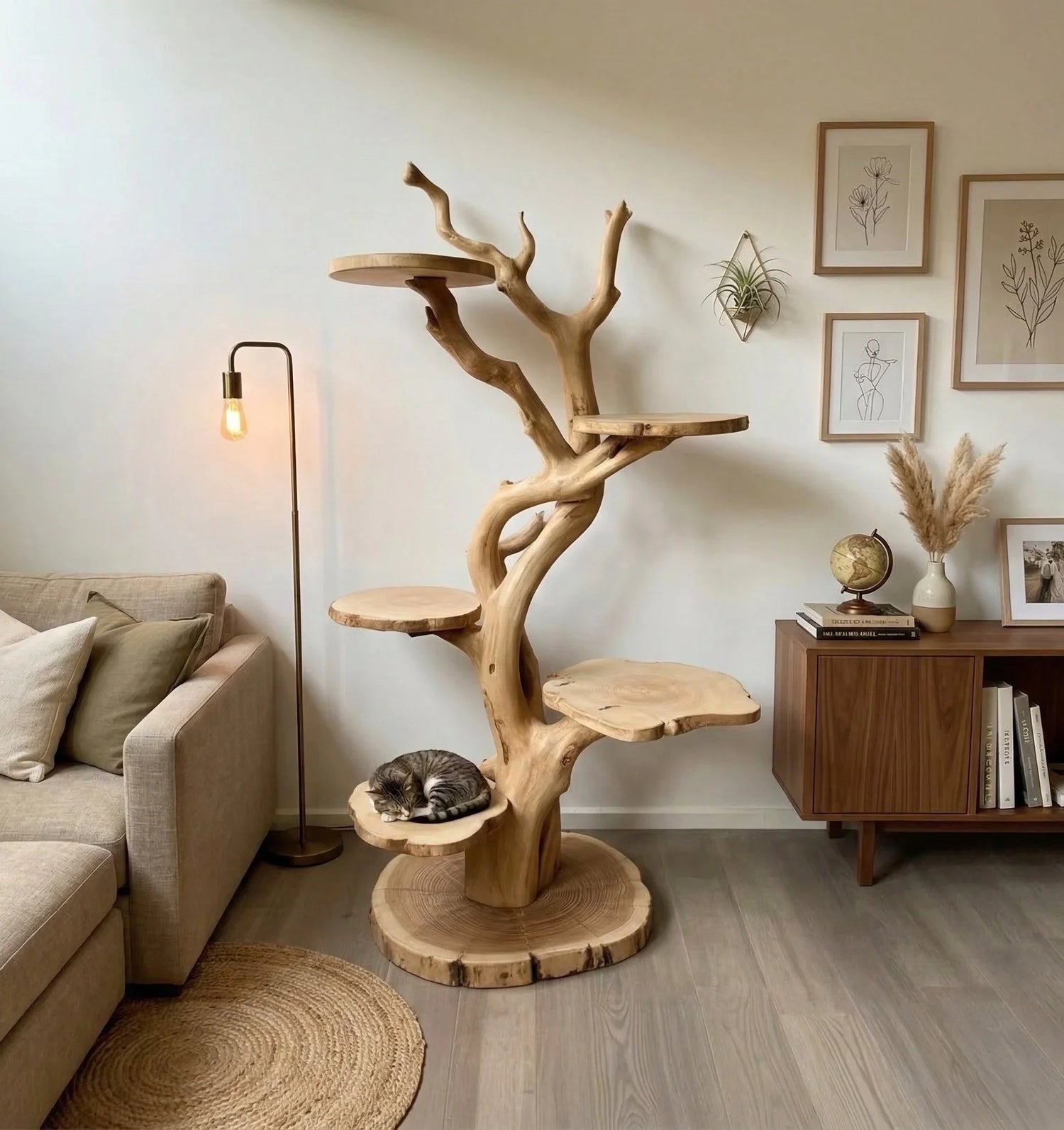
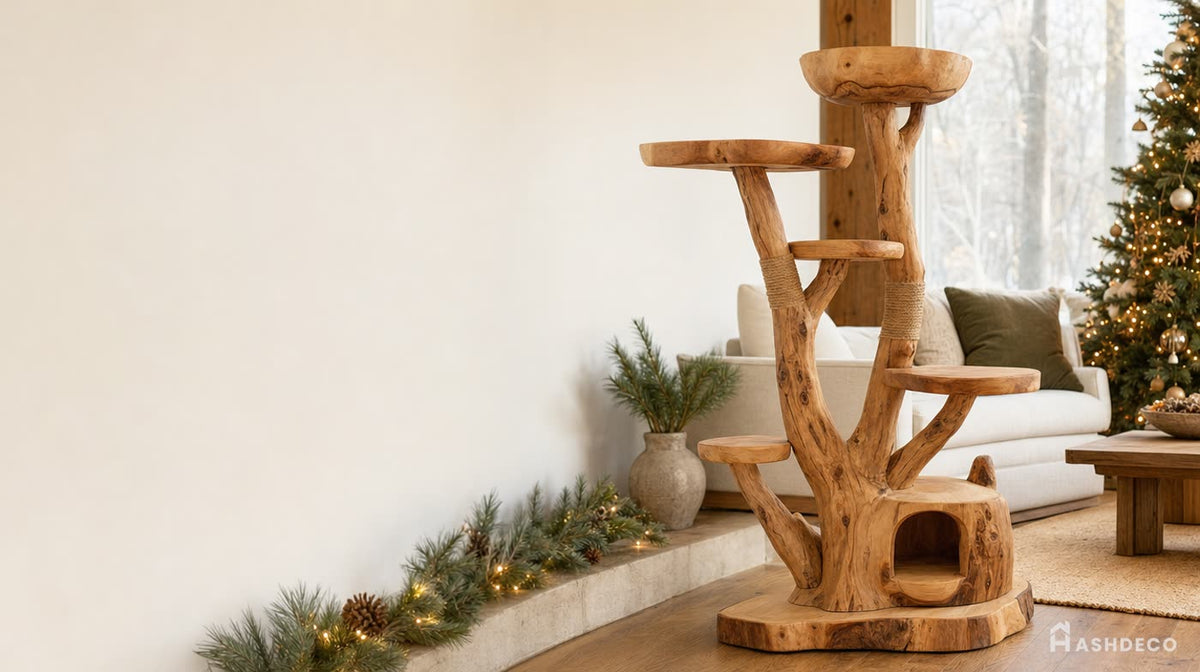
The best natural cat furniture mimics the shapes cats actually climb in the wild: trunks with branches, platforms at varying heights, and surfaces with texture and grip. At Ashdeco, our artisans in Vietnam hand-carve each tower to resemble a real tree - trunk, branches, platforms - assembled from modular pieces of solid hardwood. Each piece is carved separately, then assembled into the final structure.
This isn't a tree trunk bolted to a base. It's sculpted furniture. The branches become perches. The trunk provides vertical scratching surface. The knots and organic curves aren't defects - they're what make each piece one-of-a-kind. You can see exactly how these towers are carved and assembled in our workshop walkthrough.
Who Buys Natural Wood Cat Towers
The typical buyer falls into one of three groups. First: owners of large cats (Maine Coons, Ragdolls, Norwegian Forest Cats) who've broken one or more carpet-wrapped trees. Second: homeowners who refuse to put an ugly beige carpet tower in their living room. Third: people who've calculated the five-year cost and realized that one solid wood tower costs less than three cheap replacements.
You don't need to be in all three groups. Any one of those reasons is enough.
Why Solid Wood Beats Carpet-Wrapped Particle Board
Solid wood cat towers outperform carpet-wrapped particle board in every measurable category: structural strength, weight capacity, lifespan, hygiene, safety, and aesthetic longevity. The only metric where particle board wins is upfront price - and even that advantage disappears within 2-3 years of replacements.

Structural Integrity Over Time
Particle board is made by compressing wood chips and sawdust with resin binders. It has no continuous grain structure. When it gets scratched - which happens immediately with cats - the surface layer breaks, exposing the crumbly interior. Add any moisture (cat drool, a spilled water bowl, humidity), and particle board swells and weakens permanently.
Solid hardwood has continuous grain running through the entire piece. Scratches affect only the surface and can be sanded out. Moisture evaporates from solid wood without causing structural damage. A solid wood cat tower built in 2026 will still be structurally sound in 2036. A particle board tower built today will be in a landfill by 2028.
Weight Capacity: Real Numbers
This is where the gap becomes dangerous, not just inconvenient. A typical carpet-wrapped cat tree has a per-platform weight capacity of 15-25 pounds. Manufacturers rarely test this aggressively - static weight on a showroom floor is different from a 20-pound cat jumping from 4 feet up, which generates 60+ pounds of impact force.
Solid wood platforms on handcrafted cat towers handle 50-66 pounds per platform - static. With impact loading from jumps, that margin is what keeps the platform from cracking and your cat from getting hurt. If you own a large breed, or multiple cats who share a tower, the particle board capacity isn't even close to adequate.
Hygiene and Allergens
Carpet traps everything: cat hair, dander, dust, bacteria, and - eventually - odor. You can vacuum a carpet-wrapped tower weekly and it'll still harbor allergens deep in the fibers. Over time, the carpet becomes a breeding ground for dust mites and bacteria, which is especially problematic for households with allergy sufferers.
Solid wood surfaces are non-porous and smooth. Cleaning is a damp cloth and five minutes. Pet dander doesn't embed in wood grain the way it does in carpet fibers. For anyone managing cat allergies (the number one pet allergy in the US), switching from carpet to wood cat furniture removes one of the largest allergen reservoirs in the home.


The Full Comparison: Solid Wood vs. MDF vs. Carpet-Wrapped
Most cat tower buyers are choosing between three material categories, not two. MDF occupies a middle ground that often gets lumped in with "solid wood" by dishonest marketing. This table separates the three clearly so you can compare on facts, not branding.

| Feature | Solid Hardwood | MDF (Medium-Density Fiberboard) | Carpet-Wrapped Particle Board |
|---|---|---|---|
| Core Material | Walnut, oak, ash, teak - continuous grain | Wood fibers + resin, pressed into sheets | Wood chips + glue, pressed loosely, wrapped in carpet |
| Lifespan | 15-25+ years | 5-8 years | 1-3 years |
| Weight Capacity (per platform) | 50-66 lbs | 25-40 lbs | 15-25 lbs |
| Total Unit Weight | 35-70 lbs | 20-35 lbs | 12-25 lbs |
| Tip Resistance | Excellent - heavy base, low center of gravity | Moderate - lighter but stable if well-designed | Poor - lightweight, top-heavy designs common |
| Moisture Resistance | High - dries without damage | Low - swells and won't recover | Very low - swells, warps, grows mold |
| Scratch Resistance | Surface scratches only - sandable | Surface damage exposes crumbly core | Carpet shreds; exposed board crumbles |
| Cleaning | Damp cloth wipe | Damp cloth (avoid soaking) | Vacuum + spot clean (odor persists) |
| Allergen Buildup | Minimal - smooth, non-porous surface | Low - smooth but seams trap dust | High - carpet fibers trap dander, dust, mites |
| Off-Gassing (VOC) | None (natural material) | Moderate - formaldehyde in resin binders | Moderate to high - adhesives + carpet chemicals |
| Aesthetics | Furniture-grade, natural grain, improves with age | Clean but generic - laminate or painted | Looks like cat furniture - beige/brown carpet |
| Repairability | Sand scratches, re-oil, replace sisal | Limited - damaged core can't be restored | Replace entire unit (carpet can't be re-stapled cleanly) |
| Upfront Cost | $250-$800+ | $100-$300 | $40-$150 |
| 5-Year Cost | $250-$800 (one purchase) | $200-$600 (1-2 replacements) | $120-$450 (2-4 replacements) |
| Environmental Impact | Low - long-lasting, biodegradable | Moderate - resin binders, shorter lifespan | High - synthetic carpet + board = landfill every 1-3 years |
Breaking Down the Cost Per Year
The sticker price of a natural wood cat tower is higher - no sugarcoating that. A handcrafted solid wood tower runs $250-$800+, while you can grab a carpet-wrapped particle board tree on Amazon for $60. But the per-year math tells a different story.
At a $60 price point and a 1.5-year average lifespan, that carpet tree costs you $40/year. Over 10 years, you're spending $400 and sending 6-7 cat trees to a landfill. A solid wood tower at $400 and a 15-year lifespan costs $26.67/year - and generates zero waste beyond the occasional sisal rope replacement.
The math gets worse for carpet trees when you factor in the hidden costs: the rug cleaner for the carpet fibers your cat shredded across the living room floor, the replacement sisal posts that don't fit quite right, and the time spent assembling a new tree every 12-18 months.
The Safety Gap Nobody Talks About
Exposed staples are the single most common cat tree injury risk, and it's a problem unique to carpet-wrapped designs. When cats scratch carpet, they pull fibers loose. The carpet pulls away from the staple line. Staples become exposed. Cats can snag claws on exposed staples, leading to torn nails or paw injuries.
Solid wood cat towers don't use staples to attach surface material - there's no carpet to staple. Scratching surfaces are typically sisal rope wound around trunk sections, or the natural wood surface itself. When sisal wears down, you re-wrap it. No staple exposure, no injury risk.
There's also the formaldehyde question. MDF and particle board use urea-formaldehyde resin as a binder. Formaldehyde off-gasses slowly, especially when the board is new. Cats spend hours on these surfaces - sleeping, grooming - in direct contact with the material. Solid wood contains zero formaldehyde. It's wood. That's it.
What Makes a Handcrafted Cat Tower Different From Factory-Made
A handcrafted cat tower - or cat tree handmade - is built by a person with woodworking skills, not stamped out by a CNC router on an assembly line. The difference shows up in structural integrity, design uniqueness, and how the tower ages over time. Handcrafted doesn't just mean "expensive." It means the joints are stronger, the wood is selected by hand, and the design accounts for how cats actually use the structure.

Joinery vs. Hardware
Factory cat trees rely on cam locks, metal brackets, and Allen bolts to hold pieces together. These fasteners loosen with vibration - and a cat jumping from a 5-foot platform creates vibration. After 6-12 months of daily use, you'll notice wobbling. Tightening the bolts helps temporarily, but the holes in particle board strip out. Once they strip, the connection is permanently compromised.
Handcrafted solid wood towers use traditional joinery techniques: mortise and tenon, dowel joints, or precision tongue-and-groove connections. These joints get tighter under load, not looser. Combined with wood glue that bonds at a molecular level with the wood fibers, the result is a connection that's stronger than the wood itself. You'll never tighten a bolt on a properly joined solid wood cat tower.
Artisan Carving: Nature-Sculpted, Not CNC-Stamped
At Ashdeco, each natural wood cat tower is shaped by Vietnamese artisans who specialize in wood sculpting. These aren't rough-cut logs bolted together. The artisans carve trunk sections to resemble natural tree forms - realistic bark texture, organic branch angles, naturalistic platform shapes. Each piece is modular: the trunk, branches, and platforms are carved separately and then assembled.
This matters for two reasons. First, it means every tower is genuinely one-of-a-kind. The grain pattern, the specific curves, the way the bark texture wraps around a branch - no two are identical. Second, modular construction means individual components can be replaced or reconfigured without discarding the entire tower. If a cat destroys the sisal wrapping on one branch after five years, you replace that wrap - not the whole tree.
Why Vietnamese Woodworking Matters
Vietnam has one of the deepest traditions of wood carving in Southeast Asia, dating back centuries. The artisans who build Ashdeco's towers aren't learning on the job - they're applying generational skills to a new product category. Wood sculpting is the same discipline whether you're carving a temple panel or a cat tower trunk. The precision, the understanding of grain direction, the ability to shape hardwood by hand - that's what makes the finished product look and feel like art rather than pet furniture.
Compare that to the typical supply chain for a $60 Amazon cat tree: machine-cut particle board from a factory floor, wrapped in carpet by workers following a standardized pattern, packed flat, and shipped in a box. There's nothing wrong with efficiency, but the result is identical to 10,000 other units. If "interchangeable with every other cat tree on the market" is fine with you, stop reading here. If you want something that belongs in your home, keep going.
Don't miss
These pieces qualify for 10% off orders over $2,000. Applied automatically at checkout.
10% off
Sculptural Spiral Solid Wood Cat Tree Tiered Modern Feline Lounger
From $2,217.00
10% off at checkout
10% off
Artisanal Solid Wood Sculptural Tree Cat Tower & Multi-Tier Botanical Display Perch Stand
From $2,076.00
10% off at checkout
10% off
Sculptural Hand-Carved Tree Solid Wood Wall-Mounted Cat Climbing Tower with Dual House Condos & Display Shelves
$3,012.00
10% off at checkout
10% off
Sculptural Hand-Carved Tree Solid Wood Cat Tower & Multi-Tier Luxury Feline Climbing Tree with Tunnel Condo Base
From $2,654.00
10% off at checkout
Solid Wood Cat Trees and Home Aesthetics - Why Design Matters
A rustic cat tree made from solid wood integrates into home décor the way carpet-wrapped particle board never can. Interior designers increasingly recommend natural wood cat furniture as dual-purpose pieces - functional for cats, beautiful for humans. The shift from "hiding cat furniture in a spare room" to "featuring it in the living room" requires a tower worth featuring.

Design Styles That Work
Solid wood cat towers work across almost every interior style because wood is a universal design material. Here's how different aesthetics pair with natural wood towers:
- Mid-century modern: Clean lines, walnut or teak tones, minimal branching. The tree becomes a sculptural accent piece next to a sofa or reading chair.
- Rustic / Farmhouse: A rustic cat tree with visible bark texture, knots, and organic shapes. Pair with exposed beam ceilings, reclaimed wood furniture, or stone accents.
- Scandinavian / Minimalist: Light-toned wood (ash, birch), simple branch structure, understated platforms. The tower blends with the room rather than competing with it.
- Bohemian: Darker woods with macramé or woven basket additions. The organic shape of a tree tower naturally fits the layered, textured boho look.
- Modern Industrial: Oak or walnut with matte black metal accents on the base. The wood provides warmth against concrete, steel, and exposed brick.
The common thread: real wood works in every setting because it's a natural material. Beige carpet wrapped around a tube does not.
The "Would You Put It in Your Living Room" Test
This is the simplest way to evaluate any cat tower. Stand in your living room, look around, and ask: would I voluntarily place this object here? If the answer is "no, it goes in the spare bedroom" or "I'll put it in the corner where guests won't see it," you've already answered the design question.
Natural cat furniture should pass the living room test. A solid wood cat tower with hand-carved bark texture and visible grain belongs next to your bookshelf, your sofa, your plants. It looks like a piece of sculptural furniture because that's what it is. Carpet-wrapped towers fail this test almost universally - there's no interior style where a beige polyester tube next to a mid-century walnut coffee table looks intentional.
How Wood Ages vs. How Carpet Ages
Wood develops patina. Over years of use, solid hardwood deepens in color, develops character, and actually becomes more attractive. A walnut cat tower that looks warm and rich on day one will look warmer and richer on year five. Scratches from cat claws become part of the story - like a well-loved leather chair.
Carpet does the opposite. It stains, frays, mats down, collects hair, and yellows. A carpet cat tree at month one looks decent. At month six, it looks used. At month twelve, it looks like something you should have thrown away two months ago. The aging curve runs in opposite directions for these two materials.
Cat Tower Sizing Guide by Breed
Choosing the right cat tower dimensions depends on your cat's breed, weight, activity level, and the number of cats sharing the structure. A tower that works perfectly for a 9-pound Siamese will be dangerously inadequate for a 22-pound Maine Coon. This guide gives breed-specific recommendations so you buy the right size the first time.

Small Cats (Under 10 lbs)
Breeds: Singapura, Cornish Rex, Devon Rex, Abyssinian, Siamese, domestic shorthair (petite). These cats are agile, light, and typically the most active climbers. They don't need massive platforms - they want height and variety.
| Dimension | Recommended |
|---|---|
| Tower height | 48-60 inches (4-5 ft) |
| Platform width | 12-14 inches |
| Platform depth | 10-12 inches |
| Platform spacing | 12-16 inches apart |
| Weight capacity needed | 20+ lbs per platform (for impact) |
| Base footprint | 18" × 18" minimum |
Small cats can use nearly any well-built tower, but they prefer structures with multiple levels close together - they like to hop quickly between perches. Three to five platforms work well. Scratching posts with sisal at multiple heights keep them engaged vertically.
Medium Cats (10-15 lbs)
Breeds: American Shorthair, Bengal, Russian Blue, Scottish Fold, Burmese, British Shorthair (smaller individuals), most domestic mixed breeds. This is the largest category - most pet cats fall in this range.
| Dimension | Recommended |
|---|---|
| Tower height | 54-66 inches (4.5-5.5 ft) |
| Platform width | 14-18 inches |
| Platform depth | 12-14 inches |
| Platform spacing | 14-18 inches apart |
| Weight capacity needed | 35+ lbs per platform |
| Base footprint | 20" × 20" minimum |
Medium cats need wider platforms than small cats because they sprawl when resting - a 12-pound cat lying on its side takes up more surface area than you'd expect. Aim for platforms where the cat can lie fully stretched without limbs hanging over the edge. For multi-cat households with two medium cats, add at least one extra platform so both cats have a "private" perch.
Large and Extra-Large Cats (15-25+ lbs)
Breeds: Maine Coon, Ragdoll, Norwegian Forest Cat, Savannah, Bengal (large males), British Shorthair (large males), Chausie. These are the breeds that break cheap cat trees. If you own a large breed, the best cat trees for large cats need to be built like furniture, not toys.
| Dimension | Recommended |
|---|---|
| Tower height | 60-80 inches (5-6.5 ft) |
| Platform width | 18-24 inches |
| Platform depth | 14-18 inches |
| Platform spacing | 16-20 inches apart |
| Weight capacity needed | 50-66 lbs per platform |
| Trunk/post diameter | 4-6 inches (solid wood trunk) |
| Base footprint | 24" × 24" minimum |
| Total tower weight | 40-60+ lbs (stability requirement) |
For large cats, the tower's own weight is a safety feature. A 15-pound cat tree with a 22-pound cat on the top platform is a tipping hazard. You want the tower to weigh at minimum twice the weight of the heaviest cat who'll use it. Solid wood cat trees naturally meet this requirement because hardwood is dense. Carpet-wrapped particle board trees often don't - they're designed to be light for easy shipping, which is the opposite of what large cats need.
How to Evaluate a Natural Wood Cat Tower Before Buying
Not every product labeled "natural wood" or "solid wood" actually is. The pet furniture market has less regulation than human furniture, and marketing claims go unchecked. This section gives you a practical checklist so you can evaluate any tower - Ashdeco's included - before spending money.

The Weight Test
Check the shipping weight. A solid hardwood cat tower standing 5 feet tall should weigh 35-60+ pounds. If the product listing shows a shipping weight under 25 pounds for a tower that tall, the "solid wood" claim is almost certainly false. Weight is the single fastest indicator of real wood vs. engineered material.
Here's a reference: a cubic foot of red oak weighs about 44 pounds. A cubic foot of particle board weighs about 28 pounds. A cubic foot of MDF weighs about 48 pounds (MDF is actually denser than some hardwoods - but it lacks the structural grain that gives hardwood its strength). When you feel the difference, you know.
The Material Verification Checklist
Ask these questions before buying any cat tower marketed as "wood" or "natural":
- What wood species is used? A legitimate solid wood seller will name the species: walnut, oak, teak, ash. If the listing just says "wood" or "natural wood" without specifying, it's likely MDF or particle board.
- Is the grain visible and continuous? Real wood grain runs continuously through the piece. If the surface looks printed or repeats in a perfect pattern, it's laminate over engineered board.
- What's the weight capacity per platform? If they can't give you a number, or the number is under 30 lbs, the platform isn't solid hardwood.
- What finish is used? Solid wood towers typically use natural oils, beeswax, or food-safe polyurethane. Carpet-wrapped trees don't need finish because the wood is hidden.
- Can you see the wood at the edges? On solid wood platforms, the edge grain is visible. On MDF, edges are either covered with edge banding or show the characteristic uniform, sandy-colored core.
Red Flags in Product Listings
Watch for these warning signs:
- "Engineered wood" - this means MDF or particle board, not solid wood.
- "Wood composite" - same thing. It's a marketing euphemism.
- "Easy assembly" with 30+ pieces - genuine solid wood towers have fewer, heavier components. A box with 30 pieces is machine-cut engineered board.
- Shipping weight under 20 lbs for towers over 4 feet - physically impossible with solid hardwood.
- No wood species named - if they're proud of the material, they name it.
- "Eco-friendly MDF" - still MDF. The "eco" refers to lower formaldehyde content, not to solid wood.
Maintenance and Care for Solid Wood Cat Towers
A solid wood cat tower requires less maintenance than a carpet-wrapped tree, but it does benefit from occasional care. Proper maintenance extends an already long lifespan and keeps the wood looking its best. Most maintenance tasks take under 10 minutes and happen quarterly, not weekly.

Weekly and Monthly Care
Weekly, wipe down platforms and perches with a dry microfiber cloth to remove cat hair and dust. That's it. Once a month, use a slightly damp cloth (wring it out thoroughly - damp, not wet) with a drop of mild dish soap if there are any sticky spots or stains. Dry immediately with a clean cloth.
For cat hair that clings to carved bark textures, a soft bristle brush (like a clean paintbrush) works better than a cloth. Run it along the grain of the carving. The textured surfaces that make handcrafted towers beautiful also collect hair in the grooves - but unlike carpet, the hair sits on top and brushes away easily.
Seasonal Deep Care
Every 3-6 months, apply a thin coat of food-safe wood oil (mineral oil, tung oil, or the oil recommended by the manufacturer). This keeps the wood from drying out in heated or air-conditioned homes where humidity fluctuates. Use a soft cloth, apply a thin coat, let it soak for 20 minutes, then buff off any excess.
If your cat has scratched the wood surface (not the sisal-wrapped areas), you can sand the scratch lightly with 220-grit sandpaper and re-oil. This isn't damage repair - it's part of the natural aging process. Some owners prefer to leave scratches for character. Either approach works.
Replacing Sisal and Rope Wrapping
Sisal rope is the consumable element of a solid wood cat tower. It's designed to be scratched and will wear out - typically every 2-4 years depending on how aggressively your cat scratches. Replacement is straightforward: unwrap the old sisal, clean the trunk section underneath, and wind new sisal rope. No tools required beyond scissors and a hot glue gun for securing the ends.
A roll of 1/4-inch sisal rope (100 ft) costs $10-$15 and covers one trunk section. Compare that to replacing an entire $60-$100 carpet tree. The economics of repair-vs-replace strongly favor solid wood cat trees with sisal wrapping.
Environmental Impact: Why Material Choice Matters
The environmental case for natural wood cat towers is straightforward: a product you buy once and keep for 15-20 years generates less waste than a product you buy five times and landfill four of them. Beyond the replacement math, the materials themselves have vastly different environmental footprints.

The Landfill Problem
Americans buy an estimated 25-30 million cat trees per year. With an average lifespan of 1.5-3 years for carpet-wrapped trees, that's 8-20 million cat trees entering the waste stream annually. Carpet-covered particle board isn't recyclable - the combination of synthetic carpet fibers, staples, adhesives, and resin-bonded wood chips makes separation impractical. These trees go to landfill, whole.
A solid wood cat tower that lasts 15 years replaces 5-10 disposable trees over its lifetime. When it eventually reaches end of life, solid wood is biodegradable. The metal hardware can be separated and recycled. There's no synthetic carpet, no resin-bonded chip board, no non-recyclable composite to deal with.
Responsible Wood Sourcing
Not all wood is created equal when it comes to sustainability. At Ashdeco, the hardwood used for our cat towers comes from managed forestry sources. Responsible sourcing means harvesting at a rate that allows regrowth, selecting mature trees that have completed their peak carbon-sequestration phase, and replanting at higher density than harvest.
Ask any natural wood cat tower manufacturer about their wood sourcing. Legitimate operations will tell you the species, origin region, and whether the wood carries FSC certification or equivalent. If they can't answer, the "natural" in their marketing is just a word.
The Carbon Footprint of Shipping
Solid wood towers are heavier, which means higher shipping weight and fuel consumption per unit. That's a real environmental cost. However, shipping one 50-pound tower once over 15 years produces less total shipping emissions than shipping five 20-pound towers over the same period (100 total pounds shipped). The buy-it-once model wins on shipping carbon too - it just front-loads the cost instead of spreading it across multiple disposable purchases.
Multi-Cat Households: Sizing and Configuration
If you have more than one cat, tower sizing isn't just about the individual cat - it's about territory. Cats establish vertical hierarchies. The dominant cat claims the highest perch. If there aren't enough platforms at desirable heights, cats fight for position, which stresses the animals and stress-tests the tower.

Platform Count by Number of Cats
The formula is simple: minimum platforms = number of cats + 1. Two cats need three platforms. Three cats need four platforms. The extra platform reduces competition and gives the subordinate cat an escape option when the dominant cat is feeling territorial.
| Number of Cats | Minimum Platforms | Ideal Platforms | Recommended Tower Height |
|---|---|---|---|
| 1 cat | 2 | 3-4 | 48-60" |
| 2 cats | 3 | 4-5 | 54-66" |
| 3 cats | 4 | 5-6 | 60-72" |
| 4+ cats | 5+ | 6-8 (or two towers) | 66-80" (or two shorter towers) |
Weight Capacity for Multiple Cats
Here's a scenario many multi-cat owners face: two 14-pound cats both jump onto the same platform at the same time. That's 28 pounds static - plus impact force. A carpet-wrapped tree with a 20-pound platform capacity will either crack, wobble dangerously, or collapse. It's not a matter of if, but when.
A solid wood platform rated at 50+ pounds handles two medium cats simultaneously without stress. That capacity also accounts for the inevitable moment when one cat is sleeping on a platform and the other lands on it from the platform above. Impact plus dead weight can easily hit 50 pounds for two average-sized cats. Build for the worst case, not the best case.
Strategic Placement in the Home
Place the tower near a window if possible - cats prefer perches with a view. Avoid corners where the tower is boxed in on two sides, which limits escape routes and increases territorial tension in multi-cat homes. A wall-adjacent position with one open side is ideal: the wall provides a sense of security at the back while leaving a clear approach path.
For homes with both cats and dogs, elevate the lowest platform to at least 24 inches off the ground. This gives cats a clear escape from ground-level dog activity without needing to climb all the way to the top. The tower becomes a refuge, not just a toy.
Common Myths About Natural Wood Cat Towers
Despite growing popularity, natural wood cat towers are surrounded by misconceptions - some from uninformed cat owners, some deliberately spread by companies selling cheaper alternatives. Let's address the most common myths with facts.

Myth 1: "They're Too Heavy to Move"
A 45-pound cat tower isn't light, but it's not a refrigerator either. One adult can slide it across a floor. Two adults can carry it between rooms. You'll reposition a cat tower maybe 2-3 times per year - during deep cleaning or when rearranging furniture. The weight that makes it inconvenient to move is exactly what makes it safe for your cat. This is a feature you're accepting, not a problem you're stuck with.
Myth 2: "Cats Won't Scratch Wood - They Need Carpet"
Cats don't scratch carpet because they prefer carpet. They scratch carpet because it's there. In the wild, cats scratch tree bark. Solid wood cat towers with sisal-wrapped trunk sections replicate the scratching surface cats instinctively prefer. Multiple studies show cats choose sisal and wood textures over carpet when given the option. The carpet is a human default, not a feline preference.
Myth 3: "Natural Wood Isn't Safe - Splinters"
A properly finished solid wood cat tower has smooth, sanded surfaces on all platforms and perches. Bark-textured trunk sections are carved (sculpted to look like bark), not raw bark that flakes off. Handcrafted towers are sanded to 220+ grit on all contact surfaces and finished with food-safe oils or sealants. The splinter risk on a finished hardwood surface is lower than the exposed-staple risk on a deteriorating carpet tree.
Myth 4: "They're Only for Rich People"
A $400 cat tower that lasts 15 years costs $26.67 per year. A $60 cat tree that lasts 18 months costs $40 per year. The solid wood tower is cheaper over any time horizon longer than 3.5 years. The upfront cost is higher - that's true. But "expensive" and "costs more" are different concepts. The natural wood cat tower costs more on Tuesday. It costs less over its lifetime.
How Ashdeco Builds Its Natural Wood Cat Towers
Understanding how a cat tower is built tells you more than any marketing copy. Here's the actual process behind Ashdeco's cat tree handmade towers - from raw timber to finished product.

Wood Selection
Each tower starts with hardwood selection. Our artisans choose timber based on grain quality, density, and structural suitability for the specific tower design. Pieces with knots or irregularities aren't rejected - they're incorporated into the design as natural features. The grain direction is matched to the structural load: vertical grain for trunk sections (strongest in compression), horizontal grain for platforms (strongest in bending resistance).
The wood is kiln-dried to 8-12% moisture content before carving begins. Kiln drying prevents warping, cracking, and movement after the tower is assembled. It also kills any insects or larvae in the wood. Skipping this step - which many cheaper operations do - results in towers that crack, warp, or develop gaps at joints within the first year.
Hand Carving and Sculpting
Vietnamese artisans carve each component by hand using traditional wood sculpting techniques. Trunk sections are shaped to resemble natural tree forms - not uniform cylinders but organic, slightly irregular shapes with carved bark texture. Branch sections angle outward naturally, like real tree branches. Platforms are shaped to follow the organic flow of the branch they sit on.
This carving process takes 15-40 hours per tower depending on complexity. By comparison, a factory CNC router cuts all the pieces for a particle board cat tree in under 10 minutes. The time investment is why handcrafted towers cost more - and it's why they look fundamentally different from anything a machine produces. For a full look inside the workshop, see our cat tower workshop walkthrough.
Modular Assembly and Finishing
Each component - trunk sections, branch perches, platforms, base - is carved separately and then assembled using traditional joinery. Mortise-and-tenon joints connect trunk to base. Dowel joints secure platforms to branches. Wood glue reinforces every joint. The modular approach serves two purposes: it allows precise fitting of each connection, and it means individual components can be replaced or reconfigured later without discarding the entire tower.
After assembly, surfaces are sanded progressively to 220-grit smoothness on all contact areas. Carved bark textures on trunk sections are left rougher intentionally - the texture provides grip for climbing cats and visual character. A food-safe natural oil finish is applied to protect the wood while maintaining its natural look and feel. No paint, no stain, no polyurethane shell that cracks and peels.
Frequently Asked Questions
How long does a natural wood cat tower last?
A solid hardwood cat tower lasts 15-25+ years with basic maintenance. The wood structure itself is essentially permanent - what wears out is the sisal rope wrapping, which is replaceable every 2-4 years at $10-$15 per section. By comparison, carpet-wrapped particle board towers last 1-3 years before structural failure or irreversible deterioration.
Can a solid wood cat tree support a 20-pound cat?
Yes. Solid hardwood platforms typically support 50-66 pounds per platform, well above the static weight of any domestic cat breed. This capacity also accounts for the impact force generated when a large cat jumps onto a platform from above, which can double or triple the effective load. Most carpet-wrapped trees have platform capacities of only 15-25 pounds.
Are natural wood cat towers safe for kittens?
Solid wood cat towers are safe for kittens. All contact surfaces are sanded smooth and finished with food-safe oils. For kittens under 4 months, choose a shorter tower (under 48 inches) or block access to the highest platforms until the kitten develops full coordination. Kittens are actually safer on solid wood than carpet trees because there are no loose carpet fibers to ingest and no exposed staples.
Do cats actually use wooden cat towers?
Cats use wooden towers readily - often with more enthusiasm than carpet trees. Cats are attracted to natural textures and scents that wood provides. Sisal-wrapped trunk sections replicate the bark-scratching experience cats seek instinctively. The weight and stability of solid wood towers also gives cats confidence to jump and climb aggressively, whereas wobbly carpet trees make some cats hesitant.
How do I clean a solid wood cat tower?
Wipe platforms weekly with a dry microfiber cloth. Monthly, use a damp cloth with mild soap for any sticky spots, then dry immediately. Every 3-6 months, apply a thin coat of food-safe wood oil (mineral oil or tung oil). For carved bark textures, use a soft-bristle brush to remove hair from grooves. The entire routine takes under 10 minutes per session.
Can I customize the size of a handcrafted cat tower?
Most handcrafted cat tower makers, Ashdeco included, offer customization. Common requests include adjusting total height for low-ceiling rooms, adding extra platforms for multi-cat households, choosing specific wood species for color matching, and modifying branch angles for tight spaces. Because each tower is made individually, customization doesn't require retooling - the artisan simply adjusts the carving plan.
Is a natural wood cat tower worth the higher price?
Over a 5-year period, a solid wood cat tower at $400 costs $80/year. A carpet tree at $80 replaced every 18 months costs $267 over 5 years - $53/year plus the cost of your time assembling and disposing of trees. Over 10 years, the solid wood tower costs $40/year vs. $53+/year for carpet replacements. The break-even point is around 3.5 years, after which the wood tower saves money every year.
What's the difference between a rustic cat tree and a modern wood cat tree?
A rustic cat tree features visible bark texture, organic curves, knot details, and a more natural, rough-hewn aesthetic - it looks like a sculpted tree. A modern wood cat tree typically has cleaner lines, smoother surfaces, geometric platforms, and a more minimalist appearance. Both use solid wood. The difference is design style, not material quality. Ashdeco's tree-shaped towers lean toward the rustic-natural end of the spectrum.
Making the Right Choice
A natural wood cat tower isn't the right choice for everyone. If you're renting short-term, have a kitten who might outgrow preferences, or genuinely can't afford the upfront cost, a decent MDF tower serves as a reasonable temporary solution. No judgment.
But if you're looking for a cat tower that lasts as long as your cat does, looks like furniture you chose rather than furniture you tolerate, and holds up to the reality of a 20-pound cat launching himself off the top platform - solid wood is the only material that delivers on all three. Browse Ashdeco's handcrafted cat tree towers to see what nature-sculpted, one-of-a-kind solid wood looks like in practice.