



Quick view
- What Actually Counts as a "Small" Cat Tree?
- Why Small Trees Are Harder to Pick Than Big Ones
- What Real Buyers Keep Running Into (Pain Points from Amazon Reviews)
- Solid Wood vs Carpet/MDF - The Material Decision
- Stability Is Everything - How to Tell Before You Buy
- Scratching Post Quality in Small Trees
- Placement Guide for Small Spaces
- Small Cat Tree for One Cat vs Multiple Cats
- Sizing Quick Reference
- My Recommendation
- FAQ
Shop this guide
Handcrafted Cat Tree Tower, made to order in solid wood.
 Hollow Tunnel Cave Sisal Scratching Cat Tree Tower in Sculpted Solid Wood
From $1,532.00
Hollow Tunnel Cave Sisal Scratching Cat Tree Tower in Sculpted Solid Wood
From $1,532.00
 Multi Tier Sculpted Botanical Canopy Cat Tree Tower in Matte Finished Solid Wood
From $1,765.00
Multi Tier Sculpted Botanical Canopy Cat Tree Tower in Matte Finished Solid Wood
From $1,765.00
 Sculptural Spiral Solid Wood Cat Tree Tiered Modern Feline Lounger
From $2,217.0010% off at checkout
Sculptural Spiral Solid Wood Cat Tree Tiered Modern Feline Lounger
From $2,217.0010% off at checkout
 Nature Inspired Branch Solid Wood Corner Cat Tree Tower Condo
From $1,854.00
Nature Inspired Branch Solid Wood Corner Cat Tree Tower Condo
From $1,854.00
 Live Edge Slice Tiered Solid Wood Cat Tree Freestanding Multi Level Perch
From $1,732.00
Live Edge Slice Tiered Solid Wood Cat Tree Freestanding Multi Level Perch
From $1,732.00
 Artisanal Solid Wood Sculptural Tree Cat Tower & Multi-Tier Botanical Display Perch Stand
From $2,076.0010% off at checkout
Artisanal Solid Wood Sculptural Tree Cat Tower & Multi-Tier Botanical Display Perch Stand
From $2,076.0010% off at checkout
Small Cat Tree: How to Pick the Right One Without Wasting Money on a Wobbly Mess
If you've ever bought a "compact" cat tree and watched it tip the first time your cat jumped on it, you know exactly why this guide exists.
Small cat trees are harder to get right than tall ones. Less base width means less stability margin. Fewer platforms mean each one matters more. And a cheap small tree feels cheap immediately - there's no height or extra features to distract from the wobble.
This guide covers what actually matters when buying small: dimensions that work, stability red flags, material traps to avoid, and where to place it so your cat will actually use it.
If you're looking at taller solid wood towers instead, our full natural wood cat tower guide covers material quality and sizing for larger setups. This article stays focused on the small end of the spectrum. And if you're still not sure whether a branching cat tree or a stacked cat tower shape is right for your space, our cat tree vs cat tower guide breaks down the difference.

What Actually Counts as a "Small" Cat Tree?
The industry uses "small" loosely. Here's what the numbers actually look like:
Height tiers:
- Truly small: under 30 inches - 1-2 platforms, sits on a desk or dresser
- Compact: 30-48 inches - 2-4 platforms, the sweet spot for most apartments
- Mid-size: 48-60 inches - starts overlapping with what many brands call "tall"
Footprint:
- Base width: 16-24 inches is the small range
- Platform size: 12 inches minimum for a cat to curl up; under 10 inches is sitting-only
Weight:
- A quality small tree weighs 8-15 pounds
- Under 5 pounds at any size = red flag for tipping
Here's the sizing breakdown:
| Category | Height | Base Width | Platform Min | Best For |
|---|---|---|---|---|
| Micro (desk-top) | 12-20" | 12-16" | 8-10" | Windowsill, desk perch, kitten-safe |
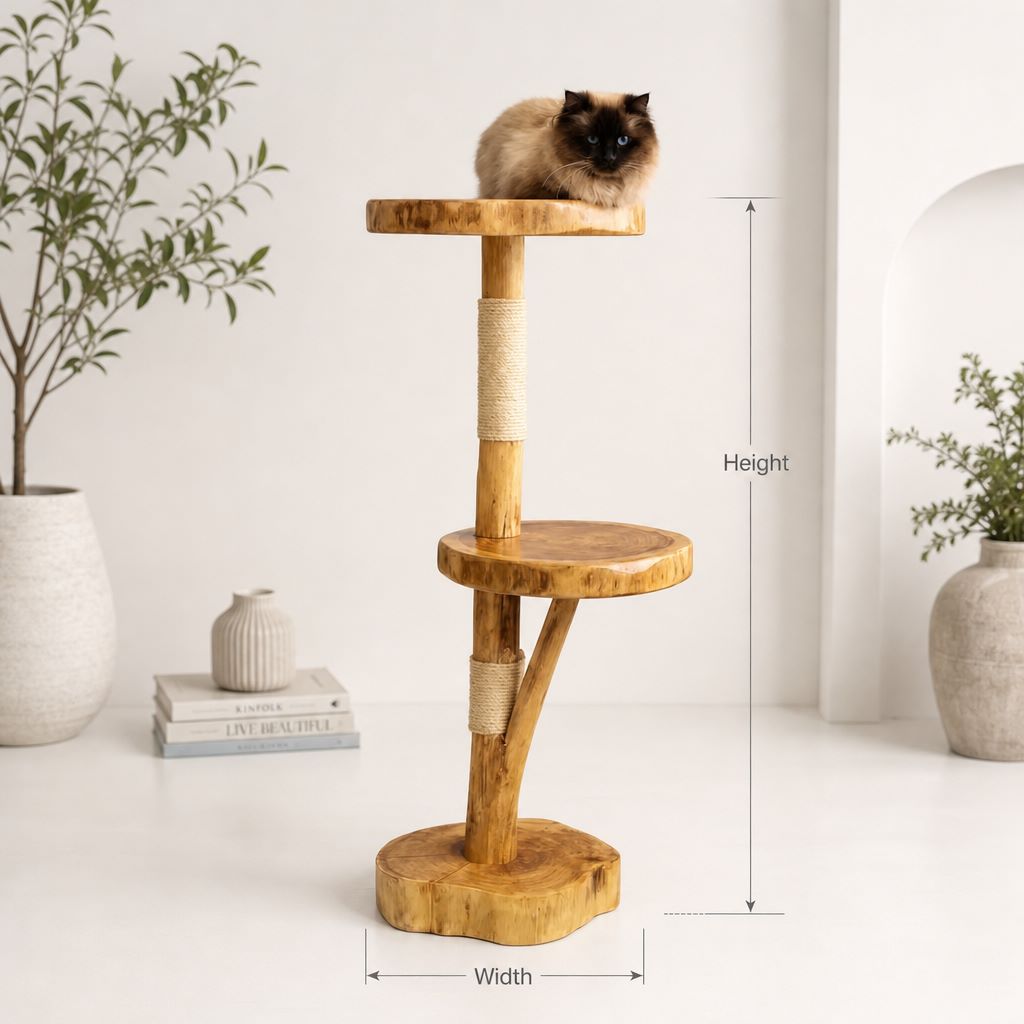
| Small | 20-30" | 16-20" | 10-12" | Single cat, bedroom corner, senior cats |
| Compact | 30-48" | 18-24" | 12-14" | 1-2 cats, apartment living, active adults |
If a product listing just says "small" without dimensions, ask. "Small" on Amazon can mean anything from a 10-inch perch to a 50-inch tower with a narrow base. For a size that's the exact opposite problem - matching height to ceiling and cat energy level - see our cat tree height guide.

Why Small Trees Are Harder to Pick Than Big Ones
A 6-foot cat tree can afford some wobble - the wide base and multiple support points absorb it. A 24-inch tree with a 16-inch base has almost no margin for error.
Three things make small tree selection trickier:
Stability ratio is tighter. The height-to-base-width ratio on a small tree is often worse than on a tall tree. A 60-inch tree with a 24-inch base has a 2.5:1 ratio. A 28-inch tree with a 14-inch base has a 2:1 ratio - sounds better, but the lighter weight means less resistance when a cat lands on the top platform.
Every platform matters. On a big tree with 5 perches, one slightly-too-small platform is a minor annoyance. On a small tree with 2 platforms, a 9-inch top perch means the tree basically doesn't work for lounging.
Material weaknesses amplify. Thin particle board that might hold up on a short tree starts flexing under a cat's weight. Carpet that's stapled on poorly shows every gap at this scale. The manufacturing shortcuts are more obvious because there's less structure to hide behind.


What Real Buyers Keep Running Into (Pain Points from Amazon Reviews)
We read through hundreds of reviews for small cat trees across Amazon, Chewy, and Wayfair. Here are the problems that keep showing up:
"Tips over when my cat jumps on it." The #1 complaint. Lightweight base (under 5 lbs) + narrow footprint + enthusiastic cat = tipping. Happens most on flat-pack trees where the base is a thin MDF panel instead of a solid wood slab.
"Sisal rope came loose after two weeks." Cheap trees use 3-4mm thin sisal glued (not wound) around a cardboard or thin wood post. Cats scratch it loose in days, and once the glue gives way, the whole rope slides off.
"Platform is smaller than it looks in the photo." Multiple reviews call out platforms measuring 8-10 inches when the listing implies room for lounging. A 10-pound cat needs at least 12 inches to curl up comfortably. Under 10 inches = sitting upright only.
"Carpet started ripping at the edges." Carpet-wrapped trees staple fabric to the platform edges. Cats scratch those edges, staples pull through, carpet peels. Eventually the exposed MDF underneath starts crumbling.
"The board swelled after a month." Particle board + bathroom-adjacent humidity + cat drool on the platform = swollen edges. Once particle board swells, it doesn't go back. The platform becomes uneven and the carpet bubbles.
"Sharp corners where my kitten could get hurt." Some budget small trees have unfinished cut edges or exposed hardware at cat-head height. Not a dealbreaker for adult cats, but risky for kittens who bump into everything.
These aren't edge cases. They're the most common complaints across the category. Here's how to avoid them.

Solid Wood vs Carpet/MDF - The Material Decision
Most small cat trees are made from one of three materials. The choice matters more at this scale than at larger sizes, because every weakness is amplified.
For the full breakdown of why solid wood outperforms MDF and carpet-wrapped particle board (with weight capacity numbers, lifespan comparisons, and hygiene data), see our natural wood cat tower guide. Here's the small-tree-specific version:
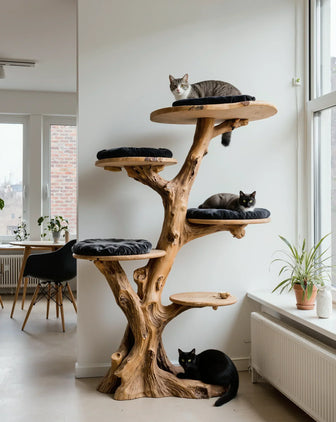
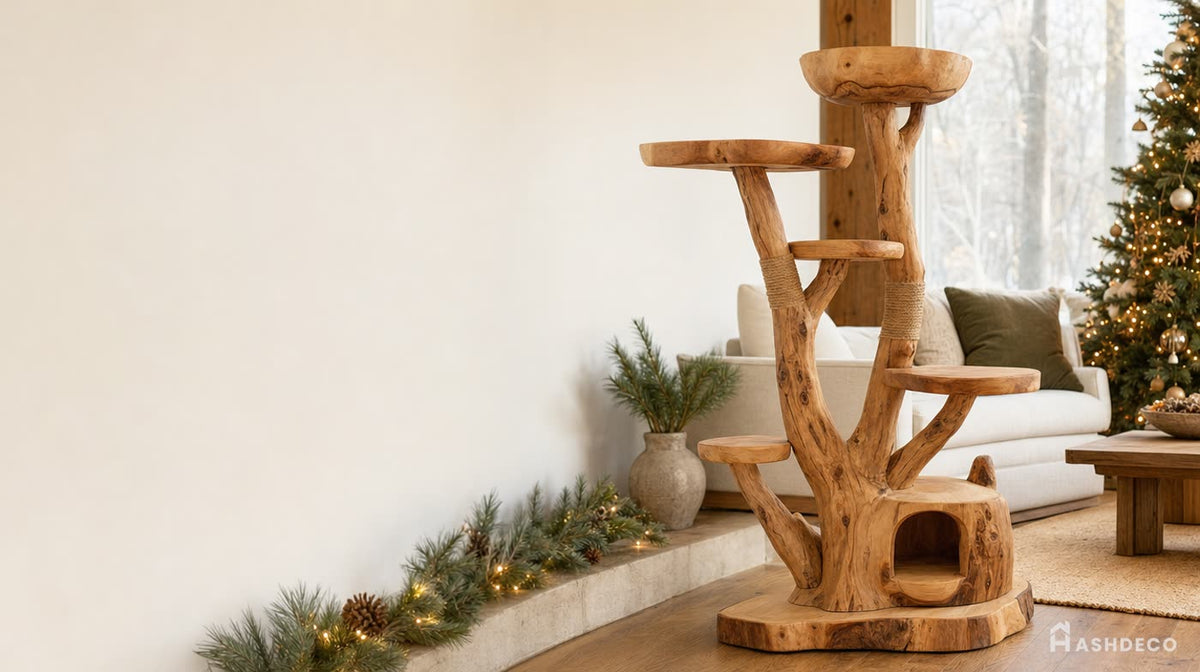
Solid wood (small tree): Heavier base = better stability. Smooth surface = no carpet to shred. Natural grain = looks like furniture, not pet supplies. Costs $80-300 for small sizes, but lasts 10+ years. Brands like Ashdeco handcraft small cat trees from single pieces of hardwood - no particle board, no staples. Browse the cat tree tower collection to see what real solid wood small trees look like.
MDF with veneer: Lighter than solid wood, which is a problem for stability. Surface looks nice initially but the edges are vulnerable. If a cat scratches the veneer edge, the compressed fiberboard underneath is exposed to moisture and swells. $40-120 for small sizes, lifespan 2-4 years.
Carpet-wrapped particle board: The cheapest option ($20-80), the lightest (worst for tipping), and the shortest-lived (1-3 years). Carpet traps allergens, staples expose over time, and the board crumbles when scratched. If your budget only allows this, buy the heaviest one you can find - weight is your best proxy for base stability.
The honest take: if you're buying a small cat tree for a room where you actually spend time (living room, bedroom, home office), the material matters. A solid wood tree at $150 looks intentional. A carpet-wrapped tree at $35 looks like you gave up.

Don't miss
These pieces qualify for 10% off orders over $2,000. Applied automatically at checkout.
10% off
Sculptural Spiral Solid Wood Cat Tree Tiered Modern Feline Lounger
From $2,217.00
10% off at checkout
10% off
Artisanal Solid Wood Sculptural Tree Cat Tower & Multi-Tier Botanical Display Perch Stand
From $2,076.00
10% off at checkout
 10% off
Sculptural Hand-Carved Tree Solid Wood Wall-Mounted Cat Climbing Tower with Dual House Condos & Display Shelves
$3,012.00
10% off at checkout
10% off
Sculptural Hand-Carved Tree Solid Wood Wall-Mounted Cat Climbing Tower with Dual House Condos & Display Shelves
$3,012.00
10% off at checkout
 10% off
Sculptural Hand-Carved Tree Solid Wood Cat Tower & Multi-Tier Luxury Feline Climbing Tree with Tunnel Condo Base
From $2,654.00
10% off at checkout
10% off
Sculptural Hand-Carved Tree Solid Wood Cat Tower & Multi-Tier Luxury Feline Climbing Tree with Tunnel Condo Base
From $2,654.00
10% off at checkout
Stability Is Everything - How to Tell Before You Buy
You can't test stability through a screen. But you can predict it from the listing:
Base weight matters most. Look for a base that's at least 40% of the total tree weight. A 12-pound tree should have a base around 5 pounds minimum. If the total weight is listed as 6 pounds, the base is probably 2 pounds - not enough to resist a jumping cat.
Pre-assembled beats flat-pack. Wirecutter's testing found that pre-assembled cat trees are significantly more stable than flat-pack versions. The factory uses 2½-inch wood screws and proper adhesive. Flat-pack trees rely on single screws at each pole end, and the pole holes in particle board strip out over time.
Post thickness. Posts should be at least 2 inches in diameter (or 2x4 equivalent). Thin dowel posts (under 1.5 inches) flex under a cat's weight, which creates the wobble that makes cats stop using the tree.
Look for wall anchor options. Some small trees come with a wall strap or bracket. In earthquake-prone areas or homes with very active cats, anchoring a tall-but-narrow small tree to the wall eliminates the tipping risk entirely.
Read the negative reviews first. Search reviews for "wobbly," "tip," "cheap," and "broke." If more than 15% of reviews mention stability issues, skip it - no amount of positive reviews about how "cute" it is will fix a tree your cat won't use.
Scratching Post Quality in Small Trees
A small cat tree usually has 1-2 scratching posts. They need to be good ones, because your cat doesn't have 5 other posts to choose from.
Sisal rope diameter matters. 6mm+ sisal is noticeably more durable than 3-4mm. The thin stuff shreds under daily scratching. Check the product photos closely - if the rope looks like thread, it is thread.
Post height for stretching. Cats scratch to stretch their full body length. A scratching post should be tall enough for a cat to extend fully - at least 12-16 inches of scratchable height. On a 24-inch tree, that means the post runs most of the tree's height. If the scratchable section is only 6 inches tall, it's a toy, not a scratcher.
Sisal vs carpet-wrapped post. Most cats prefer sisal for scratching - it gives under their claws in a satisfying way and doesn't trap hair. Carpet-wrapped posts work, but cats tend to scratch the edges where staples are, accelerating damage. If your small tree has carpet-wrapped posts, check whether the carpet fully covers the staples.
Replacement availability. Some brands sell replacement sisal posts or rope. Most don't. If a brand offers replacement parts, that's a signal they expect their trees to last long enough for parts to wear out. Ashdeco's handcrafted trees are built so individual components can be replaced - if a branch or post wears out after years of use, you don't toss the whole tree.

Placement Guide for Small Spaces
Where you put a cat tree matters almost as much as which one you buy. Cats are territorial about their spots, and a great tree in the wrong corner is a great tree nobody uses.
Near a window = best spot. Cats love watching outside. A small tree placed by a window becomes a viewing perch, which increases usage dramatically. Even a basic 20-inch tree by a sunny window will get more use than an expensive 40-inch tree in a dark hallway.
Avoid doorways and high-traffic paths. Cats feel vulnerable when their perch is in a path where people or other pets walk by constantly. Place the tree against a wall or in a corner where your cat can observe without being startled.
Corner placement vs center of room. Corners are ideal for stability (two walls = less tipping risk) and for the cat's sense of security (covered on two sides). If you must place it in the center of a room, make sure the base is heavy enough to handle bumps.
Connect to existing furniture. Cats love to "island hop" - jump from the couch to the tree to a shelf. Place your small tree near a piece of furniture your cat already uses. The tree becomes part of a vertical route rather than an isolated destination. If you like the idea of furniture doing double duty, our tree bookshelf cat tower ideas cover designs where climbing structure and shelving share the same footprint - a smart option for small spaces.
Keep it away from the litter box. Cats don't want to climb and perch next to where they eliminate. Even a small tree loses appeal if it's within 3 feet of the litter box.

A small tree that won't wobble.
Ashdeco's handcrafted solid wood cat trees are carved from single pieces of hardwood - no particle board, no staples, no carpet to shred. Heavy base, real stability, built to last a decade or more.
Shop Cat Tree Towers →Solid wood · Handcrafted · No wobble
Small Cat Tree for One Cat vs Multiple Cats
This is where small trees get complicated.
One cat, one small tree: Generally works fine. Pick a tree with 2-3 platforms and at least one scratching post. Your cat will claim the whole thing.
Two cats, one small tree: Possible, but with conditions. Each cat needs at least one platform they can claim as their own. If the tree has only one perch, one cat will guard it and the other won't use the tree. Look for trees with at least 2 separate perches at different heights.
Red flag: resource guarding. If one cat sits on the tree and the other cat won't go near it, that's resource guarding - not a size problem, a behavior one. The fix isn't a bigger tree - it's adding a second perch somewhere else in the room (a wall-mounted shelf, a windowsill perch) so both cats have elevated spots. For the full breakdown of territorial dynamics, hierarchy, and which setup fits your cats' specific social pattern, see our cat tree for multiple cats guide.
Two cats, two small trees: Often better than one medium tree. Two separate small trees in different spots of the room give each cat their own territory. This works especially well in apartments where one tree goes by the window and the other goes in a quiet corner.
The condo question. If your small tree has an enclosed condo (hideaway), check that it has two openings - entrance and exit. Cat behaviorist Irith Bloom recommends this for multi-cat households: "When animals are in a spat, they may block or guard an opening, trapping a cat inside. Multiple ways in and out prevent that." Single-opening condos are fine for single-cat homes but risky when cats share space - our multi-cat behavior guide covers this exact problem in more depth, along with placement strategies for households where cats actively compete for space.

Sizing Quick Reference
| Your Cat's Weight | Min Platform Width | Recommended Tree Height | Min Base Weight |
|---|---|---|---|
| Under 8 lbs (kitten, small breed) | 10" | 16-24" | 3 lbs |
| 8-12 lbs (average domestic) | 12" | 24-36" | 5 lbs |
| 12-18 lbs (large breed) | 14" | 30-48" | 8 lbs |
| 18+ lbs (Maine Coon, Ragdoll) | 16"+ | Consider tall tree instead | 10+ lbs |
For cats over 15 pounds, a small tree often won't have the platform space or base stability they need. At that point, you're better off looking at our guide to unique cat trees for large cats - designs specifically built to hold big breeds without wobbling.
My Recommendation
One cat, apartment living: Get a 24-36 inch solid wood tree with 2-3 platforms and at least one sisal post. Place it near a window. Ashdeco's handcrafted cat tree towers come in sizes that work for this - real wood, no carpet, stable base.
Two cats, small house: Either one compact tree (36-48") with 3+ platforms, or two small trees (24-30") in different spots. Two trees usually work better - each cat gets their own territory and you avoid resource guarding. Our cat tree for multiple cats guide walks through which setup fits your specific household dynamic.
Senior cat: Go shorter (16-24") with platforms close together (8-12 inch gaps). Older cats don't want to jump far. Some small trees with ramps instead of jumps are ideal - check our cat tree for senior cats guide for age-specific design and our natural wood cat tower guide for material and design specifics.
Kitten: Start small (16-24") with soft edges and low platforms. Kittens are clumsy and a tall tree is intimidating. As they grow, you can upgrade or add a second tree. A solid wood small tree lasts through the kitten phase and into adulthood.
Active adult cat who jumps hard: Prioritize base weight and pre-assembled construction. Skip flat-pack. Look for a tree where the base is at least 40% of total weight. If your cat is a parkour enthusiast, consider wall-mounting the top platform for extra security.
For a broader look at what's worth buying across all sizes and price points, see our Best Cat Towers 2026 guide.
FAQ
What size cat tree is considered small?
Small cat trees are typically under 48 inches tall, with a base footprint of 16-24 inches wide. The truly "small" range is under 30 inches - these sit on desks, dressers, or windowsills and provide 1-2 perches. Anything 48-60 inches starts overlapping with what many brands call "tall."
Are small cat trees stable enough for active cats?
They can be, if you pick the right one. The key is base weight - a small tree should weigh at least 8-12 pounds total with a base that's 40%+ of that weight. Pre-assembled trees are more stable than flat-pack. If your cat is over 15 pounds or particularly athletic, consider a compact (36-48") tree with a wider base instead of a truly small one.
Can two cats share a small cat tree?
Yes, but only if the tree has at least 2 separate platforms. If there's only one perch, one cat will claim it and the other won't use the tree. For two cats, either pick a small tree with 3+ platforms or buy two small trees for different spots in the room. Also check that any enclosed condo has two openings (entrance and exit) to prevent trapping. See our cat tree for multiple cats guide for the full behavioral breakdown.
Do small cat trees actually save space?
Yes - a quality small tree with a 16-20 inch footprint takes up less floor space than a traditional cat bed (which often runs 20-24 inches wide). The vertical design gives your cat more usable space (multiple perches) in a smaller footprint. Place it in a corner or against a wall and it barely impacts your room layout.
How long does a small cat tree last?
A solid wood small tree lasts 10-15+ years with minimal maintenance. Carpet-wrapped particle board trees last 1-3 years before the carpet shreds, staples expose, and the board swells. MDF trees with veneer last 2-4 years before edge damage becomes visible. The material choice determines lifespan more than the size does. For a detailed comparison of materials and expected lifespans, see our natural wood cat tower buying guide.
Looking for handcrafted options? Browse Ashdeco's solid wood cat tree tower collection - real hardwood, no particle board, no carpet. Each piece is carved by artisans and built to last. For more detail on wood types, joinery, and sizing for larger cats, check the full natural wood cat tower guide.