



















Quick view
- Why Most Cat Trees Don't Work for Older Cats
- 7 Criteria for Choosing Cat Tree for Senior Cats (and the Red Flags to Avoid)
- Four Ashdeco Designs That Work Well for Senior Cats
- Why a Custom Consultation Matters for Senior Cat Furniture
- When a Cat Tree Isn't the Right Choice
- Frequently Asked Questions
- The Bottom Line
Shop this guide
Handcrafted Cat Tree Tower, made to order in solid wood.
 Hollow Tunnel Cave Sisal Scratching Cat Tree Tower in Sculpted Solid Wood
From $1,532.00
Hollow Tunnel Cave Sisal Scratching Cat Tree Tower in Sculpted Solid Wood
From $1,532.00
 Multi Tier Sculpted Botanical Canopy Cat Tree Tower in Matte Finished Solid Wood
From $1,765.00
Multi Tier Sculpted Botanical Canopy Cat Tree Tower in Matte Finished Solid Wood
From $1,765.00
 Sculptural Spiral Solid Wood Cat Tree Tiered Modern Feline Lounger
From $2,217.0010% off at checkout
Sculptural Spiral Solid Wood Cat Tree Tiered Modern Feline Lounger
From $2,217.0010% off at checkout
 Nature Inspired Branch Solid Wood Corner Cat Tree Tower Condo
From $1,854.00
Nature Inspired Branch Solid Wood Corner Cat Tree Tower Condo
From $1,854.00
 Live Edge Slice Tiered Solid Wood Cat Tree Freestanding Multi Level Perch
From $1,732.00
Live Edge Slice Tiered Solid Wood Cat Tree Freestanding Multi Level Perch
From $1,732.00
 Artisanal Solid Wood Sculptural Tree Cat Tower & Multi-Tier Botanical Display Perch Stand
From $2,076.0010% off at checkout
Artisanal Solid Wood Sculptural Tree Cat Tower & Multi-Tier Botanical Display Perch Stand
From $2,076.0010% off at checkout
Cat Tree for Senior Cats: 7 Red Flags That Turn It Into an Expensive Shelf
A cat tree for senior cats needs to solve a completely different problem than a cat tree for a young, agile cat - and most products on the market simply weren't designed for that. This guide comes straight from the Ashdeco workshop, where we handcraft solid wood cat trees and climbing furniture. Over the years, enough customers with senior or disabled cats have told us the same story: they bought a 'best cat tree' pick from a generic list, and it just didn't work for their older cat. If your cat is 10, 12, or 15 years old, a 72-inch tower with 12-inch jumps between platforms isn't a cat tree. It's an obstacle course. If you're still weighing a branching cat tree against a vertical cat tower in general, our cat tree vs. cat tower comparison breaks down the difference.

Why Most Cat Trees Don't Work for Older Cats
To understand what actually goes wrong for senior cats, we read through a large sample of customer reviews for mass-market cat trees - the kind you'd find on Amazon or big-box pet stores. We're summarizing patterns and paraphrasing common complaints below rather than quoting reviews verbatim, since individual reviews belong to their authors. A few issues came up again and again, and several are especially relevant for older cats:
Platforms are too far apart. Multiple reviewers noted that even their healthy, young cats hesitated to jump between certain levels. For a senior cat with joint stiffness, those same gaps are simply unreachable. Some reviewers described mid-sized cats having to turn back on a landing because the next platform was out of comfortable reach.
Smooth surfaces cause slipping. This came up repeatedly: bare wood platforms, glossy finishes, and slick surfaces where cats' claws can't grip. Several reviewers mentioned adding anti-slip bands or sewing custom pads to compensate. For an older cat with weaker claws and slower reflexes, a slippery platform isn't just uncomfortable - it's dangerous.
Structures wobble when cats jump. Both light and heavy cat trees got this complaint. Tower-style designs sway when cats land, and tension-rod ceiling-mount designs were frequently described as unstable. Young cats can recover their balance; older cats often won't try again after a scary experience. We've written more on this specific problem in our guide to sturdy cat trees that won't wobble or tip over.
Carpet fibers trap weak claws. Standard carpet-covered cat trees work fine for healthy cats with strong claws. But several reviewers mentioned their cats' claws getting caught in carpet fibers, causing visible distress. Older cats tend to have more brittle nails, making this a real concern.
Condo holes are too small. More than one reviewer pointed out entrances placed awkwardly relative to interior bowls or beds, effectively making an entire level hard to use. For a cat with arthritis in the shoulders or hips, squeezing through a narrow entrance isn't just annoying - it's painful.
Particle board breaks under weight. Multiple reviews mentioned broken corners, peeling layers, and cracked pieces right out of the box. Senior cats tend to weigh more due to reduced activity, and a platform designed for a lean 8-pound kitten may not hold a 16-pound older cat safely - a problem we also cover from a different angle in our guide to unique cat trees for large cats.
These aren't edge cases. They're design problems that affect a growing segment of cat owners.

7 Criteria for Choosing Cat Tree for Senior Cats (and the Red Flags to Avoid)
1. Step Height: 8 Inches or Less Between Levels
What to look for: The vertical distance between any two consecutive platforms should be no more than 8 inches. Ideally, the bottom step is even lower - 5 to 6 inches - so your cat can start climbing without a big initial jump.
Red flag: Any cat tree that requires jumps of 12 inches or more between levels. If the product photos show big gaps between platforms, your senior cat won't use the upper levels. They'll stay on the bottom and you'll have paid for a very expensive shelf.
Why it matters: Older cats lose muscle mass and flexibility. A jump that was easy at age 3 becomes risky at age 12. Repeated failed attempts can lead to injury or your cat simply abandoning the tree entirely. For a broader look at matching total tower height to your ceiling and your cat's energy level, see our cat tree height guide.
2. Platform Width: At Least 15 Inches of Usable Space
What to look for: Platforms should be wide enough for your cat to stand, turn around, and lie down comfortably. For most domestic cats, that means at least 15 inches of clear space.
Red flag: Narrow perches or landing spots barely wider than the cat itself, which force awkward mid-air turns just to land safely.
Why it matters: Senior cats move more deliberately. They need room to position themselves before jumping or settling down. A platform that's too small forces awkward movements that stress joints.
3. Non-Slip Surface: Textured Wood, Felt, or Thin Carpet
What to look for: Natural wood with visible grain texture, felt pads, or thin carpet that gives claws something to grip without trapping them. Solid wood with a matte or natural finish generally provides better traction than glossy or lacquered surfaces - the kind of natural, formaldehyde-free finish we use across our pieces. Wood species matters here too - some hardwoods simply grip better under a cat's claws than others, which we cover in our wood species and safety guide.
Red flag: Glossy, lacquered, or overly smooth wood surfaces - a common enough problem that many owners end up buying separate anti-slip bands or sewing their own pads after the fact.
Why it matters: Older cats have weaker claws and slower reflexes. If their claws can't grip the surface, they'll slip, panic, and stop using the tree. This is one of the most common reasons senior cats abandon new cat furniture.
4. Low Center of Gravity: Stability Over Height
What to look for: A wide, heavy base relative to the overall height. Wall-mounted designs are inherently stable because they're anchored to the structure of your home. For floor-standing trees, look for a base that's at least as wide as the highest platform.
Red flag: Tall, narrow towers with small bases, or tension-rod ceiling-mount designs that owners commonly describe as wobbly or unsteady.
Why it matters: A wobbling platform is terrifying for any cat, but especially for an older one with reduced balance. Even if the tree doesn't tip over, the sensation of movement will deter your cat from using the upper levels - our cat tree weight and stability guide explains why heavier is almost always safer.
5. Open Design: Avoid Small Enclosed Holes
What to look for: Open beds, hammocks, or condos with generous entrance openings (at least 7 inches in diameter for average cats, larger for big breeds). Fully open platforms are ideal because there's no entrance to navigate at all.
Red flag: Condo-style cubbies with small round or oval holes, especially when the interior layout leaves an awkward gap between the entrance and the resting spot.
Why it matters: Arthritis in the shoulders and hips makes squeezing through tight spaces painful. Older cats also lose some flexibility in the spine, making it harder to contort through narrow openings.
6. Removable, Washable Cushions
What to look for: Cushions or pads that detach easily for machine washing. Velcro attachments are common and work well when they're securely fastened - weak velcro is a frequent complaint, so check reviews for durability specifically.
Red flag: Fixed carpet or permanently attached fabric that can't be removed for cleaning.
Why it matters: Senior cats are more prone to vomiting, incontinence, and shedding. Furniture that can't be cleaned thoroughly will develop odors that deter both cats and humans from using the space. Wood surfaces in particular tend to be easier to wipe clean than fabric or carpet.
7. Weight Capacity: Plan for a Heavier Cat
What to look for: Solid wood construction with thick platforms. A tree that can comfortably support 15 to 20 pounds per platform - even if your cat currently weighs less. Senior cats often gain weight due to reduced activity, and the furniture should accommodate that. If your senior cat is also a large breed, our complete buyer's guide for large cats covers weight capacity in more depth, and our wood vs. carpet comparison lays out exactly why particle board falls short at higher weights.
Red flag: Particle board, thin plywood, or platforms described in reviews as flimsy or prone to bending.
Why it matters: A 16-pound senior cat jumping onto a platform designed for an 8-pound kitten creates stress on the joints and the structure. If the platform flexes or creaks, your cat will feel it - and may not try again. Solid wood construction eliminates this concern entirely.



Four Ashdeco Designs That Work Well for Senior Cats
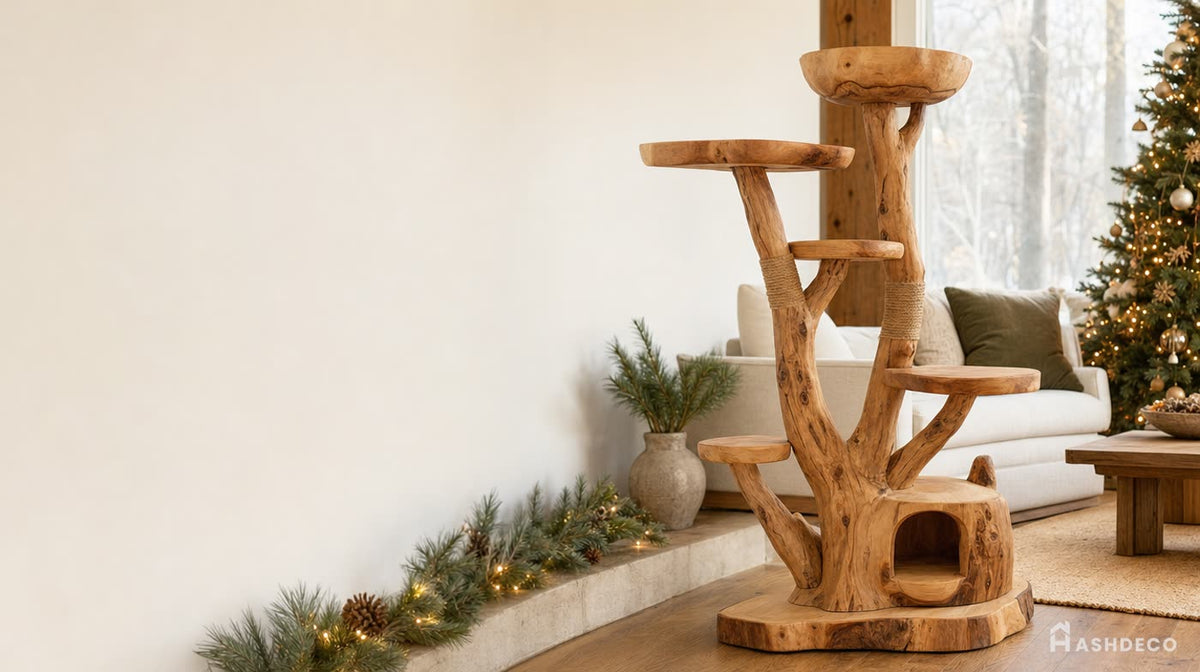
Every cat tree in our collection is handcrafted from solid wood and kiln-dried for 18 months before production - a process that gives our pieces structural stability that particle board and MDF simply can't match. For an older cat, that stability is everything.
Because each piece is handmade, exact step heights, platform widths, and weight capacities vary slightly by unit. The table below gives you the overall footprint and design logic for each option; a design consultation is the best way to confirm exact measurements against your cat's specific mobility needs.
| Product | Overall Size | Design Type | Why It Works for Senior Cats | Price |
|---|---|---|---|---|
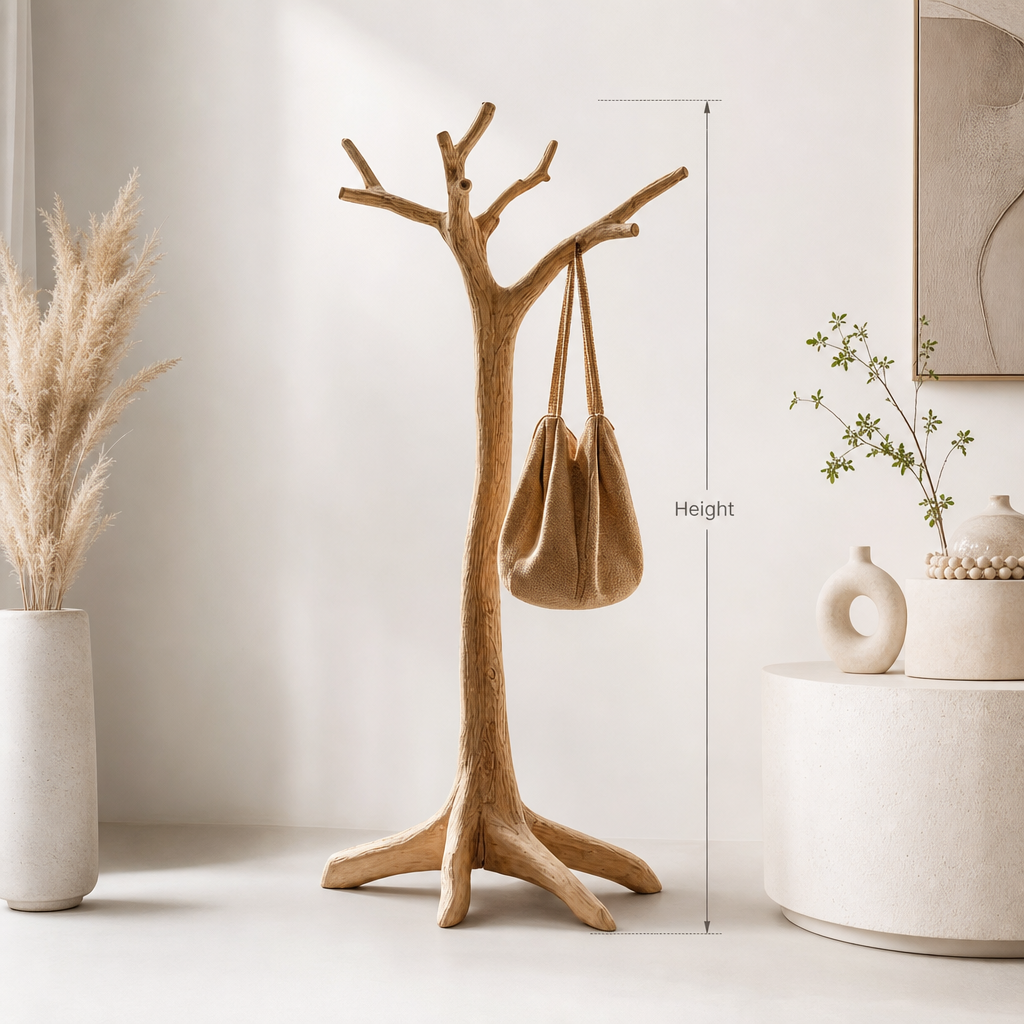
| Rustic Solid Wood Cat Tree – Natural Branch | 18"W × 39"H | Floor-standing, natural branch | Shortest option at 39" - branch design creates natural stepping points rather than requiring big jumps. Solid wood handles heavier cats without flex. Natural grain provides inherent traction without added carpet. | $1,023 (~$51/year over 20+ years) |
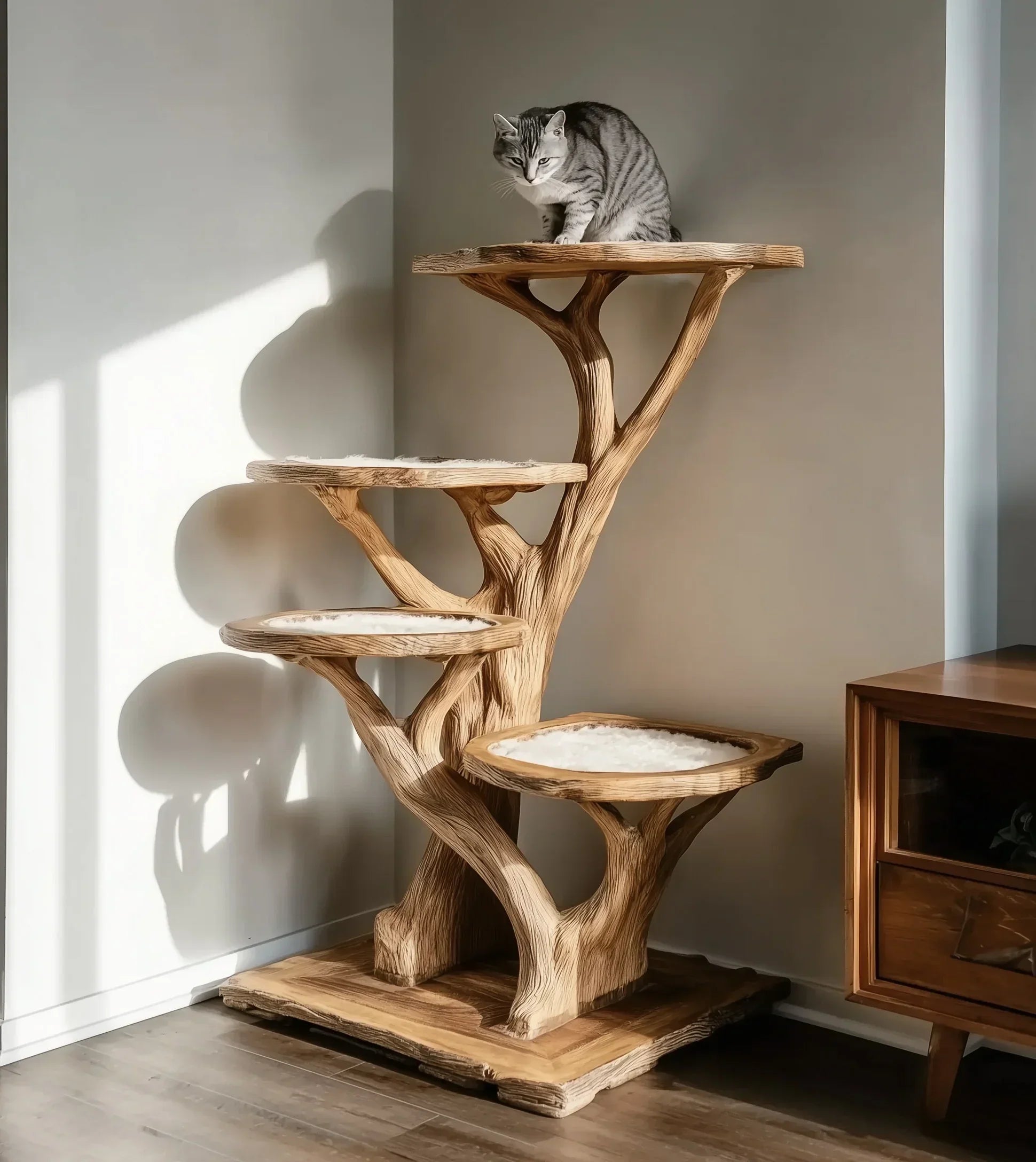
| Modern Solid Wood Climbing Tower | 30"W × 59"H | Floor-standing, stepped platforms | Widest base at 30" - generous platform space for cats to turn and settle comfortably. Solid wood means no wobble on landing. Stepped design keeps transitions between levels gradual. | $1,939 (~$97/year over 20+ years) |
| Cat Tree Tower – Tall Cat Scratcher | 24"W × 60"H | Floor-standing, vertical scratching | 24" base resists sway when cats land. Natural wood texture gives better grip than glossy surfaces or worn carpet. A taller design that still keeps access stable. | $1,339 (~$67/year over 20+ years) |
| Artistic Branch Cat Tree & Bookshelf | 60"W × 70"H | Wall-mounted, organic branch | Wall-mounted for zero wobble - anchored to your wall, so there's no sway on landing. Branch design lets cats choose their own step height. Fully open, with no enclosed holes to navigate. | $2,662 (~$133/year over 20+ years) |
The "cost per year" figures assume a 20-year lifespan, which is the general expectation for solid, well-maintained wood furniture rather than a guaranteed figure for every household - actual longevity depends on use and care.
A note on specifications: Because each Ashdeco piece is handcrafted and unique, exact step heights, individual platform widths, and weight capacities vary by design and are discussed during your consultation. If you have a specific cat with specific mobility needs, our senior designers can advise on the best configuration before production.

Not sure which design fits your cat?
Book a free 30-minute design consultation with a senior Ashdeco designer. Tell us your cat's age, weight, and mobility needs, and we'll help you choose (or customize) the right piece before it's built.
Cat Tree for Senior CatsWhy a Custom Consultation Matters for Senior Cat Furniture
Here's something you won't find when shopping mass-market: the ability to talk to the person making your cat's furniture before it's built.
Every Ashdeco buyer gets a complimentary 30-minute design consultation with a senior designer. For cat owners with senior or disabled cats, this is where you can address the specific needs that a standard product can't cover - things like adjusting step heights for a cat who can no longer jump more than a few inches, widening platforms for a cat who's gained weight, choosing wall-mounted over floor-standing for stability, or fine-tuning the wood finish for grip without roughness underfoot.
These aren't unusual requests. They're the kind of details that make the difference between a cat tree your senior cat uses every day and one that becomes an expensive shelf. A consultation lets you get those details right before the piece is made, rather than modifying it afterward with the kind of workarounds - anti-slip bands, custom pads, reinforced bases - that show up so often in reviews of off-the-shelf trees.

Don't miss
These pieces qualify for 10% off orders over $2,000. Applied automatically at checkout.
10% off
Sculptural Spiral Solid Wood Cat Tree Tiered Modern Feline Lounger
From $2,217.00
10% off at checkout
10% off
Artisanal Solid Wood Sculptural Tree Cat Tower & Multi-Tier Botanical Display Perch Stand
From $2,076.00
10% off at checkout
 10% off
Sculptural Hand-Carved Tree Solid Wood Wall-Mounted Cat Climbing Tower with Dual House Condos & Display Shelves
$3,012.00
10% off at checkout
10% off
Sculptural Hand-Carved Tree Solid Wood Wall-Mounted Cat Climbing Tower with Dual House Condos & Display Shelves
$3,012.00
10% off at checkout
 10% off
Sculptural Hand-Carved Tree Solid Wood Cat Tower & Multi-Tier Luxury Feline Climbing Tree with Tunnel Condo Base
From $2,654.00
10% off at checkout
10% off
Sculptural Hand-Carved Tree Solid Wood Cat Tower & Multi-Tier Luxury Feline Climbing Tree with Tunnel Condo Base
From $2,654.00
10% off at checkout
When a Cat Tree Isn't the Right Choice
Not every senior cat needs - or can use - a cat tree, regardless of how well it's designed. If your cat has significant mobility issues, is bedridden, or has severe arthritis that limits any jumping, consider these alternatives:
- Floor-level cat beds - no elevation needed, still gives your cat a designated space. Check out our cat bed collection for solid wood options that sit at ground level.
- Pet ramps - gentle inclines to reach window sills or low furniture.
- Low window perches - mounted close to the ground for cats who still want to look outside.
The goal isn't to get your cat climbing. It's to give them comfortable, accessible spaces that match their current abilities. Sometimes that's a cat tree. Sometimes it's not.
Frequently Asked Questions
Do senior cats still use a cat tree for senior cats?
Yes, but they use them differently. A young cat will climb to the highest perch and nap there. A senior cat may only use the bottom two or three levels, and that's fine. The right cat tree for senior cats gives them options at heights they can actually reach, rather than forcing them to attempt jumps they can no longer make.
Is a tall cat tree for senior cats safe?
It depends on the design. A tall tree with small, widely-spaced platforms is not safe - your cat will either injure themselves trying or stop using it. A tall tree with gradual steps, wide platforms, and a stable base can work well. The 39-inch Rustic Solid Wood Cat Tree is our shortest option and often the best starting point for senior cats.
Should I choose a wall-mounted cat tree for senior cats?
Wall-mounted designs are inherently more stable than floor-standing ones because they're anchored to your home's structure. If your senior cat is hesitant because of wobbling, a wall-mounted option like the Artistic Branch Cat Tree & Bookshelf eliminates that concern entirely.
At what age should I start looking for a cat tree for senior cats?
Most veterinarians consider cats senior between ages 7 and 10, depending on breed and health. Larger breeds tend to age a bit slower. If your cat is slowing down, sleeping more, or showing reluctance to jump onto furniture they previously used, it's time to think about their environment - including their cat tree.
Is carpet or wood better for a cat tree for senior cats?
Wood with a natural, textured finish is generally better than thick carpet. Thick carpet can trap brittle claws and cause panic. Wood with a matte or natural finish provides traction without the risk. Thin felt pads on wood platforms offer a good compromise - grip without trapping. Wood is also easier to clean if your senior cat has accidents.
How much should a cat tree for senior cats cost?
Mass-market cat trees range from $30 to $80, but they're typically made from particle board and often show significant wear within 1–2 years. Solid wood handcrafted cat trees start around $1,000 and are built to last considerably longer. When you break it down, a $1,023 cat tree used over 20 years costs about $51 per year - comparable to or less than repeatedly replacing a $60 particle board tree every year or two. For a senior cat, the structural reliability of solid wood also matters from a safety standpoint.
The Bottom Line
Choosing a cat tree for a senior cat comes down to one principle: accessibility matters more than height. Your older cat doesn't need to reach the ceiling. They need safe, comfortable spaces at heights they can actually manage, on surfaces they can grip, in structures that don't move when they land.
Solid wood handcrafted furniture addresses most of these concerns inherently - it's stable, it's strong, it has natural texture for grip, and it's built to last long enough to be a genuine investment rather than a disposable purchase.
If you're looking for a cat tree that will serve your senior cat well for years to come, browse our cat tree collection or book a free design consultation to talk through your cat's specific needs. We're also happy to answer questions about other cat furniture options if a traditional tree isn't the right fit.