





























Quick view
- Base Width & Footprint: The Foundation of Every Sturdy Coat Rack
- Leg Geometry: Why a Standing Coat Rack Tree Resists Tipping
- Material & Weight: What Makes a Wooden Coat Rack Actually Stable
- Height-to-Base Ratio: The Quick Math Test
- How to Test a Coat Rack Stand Before You Buy
- Freestanding Coat Rack vs. Wall-Mounted: Which Removes the Risk?
- Red Flags to Avoid When Shopping for a Coat Rack Online
- Pre-Purchase Checklist for a Sturdy Coat Rack
- FAQ
Shop this guide
Handcrafted Coat Racks & Hangers, made to order in solid wood.
 Christmas edit
Custom Wood Coat Rack – Driftwood Wall Mount Clothes Rack with Unique Hooks
From $697.00
Christmas edit
Custom Wood Coat Rack – Driftwood Wall Mount Clothes Rack with Unique Hooks
From $697.00
 Christmas edit
Antler Coat Rack – Rustic Handmade Wall Hook for Home & Office
From $517.00
Christmas edit
Antler Coat Rack – Rustic Handmade Wall Hook for Home & Office
From $517.00
 Christmas edit
Natural Driftwood Coat Rack – Handcrafted Tree Branch Standing Hanger for Entryway or Bedroom
From $1,056.00
Christmas edit
Natural Driftwood Coat Rack – Handcrafted Tree Branch Standing Hanger for Entryway or Bedroom
From $1,056.00
 Christmas edit
Ashdeco Solid Wood Coat Rack – Vintage 10 Hooks Hat & Clothes Stand
$520.00
Christmas edit
Ashdeco Solid Wood Coat Rack – Vintage 10 Hooks Hat & Clothes Stand
$520.00
 Christmas edit
Rustic Tree Branch Coat Rack – Solid Wood Standing Hanger for Home Decor
From $1,556.00
Christmas edit
Rustic Tree Branch Coat Rack – Solid Wood Standing Hanger for Home Decor
From $1,556.00
 Rustic Wooden Standing Coat Rack – Handmade Tree Branch Hook Organizer
From $1,056.00
Rustic Wooden Standing Coat Rack – Handmade Tree Branch Hook Organizer
From $1,056.00
Sturdy Coat Rack or Tip Hazard? How to Tell Before You Buy
Wondering if a sturdy coat rack you found online will actually stay upright once it's loaded with real coats? You can tell more than you'd think from a product photo - if you know what to look for. You've probably seen it happen: an overloaded coat rack wobbles, tips, and dumps coats and bags on the floor. It's annoying, it can damage the rack, and if it lands on a kid or a pet, it's genuinely unsafe.
The good news is that whether a coat rack will tip over is almost always predictable before you buy it - you just need to know what to look for. In this guide, you'll learn the factors that determine stability: base width, leg geometry, material, and height-to-base ratio. Use the checklist to spot a sturdy coat rack from a listing photo or a showroom floor, no guesswork required.

Base Width & Footprint: The Foundation of Every Sturdy Coat Rack
If you only check one thing, check this. The base is what keeps a freestanding coat rack upright, and a narrow base is the #1 reason racks tip.
A simple rule of thumb: the base width should be at least a third of the rack's total height. A 66" tall sturdy coat rack, for example, should have a base spread of roughly 18–22" to stay stable under normal use. Most well-made standing coat rack tree designs land in the 12–18" diameter range for the base, with wider bases used on taller pieces.
When shopping online, look for:
- A base width or diameter listed in the specs (if it's missing, that's a red flag - see section 7)
- Product photos taken from a low angle that actually show the base, not just the top branches
- Tripod or splayed-leg bases rather than a single flat disc, since spread legs resist tipping sideways better than a flat circular base of the same size

Leg Geometry: Why a Standing Coat Rack Tree Resists Tipping
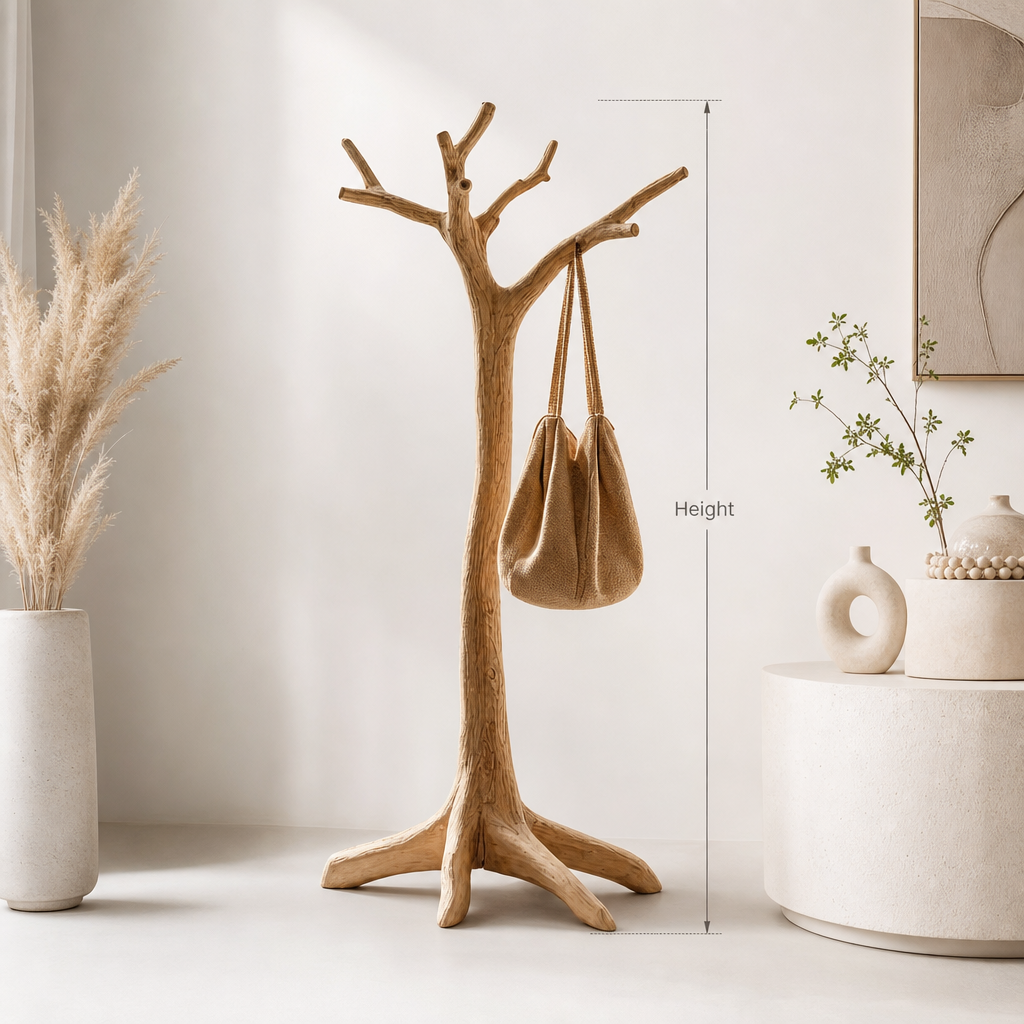
Base area matters, but so does shape. A coat rack stand with 3–4 legs angled outward from the trunk is more resistant to tipping than one with a narrow pole and a small round foot, even if the total footprint is similar.
This is part of why tree coat rack designs tend to be more stable than they look. The trunk splits into multiple branch-like legs near the floor, so the weight-bearing footprint is wider than the visual "pole" would suggest. If you're comparing two racks, picture pushing on the top from the side - the one with legs spread furthest in that direction will resist better.


Material & Weight: What Makes a Wooden Coat Rack Actually Stable
It's tempting to assume a heavier coat rack is automatically more stable. That's only half true.
- A wooden coat rack made from solid hardwood (oak, walnut, teak, acacia) carries real weight low in the base, which lowers the center of gravity and genuinely helps.
- A sturdy coat rack that's heavy at the top - thick branches, many hooks, dense upper structure - but light at the base can still tip easily, because the weight is working against you, not for you.
- Cheap MDF or particleboard racks wrapped in veneer are usually lighter overall, but the bigger issue is they often pair thin bases with tall profiles to save material, which is the worst combination for stability.
What you actually want is a weighted coat rack in the sense of a low, solid base - not just a heavy rack in general. Solid wood scores well here because the density is consistent throughout, not just added as ballast.
Height-to-Base Ratio: The Quick Math Test
This combines sections 1 and 3 into one gut-check number: divide the sturdy coat rack's height by its base width.
- Ratio under 3:1 - generally stable for normal use (coats, hats, bags)
- Ratio of 4:1 or higher - increasing tip risk, especially near an entryway where the rack gets bumped, or if heavier items (winter coats, backpacks) hang unevenly on one side
Most standing coat racks run 60–72" tall. Using the 3:1 guideline, that means you want a base in the 20–24" range for the taller end of that spectrum, or a design with a genuinely wide leg spread even if the "diameter" number looks smaller on paper.

Don't miss
These pieces qualify for 10% off orders over $2,000. Applied automatically at checkout.
 10% off
Sculptural Solid Wood Hall Tree - Artistic Branch Tree Hanger - Unique Live Edge Entryway Coat Rack
$2,234.00
10% off at checkout
10% off
Sculptural Solid Wood Hall Tree - Artistic Branch Tree Hanger - Unique Live Edge Entryway Coat Rack
$2,234.00
10% off at checkout
 10% off
Handcrafted Tree Branch Clothing Rack – Solid Wood Wardrobe Shelf Organizer for Home Décor
$2,333.00
10% off at checkout
10% off
Handcrafted Tree Branch Clothing Rack – Solid Wood Wardrobe Shelf Organizer for Home Décor
$2,333.00
10% off at checkout
 10% off
Sculptural Hand-Carved Solid Wood Tree Entryway Bench & Branch Coat Rack with Integrated Shoe Shelf
From $2,534.00
10% off at checkout
10% off
Sculptural Hand-Carved Solid Wood Tree Entryway Bench & Branch Coat Rack with Integrated Shoe Shelf
From $2,534.00
10% off at checkout
 10% off
Sculptural Hand-Carved Tree Solid Wood Open Wardrobe Closet System & Branch Wall Storage Bench
$3,876.00
10% off at checkout
10% off
Sculptural Hand-Carved Tree Solid Wood Open Wardrobe Closet System & Branch Wall Storage Bench
$3,876.00
10% off at checkout
How to Test a Coat Rack Stand Before You Buy
In-Store Test
If you're buying a coat rack in person, this takes 30 seconds:
- Push test - apply light, steady pressure near the top hooks in several directions. It should resist, not rock.
- Load test - hang the heaviest coat available (or ask staff) on one side only, near the top. Uneven loading is the real-world scenario that causes tips, not evenly distributed weight.
- Surface test - try it on a hard floor and, if possible, on a rug or uneven surface. A rack that's stable on tile can behave differently on carpet.
Online Buying Checklist
Buying a sturdy coat rack online, you can't physically test it, but you can:
- Read reviews specifically for words like "tipped," "wobbly," "unstable," or "top-heavy"
- Check if the listing states a weight capacity (standing coat racks are commonly rated for 30–50 lbs total, with 5–10 lbs per individual hook) - a listing with no capacity info at all is worth being cautious about
- Look for mention of wall anchor straps included as a safety backup, which reputable makers include even on freestanding designs

Freestanding Coat Rack vs. Wall-Mounted: Which Removes the Risk?
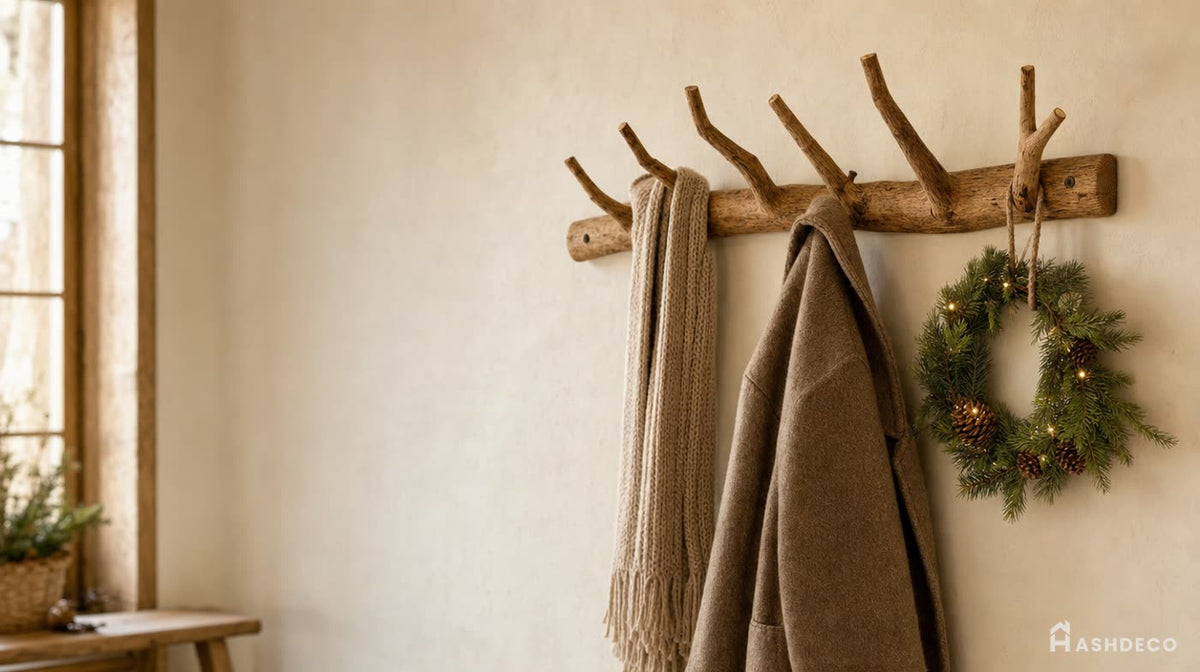
If tip-over risk is a dealbreaker (small kids, pets, a narrow hallway with foot traffic), a wall mounted coat rack sidesteps the whole problem. Anchored into wall studs, it physically cannot tip the way a freestanding piece can.
The trade-off is installation - most wall-mounted racks need studs located, screws, and 15–20 minutes of setup - and you lose the ability to move it between rooms. A freestanding coat rack wins on flexibility; wall-mounted wins on guaranteed stability. If you're on the fence, a busy mudroom or a home with young kids tips the decision toward wall-mounted.
>>> For a full breakdown of styles, stud-finding tips, and installation steps, see our standing vs. wall-mounted coat rack comparison.
Red Flags to Avoid When Shopping for a Coat Rack Online
Before you add a sturdy coat rack to cart, scan the listing for these warning signs:
- No base width/diameter listed anywhere in the specs - if a seller doesn't mention it, it's often because it's small
- Product photos that crop out the base or only show close-ups of the hooks and branches
- Excessive hook count on a tall, narrow silhouette - more hooks means more potential for uneven loading, which is exactly the scenario that causes tips
- No stated weight capacity - reputable listings for standing racks will tell you both the total capacity and per-hook capacity
- Reviews mentioning it "looks bigger in photos" - often a sign the base is smaller in person than the listing implies
Pre-Purchase Checklist for a Sturdy Coat Rack
Quick recap before you buy:
- Base width is at least ⅓ of total height
- Legs/base spread outward rather than a single narrow pole
- Made from solid wood (or another dense, weight-appropriate material), not hollow MDF
- Weight capacity is listed (both total and per-hook)
- Reviews don't mention tipping, wobbling, or instability
- If floor space or wobble risk is a concern, wall-mounted is on the table as an option
FAQ
How high should a sturdy coat rack be?
Most standing coat racks run 60–72" tall, tall enough for adult coats on upper hooks while keeping lower hooks reachable for kids or bags. Wall-mounted racks are typically installed 50–60" from the floor for adults, or 36–42" for kids' rooms.
What is the standard coat rack height?
There's no single universal standard, but 66–70" is the most common range for freestanding models, balancing hook accessibility with a stable height-to-base ratio.
Are wall-mounted coat racks safer than freestanding ones?
Yes, structurally. A wall-mounted coat rack anchored into studs cannot tip over the way a freestanding one can. Freestanding racks can still be very stable with the right base and materials, but wall-mounted removes the risk entirely.
Do weighted or wide-base coat racks tip over less?
Yes. A low center of gravity combined with a wide, splayed base is the biggest factor in tip resistance - more important than total weight alone. A heavy rack with a narrow base can still tip; a lighter rack with a wide, low base often won't.
Looking for a sturdy coat rack?

Explore handcrafted sturdy coat rack designs in solid wood - standing and wall-mounted, with wide branch bases and real hardwood weight, not MDF or metal rods.