



















Quick view
- What Makes a Live Edge Coffee Table Different?
- Best Wood Species for Live Edge Coffee Tables
- Round vs Rectangular vs Waterfall: Shape Guide
- Choosing the Right Size
- Base Styles That Work
- What to Look for When Buying
- How Much Should You Spend?
- Epoxy River Tables: Worth Considering?
- Styling Your Live Edge Coffee Table
- Frequently Asked Questions
Shop this guide
Handcrafted Coffee Tables, made to order in solid wood.
 Round Biomorphic Solid Wood Coffee Table Sculptural Hollowed Center Table
From $2,156.0010% off at checkout
Round Biomorphic Solid Wood Coffee Table Sculptural Hollowed Center Table
From $2,156.0010% off at checkout
 Curved Biomorphic Solid Wood Coffee Table Monolithic Organic Low Table
From $1,789.00
Curved Biomorphic Solid Wood Coffee Table Monolithic Organic Low Table
From $1,789.00
 Christmas edit
Handcrafted Live-Edge Solid Wood Christmas Coffee Table with Monolithic Tree-Trunk Stump Pedestal Base & Natural Slab Top
From $2,176.0010% off at checkout
Christmas edit
Handcrafted Live-Edge Solid Wood Christmas Coffee Table with Monolithic Tree-Trunk Stump Pedestal Base & Natural Slab Top
From $2,176.0010% off at checkout
 Modern Handcrafted Solid Wood Square Plinth Coffee Table with Open Storage & Architectural Block Pillars
From $1,567.00
Modern Handcrafted Solid Wood Square Plinth Coffee Table with Open Storage & Architectural Block Pillars
From $1,567.00
 Modern Handcrafted Solid Wood Plinth Coffee Table with Cantilevered Top, Storage Cubby & Drawer
From $1,865.00
Modern Handcrafted Solid Wood Plinth Coffee Table with Cantilevered Top, Storage Cubby & Drawer
From $1,865.00
 Sculptural Hand-Carved Tree Root Round Solid Wood Coffee Table & Sprawling Branch Base
From $2,212.0010% off at checkout
Sculptural Hand-Carved Tree Root Round Solid Wood Coffee Table & Sprawling Branch Base
From $2,212.0010% off at checkout
A live edge coffee table brings raw, natural beauty into your living room - no two pieces look alike. The organic contours of the wood's original bark line create a focal point that factory furniture simply cannot replicate. But with so many options in wood species, shapes, and finishes, choosing the right one takes more than gut instinct.
This guide covers everything: wood types and their grain characteristics, shape comparisons, sizing for your space, base styles, and what to expect when investing in a live edge wood coffee table built to last generations.
What Makes a Live Edge Coffee Table Different?
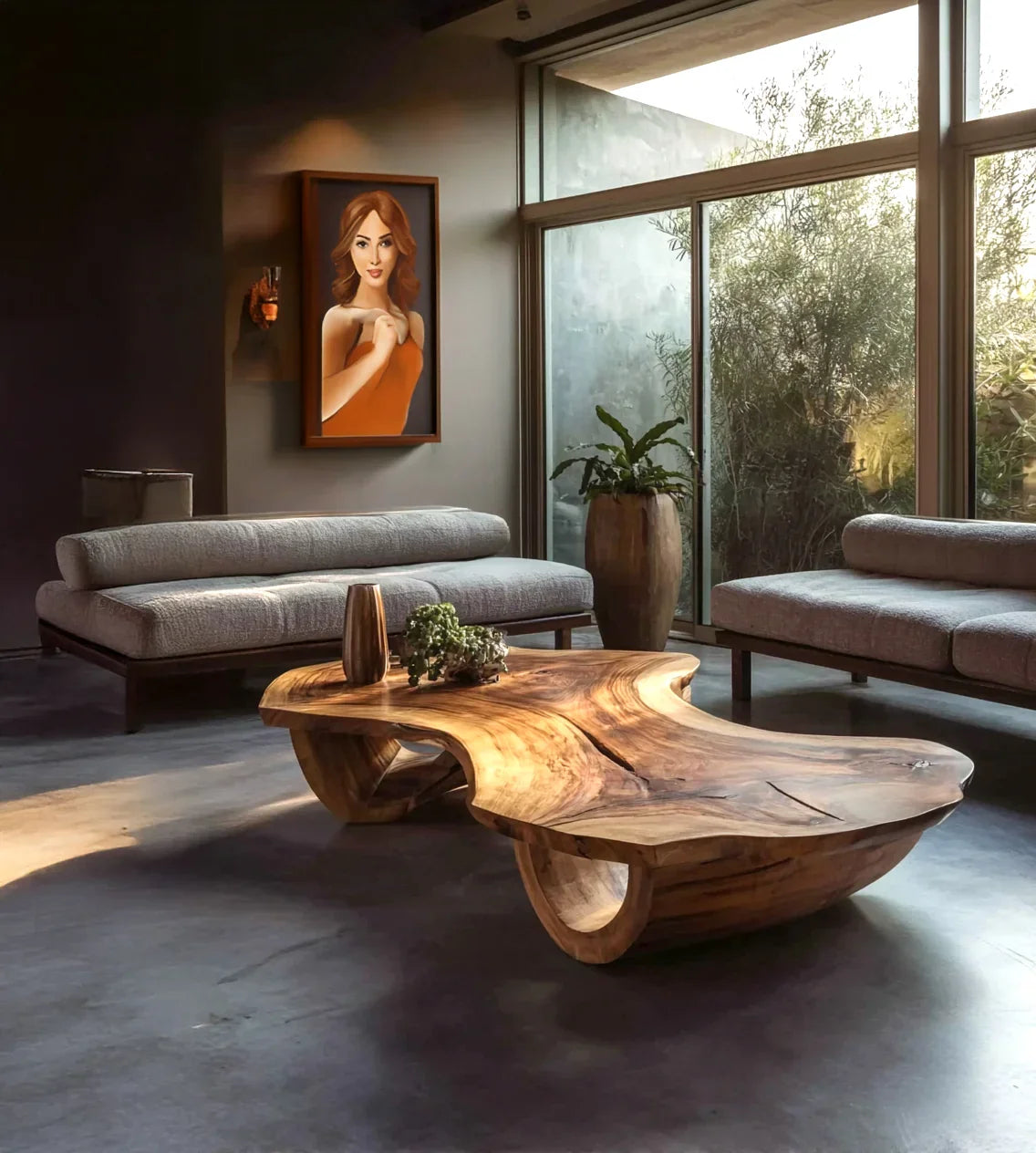
A live edge coffee table preserves the natural outer contour of the tree - the bark line, the curves, the knots. Instead of squaring off the slab into uniform dimensions, the craftsman works with the wood's original shape. Every crack, burl, and grain sweep tells the story of how that tree grew.
This means your table is genuinely one-of-a-kind. Two slabs cut from the same walnut log will have different widths, different grain flow, different character marks. That's the entire appeal.
At Ashdeco, each piece is handcrafted by Vietnamese artisans who select, dry, and finish every slab by hand. No CNC templates. No mass production. Just skilled hands and solid wood.
Best Wood Species for Live Edge Coffee Tables
Wood species determines the color, grain pattern, hardness, and long-term durability of your table. Here's what you need to know about the most popular options for a natural wood coffee table.
Black Walnut
The king of live edge furniture. Walnut offers rich chocolate-brown tones with purple and golden undertones. The grain is typically straight with occasional cathedral patterns. Janka hardness sits at 1,010 - hard enough for daily use, soft enough to develop a warm patina over years.
Walnut slabs often feature dramatic sapwood contrast: creamy white edges against dark heartwood. This two-tone effect is especially striking on live edge pieces.
White Oak
Dense, durable, and water-resistant. White oak has a Janka rating of 1,360, making it one of the toughest domestic hardwoods. The grain shows prominent ray flecks - those shimmery lines that catch light at certain angles.
Color ranges from pale tan to warm honey. It takes stain beautifully if you want a darker look, but natural finishes showcase the grain best.
Hard Maple
Light, bright, and contemporary. Maple's fine, uniform grain creates a clean aesthetic that pairs well with modern and Scandinavian interiors. Janka hardness of 1,450 makes it extremely durable.
Look for figured maple (curly, quilted, or bird's eye) if you want visual drama. These rare grain patterns create a 3D shimmer effect under clear finish.
Cherry
Cherry starts as a warm pinkish-tan and deepens to a rich reddish-brown with sun exposure over 6-12 months. This natural darkening process - called oxidation - is part of cherry's charm. The grain is fine and straight with a satin-like luster.
At Janka 950, cherry is the softest option here. It develops character marks faster, which some owners love and others want to avoid.
Wood Species Comparison
| Wood Species | Color | Janka Hardness | Grain Pattern | Best For |
|---|---|---|---|---|
| Black Walnut | Dark chocolate/purple | 1,010 | Straight, cathedral | Statement pieces, warm interiors |
| White Oak | Tan to honey | 1,360 | Ray flecks, coarse | High-traffic homes, farmhouse style |
| Hard Maple | Pale cream to white | 1,450 | Fine, uniform | Modern/minimalist spaces |
| Cherry | Pink to deep red-brown | 950 | Fine, straight | Traditional, mid-century |


Round vs Rectangular vs Waterfall: Shape Guide
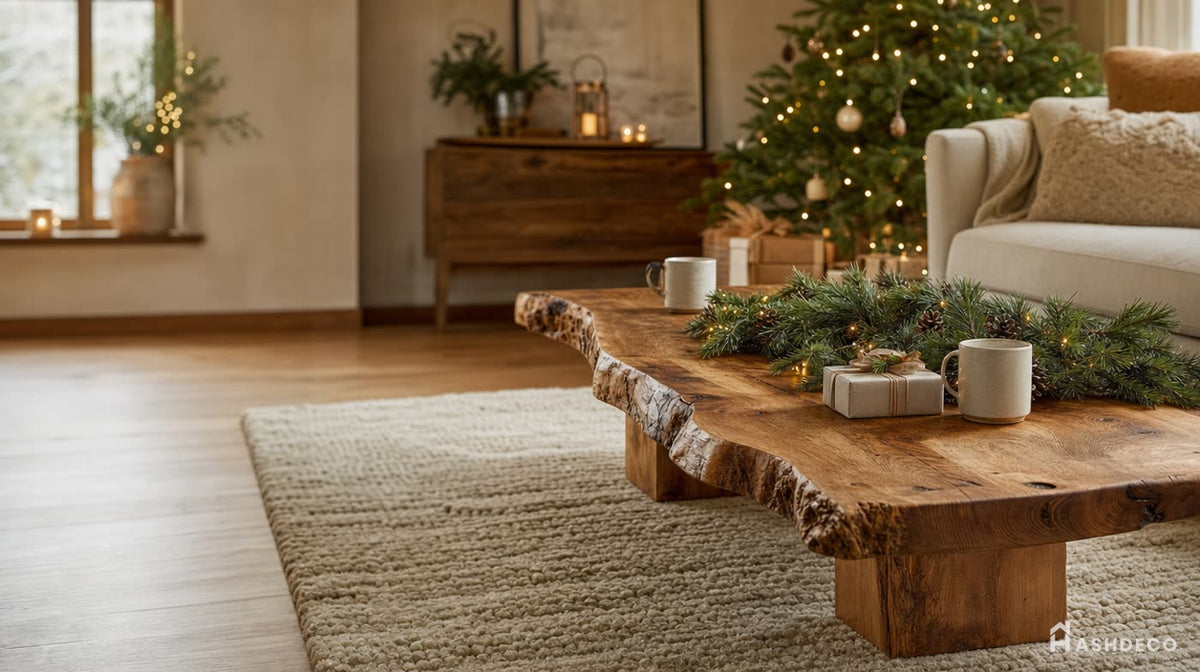
The shape of your live edge coffee table affects both visual impact and how it functions in your space. Each style highlights the wood differently and fits different room layouts. If you're weighing your options, our guide on live edge vs regular coffee table breaks it down further.
Rectangular / Slab-Style
The classic. A single long slab with live edges on both sides. This shape maximizes the natural contour and showcases the full width of the tree. Rectangular tables work best in front of standard sofas and sectionals.
Typical dimensions: 48-60" long × 20-28" wide. The length provides ample surface area for drinks, books, and decor without overwhelming the room.
Round Live Edge
Cut as a cross-section ("cookie cut") from a large-diameter log, round live edge tables show the tree's growth rings radiating outward. The bark line forms the entire perimeter. These work beautifully in smaller spaces and between facing sofas. Our round vs rectangular live edge article walks through the specifics.
Key consideration: round slabs are prone to cracking along the pith (center) if not properly dried and stabilized. Ask your maker about moisture content and stabilization methods.
Waterfall Edge
The slab wraps over the edge and continues down to the floor, creating a "waterfall" effect. This requires a precise miter joint at the corner - a mark of serious craftsmanship. The grain flows continuously from top to side, creating a seamless sculptural look.
Waterfall tables cost more due to the extra material and joinery skill required. They make the strongest design statement of the three.
Shape Comparison
| Shape | Best Room Layout | Price Range | Visual Impact | Maintenance |
|---|---|---|---|---|
| Rectangular Slab | L-shaped / standard sofa | $$ | High - full edge display | Low |
| Round / Cookie | Small rooms, facing sofas | $$ | Medium - growth rings | Medium (cracking risk) |
| Waterfall | Open-plan, modern spaces | $$$ | Very high - sculptural | Low |
Choosing the Right Size
Size matters more than most buyers realize. A table that's too large dominates the room; too small and it looks lost. Here's the rule of thumb professional designers use.
Length: Your coffee table should be approximately ⅔ the length of your sofa. For a standard 84" sofa, aim for 48-56" long. For a sectional, 54-60" works well.
Width: Keep 18" minimum clearance between the table edge and sofa front. In a typical setup, that means 20-26" wide tables for most living rooms.
Height: Standard coffee table height is 16-18". The top should sit level with or slightly below your sofa seat cushions. Live edge tables often run 17-18" to account for the slab's natural thickness (typically 1.5-2.5").
Don't miss
These pieces qualify for 10% off orders over $2,000. Applied automatically at checkout.
10% off
Round Biomorphic Solid Wood Coffee Table Sculptural Hollowed Center Table
From $2,156.00
10% off at checkout
10% off
Handcrafted Live-Edge Solid Wood Christmas Coffee Table with Monolithic Tree-Trunk Stump Pedestal Base & Natural Slab Top
From $2,176.00
10% off at checkout
10% off
Sculptural Hand-Carved Tree Root Round Solid Wood Coffee Table & Sprawling Branch Base
From $2,212.00
10% off at checkout
 10% off
Sculptural Oval Solid Wood Coffee Table with Continuous Infinity Wave Base
From $2,176.00
10% off at checkout
10% off
Sculptural Oval Solid Wood Coffee Table with Continuous Infinity Wave Base
From $2,176.00
10% off at checkout
Base Styles That Work
The base does more than hold up the slab - it sets the aesthetic tone. The wrong base can fight the wood instead of complementing it. Here are the most popular options.
Hairpin Legs: Mid-century modern classic. Thin steel rods (usually black or brass) keep the focus on the slab. Best for lighter wood species like maple. The open, airy look works well in smaller rooms where heavy bases would feel cramped.
Trapezoid Steel: Industrial and sturdy. Flat steel bars welded into A-frame or trapezoid shapes. Works with any wood species. The heavier visual weight balances thick slabs well. Powder-coated matte black is the most popular finish - it pairs with everything.
Wooden Trestle: For a fully organic look. Matching or contrasting wood legs and stretchers create warmth. Pairs beautifully with walnut and cherry. A walnut slab on walnut trestle legs creates a seamless, sculptural piece where the entire table reads as one continuous form.
U-Shaped Steel: Clean, contemporary, minimal. Two flat steel U-shapes at each end. Doesn't compete with dramatic grain patterns. A favorite for waterfall designs. The simplicity of U-legs lets a figured walnut or curly maple slab command all the attention.
How to match: As a general rule, pair thin bases with thinner slabs (1.5") and heavier bases with thicker slabs (2"+). A delicate hairpin leg under a 3" thick walnut slab looks unstable. A massive steel frame under a thin piece looks top-heavy. Visual balance matters as much as structural balance.
What to Look for When Buying
Not all live edge furniture is created equal. Here are the details that separate a quality piece from something that'll warp, crack, or fall apart within a year.
Moisture content: The slab should be kiln-dried to 6-8% moisture content for indoor furniture. Ask the maker. If they can't answer, walk away.
Slab thickness: Minimum 1.5" for a coffee table. Thinner slabs lack structural integrity and visual presence. Premium pieces use 2-2.5" thick slabs.
Finish quality: Run your hand across the surface. It should feel smooth and consistent - no rough patches, drips, or sticky spots. Quality finishes include hardwax oil, conversion varnish, or high-build polyurethane.
Crack and void filling: Natural cracks are normal. What matters is how they're handled. Epoxy fills should be bubble-free and level with the surface. Butterfly (bowtie) keys should be tight-fitting with no gaps.

Browse our full collection of live edge coffee tables to see these quality markers in every piece.
How Much Should You Spend?
Live edge coffee tables range from $300 for small, basic pieces to $3,000+ for premium slabs with custom bases. Here's a realistic breakdown for solid, handcrafted pieces. We cover this in more detail in our DIY vs handcrafted coffee tables guide.
$400-$800: Smaller slabs (36-44"), domestic hardwoods, standard metal bases. Great starting point for apartments and secondary rooms.
$800-$1,500: Full-size slabs (48-60"), premium species like walnut, custom base options. The sweet spot for most living rooms.
$1,500-$3,000+: Book-matched slabs, waterfall construction, figured wood, large-scale pieces. Statement furniture for design-focused homes.
Consider this: a solid hardwood live edge table lasts 50-100+ years. A particle-board alternative from a big-box store lasts 3-7 years and ends up in a landfill. Per-year cost often favors the real thing.
Epoxy River Tables: Worth Considering?
Epoxy river tables feature a channel of colored resin running through the center of a split slab. They're eye-catching and polarizing - you either love them or find them gimmicky. Here's an honest take from a woodworking perspective.
The appeal: Resin fills voids, cracks, and gaps with vivid color (often blue, green, or clear). It can incorporate LED lighting, embedded objects, or glow-in-the-dark pigments. The contrast between organic wood and glossy resin is dramatic.
The trade-offs: Epoxy yellows over time with UV exposure, especially cheaper formulations. It scratches easily and cannot be refinished like bare wood - you'd need to sand and re-pour. The resin also doesn't develop patina; it just ages.
Our take: If you love the look, go for it - but choose a table where the wood is still the star and the resin plays a supporting role. Avoid designs where the resin channel is wider than the wood. The best epoxy tables use minimal resin to fill natural voids rather than creating artificial rivers.
Styling Your Live Edge Coffee Table
The table itself is already the statement piece. The goal with styling is to complement - not compete. Keep it simple and let the wood breathe.
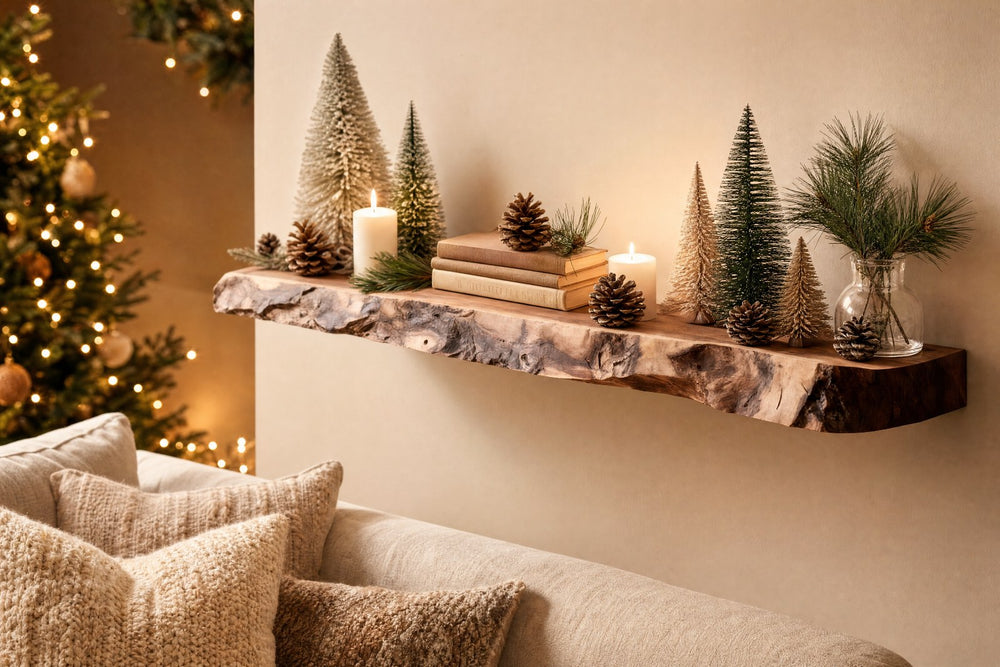
On the table: One low vase or planter, a small stack of books, and a candle. That's it. Resist the urge to clutter a beautiful slab.
Around the table: Solid-colored upholstery works best. Busy patterns can fight the organic lines of the wood. Neutral rugs ground the space without distraction.
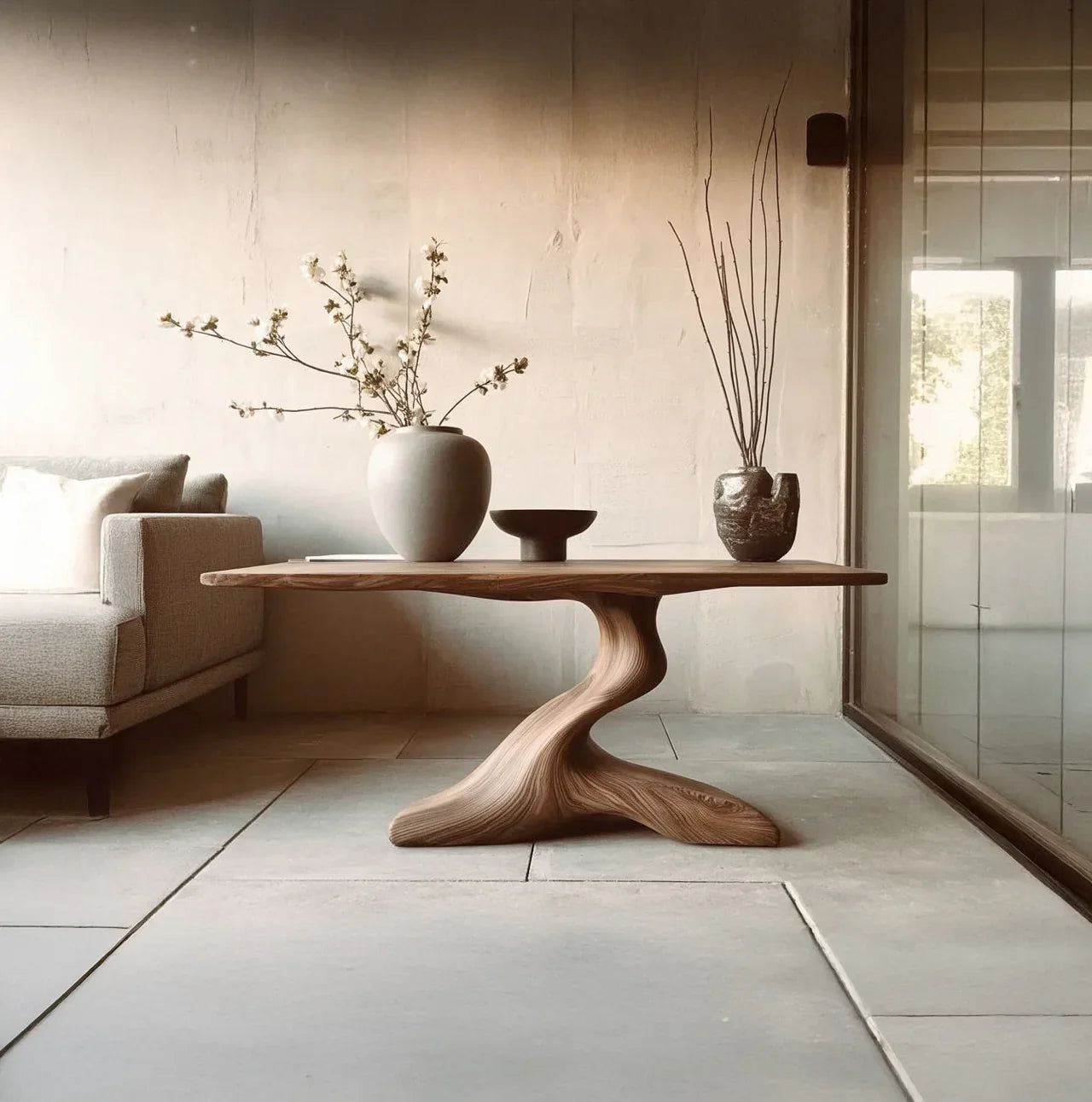
Pair with other live edge pieces: A live edge console table in the entryway or a live edge desk in the home office creates a cohesive wood-forward aesthetic throughout your home.
Frequently Asked Questions
How long does a live edge coffee table last?
With proper care, a solid hardwood live edge coffee table lasts 50-100+ years. The wood actually gets more beautiful with age as it develops a natural patina. Quality joinery and finish are the keys to longevity - not the wood itself. For a deeper dive, see our article on how to care for live edge coffee table.
Is a live edge coffee table good for families with kids?
Yes, with the right wood and finish. Choose a harder species like white oak (Janka 1,360) or maple (1,450) and apply a durable conversion varnish finish. The organic edges are actually softer and rounder than sharp factory-cut corners, making them arguably safer for small children.
What's the best wood for a live edge coffee table?
Black walnut is the most popular choice for its rich color and dramatic grain. White oak is best for durability. Maple suits modern interiors. Cherry is ideal if you love warm reddish tones that deepen over time. Each has distinct advantages depending on your style and usage.
Do live edge tables crack over time?
Properly kiln-dried slabs (6-8% moisture content) rarely develop new cracks. Minor seasonal movement is normal - wood expands slightly in humid months and contracts in dry ones. A quality maker accounts for this in the design with floating joinery and appropriate finish.
How do I know if a live edge table is real solid wood?
Check the edge grain and end grain. Real solid wood shows continuous grain lines from the top surface through the edge. Veneered or laminated pieces have a thin layer on top with different material underneath. Weight is another clue - a 48" walnut slab coffee table typically weighs 50-80 lbs.
Ready to find your perfect piece? Explore our full live edge coffee table collection - every slab hand-selected and finished by our workshop team.