Quick view
Shop this guide
Handcrafted Coffee Tables, made to order in solid wood.
 Round Biomorphic Solid Wood Coffee Table Sculptural Hollowed Center Table
From $2,156.0010% off at checkout
Round Biomorphic Solid Wood Coffee Table Sculptural Hollowed Center Table
From $2,156.0010% off at checkout
 Curved Biomorphic Solid Wood Coffee Table Monolithic Organic Low Table
From $1,789.00
Curved Biomorphic Solid Wood Coffee Table Monolithic Organic Low Table
From $1,789.00
 Christmas edit
Handcrafted Live-Edge Solid Wood Christmas Coffee Table with Monolithic Tree-Trunk Stump Pedestal Base & Natural Slab Top
From $2,176.0010% off at checkout
Christmas edit
Handcrafted Live-Edge Solid Wood Christmas Coffee Table with Monolithic Tree-Trunk Stump Pedestal Base & Natural Slab Top
From $2,176.0010% off at checkout
 Modern Handcrafted Solid Wood Square Plinth Coffee Table with Open Storage & Architectural Block Pillars
From $1,567.00
Modern Handcrafted Solid Wood Square Plinth Coffee Table with Open Storage & Architectural Block Pillars
From $1,567.00
 Modern Handcrafted Solid Wood Plinth Coffee Table with Cantilevered Top, Storage Cubby & Drawer
From $1,865.00
Modern Handcrafted Solid Wood Plinth Coffee Table with Cantilevered Top, Storage Cubby & Drawer
From $1,865.00
 Sculptural Hand-Carved Tree Root Round Solid Wood Coffee Table & Sprawling Branch Base
From $2,212.0010% off at checkout
Sculptural Hand-Carved Tree Root Round Solid Wood Coffee Table & Sprawling Branch Base
From $2,212.0010% off at checkout
Choosing between a round live edge coffee table and a rectangular one changes how your entire living room feels. Both showcase natural wood beauty, but they fill space differently, suit different layouts, and highlight different grain characteristics. This comparison breaks down everything so you can choose with confidence.
How Round and Rectangular Live Edge Tables Are Made
The shape of a live edge coffee table depends on how the slab is cut from the tree. Rectangular tables come from longitudinal cuts along the trunk, preserving the bark line on two long sides. Round tables - often called "cookie cuts" - come from cross-sections sliced perpendicular to the trunk.
This fundamental difference affects the grain pattern you see. Rectangular slabs display long, flowing grain lines that follow the tree's growth direction. Round slabs reveal concentric growth rings radiating from the center, with the bark edge forming the entire perimeter.
Both styles are handcrafted by Vietnamese artisans at Ashdeco, with each slab individually selected for character and structural integrity.
Round Live Edge Coffee Table: Pros and Cons
A live edge round coffee table works as a sculptural centerpiece. The circular form softens a room full of angular furniture - straight-lined sofas, rectangular TV units, square shelving. That visual contrast creates balance.
Advantages
No sharp corners. Round tables are inherently safer for homes with young children. The bark edge adds a soft, irregular perimeter rather than a hard point.
Better traffic flow. In smaller rooms, people can move around a round table more easily than a rectangular one. There are no protruding corners to catch a hip on.
Conversation-friendly. Everyone seated around a round table faces the center equally. For living rooms where the seating faces inward (two sofas facing each other, for example), a round table fits naturally.
Considerations
Drying challenges. Cross-cut slabs include the pith (the tree's center), which creates tension as the wood dries. Without expert kiln-drying and stabilization, round slabs can crack from the center outward. Always verify the maker's drying process.
Smaller surface area. A 36" diameter round table has about 1,018 sq inches of surface. A 48" × 24" rectangular table provides 1,152 sq inches. You get less usable surface per footprint with round shapes.
Limited slab availability. Not every tree produces trunks wide enough for a good round coffee table. Expect fewer options and potentially higher prices for large-diameter rounds. We cover this in more detail in our coffee table dimensions guide guide.


Rectangular Live Edge Coffee Table: Pros and Cons
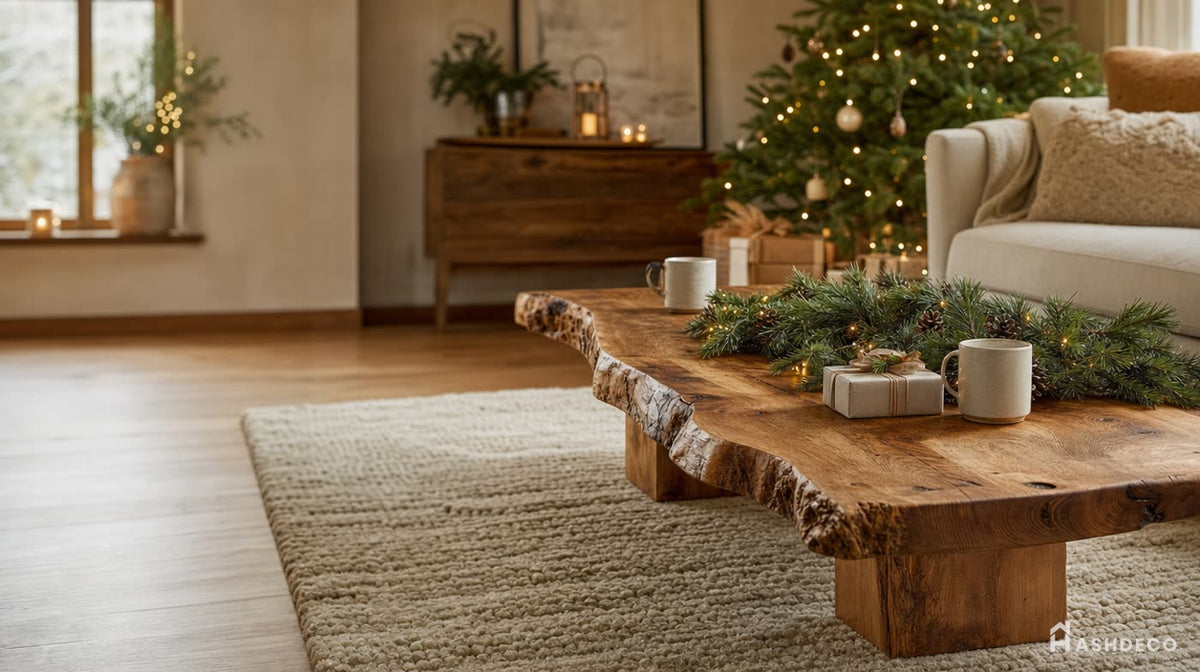
The rectangular slab is the classic live edge form - and for good reason. It maximizes the visual impact of the wood's natural edge and offers the most usable surface area.
Advantages
Maximum edge display. Two full-length live edges running parallel give you the most dramatic showcase of the tree's natural contour. This is where knots, bark inclusions, and curves really shine.
More surface area. Rectangular tables provide better coverage for drinks, remotes, books, and decor. A 54" × 26" slab gives you room without crowding.
Structural stability. Longitudinal cuts follow the grain direction, making them inherently more stable than cross-cuts. Properly dried rectangular slabs have minimal cracking risk.
Considerations
Needs a longer room. A 48-60" rectangular table requires a sofa of at least 72" to look proportional. In small or square rooms, it can feel oversized.
Corners (sort of). While the long edges are organic, the short ends are typically squared off. Some makers add live edge cuts on the ends too, but this uses more material and costs more.
Size and Layout Guide
Your room layout should drive the shape decision more than personal taste. Here's a practical matching guide based on common living room configurations.
| Room Layout | Best Shape | Recommended Size |
|---|---|---|
| L-shaped sectional | Rectangular | 48-60" × 24-28" |
| Two sofas facing each other | Round | 30-40" diameter |
| Sofa + two armchairs | Either | 42-48" any direction |
| Small apartment / studio | Round | 28-34" diameter |
| Open-plan living | Rectangular | 54-60" × 26-30" |
Clearance rule: Maintain at least 18" between the table edge and seating on all sides. This applies equally to both shapes.
Don't miss
These pieces qualify for 10% off orders over $2,000. Applied automatically at checkout.
10% off
Round Biomorphic Solid Wood Coffee Table Sculptural Hollowed Center Table
From $2,156.00
10% off at checkout
10% off
Handcrafted Live-Edge Solid Wood Christmas Coffee Table with Monolithic Tree-Trunk Stump Pedestal Base & Natural Slab Top
From $2,176.00
10% off at checkout
10% off
Sculptural Hand-Carved Tree Root Round Solid Wood Coffee Table & Sprawling Branch Base
From $2,212.00
10% off at checkout
 10% off
Sculptural Oval Solid Wood Coffee Table with Continuous Infinity Wave Base
From $2,176.00
10% off at checkout
10% off
Sculptural Oval Solid Wood Coffee Table with Continuous Infinity Wave Base
From $2,176.00
10% off at checkout
Which Wood Species Works Best for Each Shape?
Certain woods pair better with certain shapes based on their grain characteristics and typical trunk dimensions.
For round tables: White oak and maple are excellent choices. Oak's ray flecks create a starburst pattern radiating from the center of a cross-cut slab - genuinely stunning. Maple's fine grain looks clean and contemporary in round form.
For rectangular tables: Black walnut is the standout. Its long, flowing cathedral grain patterns need length to fully unfold. The sapwood-to-heartwood color transition (cream to dark chocolate) is most dramatic along a long slab. Cherry also shines in rectangular form, where its subtle grain gets room to breathe.
Base Pairings for Each Shape
The base should match the table's geometry. Mismatched proportions look awkward.
Round tables: Pedestal bases (single central column) or tripod legs work best. They echo the circular form and keep the underside open. Avoid four straight legs on a round slab - it creates visual tension between the organic top and rigid base.
Rectangular tables: Dual trapezoid steel, U-shaped frames, or wooden trestle bases. These mirror the table's linear orientation. Hairpin legs also work well for a mid-century look.
Price Comparison
Round and rectangular live edge coffee tables sit in a similar price range for comparable wood species and sizes. The main cost factors are slab thickness, wood species rarity, and base complexity - not the shape itself. We've written a full breakdown in our live edge coffee table buyers guide post.
That said, very large round slabs (36"+ diameter) can command a premium because they require older, larger-diameter trees. A 36" walnut round may cost 10-20% more than a 48" × 24" walnut rectangle from the same grade of lumber.

Explore both styles in our live edge coffee table collection to compare real pieces and pricing. If you're weighing your options, our guide on live edge vs regular coffee table breaks it down further.
The Verdict
Choose round if you have a smaller room, facing sofas, young children, or want a sculptural conversation piece that softens angular furniture.
Choose rectangular if you have a standard sofa layout, want maximum surface area, prefer dramatic grain display, or plan to pair it with other linear furniture.
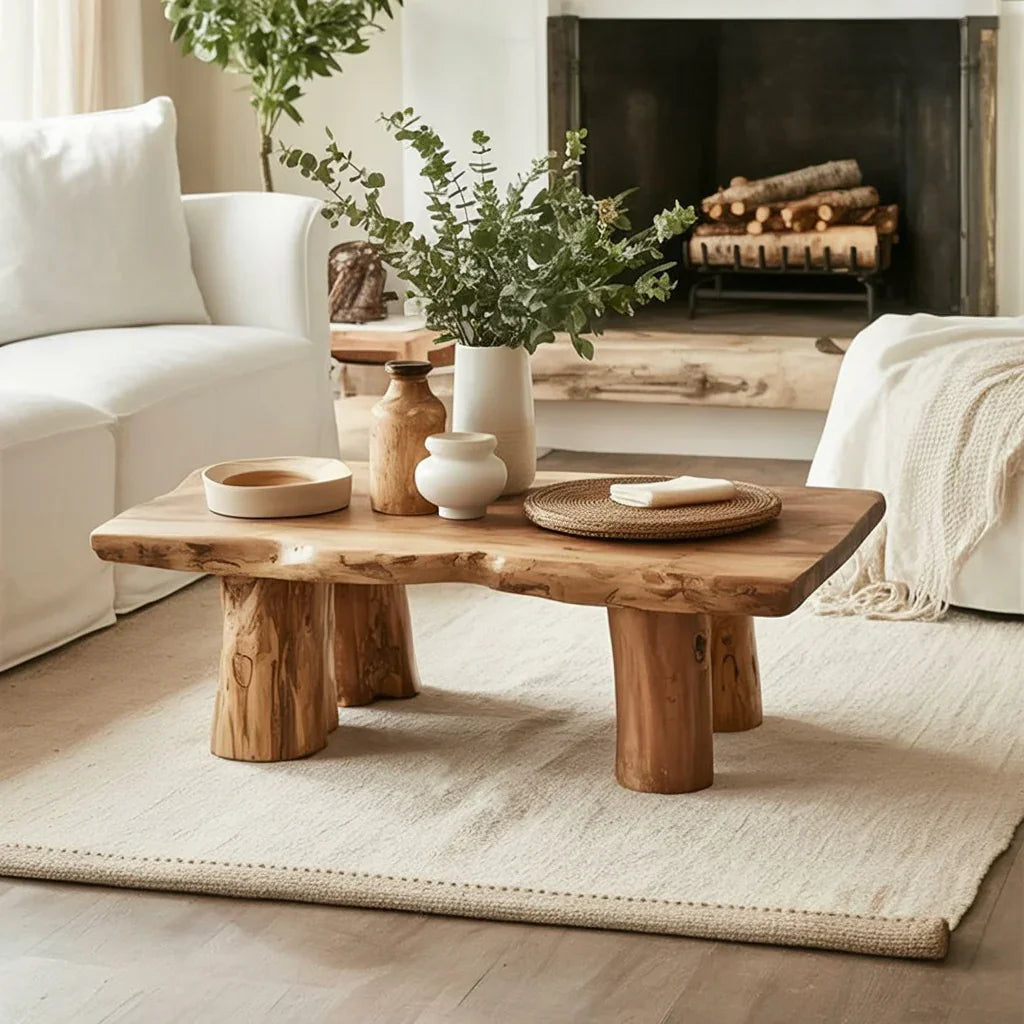
Either way, you're getting a one-of-a-kind piece of natural art. The "wrong" shape doesn't exist - only the wrong fit for your specific space. Browse our handcrafted live edge coffee tables to see what speaks to you.
Frequently Asked Questions
Are round live edge coffee tables more expensive?
Not necessarily. Price depends more on wood species, slab thickness, and base style than shape. Large-diameter rounds (36"+) can cost slightly more because they require bigger trees, but standard sizes are comparably priced to rectangular tables.
Do round live edge tables crack more easily?
Cross-cut (round) slabs have higher cracking risk than longitudinal cuts because they include the pith. However, proper kiln-drying to 6-8% moisture content and professional stabilization eliminates most risk. Always confirm the drying method before buying.
What size round coffee table for a small living room?
A 28-34" diameter round live edge coffee table works well in rooms under 200 sq ft. Keep at least 18" clearance between the table and seating. In very tight spaces, consider a 24" round as a side table alternative.
Can I get live edge on all four sides of a rectangular table?
Technically yes, but it's rare and expensive. It requires a wider slab that's long enough to also show natural edges on the short ends. Most rectangular live edge tables have natural edges on the two long sides with clean-cut ends.