




















Quick view
- The Quick Comparison: Wood vs. Carpet Cat Trees
- Durability: Why Wood Lasts and Carpet Doesn't
- Cleaning and Hygiene: Not Even Close
- Aesthetics: Cat Furniture That Looks Like Furniture
- Safety: What's Actually Safer for Your Cat
- Cost: The Real Math
- When a Carpet Cat Tree Actually Makes Sense
- What Makes a Good Wood Cat Tree
- Frequently Asked Questions
Shop this guide
Handcrafted Cat Tree Tower, made to order in solid wood.
 Hollow Tunnel Cave Sisal Scratching Cat Tree Tower in Sculpted Solid Wood
From $1,532.00
Hollow Tunnel Cave Sisal Scratching Cat Tree Tower in Sculpted Solid Wood
From $1,532.00
 Multi Tier Sculpted Botanical Canopy Cat Tree Tower in Matte Finished Solid Wood
From $1,765.00
Multi Tier Sculpted Botanical Canopy Cat Tree Tower in Matte Finished Solid Wood
From $1,765.00
 Sculptural Spiral Solid Wood Cat Tree Tiered Modern Feline Lounger
From $2,217.0010% off at checkout
Sculptural Spiral Solid Wood Cat Tree Tiered Modern Feline Lounger
From $2,217.0010% off at checkout
 Nature Inspired Branch Solid Wood Corner Cat Tree Tower Condo
From $1,854.00
Nature Inspired Branch Solid Wood Corner Cat Tree Tower Condo
From $1,854.00
 Live Edge Slice Tiered Solid Wood Cat Tree Freestanding Multi Level Perch
From $1,732.00
Live Edge Slice Tiered Solid Wood Cat Tree Freestanding Multi Level Perch
From $1,732.00
 Artisanal Solid Wood Sculptural Tree Cat Tower & Multi-Tier Botanical Display Perch Stand
From $2,076.0010% off at checkout
Artisanal Solid Wood Sculptural Tree Cat Tower & Multi-Tier Botanical Display Perch Stand
From $2,076.0010% off at checkout
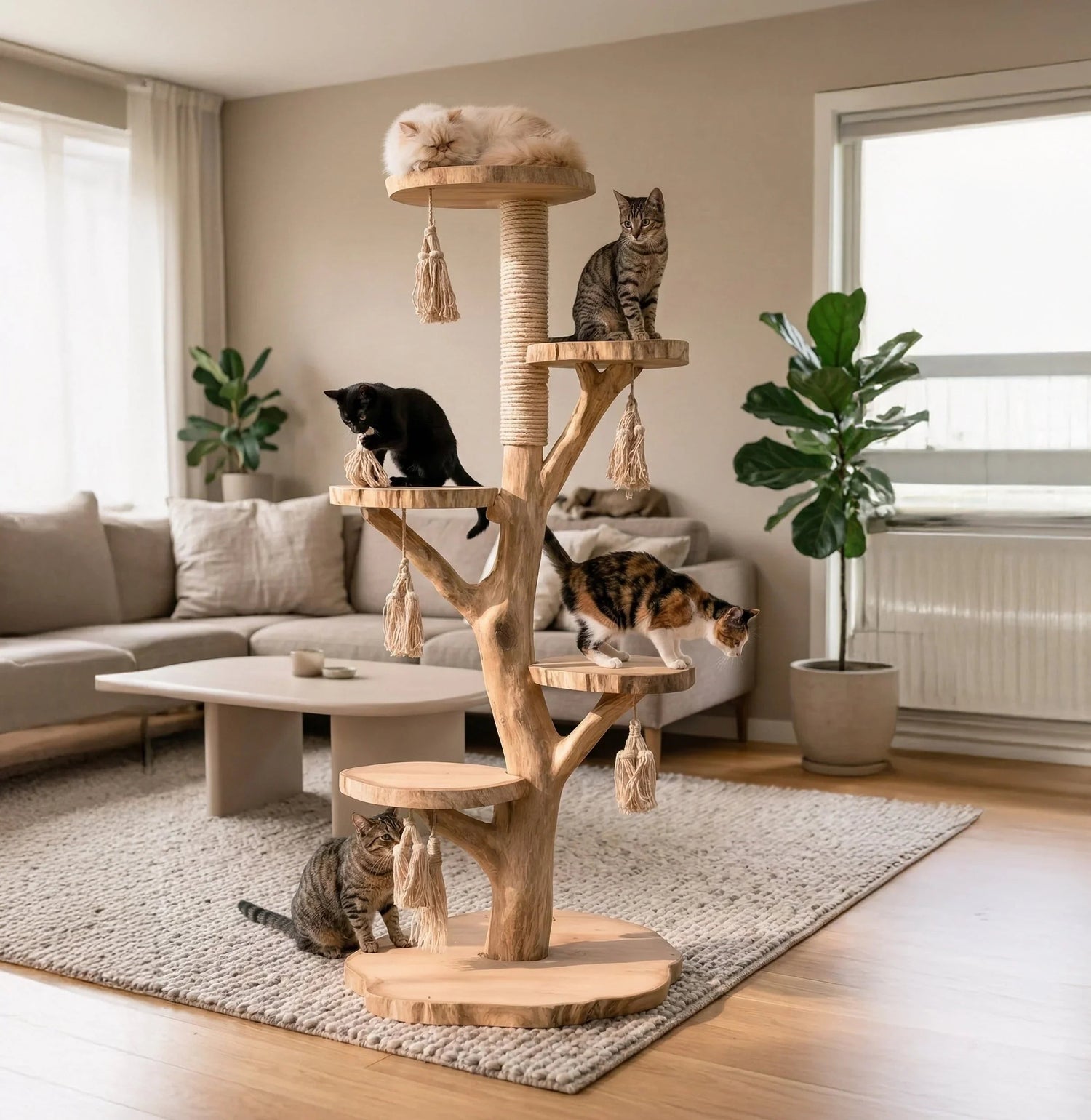
Choosing between a wood cat tree and a carpet cat tree comes down to five factors: durability, cleaning, aesthetics, safety, and cost. Both styles give cats the vertical territory they crave, but they age very differently. A carpet cat tree looks great on day one and deteriorates from there. A wooden cat tree looks better with age - and lasts years longer.
This guide gives you an honest side-by-side comparison. No sugarcoating either option. If a carpet tree makes more sense for your situation, we'll say so. But if you want the full picture on modern cat tree options and premium cat furniture, read on.
The Quick Comparison: Wood vs. Carpet Cat Trees
Before diving into details, here's the high-level breakdown. This table captures the core differences that most cat owners care about when choosing between wood and carpet-wrapped cat trees.
| Factor | Wood Cat Tree | Carpet Cat Tree |
|---|---|---|
| Lifespan | 10-20+ years | 2-5 years |
| Cleaning | Wipe with damp cloth | Vacuum + spot clean (stains persist) |
| Odor Resistance | Non-porous - doesn't absorb odors | Absorbs odors over time |
| Aesthetics | Furniture-grade, blends with décor | Looks like cat furniture (beige/brown carpet) |
| Stability | Heavy and solid - rarely tips | Lighter - can wobble or tip with large cats |
| Scratching Surface | Sisal wrapping or natural bark (replaceable) | Carpet itself (shreds and frays) |
| Allergen Buildup | Minimal - smooth surfaces | High - traps dander, dust, fur in fibers |
| Cost (upfront) | $150-$600+ | $50-$200 |
| Cost (5-year) | $150-$600 (one purchase) | $100-$400 (1-2 replacements) |
| Environmental Impact | Sustainable (solid wood, long-lasting) | Synthetic carpet + particleboard = landfill |
Durability: Why Wood Lasts and Carpet Doesn't
Durability is where wood cat trees pull ahead decisively. Solid wood doesn't fray, unravel, or lose structural integrity from daily cat use. Carpet does - it's designed for floors, not for being scratched, climbed, and gnawed by animals with retractable claws.
Wood cat trees made from solid hardwood - walnut, oak, maple, or similar species - handle decades of climbing, jumping, and scratching without structural degradation. Scratching posts on wood trees are typically wrapped in sisal rope, which is replaceable when it wears out. The tree itself stays intact.
Carpet cat trees use particleboard or MDF cores wrapped in short-pile carpet or faux fur. The carpet is stapled on, and cats shred it through normal scratching behavior. Within 6-12 months, you'll see exposed staples, hanging carpet threads, and bald spots. The particleboard underneath isn't designed for exposure - it absorbs moisture and weakens.
A $300 wood cat tree used for 15 years costs $20 per year. A $100 carpet tree replaced every 3 years costs $33 per year - plus the hassle and waste of disposal.


Cleaning and Hygiene: Not Even Close
Cleaning is the single biggest daily-life difference between wood and carpet cat trees. If you've ever tried to clean a carpet cat tree thoroughly, you know the frustration. Wood surfaces change the equation entirely.
Wood surfaces clean with a damp cloth and mild soap. Cat hair doesn't embed in smooth wood - it sits on top and wipes off in seconds. Vomit, food spills, and accidents wipe clean without staining. Sanitizing takes one pass with a pet-safe disinfectant spray.
Carpet surfaces trap cat hair, dander, skin oils, and dried saliva in the fibers. Vacuuming removes surface debris but not embedded contaminants. Steam cleaning helps but can damage the particleboard core if moisture penetrates. Over time, carpet cat trees develop a persistent odor that no amount of cleaning fully eliminates - the fibers absorb and hold it.
For households with allergies: Wood cat trees are significantly better. Carpet fibers are one of the top allergen reservoirs in homes. A carpet cat tree in a bedroom can noticeably worsen cat allergy symptoms compared to a wood or smooth-surface alternative.
Aesthetics: Cat Furniture That Looks Like Furniture
This is where personal taste enters, but the trend is clear: modern homes are moving away from the beige-carpet-tower look. A wood cat tree integrates into your living space as furniture. A carpet cat tree announces itself as a pet product.
Wood cat trees come in styles ranging from sleek mid-century modern to organic natural-form designs. They match hardwood floors, complement wooden furniture, and don't clash with your sofa. You don't have to hide them when guests come over - they look like they belong.
Carpet cat trees are almost exclusively available in beige, brown, or gray. The carpet texture and color have no design equivalent in modern interiors. They dominate the room visually and rarely match anything else in the space. Some people solve this by putting the cat tree in a spare room - which defeats the purpose since cats want to be where people are. We cover this in more detail in our best cat trees for large cats guide.

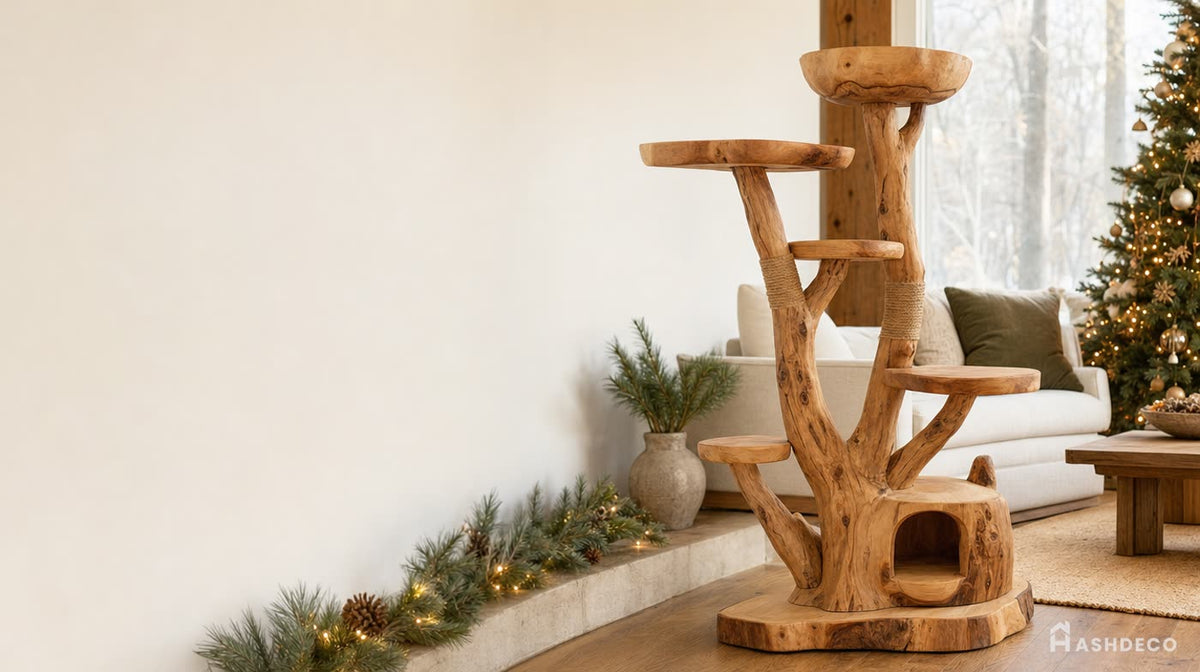
Ashdeco's handcrafted wooden cat trees take aesthetics a step further - Vietnamese artisans shape solid wood into natural tree forms that function as cat furniture and sculptural art simultaneously. Each piece follows the wood's organic grain, so no two trees look alike.
Don't miss
These pieces qualify for 10% off orders over $2,000. Applied automatically at checkout.
10% off
Sculptural Spiral Solid Wood Cat Tree Tiered Modern Feline Lounger
From $2,217.00
10% off at checkout
10% off
Artisanal Solid Wood Sculptural Tree Cat Tower & Multi-Tier Botanical Display Perch Stand
From $2,076.00
10% off at checkout
 10% off
Sculptural Hand-Carved Tree Solid Wood Wall-Mounted Cat Climbing Tower with Dual House Condos & Display Shelves
$3,012.00
10% off at checkout
10% off
Sculptural Hand-Carved Tree Solid Wood Wall-Mounted Cat Climbing Tower with Dual House Condos & Display Shelves
$3,012.00
10% off at checkout
 10% off
Sculptural Hand-Carved Tree Solid Wood Cat Tower & Multi-Tier Luxury Feline Climbing Tree with Tunnel Condo Base
From $2,654.00
10% off at checkout
10% off
Sculptural Hand-Carved Tree Solid Wood Cat Tower & Multi-Tier Luxury Feline Climbing Tree with Tunnel Condo Base
From $2,654.00
10% off at checkout
Safety: What's Actually Safer for Your Cat
Both wood and carpet cat trees are generally safe, but they fail differently - and those failure modes matter for cat safety. Understanding the risks of each helps you make a more informed choice for your household.
Stability
Wood cat trees are heavier, which makes them inherently more stable. A solid wood tree weighing 30-50 pounds stays planted when a 15-pound cat launches off the top platform. Carpet-covered particleboard trees often weigh 15-25 pounds - light enough that a large cat's momentum can tip them, especially on hard floors.
Exposed Hardware
Carpet trees use staples to attach carpet to the core. As cats scratch and pull at the carpet, staples become exposed - these are sharp enough to cut paw pads or snag claws. Wood trees with sisal-wrapped posts use tightly wound rope secured at the ends only, with no exposed fasteners along the scratching surface.
Chemical Off-Gassing
Particleboard and MDF used in carpet cat trees contain formaldehyde-based adhesives that off-gas, particularly when new. Cats spend hours sleeping on these surfaces with their faces pressed against the material. Solid wood doesn't have this issue - there's no adhesive binding layers of compressed fiber together.
Claw Safety
Carpet loops can catch and trap claws, especially long claws or dew claws. Cats panic when their claws get stuck, which can lead to torn claws or falls from height. Wood platforms with sisal rope posts avoid this - claws slide cleanly in and out of sisal fibers without snagging.
Cost: The Real Math
The sticker price favors carpet cat trees. The total cost of ownership favors wood. Here's the math that changes most people's perspective on the "expensive" wood cat tree.
Carpet cat tree: Average price $100. Average lifespan: 3 years (generous - many look terrible after 18 months). Over 15 years: you'll buy 5 trees = $500. Plus the time and environmental cost of disposing each worn-out unit.
Wood cat tree: Average price $200-$400 for quality construction. Average lifespan: 15+ years. Over 15 years: you'll buy 1 tree = $200-$400. Potentially replace sisal rope once or twice at $15-$30 per replacement. Total: $230-$460.
The 15-year cost is roughly equivalent - sometimes the wood tree wins outright. And during those 15 years, the wood tree looks better, cleans easier, and doesn't accumulate allergens.

For the premium tier, Ashdeco's handcrafted solid wood cat trees range from $200-$600+. These are built by skilled artisans from solid hardwood and designed to last a cat's lifetime. The per-year cost over a 20-year lifespan drops to $10-$30 - less than annual flea medication.
When a Carpet Cat Tree Actually Makes Sense
Being honest: carpet cat trees aren't universally bad. There are specific situations where they're the more practical choice. If any of these describe you, a carpet tree might be the right call.
Temporary housing: If you're in a short-term rental or moving within a year, investing in a premium wood cat tree that might get damaged in transit doesn't make sense. A $75 carpet tree does the job.
Kittens: Kittens are chaotic. They chew, scratch excessively, and treat everything as a toy. Some owners prefer to buy an inexpensive carpet tree for the kitten phase and upgrade to wood once the cat matures and calms down (around 2-3 years old).
Tight budget, right now: If $50-$80 is your current budget and the alternative is no cat tree at all, a carpet tree is infinitely better than nothing. Vertical territory is essential for cats' mental health. Get what you can afford now and upgrade when finances allow.
What Makes a Good Wood Cat Tree
Not all wood cat trees are equal. "Wood" on a product listing might mean solid hardwood, pine plywood, bamboo laminate, or even particleboard with a wood-print vinyl wrap. Here's what to look for when shopping for a genuine wooden cat tree.
Solid hardwood construction: The platforms, posts, and base should be real hardwood - not plywood or MDF with wood veneer. Check the product description for species names: walnut, oak, maple, ash, acacia, or mango wood. If it just says "wood" with no species, it's probably not solid hardwood.
Secure joinery: Look for bolt-through construction or mortise-and-tenon joints rather than glue-only assembly. Good joinery is what keeps a cat tree stable after thousands of jumps.
Replaceable scratching components: Sisal rope wears out - that's normal and expected. A well-designed wood cat tree lets you re-wrap the posts without disassembling the entire unit. Stapled-on sisal is fine; glued-on sisal means you're replacing the whole post.
Weight: Heavier is better for stability. A quality wood cat tree for a single adult cat should weigh at least 25 pounds. Multi-cat towers should exceed 35-40 pounds. If a "wood" cat tree weighs the same as a carpet one, it's not solid wood. For a deeper dive, see our article on cat tree towers — workshop walkthrough.
Ashdeco's cat tree towers check every box - handcrafted from solid wood by Vietnamese artisans, each piece is shaped from real timber with natural curves and textures. They're heavy, stable, and built with joinery that handles aggressive cat use for years.
Frequently Asked Questions
Do cats actually prefer wood or carpet cat trees?
Cats primarily care about height, stability, and scratching texture - not the material of the platforms. Most cats adapt to either surface within a day or two. However, cats tend to avoid carpet trees once they develop bald spots and exposed staples. Wood trees maintain consistent texture throughout their lifespan, so cats use them more consistently long-term. Adding a removable fleece pad to a wood platform gives cats a soft sleeping surface with the option to wash it.
Is a wood cat tree worth it for one cat?
Yes. A single cat still scratches, climbs, and sheds enough to wear out a carpet tree in 2-3 years. The durability and cleaning advantages of wood apply regardless of how many cats you have. For one cat, a smaller wood cat tree in the $150-$250 range lasts 15+ years - making it one of the best per-year-cost investments in cat furniture you can make.
How do I add soft surfaces to a wood cat tree?
Use removable cushions, fleece pads, or washable hammock attachments on sleeping platforms. These give your cat soft napping spots while keeping the wood tree's cleaning advantage - pull off the pad, toss it in the washing machine, and replace. This is better than built-in carpet because you can wash it regularly instead of watching it absorb odors for years.
Are wood cat trees safe for kittens?
Yes, with one consideration: ensure platforms have a slight lip or raised edge to prevent kittens from rolling off during sleep. Kittens are less coordinated than adults, so a 0.5-inch edge acts as a safety rail. The wood surface itself is safe - no staple hazards, no loose carpet threads to chew and ingest. Start with a shorter tree (3-4 feet) and upgrade to taller models as the kitten grows.
Can I just replace the carpet on my old cat tree instead of buying a new one?
Yes, if the particleboard core underneath is still structurally sound. You can buy replacement carpet or sisal rope online and re-wrap the posts and platforms yourself with a staple gun and contact adhesive. This works as a budget fix, but it only solves the surface problem — if the particleboard itself has swollen, cracked, or developed mold from years of moisture exposure, re-carpeting won't fix the underlying instability. At that point, a solid wood replacement becomes the better long-term investment.
Can I build a wood cat tree myself?
If you have basic woodworking tools (miter saw, drill, orbital sander), yes. Use untreated hardwood or softwood like pine for the structure and wrap posts in sisal rope. Apply a pet-safe finish (tung oil, Danish oil, or food-grade mineral oil). Budget $80-$200 in materials depending on size. For a more refined result without the workshop time, handcrafted options from makers like Ashdeco deliver artisan-quality construction that's difficult to replicate in a home shop.