



















Quick view
- The Kitchen Environment: What Your Shelves Actually Face
- Solid Wood Floating Shelves: The Complete Kitchen Performance
- MDF Floating Shelves: The 18-Month Kitchen Problem
- Metal Floating Shelves: Strong But Cold
- Glass Floating Shelves: Beautiful and Vulnerable
- Kitchen Shelf Material Comparison Table
- Maintenance Schedules by Material
- FAQ
Shop this guide
Handcrafted Floating Shelves, made to order in solid wood.
 Sculptural Overlapping Circular Solid Wood Wall Shelf with Multi Tier Display
From $1,354.00
Sculptural Overlapping Circular Solid Wood Wall Shelf with Multi Tier Display
From $1,354.00
 Mountain Landscape Relief Solid Wood Floating Shelf Live Edge Display Ledge
From $1,154.00
Mountain Landscape Relief Solid Wood Floating Shelf Live Edge Display Ledge
From $1,154.00
 Enchanted Forest Circular Wall Shelf - Round Carved Timber Mushroom Portal
From $1,023.00
Enchanted Forest Circular Wall Shelf - Round Carved Timber Mushroom Portal
From $1,023.00
 Cottagecore Arched Wood Wall Niche - Hand-Carved Fairy Mushroom Alcove Shelf
From $1,356.00
Cottagecore Arched Wood Wall Niche - Hand-Carved Fairy Mushroom Alcove Shelf
From $1,356.00
 Sculptural Hand-Carved Mushroom Solid Wood Corner Floating Shelf & Biomorphic Wall Display Ledge
From $345.00
Sculptural Hand-Carved Mushroom Solid Wood Corner Floating Shelf & Biomorphic Wall Display Ledge
From $345.00
 Sculptural Hand-Carved Mushroom Solid Wood Floating Shelves & Biomorphic Wall Display Ledges
From $345.00
Sculptural Hand-Carved Mushroom Solid Wood Floating Shelves & Biomorphic Wall Display Ledges
From $345.00
Floating shelves in a kitchen face conditions that no other room inflicts - daily steam from cooking, airborne grease that coats every surface, temperature swings from stovetop heat, and the sustained load of heavy ceramic dishes and cast iron. Most shelf material guides ignore these conditions entirely. This one doesn't. Below is a material-by-material breakdown comparing kitchen floating shelves in solid wood, MDF, metal, and glass under the conditions that actually matter.

We've been building floating shelves for kitchens for years, and we've heard the full range of customer feedback - what holds up, what doesn't, and what falls apart after 18 months. Here's the data.
The Kitchen Environment: What Your Shelves Actually Face
Before comparing materials, understand the specific stresses a kitchen imposes. These aren't theoretical - they're measured conditions from typical home kitchens, based on ASHRAE residential environment data.
Steam and humidity: Stovetop cooking produces steam that raises local humidity to 70-85% within 3 feet of the stove. A pot of boiling pasta generates approximately 1 quart of water vapor in 20 minutes. Shelves within 4 feet of a stove experience daily humidity cycling from ambient (40-55%) to elevated (65-85%) and back.
Airborne grease: Frying produces micro-droplets of oil that travel 4-6 feet from the pan. Over 30 days of regular cooking, shelves within this range accumulate a detectable film of grease that attracts dust and discolors porous surfaces.
Heat: The air temperature 18 inches above a gas burner reaches 150-200°F during active cooking. Electric stoves produce less ambient heat but still generate 120-160°F in the immediate area. Shelves mounted too close face material stress from repeated thermal cycling.
Weight load: A set of four dinner plates weighs approximately 8 lbs. A stack of six cereal bowls weighs 6-7 lbs. A full set of mugs (6 mugs on hooks or stacked) weighs 5-6 lbs. Spice jars in a row (12 standard jars) weigh about 4 lbs. Kitchen shelves routinely carry 15-30 lbs per shelf.
Solid Wood Floating Shelves: The Complete Kitchen Performance
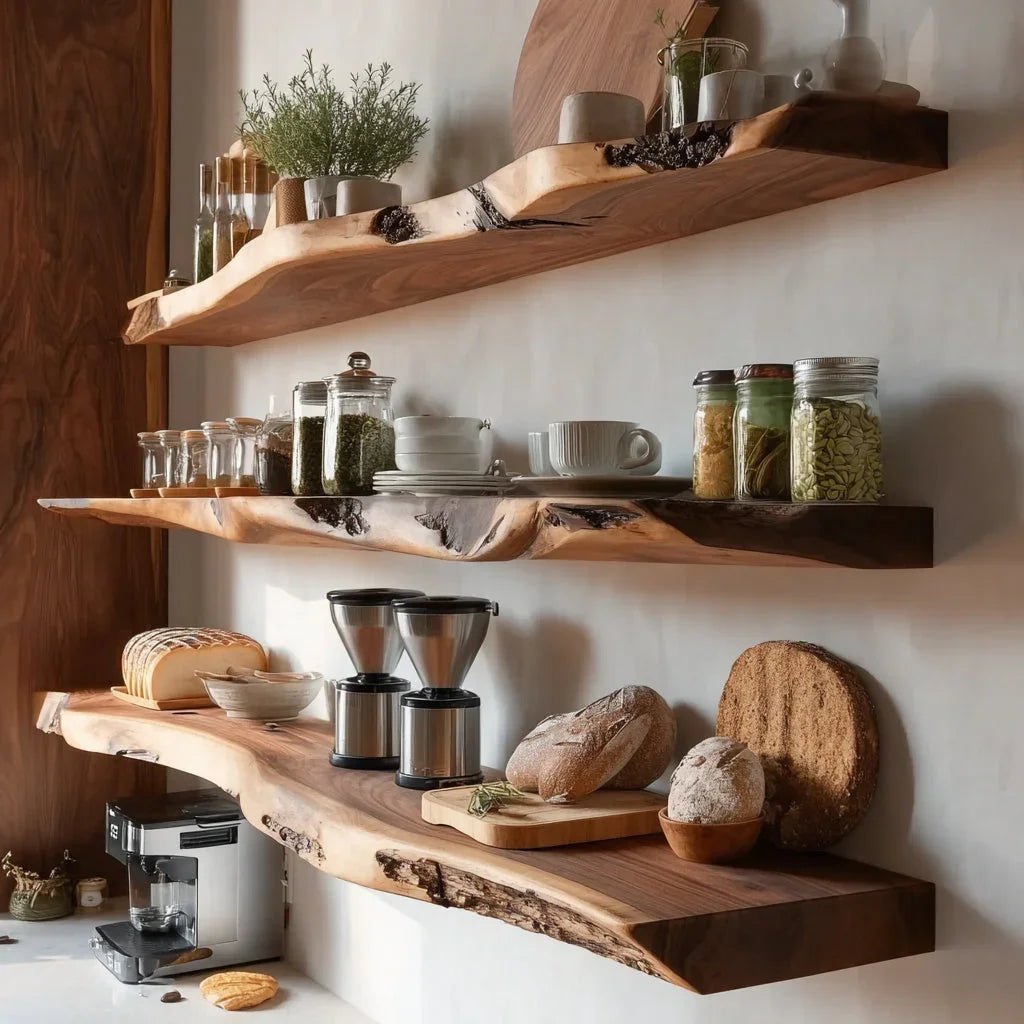
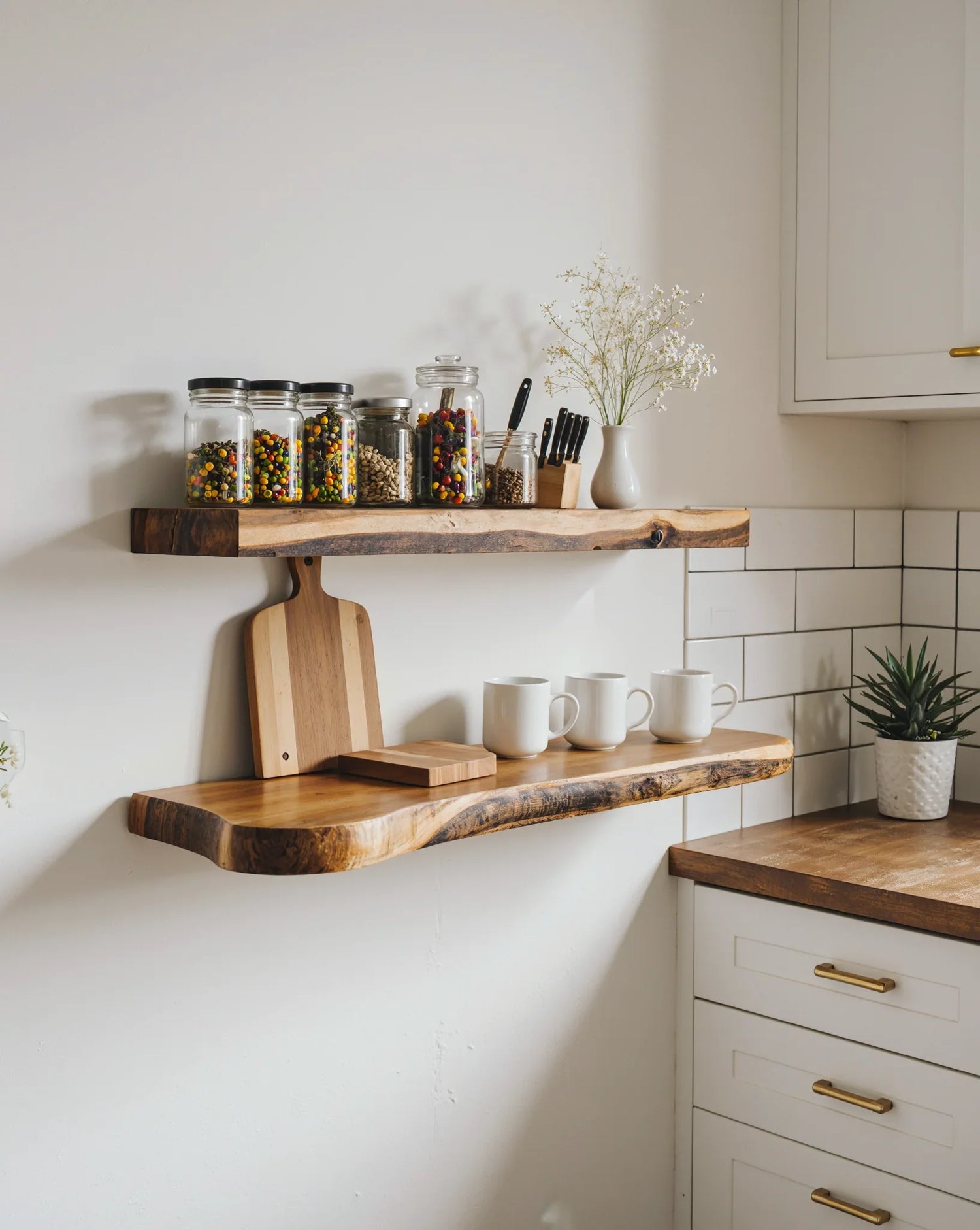
Solid wood kitchen floating shelves made from dense hardwoods perform well in kitchen conditions when properly sealed and maintained. The wood type matters enormously - teak, walnut, and white oak are top performers, while pine and poplar struggle. We've written a full breakdown in our open kitchen shelving review post.
Steam and moisture resistance: Unsealed wood absorbs moisture and warps. Sealed wood (polyurethane, lacquer, or tung oil finish) resists moisture penetration for 2-5 years between reapplications. Teak contains natural oils (silica content of 1.4%) that provide inherent water resistance even with minimal finish. Walnut and white oak perform well with a quality sealant. Pine absorbs moisture 3x faster than teak and is not recommended near stoves.
Grease resistance: Sealed solid wood resists grease staining. Oil-finished wood is more vulnerable - grease darkens the surface within weeks if not wiped promptly. Solution: use a polyurethane or lacquer topcoat over oil finishes in kitchen applications. Wipe shelves weekly with a damp cloth and mild dish soap.
Heat tolerance: Solid wood handles temperatures up to 200°F without damage. It won't warp, melt, or discolor from cooking heat at standard shelf distances (18+ inches above counter). Wood's thermal expansion rate is negligible at kitchen temperatures - a 24-inch shelf expands less than 0.01 inches from ambient to 180°F. For a deeper dive, see our article on kitchen shelf spacing guide.
Weight capacity: A 24-inch solid wood floating shelf (1.5 inches thick, mounted with a French cleat into studs) holds 35-50 lbs. A 36-inch shelf of the same thickness holds 25-40 lbs (longer span = more flex). This handles any reasonable kitchen load.
Lifespan in kitchen conditions: 15-30+ years with proper maintenance. Scratches and water rings can be sanded and refinished - the only material on this list that allows repair rather than replacement.

Browse our floating shelves collection - all solid wood, all hand-crafted for kitchen-ready durability.


MDF Floating Shelves: The 18-Month Kitchen Problem
MDF (medium-density fiberboard) is the most common material for budget floating shelves. In a living room, it works fine. In a kitchen, it has a predictable failure timeline.
Steam and moisture resistance: MDF absorbs moisture through any unsealed edge, cut, or nick in the surface coating. Once moisture enters, the compressed wood fibers swell irreversibly. A 24-inch MDF shelf exposed to kitchen steam without edge sealing visibly warps within 6-12 months. Edge swelling of 1/8 to 1/4 inch is typical in the first year near a stove.
Grease resistance: The laminate or paint surface on MDF resists grease initially. However, as moisture causes the laminate to lift at edges and corners (the most common MDF failure mode), grease penetrates the exposed fiberboard beneath. Grease-stained MDF cannot be cleaned - the stain is permanent.
Heat tolerance: MDF adhesives weaken above 160°F. Sustained heat (direct sunlight through a window or proximity to an oven) can cause delamination of the surface coating. Not a concern for shelves far from the stove, but a serious issue for shelves above or beside cooking areas.
Weight capacity: A 24-inch MDF shelf holds 20-30 lbs when new. As moisture weakens the core over 12-18 months, capacity drops. Screw-holding strength in MDF is 40-60% lower than solid wood, so the mounting hardware is the failure point - screws pull through swollen MDF long before the bracket fails.
Lifespan in kitchen conditions: 2-4 years before visible damage (swelling, delamination, discoloration). Cannot be refinished - replacement is the only fix.
Metal Floating Shelves: Strong But Cold
Steel or iron floating shelves offer excellent strength-to-weight ratios and complete moisture immunity, but they introduce other kitchen-specific problems.
Steam and moisture resistance: Powder-coated or stainless steel shelves are impervious to moisture. Stainless steel is the standard in commercial kitchens for exactly this reason. Bare iron or carbon steel shelves will rust within weeks in a kitchen - powder coating is mandatory.
Grease resistance: Excellent. Metal surfaces clean to like-new with any degreaser. No absorption, no staining, no long-term damage.
Heat tolerance: Metal handles kitchen heat without any concern. However, metal conducts heat - a shelf near a stove will be noticeably warm to the touch and will transfer heat to items stored on it. Not ideal for heat-sensitive items like spices (heat degrades spice potency - according to McCormick's storage guidelines, spices should be stored below 70°F).
Weight capacity: 24-inch steel shelves hold 40-60 lbs depending on bracket style and wall mounting. Superior to wood for heavy-duty storage.
Lifespan in kitchen conditions: 10-20+ years for powder-coated steel; indefinite for stainless steel. Cannot be refinished in the traditional sense, but powder coating can be reapplied professionally.
The downside: Metal shelves feel industrial. They're loud when you set dishes down (clanking), cold to the touch, and visually harsh in warm kitchen designs. They lack the acoustic and thermal damping that wood provides.
Don't miss
These pieces qualify for 10% off orders over $2,000. Applied automatically at checkout.
Glass Floating Shelves: Beautiful and Vulnerable
Tempered glass shelves offer visual lightness and a modern aesthetic. In kitchens, they present unique challenges.
Steam and moisture resistance: Glass itself is moisture-proof. However, glass shows every water spot, steam residue, and fingerprint instantly. In a kitchen, this means daily cleaning to maintain clarity. After cooking, a steam haze forms on glass surfaces within minutes.
Grease resistance: Grease wipes off glass easily, but grease is also the most visible on glass - every splatter shows at every angle. Practically, glass shelves within 4 feet of a stove require cleaning after every cooking session.
Weight capacity: A 24-inch tempered glass shelf (3/8-inch thick) holds 20-30 lbs. This is adequate for lighter items (glasses, spice jars) but insufficient for heavy stoneware or cast iron. Glass has zero flex - loads beyond capacity result in catastrophic shattering rather than gradual bowing.
Lifespan: Indefinite if not impacted. But kitchen environments are high-impact - setting down a heavy mug, stacking plates, bumping with a pan handle. One thermal shock (placing a hot pan on a cold glass shelf) can cause cracking.
Kitchen Shelf Material Comparison Table
| Factor | Solid Wood (Sealed) | MDF | Metal (Powder-Coated) | Tempered Glass |
|---|---|---|---|---|
| Steam resistance | Good (with finish) | Poor | Excellent | Excellent |
| Grease resistance | Good (sealed) | Fair (short-term) | Excellent | Excellent (shows marks) |
| Heat tolerance | Up to 200°F | Up to 160°F | Unlimited | Moderate (thermal shock risk) |
| Weight capacity (24") | 35-50 lbs | 20-30 lbs | 40-60 lbs | 20-30 lbs |
| Maintenance frequency | Monthly wipe, annual reseal | Unrepairable damage | Monthly wipe | Daily wipe |
| Refinishable | Yes | No | Recoatable | No |
| Lifespan in kitchen | 15-30 years | 2-4 years | 10-20 years | Indefinite (if unbroken) |
| Aesthetic warmth | High | Medium | Low | Low |
| Cost (24" shelf) | $40-$120 | $15-$40 | $30-$80 | $25-$60 |
Maintenance Schedules by Material
Solid wood (weekly): Wipe with a damp microfiber cloth and mild dish soap. Dry immediately. Monthly: Check for grease buildup along edges and wipe with diluted white vinegar. Annually: Reapply finish coat - tung oil for a natural look, wipe-on polyurethane for maximum protection. Every 3-5 years: Light sanding (220 grit) and full refinish if needed.
MDF (weekly): Wipe with a dry or barely damp cloth. Avoid excess moisture. Monthly: Inspect edges for swelling. Annually: Check for soft spots indicating internal moisture damage. If found, replacement is the only option.
Metal (monthly): Wipe with a damp cloth and mild soap. Check for powder coating chips - touch up with matching spray paint to prevent rust progression. Annually: Full cleaning with a metal-appropriate cleaner.
Glass (after every use): Wipe with glass cleaner and a lint-free cloth. Weekly: Deep clean mounting hardware and brackets.

For kitchens specifically, explore our corner floating shelves - they maximize dead corner space that every kitchen has.
FAQ
What's the best material for kitchen floating shelves? Sealed solid hardwood (walnut, teak, or white oak) offers the best overall performance - strong weight capacity, grease resistance when sealed, refinishable, and visually warm. Metal is a close second for raw durability but lacks warmth. MDF should be avoided near stoves or sinks; glass requires daily cleaning.
How much weight can a kitchen floating shelf hold? A 24-inch solid wood shelf mounted into studs holds 35-50 lbs - enough for a full set of dinner plates (8 lbs), a stack of bowls (7 lbs), and a row of mugs (6 lbs) with capacity to spare. Always mount into studs, not drywall alone, for kitchen shelves carrying dishes. Our how to mount floating shelves article walks through the specifics.
Do floating shelves work near a stove? Yes, but maintain at least 18 inches of clearance above the countertop and position shelves 24+ inches from the nearest burner horizontally. Avoid MDF and glass within 3 feet of the stove. Solid wood and metal are the safest choices near heat and steam.
How do I protect wooden kitchen shelves from grease? Apply a polyurethane or lacquer topcoat - not just oil. Oil finishes absorb grease over time, while film-forming finishes (poly, lacquer) create a barrier that wipes clean. Reapply annually. Weekly wiping with dish soap removes grease before it has time to build up.
How often do kitchen floating shelves need refinishing? Solid wood with a polyurethane finish needs refinishing every 3-5 years in kitchen conditions. Oil finishes need annual reapplication. In lower-humidity kitchens with range hoods that vent outside, finishes last toward the upper end of these ranges. No other shelf material offers the option to refinish - MDF, metal, and glass are replace-only.