Brick Fireplace Mantel: Choosing, Sizing & Installing a Wood Mantel on Brick
A brick fireplace mantel is its own category of problem. Brick doesn't behave like drywall or a stud wall - the face is dense, the mortar joints are weaker than the brick itself, and the surface is rarely perfectly flat. Get the mantel for brick fireplace wrong and you either drill into crumbling mortar, or you hang a wood beam that fights the brick instead of complementing it.

The good news: brick fireplace with wood mantel is one of the most reliable combinations in home design. Warm wood against dense, textured brick is a pairing that has worked for a century, and it's one of the few "trends" that never actually goes out of style. The install is also more predictable than people assume, once you know what brick actually needs.
As a handmade furniture brand that ships solid wood mantels onto brick fireplaces every week, here's what we tell customers before they pick up a drill.
- Quick answer: what works on a brick fireplace
- Why brick fireplaces are different
- Choosing a mantel for a brick fireplace
- Sizing a mantel for brick fireplace
- How to install a mantel on a brick fireplace
- Weight: what a brick-mounted mantel can hold
- Common mistakes on brick fireplace mantels
- Ashdeco mantels for brick fireplaces
- FAQ
- Related guides
Quick Answer: What Works on a Brick Fireplace
- Best mantel material for brick: Solid wood (walnut, oak, teak, acacia) - it's the classic pairing and the one that photographs and ages the best.
- Best mounting method: Hidden steel rods epoxied into drilled brick, or a ledger/cleat method for surround-style mantels.
- Drill into brick, not mortar, whenever possible. Brick is denser and holds fasteners better long-term.
- Standard depth: 7-8" works on most brick fireplaces without pushing clearance requirements too high.
- Standard width: Firebox width + 6" minimum overhang on each side (see the fireplace mantel size guide).
If you take one thing from this article: brick is a good wall for a mantel, but only if you fasten into the brick face itself, not the mortar joints between them.
Why Brick Fireplaces Are Different From Drywall or Stud Walls
Most fireplace mantel content assumes a stud wall. Brick changes three things:
- No studs to find. You're not hunting for structure behind a surface - the brick itself is the structure, assuming it's solid masonry and not a thin veneer over something else.
- Mortar vs. brick face matters. Mortar joints are easier to drill but weaker, especially on older or exterior-facing chimney breasts that have gone through freeze-thaw cycles. Brick is denser and holds anchors better.
- The surface is rarely flat. Old brick has variation from face to face. A rigid mantel back can rock unless you shim it.
None of this makes brick a bad wall for a mantel - it's actually one of the strongest walls available, once you drill in the right spot.

Choosing a Mantel for a Brick Fireplace
Wood is still the classic pairing
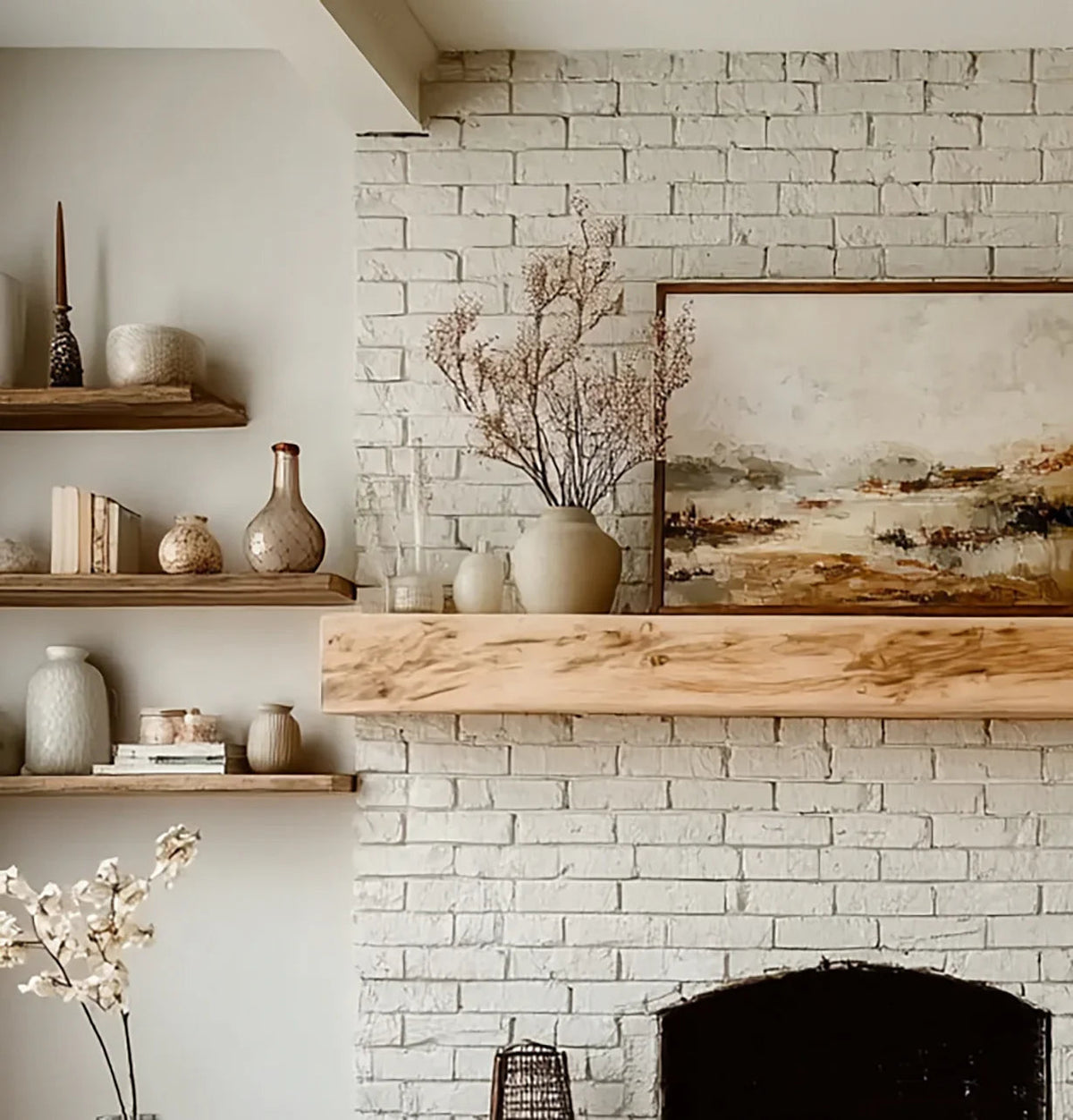
A brick fireplace with wood mantel works because the two materials contrast in exactly the right way: brick is hard, textured, and monochrome; wood adds warmth, grain, and visual softness. This pairing shows up as a recurring theme under two-tone contrast - dark or reddish brick paired with a lighter oak or walnut shelf, or vice versa.
What to avoid: a mantel finish that fights the brick's undertone. Reddish brick clashes with cool gray-washed wood. Warm honey oak or walnut almost always works. If the brick is painted white or a neutral tone, you have more finish flexibility.
Solid wood over hollow "beam-look" mantels
Brick is a heavy, permanent material. A hollow MDF box beam with a brick-print veneer will look thin and temporary against real masonry - the visual mismatch is obvious up close. A solid hardwood mantel like our rustic wooden fireplace mantel or sustainable solid wood fireplace mantel carries enough visual weight to hold its own against brick.
Live edge is also a strong choice here. The organic, uneven edge plays well against brick's irregular texture in a way that a razor-straight modern shelf sometimes doesn't. See live edge mantel shelves if that's the direction you want.
Sizing a Mantel for Brick Fireplace
The sizing math is the same as any fireplace, but brick fireboxes are often set into a larger brick surround, which changes what "centered" looks like.
- Width: minimum firebox width + 6" overhang on each side. On a wide brick surround, you can go wider than the strict minimum so the mantel doesn't look lost against the mass of the brick.
- Depth: 7-8" is the standard that balances styling room with reasonable clearance. Deeper mantels (10"+) work on larger brick fireplaces but need more vertical clearance above the firebox - full breakdown in our fireplace mantel depth guide.
- Height: 54-60" from the floor is standard. Brick fireplaces with a raised hearth may need this adjusted - measure from the floor, not the hearth. Full formula in mantel on fireplace: height, clearance & decor rules.
How to Install a Mantel on a Brick Fireplace
This is the part most guides gloss over. Here's the process we point customers to.
Step 1: Decide brick face vs. mortar joint
Drill into the brick, not the mortar, when you can. Brick is denser and holds anchors better over time. Mortar is easier to drill through but weaker - it's the first thing to fail under freeze-thaw cycling on an exterior-facing chimney breast.
If the brick is old, soft, or spalling, mortar-joint anchors with epoxy-set rod can be the less destructive option. That's a judgment call - if the brick face is crumbling when you test-drill, stop and reassess.
Step 2: Choose your mounting method
Hidden steel rods (floating look). The cleanest, most popular method for a brick fireplace mantel.
- Mark a level line at the bottom of the mantel, and recheck fire clearance above the firebox first.
- Mark rod locations - two rods minimum under 60" width, three on longer mantels. Keep rods in from the ends.
- Hammer-drill into the brick face. Blow out all dust - dust kills epoxy bond strength.
- Dry-fit the rods and confirm they're level with each other. A 1/8" error shows up as a visibly tilted mantel.
- Transfer rod positions to the back of the mantel using a template or a helper holding the beam in place.
- Drill mantel holes slightly oversized for micro-adjustment room.
- Set the rods in the wall with masonry epoxy. Do not load them yet.
- Dry-fit the mantel dry, shimming if the brick face is uneven.
- Add adhesive in the wood holes, slide the mantel onto the rods, and brace it while the epoxy cures fully.
Ledger/cleat method (surrounds and boxed mantels). Screw a hardwood or treated ledger to the brick with masonry screws, inset about 3/4" if the mantel has a finished interior, then sleeve the mantel over the cleat and fasten from the top or unseen back edge. This is the better method for three-sided mantels with legs, not single floating beams.
Step 3: Fastener notes specific to brick
- Use a hammer drill with a carbide masonry bit - a standard drill will not get through brick efficiently.
- Match anchor rating to expected load, with margin. If you want the mantel to hold 100 lbs of decor, don't use anchors individually rated at 40 lbs and assume two of them solves it - a deep mantel with front-loaded weight eats into that rating fast.
- Construction adhesive supplements mechanical fasteners. It is never a substitute for them on a brick install.
Full step-by-step across every wall type (not just brick) is in how to install a fireplace mantel.

Weight: What a Brick-Mounted Mantel Can Hold
A properly executed brick install - two 1/2" rods epoxied 3-4"+ into solid brick - typically supports 80-150 lbs of working load, with weight kept toward the back of the shelf rather than the front edge. That's enough for a real vignette: books, ceramics, a leaning mirror, seasonal decor.
The wall connection is almost never the weak point on a correctly drilled brick install - the epoxy cure time and dust removal during drilling matter more than people expect. Full weight math and real-object comparisons are in how much weight can a fireplace mantel hold.
Common Mistakes on Brick Fireplace Mantels
Drilling only into mortar because it's easier. It's weaker long-term, especially outdoors or on older mortar. Use it only when the brick face itself is unsuitable.
Skipping the dust-out step before epoxy. Masonry dust in the hole kills adhesion. Blow it out, every hole, every time.
Ignoring an uneven brick face. Old brick is rarely perfectly flat. A rigid mantel back will rock unless you shim behind it - color-matched shims or a discreet caulk line after installation solves this invisibly.
Choosing a finish that fights the brick tone. Reddish brick against cool gray-washed wood looks off. Warm oak, walnut, or acacia tones nearly always read better against traditional red or orange-toned brick.
Under-sizing the mantel against a large brick surround. A narrow mantel on a wide brick chimney breast looks like an accessory, not a fixture. Size up if the wall has the room.
Enough visual weight to hold its own against brick
Every Ashdeco mantel is solid hardwood, kiln-dried, at a consistent 8" depth - sized to work with the rod-and-epoxy brick install described above.
Shop Fireplace Shelves → Shop Live Edge Mantels →Ashdeco Mantels for Brick Fireplaces
Every Ashdeco mantel is solid hardwood, kiln-dried, and built at a consistent 8" depth across widths from 30" to 79" - deep enough to hold its visual weight against brick, and sized to work with the standard rod-and-epoxy install described above.
If your brick fireplace currently has a thin builder-grade shelf or no mantel at all, a solid wood replacement is one of the highest-impact upgrades you can make to the room without touching the brick itself.
Shop fireplace shelves and live edge mantel shelves, including the rustic wooden fireplace mantel and floating live edge fireplace mantel shelf - both mount cleanly using the brick method above.
FAQ
What is the best mantel for a brick fireplace?
Solid hardwood - walnut, oak, teak, or acacia - is the classic and most reliable pairing. The contrast between dense, textured brick and warm wood grain is a combination that has held up for decades and still reads as current in 2026's two-tone design trend.
How do you attach a mantel to a brick fireplace?
Hammer-drill into the brick face (not the mortar, when possible), set masonry anchors or epoxy-set steel rods, then slide the mantel onto the rods or fasten it to a masonry-screwed ledger. Let epoxy fully cure before loading any weight.
Should you drill into brick or mortar for a mantel?
Brick, when the brick face allows it. It's denser and holds fasteners better over time. Mortar is easier to drill but weaker, especially on older or weathered joints - use it only as a fallback.
Can you put a wood mantel on a painted brick fireplace?
Yes. Paint doesn't change the mounting method - you still drill through to the brick or mortar underneath. Painted brick also opens up more wood finish options since there's no natural brick tone to clash with.
How wide should a mantel be on a brick fireplace?
Same rule as any fireplace: minimum firebox width plus 6 inches of overhang on each side. On a wide brick surround, sizing up beyond the minimum usually looks more proportional than sticking to the bare minimum width.
Related Guides
- Fireplace Mantel Size Guide - width, depth, and height for 30" to 79" fireboxes
- Fireplace Mantel Depth Guide - the full depth-vs-clearance breakdown
- What's the Best Wood for a Fireplace Mantel? A 7-Species Breakdown - species-by-species comparison with heat resistance
- Affordable Fireplace Mantels: 5 Materials Under $750 That Look Premium - budget options that still look solid against brick
Brick is one of the best walls you can mount a mantel on - once you know to drill the brick itself, dust out the holes, and let the epoxy cure. Get those three things right and the wood-on-brick pairing does the rest of the design work for you.