





Quick view
- Mantle vs Mantel - What's the Difference?
- How High Should a Mantel Be Above a Fireplace?
- Fire Safety Clearance: What You Need to Know Before You Drill
- What to Put Above a Fireplace Mantel - 7 Designer Ideas
- Mounting a TV Above the Fireplace: Spacing & Heat Rules
- 5 Common Mantel Mistakes (and How to Avoid Them)
- How to Choose the Right Mantel for Your Fireplace
- FAQ
- Final Checklist Before You Install
Shop this guide
Handcrafted Fireplace Shelves, made to order in solid wood.
 Christmas edit
Solid Wood Live-Edge Fireplace Mantel Shelf
From $750.00
Christmas edit
Solid Wood Live-Edge Fireplace Mantel Shelf
From $750.00
 Christmas edit
Solid Wood Christmas Live-Edge Fireplace Mantel Shelf
From $750.00
Christmas edit
Solid Wood Christmas Live-Edge Fireplace Mantel Shelf
From $750.00
 Christmas edit
Rustic Wooden Fireplace Mantel – Handcrafted Floating Solid Wood Beam with Live Edge Shelf
From $750.00
Christmas edit
Rustic Wooden Fireplace Mantel – Handcrafted Floating Solid Wood Beam with Live Edge Shelf
From $750.00
 Christmas edit
Sustainable Solid Wood Fireplace Mantel – Floating Shelf & Modern Surround
From $750.00
Christmas edit
Sustainable Solid Wood Fireplace Mantel – Floating Shelf & Modern Surround
From $750.00
Mantel On Fireplace: Exact Height, Clearance & Decor Rules (2026)
If your fireplace is the heart of your home, the mantel on fireplace is its smile - the detail that ties the whole room together. Get it right, and you have a stunning focal point. Get the height wrong, and you risk damaging your decor or even creating a fire hazard.
Whether you're installing a new floating mantel shelf, mounting a TV above the hearth, or just wondering what to put on that bare wall, this guide gives you the exact measurements, safety codes, and styling tips you need. No guesswork.
Mantle vs Mantel - What's the Difference?
Let's clear this up first: "mantle" and "mantel" are the same thing when it comes to fireplaces. "Mantel" is the correct spelling for the shelf above a fireplace. "Mantle" technically refers to a cloak or a geological layer - but thanks to centuries of casual usage, both spellings are now widely accepted in home improvement contexts.
For this article, we'll use "mantel" (the correct term) but you'll find the same information whether you search "mantle above fireplace" or "mantel above fireplace" on Google.

How High Should a Mantel Be Above a Fireplace?
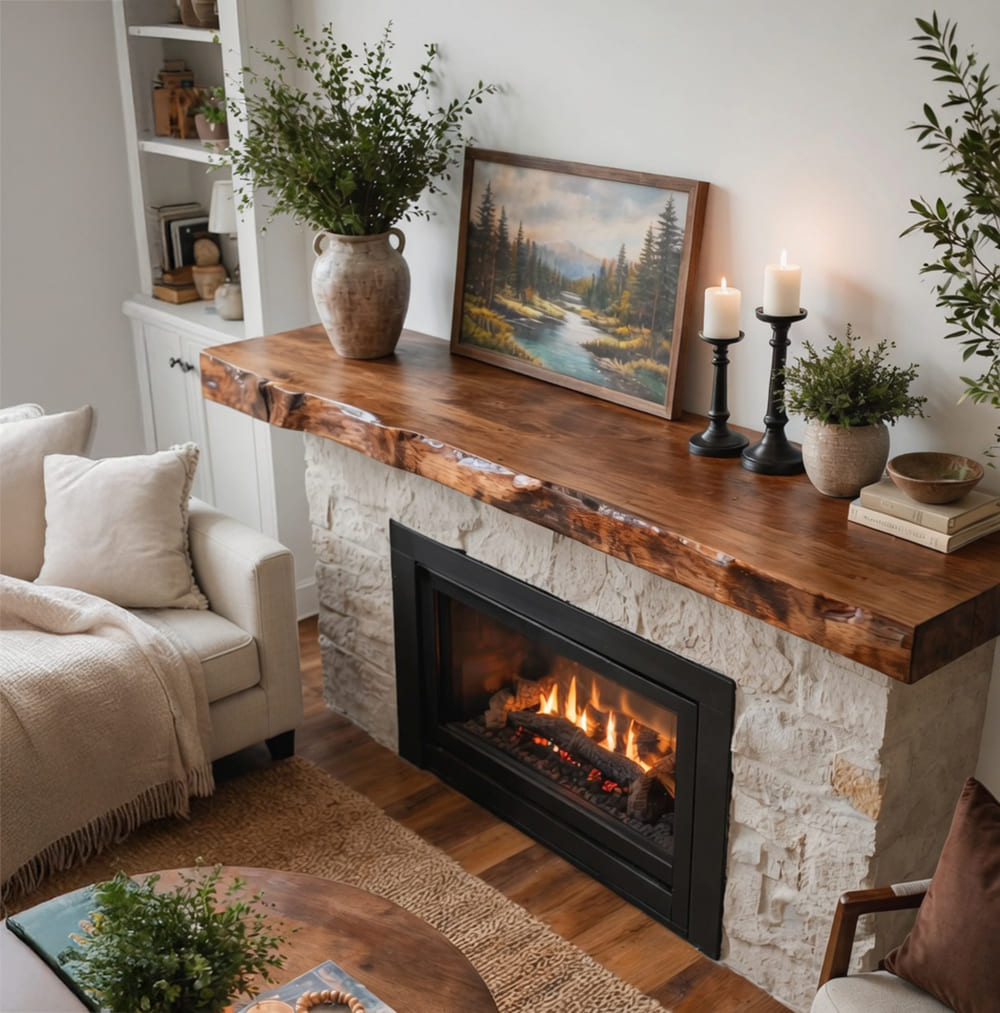
For decades, interior designers and architects have rallied around one magic number: 54 inches from the floor to the bottom of the mantel shelf.
The 54-Inch Golden Rule
Why 54 inches? This height hits three key targets simultaneously:
- Eye level when seated - roughly matches the sightline of someone sitting on a sofa
- Comfortable leaning height - a standing adult can rest an elbow on the shelf naturally
- Artwork alignment - when you hang art above a 54-inch mantel, the center typically lands at the ideal 60-to-66 inch viewing level
The acceptable range falls between 53 and 60 inches, depending on your home's style:
| Home Style | Recommended Mantel Height |
|---|---|
| Traditional / Cozy | 53–55 inches |
| Modern / Contemporary | 56–60 inches |
| Low-profile / Lounge | 50–52 inches (non-combustible only) |
Adjusting for Ceiling Height
One size does not fit all rooms. A mantel that looks commanding in a standard apartment might look dwarfed in a great room with vaulted ceilings:
- 8-foot ceilings: Stick to 54 inches. Going above 58 inches leaves too little breathing room between the mantel decor and the ceiling molding.
- 9-foot ceilings: You can safely push to 58–60 inches. Consider a thicker mantel face (8–10 inches tall) to add visual weight.
- Vaulted or cathedral ceilings: 60–62 inches works well, but scale the mantel thickness proportionally - a thin shelf on a massive wall looks weak.
Pro tip: Before drilling, use painter's tape to outline the mantel position on your wall. Sit on your sofa, stand up, and walk into the room. If it feels like the shelf is "looming" over you, drop it down an inch.



Fire Safety Clearance: What You Need to Know Before You Drill
Design is subjective. Fire safety is not. The National Fire Protection Association (NFPA) 211 Standard, along with local building codes, governs the minimum clearance between a firebox opening and any combustible material above it - including a wooden mantel shelf.
Combustible vs Non-Combustible Materials
Your material choice determines how much clearance you need:
- Combustible materials - Wood, MDF, particleboard, plaster over wood lath. These require strict clearance distances because radiant heat can ignite them over time.
- Non-combustible materials - Solid stone, concrete, metal, steel. These can technically be placed right at the firebox opening (though 6 inches is recommended for aesthetics).
Important: There Is No Single Universal Clearance Formula
Here's something most fireplace articles won't tell you: the exact ratio between mantel depth and required clearance is interpreted inconsistently across sources, code officials, and jurisdictions. We compared several widely-cited references - including the underlying code language and multiple fireplace industry sources - and found meaningfully different ratios, ranging from roughly 1 extra inch of clearance per inch of added depth, up to far stricter interpretations that require significantly more. Even professional fireplace installers debate the precise reading of NFPA 211 on forums.
What is consistently agreed on, across every source we checked:
- Combustible mantels must never sit closer than 6 inches from the firebox opening - this is the one hard floor everyone agrees on.
- 12 inches of clearance is the most commonly cited practical minimum for a standard mantel of typical depth (6–8 inches).
- Deeper mantels need meaningfully more clearance - but the exact number that satisfies your local inspector can vary.
For reference, here's a commonly cited practical guideline used by several fireplace mantel retailers - treat it as a reasonable starting point for planning, not as a code-verified formula:
| Mantel Depth (Projection) | Commonly Cited Clearance Above Firebox |
|---|---|
| 1.5 inches | 6 inches (absolute minimum) |
| 2 inches | 8 inches |
| 4 inches | 10 inches |
| 6 inches (standard) | 12 inches |
| 8 inches | 14 inches |
| 10 inches | 16 inches |
| 12 inches | 18 inches |
Before you finalize any measurement: confirm the exact clearance with your local building department or a licensed fireplace inspector, and check your fireplace manufacturer's documentation if you have a factory-built or gas/electric unit - manufacturer specs override general guidance and vary significantly by model. When in doubt, mount higher than the minimum. You can always fill extra vertical space with decor; you cannot undo a mantel mounted too close to open flame.

What to Put Above a Fireplace Mantel - 7 Designer Ideas
Once your mantel is installed at the right height, the next question is: what goes on (and above) it? Here are seven proven approaches:
1. Oversized Mirror
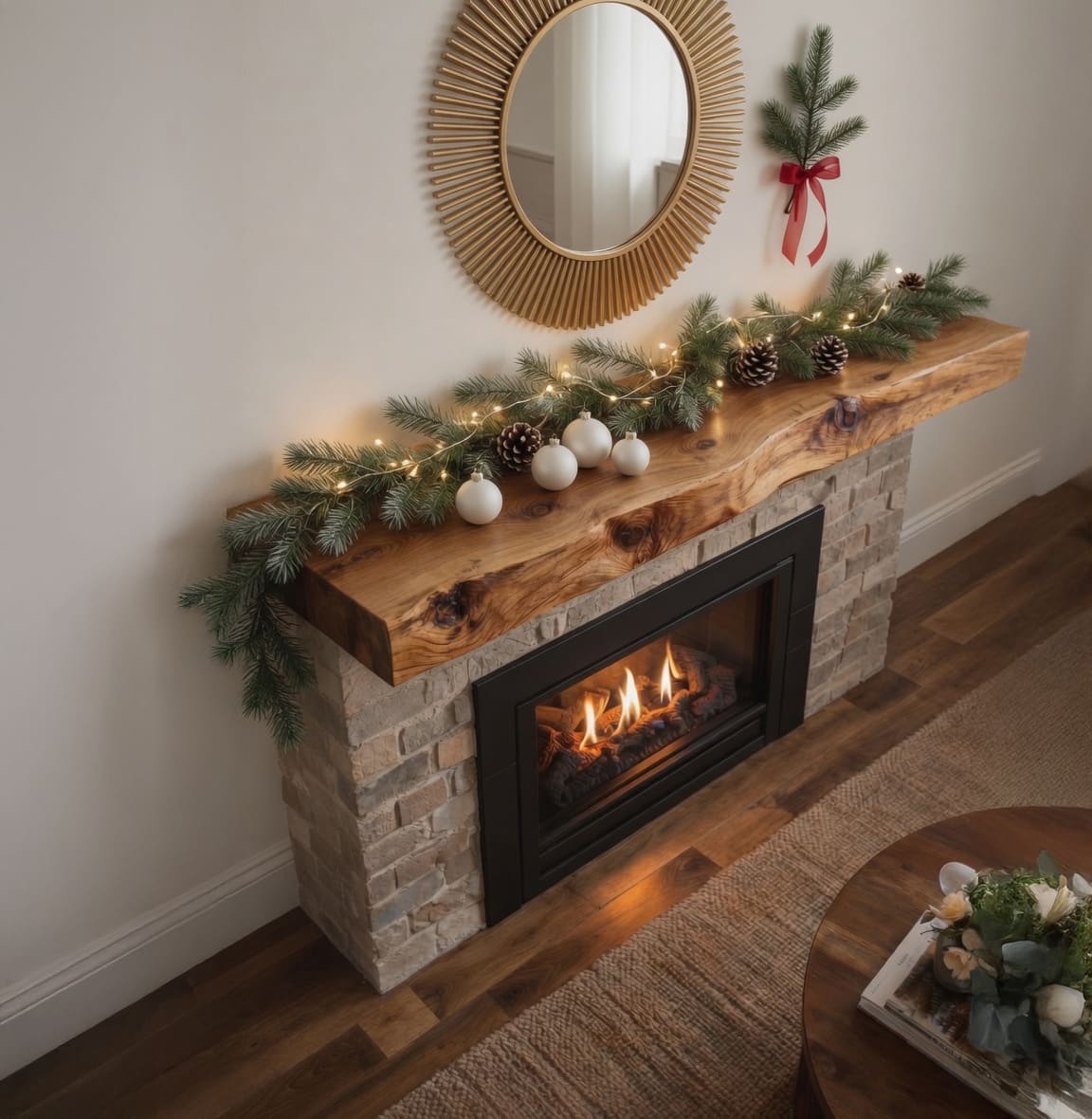
A large mirror above the mantel adds glamour and creates the illusion of more space. Choose an ornate frame for traditional elegance or a minimal circular frame for a contemporary look.

2. Statement Artwork
One large canvas or a gallery of 2–3 coordinated frames works beautifully. Keep the artwork width roughly two-thirds to three-quarters of the mantel width for balanced proportions.
3. Seasonal Decor Rotation
Fall wreaths, winter garlands, spring greenery - a mantel is the perfect spot for seasonal touches that keep your living room feeling fresh year-round.

4. Layered Vignette
Use the "rule of three": a tall anchor piece (vase, candlestick, or sculpture) on one end, a medium-height item in the middle, and a shorter piece on the other end. Add trailing ivy or eucalyptus for organic flow.
5. Decorative Clock
An oversized wall clock makes a practical and stylish centerpiece. Sunburst, Roman numeral, or minimalist designs all work depending on your room's aesthetic.
6. Family Photos in Frames
Lean framed photos on the mantel shelf rather than hanging them - layering 3–5 frames at slightly different depths creates a curated, personal look.

7. Floating Shelf as Faux Mantel
No built-in mantel? A thick floating shelf mounted above the fireplace opening serves the same purpose - see our Floating Shelves Ideas guide for more room-by-room inspiration. Choose a shelf at least 6 inches thick for visual weight that matches the fireplace's scale. Our sustainable solid wood fireplace mantel shelf is designed exactly for this - a clean, eco-friendly option available from 30" to 79" wide at a consistent 8" depth, working with both rustic and modern interiors.
Mounting a TV Above the Fireplace: Spacing & Heat Rules
This is the most debated setup in modern living rooms. Homeowners love the space savings; designers worry about neck strain and heat. Here's how to do it right:
- Minimum clearance: Allow 7 to 10 inches between the top of the mantel and the bottom of your TV to prevent heat damage from the fireplace.
- Viewing height: The center of your TV screen should ideally be at or slightly below seated eye level (roughly 42–48 inches from the floor). If mounting above a mantel pushes it higher, consider a tilting mount that angles the screen downward.
- TV size vs. mantel width: The TV should be no wider than the mantel. A 65-inch TV needs a mantel at least 65 inches wide - ideally wider - to avoid looking top-heavy.
- Heat management: Use a mantel with sufficient depth to deflect rising heat away from the TV. If your fireplace runs frequently, consider a heat-deflecting mantel mount or a recessed installation.
For smaller setups, a floating shelf beside the fireplace can hold media equipment instead, freeing the wall above the mantel for decor.

Ready for a mantel that's built to last?
Ashdeco's handcrafted solid wood fireplace mantel shelf comes in 6 widths from 30" to 79", each at a consistent 8" depth - kiln-dried, sustainably sourced, and hand-finished by artisans in Vietnam.
Shop Fireplace Mantel Shelves →5 Common Mantel Mistakes (and How to Avoid Them)
Mistake 1: Mounting Too High
The most common error. A mantel placed above 60 inches in a room with standard 8-foot ceilings disconnects from the rest of the room. Fix: Measure from the floor, not the fireplace surround. Aim for 54 inches.
Mistake 2: Ignoring the Depth-to-Clearance Relationship
A deep, chunky mantel mounted too close to the firebox is a fire hazard. Fix: Use 12 inches as your baseline for standard-depth mantels, go higher for anything deeper, and confirm the exact number with your local inspector - don't rely on any single online chart as the final word.
Mistake 3: TV Too Large for the Space
A TV wider than the mantel looks top-heavy and unbalanced. Fix: Measure your mantel width first, then choose a TV that's 80–90% of that width at most.
Mistake 4: Cluttered Mantel Styling
Too many small items make the mantel look like a garage sale display. Fix: Use the rule of three - one anchor, one medium, one small. Leave breathing room between objects.
Mistake 5: Wrong Material for the Fireplace Type
A wood mantel above a wood-burning fireplace without proper clearance will discolor, warp, or worse. Fix: For wood-burning fireplaces, use non-combustible materials (stone, metal) or follow strict clearance distances confirmed with a professional. For electric or gas fireplaces, wood is generally safe at standard heights - always check the unit manufacturer's spec sheet.
How to Choose the Right Mantel for Your Fireplace
When selecting a mantel, consider these four factors:
- Fireplace type: Wood-burning needs strict clearances. Gas and electric are more forgiving. Always check your fireplace manufacturer's specifications.
- Material: Solid wood (like reclaimed pine, oak, or live edge) adds warmth and character. Stone and concrete offer a modern, zero-clearance option. MDF is budget-friendly but less durable.
- Depth: Standard depth is 6–8 inches. Deeper shelves (10–12 inches) make bold statements but require more clearance above the firebox.
- Width: The mantel should extend 3 to 6 inches beyond the firebox on each side. For a 36-inch firebox, that means a 42-to-48-inch mantel minimum.
If you're looking for a solid wood shelf that doubles as a fireplace mantel, browse Ashdeco's fireplace shelves collection or the broader rustic floating shelves collection - kiln-dried for stability and designed to mount cleanly above most fireplace types. Always follow the clearance guidance above and confirm with a professional before installing.
FAQ
What is the minimum distance for a mantle above a fireplace?
Every source agrees on one hard floor: a combustible wood mantel should never sit closer than 6 inches from the firebox opening. For a standard mantel projecting 6 inches from the wall, 12 inches above the firebox opening is the most commonly cited practical minimum - but exact requirements vary by jurisdiction and mantel depth, so confirm with your local building department before installing.
Can I put a TV above my fireplace mantel?
Yes, but maintain at least 7–10 inches between the mantel top and the TV bottom. Use a tilting mount if the TV sits above seated eye level, and verify your fireplace type doesn't produce excessive upward heat.
How wide should a fireplace mantel be?
The mantel should be 3 to 6 inches wider than the firebox on each side. For a standard 36-inch firebox, choose a 42-to-48-inch mantel. For larger fireplaces, scale proportionally.
What material is best for a fireplace mantel?
For wood-burning fireplaces, stone or metal are safest. For gas and electric fireplaces, solid wood is excellent - it adds warmth, character, and can be styled seasonally. Avoid MDF directly above high-heat sources.
Is "mantle" or "mantel" correct?
"Mantel" is the technically correct spelling for the shelf above a fireplace. "Mantle" is a common variant that Google treats identically in search results. Both refer to the same architectural feature.
Final Checklist Before You Install
Before mounting your mantel, run through this quick checklist:
- ☐ Confirm fireplace type (wood-burning, gas, or electric)
- ☐ Measure firebox opening height and width
- ☐ Choose mantel material (combustible or non-combustible)
- ☐ Determine mantel depth, then confirm required clearance with your local building department or inspector - don't rely on a single online source
- ☐ Calculate target height from floor (aim for 54 inches, adjust for ceiling height)
- ☐ Verify against local building codes
- ☐ Mark position with painter's tape and do a visual check from seating position
- ☐ Confirm wall studs or masonry anchors can support the mantel weight
- ☐ If adding a TV above, verify 7–10 inch heat clearance and comfortable viewing angle
Get these numbers right, and you'll have a mantel that's safe, beautiful, and perfectly proportioned for years to come.