





















Quick view
Shop this guide
Handcrafted Floating Shelves, made to order in solid wood.
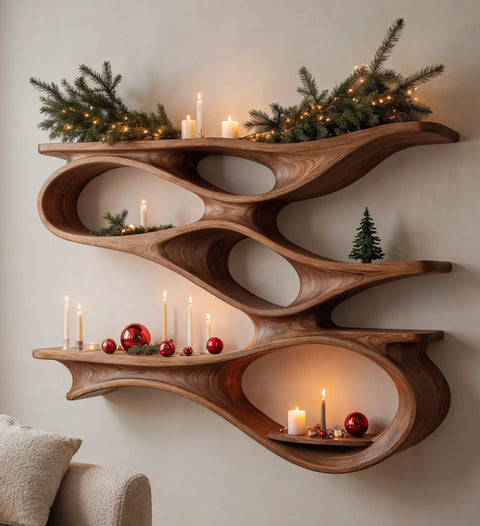
 Sculptural Overlapping Circular Solid Wood Wall Shelf with Multi Tier Display
From $1,354.00
Sculptural Overlapping Circular Solid Wood Wall Shelf with Multi Tier Display
From $1,354.00
 Mountain Landscape Relief Solid Wood Floating Shelf Live Edge Display Ledge
From $1,154.00
Mountain Landscape Relief Solid Wood Floating Shelf Live Edge Display Ledge
From $1,154.00
 Enchanted Forest Circular Wall Shelf - Round Carved Timber Mushroom Portal
From $1,023.00
Enchanted Forest Circular Wall Shelf - Round Carved Timber Mushroom Portal
From $1,023.00
 Cottagecore Arched Wood Wall Niche - Hand-Carved Fairy Mushroom Alcove Shelf
From $1,356.00
Cottagecore Arched Wood Wall Niche - Hand-Carved Fairy Mushroom Alcove Shelf
From $1,356.00
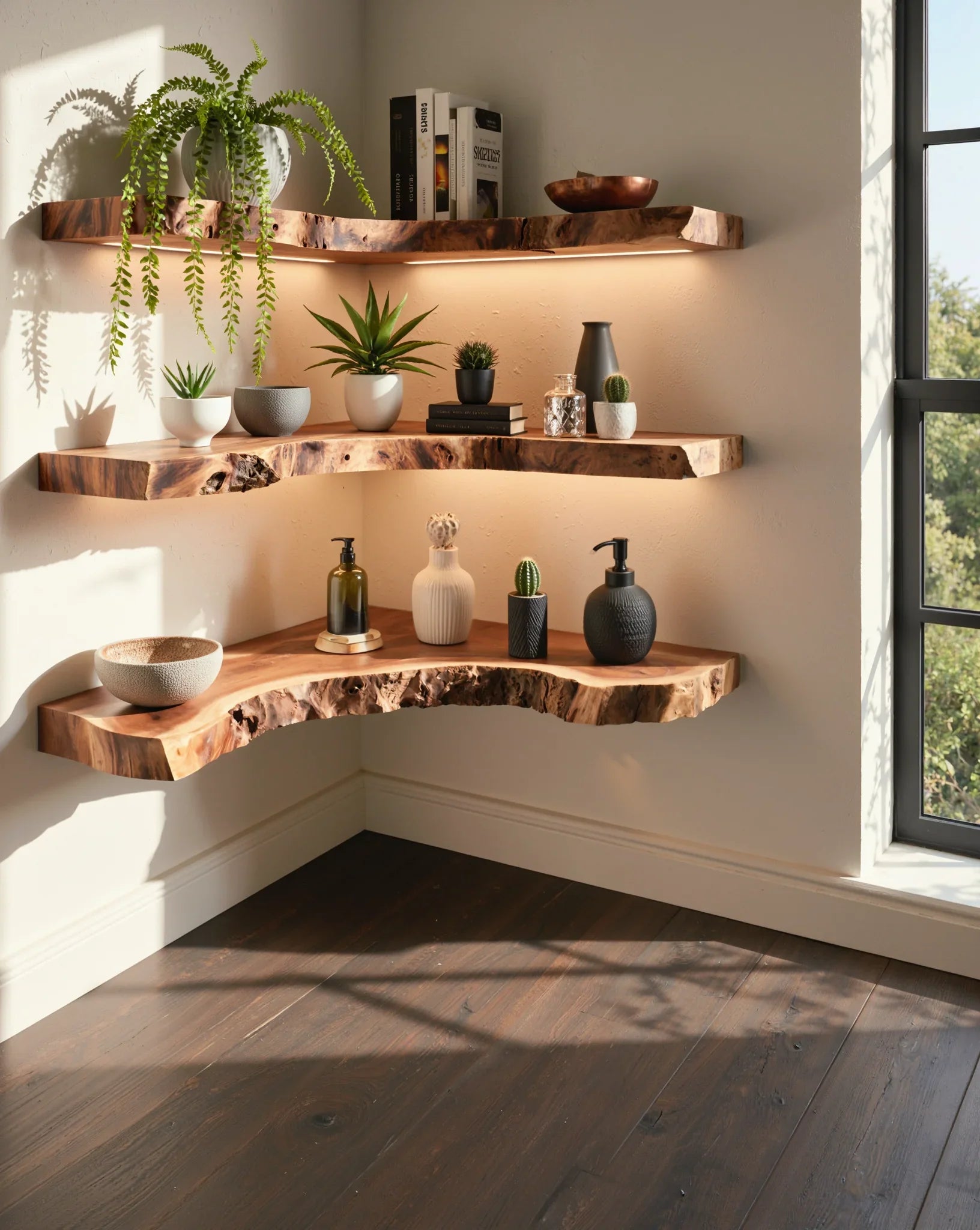
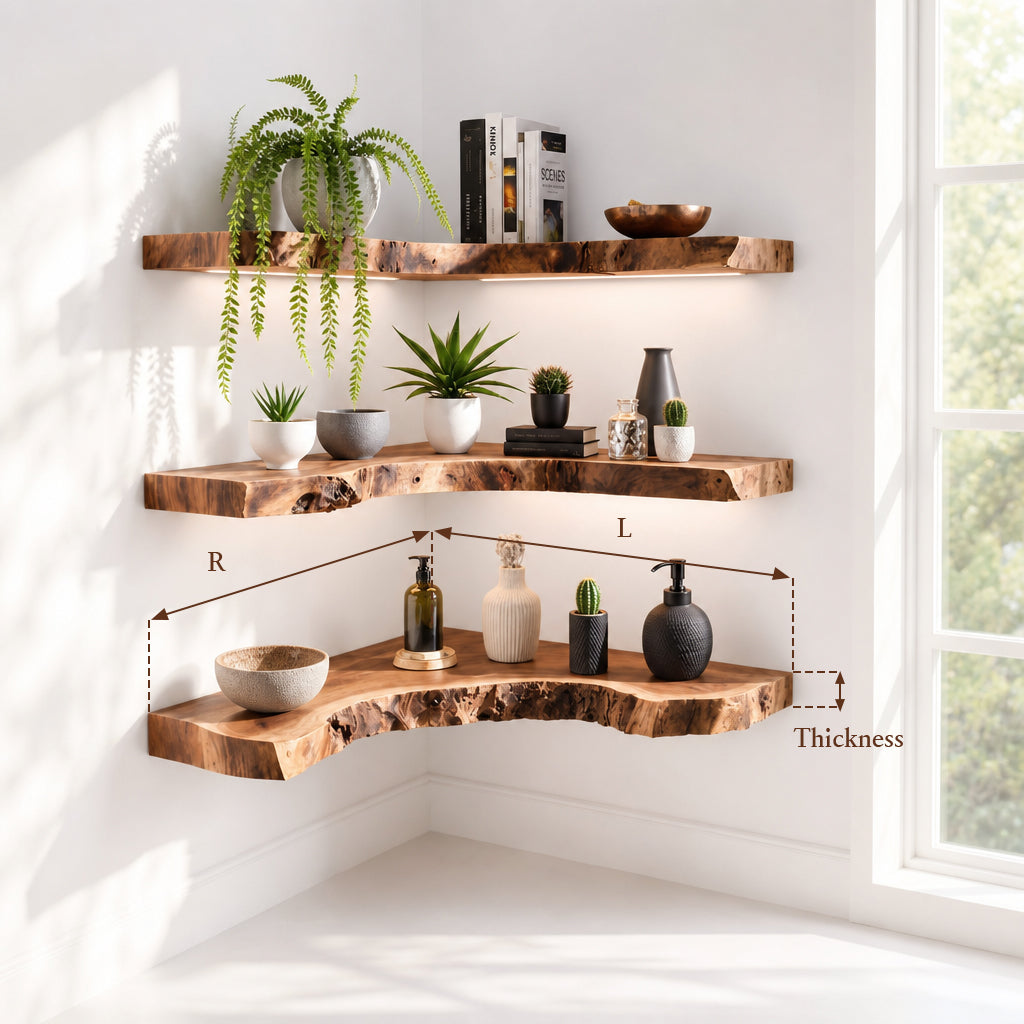
 Sculptural Hand-Carved Mushroom Solid Wood Corner Floating Shelf & Biomorphic Wall Display Ledge
From $345.00
Sculptural Hand-Carved Mushroom Solid Wood Corner Floating Shelf & Biomorphic Wall Display Ledge
From $345.00
 Sculptural Hand-Carved Mushroom Solid Wood Floating Shelves & Biomorphic Wall Display Ledges
From $345.00
Sculptural Hand-Carved Mushroom Solid Wood Floating Shelves & Biomorphic Wall Display Ledges
From $345.00
Wood floating shelves and particle board floating shelves look similar from across a room. Up close - and especially when you cut them open - they're entirely different objects. I've spent years working with both materials in our workshop, and the differences aren't just about aesthetics. They're structural, chemical, and permanent. Understanding what's inside your floating shelf matters because it determines what happens in year 2, year 5, and beyond.

This is the comparison from someone who handles raw lumber and sees returned particle board shelves that customers replace with solid wood floating shelves. Here's what we find when we look inside.
What's Inside: The Cross-Section Comparison
Cut a solid wood floating shelf in half and you'll see continuous wood fiber running from one face to the other. The grain lines - the growth rings of the tree - flow unbroken through the entire thickness. These fibers are nature's engineered beams: strong in tension (pulling), strong in compression (pushing), and held together by lignin, the natural polymer that gives wood its rigidity.
A typical solid wood shelf is 1-2 inches thick. At 1.5 inches, you're looking at approximately 10-20 growth rings of continuous fiber, each one reinforcing the next. This structure is why wood has been the primary building material for thousands of years - it performs.
Cut a particle board floating shelf in half and you see something different: compressed wood chips, shavings, and sawdust bonded with urea-formaldehyde adhesive. The particles are randomly oriented - no continuous fiber, no grain direction, no natural structural logic. The density varies across the cross-section: denser near the faces (where the press compressed the particles most), looser in the core.
MDF (medium-density fiberboard) is a step between them. It uses finer wood fibers than particle board, resulting in a smoother, denser, and more uniform cross-section. But the core principle is the same: bonded fiber with no continuous grain. MDF is to particle board what fine gravel is to coarse rock - smoother, but still aggregate.
The outer surface of a particle board shelf is either laminate (a thin plastic sheet heat-pressed onto the board), veneer (a thin slice of real wood glued to the surface), or paint. None of these coatings contribute to structural strength - they're cosmetic.
How Each Responds to Humidity Over 5 Years
This is where the materials diverge most dramatically, and it's the test that matters most for floating shelves - which are installed on walls and exposed to room conditions for years. Our how to mount floating shelves article walks through the specifics.
Solid wood responds to humidity by absorbing and releasing moisture through its cells. In high humidity (above 60%), wood absorbs moisture and expands slightly - typically 1/32 to 1/16 inch across an 8-inch shelf width. In low humidity (below 35%), it contracts by the same amount. This movement is cyclical, predictable, and has zero structural effect. The wood returns to its original dimension when humidity normalizes.
Over 5 years of seasonal cycling, a well-finished solid wood shelf shows no measurable degradation. The finish (oil, poly, or lacquer) slows moisture exchange, making movement even smaller. The shelf at year 5 is structurally identical to day one.
Particle board also absorbs moisture - but it can't release it the same way. When moisture reaches the core (through an unsealed edge, a chip in the laminate, or a screw hole), the compressed particles swell. Unlike solid wood, this swelling is largely irreversible. The adhesive bonds between particles weaken permanently when saturated.
Here's the 5-year progression:
- Year 1: No visible issues if the laminate is intact. Internal moisture content rises from factory-standard 8% to 10-12% in humid rooms (bathrooms, kitchens).
- Year 2: Edges show the first signs of swelling - particularly around screw holes where mounting hardware penetrated the laminate. Swelling of 1/16 inch is typical.
- Year 3: If any laminate has chipped or peeled, the exposed area has darkened and softened. The shelf may show slight curvature (bowing) along its length under sustained load.
- Year 5: Significant edge degradation. The bottom face may show sagging of 1/8 to 1/4 inch at center span on shelves over 24 inches long carrying 10+ lbs. Screws holding the shelf to the bracket have loosened due to the core expanding around them.
MDF follows a similar trajectory but slower. The denser, finer fiber structure delays moisture penetration by 6-12 months compared to particle board. By year 5, MDF in normal room conditions shows approximately 60% of the degradation that particle board shows.


Screw-Holding Strength: The Numbers
Floating shelves depend on their connection to a wall bracket. That connection is only as strong as the shelf's ability to hold screws. Here's the data, based on Forest Products Laboratory testing standards.
| Material | Screw Withdrawal Strength (face grain) | Screw Withdrawal Strength (edge grain) |
|---|---|---|
| Walnut (solid) | 130-160 lbs per inch of screw thread | 110-140 lbs per inch |
| Ash (solid) | 140-170 lbs per inch | 120-150 lbs per inch |
| Cherry (solid) | 120-150 lbs per inch | 100-130 lbs per inch |
| Pine (solid) | 80-100 lbs per inch | 60-80 lbs per inch |
| MDF (standard) | 60-90 lbs per inch | 40-60 lbs per inch |
| Particle board (standard) | 40-70 lbs per inch | 25-45 lbs per inch |
What this means practically: A 1.5-inch deep screw into walnut resists 195-240 lbs of pullout force. The same screw into particle board resists 60-105 lbs. That's a 2x to 3x difference. When you load a floating shelf with 20 lbs of books and dishes, the lever arm created by the shelf's projection from the wall multiplies the pullout force on the top screw. A solid wood shelf handles this multiplication with margin; particle board operates near its limit.
Over time, the gap widens. Solid wood maintains its screw-holding strength indefinitely (assuming no rot or insect damage). Particle board's strength decreases as moisture weakens the adhesive bonds around each screw. This is why particle board floating shelves sag - the screws slowly pull through the softened core. For a deeper dive, see our article on best wood for closet shelves.
Refinishability: The Permanent Difference

This is the single factor that separates solid wood from every engineered alternative, and it's the reason our floating shelves outlast multiple generations of particle board replacements.
Solid wood can be sanded to bare surface and refinished in any color, finish type, or sheen - indefinitely. A walnut shelf that's been oil-finished for 10 years can be sanded back to raw wood in 20 minutes with 80-grit and 120-grit sandpaper, then restained dark espresso, bleached blonde, or finished natural. The wood beneath the surface is the same material as the surface. Every layer you remove reveals more wood.
A shelf that was too dark for your old apartment becomes perfect for your new one with an afternoon of sanding and a fresh coat of oil. This isn't maintenance - it's transformation.
Particle board cannot be refinished. Sanding through the laminate (which takes about 10 seconds of moderate pressure) exposes the compressed fiber core, which is brown, rough, and cannot accept stain evenly. Painting over it requires adhesion primer and multiple coats, and the result chips within 1-2 years because paint doesn't bond mechanically to loose fiber the way it bonds to wood grain.
MDF is marginally better - it sands smoother than particle board - but still cannot be stained. It can be painted with better adhesion than particle board, but the paint film becomes the visible surface. You're painting MDF, not finishing wood.
Don't miss
These pieces qualify for 10% off orders over $2,000. Applied automatically at checkout.
Janka Hardness: Surface Durability Compared
Janka hardness measures the force required to embed a 0.444-inch steel ball halfway into the wood surface. Higher numbers mean better resistance to dents, scratches, and surface damage from daily use.
| Species | Janka Hardness (lbf) | Shelf Suitability |
|---|---|---|
| Hickory | 1,820 | Excellent - extremely dent-resistant, strong grain |
| Hard maple | 1,450 | Excellent - fine grain, very smooth |
| White oak | 1,360 | Excellent - water-resistant, strong |
| Ash | 1,320 | Excellent - flexible, shock-resistant |
| Walnut | 1,010 | Very good - rich color, moderate hardness |
| Cherry | 950 | Good - softer, develops deepest patina |
| Pine | 690 | Fair - dents easily, budget option |
| MDF | N/A (400-600 equivalent) | Poor - surface dents easily once coating is breached |
| Particle board | N/A (300-500 equivalent) | Poor - surface entirely dependent on laminate quality |
For floating shelves that hold books (hardcovers weigh 1-2 lbs and have sharp corners), dishes (ceramic on wood creates point loads), and decorative objects, a Janka hardness above 900 lbf provides reliable dent resistance for decades. Below 700 lbf, daily use produces visible dents within the first year.

Our workshop uses walnut, ash, and cherry most frequently for floating shelves - the sweet spot between hardness, workability, and visual beauty. For kitchen applications, white oak's combination of hardness (1,360 lbf) and natural water resistance makes it an ideal choice, available in our kitchen floating shelf collection.
The Cost-Per-Year Reality
The purchase price of particle board shelves is lower. The cost per year of ownership is higher. Here's the math.
Solid wood floating shelf (24 inches, walnut): $50-$100. Lasts 20-30+ years. Cost per year: $1.70-$5.00.
Particle board floating shelf (24 inches): $12-$30. Lasts 3-5 years. Cost per year: $2.40-$10.00. Over 20 years, you'll purchase 4-7 replacement shelves totaling $48-$210.
MDF floating shelf (24 inches): $20-$50. Lasts 5-10 years. Cost per year: $2.00-$10.00.
Solid wood wins every cost-per-year calculation beyond a 7-year horizon. Add the value of refinishability - which gives solid wood shelves a second and third life in different rooms and styles - and the economics aren't close.

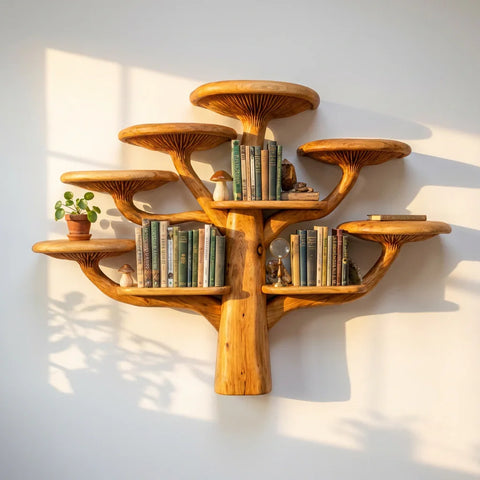
Our mushroom floating shelves demonstrate this perfectly: hand-carved solid wood mushroom forms that cannot be replicated in particle board because the material can't hold the sculptural shape without crumbling at thin points.
FAQ
Are solid wood floating shelves worth the extra cost? Yes, when measured by cost per year of use. A $75 walnut shelf lasting 25 years costs $3/year. A $20 particle board shelf lasting 4 years costs $5/year - and you need 6 replacements across the same period, adding disposal hassle and environmental waste. Solid wood is the cheaper long-term option.
How can I tell if a floating shelf is real wood or particle board? Check three indicators: weight (solid wood is 40-60% heavier than particle board at the same dimensions), edge grain (solid wood shows continuous grain lines on all surfaces; particle board shows a flat laminate or a different texture on edges), and sound (knock on it - solid wood produces a resonant tone; particle board sounds flat and dull).
Do solid wood floating shelves warp? Properly kiln-dried and finished solid wood shelves experience minor seasonal movement (1/32 to 1/16 inch across 8 inches) but do not warp in normal indoor conditions (35-55% relative humidity). Warping occurs when one face is sealed and the other isn't, creating uneven moisture absorption. Our shelves are finished on all surfaces, including the bottom and back, to prevent this.
What's the strongest wood for floating shelves? By Janka hardness: hickory (1,820 lbf), hard maple (1,450 lbf), and white oak (1,360 lbf) are the hardest common species. Ash (1,320 lbf) offers the best combination of hardness and visual grain. Walnut (1,010 lbf) provides excellent strength with the richest color. All are significantly stronger than MDF or particle board in screw-holding and load-bearing capacity.
Can I paint solid wood floating shelves? Yes, though many owners prefer natural finishes that show the grain. If you want a painted look, solid wood accepts paint better and longer than any engineered material - the wood grain provides mechanical adhesion that MDF and particle board lack. And if you change your mind, you can sand the paint off and return to a natural finish. That flexibility doesn't exist with particle board.