



















Quick view
- Mushroom Shelf - When Your Corner Needs More Than Just Storage
- Corner Floating Shelf - When Every Inch of Floor Space Counts
- Head-to-Head - 8 Factors That Actually Matter
- The Corner Measurement Checklist (Read This Before Buying)
- How to Decide - 3 Questions, 60 Seconds
- Frequently Asked Questions
- Final Thoughts
Shop this guide
Handcrafted Lamps for Modern Homes, made to order in solid wood.
 Christmas edit
Rustic Driftwood Floor Lamp – Handmade Solid Wood Standing Light for Home Décor
From $1,220.00
Christmas edit
Rustic Driftwood Floor Lamp – Handmade Solid Wood Standing Light for Home Décor
From $1,220.00
 Christmas edit
Driftwood Wall Sconce - Handcrafted Rustic Wooden Wall Lamp
From $650.00
Christmas edit
Driftwood Wall Sconce - Handcrafted Rustic Wooden Wall Lamp
From $650.00
 Christmas edit
Rustic Driftwood Floor Lamp with Shelves – Handmade Wooden Standing Light
From $2,350.0010% off at checkout
Christmas edit
Rustic Driftwood Floor Lamp with Shelves – Handmade Wooden Standing Light
From $2,350.0010% off at checkout
 Christmas edit
Twisted Vine Wooden Floor Lamp - Handcrafted Driftwood Standing Light With Leaf Shade
From $1,280.00
Christmas edit
Twisted Vine Wooden Floor Lamp - Handcrafted Driftwood Standing Light With Leaf Shade
From $1,280.00
 Christmas edit
S-Curve Wooden Floor Lamp - Driftwood Standing Light With Dual Glow Openings
From $1,480.00
Christmas edit
S-Curve Wooden Floor Lamp - Driftwood Standing Light With Dual Glow Openings
From $1,480.00
 Christmas edit
Dual Nursery Mushroom Floor Lamp with Gill Glow Caps
From $1,680.00
Christmas edit
Dual Nursery Mushroom Floor Lamp with Gill Glow Caps
From $1,680.00
Mushroom Shelf vs Corner Floating Shelf: Which One Solves Your Awkward Corner?
As a handmade wood furniture brand that builds shelves to order, we've helped hundreds of customers figure out what to do with that one awkward corner - the one next to the entry door, the dead space at the end of a hallway, or the gap between a staircase and the living room wall. What follows is an honest comparison based on real installation experience, not a spec sheet.
Every home has at least one corner that fights back. It's too narrow for a console table, too visible to leave empty, and too awkward for a standard rectangular shelf. You want to use it - but do you go with a sculptural mushroom shelf that turns the corner into a visual moment, or a corner floating shelf that maximizes every inch without calling attention to itself?
They solve different problems. This comparison breaks down installation, weight, cost, space efficiency, and real-world use cases so you can pick the one that actually fits your corner.

Mushroom Shelf - When Your Corner Needs More Than Just Storage
A mushroom shelf is defined by its thick, rounded front edge and organic silhouette - think a cross-section of a mushroom cap mounted on a wall. It's not subtle. That's the point.
If you're still figuring out whether a mushroom shelf works for your space at all, our mushroom wall shelf buying guide covers the basics - material quality, shape, mounting - before you commit to a corner placement.

Why Corners Actually Work Well for Mushroom Shelves
Two walls meeting at 90 degrees create a natural frame. Instead of a mushroom shelf floating alone on a wide, flat wall where it can look lost, the corner gives it architectural context. The shelf becomes a vignette - something your eye lands on when you walk in.
Where Mushroom Shelves Shine
- Corner reading nooks - holds a small stack of paperbacks, a candle, and a trailing pothos without looking like a storage unit
- Entryway vignettes - keys on the top surface, a small tray, maybe a framed photo; the shelf itself adds warmth to a usually utilitarian zone
- Nursery corners - rounded edges mean no sharp corners at toddler height, and the organic shape fits the softer aesthetic most parents want in a baby's room
- Powder rooms - a single mushroom shelf above a corner sink adds character without the bulk of a vanity
Where Mushroom Shelves Struggle in Corners
Depth. Most mushroom shelves run 8-12 inches deep. In a tight hallway corner that's only 36 inches wide from wall edge to door frame, a 12-inch shelf will eat into your walking path. That's the kind of friction you notice every time you squeeze past it with a grocery bag.
Price. Handcrafted solid wood mushroom shelves typically cost $185-$600+. If your goal is purely functional corner storage, that's hard to justify when a corner floating shelf does the job for a fraction of the cost.
Installation: What You're Actually Getting Into
Mushroom shelves are heavier than they look - a 24-inch solid hardwood piece can weigh 9-15 lbs before you put anything on it. That matters for mounting.
- Hardware: Most mushroom shelves use a hidden French cleat or a steel bracket with 2-3 mounting holes. You'll need 3-inch wood screws if hitting studs, or heavy-duty toggle bolts for drywall.
- Stud requirement: Because of the weight and the leverage effect of the shelf projecting out from the wall, at least one screw must hit a stud. If your corner doesn't have a stud near the mounting point, use snap-toggle drywall anchors rated for 45+ lbs each.
- Leveling: Mushroom shelves are less forgiving than flat shelves when it comes to being off-level. The curved underside makes any tilt visible - if the shelf isn't level, the mushroom silhouette looks "off" even if you can't immediately tell why. Use a 4-foot level or a laser level.
- Two-person job: For anything over 20 inches, having a second person hold the shelf while you mark and drill makes the difference between a clean install and a wall full of trial-and-error holes.

Corner Floating Shelf - When Every Inch of Floor Space Counts
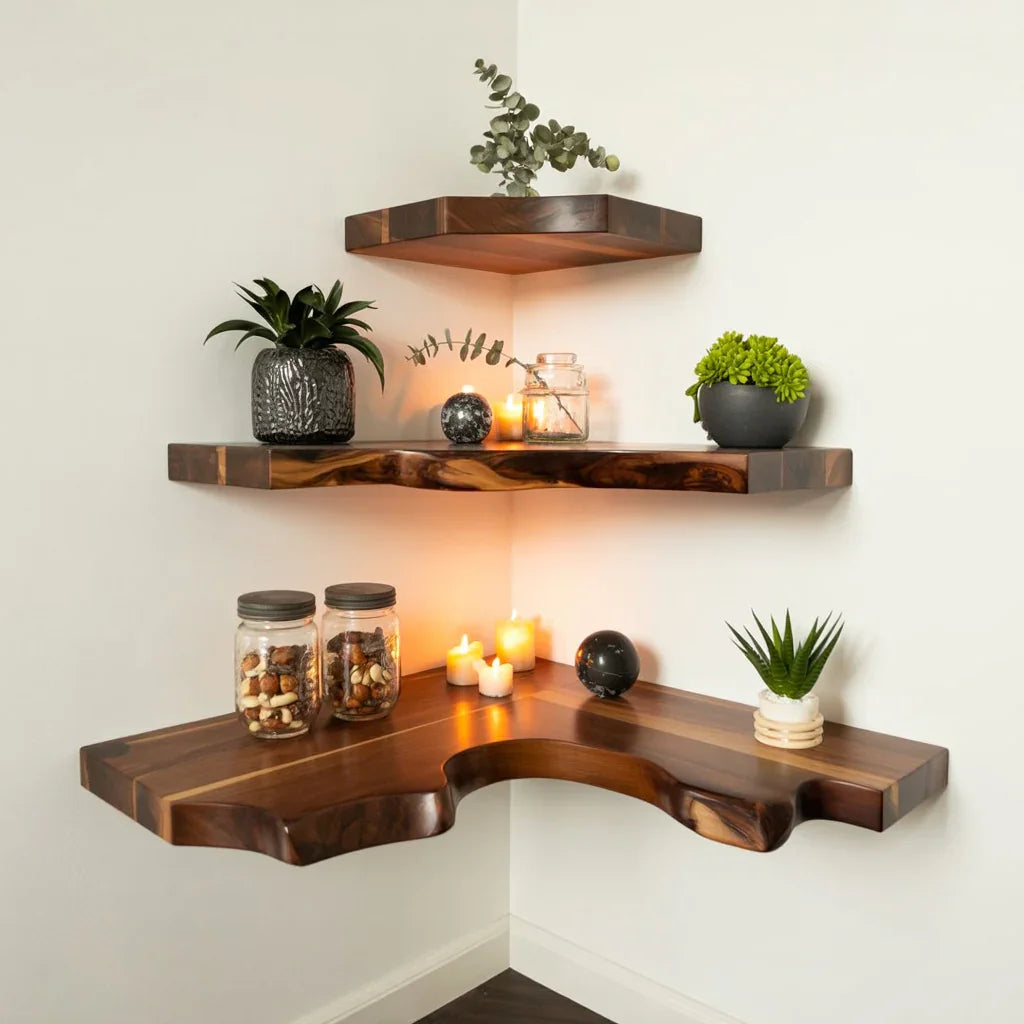
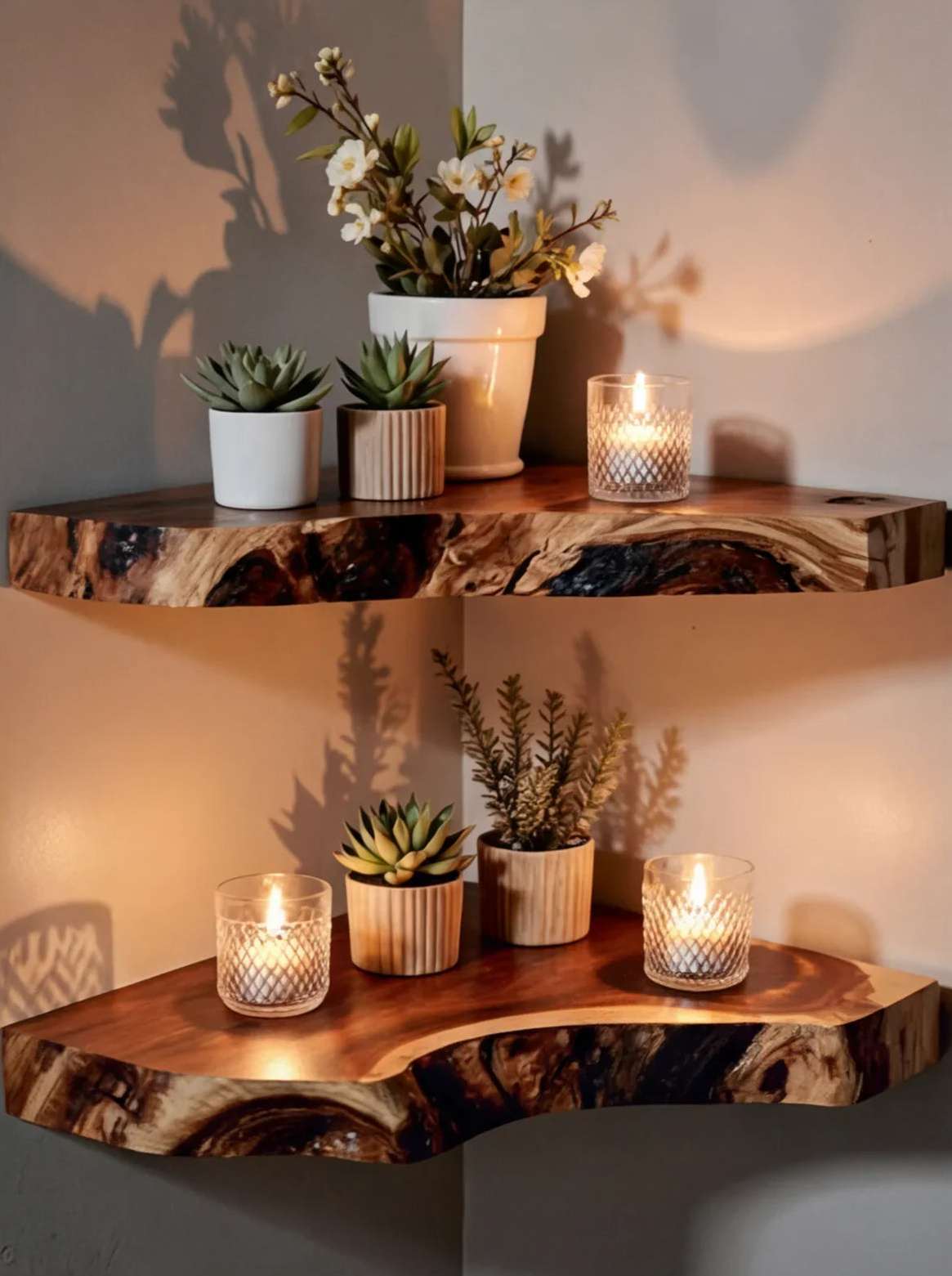
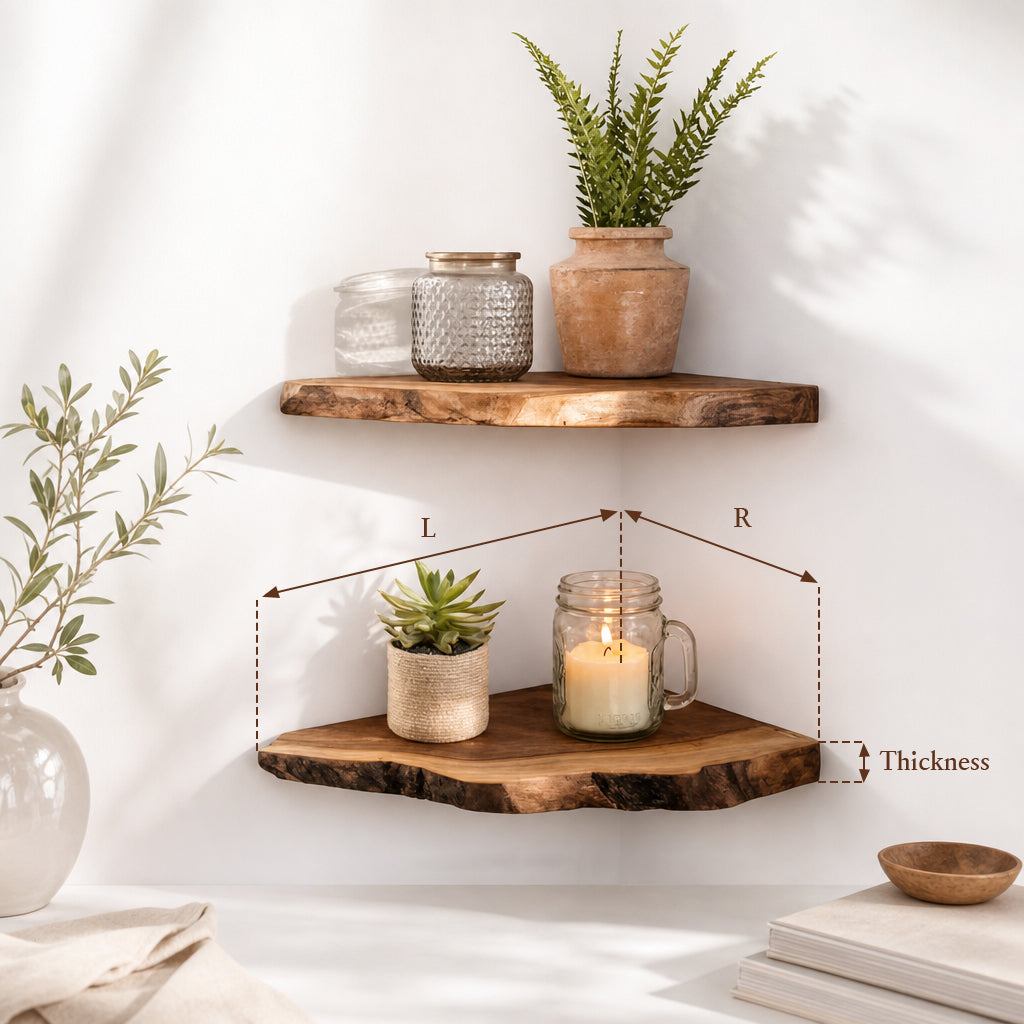
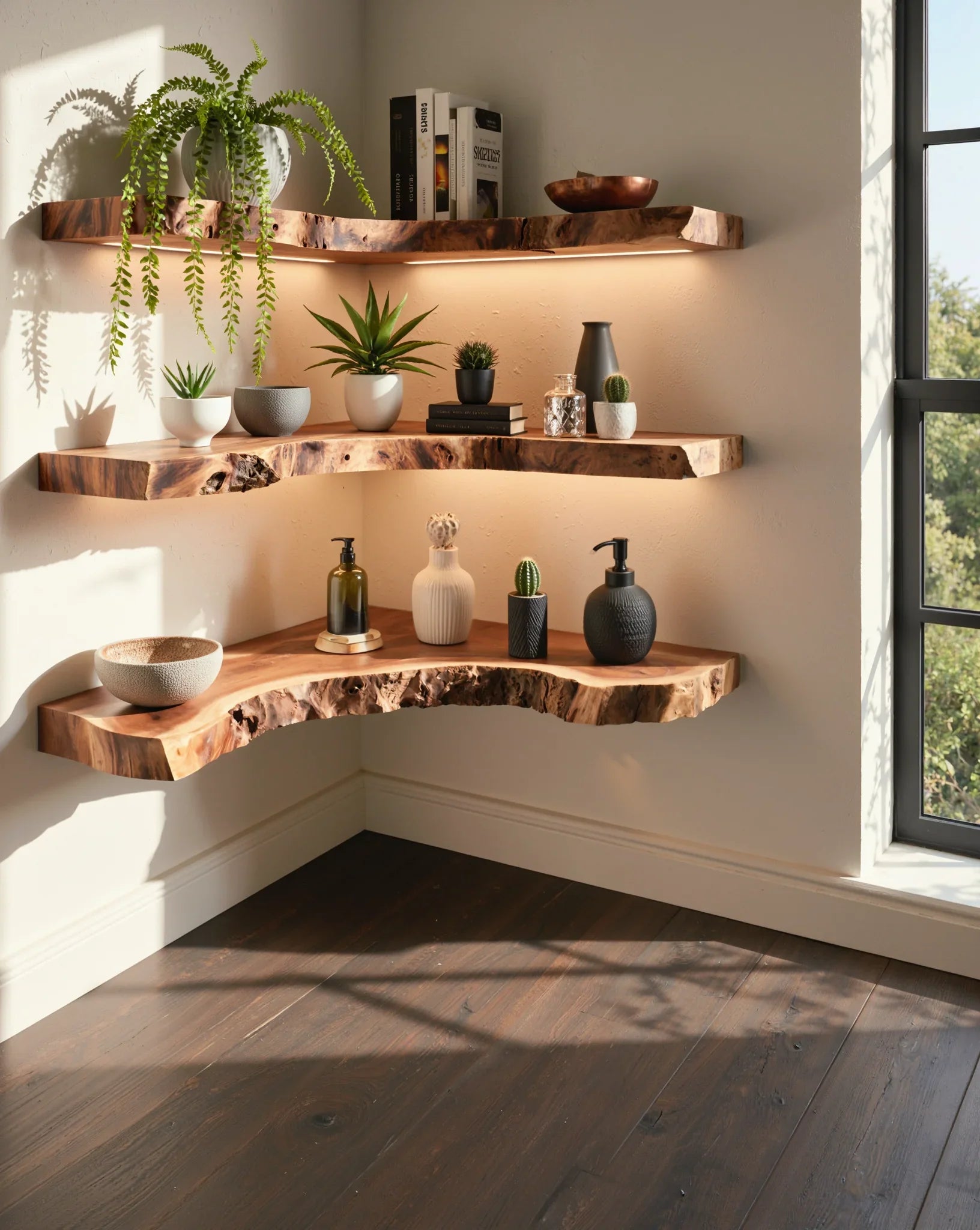
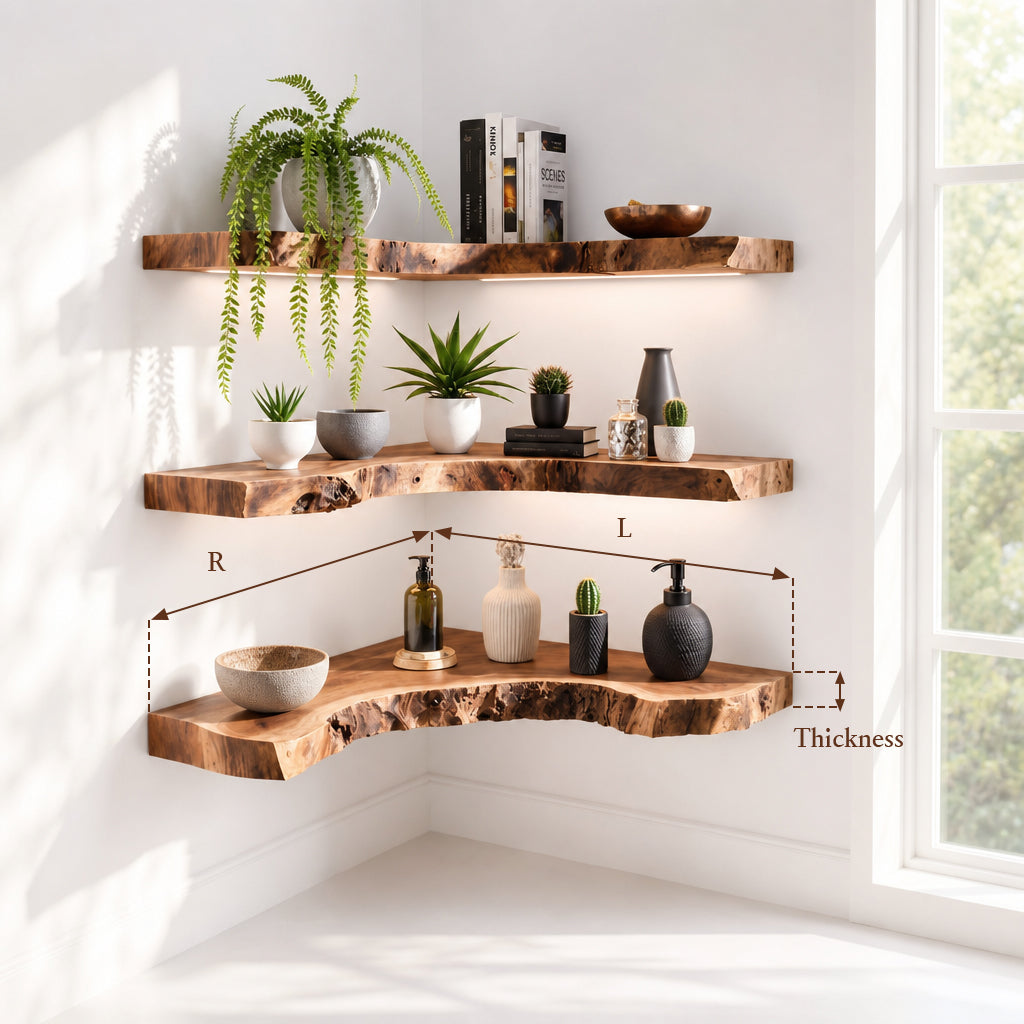
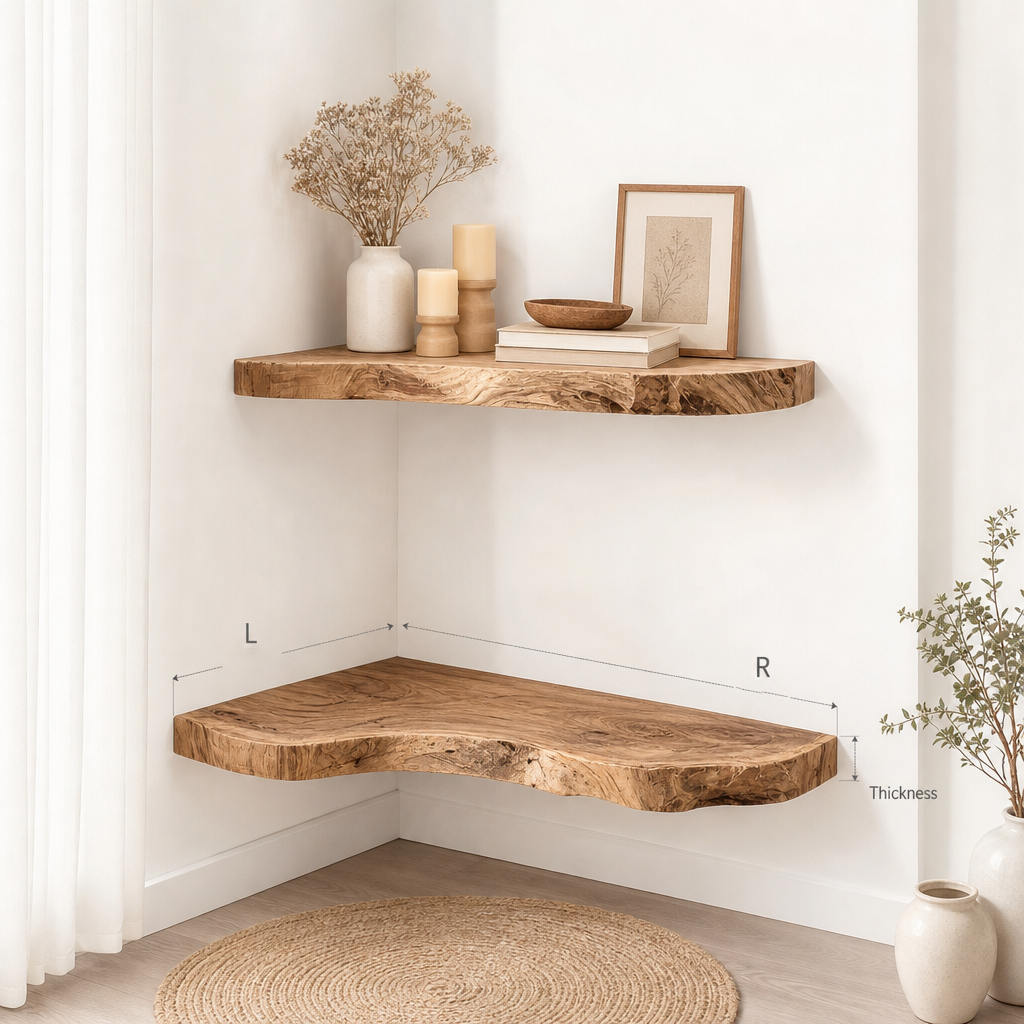
A corner floating shelf is a triangular or L-shaped shelf designed to nest into the corner, with the longest edge against each wall. It's utilitarian by nature - no sculptural edges, no thick profile, just clean lines and maximum space efficiency.
We wrote a separate guide on corner floating shelf measurements because 90% of returns come from measurement errors, not product defects. Worth a read before you buy anything.

The Practical Advantages
Zero floor footprint. This is the main reason people choose corner shelves. In an entryway that's barely wider than the door swing, or a bathroom where the toilet sits 12 inches from the corner, a corner shelf uses space nothing else can. You can place a shoe bin, a small plant, or even a wastebasket directly underneath.
Lower profile, fewer conflicts. Most corner floating shelves are 6-10 inches deep along each wall edge. That means even in a tight hallway, you're not bumping your shoulder every time you walk past.
Easier to install solo. Corner floating shelves are lighter (3-7 lbs typical) and often come with pre-drilled mounting holes that line up with L-brackets or a hidden mounting rail. One person with a drill and a level can handle it in 20-30 minutes.
Where Corner Floating Shelves Fall Short
They don't turn heads. A corner floating shelf is invisible design - it works, it looks tidy, but nobody's going to compliment it. If you want the corner to feel intentional and styled, not just "handled," a corner shelf alone won't do it.
Weight capacity is lower. Most corner floating shelves hold 10-25 lbs depending on the bracket system. That's fine for toiletries, a small plant, or a few paperbacks. It's not fine for a row of hardcover books, a large ceramic vase, or anything you'd describe as "heavy."
Corners are rarely square. If your corner angle is off by more than 3 degrees from 90°, an off-the-shelf corner shelf won't sit flush. You'll see a gap on one side, and no amount of shimming will fix it completely. Custom-cut shelves or adjustable bracket systems solve this, but they cost more.
Installation: What You're Actually Getting Into
Corner floating shelves are the more DIY-friendly option, but corners add complexity.
- Hardware: Most come with 2 L-brackets or a hidden mounting rail. You'll need 2-4 screws per bracket - so 4-8 screws total - plus wall anchors if you're not hitting studs.
- Stud requirement: Not strictly required for light-duty use. A quality toggle anchor in drywall handles 10-20 lbs per anchor, which covers most corner shelf use cases (toiletries, decor, small plants). But if you plan to stack books or place anything over 10 lbs, find at least one stud.
- Leveling in two dimensions: On a flat wall, you level left-to-right. In a corner, you need to level along both walls - meaning the shelf must be level from left to right AND from front to back. A laser level makes this much easier. Without one, use a standard bubble level and check both directions before you drill.
- Start from the back: Mount the back edge of the bracket first (where the two walls meet), verify it's flush in the corner, then secure the front edge. If you start from the front, the back can end up proud of the wall and create a visible gap.



Head-to-Head - 8 Factors That Actually Matter
1. Space Efficiency
Winner: Corner Floating Shelf
A corner floating shelf fits into corners as narrow as 24 inches from wall edge to obstruction. Mushroom shelves need 32-40 inches of clearance to avoid feeling crowded. If your corner is tight, the corner shelf wins by default.
2. Visual Impact
Winner: Mushroom Shelf
A mushroom shelf is a statement. The sculptural form, the thick wood profile, the organic edge - it turns an ignored corner into something people notice. A corner floating shelf does the opposite: it disappears, which is great for utility but flat for style.
3. Weight Capacity
Winner: Mushroom Shelf
Solid wood mushroom shelves: 30-60 lbs when properly mounted. Corner floating shelves: 10-25 lbs. The difference comes down to material thickness (mushroom shelves are typically 2-3 inches thick vs. 0.75-1.5 inches for corner shelves) and bracket design.
4. Price
Winner: Corner Floating Shelf
Corner floating shelves: $40-$200 for most off-the-shelf options. Mushroom shelves: $185-$600+ for handcrafted solid wood. If you're furnishing multiple corners, the cost gap adds up fast.
5. Installation Difficulty
Winner: Corner Floating Shelf
Corner shelves are lighter, use simpler bracket systems, and don't require a stud as often. Mushroom shelves need more planning - stud location matters more, leveling is less forgiving, and the weight makes solo installation harder. Both are DIY-able; the corner shelf is just the easier of the two.
6. Room Versatility
Winner: Corner Floating Shelf
A corner floating shelf works in a bathroom, kitchen, hallway, office, bedroom, or entryway without clashing with any aesthetic. A mushroom shelf is more style-specific - it fits beautifully in warm, organic, or rustic spaces, but can feel out of place in a stark modern or industrial room.
7. Longevity
Winner: Mushroom Shelf
A handcrafted solid wood mushroom shelf, properly mounted and maintained, will last decades. The material is thick enough to refinish if it gets scratched, and the construction doesn't rely on thin veneers or particleboard. Most corner floating shelves use MDF or thinner solid wood and have a functional lifespan of 5-10 years before they start looking worn.
8. Child Safety
Winner: Mushroom Shelf
Rounded edges everywhere. No sharp corners for a toddler to bump into. Corner floating shelves often have sharper front edges - especially cheaper ones with square-cut MDF - and the lower mounting height in corners puts them right at head-bumper level for small kids.

The Corner Measurement Checklist (Read This Before Buying)
Don't skip this. The #1 reason people return corner shelves is measurement error, not product quality.
1. Measure the corner angle. Use a digital angle finder or a smartphone app. If the angle is between 87° and 93°, off-the-shelf shelves will work. Anything beyond that range and you need either an adjustable bracket system or a custom-built shelf. Most older homes have corners that drift 2-4 degrees off square - it's normal, but it matters for fit.
2. Check the clear path. Measure from the corner point outward along each wall. Your shelf depth plus a minimum of 24 inches of clear walking space is the comfort zone. Less than that and you'll be sidestepping the shelf every time you pass.
3. Map the wall material.
- Drywall only → toggle anchors, 10-20 lbs per anchor limit
- One stud in range → drive at least one 3-inch wood screw into it
- Tile (bathroom) → carbide masonry bit, plastic wall plugs, don't crack the tile
- Plaster (older homes) → thicker than drywall but more brittle, use longer screws and consider a backing plate
4. Identify obstacles within 12 inches of the corner. Light switches, electrical outlets, plumbing pipes, HVAC vents - mark them before you drill. In older homes, there's often a junction box or pipe hiding right where you want to mount the bracket. A stud finder with AC detection helps.
5. Pick the right mounting height.
- Display use (plants, candles, photos): 48-56 inches from floor - eye level when standing
- Everyday grab-and-go (keys, mail, small items): 55-60 inches - natural hand height without reaching up or bending down
- Bathroom toiletries: 60-65 inches - above the sink, within arm's reach, away from splash zone
Don't miss
These pieces qualify for 10% off orders over $2,000. Applied automatically at checkout.
10% off
Rustic Driftwood Floor Lamp with Shelves – Handmade Wooden Standing Light
From $2,350.00
10% off at checkout
 10% off
Rustic Driftwood Floor Lamp with Side Table – Solid Wood Standing Light with Rattan Shade
From $2,350.00
10% off at checkout
10% off
Rustic Driftwood Floor Lamp with Side Table – Solid Wood Standing Light with Rattan Shade
From $2,350.00
10% off at checkout
 10% off
Authentic Hand-Carved Solid Wood Twisted Floor Lamp - Sculptural Timber Column with Fabric Shade
From $2,280.00
10% off at checkout
10% off
Authentic Hand-Carved Solid Wood Twisted Floor Lamp - Sculptural Timber Column with Fabric Shade
From $2,280.00
10% off at checkout
 10% off
Authentic Hand-Carved Solid Wood Abstract Floor Lamp - Sculptural Biomorphic Accent Light
From $2,280.00
10% off at checkout
10% off
Authentic Hand-Carved Solid Wood Abstract Floor Lamp - Sculptural Biomorphic Accent Light
From $2,280.00
10% off at checkout
How to Decide - 3 Questions, 60 Seconds
"Is this corner tight or spacious?"
Clear floor space under 10 sq ft → corner floating shelf. More than 15 sq ft → mushroom shelf has room to breathe.
"Do I want this corner to stand out or blend in?"
Focal point, conversation piece, styled vignette → mushroom shelf. Clean, functional, invisible storage → corner floating shelf.
"What's going on it?"
Heavy books, large plants, ceramics, anything over 10 lbs → mushroom shelf. Toiletries, a small candle, light decor, keys → corner floating shelf handles it fine.

Frequently Asked Questions
Can you put a mushroom shelf in a corner?
Yes - and corners actually frame mushroom shelves better than flat walls do. The two adjacent walls create a natural visual border that makes the shelf feel anchored rather than floating in empty space. Just make sure you have at least 32 inches of clearance from the corner point to the nearest door frame or obstruction, and that at least one mounting screw hits a wall stud for the weight.
How deep should a corner floating shelf be for a small entryway?
6 to 8 inches maximum. In a typical entryway that's 36-48 inches wide from door to the opposite wall, anything deeper than 8 inches will reduce your walking path below the comfortable 24-inch minimum. If your entryway is wider than 48 inches, you can go up to 10 inches, but measure first - walk the path with your arms full and see how much space you actually need.
Do corner floating shelves need special brackets?
Yes. Standard straight-wall brackets are designed for one mounting surface. Corner shelves need either L-shaped brackets (one arm per wall) or a specialized corner mounting rail. If your corner angle isn't exactly 90 degrees, look for adjustable corner brackets that accommodate 85-95 degree angles. Using regular brackets in a corner will leave gaps and reduce weight capacity because the bracket can't sit flush against both walls simultaneously.
Which holds more weight - mushroom shelf or corner floating shelf?
A properly mounted solid wood mushroom shelf holds 30-60 lbs because of its thick construction (2-3 inches of solid hardwood) and robust hidden bracket system. A typical corner floating shelf holds 10-25 lbs - the triangular shape means the weight is distributed across two shorter bracket arms, and the shelf itself is usually thinner (0.75-1.5 inches). If you need to hold more than 25 lbs on a corner shelf, make sure at least one bracket anchors into a wall stud.
What's the ideal height to mount a corner shelf in an entryway?
For everyday items like keys, mail, and a small catch-all tray: 55-60 inches from the floor. This puts the shelf surface at a natural reach height for most adults (shoulder-to-chest level) without requiring you to lift your arm or bend down. For purely decorative display - a small plant, a candle, a framed photo - go slightly lower at 48-55 inches so the items sit at eye level when you're standing in the entryway. If your household includes children and you want them to reach the shelf independently, 40-44 inches is the sweet spot for ages 4-8.
Final Thoughts
That awkward corner isn't dead space - it's the most underused real estate in your home. A mushroom shelf turns it into something you notice every time you walk past: warm, sculptural, intentional. A corner floating shelf turns it into something you stop worrying about: tidy, efficient, out of the way.
Neither choice is wrong. But they're not interchangeable. Pick the mushroom shelf if your corner has room and you want it to feel like part of the room's design. Pick the corner floating shelf if space is tight and function matters more than form.
As a handmade wood furniture brand, we build both - and the most satisfying orders are the ones where the customer measured their corner, thought about what they actually needed from it, and picked accordingly. The shelf that fits your space and your habits is the one you'll still love three years from now. Not the one that looked best in a styled photo.
Browse our full collection of mushroom floating shelves, corner floating shelves, and all wall shelves. Need help picking? Contact our design team for a free consultation.