



















Quick view
- Is Your Wall Actually Drywall?
- Can You Hang a Floating Corner Shelf on Drywall?
- Corner shelves built for drywall - no carpentry required
- How to Choose the Right Corner Shelf for Drywall
- Installation Overview
- Why Corner Shelves Fall Off Drywall (And How to Prevent It)
- Frequently Asked Questions
- Corner Floating Shelf Ideas by Room
Shop this guide
Handcrafted Floating Shelves, made to order in solid wood.
 Sculptural Overlapping Circular Solid Wood Wall Shelf with Multi Tier Display
From $1,354.00
Sculptural Overlapping Circular Solid Wood Wall Shelf with Multi Tier Display
From $1,354.00
 Mountain Landscape Relief Solid Wood Floating Shelf Live Edge Display Ledge
From $1,154.00
Mountain Landscape Relief Solid Wood Floating Shelf Live Edge Display Ledge
From $1,154.00
 Enchanted Forest Circular Wall Shelf - Round Carved Timber Mushroom Portal
From $1,023.00
Enchanted Forest Circular Wall Shelf - Round Carved Timber Mushroom Portal
From $1,023.00
 Cottagecore Arched Wood Wall Niche - Hand-Carved Fairy Mushroom Alcove Shelf
From $1,356.00
Cottagecore Arched Wood Wall Niche - Hand-Carved Fairy Mushroom Alcove Shelf
From $1,356.00
 Sculptural Hand-Carved Mushroom Solid Wood Corner Floating Shelf & Biomorphic Wall Display Ledge
From $345.00
Sculptural Hand-Carved Mushroom Solid Wood Corner Floating Shelf & Biomorphic Wall Display Ledge
From $345.00
 Sculptural Hand-Carved Mushroom Solid Wood Floating Shelves & Biomorphic Wall Display Ledges
From $345.00
Sculptural Hand-Carved Mushroom Solid Wood Floating Shelves & Biomorphic Wall Display Ledges
From $345.00
Floating Corner Shelves for Drywall: The Complete Guide (2026)
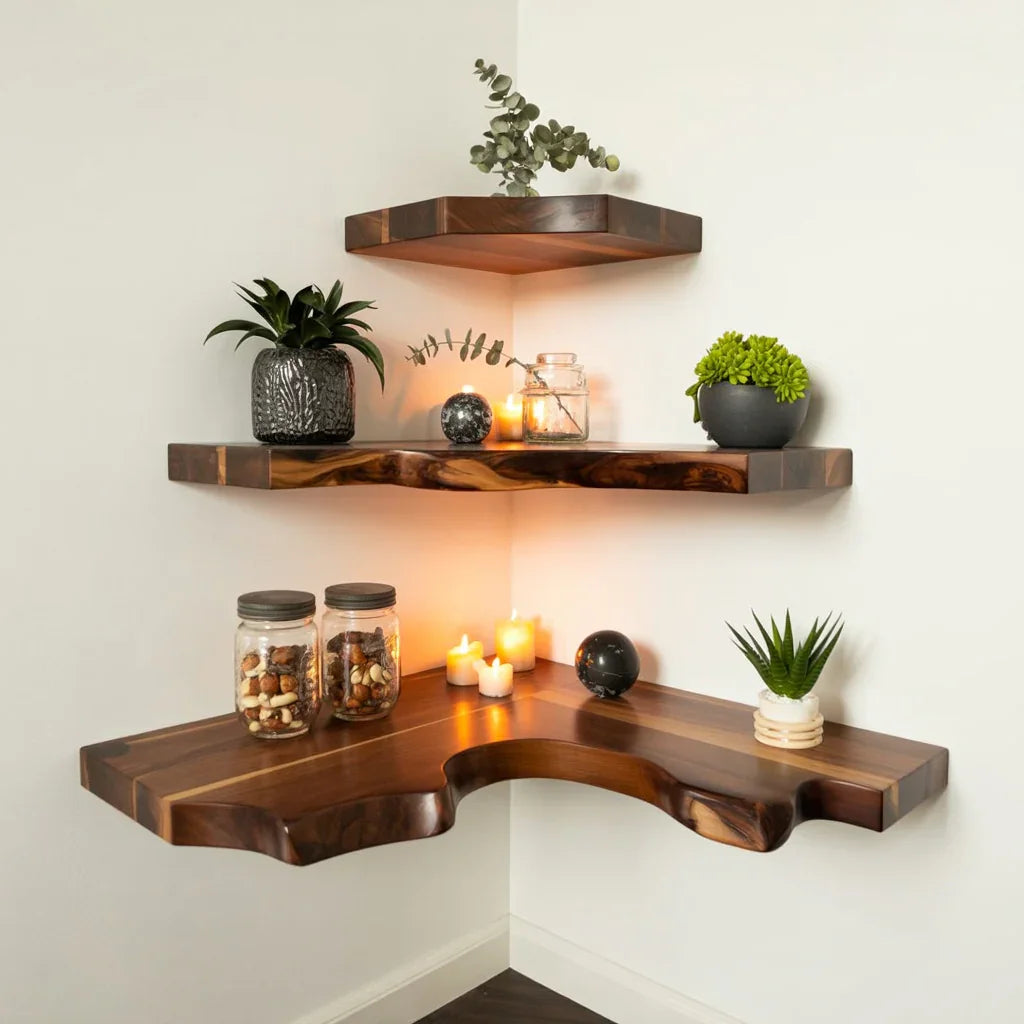
You know that corner. The one behind the entry door that just sits there. Or the dead space at the end of the hallway that catches dust and nothing else. A floating corner shelf fixes that in one afternoon. No floor footprint, no bulky brackets, no renovation - just a clean line that turns wasted space into something useful.
But here's the catch: most homes have drywall, not solid plaster or brick. And if you don't account for that, your new shelf becomes a hole in the wall with a sad crack around it.
This guide focuses specifically on mounting a floating corner shelf on drywall - what anchors to use, how much weight your wall can actually hold, and what makes corner installations different from standard wall shelving.
Already debating between a mushroom shelf and a corner floating shelf? We wrote a full comparison of mushroom shelf vs corner floating shelf that breaks down the trade-offs on cost, style, and weight capacity.

Is Your Wall Actually Drywall?
Before buying anchors or drilling anything, confirm what your wall is made of. The wrong anchor in the wrong wall type is the number one reason shelves fall.
How to Tell If Your Wall Is Drywall or Plaster
Most homes built after 1950 in the US use drywall (also called gypsum board or sheetrock). Homes built before that are more likely to have plaster walls - and they look identical from the outside.
Three quick ways to check:
- The knock test: Knock firmly on the wall. Drywall sounds hollow. Plaster sounds dense and solid.
- The nail test: Push a thumbtack into an inconspicuous spot. Drywall gives way easily. Plaster resists and may crack.
- The age test: If your home was built before 1950, assume plaster until you confirm otherwise.
Why It Matters for Floating Corner Shelf
Drywall anchors - expansion plugs, toggle bolts, molly bolts - are designed specifically for 1/2-inch gypsum board. In plaster walls, most of these anchors either don't grip or crack the surface. If you have plaster, you need plaster-specific anchors or must hit a stud on every mounting point. The rest of this guide assumes drywall.

Can You Hang a Floating Corner Shelf on Drywall?
Short answer: yes. But "yes" comes with conditions.
Drywall is not structural material. It's a thin gypsum panel - typically 1/2 inch thick - screwed onto wooden studs spaced 16 or 24 inches apart. the drywall itself holds almost nothing. The anchors you use, and whether you hit a stud, determine everything.
Weight Limits by Anchor Type
| Anchor Type | Weight per Anchor | Best For |
|---|---|---|
| Plastic expansion plug | 5–10 lbs | Small decor, lightweight items |
| Self-drilling anchor | 10–20 lbs | Light books, small plants |
| Molly bolt | 15–30 lbs | Medium loads, spice jars, candles |
| Toggle bolt / snap-toggle | 25–50 lbs | Heavy books, large plants, anything substantial |
| Direct into stud | 50+ lbs | Maximum weight - no anchor needed |
Real-World Load Examples
- A trailing pothos in a small pot (~3 lbs) - any anchor works
- A stack of 10–15 paperbacks (~15 lbs) - self-drilling anchors or molly bolts
- A row of hardcover books (~30 lbs) - toggle bolts, minimum two
- A large ceramic planter with soil (~20–40 lbs) - toggle bolts or stud mounting
- A small speaker or art object (~5–10 lbs) - any anchor works
The shelf material matters too. A thin MDF shelf will sag under 20 lbs before the anchors fail. A solid hardwood shelf will hold far more than the drywall can support. The bottleneck is almost always the wall, not the wood.
When You Must Hit a Stud
Any shelf that will hold more than 25 lbs should be anchored into at least one stud. In a corner, one side often has a stud right along the edge - corners are where two walls meet, so there's usually framing there. Use a stud finder or the knock test (solid sound = stud, hollow = empty cavity) to locate it.
Corner-Specific Anchoring: The Two-Wall Problem
Here's what most shelf guides miss: a corner shelf anchors into two separate walls, not one. That means you're dealing with two independent anchor systems - and they rarely have identical stud placement.
What typically happens: one wall has a stud near the corner (easy - screw straight in), and the other wall has nothing for 8–12 inches (use a toggle bolt). The result is uneven load distribution. The stud side holds 50+ lbs. The anchor side holds 25–50 lbs.
In practice, this means your corner shelf's real-world weight limit is determined by the weaker side - usually the drywall anchor side. Design your load around that number, not the stud side. If both arms are toggle-bolted with no stud, assume 25–40 lbs total across both walls as a conservative safe limit.
Finding Studs in a Corner
Corner studs can be tricky. Sometimes there's a single stud at the exact corner, sometimes there's a "floating corner" with no stud at all - just two sheets of drywall meeting with nothing behind them. If your stud finder reads empty on both sides of the corner, plan on toggle bolts for all mounting points. They'll handle the load for any normal residential use.


How to Choose the Right Corner Shelf for Drywall
L-Shaped vs Triangular
For drywall mounting, L-shaped corner shelves are more forgiving than triangular ones. Each arm anchors independently into one wall - so if one side hits a stud and the other doesn't, you can use different anchor types without compromising the shelf. Triangular shelves often use a single central bracket, which concentrates all the load into one anchor point and limits your flexibility on drywall.
Size and Depth
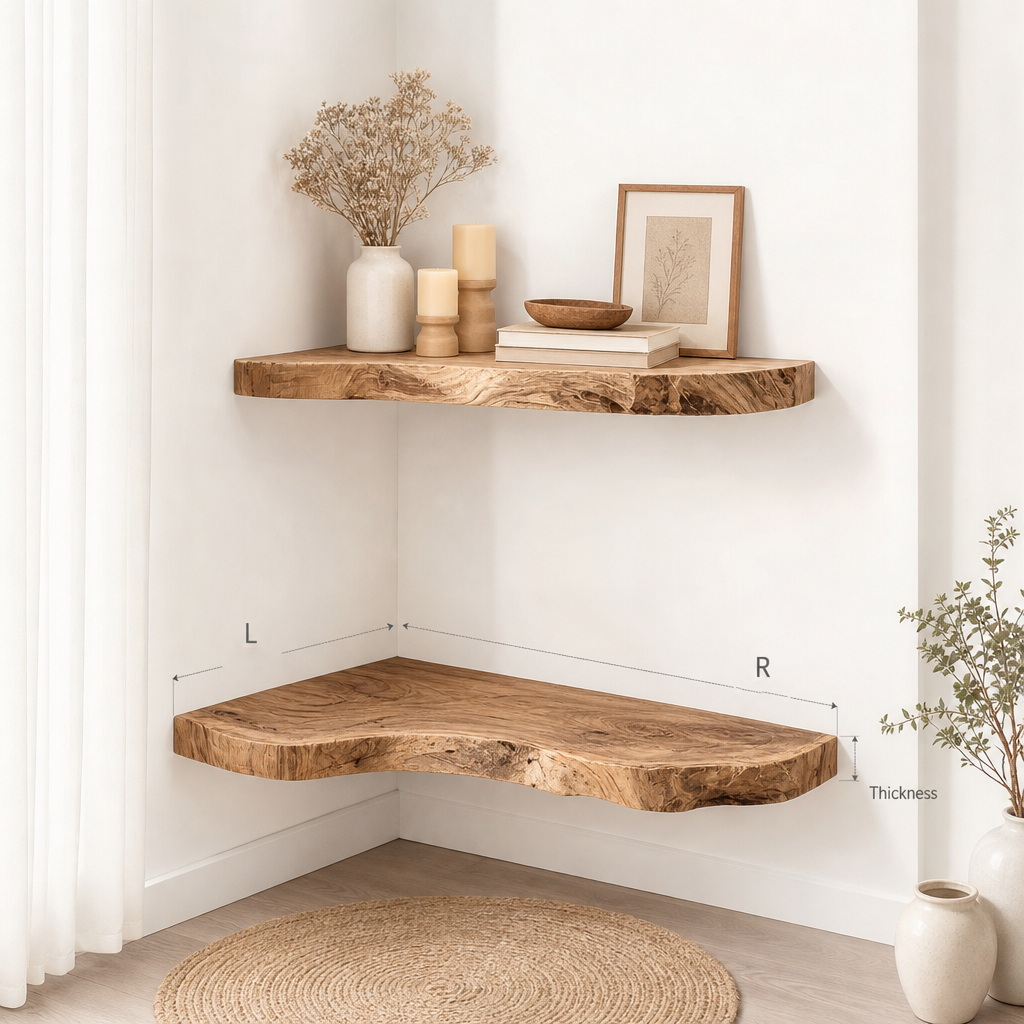
Measure wall-to-obstruction distance first - from the corner to the nearest door frame, light switch, or furniture. That's your maximum shelf length on each side.
For depth:
- 6–8 inches - Tight corners, bathrooms, behind doors. Holds small decor and toiletries.
- 8–10 inches - Most entryways and living room corners. Fits a small plant, books, or a tray.
- 10–14 inches - Open corners with plenty of clearance. Handles larger items without encroaching on walkways.
When in doubt, go shallower. A shelf that sticks out too far becomes an obstacle. One that's slightly too small is barely noticeable. For detailed sizing help, see our corner floating shelf measurement guide.
Material - Why It Matters for Drywall Installations
On drywall, the wall is almost always the weakest link - not the shelf. But shelf material still matters for one reason: sag. A thin MDF or particleboard shelf will bow in the middle under 20 lbs, even if the anchors hold perfectly. Solid hardwood won't. If you're planning to load the shelf with books, plants, or anything substantial, solid wood is worth the extra cost - not because drywall can't hold it, but because the shelf itself will last.
Single Shelf vs Multi-Tier Sets
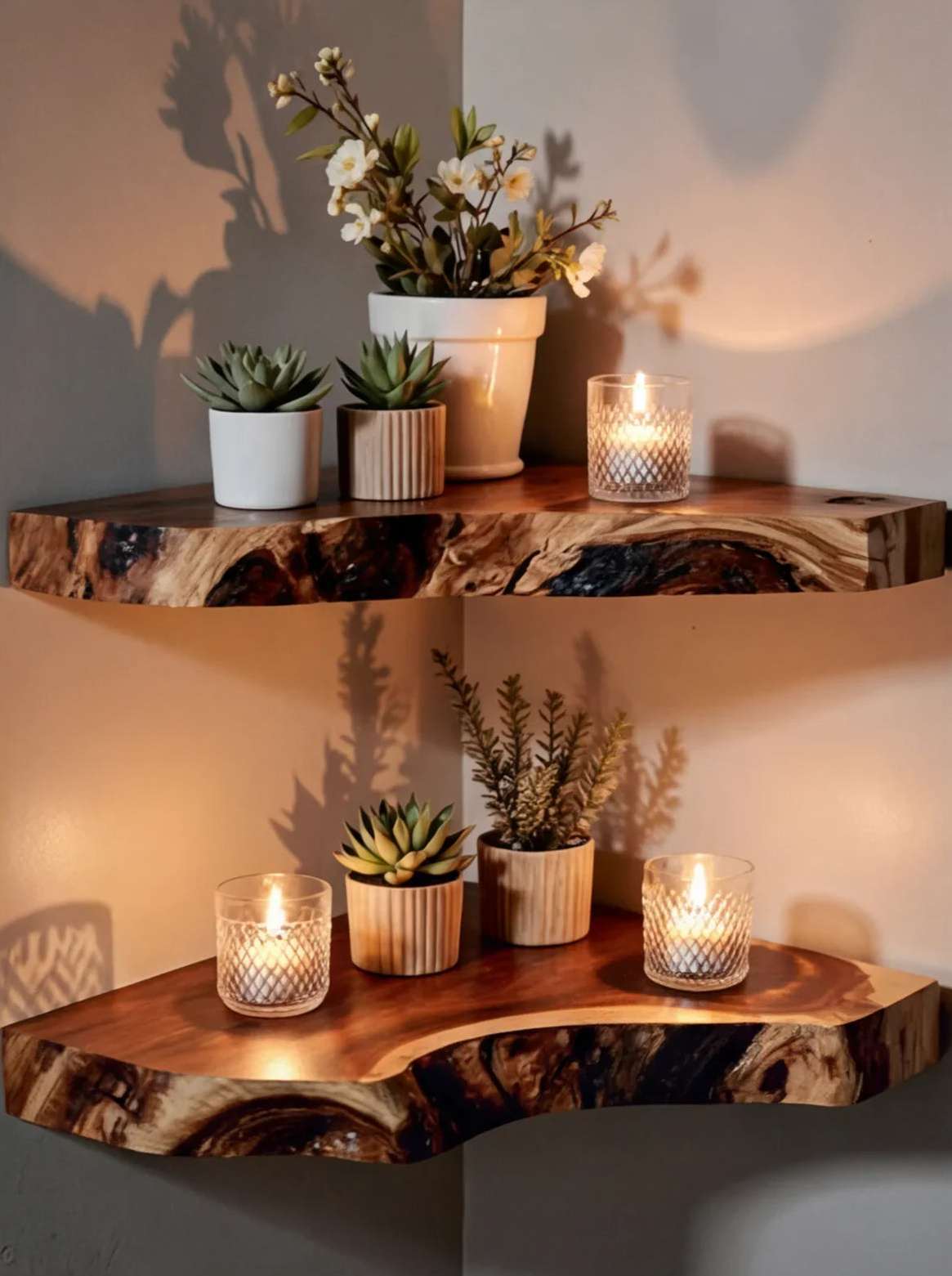
A single shelf works for one focused display - a plant, a small collection, a candle and frame. Multi-tier sets (typically 3 shelves) make sense when you want to use the full vertical height of a corner: books on the bottom, plants in the middle, decor on top. If you're on the fence, start with a set of 3 - it's easier to leave a shelf empty than to buy a second set later and try to match the finish.

Don't miss
These pieces qualify for 10% off orders over $2,000. Applied automatically at checkout.
Installation Overview
For most people: one afternoon, basic tools, no contractor needed. Mark your height, locate a stud or choose the right anchor, drill two to four holes per wall, mount the bracket or rail, then slide the shelf on.
The trickiest part is getting level in a corner - you're checking two walls at once, not one. A bubble level works fine. The most common mistake is rushing the leveling step and ending up with a shelf that looks slightly off, which is especially visible in a corner where both walls frame the view.
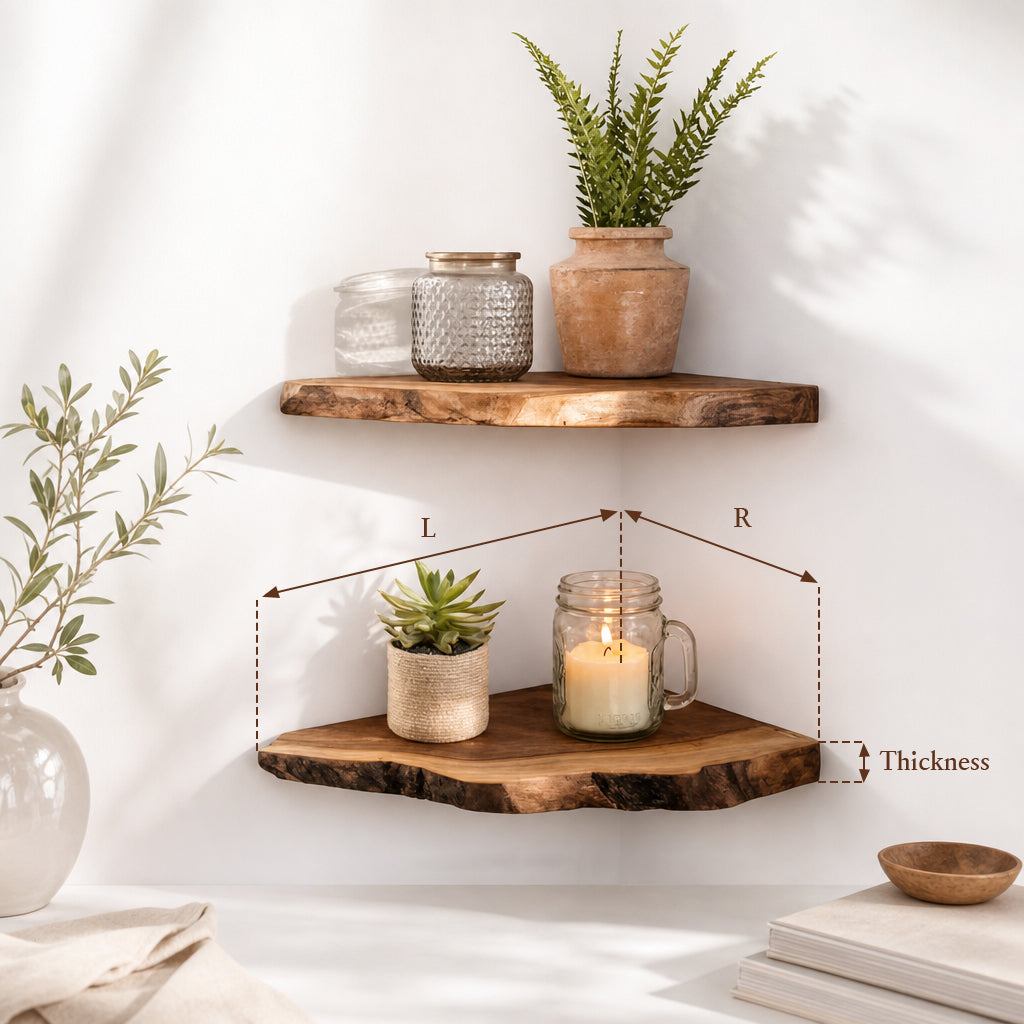
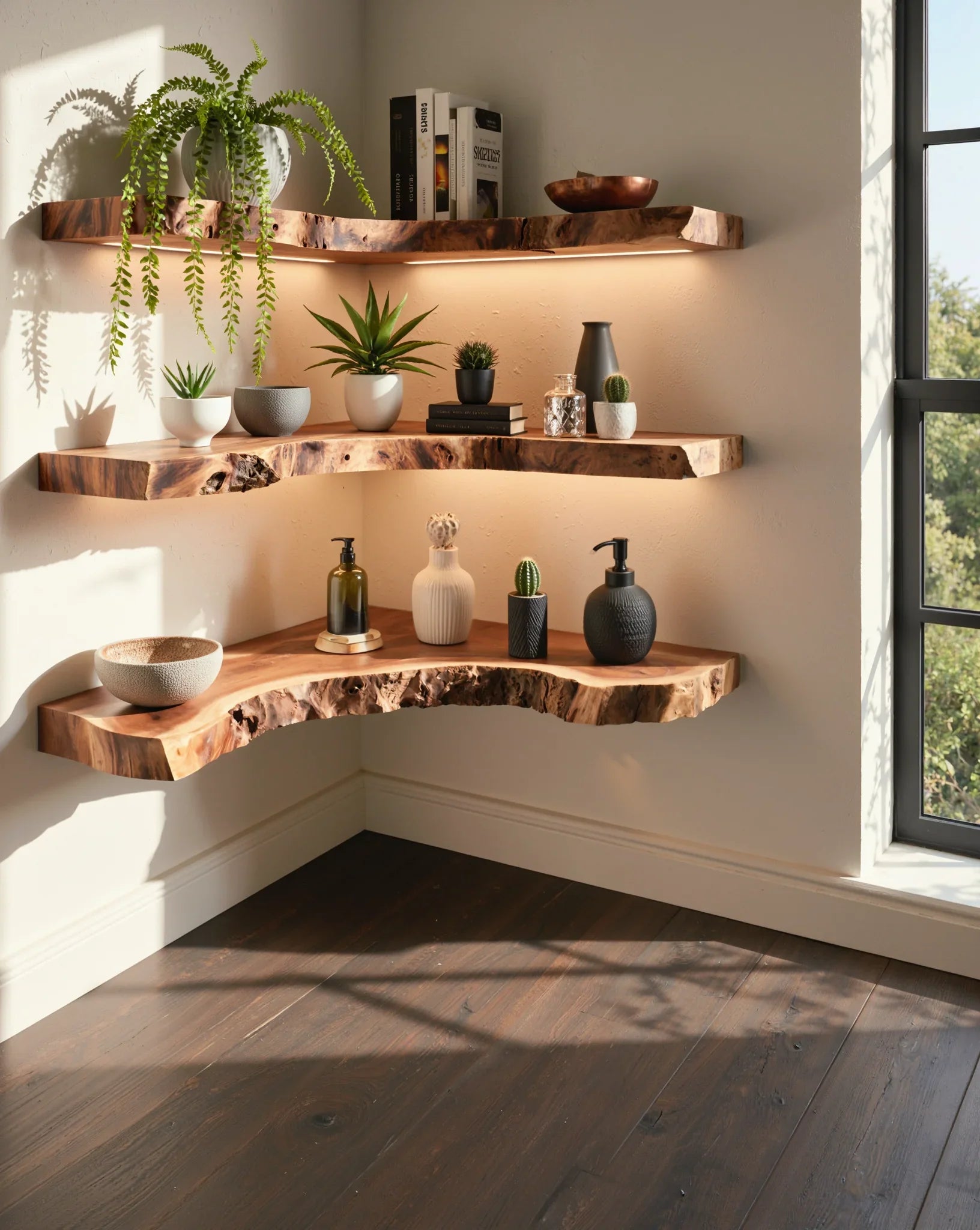
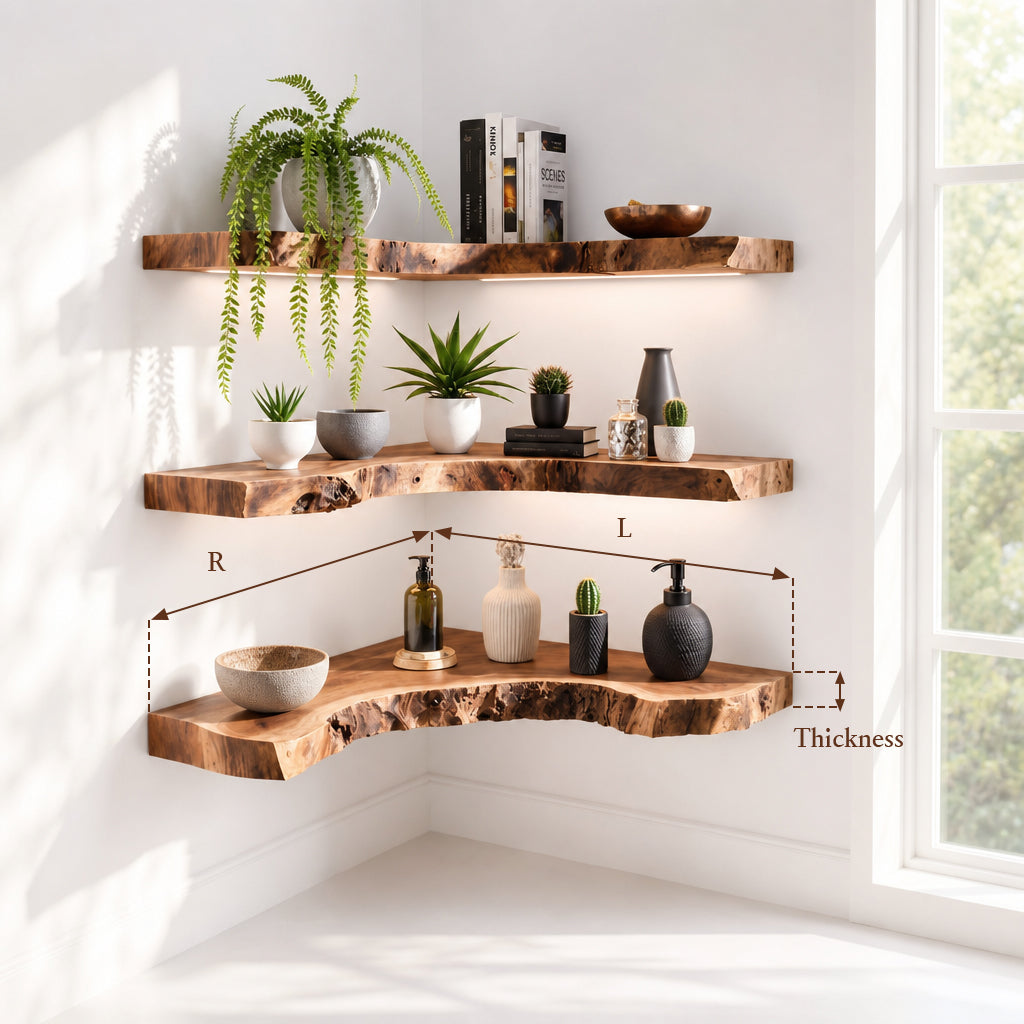
Ashdeco's solid wood corner shelves come with a hidden mounting rail system designed to work with standard drywall anchors or direct stud mounting - no proprietary hardware, nothing you can't find at any hardware store.
Why Corner Shelves Fall Off Drywall (And How to Prevent It)
Wrong anchor for the load. The number one cause. A plastic expansion plug rated for 10 lbs holds fine with a small candle. Add three books and the anchor slowly pulls out - usually at 2 AM with a loud crack.
Not hitting a stud when you should. If your shelf is loaded with anything over 25 lbs and neither side is screwed into a stud, it's a matter of time. Toggle bolts help, but studs are always better.
Ignoring the two-wall weight split. Most people calculate total shelf weight and divide by anchor count - but forget that a corner shelf's two walls are independent systems. If one side fails, the whole shelf goes. Always design around the weaker anchor side.
Off-level mounting. In a corner, the shelf needs to be level along both walls simultaneously. If it tilts toward the front edge, weight distribution shifts and puts extra stress on the front anchors. Over time, they pull out.
Corner not square. If the corner is off by more than 3 degrees, the shelf doesn't sit flush. That creates uneven pressure on the brackets, loosening screws over weeks of micro-vibration from footsteps and door slams.
Overloading beyond design limits. Check the manufacturer's specs. If none are listed, assume 15 lbs per drywall anchor as a conservative safe limit.

Frequently Asked Questions
How much weight can a floating corner shelf hold on drywall?
With plastic anchors: 5–10 lbs per anchor. With toggle bolts: 25–50 lbs per anchor. Directly into a stud: 50+ lbs. For corner shelves specifically, the real-world weight limit is determined by the weaker anchor side - usually the drywall-only side. With one stud mount and one toggle bolt (typical corner installation), a safe working limit is 30–50 lbs total.
Do I need to find a stud for a corner shelf?
Not always. For light decorative loads (plants, candles, small decor), quality drywall anchors are enough. For anything over 25 lbs - books, heavy planters, electronics - you should hit at least one stud across the two walls.
Will a floating corner shelf damage my drywall?
Drilling creates holes - that's unavoidable. But using the right anchor size minimizes damage, and holes can be patched with spackle if you ever remove the shelf. The real risk is anchors pulling out under excess weight, which tears a larger chunk of drywall. Follow weight guidelines and use toggle bolts for heavier loads, and your drywall will be fine.
What's the best anchor for drywall corner shelves?
Toggle bolts or snap-toggle anchors are the best all-around choice - rated for 25–50 lbs each, work in standard 1/2-inch drywall, and don't require a stud. For light loads, self-drilling anchors are simpler to install. Avoid plastic expansion plugs for anything beyond small decorative items.
Can I install a floating corner shelf without drilling?
Adhesive strips like 3M Command aren't reliable for corner shelves. The corner geometry creates uneven stress on adhesive mounts, and they tend to fail within weeks. If drilling isn't an option, look for tension-mounted corner shelves that sit between floor and ceiling - but those aren't truly floating.
How far apart should corner shelf brackets be?
For L-shaped shelves, one bracket per wall side is enough if each hits an anchor or stud. For longer shelves (over 24 inches per side), add a second bracket per side. As a rule: no more than 16 inches between support points.
How do I know if my wall is drywall or plaster?
Knock firmly on the wall - drywall sounds hollow, plaster sounds dense and solid. You can also push a thumbtack in: drywall gives way easily, plaster resists. Homes built before 1950 are more likely to have plaster. This matters because standard drywall anchors don't work reliably in plaster walls.
Corner Floating Shelf Ideas by Room
Entryway Corners
A small tray for keys, a candle, and a trailing plant. Keep it light - entryway corners see constant foot traffic, and you don't want anything heavy falling if someone bumps the wall.
Bathroom Corners
Rolled hand towels, a small soap dish, a candle. Moisture-resistant wood or sealed finishes work best here. Unsealed pine will warp within months in a steamy bathroom.
Kitchen Corners
Spice jars in a small basket, a cookbook stand, or a small herb pot. Keep anything grease-related off the shelf - it's harder to clean than you'd think.
Living Room & Reading Nook
A stack of current reads, a small sculpture or art object, a trailing plant. This is where a wood floating corner shelf really shines - the grain and warmth add character that metal can't replicate.
Office Corners
Framed photo, small supply caddy, a desk plant. Keep cables off the shelf unless you want visible wires ruining the floating illusion.
Looking for a handcrafted wood floating corner shelf built for drywall installation? Browse Ashdeco's floating shelf collection - solid wood, hidden mounting system, ships ready to install.