



















Quick view
- Why Corner Shelves Are the Most Underused Storage Solution
- Installation Guide: Mounting Corner Floating Shelves
- Weight Capacity: What Your Corner Shelves Can Actually Hold
- Corner Shelf Styling Ideas by Room
- Materials: Choosing Corner Shelves That Last
- Common Corner Shelf Mistakes (and How to Avoid Them)
- Frequently Asked Questions
Shop this guide
Handcrafted Floating Shelves, made to order in solid wood.
 Sculptural Overlapping Circular Solid Wood Wall Shelf with Multi Tier Display
From $1,354.00
Sculptural Overlapping Circular Solid Wood Wall Shelf with Multi Tier Display
From $1,354.00
 Mountain Landscape Relief Solid Wood Floating Shelf Live Edge Display Ledge
From $1,154.00
Mountain Landscape Relief Solid Wood Floating Shelf Live Edge Display Ledge
From $1,154.00
 Enchanted Forest Circular Wall Shelf - Round Carved Timber Mushroom Portal
From $1,023.00
Enchanted Forest Circular Wall Shelf - Round Carved Timber Mushroom Portal
From $1,023.00
 Cottagecore Arched Wood Wall Niche - Hand-Carved Fairy Mushroom Alcove Shelf
From $1,356.00
Cottagecore Arched Wood Wall Niche - Hand-Carved Fairy Mushroom Alcove Shelf
From $1,356.00
 Sculptural Hand-Carved Mushroom Solid Wood Corner Floating Shelf & Biomorphic Wall Display Ledge
From $345.00
Sculptural Hand-Carved Mushroom Solid Wood Corner Floating Shelf & Biomorphic Wall Display Ledge
From $345.00
 Sculptural Hand-Carved Mushroom Solid Wood Floating Shelves & Biomorphic Wall Display Ledges
From $345.00
Sculptural Hand-Carved Mushroom Solid Wood Floating Shelves & Biomorphic Wall Display Ledges
From $345.00
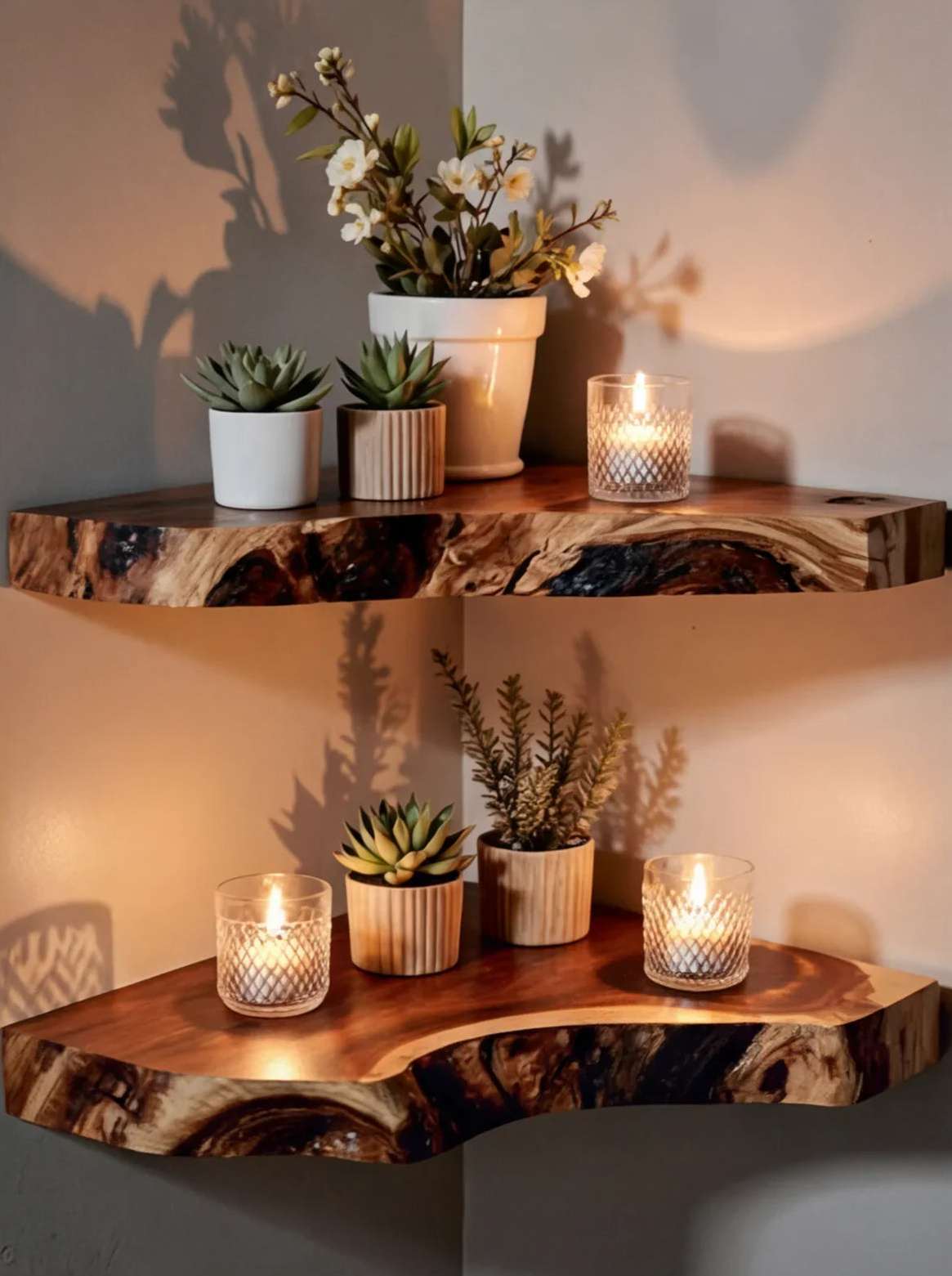
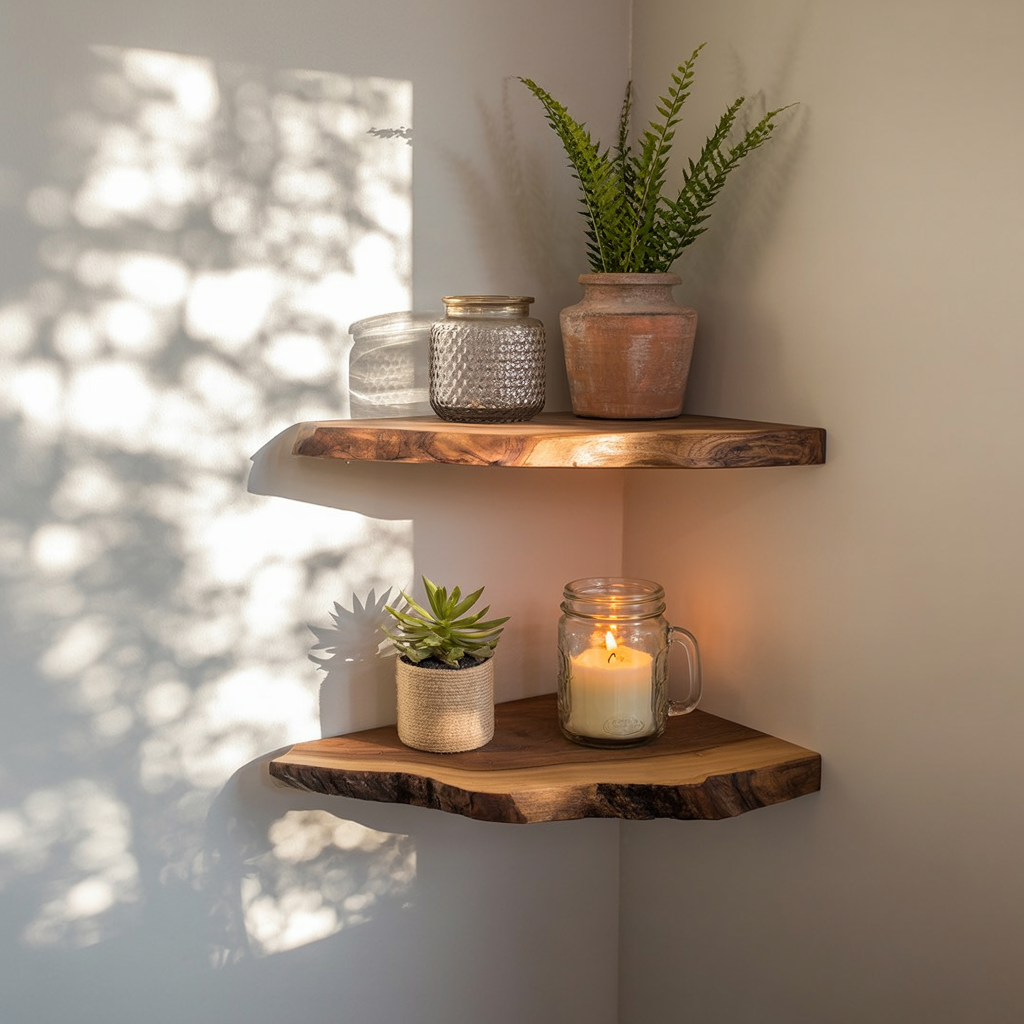
Corner floating shelves transform the most neglected spots in your home into functional display and storage areas. Every room has corners - and most of them sit completely empty, collecting dust and dead air. A single corner shelf adds 2-3 square feet of usable surface without taking up any floor space. Stack three or four vertically and you've built a full display column in a space that was previously invisible.
This guide covers everything you need to install corner shelves that stay put: finding studs in corners (it's trickier than flat walls), choosing between stud mounting and drywall anchors, weight capacity realities, and room-by-room styling ideas that actually look good. Plus a breakdown of corner wall shelf materials and what holds up best long-term.
Why Corner Shelves Are the Most Underused Storage Solution
Corners represent roughly 10-15% of your total wall space, yet most homes use none of it. Flat-wall shelves, artwork, and furniture all skip corners because standard pieces don't fit the 90-degree angle. Corner floating shelves solve this by design - they're shaped specifically to nestle into the junction where two walls meet.
The practical impact is real. A 12"x12" triangular corner shelf provides about 72 square inches of surface area. Stack five of them in a floor-to-ceiling arrangement and you've added 360 square inches - roughly 2.5 square feet - of display and storage space using zero floor footprint and zero flat wall space.
For small apartments, this isn't a nice-to-have. It's a strategy for making 600 square feet function like 700.
Installation Guide: Mounting Corner Floating Shelves
Corner shelf installation is more nuanced than flat-wall shelf mounting. The geometry is different, stud locations behave differently in corners, and the weight distribution follows different physics. Get these details right and your shelves stay solid for years. Rush through them and you'll wake up to shelves on the floor.
Finding Studs in Corners
Here's what most installation guides don't tell you: corner framing varies significantly depending on your home's age and construction method. Modern homes (2000s+) typically have two studs meeting at the corner, creating an L-shaped or T-shaped nailing surface. Older homes might have a single stud with blocking, or three studs forming a solid corner post.
Use a stud finder starting 1 inch from the corner on each wall and scanning outward. Mark what you find. In most standard framing, you'll hit solid wood within 1-2 inches of the corner on at least one wall, with the next stud at 16 inches out on each side.

Critical tip: Solid wood corner shelves are heavy - a 1.5-inch-thick walnut corner shelf can weigh 5-8 pounds empty. Add books or décor and you're easily at 20-30 pounds. Always mount into at least one stud per wall when using solid wood shelves from Ashdeco's corner floating shelf collection. For a deeper dive, see our article on corner floating shelf ideas.
Stud Mounting vs. Drywall Anchors
This decision depends on shelf material, intended load, and wall type. Here's the honest breakdown - not the optimistic version anchor manufacturers print on their packaging.
| Mounting Method | Realistic Weight Capacity | Best For | Avoid When |
|---|---|---|---|
| Lag screws into studs | 50-100+ lbs per bracket | Heavy solid wood shelves, books, kitchenware | Never bad - always the strongest option |
| Toggle bolts (drywall) | 25-50 lbs per bolt | Medium loads, lighter shelves where studs don't align | Heavy loads, plaster walls (toggle wings can break plaster) |
| Snap toggle anchors | 30-60 lbs per anchor | Same as toggle bolts but easier to install | Ceiling mounts, heavy dynamic loads |
| Plastic expansion anchors | 10-20 lbs per anchor | Very light shelves, decorative items only | Anything weighing more than a picture frame |
The stud rule for solid wood: If you're mounting shelves from Ashdeco's handcrafted corner shelf line - or any solid hardwood corner shelf - mount into studs. These shelves are made from real wood by Vietnamese artisans and have the weight to prove it. Drywall anchors are a compromise, not a solution, for heavy shelves carrying meaningful loads.
Step-by-Step Corner Shelf Installation
1. Measure and mark height. Use a tape measure from the floor, not from the ceiling (ceilings are rarely level). Mark your desired shelf height on both walls at the corner. Standard spacing between stacked corner shelves: 12-16 inches for books, 8-10 inches for small décor. Our corner shelves for small spaces article walks through the specifics.
2. Level across both walls. Place a short level (12 inches) spanning from one wall mark to the other through the corner. Corners often aren't perfectly 90 degrees - adjust marks until level.
3. Install brackets or cleats. For concealed-bracket shelves, mount the bracket hardware to both walls using 2.5-3 inch screws into studs. For visible bracket shelves, install L-brackets with the vertical arm against the wall. We've written a full breakdown in our how to mount floating shelves post.
4. Set the shelf and secure. Slide the shelf onto concealed brackets or set it on visible brackets. Some designs include a set screw from underneath to lock the shelf in place - use it. Without it, bumping the shelf can slide it off the brackets.
5. Test before loading. Press down firmly on the outer edge of the shelf (the point farthest from the wall). If there's any give, flexing, or pulling away from the wall, your mounting isn't adequate. Fix it before putting anything on the shelf.


Weight Capacity: What Your Corner Shelves Can Actually Hold
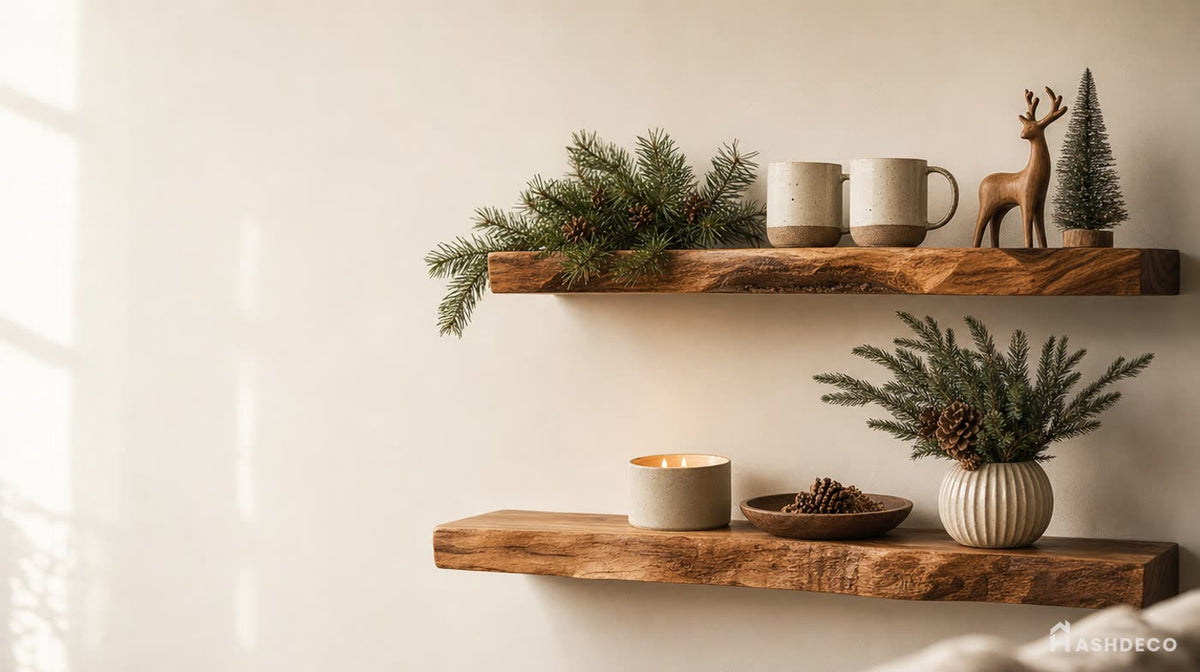
Weight capacity depends on three factors working together: shelf material strength, bracket or mounting hardware rating, and wall attachment quality. The weakest link in that chain determines your real-world limit. Most shelf collapses happen because people calculate based on the strongest component alone.
Solid hardwood shelves (1.5" thick walnut, oak, or maple): The shelf itself can handle 50+ pounds across a 12"x12" surface. Your limiting factor is the mounting hardware and wall attachment.
MDF or hollow-core shelves: The shelf material is the weak link. MDF corner shelves over 10 inches deep will sag under 15-20 pounds if the span isn't supported. Hollow-core shelves are even worse - some can't hold more than a candle and a small plant.
For book storage: Books are dense. A linear foot of average hardcover books weighs 20-25 pounds. A corner shelf loaded with books might hold 10-15 books weighing 15-25 pounds total. That's fine for solid wood on stud-mounted brackets. It's risky for MDF on drywall anchors.

Browse solid wood corner floating shelves if you need shelves that handle real loads, not just decorative items.
Corner Shelf Styling Ideas by Room
Corner shelves serve different purposes in different rooms. What works in a bathroom looks wrong in a living room. Here are specific, room-tested combinations that solve real problems rather than just filling space.
Living Room
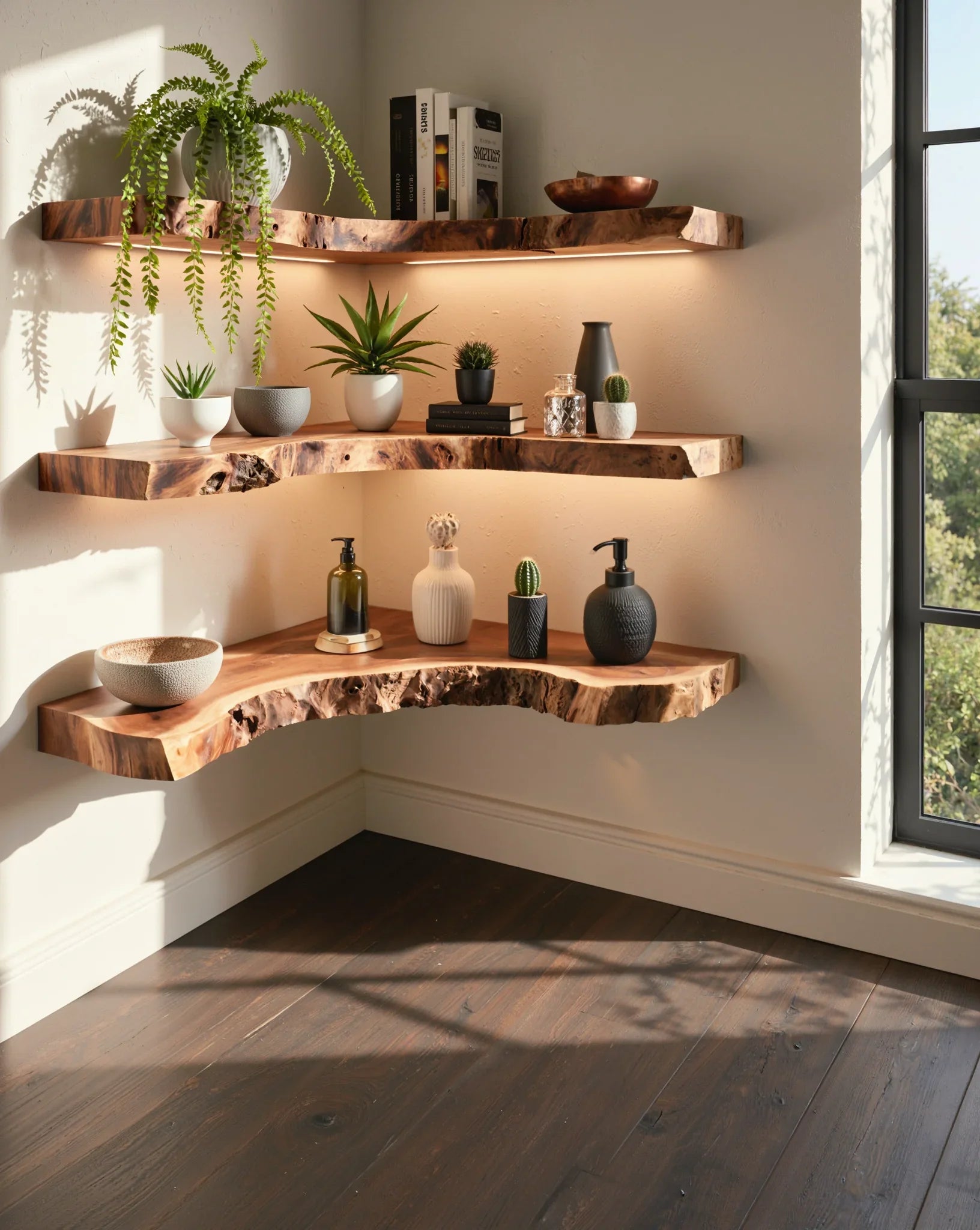
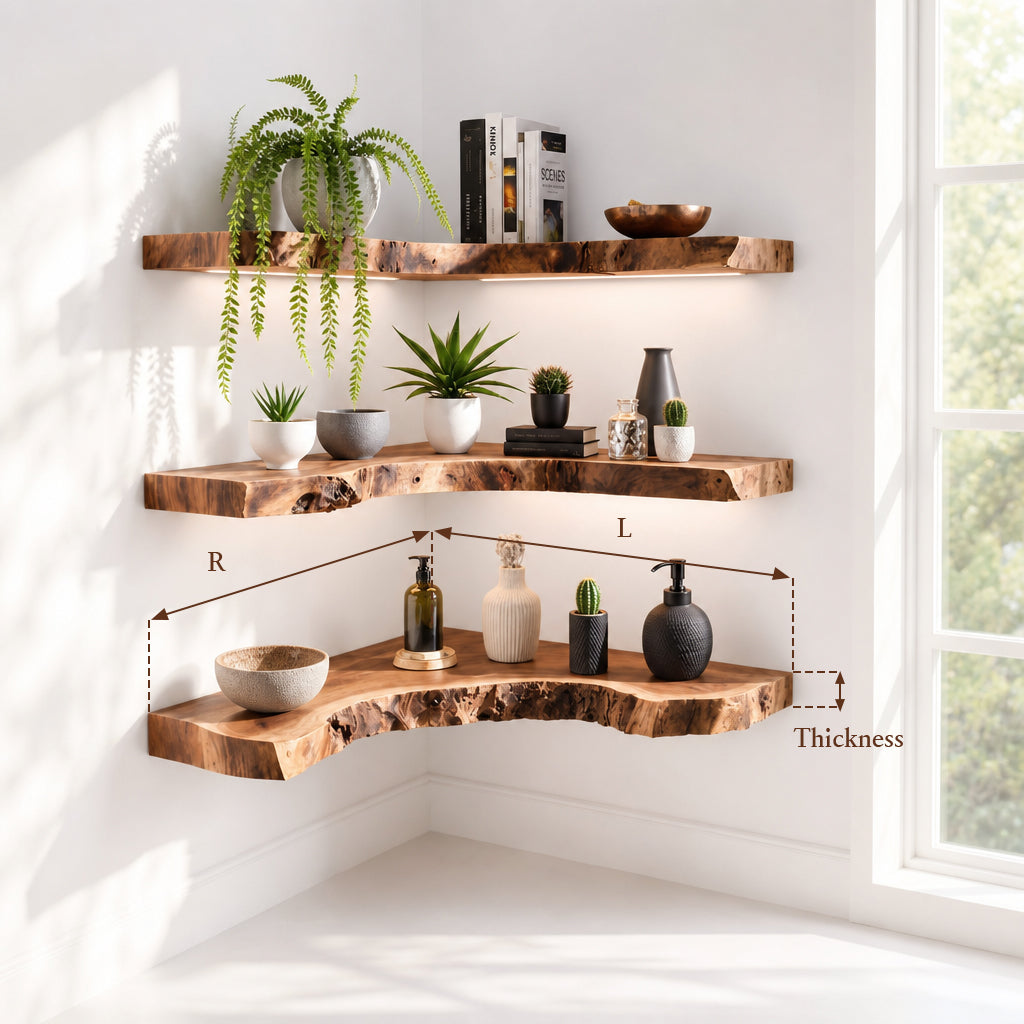
Use a vertical stack of 3-5 corner shelves as a display column for books, small plants, and collected objects. Vary the spacing: wider gaps for tall items, tighter spacing for small objects. This creates visual rhythm instead of a monotonous grid.
Place the stack in the corner behind your sofa or next to a window. These are natural "dead zones" where freestanding furniture doesn't fit, making them perfect for corner shelves.
Kitchen
Corner shelves above a countertop or next to the stove hold frequently used spices, oils, and small utensils. Open shelving in the kitchen is both functional and visually appealing - you see everything at a glance instead of digging through cabinets.
Use solid wood or stainless steel in kitchens. Avoid MDF - it swells and deteriorates with exposure to cooking moisture and heat.
Bathroom

A single corner shelf near the shower or above the toilet holds toiletries without the bulk of a medicine cabinet. Waterproof the shelf with marine-grade polyurethane or use teak, which handles moisture naturally. Pair corner shelves with standard floating shelves on adjacent walls for a complete bathroom storage solution.
Bedroom
Corner shelves flanking a bed replace nightstands, freeing floor space in tight bedrooms. Mount one on each side of the headboard at mattress-top height. Size them to hold a phone, book, and small lamp - nothing more.
Home Office
A corner shelf above a desk keeps reference materials, a small speaker, or a desk plant off the work surface. Position it 18-24 inches above monitor height to avoid head-bump territory. Multiple stacked corner shelves in an office corner create a mini reference library.
Don't miss
These pieces qualify for 10% off orders over $2,000. Applied automatically at checkout.
Materials: Choosing Corner Shelves That Last
Material choice for corner shelves matters more than flat shelves because the triangular shape concentrates stress at the wall junction. Weak materials crack or split at the corner apex over time. Strong materials handle the geometry without issues.
| Material | Durability | Moisture Resistance | Aesthetic | Corner Stress Handling |
|---|---|---|---|---|
| Solid Hardwood | Excellent - decades | Good (with finish) | Warm, natural grain | Excellent - grain runs continuously |
| Bamboo | Very Good | Very Good | Light, modern | Good - cross-laminated |
| MDF (painted) | Fair - 3-5 years | Poor - swells when wet | Smooth, uniform | Poor - prone to corner splitting |
| Glass | Good (tempered) | Excellent | Invisible, modern | Good - no grain to split |
| Metal | Excellent | Excellent (if coated) | Industrial, modern | Excellent |
Ashdeco's corner shelves are handcrafted from solid hardwood, shaped and finished by Vietnamese artisans. The continuous grain through the corner point means no weak joints or stress cracks - the kind of structural detail that matters when shelves carry real weight over real time.
Common Corner Shelf Mistakes (and How to Avoid Them)
After seeing hundreds of corner shelf installations - both professional and DIY - these are the mistakes that show up repeatedly. Skip them and your installation will look and perform better from day one.
Mistake 1: Ignoring the corner angle. Not all corners are exactly 90 degrees. Older homes can be off by 2-5 degrees, leaving visible gaps between the shelf and one wall. Measure your corner angle with a protractor or angle finder before ordering. Custom or handmade shelves can be shaped to fit non-standard angles.
Mistake 2: Spacing shelves too close together. Under 8 inches between shelves makes items hard to place and retrieve. You end up with shelves you don't use because reaching in is annoying. Give yourself at least 10 inches between shelves, more for taller items.
Mistake 3: Overloading decorative shelves. Thin MDF corner shelves sold at big-box stores are designed for 5-10 pounds of decorative items. They are not book shelves, kitchen shelves, or plant shelves. If you need to hold meaningful weight, invest in solid wood mounted into studs.
Mistake 4: Using mismatched finishes. A single set of matching corner shelves looks intentional. Mixing three different materials or finishes in the same corner looks like you bought whatever was on clearance. Pick one material, one finish, and commit.

Pair your corner shelves with matching straight floating shelves on adjacent walls for a cohesive storage system throughout the room.
Frequently Asked Questions
Can I install corner floating shelves without studs?
Yes, but with significant weight limitations. Use heavy-duty toggle bolts or snap toggle anchors rated for at least 50 pounds each. Realistically, expect to hold 15-25 pounds per shelf with drywall-only mounting. For lightweight décor and small plants, that's fine. For books, kitchenware, or solid wood shelves, you need studs. If no studs align with your corner, consider adding a plywood backer board anchored to available studs and then mounting the shelf hardware to the backer.
What size corner floating shelf should I get?
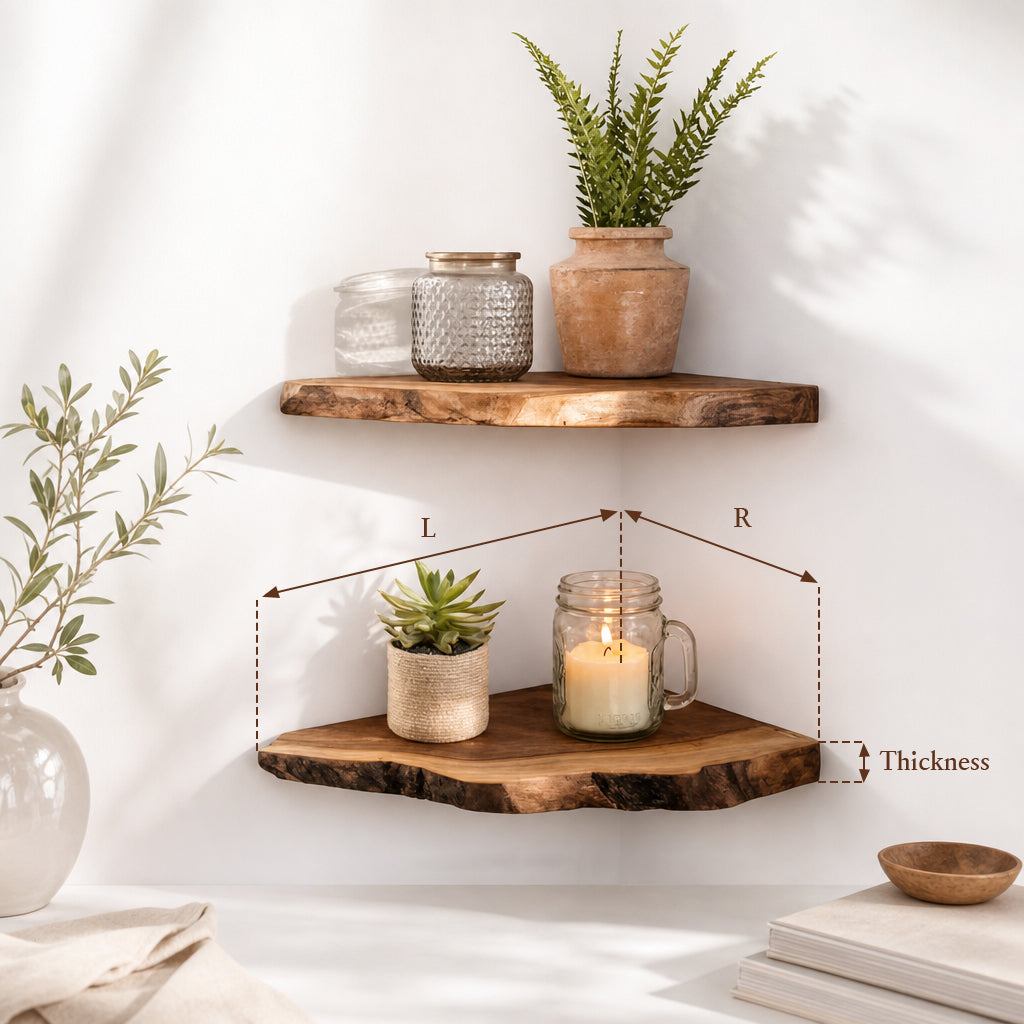
The most versatile size is 10-12 inches per side (measuring along each wall from the corner). This provides enough surface for books, small plants, or décor without protruding so far that it becomes a head-bump hazard. For display-only shelves with small items, 8 inches per side works. For functional storage (kitchen spices, bathroom supplies), go 12-14 inches per side.
How do I clean and maintain solid wood corner shelves?
Dust weekly with a dry microfiber cloth. For deeper cleaning, use a slightly damp cloth with a drop of dish soap, then dry immediately - standing water damages wood finishes. Apply paste wax or furniture polish once or twice a year to maintain the protective layer. For natural oil finishes (common on handcrafted pieces), reapply a thin coat of the same oil (tung, Danish, or linseed) annually.
Can corner shelves hold heavy items like books?
Solid wood corner shelves mounted into studs with proper brackets can hold 30-50+ pounds - easily enough for a stack of books. MDF or hollow-core shelves on drywall anchors struggle with anything over 10-15 pounds. The critical factor is mounting quality, not just shelf material. A strong shelf on weak anchors still fails. Always test your installation with weight before loading valuable items.
What's the ideal spacing between stacked corner shelves?
For books: 12-14 inches between shelves. For small décor and plants: 10-12 inches. For kitchen storage (spice jars, oils): 8-10 inches. For display items of varying heights: alternate between 10 and 14 inches to create visual interest. Always measure your tallest intended item and add 2 inches - that's your minimum spacing for that shelf.