

























Quick view
- How Many Records Do You Actually Need to Store?
- Types of Storage Configurations
- Storage Capacity Comparison by Stand Type
- How to Organize Your Vinyl Collection Inside a Stand
- What to Look For in Build Quality
- Caring for Records Inside Your Stand
- A stand that holds your records - and your turntable's sound quality.
- Finding the Right Stand for Your Space
- Frequently Asked Questions
Shop this guide
Handcrafted Record Player Stand, made to order in solid wood.
 Mid Century Stepped Solid Wood Record Player Stand with Vinyl Storage and Drawers
From $2,318.0010% off at checkout
Mid Century Stepped Solid Wood Record Player Stand with Vinyl Storage and Drawers
From $2,318.0010% off at checkout
 Sculptural Wavy Solid Wood Record Player Stand with Vinyl Storage and Drawers
From $1,536.00
Sculptural Wavy Solid Wood Record Player Stand with Vinyl Storage and Drawers
From $1,536.00
 Biophilic Sculptural Solid Wood Vinyl Record Credenza - Handcrafted Turntable Console & Media Sideboard
From $2,743.0010% off at checkout
Biophilic Sculptural Solid Wood Vinyl Record Credenza - Handcrafted Turntable Console & Media Sideboard
From $2,743.0010% off at checkout
 Sculptural Handcrafted Solid Wood Vinyl Record Storage Console with Circular Tunnel Base
From $2,217.0010% off at checkout
Sculptural Handcrafted Solid Wood Vinyl Record Storage Console with Circular Tunnel Base
From $2,217.0010% off at checkout
 Sculptural Handcrafted Z-Shape Solid Wood Turntable Stand & 2-Tier Vinyl Record Storage Rack
From $1,564.00
Sculptural Handcrafted Z-Shape Solid Wood Turntable Stand & 2-Tier Vinyl Record Storage Rack
From $1,564.00
 Sculptural Handcrafted Wave Solid Wood Turntable Stand & Low-Profile Audio Console
From $1,543.00
Sculptural Handcrafted Wave Solid Wood Turntable Stand & Low-Profile Audio Console
From $1,543.00
Your vinyl collection is growing, and it needs a proper home. A record player stand with storage solves two problems at once: it gives your turntable a stable, vibration-dampened platform and keeps your LPs organized, protected, and within arm's reach. No more stacking records on the floor or cramming them into bookshelves that weren't designed for the weight.

This guide covers every storage configuration available in 2026 - from open cubes to fully enclosed cabinets - so you can find the vinyl record storage furniture that fits your space, your collection size, and your listening habits.
How Many Records Do You Actually Need to Store?
Before choosing a stand, count your records. Then add 30 percent. Vinyl collectors consistently underestimate how fast their collections grow - the average enthusiast adds 25 to 50 LPs per year, according to data from Discogs, the world's largest music database.
Here's a quick reference for planning storage capacity:
| Collection Size | Linear Space Needed | Approximate Weight |
|---|---|---|
| 50 LPs | 7 inches | 25 lbs |
| 100 LPs | 14 inches | 50 lbs |
| 200 LPs | 28 inches | 100 lbs |
| 500 LPs | 70 inches | 250 lbs |
Each standard 12-inch LP in a jacket measures roughly 12.5 × 12.5 × 0.14 inches and weighs about 0.5 pounds. These numbers matter because vinyl record storage furniture must support serious weight - 200 records exert 100 pounds of downward force on a single shelf. For a broader look at matching capacity to stand type, see our record player stand with storage buyer's guide.
Before buying a record player stand with storage, count your current collection and add 30 percent for growth. Each LP weighs about half a pound and measures 0.14 inches thick. A collection of 200 records weighs approximately 100 pounds and requires 28 linear inches of shelf space.
Types of Storage Configurations
Short on floor space? See our vinyl record storage ideas for small spaces for creative alternatives. Record player stands with storage come in four main configurations, each with distinct advantages. For a deeper dive, see our article on best record player stands for vinyl lovers (2026 guide).
Open Shelf / Cube Storage
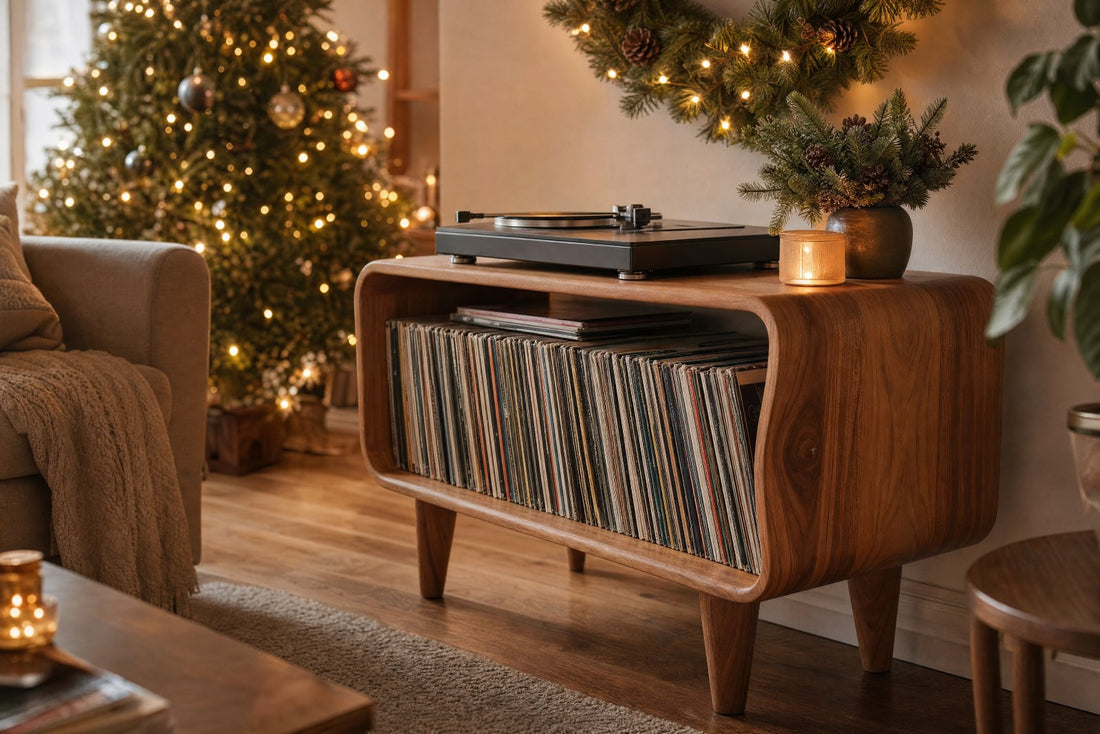
The most common and accessible design. Records sit vertically on open shelves, visible and easy to flip through. Most open-shelf stands offer two to four compartments below the turntable platform. Dust is the main concern - expect to sleeve every record in protective outer jackets.
Cabinet with Doors
Enclosed cabinets protect records from dust, light, and pets. Hinged or sliding doors add a layer of protection that open shelves can't match. The trade-off is slower access - you'll open doors every time you browse. Best for collectors who prioritize preservation over convenience. If a period-accurate look appeals to you, our retro 90s-style record player cabinet guide covers that specific aesthetic. For the open-vs-enclosed decision itself, see our wood cabinet vs open stand comparison.
Drawer Storage
Some premium stands feature pull-out drawers where records file front-to-back like hanging folders. Drawers offer the best dust protection and the most satisfying browsing experience, but they're typically more expensive and mechanically complex.
Hybrid Designs

The best record player stands combine open and enclosed storage - open cubes for your current rotation and a cabinet section for long-term storage. This gives you quick access to favorites while protecting the rest. Our vintage record player cabinet - complete style guide article walks through the specifics.
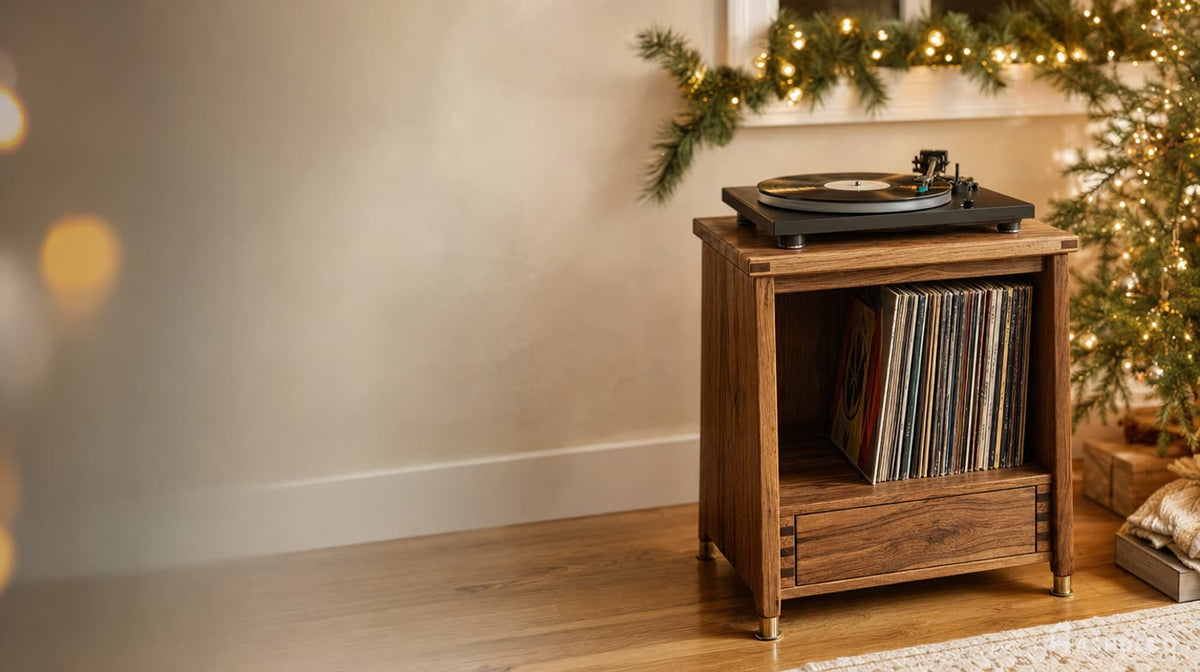
Record player stands offer four storage types: open shelves for quick access, enclosed cabinets for dust protection, pull-out drawers for premium browsing, and hybrid designs combining open and closed sections. Hybrid stands are ideal because they keep favorites accessible while protecting the rest of your collection.


Storage Capacity Comparison by Stand Type
Not all stands hold the same number of records. Here's what to expect from each configuration:
| Stand Type | Typical Capacity | Shelf Depth | Best For |
|---|---|---|---|
| 2-Cube Open Shelf | 80-120 LPs | 13-14 in | Starter collections |
| 4-Cube Open Shelf | 160-240 LPs | 13-14 in | Growing collections |
| Single-Door Cabinet | 100-180 LPs | 14-16 in | Dust-sensitive environments |
| Double-Door Cabinet | 200-400 LPs | 14-16 in | Serious collectors |
| Drawer Unit (2 drawers) | 120-200 LPs | 14-15 in | Premium browsing |
| Console / Credenza | 300-600 LPs | 14-16 in | Large collections |

Remember that shelf depth must be at least 13 inches to fit a standard 12-inch LP in a protective sleeve (12.5 inches). Ashdeco's handcrafted record player stands are built at 15 inches deep, giving you comfortable clearance for even thick gatefold sleeves. We've written a full breakdown in our DIY record player stand vs handcrafted: worth the splurge? post.
Storage capacity varies widely by stand type. Two-cube open shelves hold 80-120 LPs, four-cube designs hold up to 240, single-door cabinets store 100-180, and full consoles can accommodate 300-600 records. All shelves should be at least 13 inches deep to fit sleeved 12-inch LPs.
How to Organize Your Vinyl Collection Inside a Stand
Storage furniture is only as useful as your organization system. Here are the most practical approaches:
- Alphabetical by artist: The classic method. Works well for collections under 300 LPs. Beyond that, browsing becomes tedious.
- By genre, then alphabetical: Split your collection into 4-6 genre sections, then alphabetize within each. This mirrors how record stores organize and makes mood-based browsing intuitive.
- Chronological by acquisition: Some collectors file records in the order they bought them. Each record carries a memory of where and when you found it.
- Current rotation up front: Keep your 20-30 most-played records in the most accessible shelf or an open cube at eye level. Rotate monthly.
Whichever system you choose, use dividers. Tabbed dividers every 20-30 records prevent the dreaded "vinyl lean" where unsupported records warp from resting at an angle. Quality dividers are ⅛-inch thick acrylic or solid wood - cardboard dividers buckle under weight.
Organize vinyl inside a storage stand by genre then alphabetically, keep your 20-30 most-played records in the front-facing accessible shelf, and use tabbed dividers every 20-30 records. Dividers prevent vinyl lean and warping - choose ⅛-inch acrylic or solid wood dividers over cardboard, which buckles under weight. If you're weighing your options, our guide on vinyl record storage ideas for small spaces breaks it down further.
Don't miss
These pieces qualify for 10% off orders over $2,000. Applied automatically at checkout.
10% off
Mid Century Stepped Solid Wood Record Player Stand with Vinyl Storage and Drawers
From $2,318.00
10% off at checkout
10% off
Biophilic Sculptural Solid Wood Vinyl Record Credenza - Handcrafted Turntable Console & Media Sideboard
From $2,743.00
10% off at checkout
10% off
Sculptural Handcrafted Solid Wood Vinyl Record Storage Console with Circular Tunnel Base
From $2,217.00
10% off at checkout
 10% off
Sculptural Handcrafted Live Edge Tree Trunk Solid Wood Vinyl Record Player Stand & Media Console
From $2,178.00
10% off at checkout
10% off
Sculptural Handcrafted Live Edge Tree Trunk Solid Wood Vinyl Record Player Stand & Media Console
From $2,178.00
10% off at checkout
What to Look For in Build Quality
Considering building your own? Read our DIY vs handcrafted comparison before you commit. A record player stand with storage handles more weight than typical furniture. That 200-LP collection weighs 100 pounds, concentrated on shelves only 13-14 inches deep. Build quality isn't optional - it's structural.
Shelf thickness: Minimum ¾ inch for solid wood, 1 inch for MDF. Thinner shelves bow under the weight of vinyl over time, and once a shelf warps, your records warp with it.
Joinery: Dovetail and mortise-and-tenon joints resist lateral stress far better than cam-lock or dowel joints found in flat-pack furniture. Ask what joinery method the manufacturer uses - if they can't answer, it's probably cam-lock. Our wood turntable stand guide covers joinery and wood species in more depth.
Back panel: A solid wood or thick plywood back panel adds structural rigidity and prevents racking (the side-to-side wobble that happens when you push against a bookshelf). Thin hardboard backs - common in budget furniture - provide almost no structural value.
At Ashdeco, our Vietnamese artisans use mortise-and-tenon joinery and solid wood back panels on every piece. Each stand is built to carry a full collection's weight for decades, not just years.
Quality record player storage stands need ¾-inch minimum shelf thickness, dovetail or mortise-and-tenon joinery, and solid wood or thick plywood back panels. Budget furniture uses cam-lock joints and thin hardboard backs that wobble and fail under the concentrated weight of a vinyl collection.
Caring for Records Inside Your Stand
Proper storage extends the life of your vinyl. Follow these guidelines:
- Store records vertically, never stacked flat. Horizontal stacking causes ring wear on jackets and warps records under sustained pressure. Even 10 LPs stacked flat exert 5 pounds of concentrated pressure on the bottom record.
- Keep storage areas away from heat sources. Vinyl warps at temperatures above 140°F, but prolonged exposure to 100°F can cause gradual deformation. Position your stand away from radiators, heating vents, and sunny windows.
- Maintain moderate humidity. Paper sleeves and cardboard jackets absorb moisture. The ideal range is 45-50% relative humidity. Below 30%, jackets become brittle; above 65%, mold becomes a risk.
- Use inner and outer sleeves. Replace original paper inner sleeves with anti-static poly-lined sleeves. Add clear outer sleeves to protect jacket artwork from shelf wear.
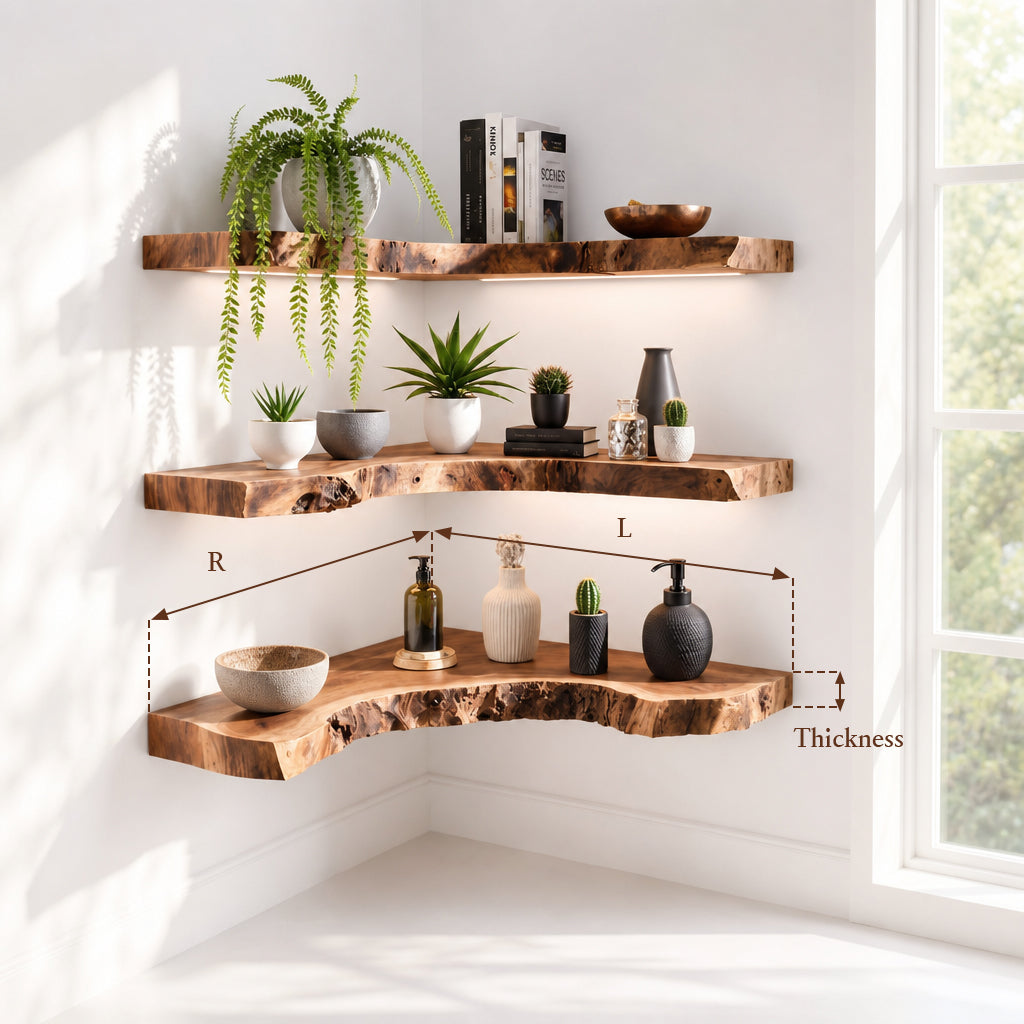
A well-built stand from a collection like Ashdeco's floating shelves can also display your favorite cover art as wall décor while keeping records safe. If you're planning a full setup rather than just storage, our guide to building a vinyl listening station at home covers speaker placement, seating distance, and cable routing alongside storage.
Store vinyl records vertically inside your stand - never stacked flat, which causes warping and ring wear. Keep the stand away from heat sources, maintain 45-50% humidity, and use anti-static poly-lined inner sleeves plus clear outer sleeves to protect both the vinyl and jacket artwork.
Finding the Right Stand for Your Space
Measure your space before you shop. Record player stands with storage tend to be deeper and wider than standard media consoles. Here are common dimensions to expect:
- Compact (apartment-friendly): 24-30 inches wide × 14-16 inches deep × 26-30 inches tall. Holds 80-150 LPs.
- Standard: 36-48 inches wide × 15-18 inches deep × 28-32 inches tall. Holds 200-400 LPs.
- Console / Credenza: 48-72 inches wide × 16-20 inches deep × 24-28 inches tall. Holds 400-600+ LPs.
Leave at least 4 inches of clearance behind the stand for cables and ventilation if you're housing an amplifier or receiver. Turntable lids that open upward need 14-18 inches of vertical clearance above the platform.
Consider pairing a compact stand with a tree bookshelf for overflow storage - it keeps the visual weight distributed across the room rather than concentrated in one heavy piece.
Compact record player stands with storage measure roughly 24-30 inches wide and hold 80-150 LPs. Standard models run 36-48 inches wide for 200-400 LPs. Full consoles stretch 48-72 inches wide and store 400-600+ records. Always leave 4 inches behind the stand for cables and ventilation.
Frequently Asked Questions
How many vinyl records can a Kallax-style shelf hold?
A standard 2×2 Kallax unit holds approximately 140-160 LPs across its four cubes. Each cube fits 35-40 records comfortably. However, Kallax shelves lack vibration dampening and aren't designed to support a turntable's weight on top long-term. Purpose-built stands offer better stability and acoustics.
Should I store records in a closed cabinet or open shelf?
Closed cabinets protect records from dust, light, and pets but require ventilation to prevent humidity buildup. Open shelves offer instant access and airflow but expose records to environmental contaminants. Hybrid designs - open cubes for current rotation, enclosed sections for storage - offer the best of both worlds.
What's the minimum shelf depth for vinyl record storage?
The minimum shelf depth for vinyl record storage is 13 inches. A standard 12-inch LP in a protective outer sleeve measures approximately 12.5 inches. We recommend 14-15 inches of depth for comfortable browsing without records hanging over the edge, especially for thick gatefold jackets.
Can vinyl record storage furniture double as a TV stand?
Yes, many record player stands with storage work as TV consoles. Look for models rated to support your TV's weight on the top surface and verify the height works for your seating position. Keep in mind that speaker vibration from a nearby TV can affect turntable playback quality.
How do I prevent my records from leaning and warping in storage?
Use vertical dividers every 20-30 records to prevent lean. Fill each shelf section completely or use bookends to keep records upright. Never store records at an angle - sustained pressure from leaning causes gradual warping over months, especially in warm environments above 75°F.