Floating Mushroom Shelf for Nursery: Safe Materials & Finish Guide
Quick Answer - 3 Things That Make a Nursery Shelf Actually Safe
Before you care about how a nursery mushroom shelf looks, check these three things:
1. Material: Solid wood or CARB Phase 2 compliant plywood only. No cheap MDF, no particleboard, no unknown composite boards. Babies breathe differently than adults - what's "fine" for a living room mushroom shelf is not fine in a nursery.
2. Finish: Zero-VOC, water-based, ideally GREENGUARD Gold certified. "Dry to touch" does not mean safe to breathe. Full cure takes 7–30 days depending on finish type.
3. Details: No glued-on decorative elements. If a painted dot, fabric flower, or resin accent can break off, it's a choking hazard once baby starts grabbing (6–9 months).
For where to place nursery shelves safely, see our Mushroom Shelf for Kids Room Guide. For mounting hardware specifics, see our Mushroom Wall Shelf Mounting Guide. For styling without looking childish, see Mushroom Shelves Design. This article focuses on the part nobody covers: what the shelf is actually made of and what it's putting into your baby's air.

The Air Your Baby Breathes - Why Nursery Mushroom Shelf Material Matters More Than You Think
Newborns spend 12–16 hours a day in the nursery, mostly in one position (the crib). They breathe 30–60 breaths per minute compared to an adult's 12–20. That means per pound of body weight, your baby is pulling in 3–5× more air than you are - including whatever chemicals that air contains.
A mushroom shelf that "smells fine" to an adult can still be emitting volatile organic compounds (VOCs) at levels that affect developing lungs. The difference isn't dramatic - you won't see anything or smell anything after the first week - but the exposure is cumulative. Months of low-level VOC exposure in an enclosed nursery adds up differently than the same exposure in a well-ventilated living room.
Most nursery furniture guides say "pick non-toxic" and stop there. Nobody explains what that actually means, how to verify it, or what labels are real certifications vs marketing. This article fixes that gap.

Wood Material Safety - What's In the Mushroom Shelf?
The wood (or wood-like material) inside a mushroom shelf determines whether it's slowly releasing chemicals into your nursery air. Here's the breakdown from safest to riskiest.
Solid Wood - The Safest Option
Oak, rubberwood, pine, walnut, maple. Solid wood has no binders, no glues, no formaldehyde. It's just wood. The only finish-related concern is what coating is applied on top (covered in the next section).
FSC (Forest Stewardship Council) certification means the wood was sustainably sourced - not a safety concern per se, but a good indicator of supply chain transparency. Brands that certify their wood tend to be more careful about finishes too.
Best for: Nursery. No caveats.
Plywood - Safe If Certified
Plywood is layers of wood veneer glued together. The glue is where formaldehyde can enter the equation. But not all plywood is equal:
- Baltic birch plywood - the gold standard. Fewer voids, thinner veneers, typically uses lower-formaldehyde adhesives. Preferred by high-end nursery furniture makers.
- CARB Phase 2 compliant plywood - meets California's formaldehyde emission limits for composite wood. This is the minimum standard you should accept for any shelf going in a nursery.
- TSCA Title VI compliant - the federal version of CARB Phase 2. Same formaldehyde limits, applies nationwide.
If a mushroom shelf listing says "engineered wood" without specifying CARB or TSCA compliance, assume it's the cheap stuff and ask the seller.
Best for: Nursery, as long as it carries CARB Phase 2 or TSCA Title VI certification.
MDF / Particleboard - Avoid for Nursery
Medium-density fiberboard and particleboard are made from wood fibers or chips bound together with urea-formaldehyde resin. That resin off-gasses formaldehyde for months to years after manufacture.
Even "low-VOC" MDF uses formaldehyde-based binders - the "low" refers to surface coatings, not the core material. E0 and E1 rated boards have lower formaldehyde content, but lower is not zero.
For a living room or adult bedroom? E1 MDF is fine. For a room where a baby spends 12+ hours a day breathing concentrated air? Not worth the risk.
What to look for on product listings:
- ✅ "Solid wood," "FSC-certified," "CARB Phase 2," "TSCA Title VI"
- ✅ "Baltic birch plywood"
- ⚠️ "E0 rated," "E1 rated" - lower formaldehyde but not zero
- ❌ "MDF," "particleboard," "engineered wood" (without certification specified)

Finish Safety - Where the Real Danger Hides
The wood itself might be fine. The finish on top of it is where most nursery shelves fail the safety test.
VOCs Explained - What They Are and Why They Matter for Babies
Volatile Organic Compounds are chemicals that evaporate at room temperature into the air you breathe. The common ones in furniture finishes:
- Formaldehyde - respiratory irritant, classified as a known human carcinogen
- Benzene - found in solvent-based finishes, linked to blood disorders
- Toluene and xylene - neurotoxic at high exposure, found in many oil-based coatings
- Phthalates - plasticizers sometimes added to finishes for flexibility, linked to endocrine disruption
The EPA and WHO both note that infants are more vulnerable to VOC exposure than adults due to higher breathing rates, developing organs, and more time spent in one location (the crib).
The good news: modern water-based finishes have largely eliminated these chemicals. The bad news: cheap imported shelves and oil-based finishes still use them.
Zero-VOC vs Low-VOC vs "No Added VOC" - The Labels Are Not the Same
This is where marketing gets confusing:
- Zero-VOC - technically means <5 grams per liter. Very low, but not absolute zero. Still the best option available.
- Low-VOC - means <50 g/L. Significantly higher than zero-VOC. Acceptable for most rooms, not ideal for an enclosed nursery.
- "No Added VOC" - the manufacturer didn't add VOCs during finishing, but the base product (wood, adhesive, primer) may contain them. This is a loophole label. A shelf can be "no added VOC" and still emit measurable formaldehyde from its core material.
If a listing only says "eco-friendly," "green," or "natural finish" without specifying a VOC number or certification - it's marketing, not a safety claim.
GREENGUARD Gold Certification - What It Actually Tests For
GREENGUARD Gold (formerly GREENGUARD Children & Schools) is the only nursery-relevant certification that actually tests finished products for chemical emissions, not just ingredients.
It tests for 360+ VOCs, including formaldehyde, phthalates, and semi-volatile organic compounds. The emission limits are set for "sensitive populations" - children, elderly, people with respiratory conditions. Standard GREENGUARD (without "Gold") has higher limits - designed for offices and commercial buildings, not nurseries.
Key point: GREENGUARD Gold certifies the finished product, not just the materials. That means the wood, the glue, the finish, the paint - everything - was tested together for total emissions.
Not every good nursery shelf has GREENGUARD Gold (the certification costs $5,000–10,000 per product, which many small makers can't afford). But if a shelf has it, that's a strong safety signal. If a shelf claims to be "baby-safe" but has no certification and no finish specification - that's a red flag.
Water-Based vs Oil-Based Finishes
| Finish Type | VOC Level | Cure Time | Nursery Safe? |
|---|---|---|---|
| Water-based polyurethane | Low to zero | 7–14 days full cure | Yes |
| Oil-based polyurethane | High | 14–30 days full cure | Avoid |
| Natural oils (tung, linseed) | Low | 14–28 days full cure | Only if fully cured before baby arrives |
| Acrylic paint (water-based) | Zero to low | 3–7 days full cure | Yes |
| Solvent-based stain | High | 14–21 days full cure | Avoid |
Water-based polyurethane is the default recommendation for nursery shelves. It has low odor, fast cure, and minimal VOC emissions. Oil-based finishes are more durable but emit significantly more chemicals for significantly longer.
Natural oils (pure tung oil, raw linseed oil) are low-VOC but take a long time to fully cure - 2–4 weeks. During that curing period, they're still emitting. If you're finishing a shelf yourself with natural oil, do it at least a month before the baby arrives.
The Curing Timeline Trap - "Dry to Touch" ≠ Safe to Breathe
This is the most misunderstood part of furniture safety:
- Surface dry (2–6 hours): The finish is no longer wet. Safe to handle, NOT safe for baby air. The solvents and chemicals are still evaporating - you just can't feel them anymore.
- Touch dry (24–48 hours): No tackiness. Still off-gassing at significant levels.
- Full cure (7–30 days): The finish has fully polymerized. Chemical emissions drop to baseline. This is when the shelf is actually safe for nursery air.
The smell test: If you can smell the finish, it's still off-gassing - that's the easy check. But the reverse isn't true: absence of smell doesn't guarantee safety. Some VOCs (like formaldehyde at low concentrations) are odorless.
Recommendation: Mount and finish nursery shelves at least 4 weeks before baby arrives. This gives even the slowest-curing finishes time to fully off-gas. If shelves are already mounted and baby is already here: ventilate aggressively. Open windows, run an air purifier with an activated carbon filter (HEPA alone doesn't capture VOCs), and keep the nursery door open when possible.

Small-Parts & Decorative Detail Safety
A mushroom shelf's shape is its selling point - the cap, the stem, sometimes painted spots or carved gills. But those decorative details introduce a safety consideration that rectangular shelves don't have.
Integrated vs Glued-On Details
- Integrated details - painted dots, carved gills, sculpted cap shape that's part of the wood itself. These can't break off. Safe.
- Glued-on elements - plastic dots, fabric flowers, resin mushrooms, decorative beads glued onto the shelf surface. These can break off, especially as wood expands and contracts with humidity changes. Choking hazard once baby can reach the shelf.
How to tell the difference: Run your fingernail along the edge of any decorative element. If you feel a seam or ridge where the detail meets the shelf surface, it's likely glued or attached separately. Integrated details are carved or painted into the wood - no seam.
The "Reach Phase" Timeline
Babies typically start pulling themselves up and grabbing objects at 6–9 months. Before that stage, shelf contents don't matter much - baby can't reach them. After that stage, everything on a nursery shelf within baby's reach is either:
- Too big to swallow (safe)
- Small enough to swallow (choking hazard)
- Heavy enough to hurt if dropped (impact hazard)
Re-evaluate shelf contents at 6 months. Remove any item smaller than a toilet paper tube (the standard choke-test cylinder). Move the shelf higher if needed. Or switch to items that are too large to grab and swallow.
Edge Safety
Mushroom shelves typically have rounded, organic edges - which is one reason they're safer than rectangular shelves in a nursery. But "rounded" isn't guaranteed. Run your hand along every edge before mounting. If you feel a rough spot, splinter, or sharp corner, sand it down or return the shelf. Babies will find every rough edge eventually.

What to Put ON a Nursery Mushroom Shelf (and What to Skip)
Safe Items
- Board books - lightweight, unbreakable, age-appropriate
- Small stuffed animals - soft, no small parts, lightweight if they fall
- Wooden toys - solid, smooth, too large to swallow
- Fabric baskets - for storing diapers, wipes, small supplies (on shelves above changing tables)
- Acrylic photo frames - unbreakable alternative to glass
- Soft textiles - small knitted blankets, fabric bunting
Items to Skip
- Glass decor - break hazard. Even if mounted high, it can be knocked off during cleaning or by an older sibling.
- Heavy hardcover books at shelf edges - if they fall from shelf height onto a baby, they can cause injury. Keep heavy items at the back, or skip them entirely.
- Small choking-hazard items - anything that fits inside a toilet paper tube should not be on a nursery shelf within baby's reach.
- Live plants - soil introduces mold spores into nursery air. Some common houseplants (pothos, philodendron, peace lily) are toxic if ingested. Not worth the risk.
- Scented candles or diffusers - these add VOCs to nursery air, directly defeating the purpose of choosing a non-toxic shelf. If you want the nursery to smell nice, ventilate with fresh air.
- Loose decorative beads, sequins, or small craft items - choking hazard, dust magnet.
Practical Items Above the Changing Table
If your mushroom shelf is positioned above the changing table (one of the safest and most practical spots):
- Diaper cream (keep tube sealed)
- Thermometer
- Burp cloths (in a fabric basket)
- Wipes (keep package sealed to prevent drying)
- Small night-light
Keep these items toward the back of the shelf, out of baby's reach once they start swatting at objects (around 4–5 months).
Rotation Strategy
Swap shelf items monthly to maintain visual interest without adding more stuff. Clutter = dust = baby air quality issue. A shelf with 3–5 well-chosen items looks better and is safer than one packed to the edges.

Mushroom Shelf vs Regular Floating Shelf for Nursery
When does the mushroom shape actually matter for a nursery?
Mushroom wins when:
- Soft rounded corners are a priority (no sharp edges near baby's head)
- The room has a woodland, fairy tale, or nature theme
- You want visual warmth without adding more items
- The shelf is primarily decorative with light storage needs
Regular floating shelf wins when:
- Maximum storage is the goal (mushroom shape reduces usable surface area)
- The room is minimalist or modern
- Budget is the primary constraint (mushroom shelves typically cost 20–50% more than equivalent rectangular shelves)
Storage capacity is also a fair question to ask before choosing either shape - our guide to what a mushroom shelf can hold covers realistic weight limits by design, which matters more once you're past the newborn stage and the shelf starts holding board books and toys instead of just decor.
For the full comparison of mushroom shelf types and sizes, see our Mushroom Shelf Buying Guide. If you're weighing shapes and styles side by side, browse the full Floating Shelves for Nursery collection to compare mushroom, wall, and tree styles in one place.
FAQ
What is the safest material for a nursery mushroom shelf?
Solid wood with a water-based, zero-VOC finish. Look for FSC certification (sustainable sourcing) and GREENGUARD Gold certification (emissions tested). If solid wood is outside budget, CARB Phase 2 compliant Baltic birch plywood is the next best option.
Is GREENGUARD Gold certification worth it for nursery furniture?
It's the strongest safety signal available for chemical emissions. The certification tests for 360+ VOCs at levels designed for children's sensitivity. Not every good nursery shelf has it (certification is expensive for small makers), but if a shelf has it, that's a meaningful differentiator.
How long should I wait after finishing a shelf before putting it in a nursery?
At least 4 weeks for full cure. Water-based finishes cure faster (7–14 days), but oil-based finishes and natural oils can take 14–30 days. If you can still smell the finish, it's still off-gassing - and some VOCs are odorless even at unsafe levels.
Are painted mushroom shelves safe for baby rooms?
Yes, as long as the paint is water-based, zero-VOC acrylic paint. Avoid solvent-based paints and any shelf where the paint type isn't specified. Water-based acrylic paint is the same type used in children's toys and is safe once fully cured (3–7 days).
What items should I NOT put on a nursery shelf?
Glass decor, small choking-hazard items (anything fitting inside a toilet paper tube), live plants (mold + toxicity risk), scented candles or diffusers (VOCs), and heavy hardcover books at shelf edges (impact hazard if they fall).
When should I re-evaluate what's on my nursery shelves?
At 6–9 months, when baby starts pulling up and grabbing objects. Before this stage, shelf contents are mostly out of reach. After it, everything within baby's reach needs to be either too large to swallow or soft enough to be harmless if dropped.
Related Reading
- Mushroom Shelf for Kids Room Guide - safe sizes, mounting height, storage limits
- Mushroom Wall Shelf Mounting Guide - stud vs drywall, anchor types, hardware
- Mushroom Shelves Design - styling without looking childish
- Mushroom Shelf Buying Guide - types, sizes, and what to know before you buy
Looking for a nursery shelf that's actually safe - not just cute?
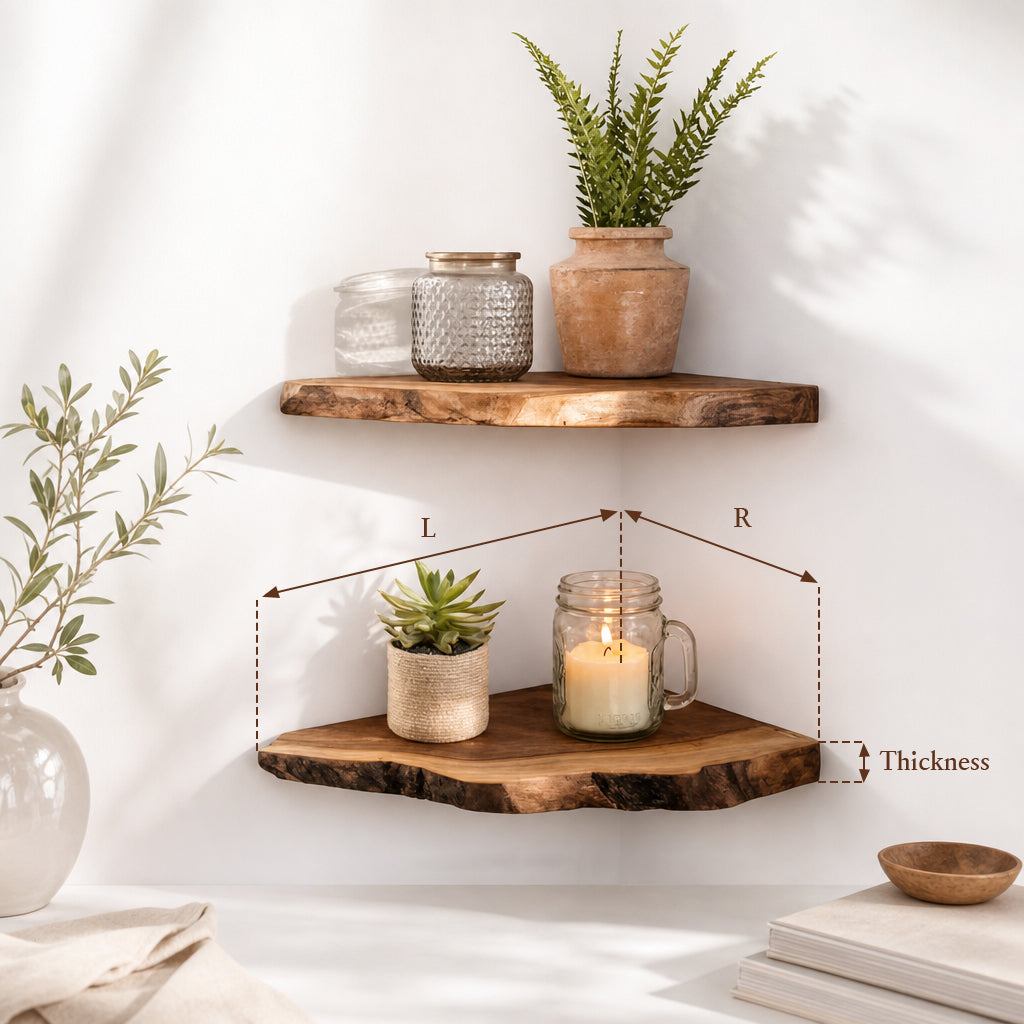
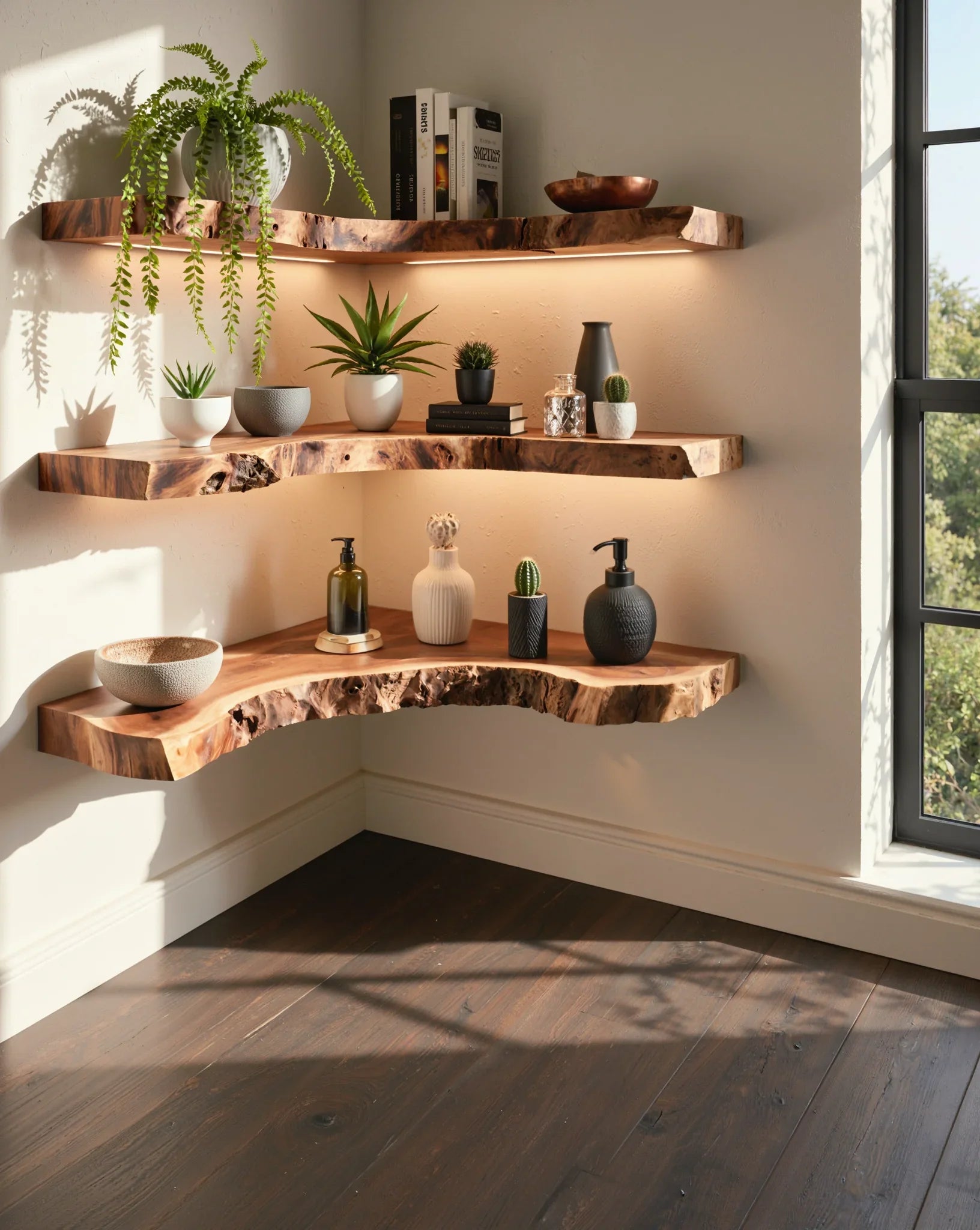
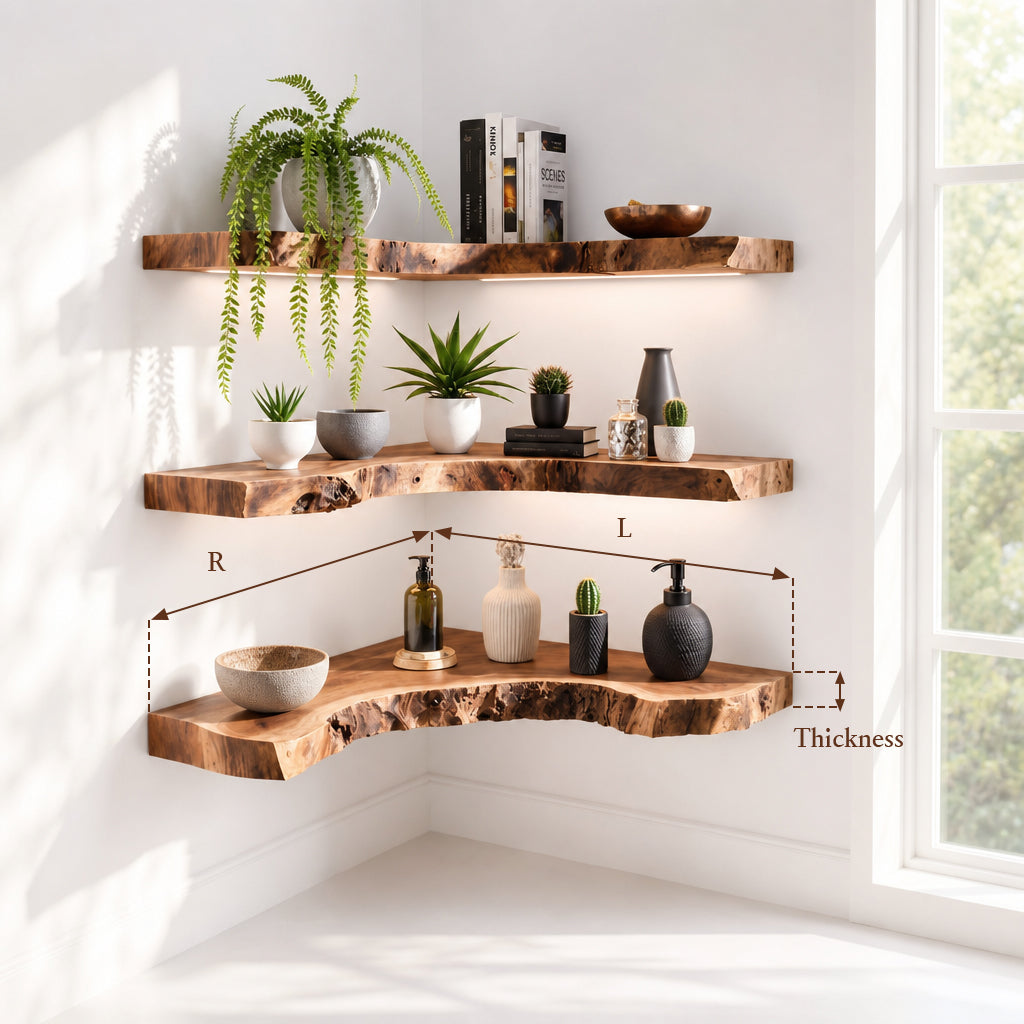
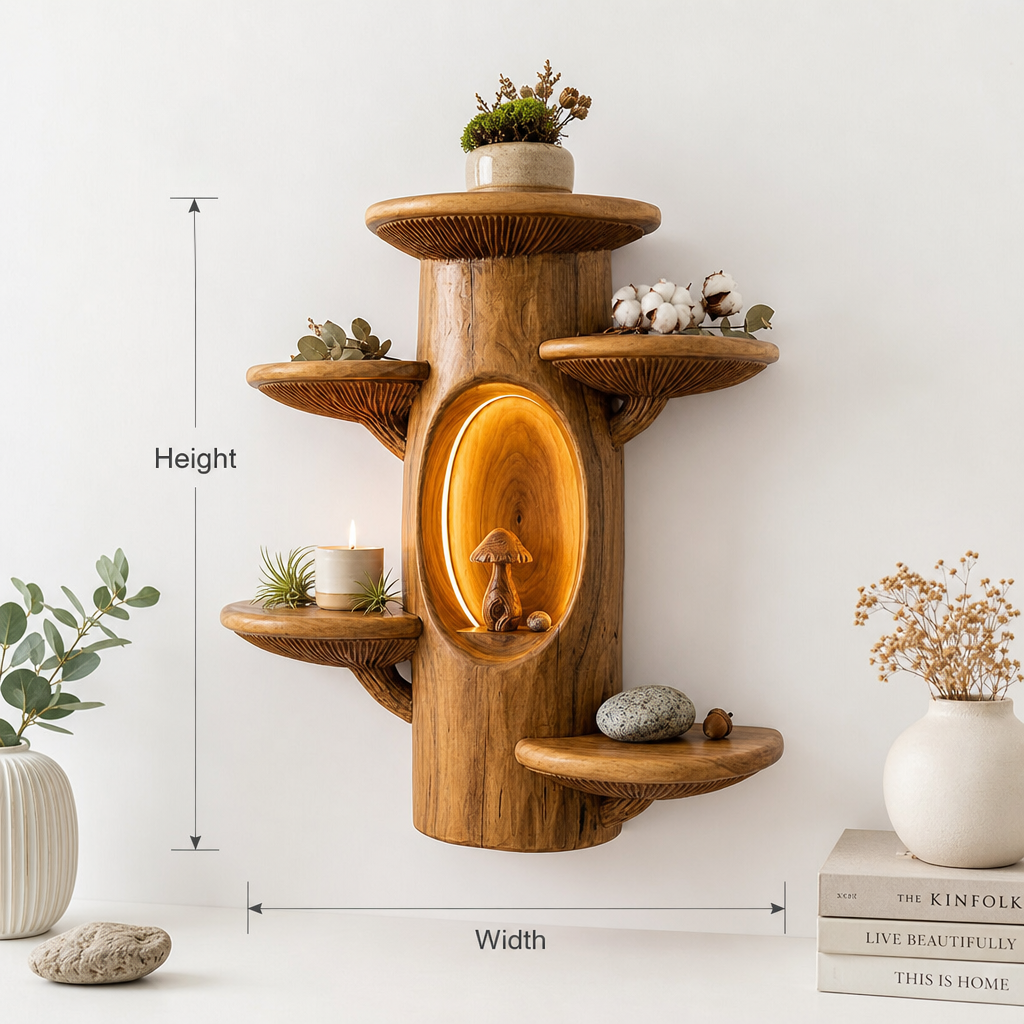
Ashdeco's mushroom and floating shelves are hand-carved from solid hardwood, no MDF, no particleboard, and finished with smooth, rounded live edges built for children's spaces.
Shop Nursery Shelves →