


Quick view
- Quick Answer - The 3 Things That Matter Most
- Dining Chair Dimensions That Actually Matter
- The 10–12" Rule in One Sentence
- Chair Types Compared - Which Is Right for Your Space?
- Comfort Factors Most People Ignore
- Material Guide - What Lasts, What's Worth It
- How Many Chairs Fit - A Room Math Problem, Not a Chair Problem
- Style Pairing - Match or Contrast with Your Table?
- Common Mistakes When Buying Dining Chairs
- Maintenance & Longevity - What You're Signing Up For
- Frequently Asked Questions
Shop this guide
Handcrafted Dining Tables, made to order in solid wood.
 Round Solid Wood Pedestal Dining Table Handcrafted Solid Wood Center Table
From $1,345.00
Round Solid Wood Pedestal Dining Table Handcrafted Solid Wood Center Table
From $1,345.00
 Round Bistro Dining Table, Small Kitchen Breakfast Table, Compact Circular Dining Table
From $1,022.00
Round Bistro Dining Table, Small Kitchen Breakfast Table, Compact Circular Dining Table
From $1,022.00
 Organic Modern Live Edge Solid Wood Dining Table - Handcrafted Slab Table with Dual Storage Pedestals
From $6,800.0010% off at checkout
Organic Modern Live Edge Solid Wood Dining Table - Handcrafted Slab Table with Dual Storage Pedestals
From $6,800.0010% off at checkout
 Round Solid Wood Dining Table with Architectural Spider Pedestal Base
From $1,254.00
Round Solid Wood Dining Table with Architectural Spider Pedestal Base
From $1,254.00
 Flowing Pedestal Solid Wood Round Dining Table - Japandi Living Sculpture
From $5,850.0010% off at checkout
Flowing Pedestal Solid Wood Round Dining Table - Japandi Living Sculpture
From $5,850.0010% off at checkout
 Sculptural Pedestal Solid Wood Round Dining Table - Organic Modern Centerpiece
From $5,850.0010% off at checkout
Sculptural Pedestal Solid Wood Round Dining Table - Organic Modern Centerpiece
From $5,850.0010% off at checkout
Quick Answer - The 3 Things That Matter Most
Before you fall in love with a chair's look, check these three numbers - get them wrong, and no amount of styling will make the chair comfortable:
1. Seat height → 10–12" clearance from seat to table apron. This is the single most important number in chair buying. If your table is 30" tall (standard), you need a chair with a 17–19" seat height. Get this wrong and your knees hit the apron, or your elbows sit too high. For the full breakdown - including counter-height and bar-height pairings - see our Standard Dining Table Height Guide.
2. Seat width → 24" per person minimum. That's the space each diner needs for elbow room. Armchairs need 28–30".
3. Comfort → seat depth + backrest angle beats cushion thickness. A thick cushion means nothing if the seat is too deep and your feet don't touch the floor.
Get those three right, and almost any chair will work. Now let's go deeper into what to look for.

Dining Chair Dimensions That Actually Matter
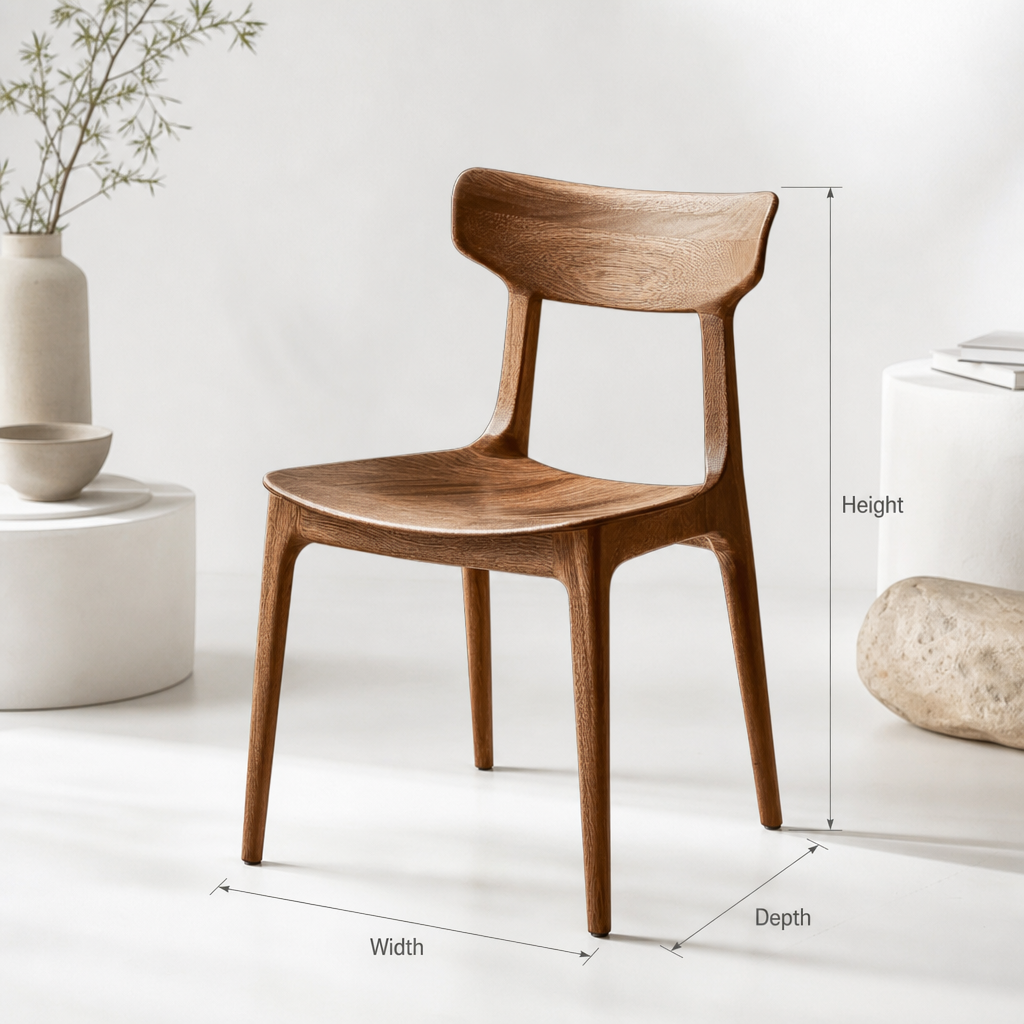
Most buying guides fixate on seat height and stop there. But seat height is only one of five dimensions that determine whether a chair actually works in your space. Here's the full list:
Seat Height: The Starting Point
Standard dining chair seat height runs 17–19 inches (43–48 cm). This pairs with standard dining tables at 28–30", leaving the critical 10–12" thigh clearance.
If you're buying chairs for a counter-height table (34–36"), you'll need seat heights of 24–26". For bar-height tables (40–42"), go 28–30".
The rule: Table height minus seat height should equal 10–12 inches. No exceptions, no "close enough."
For the complete table-height pairing guide (with counter and bar heights), check our Standard Dining Table Height Guide.
Seat Depth: The Most Overlooked Dimension
Seat depth is the distance from the front edge of the seat to the backrest. Ideal range: 15–18 inches (38–46 cm).
Here's why it matters more than you think: if the seat is too deep, shorter people can't sit back against the backrest while keeping their feet on the floor. Their knees bend against the front edge, cutting off circulation. After 20 minutes, they're shifting, leaning forward, uncomfortable - and they don't know why.
If the seat is too shallow, your thighs aren't supported. You feel like you're perching on a stool.
The test: Sit all the way back. Your feet should be flat on the floor with a small gap (1–2") between the back of your knees and the seat edge. If your knees hit the front, the seat is too deep.
Seat Width: Hip Room + Elbow Room
Standard dining chair seat width: 16–20 inches (40–51 cm). But the number that matters for planning is the space per person at the table:
- Side chairs: 24" per person minimum
- Armchairs: 28–30" per person
A chair might be 18" wide at the seat, but its arms could span 22". That's why armchairs eat more table real estate - and why you can't swap the math from side chairs to armchairs without losing seats. For the full breakdown of how chair type changes your table's actual capacity, see our Dining Table Seating Capacity Guide.
Backrest Height: Lumbar vs Full Support
Total chair height (floor to top of backrest): 28–36 inches for standard dining chairs.
But what matters for comfort is where the backrest supports you:
- Low backrest (28–32"): Supports mid-back only. Fine for quick meals, less comfortable for long dinners.
- Full backrest (32–36"+): Supports upper back and shoulders. Better for long dinners, but can feel imposing in small rooms.
- Lumbar-only curve: The sweet spot - a curved backrest that hits your lower back at the right spot. Often found in mid-century and Scandinavian designs.
Arm Height: The Table Apron Trap
If you're considering armchairs, measure this: arm height from floor.
The arms must clear your table's apron (the frame underneath the tabletop). Standard table aprons are 3–4" thick, starting at about 26–27" from the floor. If your armchair's arms are at 25" or higher, they won't slide under the table. You'll be eating with your arms pushed out, shoulders raised - exhausting after 10 minutes.
The check: Arm height should be at least 2" lower than the bottom of the table apron.


The 10–12" Rule in One Sentence
Your seat-to-table-apron clearance should be 10–12 inches - enough room for your thighs, not so much that your elbows sit above the table surface. Counter-height and bar-height tables follow the same principle with different numbers. For the full table-height pairing guide (with exact measurements for every table type), see our Standard Dining Table Height Guide.
Chair Types Compared - Which Is Right for Your Space?
Not all dining chairs serve the same purpose. Here's how the main types compare:
Side Chairs
The default. No arms, fits under any table, stacks or nests for storage. Most space-efficient option - you get 24" per person instead of 28–30" for armchairs. Best for everyday use, small spaces, and when you need maximum seating.
Pros: Space-efficient, versatile, stackable, affordable
Cons: Less comfortable for long meals, less "statement" presence
Best for: Everyday dining, small spaces, families with kids
Armchairs
The comfort king. Arms give you somewhere to rest while eating, leaning back, or holding a conversation. Usually reserved for the "head" positions at a rectangular table - the host seats. But every armchair you add costs 4–6 inches of table edge space compared to a side chair.
Pros: Superior comfort, authoritative presence, great for host seats
Cons: Space penalty (28–30" per person vs 24"), arms may not fit under table apron, harder to stack/store
Best for: Head-of-table positions, formal dining, long dinners
For the math on how armchairs change your table's actual seating count, see Dining Table Seating Capacity Guide.
Benches
The family wildcard. Benches tuck completely under the table (zero visual footprint), seat more people than individual chairs in the same width, and kids love them. But: no back support, hard to get in/out if you're in the middle, and once someone sits down, the bench is "claimed."
Pros: Tucks under completely, seats more per linear foot, casual vibe, affordable
Cons: No back support, middle person is trapped, less formal
Best for: Kitchen nooks, families with kids, casual dining, one side of a rectangular table
Windsor / Spindle-Back Chairs
Classic, breathable, lightweight. The open spindle back lets air through (comfortable in warm climates) and looks lighter in a room than a solid backrest. Often found in farmhouse and traditional settings. Downsides: spines can feel hard against your back during long meals, and the narrow spindles aren't great for leaning back.
Pros: Lightweight, breathable, classic look, affordable
Cons: Hard back for long sits, spindles can dig in, not great for leaning
Best for: Farmhouse style, warm climates, budget-friendly classic look
Upholstered Chairs
Luxury feel, but with a maintenance trade-off. Fabric cushions are comfortable - no contest. But they stain, trap crumbs, and need regular vacuuming. If you have kids, pets, or eat messy food often, fabric upholstery will show it.
Pros: Most comfortable, premium feel, wide color/texture range
Cons: Stains easily, needs regular cleaning, harder to maintain with kids/pets
Best for: Formal dining rooms, adults-only households, luxury settings
Folding Chairs
The occasional-use solution. Not your dining room's primary chairs, but great for when guests show up and you need extra seats that disappear into a closet afterward. Modern folding chairs have improved dramatically - some look indistinguishable from fixed chairs when set up.
Pros: Store flat, cheap, great for occasional guests
Cons: Less stable, less comfortable, not for everyday use
Best for: Extra seating, small apartments, occasional entertaining

Don't miss
These pieces qualify for 10% off orders over $2,000. Applied automatically at checkout.
10% off
Organic Modern Live Edge Solid Wood Dining Table - Handcrafted Slab Table with Dual Storage Pedestals
From $6,800.00
10% off at checkout
10% off
Flowing Pedestal Solid Wood Round Dining Table - Japandi Living Sculpture
From $5,850.00
10% off at checkout
10% off
Sculptural Pedestal Solid Wood Round Dining Table - Organic Modern Centerpiece
From $5,850.00
10% off at checkout
 10% off
Organic Live Edge Solid Wood Dining Table with Sculptural River Legs
From $4,180.00
10% off at checkout
10% off
Organic Live Edge Solid Wood Dining Table with Sculptural River Legs
From $4,180.00
10% off at checkout
Comfort Factors Most People Ignore
This is where most chair buying guides stop at "check the cushion." But comfort is multi-layered, and the things that actually make a chair uncomfortable are rarely the cushion.
Seat Depth & the "Back-of-Knee" Test
We covered this in the dimensions section, but it's worth repeating because it's the #1 reason people say a chair is "uncomfortable" when the measurements look right: if your feet don't touch the floor when sitting all the way back, the seat is too deep.
Test every chair this way in the showroom. Don't just sit - sit all the way back and check your feet.
Backrest Angle: 95°–105° Is the Sweet Spot
A perfectly vertical backrest (90°) sounds ergonomic but isn't. Your spine has a natural S-curve, and sitting at exactly 90° forces your lower back to flatten. Most comfortable dining chairs angle the backrest back slightly - 95° to 105° from vertical.
This is subtle - you won't notice it visually - but your back will feel the difference after 30 minutes.
How to check: Sit back fully. If you feel pressure on your lower back, the angle is too upright. If you feel like you're sliding forward, it's too reclined.
Lumbar Support: Curved vs Flat
A flat backrest distributes pressure evenly but doesn't match your spine's curve. A curved backrest (often called "contoured" or "ergonomic") supports your lumbar region specifically.
For quick meals (under 30 minutes), flat is fine. For dinners that last an hour or more - holiday dinners, date nights, game nights - lumbar support makes a real difference.
Seat Edge: Waterfall vs Flat
The front edge of the seat matters more than you'd think. A waterfall edge (curved downward) reduces pressure on the back of your thighs, improving blood circulation. A flat, sharp edge can cut off circulation after extended sitting - especially for shorter people whose thighs press harder against the edge.
Look for rounded or waterfall edges on chairs you plan to sit in for more than an hour.
Cushion Density: High-Resilience Foam vs Cheap Poly
All cushions feel good on day one. The difference shows up at month six.
- High-resilience (HR) foam: Density 1.8–2.5 lb/ft³. Holds its shape for years. Found in quality chairs ($80+ per chair).
- Standard polyurethane foam: Density 1.2–1.5 lb/ft³. Flattens noticeably in 6–12 months. Common in budget chairs ($30–60).
- Foam + fiber wrap: HR foam core with a polyester fiber outer layer. Feels softer initially, maintains shape well. Mid-to-premium range.
The test: Press your thumb into the cushion. If it springs back immediately, the foam density is good. If it stays compressed for a few seconds, it'll flatten fast.

Material Guide - What Lasts, What's Worth It
Solid Wood
Oak, walnut, rubberwood, cherry. The gold standard for durability. Solid wood chairs can last decades, can be refinished when scratched, and develop character over time. Downsides: heavy, sensitive to humidity changes (can warp or crack in extreme conditions), and premium woods (walnut, cherry) are expensive.
Best for: Long-term investment, traditional and modern styles, households that refinish furniture
Metal
Powder-coated steel, chrome, iron. Extremely durable, lightweight compared to solid wood, and modern-looking. Powder-coated finishes resist scratches well. Chrome shows fingerprints and water spots. Iron can rust if the coating chips.
One thing people notice immediately: metal feels cold. In air-conditioned rooms or cold climates, metal chairs can be unpleasantly chilly without a cushion pad.
Best for: Industrial/modern style, outdoor use (if coated), lightweight needs, budget durability
Plastic / Polypropylene
The budget workhorse. Injection-molded plastic chairs (think Eames-style DSW replicas) are cheap, lightweight, stackable, and weather-resistant. But they have a weight limit (usually 200–250 lbs), can crack at stress points over time, and cheap versions yellow in sunlight.
Best for: Budget builds, outdoor dining, kids' rooms, stackable storage needs
Upholstered Fabric
Comfort king, maintenance-heavy. Fabric upholstery feels the best but requires the most care. Look for performance fabrics (Crypton, Sunbrella) if you want stain resistance. Standard fabrics will need professional cleaning every 12–18 months in a dining setting.
Pet-friendly rating: Low to medium. Unless you use performance fabric, claws and accidents will show.
Best for: Formal dining, adults-only, style-focused rooms
Leather / Faux Leather
Wipe-clean convenience with a premium look. Real leather develops a patina over time (beautiful, if you like that). Faux leather (PU, PVC) is cheaper but will crack and peel after 3–5 years, especially in warm, humid conditions.
Pet-friendly rating: Medium. Claws can scratch leather, but spills wipe right off.
Best for: Easy maintenance, premium look, households that value cleanability
Mixed Materials
Wood seat + metal frame. Leather seat + wood legs. The best of both worlds - often. Mixed-material chairs let you combine the warmth of wood or comfort of upholstery with the durability and lightness of metal. The key thing to check: joint quality. Where the different materials connect is where failures happen. Look for bolts and screws, not just glue.
Best for: Modern/eclectic style, balancing comfort and durability, visual interest
Material Quick Reference
| Material | Durability | Maintenance | Price Range | Pet-Friendly? |
|---|---|---|---|---|
| Solid wood (oak, rubberwood) | 15–30+ years | Low (occasional polish) | $60–200/chair | Yes |
| Solid wood (walnut, cherry) | 20–50+ years | Low–medium | $150–400+/chair | Yes |
| Metal (powder-coated) | 10–20 years | Low | $40–150/chair | Yes |
| Plastic / polypropylene | 3–8 years | Low | $20–80/chair | Yes |
| Upholstered fabric | 5–15 years | High | $80–300+/chair | Low (unless performance fabric) |
| Leather | 10–20 years | Medium | $100–350/chair | Medium |
| Faux leather | 3–5 years | Low | $40–120/chair | Medium |
How Many Chairs Fit - A Room Math Problem, Not a Chair Problem
How many chairs your table can hold depends on table size, chair type (side vs armchair), and - most importantly - your room's clearance. The math is straightforward: divide your table's usable perimeter by 24" for side chairs or 28–30" for armchairs. But the real question isn't "how many fit on the table" - it's "how many fit in the room with enough walking space?"
For the complete seating capacity math (by table shape and size), see our Dining Table Seating Capacity Guide. And for how different table base types affect where you can actually place chairs, check How Table Base Type Changes Seat Count.
Quick rule for mixed sets: If you're combining armchairs and side chairs, keep seat heights within 2 inches of each other. Otherwise, some diners sit noticeably higher than others - awkward for conversation and sightlines.

Style Pairing - Match or Contrast with Your Table?
This is where personal taste takes over, but there are a few rules that keep things looking intentional instead of accidental.
The Safe Route: Match Materials
Wood table + wood chairs in the same wood tone. This always works. It's traditional, cohesive, and impossible to get "wrong." The downside: it can feel a bit showroom-perfect, lacking personality.
The Interesting Route: Contrast with Intent
Modern glass table + rustic wood chairs. Live edge slab + sleek metal chairs. Dark walnut table + light oak chairs. The key is contrast with connection - pick one shared element (a leg shape, a finish tone, a design era) so the pairing feels deliberate.
Color Rules That Actually Work
- Same tone family: Light table + light chairs, dark table + dark chairs. Safe, harmonious.
- One accent: Neutral table + one bold chair color (navy, emerald, mustard). Works especially well when the accent chairs are at the head positions.
- All-accent: Bold table + bold chairs. Only works if the room is otherwise neutral (white walls, simple rug).
The "2-Chair Test"
Before buying 6 or 8 chairs, buy or borrow one and bring it home. Put it at your table. Sit in it. Eat a meal. Check if the arms clear the apron, if the height feels right, if the style works in your actual room lighting. Photos lie. Showrooms lie (everything looks good under perfect lighting). Your dining room tells the truth.

Common Mistakes When Buying Dining Chairs
1. Buying Chairs Before Measuring Table Apron Clearance
The #1 return reason for dining chairs: arms don't fit under the table. Always measure the distance from floor to the bottom of your table's apron, then compare with the chair's arm height. Arms need to be at least 2" lower.
2. Ignoring Seat Depth
Tall people buy deep seats, short people suffer. Seat depth determines whether your feet touch the floor. Always test the "sit all the way back" position.
3. All Armchairs Around a Small Table
Armchairs are comfortable, but each one costs 4–6 extra inches of table edge. Put armchairs at a 48" round table and you've eliminated 2 seats. See Seating Capacity Guide for the math.
4. Cheap Foam Cushions That Flatten in 6 Months
Budget chairs use low-density foam that feels great in the store and flat by month six. Check foam density or plan to replace cushions.
5. Mixing Too Many Styles
Two styles = eclectic. Three or more = garage sale. If you're mixing, pick a max of 2 chair designs and keep seat heights within 2 inches.
6. Forgetting Weight Capacity
Cheap chairs (especially plastic and thin-metal ones) often have 200–250 lb weight limits. Not a problem for most people, but worth checking if your household includes bigger folks.
7. Not Checking Floor Protection
Metal legs on hardwood floors = scratches. Always add felt pads or rubber caps. Wood legs are gentler but can still mark softwood floors over time.
Maintenance & Longevity - What You're Signing Up For
Every chair material comes with a maintenance commitment. Here's the honest breakdown:
Wood: Refinish every 5–10 years if heavily used. Sensitive to humidity - don't place near radiators or AC vents. Tighten joints annually.
Metal: Check for coating chips (rust starts there). Tighten bolts every 6–12 months. Wipe down weekly to prevent fingerprint buildup on chrome.
Plastic: UV exposure causes yellowing. Keep out of direct sunlight if you want them to stay white/clear. Check for stress cracks at joints yearly.
Fabric upholstery: Vacuum weekly. Spot clean immediately. Professional clean every 12–18 months. Performance fabrics extend this to 24 months.
Leather: Condition every 6–12 months to prevent cracking. Wipe spills immediately. Keep away from direct heat (radiators, sun).
The 10-Year Cost Reality
Here's a comparison most people don't make:
- Budget chair ($30) × 3 replacements over 10 years = $90 per chair. Plus the hassle of reordering, disposing of old ones, and living with flattening cushions.
- Quality chair ($100) × 1 purchase over 10 years = $100 per chair. Better comfort the entire time, no replacements.
The "cheap" option is only cheaper if you actually replace it. If you keep flattening cushions and suffer through it, you paid $30 for discomfort.
Frequently Asked Questions
What is the standard dining chair seat height?
Standard dining chair seat height is 17–19 inches (43–48 cm), which pairs with standard 28–30" dining tables to leave 10–12" of thigh clearance.
How much space does each dining chair need?
Each person needs 24 inches of table edge width for a side chair, or 28–30 inches for an armchair.
Can I mix different dining chair styles?
Yes - but limit yourself to 2 styles maximum and keep seat heights within 2 inches of each other. Three or more styles starts looking random instead of curated.
Are armchairs worth it for a dining table?
For the host seats (head of a rectangular table), absolutely. For every seat around a small table? They eat too much space. A common setup: 2 armchairs at the heads, side chairs along the long edges.
How do I know if a dining chair is comfortable?
Test three things: (1) Sit all the way back - feet flat on floor, (2) Check backrest angle - should feel supportive, not forcing you upright or making you slide forward, (3) Check seat edge - shouldn't press hard against the back of your thighs.
What material is best for dining chairs with kids/pets?
Solid wood or metal for maximum durability and easy cleaning. If you want upholstery, choose performance fabric (Crypton, Sunbrella) - standard fabric will show every spill and claw mark.
How many dining chairs can fit around my table?
Divide your table's usable perimeter by 24" (side chairs) or 28–30" (armchairs). For the complete guide by table shape and size, see our Dining Table Seating Capacity Guide.
Found the right dimensions - now find the right chair.
Browse Ashdeco's handcrafted solid wood dining chairs and tables, built to last and sized to fit your space.
Shop Dining Collection →