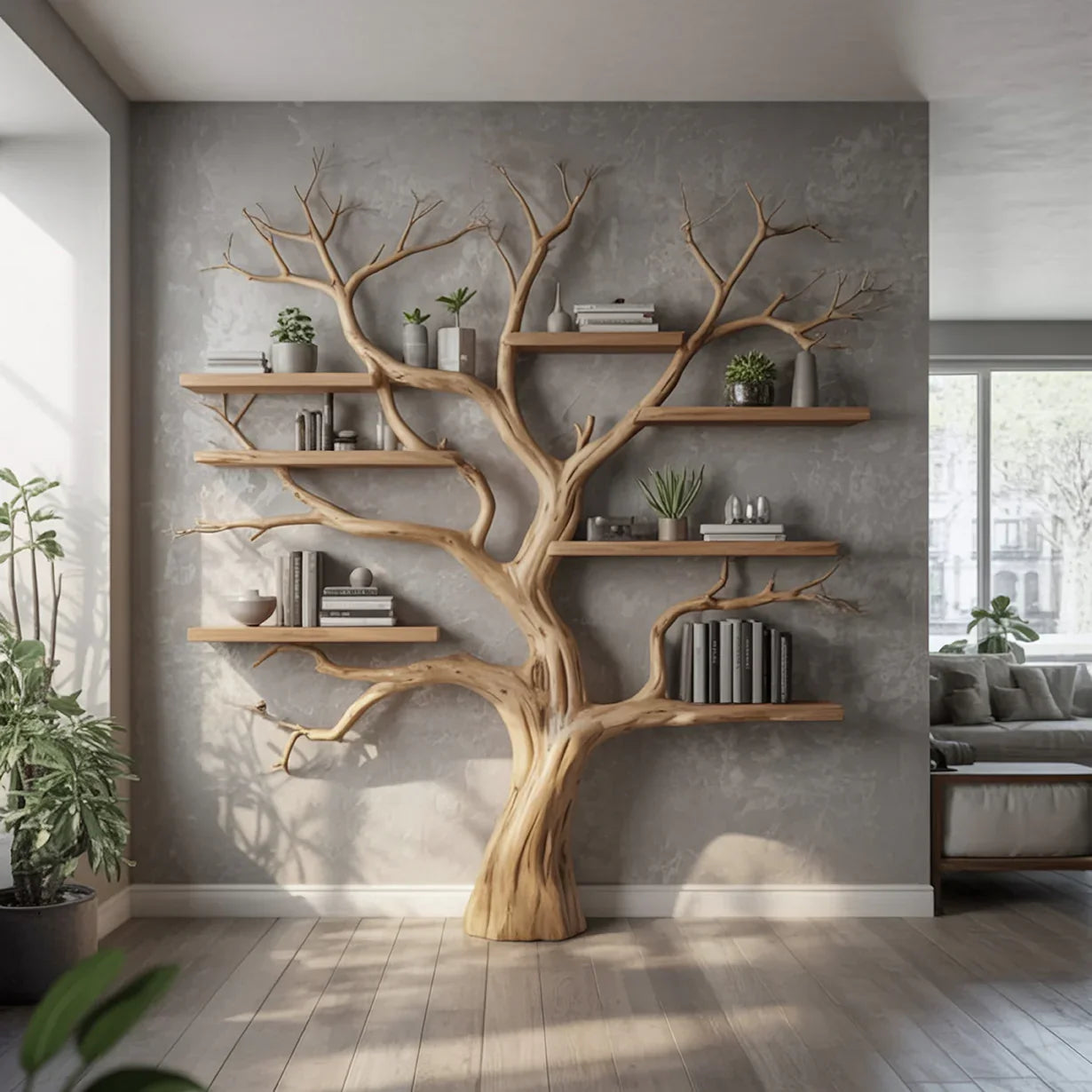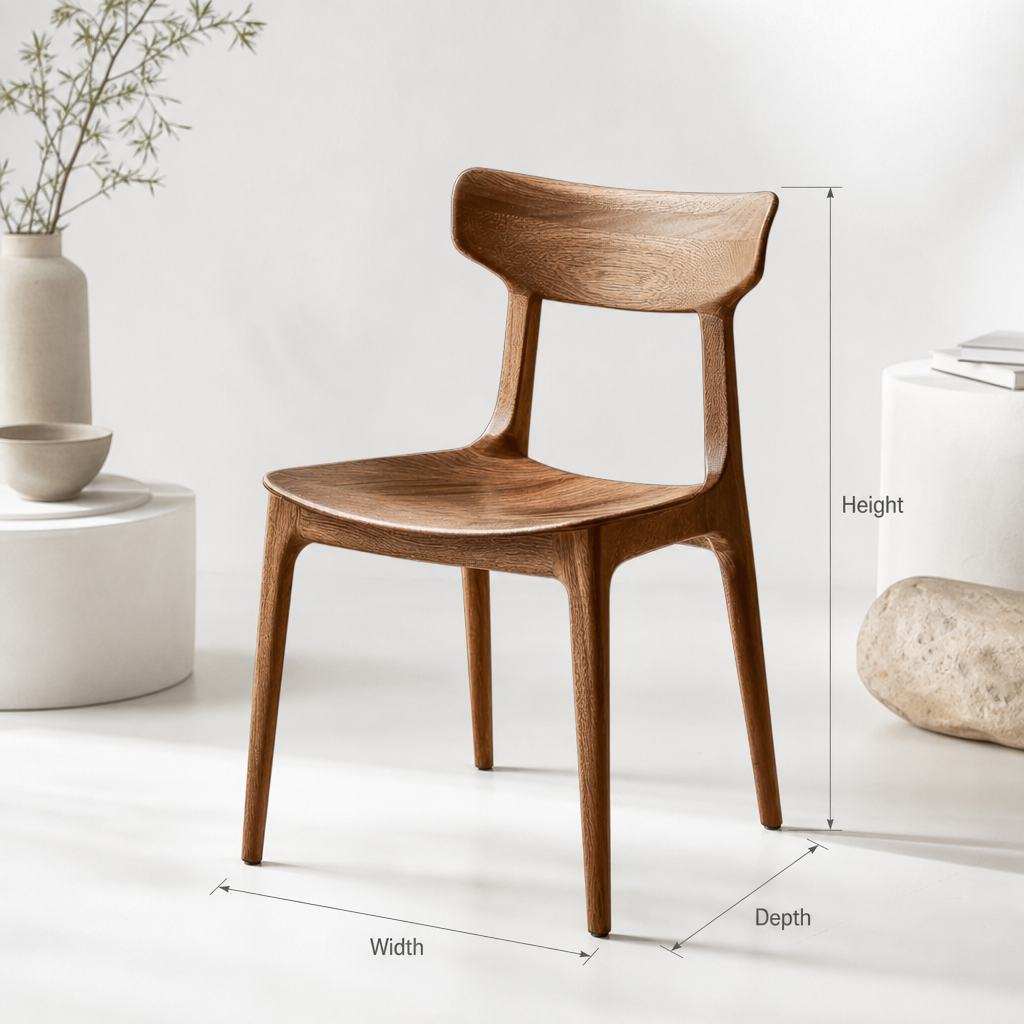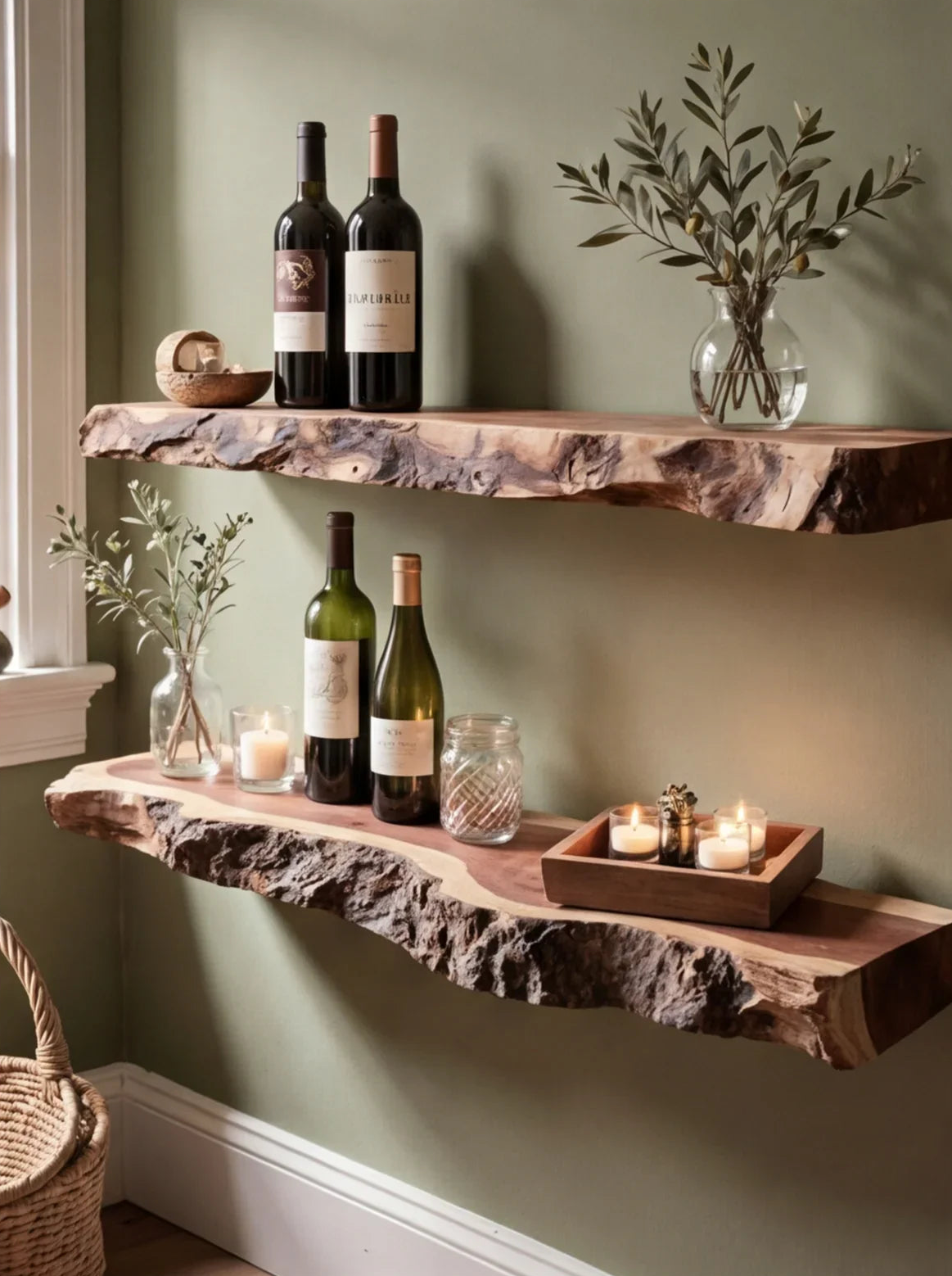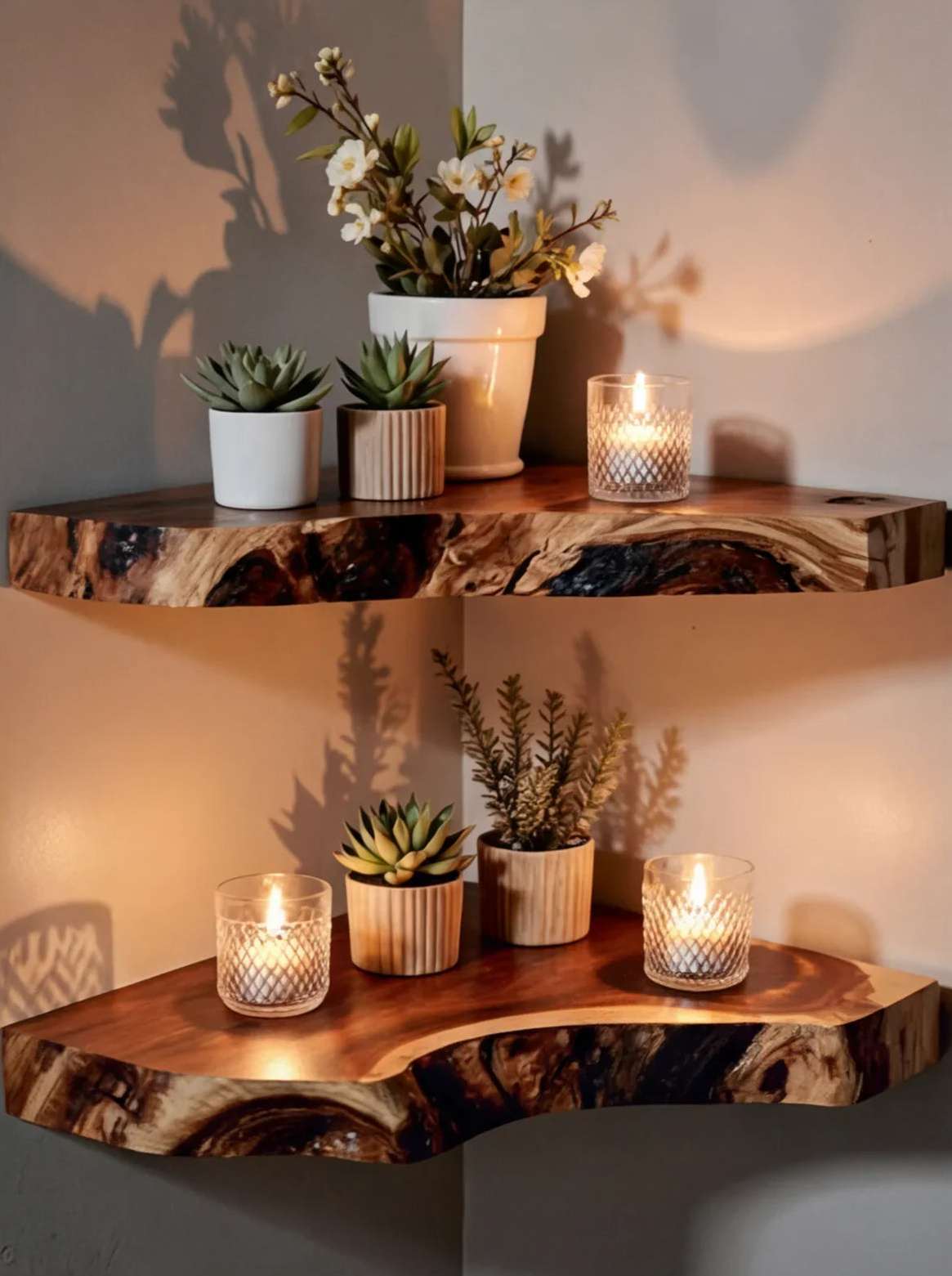
Quick view
- Quick Answer - Common Size Ranges
- The 3 Dimensions That Actually Matter
- Dimensions by Tree Bookshelf Type
- Tier Spacing - The Hidden Dimension
- Weight Capacity by Size & Mount Type
- Will It Actually Fit? - Pre-Purchase Checklist
- Real Product Dimensions - Ashdeco Examples
- Common Dimension Mistakes
- FAQs
- More Tree Bookshelf Guides
Shop this guide
Handcrafted Tree Bookshelf, made to order in solid wood.
 Christmas edit
Corner Tree Floating Bookshelf – Driftwood Branch Wall Mounted Hanging Shelf, Artistic Corner Furniture Decoration
From $901.00
Christmas edit
Corner Tree Floating Bookshelf – Driftwood Branch Wall Mounted Hanging Shelf, Artistic Corner Furniture Decoration
From $901.00
 Christmas edit
Handcrafted Solid Wood Nursery Decor & Kids' Library
$2,834.0010% off at checkout
Christmas edit
Handcrafted Solid Wood Nursery Decor & Kids' Library
$2,834.0010% off at checkout
 Christmas edit
Handcrafted Wooden Tree Wall Shelf – Rustic Branch Bookshelf
From $1,087.00
Christmas edit
Handcrafted Wooden Tree Wall Shelf – Rustic Branch Bookshelf
From $1,087.00
 Christmas edit
Solid Wood Floating Corner Shelf – Driftwood Branch Wall Shelf
From $789.00
Christmas edit
Solid Wood Floating Corner Shelf – Driftwood Branch Wall Shelf
From $789.00
 Christmas edit
Tree Bookshelf – Rustic Wooden Book Tree Shelf, Wall-Mounted Natural Wood Décor
$2,099.0010% off at checkout
Christmas edit
Tree Bookshelf – Rustic Wooden Book Tree Shelf, Wall-Mounted Natural Wood Décor
$2,099.0010% off at checkout
 Christmas edit
Floating Bookshelf – Tree Branch Wall-Mounted Bookcase for Rustic Home Decor
From $1,000.00
Christmas edit
Floating Bookshelf – Tree Branch Wall-Mounted Bookcase for Rustic Home Decor
From $1,000.00
Tree Bookshelf Dimensions Guide - How to Pick the Right Size for Your Space
Quick Answer - Common Size Ranges
Tree bookshelves don't follow one standard size - dimensions vary by maker, tier count, and mount type. Here's the fast reference:
| Type | Typical Height | Typical Width | Typical Depth | Weight Capacity |
|---|---|---|---|---|
| Standing / Freestanding | 60"–84" | 24"–48" | 14"–24" (base) | 30–60 lbs per tier |
| Wall-Mounted / Floating | 24"–72" | 18"–40" | 6"–12" | 5–15 lbs per branch |
| Corner | 48"–84" | 14"–24" per wall | 10"–16" projection | 8–15 lbs per branch |
| Kids' / Nursery | 30"–48" | 16"–24" | 6"–10" | 5–15 lbs per branch |
Key takeaway: There's no industry-standard tree bookshelf size. "5-tier" or "6-tier" tells you almost nothing about total height on its own - a handcrafted piece's actual height depends on how the maker spaces the branches. Always check actual measurements, not just tier count.
Note on terms used in this guide: "tier," "branch," and "shelf level" all refer to the same thing - one level of a tree bookshelf where you can place items. We use them interchangeably below, the way most product listings do.

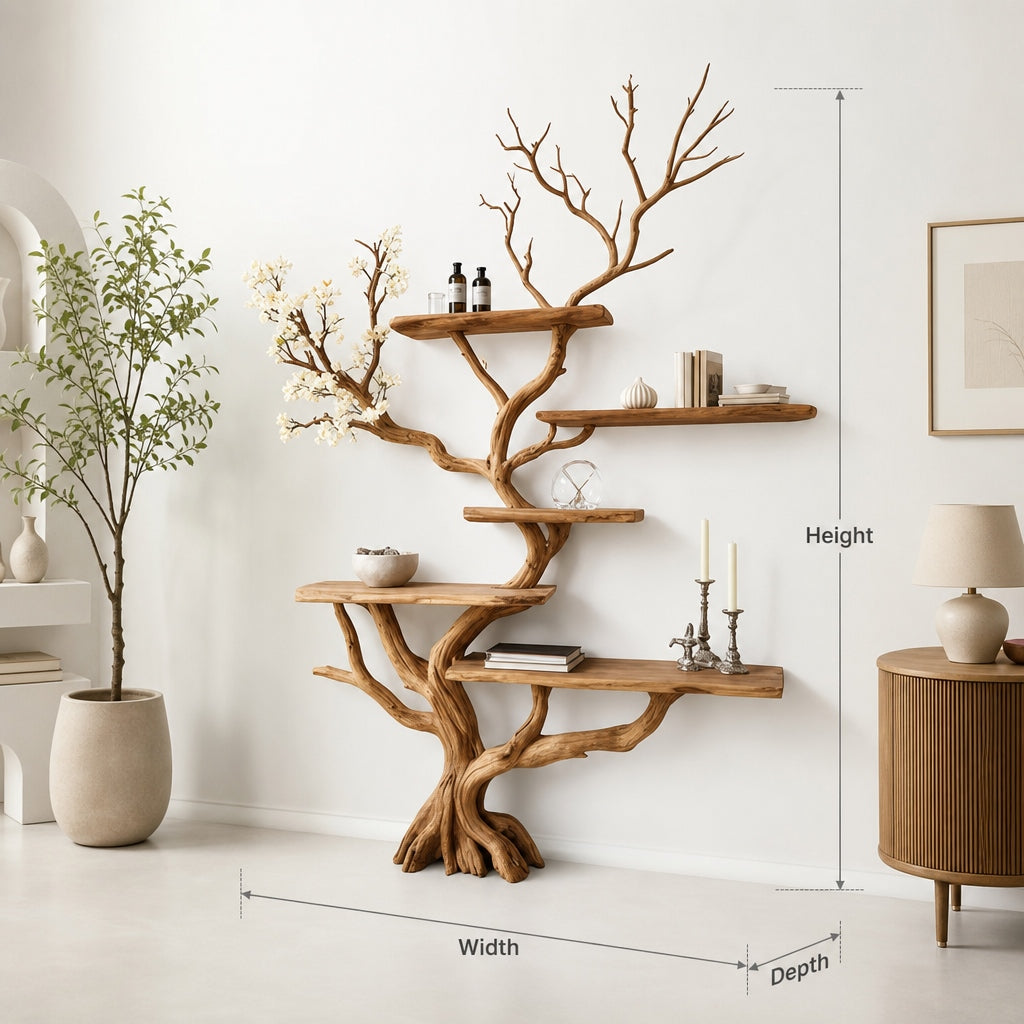
The 3 Dimensions That Actually Matter
Height - Floor to Top Branch
- 3-tier (~36"–48"): Nursery, small spaces, kids' rooms
- 4–5 tier (~60"–72"): Standard living room, most common
- 6–8 tier (80"–96"+): Statement piece, high ceilings
Rule of thumb: Leave 6"–12" of clearance above the top branch for visual breathing room - a tree bookshelf pushed right up against the ceiling reads as cramped, not tall.
Width - Widest Branch Span
- Narrow (< 24"): Corner units, hallways, small bedrooms
- Standard (24"–36"): Most living rooms
- Wide (36"+): Feature wall, open-plan spaces
Wall-mounted vs freestanding changes what "width" limits you: on a wall-mounted piece, width is capped by how many studs you can anchor into; on a freestanding piece, it's capped by base stability.
Depth - Front to Back at the Deepest Point
- Slim (6"–8"): Wall-mounted floating shelves, kids' books
- Standard (10"–12"): Most books, decor, plants
- Deep (12"–16"+): Coffee table books, large decor, freestanding units
Depth matters more on a tree bookshelf than on a standard rectangular one, because the branch angle changes how much usable depth you actually get at each tier - a branch that measures 12" at the wall may only offer 9"–10" of flat, usable surface once you account for the upward curve.



Dimensions by Tree Bookshelf Type
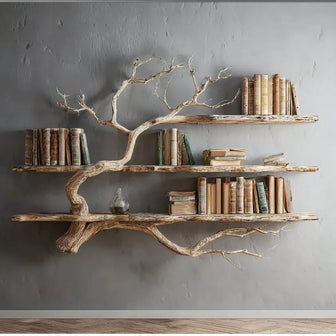
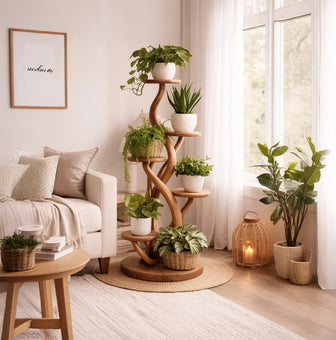
Standing / Freestanding Tree Bookshelf
Typical range: 60"–84" H × 24"–48" W × 14"–24" base diameter
- Base shape: Most Ashdeco standing tree bookshelves use a round base (measured as diameter), though some square or rectangular base designs exist - check the individual product page to confirm which shape applies.
- Base footprint vs top width: The base is always wider than the trunk at the top, for stability - a top-heavy tree with a narrow base is a tip risk.
- Clearance needed behind: 2"–4" from the wall, plus room for anti-tip hardware if you're anchoring it (recommended - see Weight Capacity section below).
For placement, stability, and capacity in more detail, see our Standing Tree Bookshelf - Room Centerpiece Guide.

Wall-Mounted / Floating Tree Bookshelf
Typical range: 24"–72" H × 18"–40" W × 6"–12" D
- No floor footprint, but needs adequate stud or anchor capacity - see Weight Capacity below.
- Mounting height: Bottom shelf is typically placed 24"–36" from the floor - comfortable eye level whether you're standing or seated nearby.

Corner Tree Bookshelf
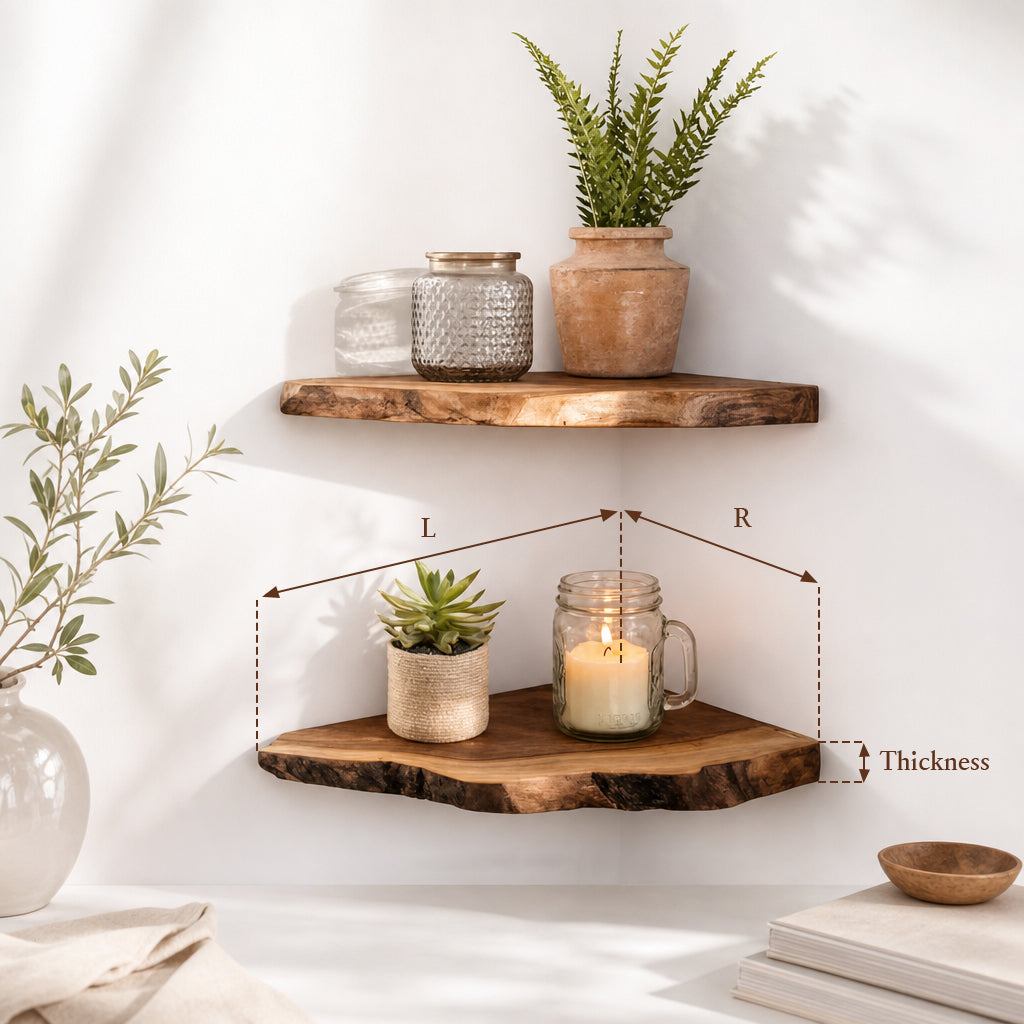
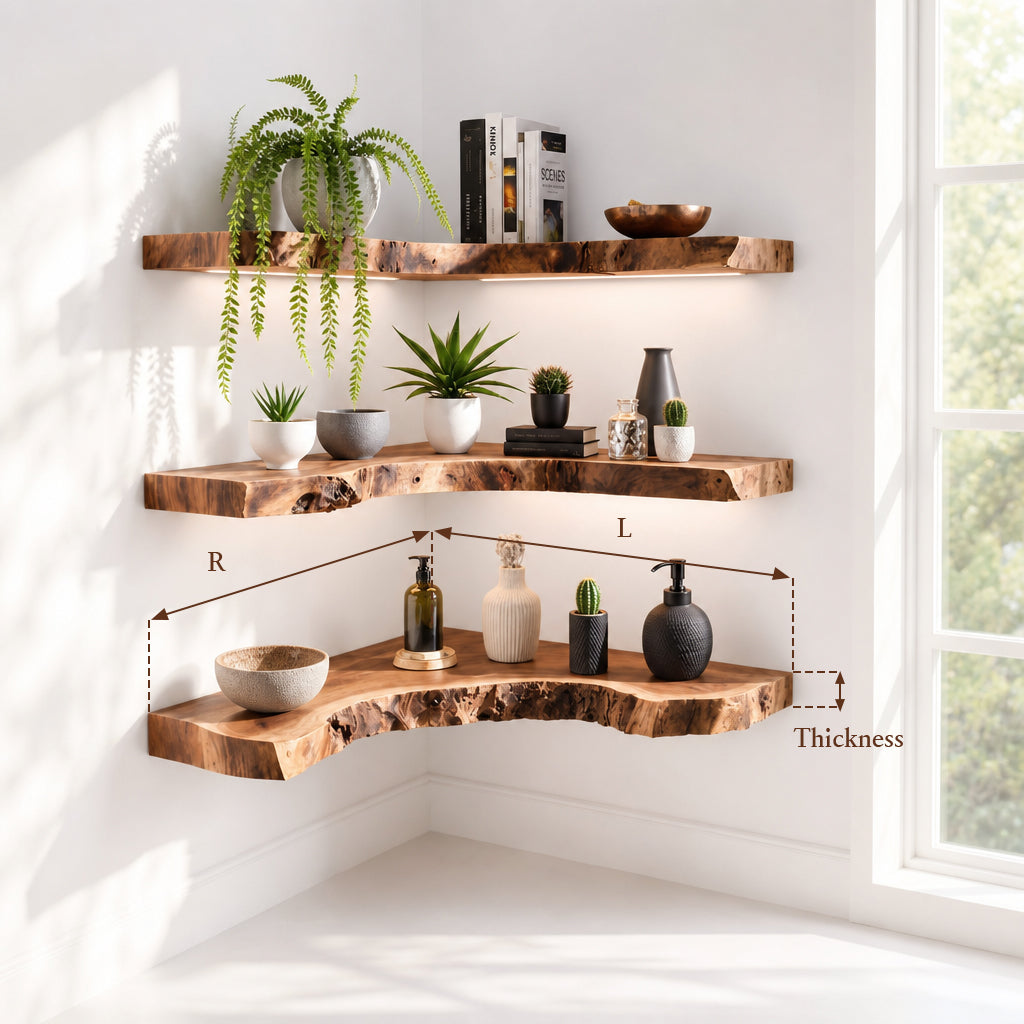
Typical range: 48"–84" H × 14"–24" per wall × 10"–16" projection from the corner (trunk sits 2"–4" off the corner point)
- Projection from corner: This is how far the unit extends from the corner into the room, measured along the 45° angle bisector from the corner point. A 15" projection means the frontmost point of the unit is 15" out from the corner.
- Baseboard interference: If you have baseboards, the unit may not sit flush in the corner. Some corner tree bookshelves have a notch cut into the back to accommodate baseboards - check product details or ask the maker.
- Standard 90° corner: Most corner tree bookshelves are designed for standard 90° corners. If your corner is non-standard (older homes sometimes have 87°–93° angles), a standard unit may leave a gap - measure first.
Measuring a corner is where most sizing mistakes happen - outlets, uneven walls, and vents near the corner all throw off the footprint. Our Corner Tree Bookshelf: How to Measure Your Corner guide walks through the 5 most common measuring mistakes in detail.

Kids' / Nursery Tree Bookshelf
Typical range: 30"–48" H × 16"–24" W × 6"–10" D
- Lower height = child-accessible. A 36" tree bookshelf puts the top tier at a 3-year-old's eye level - perfect for Montessori-style independent book selection.
- Shallower depth = safer. 6"–10" depth means fewer heavy items can fit, reducing tip hazard.
- Still needs anchoring. Even at 36" tall, a loaded tree bookshelf can tip. See the safety section below.
For more on nursery-specific sizing and safety, see our Tree Bookshelf for Nursery guide.

Tier Spacing - The Hidden Dimension
Most buyers check height, width, and depth - but skip the dimension that actually determines whether your books fit: the gap between tiers.
On a tree bookshelf, tier spacing is usually fixed (unlike adjustable shelving on a standard bookcase). Handcrafted trees have carefully carved branch positions that can't be moved after purchase.
Typical tier spacing (vertical gap between branches) and what fits:
| Gap Between Tiers | Fits | Doesn't Fit |
|---|---|---|
| 8"–10" | Paperbacks, small plants, figurines, children's picture books | Standard hardcovers, tall vases |
| 10"–12" | Standard books (most common), medium plants, most decor | Coffee table books >12" tall |
| 12"–14" | Art books, tall decor, medium vases, stacked books | Oversized art books >14" |
| 14"+ | Large coffee table books, tall vases, statement pieces | - (fits most things) |
How to check before buying: Measure your tallest book. If it's 11" tall, you need at least 12" of tier spacing (1" clearance minimum). Check the product's dimension diagram for individual tier gaps - many makers list this in the specs or product photos.
Variable spacing on handcrafted trees: Unlike factory shelves with uniform spacing, handcrafted tree bookshelves often have different spacing on each tier - mimicking how real tree branches grow at different heights. This is actually an advantage: you get a mix of tight and spacious gaps, letting you place small items on narrow tiers and large items on wider ones. But it also means you can't assume uniformity - check the diagram.

Don't miss
These pieces qualify for 10% off orders over $2,000. Applied automatically at checkout.
10% off
Handcrafted Solid Wood Nursery Decor & Kids' Library
$2,834.00
10% off at checkout
10% off
Tree Bookshelf – Rustic Wooden Book Tree Shelf, Wall-Mounted Natural Wood Décor
$2,099.00
10% off at checkout
 10% off
Authentic Hand-Carved Solid Wood Tree Bookshelf Daybed - Sculptural Lounge Library
From $4,087.00
10% off at checkout
10% off
Authentic Hand-Carved Solid Wood Tree Bookshelf Daybed - Sculptural Lounge Library
From $4,087.00
10% off at checkout
 10% off
Rustic Tree Shaped Wooden Bookshelf with Branch Design for Living Room or Home Library
$2,145.00
10% off at checkout
10% off
Rustic Tree Shaped Wooden Bookshelf with Branch Design for Living Room or Home Library
$2,145.00
10% off at checkout
Weight Capacity by Size & Mount Type
Weight capacity depends on mount type, material, and tier construction. For the full material-based durability comparison, see Tree Bookshelf: Real Wood vs Mass-Produced and Solid Wood vs MDF. Here are the numbers:
| Type | Per Branch/Tier Capacity | Total Unit Capacity |
|---|---|---|
| Wall-mounted (solid wood) | 5–15 lbs per branch | Depends on bracket/cleat rating and stud placement - typically 50+ lbs total mount capacity when properly anchored |
| Wall-mounted (MDF) | 3–8 lbs per branch | 20–40 lbs total |
| Corner (solid wood) | 8–15 lbs per branch | The triangular corner mount adds some stability over a flat-wall piece of the same size |
| Freestanding solid wood | 30–60 lbs per tier | 80–200+ lbs (see tier-count table in the Standing guide) |
| Freestanding MDF | 15–25 lbs per tier (sag risk above) | 60–100 lbs |
Important clarification on wall-mounted capacity: The 50+ lbs figure you'll see in installation guides (including our Floating Tree Bookshelf Installation Video) refers to the bracket or cleat's total load capacity - how much the entire mounting system can hold once anchored into studs. The 5–15 lbs per branch figure is the recommended distributed load per individual branch, before it's spread across the mount. These don't conflict - they measure different things: individual branch capacity vs. total mounted system capacity.
Safety - Wall Anchoring
For any freestanding tree bookshelf: always wall-anchor if there are children or large pets in the home. This is consistent with the safety guidance in our Standing Tree Bookshelf guide.
There's no "safe height" below which anchoring is unnecessary - even a 36" tree bookshelf loaded with books can tip if pulled or bumped. Anti-tip hardware takes 5 minutes to install and is included with Ashdeco standing tree bookshelves.

Will It Actually Fit? - Pre-Purchase Checklist
Step 1 - Measure Your Space
- Wall width: Measure wall-to-wall, then subtract ~½" per side for baseboards.
- Ceiling height: Measure floor to ceiling, subtract any crown molding.
- For corners: Measure along each wall from the corner point, not diagonally across. (A common mistake - see "Common Mistakes" below.)
Step 2 - Apply Clearance Rules
- Above: 6"–12" between top branch and ceiling.
- Sides: 4"–6" on each side for visual balance.
- Behind (freestanding): 2"–4" from wall for trunk curve + anti-tip hardware.
- Behind (wall-mounted): Flush - zero clearance needed.
- Floor (freestanding): Check for baseboard interference. If the base is wider than the trunk at floor level, baseboards may prevent flush wall placement.
Step 3 - Check the Delivery Path
- Doorways: Standard interior doors are 30"–36" wide. A standing tree bookshelf with a 24"+ base diameter may need to be tilted or partially disassembled.
- Stairs: Tight stair turns are the #1 delivery blocker for 72"+ freestanding units. Measure the narrowest turn, not just the door width.
- Wall-mounted units: Ship flat - no delivery path issues. Assemble on the wall.
- Modular designs: Some Ashdeco standing trees have modular branches that detach for moving and reattach at the new location - check the product page if delivery access is tight.

Real Product Dimensions - Ashdeco Examples
Here's a snapshot of actual Ashdeco tree bookshelf dimensions for reference:
| Product | Type | Dimensions (H × W × D) | Tiers | Weight Capacity |
|---|---|---|---|---|
| Corner Tree Floating Bookshelf | Corner, wall-mounted | ~48"–80" H × 14"–24" per wall × 10"–16" projection | 5–7 | 8–15 lbs per branch |
| Wall-Mounted Tree Bookshelf | Wall-mounted / floating | ~36"–72" H × 24"–36" W × 8"–12" D | 4–8 | 5–15 lbs per branch |
| Handcrafted Standing Tree Bookshelf (Large) | Freestanding | ~72"–84" H × 36"–48" W × 20"–24" base diameter | 7–9 | 30–60 lbs per tier; 160–200+ lbs total |
| Tree Branch Floating Shelf (Single) | Wall-mounted, single branch | ~6"–10" H × 24"–36" W × 6"–10" D | 1 | 5–15 lbs |
| Driftwood Floating Bookshelf | Wall-mounted, natural branch | ~24"–48" H × 20"–30" W × 8"–12" D | 3–5 | 5–15 lbs per branch |
Dimensions are approximate and vary by individual piece - each handcrafted tree bookshelf is unique. Check individual product pages for exact measurements.
Note on wood species and dimensions: Denser woods like walnut allow artisans to carve thinner branches while maintaining strength - so a walnut tree bookshelf may have slightly narrower branch profiles than a rubberwood equivalent at the same tier count. This doesn't change the overall H×W×D footprint much, but it can affect per-tier usable depth by ½"–1".
Common Dimension Mistakes
- Measuring wall-to-wall without subtracting baseboards. Baseboards are typically ½"–¾" thick on each side. A 36"-wide wall-mounted tree needs ~37" of wall-to-wall space if baseboards are present.
- Assuming "5-tier" = specific height. It doesn't. One maker's 5-tier tree might be 48" tall; another's might be 66". Tier count tells you nothing about total height without knowing the per-tier spacing. Always check actual dimensions.
- Measuring corner units diagonally. Corner tree bookshelf dimensions are given along each wall, not as a diagonal across the corner. Measure from the corner point along each wall separately. (The "projection" measurement is how far the unit extends from the corner into the room.) For the most common corner-measuring errors - including outlets, uneven walls, and heating vents near the corner - see our Corner Tree Bookshelf measuring guide.
- Not checking door/stair width before ordering a 72"+ freestanding unit. A 72" standing tree with a 24" base diameter may not fit through a 30" doorway without tilting - and may not make it up a tight stair turn at all. Measure the delivery path before ordering.
- Ignoring tier spacing. A tall tree bookshelf is useless if the gaps between branches are too small for your books. Check individual tier gaps in the product diagram - especially on handcrafted pieces where spacing varies by tier.
- Forgetting baseboard interference on freestanding units. If the base of a standing tree is wider than the trunk at floor level, baseboards can prevent the unit from sitting flush against the wall. Leave ½"–1" of clearance or check if the maker offers a baseboard notch.

FAQs
What's the standard height for a tree bookshelf?
There's no single standard. The most common range is 60"–72" (4–5 tiers) for wall-mounted and freestanding units, which fits standard 8'–9' ceilings with comfortable clearance. Standing tree bookshelves typically reach 5–7 feet (60"–84"), as detailed in our Standing Tree Bookshelf guide. Custom statement pieces can reach 96"+, but those are exceptions, not the norm.
How deep should a tree bookshelf be for regular books?
10"–12" is the sweet spot for most books. Standard hardcovers are 7"–9" deep, so a 10"–12" tier gives you 1"–3" of clearance. If you have coffee table books or large art books (12"–14" deep), look for tiers with 12"+ depth.
Can a tree bookshelf fit in a corner with baseboards?
It depends on the design. Some corner tree bookshelves have a notch cut into the back to sit flush over baseboards. If the unit doesn't have a notch, you'll have a ½"–¾" gap between the unit and the wall. Check the product specs, or see our Corner Tree Bookshelf measuring guide for how to plan around this before ordering.
How much clearance does a wall-mounted tree bookshelf need from the ceiling?
6"–12" minimum between the top branch and the ceiling. Less than 6" and the tree looks cramped against the ceiling. More than 12" is fine - it just means you have extra vertical space that could fit another shelf above.
What's the maximum safe height for a freestanding tree bookshelf?
For standard residential use, 84" (7 feet) is the practical maximum for production standing tree bookshelves. Beyond that, stability requires a proportionally larger base and wall anchoring becomes essential. Custom pieces at 96"+ exist but are designed for rooms with 10'+ ceilings and always include professional installation.
Do all tree bookshelves need to be anchored to the wall?
Wall-mounted units are anchored by definition (that's how they stay on the wall). For freestanding units: always anchor if there are children or large pets. A loaded tree bookshelf - even a short one - can tip if pulled or bumped. Anti-tip hardware is quick to install (5 minutes) and included with Ashdeco standing tree bookshelves. See our Standing Tree Bookshelf safety section for details.
More Tree Bookshelf Guides
- Tree Bookshelf: Real Wood vs Mass-Produced - Why some tree shelves last decades and others sag in a year
- Solid Wood Tree Bookshelf vs MDF - Material comparison with durability data
- Standing Tree Bookshelf - Room Centerpiece Guide - Placement, capacity, and stability for freestanding trees
- Corner Tree Bookshelf: How to Measure Your Corner - The 5 most common corner-measuring mistakes
- How Much Does a Tree Bookshelf Cost? - Price breakdown by type, material, and tier count
- Tree Bookshelf for Nursery - Safe sizing and Montessori-friendly heights for kids' rooms
- How to Install a Floating Tree Bookshelf - Video guide with mounting hardware specs
- How to Assemble a Tree Bookshelf in 30 Minutes - Step-by-step with wobble test and troubleshooting
- Tree Bookshelf DIY vs Handcrafted - Cost and time comparison

Need help finding the right size tree bookshelf for your space?
Share your room dimensions and we'll recommend the perfect fit - or browse our full collection to see actual product measurements.
Browse Tree Bookshelves →