


















Quick view
- What Makes a Tree Shelf Different From Standard Shelving
- The Book Tree Shelf: How to Display Books Without the Clutter
- Styling With Plants: Turning Your Tree Shelf Into a Living Display
- Decor Objects That Actually Work on Tree Shelves
- Tree Wall Shelf: Mounting, Sizing, and Styling for Wall-Mounted Designs
- Tree Shaped Bookcase: Freestanding Models for Bigger Collections
- Wall-Mounted vs. Freestanding: A Direct Comparison
- Room-by-Room Styling Ideas
- Wood Types and Finish Guide for Tree Shelves
- Seasonal and Thematic Styling Rotations
- Dimension and Measurement Guide
- Common Styling Mistakes (and How to Fix Them)
- Frequently Asked Questions About Tree Shelves
- Style Your Tree Shelf With Confidence
Shop this guide
Handcrafted Tree Bookshelf, made to order in solid wood.
 Christmas edit
Corner Tree Floating Bookshelf – Driftwood Branch Wall Mounted Hanging Shelf, Artistic Corner Furniture Decoration
From $901.00
Christmas edit
Corner Tree Floating Bookshelf – Driftwood Branch Wall Mounted Hanging Shelf, Artistic Corner Furniture Decoration
From $901.00
 Christmas edit
Handcrafted Wooden Tree Wall Shelf – Rustic Branch Bookshelf
From $1,087.00
Christmas edit
Handcrafted Wooden Tree Wall Shelf – Rustic Branch Bookshelf
From $1,087.00
 Christmas edit
Solid Wood Floating Corner Shelf – Driftwood Branch Wall Shelf
From $789.00
Christmas edit
Solid Wood Floating Corner Shelf – Driftwood Branch Wall Shelf
From $789.00
 Christmas edit
Tree Bookshelf – Rustic Wooden Book Tree Shelf, Wall-Mounted Natural Wood Décor
$2,099.0010% off at checkout
Christmas edit
Tree Bookshelf – Rustic Wooden Book Tree Shelf, Wall-Mounted Natural Wood Décor
$2,099.0010% off at checkout
 Christmas edit
Handcrafted Solid Wood Nursery Decor & Kids' Library
$2,834.0010% off at checkout
Christmas edit
Handcrafted Solid Wood Nursery Decor & Kids' Library
$2,834.0010% off at checkout
 Christmas edit
Floating Bookshelf – Tree Branch Wall-Mounted Bookcase for Rustic Home Decor
From $1,000.00
Christmas edit
Floating Bookshelf – Tree Branch Wall-Mounted Bookcase for Rustic Home Decor
From $1,000.00

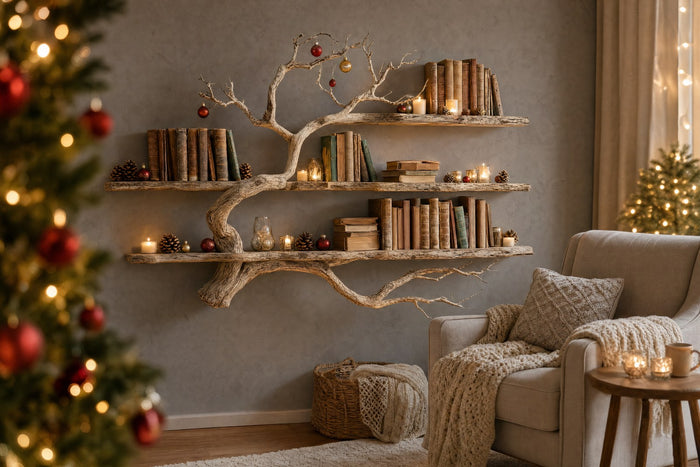
A tree shelf does something flat shelving never will - it turns a blank wall or dead corner into a living sculpture. But owning one and styling one are two different problems. Stack it wrong and it looks cluttered; leave it too sparse and it feels like you forgot to finish decorating.
This guide covers exactly how to display books, plants, and decor on tree-shaped shelves - with specific measurements, wood recommendations, and room-by-room placement strategies. Whether you're working with a wall-mounted tree wall shelf, a freestanding tree shaped bookcase, or a compact book tree shelf, you'll walk away knowing how to make it look intentional.
What Makes a Tree Shelf Different From Standard Shelving
A tree shelf mimics the branching structure of a real tree - a central trunk with asymmetric shelving arms extending outward at varied heights and angles. This organic layout creates visual movement that rectangular shelving can't replicate and naturally draws the eye upward through the room.
Unlike grid-based bookcases where every shelf is the same depth and width, tree shelves vary by branch. A typical freestanding tree shelf has branches ranging from 8 to 16 inches deep and 6 to 14 inches wide, which forces you to think about what goes where - and that's actually an advantage. The constraint becomes a curation tool.

Asymmetry Is the Point
Standard bookshelves reward uniformity: same-height books lined up, matching bookends, evenly spaced objects. Tree shelves reward the opposite. Their branches are already irregular, so your styling should lean into that - mix tall and short objects, leave some branches deliberately empty, and let the tree's silhouette do half the design work.
This is where handcrafted construction matters. Mass-produced tree shelves from particle board or MDF use identical stamped branches, which kills the organic feel. Solid wood versions - especially those carved by artisans who shape each branch individually - have natural grain variation and subtle asymmetry that makes the "tree" illusion actually convincing.
Weight Distribution Matters More Than You Think
Because tree shelf branches extend outward from a central trunk, weight creates leverage. A 5-pound plant on a 14-inch branch exerts far more torque than the same plant sitting on a flat shelf. For freestanding models, this means keeping heavier items on lower branches and closer to the trunk. For wall-mounted versions, it means proper stud mounting is non-negotiable - toggle bolts alone won't cut it above 30 pounds total load.
Solid hardwood tree shelves handle this better than engineered materials. A walnut or ash branch maintains structural integrity under load because the wood grain runs continuously through the joint, while a glued MDF branch relies entirely on adhesive strength.
The Book Tree Shelf: How to Display Books Without the Clutter
A book tree shelf looks best when you treat it as a curated display rather than bulk storage. Limit books to 60-70% of available branch space, mix orientations between vertical and horizontal stacks, and let the remaining branches handle non-book objects. This approach prevents the "overloaded coatrack" look that kills most tree shelf styling.

Vertical vs. Horizontal Book Placement
On wider branches (12+ inches), stand books vertically with a bookend or lean them against the trunk. On narrower branches (8-10 inches), stack 2-3 books horizontally - this works especially well with coffee table books and hardcovers that have attractive spines or cover art.
A good ratio: for every three branches with books, keep one branch book-free. Place a small plant, a ceramic object, or nothing at all. The negative space keeps the tree readable as a tree rather than a shapeless mass of stuff.
Organizing by Color vs. by Category
Color-blocked bookshelves photograph beautifully but feel gimmicky on a tree shelf - the organic shape fights the rigid color grouping. Instead, organize loosely by size and alternate light and dark spines to create rhythm. Put your largest volumes on the lowest branches (they're typically the widest) and work smaller as you go up, which mirrors how actual tree branches taper.
If you have a dedicated reading category - say, cookbooks in the kitchen or design books in the office - grouping by topic makes more practical sense. You'll actually find what you need, which is the point of a shelf.
One approach that works surprisingly well: arrange by spine height rather than color or topic. Graduate from tallest on the left to shortest on the right (or vice versa) within each branch. This creates a subtle visual slope that feels organic on a tree shelf and prevents the choppy look of random height alternation. It also makes it easier to spot gaps where a new book would fit perfectly.
How Many Books Can a Tree Shelf Hold?
A freestanding tree bookshelf with 8-10 branches typically holds 15-30 books comfortably, depending on branch dimensions. Wall-mounted versions with 5-7 branches hold 10-20 books. These aren't limits - they're the sweet spot where the shelf looks styled rather than stuffed.
For context, the average American home has about 130 books. A tree shelf isn't meant to hold your entire library; it's meant to showcase your favorites. Use closed storage for the rest.


Styling With Plants: Turning Your Tree Shelf Into a Living Display
Plants and tree shelves share DNA - both are organic, vertical, and sculptural. Adding 2-4 plants to a tree shelf transforms it from furniture into a living installation. The key is choosing species that trail, cascade, or stay compact enough to fit branch dimensions without blocking other objects.

Best Plants for Tree Shelf Branches
Branch shelves are typically 8-14 inches deep, which limits pot sizes to 4-6 inch diameters. Here are the plants that thrive in those conditions:
- Pothos (Golden or Marble Queen): Trails beautifully off branch edges, tolerates low light, practically unkillable. Use a 4-inch pot and let vines cascade 12-24 inches below the branch.
- String of Pearls: Dramatic trailing effect, needs bright indirect light. Place on upper branches where it gets the most light and creates the longest visual cascade.
- Small succulents (Echeveria, Haworthia): Stay compact in 3-inch pots, add sculptural texture without taking up space. Group 2-3 on a single wider branch.
- Air plants (Tillandsia): No pot needed - sit them directly on the branch. They weigh almost nothing, which makes them perfect for thinner upper branches.
- Philodendron micans: Velvety trailing leaves that look stunning against dark wood tones. Compact growth habit stays manageable.
Drainage and Protection
Water and wood don't mix. Always use pots with built-in saucers, or place a small cork or silicone coaster under each pot. On solid wood shelves - especially handcrafted pieces with natural oil finishes - water rings are permanent unless you seal the surface with polyurethane, which changes the look and feel.
For Ashdeco's solid wood tree shelves, we recommend using cachepots (decorative outer pots without drainage holes) paired with inner nursery pots. Water the plant at the sink, let it drain, then return it to the shelf. It takes 30 seconds and saves the wood indefinitely.
Plant Placement Strategy
Place trailing plants on upper branches so the vines drape downward without covering objects on lower branches. Keep compact succulents and air plants on middle branches where they're at eye level. Avoid placing anything that needs frequent watering on the highest branch - you'll stop watering it within a month because it's annoying to reach.
Two plants maximum on the same side of the tree. If you overload one side with heavy potted plants, a freestanding tree shelf can become unbalanced. Alternate plant placement left-right to distribute weight evenly.
Consider the visual "weight" of plants, too - a dark-leaved Philodendron micans looks heavier than a pale air plant, even if they weigh the same. Place visually heavy plants on lower branches and lighter, airier species higher up. This mirrors how real trees grow (dense foliage at the base, sparser at the crown) and reinforces the organic illusion.
Decor Objects That Actually Work on Tree Shelves
The best decor for tree shelves is small-to-medium, visually distinct, and lightweight. Objects between 3 and 8 inches tall work best on most branches. Anything larger overwhelms the branch proportions; anything smaller gets lost.

Objects That Work
- Ceramic vases (empty or with dried stems): 4-7 inch vases in matte finishes contrast beautifully with wood grain. Dried eucalyptus or pampas grass adds height without weight.
- Small framed photos (4×6 or 5×7): Lean them against the trunk rather than standing them flat. One or two maximum - more than that turns the tree into a photo wall.
- Wooden figurines or sculptures: Complement the shelf material. A carved wooden bird on a carved wooden tree? Perfect continuity.
- Candles (battery-operated): Real candles near books and wood are a fire risk. Battery LED candles in 3-4 inch holders give the same warmth without the hazard.
- Crystal or glass objects: One small crystal or glass piece catches light and creates contrast against the organic wood. More than one looks like a curio cabinet.
- Small clocks: A 4-inch desk clock on a mid-level branch adds function and visual weight to an otherwise decorative setup.
Objects to Avoid
Skip anything heavy with a narrow base - tall taper candle holders, top-heavy sculptures, wine bottles. These have a high center of gravity and a slight bump sends them off a branch. Also skip collections of many small identical items (20 tiny figurines, a row of shot glasses). They create visual noise that fights the tree's organic lines.
The 3-Material Rule
Limit your decor to three material types beyond the wood itself. For example: ceramic + glass + greenery, or metal + woven fiber + books. More than three materials makes the tree look like a flea market. Fewer than two makes it look like a store display. Three gives you variety with coherence.
Don't miss
These pieces qualify for 10% off orders over $2,000. Applied automatically at checkout.
10% off
Tree Bookshelf – Rustic Wooden Book Tree Shelf, Wall-Mounted Natural Wood Décor
$2,099.00
10% off at checkout
10% off
Handcrafted Solid Wood Nursery Decor & Kids' Library
$2,834.00
10% off at checkout
 10% off
Authentic Hand-Carved Solid Wood Tree Bookshelf Daybed - Sculptural Lounge Library
From $4,087.00
10% off at checkout
10% off
Authentic Hand-Carved Solid Wood Tree Bookshelf Daybed - Sculptural Lounge Library
From $4,087.00
10% off at checkout
 10% off
Rustic Tree Shaped Wooden Bookshelf with Branch Design for Living Room or Home Library
$2,145.00
10% off at checkout
10% off
Rustic Tree Shaped Wooden Bookshelf with Branch Design for Living Room or Home Library
$2,145.00
10% off at checkout
Tree Wall Shelf: Mounting, Sizing, and Styling for Wall-Mounted Designs
A tree wall shelf floats off the floor entirely, which changes everything about how you style and install it. Wall-mounted tree shelves work best in rooms under 150 square feet, above existing furniture, or in spaces where floor access matters - hallways, above desks, entryways, and nurseries.

Mounting Height Guide
The bottom branch of a wall-mounted tree shelf should sit at these heights depending on location:
| Location | Bottom Branch Height | Reason |
|---|---|---|
| Above a desk | 18-24 inches above desk surface | Clearance for monitor and head movement |
| Living room wall | 48-54 inches from floor | Eye level for average standing adult (5'4"-5'10") |
| Nursery / kids' room | 30-36 inches from floor | Child-reachable for independent book selection |
| Hallway / entryway | 52-58 inches from floor | Above coat hooks and bag height |
| Above a bed (headboard wall) | 12-18 inches above headboard | Reachable while sitting up in bed |
Wall Stud Requirements
Solid wood tree wall shelves weigh 8-20 pounds empty, plus the weight of whatever you place on them. For a fully loaded wall shelf (books, plants, decor), plan for 35-50 pounds total. This means:
- Mount into at least two wall studs (16 inches apart in standard US construction)
- Use #10 or #12 wood screws, minimum 2.5 inches long
- If studs don't align with the shelf's mounting points, use heavy-duty toggle bolts rated for 50+ pounds each
- Drywall anchors alone are not sufficient - they'll pull out within weeks under sustained load
Styling Differences From Freestanding
Wall-mounted tree shelves are viewed from below and straight-on, rarely from above. This means the tops of objects matter less than their front-facing profile. Lean picture frames forward slightly. Choose plants that trail downward (pothos, string of hearts) rather than grow upward (snake plants, ZZ plants). And keep the lowest branch lighter - it's closest to eye level and sets the visual tone for the whole piece.
Tree Shaped Bookcase: Freestanding Models for Bigger Collections
A tree shaped bookcase stands on its own base, typically 4 to 6.5 feet tall with a floor footprint of 18-30 inches in diameter. Freestanding models hold more weight (20-50 pounds total capacity), offer 360-degree visibility, and don't require any wall modification - making them ideal for renters and for placement in room centers.

Sizing by Room
| Room Size | Recommended Tree Shelf Height | Recommended Branch Span | Number of Branches |
|---|---|---|---|
| Small (under 120 sq ft) | 3.5-4.5 ft | 18-22 inches | 5-7 |
| Medium (120-200 sq ft) | 4.5-5.5 ft | 22-28 inches | 7-9 |
| Large (200+ sq ft) | 5.5-6.5 ft | 26-32 inches | 9-12 |
Measure your ceiling height before buying. A 6-foot tree shelf in a room with 8-foot ceilings looks proportional. The same shelf under a 10-foot ceiling looks stumpy. In high-ceiling rooms, go with the tallest option available or wall-mount at a height that fills the vertical space.
Placement Strategy: Corner vs. Wall vs. Open Floor
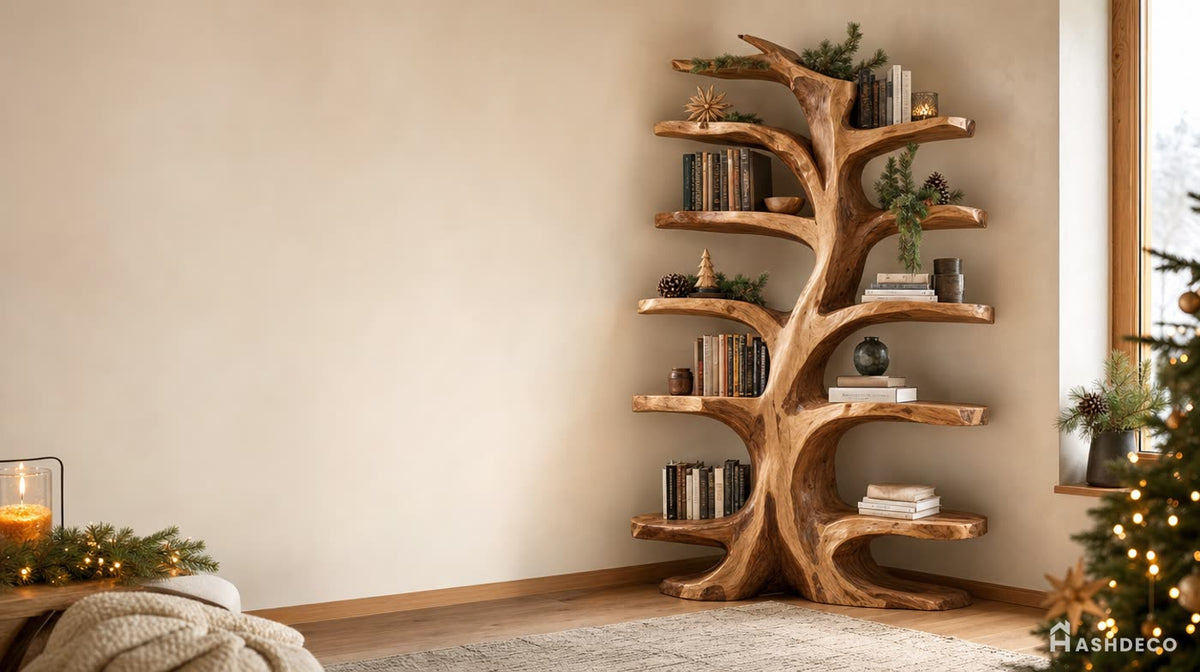
Corner placement is the most common and the most efficient. A corner tree bookshelf tucks into the 90-degree angle where two walls meet, using space that would otherwise collect dust. It's visible from the entire room without occupying walkable floor area. Most rooms have at least two usable corners - pick the one with the best natural light.
Wall placement works when the tree shelf has a flat back or leans against the wall for stability. This is the default setup for most freestanding models. Leave 1-2 inches between the shelf back and the wall for airflow and to prevent scuff marks. Consider anchoring to the wall with a furniture strap if you have children or pets.
Open floor placement is dramatic but only works in rooms over 200 square feet with clear sightlines. The tree becomes a room divider or a sculptural centerpiece. Make sure it's weighted or wide-based enough to resist being bumped - this is where solid hardwood construction pays off, since the material's density (walnut is ~38 lbs/cu ft) provides inherent stability that hollow or MDF models can't match.
Stability Anchoring for Families
If you have toddlers or large pets, anchor freestanding tree shelves to the wall regardless of how stable they seem. A single L-bracket and two screws into a stud - 10-minute job, $3 in hardware - eliminates tip-over risk entirely. Every major pediatric organization recommends anchoring furniture over 30 inches tall. Don't skip this.
For added peace of mind, choose a tree shelf with a weighted base. Solid hardwood bases are inherently heavier than hollow MDF alternatives - a walnut base can weigh 8-12 pounds on its own, providing a low center of gravity that resists tipping even before wall anchoring. Combined with a wall strap, this creates a double-safety setup that lets you stop worrying every time your toddler uses the tree as a climbing structure (they will).
Wall-Mounted vs. Freestanding: A Direct Comparison
Choosing between a wall-mounted tree shelf and a freestanding tree shaped bookcase depends on five factors: space, capacity, installation effort, household safety needs, and whether you rent or own. Here's how they compare across every dimension that matters

| Factor | Wall-Mounted Tree Shelf | Freestanding Tree Bookcase |
|---|---|---|
| Floor space required | Zero - floats on wall | 18-30 inch diameter footprint |
| Total weight capacity | 30-50 lbs (stud-mounted) | 20-50 lbs (base-dependent) |
| Book capacity | 10-25 books | 15-35 books |
| Installation time | 30-60 minutes (drill, level, mount) | 5-10 minutes (place and optionally anchor) |
| Wall damage | Yes - screw holes required | None (unless anchored) |
| Renter-friendly | Moderate - holes need patching at move-out | Excellent - no wall modification |
| Child safety | Excellent - out of reach, no tip risk | Good if anchored, risky if not |
| Best room size | Under 150 sq ft | Over 120 sq ft |
| Visual impact | Floating art-piece effect | Sculptural floor presence |
| Repositioning ease | Difficult - requires remounting | Easy - pick up and move |
Our recommendation: If you own your home and have a room under 150 square feet, wall-mount. If you rent, move frequently, or want the tree to anchor a larger room, go freestanding. For more on this comparison, read our complete tree bookshelf buying guide.
Room-by-Room Styling Ideas
Every room puts different demands on a tree shelf - different lighting, different objects, different eyeline heights. Here's how to optimize styling for each space.

Living Room
The living room is where your tree shelf works hardest. Place it beside the sofa or flanking a fireplace - this creates a natural conversation anchor. Style it with a mix of 8-12 books (vertical and horizontal), one trailing plant on an upper branch, and 2-3 decor objects (ceramic vase, small framed photo, wooden sculpture).
Color-coordinate your book spines with the room's accent colors. If your throw pillows are terracotta and olive, pull books with those spine colors to the front. This is a small detail that interior designers charge $200/hour to implement.
For living rooms with TV setups, position the tree shelf on the opposite wall. It gives the eye somewhere to land that isn't a screen, and the vertical silhouette balances the horizontal dominance of a TV unit. Explore freestanding tree bookshelves for living room-scale options.
If your living room uses an open floor plan that flows into the dining area, a freestanding tree shelf can serve as a soft room divider. Place it perpendicular to the wall at the boundary between zones - its open branch structure maintains sightlines while clearly defining where one area ends and another begins. This works better than a solid bookcase divider because it doesn't block light or create a claustrophobic wall effect.
Bedroom
In the bedroom, a tree shelf replaces (or supplements) the nightstand. Position a compact 3.5-4.5 foot model beside the bed with the lowest branch at mattress height. Use it for your current read, a small lamp or battery candle, phone, glasses, and one small plant.
On the headboard wall, a wall-mounted tree shelf creates a dramatic backdrop. Keep it simple - 4-6 books, one trailing plant, and let the wood itself be the statement. Avoid cluttering it since the bedroom should feel restful, not stimulating.
A tip for couples: if both partners read before bed, consider two smaller tree shelves flanking the headboard instead of one large unit. Each person gets their own shelf, their own current reads, their own styling territory. It's symmetrical enough to look intentional but personalized enough to feel individual - and it eliminates the "your stuff is on my side" nightstand debate permanently.
Nursery and Kids' Room
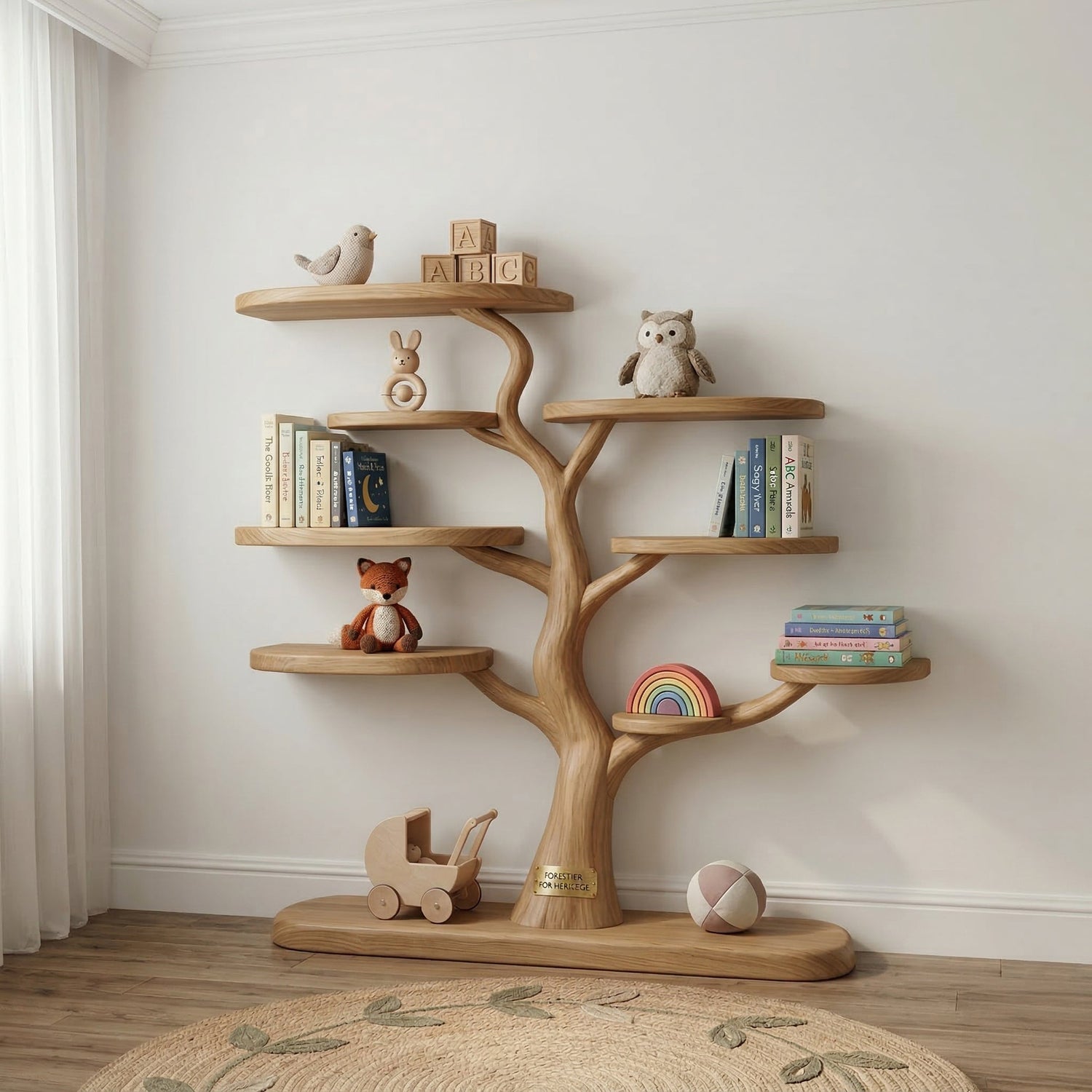
Tree shelves were practically designed for children's spaces. The branching structure sparks imagination - kids see an actual tree in their room, not a piece of furniture. Mount a wall tree shelf at 30-36 inches from the floor so toddlers can reach picture books independently.
Style with board books (spines out for easy ID), one or two stuffed animals perched on branches, and a small nightlight. Skip breakable decor entirely. As kids grow, the same shelf transitions from picture books to chapter books to display objects - no redesign needed.
Home Office
Position the tree shelf directly behind your desk chair for an instant Zoom/video call background upgrade. A tree shelf reads as "creative and intentional" on camera, while generic shelving reads as "I have stuff." Style it with professional books, a small award or certificate, one plant, and a clock.
Keep the arrangement slightly asymmetric - perfectly balanced styling looks staged on camera. One branch with nothing on it looks more natural than every branch loaded identically.
Entryway and Hallway
Entryways are narrow, which makes wall-mounted tree shelves the default choice. Use the lower branches for functional items - keys (in a small dish), sunglasses, daily carry items. Upper branches get decorative treatment - a small seasonal plant, a framed family photo, a sculptural object that signals "welcome."
In hallways, mount the tree shelf above the 52-inch mark to keep it above elbow height. Nobody wants to clip a shelf branch while walking past carrying laundry.
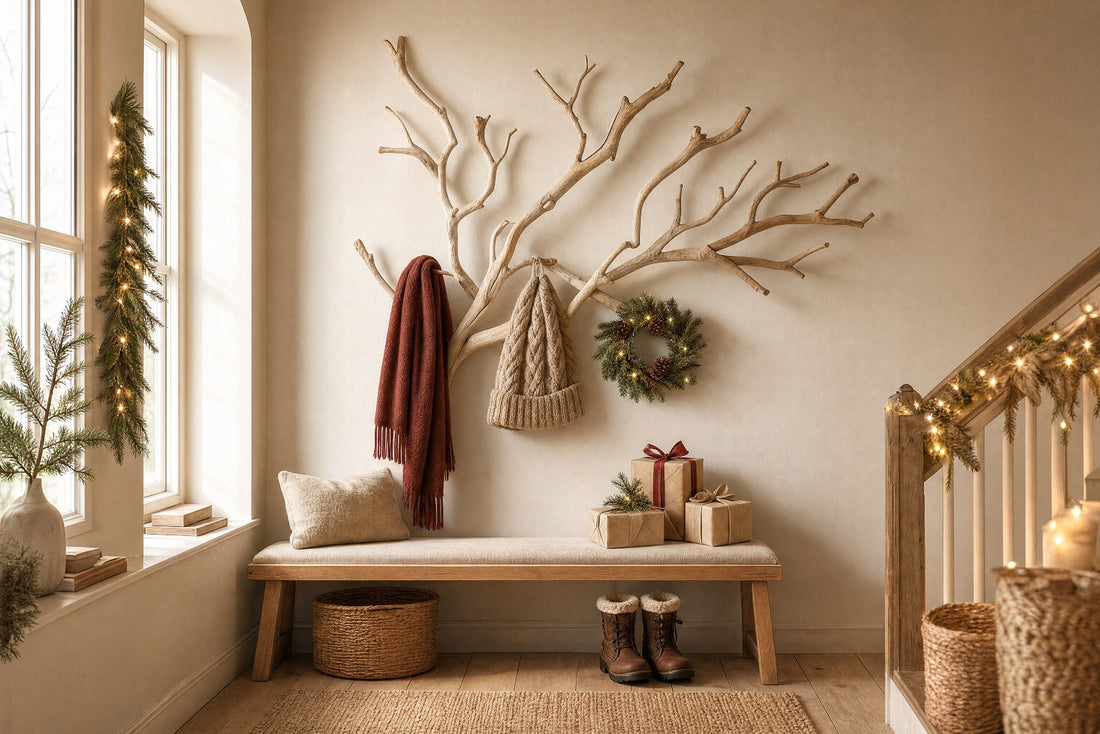
For entryways that double as coat-drop zones, pair a tree shelf with hooks mounted directly below it. The shelf handles the visual display and small items; the hooks handle coats and bags. This vertical stacking strategy uses a single 24-inch wall section for three functions - display, storage, and coat hanging - without crowding the narrow floor space that most entryways force you to work with.
Dining Room and Kitchen
A tree shelf in the dining room is unexpected, which is exactly why it works. Position it on the wall opposite the table and use it to display cookbooks, wine accessories, a small herb plant, and one or two candles. Guests notice it because they don't expect to see a tree-shaped shelf in a dining context - it becomes a conversation piece that you never have to initiate.
In the kitchen, a compact wall-mounted tree shelf can replace an open shelving unit above the counter. Use it for frequently accessed spices (in matching containers), a small trailing herb like thyme or oregano in a 4-inch pot, and one or two cookbooks you actually reference. Keep it away from the stove - grease splatter and solid wood are not friends. Position it at least 36 inches from any cooking surface and apply a polyurethane finish for easier cleaning in the kitchen environment.
Wood Types and Finish Guide for Tree Shelves
The wood species determines a tree shelf's color, grain pattern, weight, durability, and price. Here's what actually matters when choosing - cut through the marketing labels and focus on the properties that affect daily life.

Wood Species Comparison
| Wood Species | Color Range | Hardness (Janka) | Weight (per cu ft) | Best For |
|---|---|---|---|---|
| Walnut | Rich chocolate to warm brown | 1,010 lbf | 38 lbs | Dark/warm interiors, mid-century modern |
| White Oak | Honey to light tan | 1,360 lbf | 47 lbs | Scandinavian, coastal, farmhouse |
| Ash | Pale cream to light brown | 1,320 lbf | 42 lbs | Modern minimalist, Japandi |
| Cherry | Light pink aging to reddish brown | 950 lbf | 35 lbs | Traditional, transitional styles |
| Maple | Creamy white to light amber | 1,450 lbf | 44 lbs | Contemporary, children's rooms |
Why Janka hardness matters: Higher Janka ratings mean better resistance to dents and scratches. For a tree shelf that will hold books, pots, and decor objects - all of which get set down with varying degrees of care - you want a hardness above 950 lbf. Every solid wood species in the table above clears that threshold. Particle board and MDF? They don't have a Janka rating because they're not real wood.
Finish Options and Their Trade-Offs
Natural oil finish: Penetrates the wood, preserves the natural tactile feel, and enhances grain visibility. Needs reapplication every 12-18 months. Ashdeco's handcrafted tree shelves use natural oil finishes that let the wood breathe and develop a richer patina over time. Water rings are a risk - use coasters under pots.
Polyurethane / lacquer: Creates a protective surface film that resists water, scratches, and stains. The trade-off is a slightly plastic feel and a glossy sheen that can look artificial on organic shapes. Good for kitchens and bathrooms where moisture exposure is unavoidable. Available in gloss, semi-gloss, and satin - for tree shelves, satin is the sweet spot that provides protection without the furniture-showroom shine.
Matte clear coat: The middle ground. Provides moderate protection while keeping the wood's natural look. Less durable than polyurethane, more forgiving than raw oil. A solid choice for living rooms and bedrooms.
Wax finish: The most traditional option - beeswax or carnauba wax buffed into the wood creates a soft sheen with a buttery feel. Wax offers minimal moisture protection but gives the wood a warm, lived-in character that deepens over years of use. Best for decorative tree shelves in low-humidity rooms where the shelf won't be exposed to spills or plant watering. Reapply every 6-12 months with a soft cloth.
Solid Wood vs. Engineered Materials
Solid hardwood tree shelves cost 2-4× more than MDF or particle board versions, but the difference isn't just prestige. Solid wood holds screws and joints indefinitely - an MDF shelf that falls off the wall typically failed at the screw hole, where the compressed fiber has no holding power. Solid wood can be sanded and refinished decades later; MDF reveals its sawdust core the moment the surface veneer chips.
Handcrafted solid wood shelves - like those made by Vietnamese artisans at Ashdeco - add another layer: each branch is individually carved and shaped rather than machine-stamped. This means grain continuity through the trunk-to-branch joint, natural edge profiles, and subtle dimensional differences between branches that make the tree look grown rather than manufactured.
Seasonal and Thematic Styling Rotations
A tree shelf shouldn't look the same in July as it does in December. Rotate 20-30% of your objects seasonally while keeping the books and plants as your stable base. This keeps the shelf feeling fresh without requiring a complete restyle every few months.

Spring/Summer Rotation
Swap in lighter objects - a white ceramic vase, fresh-cut greenery (real or high-quality faux), a small woven basket, a light-colored framed print. If your tree shelf is near a window, add a clear glass prism or crystal that catches afternoon light and throws rainbows into the room. Replace any dark or heavy candle holders with lighter alternatives.
Spring is also the best time to replace any faux plants that have accumulated dust over winter. Artificial greenery has a shelf life - after 12-18 months, even high-quality faux plants look tired. Swap them for fresh faux or (better yet) real seasonal plants like spring-blooming African violets or small ferns that thrive in indirect light.
Fall/Winter Rotation
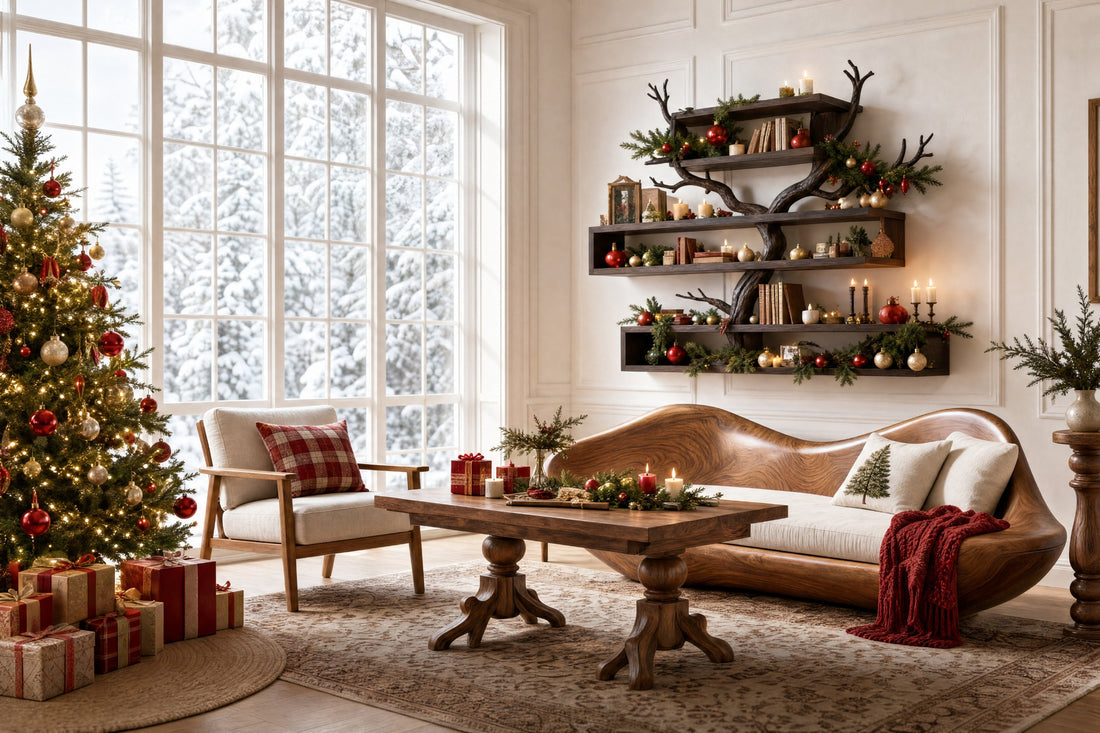
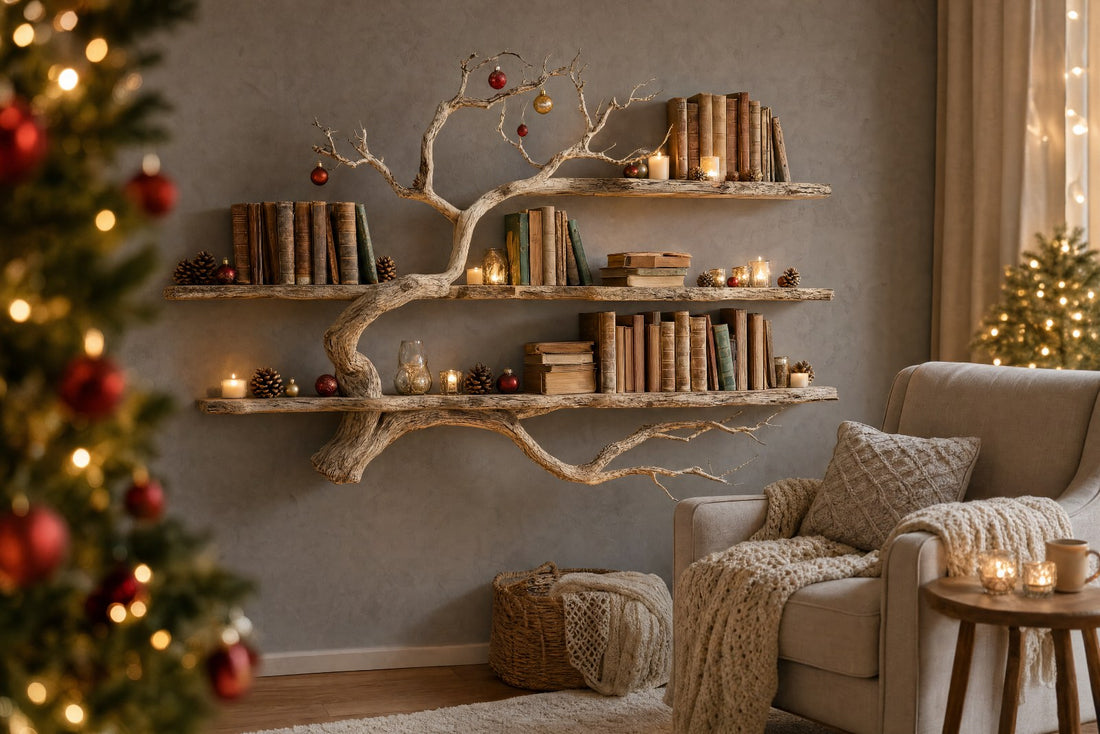
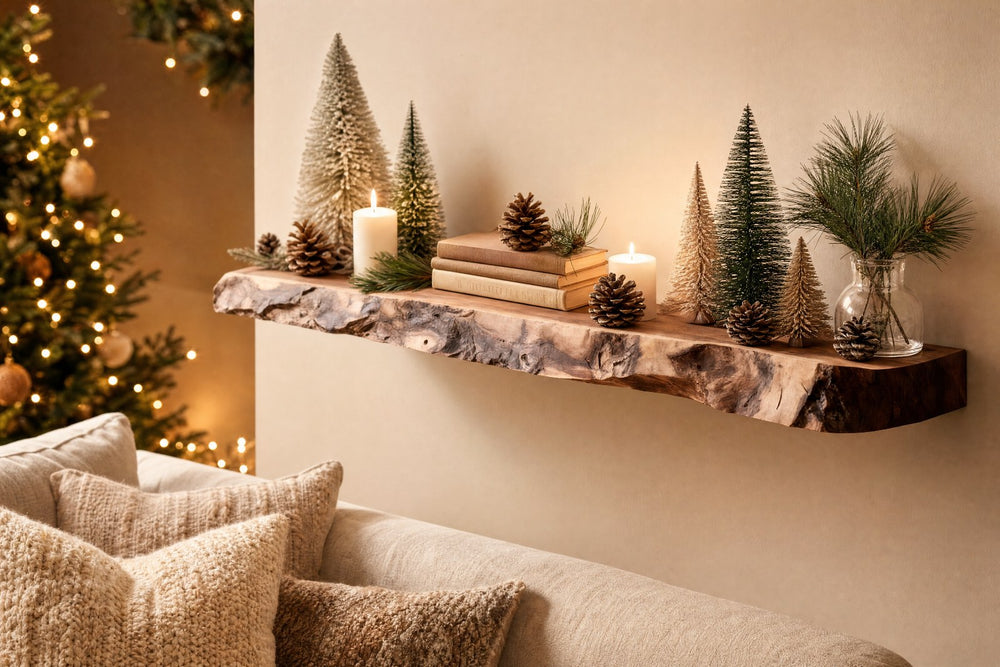
Bring in warmer tones - amber glass bottles, a small wooden bowl with dried acorns or pinecones, battery-operated LED candles in brass holders, and a darker seasonal plant (burgundy coleus, dark succulents). During the holidays, a single strand of warm micro-LED lights woven through the branches turns the tree shelf into a low-key Christmas tree alternative. It's subtle, tasteful, and gets more compliments than a full tree in most apartments.
For a more substantial winter transformation, replace one or two books with seasonal titles - a holiday cookbook in December, a cozy fiction novel in January. This tiny detail makes the shelf feel alive and evolving, like a living space should, rather than a fixed installation that was styled once and forgotten.
The "Three-Swap Rule"
Don't restyle the entire shelf - change exactly three objects per season. This takes five minutes, costs nothing if you're rotating items you already own, and creates enough visual change to feel intentional. More than three swaps and you'll lose the cohesion you've built. Fewer than three and nobody notices.
Keep a small box or basket in a closet with your "rotation objects" - the pieces that cycle on and off the tree shelf throughout the year. Having them organized and accessible means seasonal swaps actually happen instead of becoming another item on a to-do list you never get to. Label the box by season if you have enough objects to warrant it.
Dimension and Measurement Guide
Getting the right size tree shelf for your space is the difference between "perfect accent piece" and "why does this feel off?" These measurements cover ceiling clearance, branch reach, and spacing from adjacent furniture - the practical numbers that product photos never tell you.

Height-to-Ceiling Ratio
Your tree shelf should be 50-75% of your ceiling height for proportional impact. Here's the math:
| Ceiling Height | Ideal Shelf Height Range | Maximum Shelf Height |
|---|---|---|
| 8 ft (standard) | 4-6 ft | 6.5 ft |
| 9 ft | 4.5-6.5 ft | 7 ft |
| 10 ft (high ceiling) | 5-7.5 ft | 8 ft |
| 12 ft (loft/warehouse) | 6-9 ft | 9.5 ft |
Leave at least 12 inches between the top of the tree shelf and the ceiling. Anything closer looks crammed, and you won't be able to place objects on the highest branch without scraping the ceiling.
Branch Clearance From Furniture
The widest-reaching branch determines how far the tree shelf projects into the room. Measure the longest branch and add 4 inches for clearance - you don't want branches at hip or shoulder height that you'll catch on while walking past.
- Next to a sofa: Keep the nearest branch at least 6 inches from the sofa arm. Branches that hang over seating areas get bumped by heads and shoulders.
- Beside a bed: Leave 8-10 inches between the nearest branch and the pillow line. You don't want to roll into a shelf arm at 2 AM.
- In a walkway: Maintain 36 inches of clear walking space between the outermost branch and the opposite wall or furniture piece.
- Near a door: The door swing arc must fully clear every branch. Open the door completely and check before you finalize placement.
Base Diameter and Floor Impact
Freestanding tree shelves have round or X-shaped bases ranging from 14 to 30 inches in diameter. On hardwood floors, place a felt pad under the base to prevent scratches - an 18-inch felt furniture pad costs $5 and saves your floors permanently. On carpet, the base may sink slightly; use a thin wooden platform (a 1-inch plywood circle cut to size) to distribute weight and keep the shelf level.
If you're placing a freestanding tree shelf on tile or stone flooring, the base may slide when bumped. Add rubber grip pads (available in furniture supply stores for under $3) to the bottom of the base. These provide enough traction to keep the shelf planted while still allowing you to slide it when you deliberately want to reposition.
For renters concerned about floor damage, the felt pad solution applies regardless of floor type. Cut the pad to match your base shape exactly - oversized pads look sloppy and collect dust. Trace the base on the felt material, cut with scissors, and attach with removable adhesive dots so you can take it with you when you move.
Common Styling Mistakes (and How to Fix Them)
Most tree shelf styling problems fall into five categories. Identifying which one you've got is 90% of the fix.

Mistake 1: Overloading Every Branch
When every branch holds something, the tree silhouette disappears. You're left with a vaguely tree-shaped mass of stuff. Fix: remove objects from 2-3 branches entirely. The empty branches become the "air" that lets the tree shape read visually. Aim for 60-70% branch occupancy, never 100%.
Mistake 2: All Objects the Same Height
Books standing vertically on every branch creates a hedgerow effect - uniform and flat. Fix: alternate between vertical books, horizontal stacks, short decor objects, and trailing plants. Height variation of at least 4 inches between adjacent branches creates visual rhythm.
Mistake 3: Ignoring the Trunk
The trunk is the tree shelf's backbone, and it should be partially visible - not completely hidden behind objects. Fix: angle items slightly so the trunk peeks through. This reinforces the tree metaphor and prevents the shelf from looking like a generic zigzag.
On handcrafted solid wood tree shelves, the trunk is often the most visually interesting part - it has the thickest grain patterns, the most pronounced wood character, and the hand-shaped contours that distinguish artisan work from factory production. Hiding it behind objects defeats the purpose of choosing a handcrafted piece in the first place. Let 30-40% of the trunk surface remain visible.
Mistake 4: Forgetting to Step Back
Most people style their tree shelf from 12 inches away, standing right in front of it. But that's not how anyone else sees it. Fix: style from arm's length, then step back to the room's main viewing distance (usually 6-10 feet). What looks balanced up close often looks unbalanced from across the room. Adjust from the far view.
Mistake 5: Fighting the Asymmetry
Trying to make a tree shelf look symmetrical is like trying to make a waterfall flow in a straight line. Fix: embrace the irregular branch layout. Place your anchor objects (heaviest book stack, largest plant) off-center. Let one side be slightly fuller than the other. This is what designers call "visual tension," and it's what makes a styled shelf interesting rather than predictable.
Frequently Asked Questions About Tree Shelves

How much weight can a tree shelf hold?
A solid wood freestanding tree shelf typically holds 20-50 pounds total, distributed across all branches - roughly 3-6 pounds per branch depending on length and mounting. Wall-mounted tree shelves hold 30-50 pounds when properly secured into wall studs. Always check manufacturer specifications and distribute weight evenly to prevent leaning or tipping.
Are tree shelves stable enough for homes with kids and pets?
Freestanding tree shelves should be wall-anchored with an L-bracket and furniture strap in homes with children under 6 or large pets. Wall-mounted models are inherently safer since they're fixed to the wall and out of reach. Solid hardwood construction is more stable than hollow or MDF alternatives because the material density lowers the center of gravity.
What's the best wood for a tree shelf?
Walnut and white oak are the most popular choices. Walnut offers a rich dark tone with moderate hardness (1,010 Janka), while white oak provides a lighter color with superior dent resistance (1,360 Janka). Both are solid hardwoods that hold screws indefinitely and can be refinished. Avoid particle board and MDF - they lack structural integrity at branch joints where stress is highest.
Can I use a tree shelf in a bathroom or kitchen?
Yes, with the right finish. Bathrooms and kitchens expose shelves to moisture and temperature swings. Use a polyurethane or marine-grade sealant on the wood surface, and always place pots and containers in waterproof saucers. Solid hardwood handles humidity better than MDF, which swells and delaminates when exposed to moisture over time.
How do I clean and maintain a solid wood tree shelf?
Dust weekly with a dry microfiber cloth. For deeper cleaning, use a barely damp cloth with a drop of mild dish soap - never soak the wood. Reapply natural oil finish (tung oil or Danish oil) every 12-18 months to maintain protection and luster. Avoid silicone-based furniture sprays, which build up a cloudy residue over time.
What size tree shelf do I need for my room?
Match the shelf height to 50-75% of your ceiling height. For standard 8-foot ceilings, choose a 4-6 foot tall tree shelf. For rooms under 120 square feet, a compact 5-branch model with an 18-22 inch span works best. Larger rooms (200+ sq ft) can handle 9-12 branch models with a 26-32 inch span. Always leave 12 inches minimum between the shelf top and ceiling.
What's the difference between a tree shelf and a tree bookcase?
The terms are often used interchangeably. "Tree shelf" generally describes both wall-mounted and freestanding models, while "tree bookcase" or "tree shaped bookcase" usually refers specifically to freestanding floor units with wider branches designed for heavier book loads. Functionally, both use the same branching structure - the difference is primarily size, capacity, and mounting type.
Where can I find handcrafted solid wood tree shelves?
Ashdeco specializes in handcrafted tree shelves made by Vietnamese artisans from solid hardwood - each branch carved individually and assembled into a modular design. Unlike mass-produced options, every piece has unique grain patterns and subtle shape variations. Browse the full tree bookshelf collection to see available styles, sizes, and wood species.
Style Your Tree Shelf With Confidence
A tree shelf earns its place in your home when it's styled with intention - books that you actually read, plants that bring life into the room, and decor objects that mean something to you. The techniques in this guide (the 60-70% branch rule, the three-material limit, the seasonal three-swap rotation) work because they give you structure without rigidity.
Start with the anchor pieces: 8-12 books distributed across your largest branches, one or two trailing plants on upper branches, and 2-3 decor objects that represent your three chosen materials. Then step back, view it from across the room, and remove anything that feels forced. The best-styled tree shelves look like they happened naturally - even though every placement was deliberate.
Whether you choose a wall-mounted tree shelf for a compact space or a freestanding corner tree bookshelf to fill a dead zone, solid wood construction ensures the piece lasts decades - and handcrafted artisan work ensures it looks like nothing else in anyone's home. For inspiration across every room in the house, explore our tree bookshelf ideas guide.