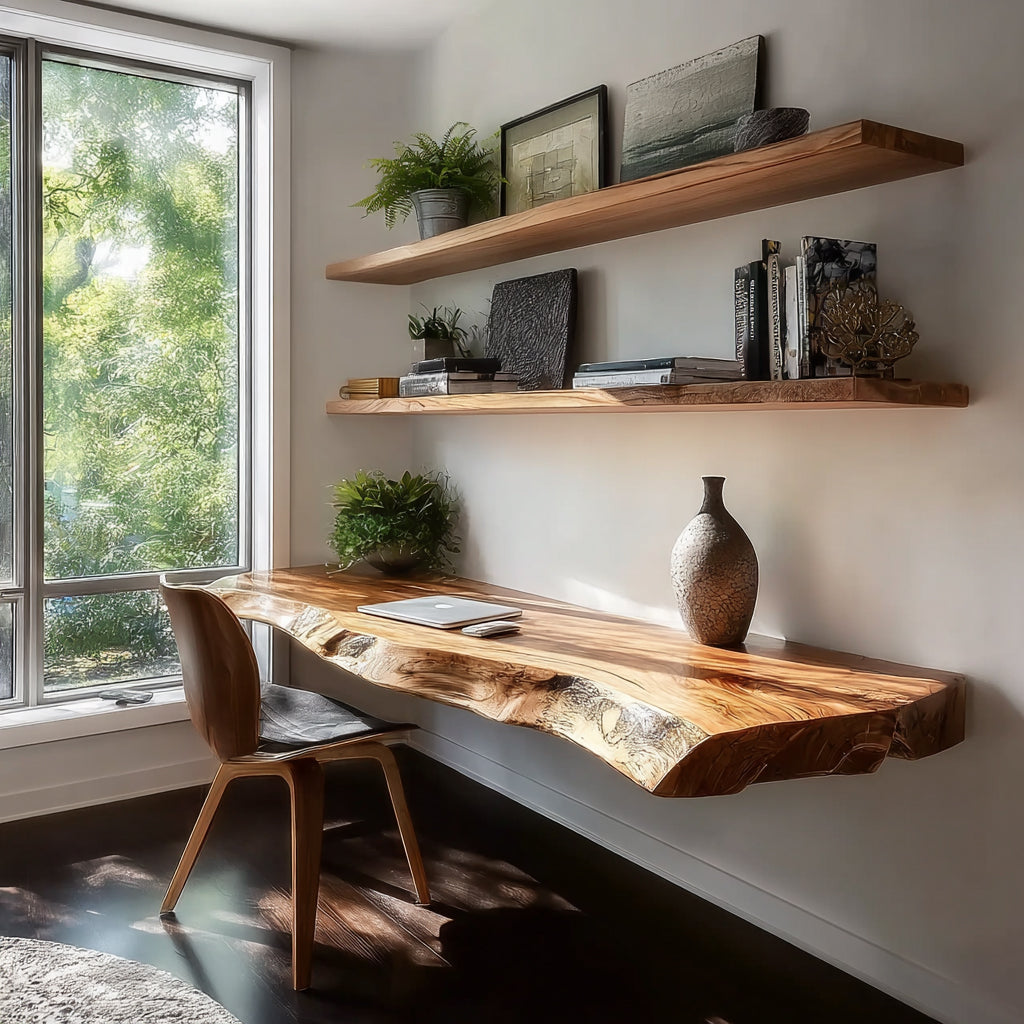
A desk with floating shelves is the smartest way to build a home workspace that looks clean, saves floor space, and actually works for eight-hour days. Instead of cramming a bulky desk and a separate bookcase into your office, you mount everything to the wall - one seamless system of solid wood that floats like it was always part of the room. In this guide, we'll walk through exact dimensions, shelf spacing formulas, material choices, and cable management tricks so you can build a wall-mounted workspace that outperforms anything from a big-box store.

Why a Desk with Floating Shelves Is the Best Home Office Layout
A desk with floating shelves combines your work surface and storage into a single wall-mounted system, eliminating floor clutter while maximizing vertical space. This layout keeps essentials within arm's reach above your monitor, and because nothing touches the floor beneath the desk, the room feels twice its actual size.
The work-from-home shift isn't slowing down. According to Stanford economist Nick Bloom's 2025 research, 28% of U.S. work days are now performed remotely - a figure that's held steady since late 2023 and shows no sign of retreating. That means millions of Americans need a real workspace at home, not a laptop balanced on a kitchen counter.
The problem? Most home offices are bedrooms, spare corners, or awkward nooks. A traditional desk-and-hutch setup eats 12-18 square feet of floor space. A wall mounted floating desk with shelves above reclaims most of that footprint because the only thing touching the ground is your chair.
Here's what this layout solves that a standard desk can't:
- Floor space: No legs means you can slide storage bins, a printer cart, or even a small filing cabinet underneath without interference.
- Vertical storage: Two or three floating shelves above the desk give you 6-12 linear feet of shelf space for books, speakers, plants, and decor - without adding another piece of furniture.
- Visual weight: A floating setup reads as architectural, not furniture. It looks built-in, even in a rental.
- Cleaning: Vacuuming under a floating desk takes seconds. Under a legged desk with a cable nest? Good luck.
If you're designing a workspace from scratch - or replacing a setup that's not cutting it - pairing a floating desk with floating shelves above is the layout that professional interior designers keep coming back to. It's functional minimalism that actually functions.

The Ideal Dimensions for a Floating Desk with Shelves
The standard ergonomic desk height is 28-30 inches from floor to desk surface, with the first shelf mounted 20-24 inches above the desk and 10-12 inches deep. Getting these three numbers right determines whether your workspace feels comfortable for full workdays or causes neck strain within an hour.
Let's break down every measurement you need.
Desk Height: 28-30 Inches from the Floor
This range works for most adults between 5'4" and 6'1". At 29 inches - the sweet spot - your elbows rest at roughly 90 degrees when typing, which is what ergonomic guidelines from OSHA and the American National Standards Institute recommend. If you're taller than 6'1", go to 30-31 inches. Shorter than 5'4"? Drop to 27-28 inches.
Because a floating wood desk mounts at whatever height you choose, you have an advantage over pre-built desks with fixed 30-inch legs. You can dial in your exact ergonomic sweet spot during installation.
Desk Depth: 20-24 Inches
For a monitor setup, you need at least 20 inches of depth so the screen sits 20-26 inches from your eyes (the distance recommended by the American Academy of Ophthalmology). A 24-inch deep desk gives you room for a monitor, a keyboard, and still leaves 4-6 inches of "landing zone" at the front edge for your wrists and forearms.
For dual monitors or an ultrawide, 24 inches is the minimum. Deeper than 26 inches starts to feel like a conference table - it pushes you away from the wall and wastes space.
Desk Length: 48-72 Inches
A 48-inch (4-foot) desk suits a single-monitor setup. For dual monitors plus peripherals, aim for 60 inches. A long floating desk at 72 inches (6 feet) gives you a full workstation on one side and open space for writing, sketching, or a second person on the other.
Solid wood planks from hardwood species like acacia, walnut, or mango typically come in slabs long enough to run 60-72 inches without seams. That single-piece construction is both an aesthetic advantage and a structural one - no joints means no weak points.
Shelf Spacing Above the Desk
This is where most people guess and get it wrong. Here's the formula:
| Shelf Position | Height Above Desk Surface | Recommended Depth | Best Use |
|---|---|---|---|
| First shelf | 20-24 inches | 10-12 inches | Books, speakers, framed photos |
| Second shelf | 36-40 inches | 8-10 inches | Plants, small decor, lighter items |
| Third shelf (optional) | 50-56 inches | 6-8 inches | Display items, trailing plants |
Why 20-24 inches for the first shelf? It needs to clear your monitor. A typical 27-inch monitor on a desk stand is about 18-19 inches tall. Adding 2-4 inches of clearance prevents the shelf from visually crushing the screen and lets you mount a monitor light bar if you use one.
Each higher shelf should be slightly shallower than the one below it. This creates a tapered look that draws the eye upward and prevents upper shelves from blocking light to the desk surface.

Solid Wood vs. Particle Board: Why Material Matters for a Floating Desk
A solid hardwood floating desk supports 100-200+ pounds when properly mounted, lasts decades, and develops a richer patina over time. Particle board desks from IKEA or Amazon typically hold 50-80 pounds maximum, sag within 2-3 years, and can't be refinished when damaged.
This isn't snobbishness - it's physics and economics. Let's compare what you're actually getting.
Weight Capacity: The Dealbreaker
A floating desk with shelves needs to support real loads. A dual-monitor setup with a laptop, books, and peripherals easily hits 50-60 pounds. Add forearm weight while typing (another 10-15 pounds of dynamic load) and the occasional lean-on-the-desk moment, and you need a surface rated for at least 100 pounds.
Particle board (MDF with melamine coating) has a bending strength around 1,500-2,500 PSI. Solid acacia wood? 7,500-10,000 PSI. That's 3-5 times stronger. When mounted with proper French cleats or heavy-duty brackets into wall studs, a 1.5-inch thick solid wood plank becomes essentially immovable.
IKEA's LACK floating shelf, for reference, is rated for 6.6 pounds. Their ALEX/LINNMON desk combo uses a honeycomb paper core - it's literally cardboard inside. These products aren't designed for the loads a real workspace demands.
Longevity and Refinishing
Solid wood can be sanded and refinished indefinitely. Got a scratch? Sand it. Coffee ring? Sand it. Want a different stain color in five years? Sand and restain. Particle board can't be sanded - once the thin melamine skin is damaged, the compressed sawdust underneath crumbles and swells, especially in humid environments.
A handcrafted solid wood desk from artisan workshops - like those made by Vietnamese woodworkers who've spent decades mastering hardwood joinery - is built to survive generations. The wood is kiln-dried to 8-12% moisture content before carving, which prevents warping and cracking after installation. That's a step mass manufacturers skip to save time.
The Real Cost Comparison
| Factor | IKEA/Amazon Particle Board | Solid Hardwood (Handcrafted) |
|---|---|---|
| Upfront cost (60" desk) | $80-$200 | $300-$800 |
| Lifespan | 2-5 years | 20-50+ years |
| Cost per year | $40-$100/year | $6-$40/year |
| Weight capacity | 50-80 lbs | 100-200+ lbs |
| Refinishable | No | Yes, unlimited times |
| Resale value | Near zero | Holds 40-60% of value |
| Environmental impact | Landfill in 3-5 years | Heirloom piece, no waste |
When you calculate cost-per-year, solid wood is actually the budget option. A $500 handcrafted floating desk that lasts 25 years costs $20 per year. A $150 IKEA desk that lasts 3 years costs $50 per year - and you have to haul the old one to the dump and buy a replacement.

Live Edge vs. Straight Edge: Choosing Your Desk Style
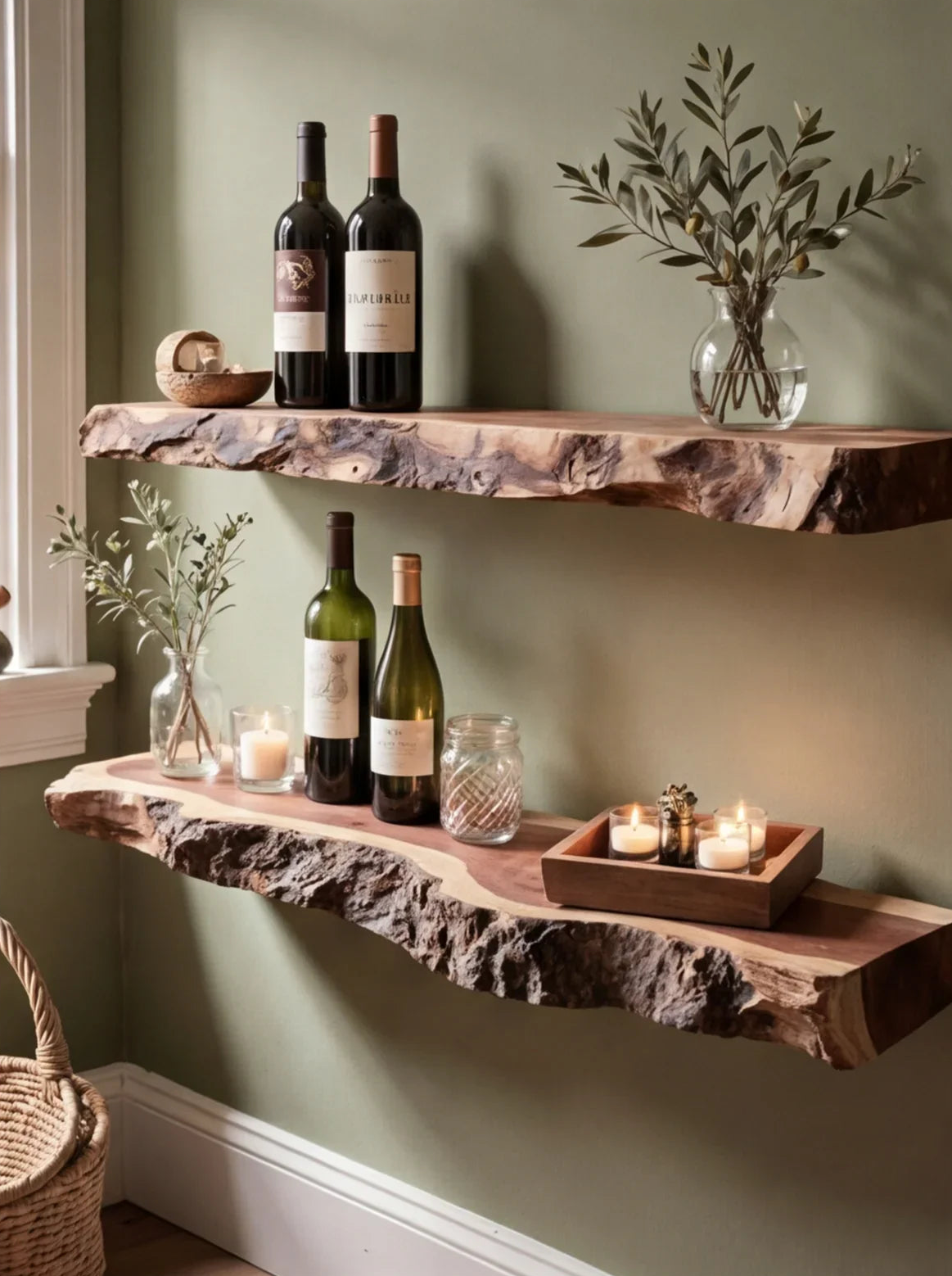
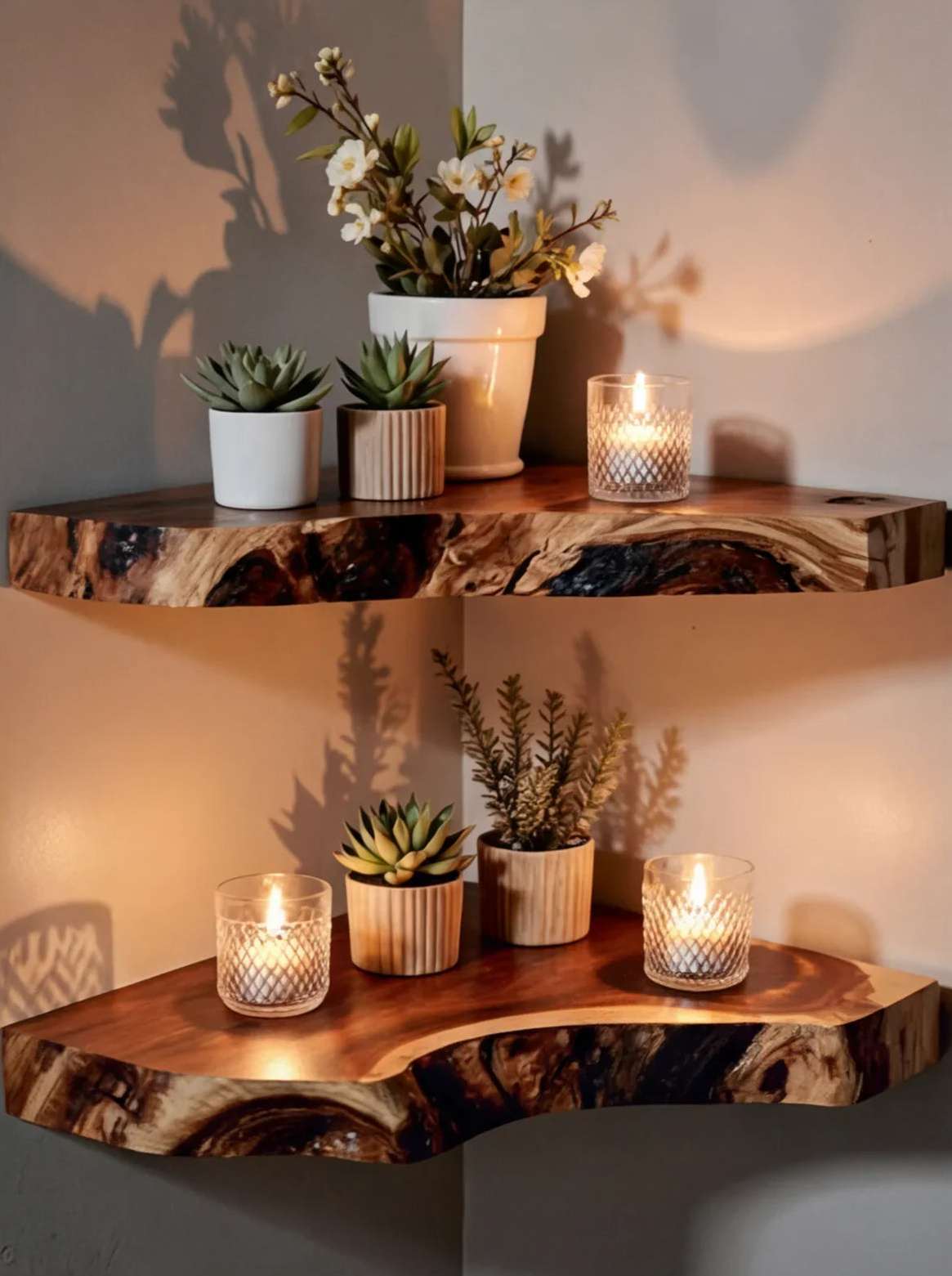
A live edge floating desk preserves the natural outer contour of the tree slab, creating an organic, one-of-a-kind silhouette. A straight edge desk is cut to uniform dimensions for a cleaner, more geometric look. Both work beautifully as wall-mounted workspaces - the choice comes down to your room's aesthetic and how you use the surface.
Live Edge: When to Choose It
Live edge desks are statement pieces. The natural bark line, undulating curves, and visible wood grain make each slab completely unique - no two are alike. This style works best when:
- Your room leans modern-organic, mid-century, or industrial
- The desk is visible from a doorway or main sightline (it deserves to be seen)
- You want a conversation piece that doubles as functional art
- You're pairing with wall floating shelves that have a similar natural wood tone
Vietnamese artisans who specialize in nature-sculpted wood furniture work directly with the slab's natural shape, hand-carving and sanding each curve rather than forcing the wood into a factory template. The result is a desk surface where you can feel the wood's original form under your fingertips - something a CNC machine or Swedish flat-pack will never replicate.
One practical note: live edge desks have an irregular front profile, which means the depth varies by 1-3 inches across the length. If you need a perfectly uniform front edge for a keyboard tray or monitor arm clamp, ask for the front edge to be straightened while keeping the back edge live.
Straight Edge: When to Choose It
Straight edge desks suit minimalist, Scandinavian, or traditional office aesthetics. They also work better for:
- L-shaped or corner configurations where two pieces need to meet cleanly
- Setups with under-desk keyboard trays or monitor arm clamps that need a uniform edge
- Shared desks where two people sit side by side
- Rooms with strong linear architecture (straight crown molding, grid tile, geometric light fixtures)
A straight-edge modern floating desk in walnut or dark acacia with clean 90-degree corners and a matte finish reads as expensive and intentional. Pair it with matching floating shelves in the same wood species and finish, and the whole wall becomes a cohesive built-in system.
Can You Mix Styles?
Absolutely. A live edge desk with straight-edge shelves above is one of the most popular combinations. The organic desk surface provides visual interest at eye level, while the geometric shelves above create order and structure. Contrast drives good design.

How to Mount a Floating Desk to the Wall (Step by Step)
A floating desk mounts securely using either a French cleat system or heavy-duty concealed brackets anchored into wall studs. Both methods hide the hardware completely, creating the illusion that a 50+ pound slab of solid wood is hovering against the wall.
Before you drill anything, here's what you need to know.
Find Your Studs - This Is Non-Negotiable
A wall mounted floating desk must anchor into studs, not just drywall. A drywall anchor rated for 50 pounds will rip out under the dynamic loads of someone working at a desk (leaning, shifting, typing). Wall studs are 16 inches apart in standard U.S. construction (sometimes 24 inches in older homes).
Use an electronic stud finder and verify with a small nail. For a 60-inch desk, you'll hit 3-4 studs, which is more than enough. Each stud connection with a 3/8" lag bolt can hold 200+ pounds of shear force.
Method 1: French Cleat (Recommended for Solid Wood)
- Cut two cleats from 3/4" hardwood or plywood at a 45-degree bevel. One mounts to the wall, one to the back of the desk.
- Level and mount the wall cleat at your desired height using 3" lag bolts into every stud. Pre-drill to avoid splitting.
- Mount the desk cleat to the back underside of your desk slab using heavy-duty wood screws.
- Hang the desk by hooking the desk cleat over the wall cleat. The interlocking 45-degree angles create a mechanical lock that distributes weight evenly.
- Add support brackets underneath at each end for extra rigidity. L-brackets (3" × 5" steel, painted to match wall) hidden underneath prevent any front-edge sag.
French cleats are the go-to for heavy solid wood because the load distributes across the entire length of the cleat, not concentrated at two or three bracket points. They also make removal easy - just lift up and off.
Method 2: Concealed Bracket System
Heavy-duty floating shelf brackets (the rod-style type that slide into drilled holes in the back of the slab) can also work for desks, but they require thicker stock. The slab should be at least 1.5 inches thick to accept the rods without weakening the wood. Each bracket typically holds 50-75 pounds, so for a 60-inch desk, you'd want 4-6 brackets.
This method gives the cleanest look - zero visible hardware from any angle. But it's less forgiving during installation and harder to remove later.
What About the Shelves?
Floating shelves above the desk use the same concealed bracket or French cleat approach, but the loads are lighter (10-30 pounds per shelf). Standard floating shelf brackets work perfectly. Mount each shelf into at least two studs, and you'll never worry about them pulling free.

Cable Management for a Floating Desk Setup
The biggest advantage of a desk with floating shelves - that clean, floating look - gets destroyed instantly by visible cables. Proper cable management isn't optional; it's what separates a professional workspace from a tangle of wires pretending to be one.
Here are the systems that actually work for wall-mounted setups.
Route Cables Behind the Desk Slab
Because a floating desk sits against the wall with a small gap behind it (typically 1/2" to 1" depending on mounting hardware), you already have a natural cable channel. Use adhesive cable clips along the back of the slab to route power cables, monitor cables, and USB lines down to a floor-level outlet or along the wall to a side outlet.
For a cleaner solution, drill a 2-inch grommet hole in the desk surface near the back corner. Run cables down through the grommet, behind the slab, and out of sight. A rubber or brass grommet cover keeps the hole looking intentional.
Use a Cable Management Tray Under the Desk
Mount a mesh cable tray (J-channel or basket style) to the underside of the desk using short wood screws. This catches the power strip, adapters, and excess cable length in one hidden basket. Because the desk floats, nobody sees underneath unless they crawl on the floor.
Recommended setup for the under-desk tray:
- One surge protector (6-8 outlets) with a single cord running to the wall outlet
- All device chargers and adapters plugged into the surge protector
- Velcro cable ties (not zip ties - you'll want to add or remove devices later) bundling excess length
- Cable sleeve or raceway for the single power cord running from tray to outlet
Shelf-to-Desk Cable Routing
If you have devices on the shelves above (speakers, a smart display, LED strip lights), run cables vertically behind the shelves. A narrow paintable cable raceway - 1/2" wide, same color as your wall - becomes invisible once painted. Alternatively, drill small holes in the back of each shelf and thread cables through, keeping them hidden between the shelf and wall.
Wireless Where Possible
Every cable you eliminate is one you don't have to manage. Prioritize:
- Wireless keyboard and mouse (eliminates 1-2 cables)
- Wireless phone charger built into or placed on the desk surface
- Bluetooth speakers on the shelves (eliminates audio cables)
- USB-C monitor with single-cable docking (one cable for video, power, and data)

Designing Your Shelf Layout: What Goes Where
The shelves above your floating desk serve three purposes: functional storage, workspace support, and visual balance. Placing the right items at the right height turns dead wall space into an organized system that makes your workday more efficient.
First Shelf (20-24 Inches Above Desk): Daily-Use Items
This is your most accessible shelf - you can reach it without standing up. Stock it with things you grab or reference multiple times per day:
- Reference books or notebooks (standing upright between bookends)
- Desktop speakers (angled slightly downward toward your ears for better sound staging)
- Small desk lamp or monitor light bar mount point
- A small plant (pothos or snake plant - low-maintenance, proven air purifiers)
Keep this shelf at 10-12 inches deep to match the visual weight of the desk below it. If it's too shallow, it looks like an afterthought. If it's deeper than the desk, it creates a claustrophobic overhang.
Second Shelf (36-40 Inches Above Desk): Display + Overflow
The second shelf is above comfortable reaching range while seated, so it's better for items you access occasionally or that serve a decorative purpose:
- Framed photos or artwork
- Decorative objects (a sculptured wood piece, a clock, a candle)
- Overflow books you don't reference daily
- A trailing plant that cascades downward toward the first shelf
At 8-10 inches deep, this shelf should be slightly shallower than the first. This tapered depth guides the eye upward and keeps upper shelves from casting shadows on the workspace.
Third Shelf (Optional, 50-56 Inches Above Desk): Decorative Only
If your ceilings are 9 feet or higher, a third shelf works beautifully. At this height, it's purely decorative - a few carefully chosen objects, a trailing plant, or a piece of wall art propped casually against the wall. Keep it shallow (6-8 inches) and don't overcrowd it. Less is more at ceiling height.
The Asymmetry Rule
Don't place identical items in identical positions on each shelf. Stagger objects - a tall plant on the left of shelf one, a stack of books on the right of shelf two. Asymmetry feels curated and intentional; symmetry feels like a retail display. Interior designers call this "visual weight balancing," and it's the difference between a workspace that looks styled and one that looks staged.

Best Wood Species for a Floating Desk with Shelves
The ideal wood for a floating desk with shelves is a dense hardwood like acacia, walnut, or mango - species that offer high bending strength for wall-mounted loads, rich natural grain patterns, and excellent durability for daily workspace use.
Not all wood is equal when it comes to floating furniture. The desk needs to resist bending under load without excessive thickness, and the shelves need to hold weight at span lengths of 36-60 inches without sagging. Here's how the most popular species compare.
Acacia: The Best All-Rounder
Acacia (specifically Acacia mangium and Acacia auriculiformis, abundant in Vietnam) is the sweet spot of strength, beauty, and sustainability. It's rated 2,300 on the Janka hardness scale - harder than walnut, oak, and maple. The grain patterns are dramatic, with flowing ribbons of honey gold and chocolate brown that make every slab look like a unique piece of art.
Vietnamese artisans have been working with acacia for generations because it responds beautifully to hand tools. It carves cleanly, takes finishes evenly, and develops a warm amber patina with age. For a floating desk that's both a work surface and a visual centerpiece, acacia is our top recommendation.
Walnut: The Premium Choice
Black walnut (Janka 1,010) is softer than acacia but has a grain sophistication and color depth - deep chocolate with purple undertones - that makes it the prestige choice for home offices. It's lighter in weight per cubic foot, which can be an advantage for wall mounting. The trade-off is that it scratches more easily than acacia, so a good sealant coat is important for a desk surface.
Mango Wood: The Sustainable Standout
Mango wood (Janka 1,070) comes from fruit trees at the end of their productive life, making it one of the most environmentally responsible hardwood choices. The grain has a distinctive character - swirling, with golden and pale tones that brighten a workspace. It's dense enough for floating desks up to 60 inches without sag when paired with a proper mounting system.
Species Comparison for Floating Furniture
| Wood Species | Janka Hardness | Weight (lbs/ft³) | Max Unsupported Span (1.5" thick) | Best For |
|---|---|---|---|---|
| Acacia | 2,300 | 42-46 | 60-72 inches | All-around desks and shelves |
| Black Walnut | 1,010 | 38-42 | 48-60 inches | Premium, lighter-weight setups |
| Mango | 1,070 | 37-40 | 48-60 inches | Eco-conscious, bright-toned spaces |
| Pine (for comparison) | 380-690 | 22-35 | 36 inches max | NOT recommended for floating desks |
| MDF/Particle Board | N/A | 44-50 | 24-36 inches | NOT recommended (sags under load) |
Notice that MDF is actually heavier than solid hardwood while being weaker. You're mounting more weight on the wall for less structural performance. It's the worst of both worlds for a floating application.

Floating Desk Ideas for Every Room Size
A modern floating desk adapts to any space - from a 4-foot bedroom wall to a full 8-foot home office feature wall. The key is matching desk length, shelf count, and configuration to the room's proportions and your workflow needs.
Small Space (Under 40 Square Feet): The Compact Nook
For apartments, bedrooms, or hallway alcoves, a 36-48 inch floating wood desk with a single shelf above creates a complete workspace in under 8 square feet of wall space. Keep the desk depth at 18-20 inches to avoid the surface protruding too far into the room.
Configuration tips for small spaces:
- Mount the desk in a corner to gain an extra 6-8 inches of perceived depth
- Use one shelf at 22 inches above the desk - skip the second shelf to avoid a top-heavy look in a small room
- Choose a lighter wood tone (mango, light acacia) to keep the space feeling open
- Wall-mount the monitor to free up the entire desk surface
Medium Space (40-80 Square Feet): The Standard Home Office
This is the most common setup - a spare bedroom or dedicated office nook. A 60-inch desk with two shelves above is the ideal configuration. You get enough surface for dual monitors, a desk pad, and a few personal items, with the shelves handling books, speakers, and decor overhead.
At 60 inches, the desk should be deep enough (22-24 inches) to accommodate a monitor arm and still leave working space in front. Two shelves above - the first at 10-12 inches deep, the second at 8-10 inches - create layered storage without overwhelming the wall.
Large Space (80+ Square Feet): The Feature Wall
If you have a full wall to work with, a long floating desk at 72-96 inches becomes the centerpiece of the room. At this length, you can create zones: a primary work area with monitors in the center, a secondary creative area on one side, and open display space on the other.
Three shelves of varying lengths above the desk - staggered, not all the same width - create an installation-art quality that doubles as storage. This is where handcrafted solid wood really shines over mass-produced alternatives. Each shelf and the desk itself can be made from the same tree, with continuous grain matching across all pieces.
For feature wall setups, pair your floating desk with matching wall floating shelves from the same wood species. The visual continuity makes the whole system look custom-built rather than assembled from separate purchases.

The WFH Trend: Why Investing in Your Workspace Pays Off
Remote work isn't a pandemic blip - it's a permanent shift in how Americans work, and investing in a proper desk with floating shelves pays measurable returns in productivity, focus, and physical health over years of daily use.
The Numbers Behind the Shift
Here's what the data says about work from home in 2025-2026:
- 28% of U.S. work days are performed from home (Stanford/WFH Research, 2025), up from 5% pre-pandemic
- 35% of workers who can work remotely do so full-time; another 41% work hybrid (Gallup, 2025)
- $12,000 per year: average savings for a remote worker (commute, food, wardrobe - Global Workplace Analytics)
- 98% of workers want to work remotely at least some of the time (Buffer State of Remote Work, 2025)
If you're spending 1,500-2,000+ hours per year at your desk, the quality of that desk directly impacts your output and your body. A wobbly IKEA table that shakes when you type, sags under your monitors, and peels at the edges within two years isn't just ugly - it's sabotaging your work.
The Ergonomic ROI
Poor workspace ergonomics cost American employers $45-54 billion annually in lost productivity and workplace injury claims (OSHA). Translate that to a home office: neck pain from a too-low monitor, wrist strain from a desk at the wrong height, back pain from hunching over a surface that's too shallow - these compound over years.
A wall-mounted desk at custom height, with shelves that keep essentials at arm's reach instead of requiring constant bending and reaching, is ergonomic by design. Add a monitor arm mounted to the desk edge and you can dial in the exact screen height and distance that prevents eye and neck strain.
The Aesthetic ROI
This one's harder to quantify but real: when your workspace looks good, you feel better working in it. A 2024 study published in the Journal of Environmental Psychology found that employees who rated their home office aesthetics highly reported 15-20% higher job satisfaction and were less likely to experience burnout.
A handcrafted solid wood desk mounted on your wall, with matching floating shelves styled with books and plants above - that's not just furniture. It's the backdrop to every video call, the first thing you see when you sit down to work, and the last thing you see when you close the laptop. Make it count.

Common Mistakes When Building a Desk with Floating Shelves
Even a well-designed floating workspace can fail if installation details are overlooked. Avoid these mistakes that account for the most common complaints about wall-mounted desks and shelves - from structural failure to ergonomic problems.
Mistake #1: Skipping the Stud Finder
Anchoring into drywall alone is the number one cause of floating furniture failure. Toggle bolts and drywall anchors are fine for a 10-pound picture frame. They are not fine for a 40-pound solid wood desk plus 60 pounds of gear plus the dynamic force of someone leaning on it. Always mount into studs.
Mistake #2: Mounting the Desk Too High or Too Low
A desk mounted at 32 inches (counter height) forces your shoulders up. A desk at 26 inches forces you to hunch. Measure from the floor to your elbow while seated in your actual office chair, then mount the desk surface at that height minus 1 inch. That's your personal ergonomic sweet spot.
Mistake #3: Shelves Too Close to the Desk Surface
Mounting the first shelf 12-15 inches above the desk creates a cramped, cave-like feel and usually means the shelf collides with your monitor. Minimum 20 inches above the desk surface for the first shelf. If you use a monitor with a tall stand, measure the monitor height first and add 3 inches of clearance.
Mistake #4: All Shelves the Same Length as the Desk
If your desk is 60 inches and every shelf above it is also 60 inches at the same depth, the whole system looks like a box mounted on the wall. Vary the shelf lengths (e.g., 48 inches, 36 inches, 24 inches ascending) and stagger their horizontal positions for a more architectural, less warehouse look.
Mistake #5: Forgetting Cable Planning
Drill grommet holes and mount cable trays before hanging the desk. It's significantly harder (and riskier) to drill into a mounted desk slab while it's hanging on the wall. Plan all cable routes on paper first, mark hole positions, drill on a workbench, then mount.
Mistake #6: Choosing Particle Board for "the Price"
We covered this in detail earlier, but it bears repeating: particle board floating desks sag at spans over 36 inches, can't support real workstation loads, and fall apart in humidity. The upfront savings evaporate when you replace the desk in two years. Invest in solid wood once.

How Handcrafted Solid Wood Floating Desks Are Made
A handcrafted floating desk starts as a rough hardwood slab and goes through 8-12 stages of artisan work - selection, drying, cutting, shaping, sanding, finishing, and hardware integration - before it's ready to mount on your wall. Understanding the process explains why these pieces outlast and outperform factory furniture by orders of magnitude.
Slab Selection and Kiln Drying
Vietnamese artisans begin by selecting hardwood slabs - often acacia or mango sourced from managed plantations - based on grain character, structural integrity, and dimensional suitability. Each slab is inspected for checks (cracks), knots, and moisture content.
The slab is then kiln-dried to 8-12% moisture content, a process that takes 2-4 weeks depending on thickness. This is critical: wood that isn't properly dried will warp, crack, or cup after installation. Factory furniture often skips thorough kiln drying to reduce production time, which is why cheap shelves develop visible bowing within months.
Shaping and Carving
Once dried, the slab is hand-planed to uniform thickness (typically 1.5-2 inches for a desk), then shaped to final dimensions. For live edge pieces, artisans carefully preserve the natural bark line while cleaning and stabilizing it with clear resin or sealant. For straight-edge desks, the slab is ripped to exact width on a table saw and the edges are hand-routed for a finished profile.
This is where the "handcrafted by Vietnamese artisans" distinction matters most. Machine-made furniture is cut once and assembled. Handcrafted pieces are shaped, tested, adjusted, and refined through multiple passes. The artisan's eye catches imperfections - a slight twist, an uneven edge, a rough patch in the grain - that a factory sensor misses.
Finishing and Mounting Hardware
The desk surface receives 3-5 coats of finish (typically a natural oil, polyurethane, or lacquer depending on the desired sheen and protection level), with hand sanding between each coat. The final surface is smooth enough to write on directly but still shows the wood's natural grain texture.
Mounting hardware - whether French cleat channels or concealed bracket receivers - is integrated during the build, not as an afterthought. The hardware is inset, leveled, and tested with weight before the piece ships. When it arrives, installation is straightforward because the critical joinery is already done.

Frequently Asked Questions
How much weight can a floating desk hold?
A solid hardwood floating desk mounted into wall studs with a French cleat or heavy-duty brackets typically holds 100-200+ pounds. This comfortably supports dual monitors, a laptop, books, and daily use. Particle board floating desks max out at 50-80 pounds and sag at wider spans.
What is the best height for a floating desk?
The standard ergonomic height is 28-30 inches from the floor to the desk surface. For most adults between 5'4" and 6'1", 29 inches works perfectly. Measure from the floor to your seated elbow height, subtract 1 inch, and mount the desk at that measurement for a custom fit.
How far apart should floating shelves be above a desk?
Mount the first shelf 20-24 inches above the desk surface to clear a monitor. Space the second shelf 14-16 inches above the first. If adding a third shelf, place it 14-16 inches above the second. Ensure the first shelf clears your tallest monitor or screen by at least 2-3 inches.
Can you put a floating desk in a rental apartment?
Yes. A floating desk mounted with lag bolts into studs creates 3/8-inch holes that are easily patched with spackle and touch-up paint when you move out. A French cleat system is especially rental-friendly because removal takes minutes with no wall damage beyond small bolt holes. Most landlords consider this normal wear.
Is a floating desk strong enough for a gaming setup?
A solid hardwood floating desk at 1.5+ inches thick is more than strong enough for gaming setups. A typical gaming rig (PC tower, monitor, keyboard, mouse, headset) weighs 40-70 pounds total - well within the 100-200 pound capacity of a properly mounted solid wood desk. Just ensure the desk depth is at least 24 inches for mouse room.
How deep should a floating desk be?
For a monitor-based workspace, 20-24 inches deep is ideal. This positions a screen 20-26 inches from your eyes, which is the recommended viewing distance. If you only use a laptop, 18 inches of depth is sufficient. For dual monitors or an ultrawide, go with the full 24 inches.
What's better for a floating desk: live edge or straight edge?
Live edge desks make a stronger visual statement and work best in modern-organic or industrial rooms. Straight edge desks suit minimalist, Scandinavian, or traditional aesthetics and work better with monitor arm clamps and keyboard trays. Both perform identically - the choice is purely aesthetic.
How do you hide cables on a floating desk?
Use a combination of desk grommet holes (2-inch diameter near the back corners), an under-desk cable management tray for the power strip and adapters, and adhesive cable clips along the back of the slab. A single paintable cable raceway running from the tray to the floor outlet keeps the single visible cable run neat.

Build Your Wall-Mounted Workspace with Solid Wood
A desk with floating shelves isn't just a space-saving trick - it's the most elegant, ergonomic, and durable way to build a home workspace that you'll actually enjoy using for years. Mount a solid hardwood desk at your perfect height, add two or three shelves in graduated depths above it, manage your cables behind the slab, and you've created something that looks built-in but can move with you to your next home.
Skip the particle board. Skip the wobbly legs. Invest in a handcrafted solid wood floating desk that holds real weight, develops character over time, and makes your workspace the best-looking room in your home.
Ready to start? Explore Ashdeco's floating desk collection and matching floating shelves - each piece handcrafted by Vietnamese artisans from solid hardwood, built to support your workday and elevate your space.