




Quick view
- Why the Right Turntable Stand Matters More Than Most Buyers Realize
- What to Look for in a Wood Turntable Stand
- Solid Wood vs Particle Board: Why Material Choices Affect Sound
- Vinyl Storage: How Much Record Space Does a Turntable Stand Need
- Dimensions and Clearances: Getting the Math Right
- Design Styles That Work in Real Living Rooms
- Multi-Component Setups: Turntable, Receiver, and Speakers on One Stand
- Common Questions About Wood Turntable Stands
- Choosing a Turntable Stand That Works for Your Setup
Shop this guide
Handcrafted Record Player Stand, made to order in solid wood.
 Mid Century Stepped Solid Wood Record Player Stand with Vinyl Storage and Drawers
From $2,318.0010% off at checkout
Mid Century Stepped Solid Wood Record Player Stand with Vinyl Storage and Drawers
From $2,318.0010% off at checkout
 Sculptural Wavy Solid Wood Record Player Stand with Vinyl Storage and Drawers
From $1,536.00
Sculptural Wavy Solid Wood Record Player Stand with Vinyl Storage and Drawers
From $1,536.00
 Biophilic Sculptural Solid Wood Vinyl Record Credenza - Handcrafted Turntable Console & Media Sideboard
From $2,743.0010% off at checkout
Biophilic Sculptural Solid Wood Vinyl Record Credenza - Handcrafted Turntable Console & Media Sideboard
From $2,743.0010% off at checkout
 Sculptural Handcrafted Solid Wood Vinyl Record Storage Console with Circular Tunnel Base
From $2,217.0010% off at checkout
Sculptural Handcrafted Solid Wood Vinyl Record Storage Console with Circular Tunnel Base
From $2,217.0010% off at checkout
 Sculptural Handcrafted Z-Shape Solid Wood Turntable Stand & 2-Tier Vinyl Record Storage Rack
From $1,564.00
Sculptural Handcrafted Z-Shape Solid Wood Turntable Stand & 2-Tier Vinyl Record Storage Rack
From $1,564.00
 Sculptural Handcrafted Wave Solid Wood Turntable Stand & Low-Profile Audio Console
From $1,543.00
Sculptural Handcrafted Wave Solid Wood Turntable Stand & Low-Profile Audio Console
From $1,543.00
Why the Right Turntable Stand Matters More Than Most Buyers Realize

Handcrafted Record Stand Artisan Living Room Decor
A turntable is a precision instrument. It spins a record at exactly 33 and a third revolutions per minute, tracks a stylus in a groove machined to fractions of a millimeter, and converts vibrations in that groove into music. Any vibration that reaches the platter from outside the system - foot traffic through the floor, sound through the air, movement through the surface the turntable sits on - gets read as noise and added to the signal. If the terminology itself is unfamiliar - turntable stand, record deck stand, record player stand - our record deck stand buying guide sorts out what each term actually means before you shop.
This is why audiophiles obsess over turntable isolation. The stand you put your turntable on is not furniture. It is part of the signal chain.
A flimsy stand transfers vibrations. A rigid, mass-loaded stand does not. The turntable platter needs to spin undisturbed. Every tremor that travels from the floor up through cheap particle board legs and into the platter adds noise your records were never meant to carry.
That said, the average vinyl listener is not running a $3,000 cartridge. Most people have turntables in the $200 to $800 range. For those systems, a solid wood turntable stand does two things: it looks like it belongs in a living room, and it provides enough mass and rigidity to keep the turntable stable and performing as designed.
The material question is real. Particle board and MDF resonate more than solid wood does. A turntable stand made from solid hardwood provides better vibration damping at the shelf level. Combined with solid construction and level placement, it removes one variable from the sound equation.
What to Look for in a Wood Turntable Stand

Handcrafted Wooden Record Player Stand – Artistic Vinyl Turntable Table
Three things determine whether a turntable stand actually performs: shelf rigidity, overall mass, and height ergonomics.
Shelf rigidity is the most important. The turntable sits on the top surface. That surface needs to be stiff enough that the turntable does not bounce when the needle drops. Particle board deflects under load. Solid hardwood does not. Look for shelves that are at least an inch thick on solid wood stands. Anything thinner is a compromise you will hear.
Overall mass matters because it determines how much energy the stand absorbs before transmitting vibration. A heavier stand is harder to excite. Solid wood stands naturally weigh more than particle board equivalents, which works in your favor. Target a stand that weighs at least 30 pounds for a single-tier unit, 50+ pounds for a two-tier unit.
Height ergonomics is practical. A turntable on a stand needs to be at a comfortable listening height - roughly the same height as the speakers or slightly lower, so the tonearm tracking angle stays consistent. For most people in a seated listening position, that means a top shelf height of 26 to 30 inches from the floor.
Check for adjustability in the stand feet. Floors are rarely perfectly level. If the stand rocks even slightly, the turntable platter will not be level, which affects speed accuracy. Solid stands with adjustable leveling feet solve this problem.
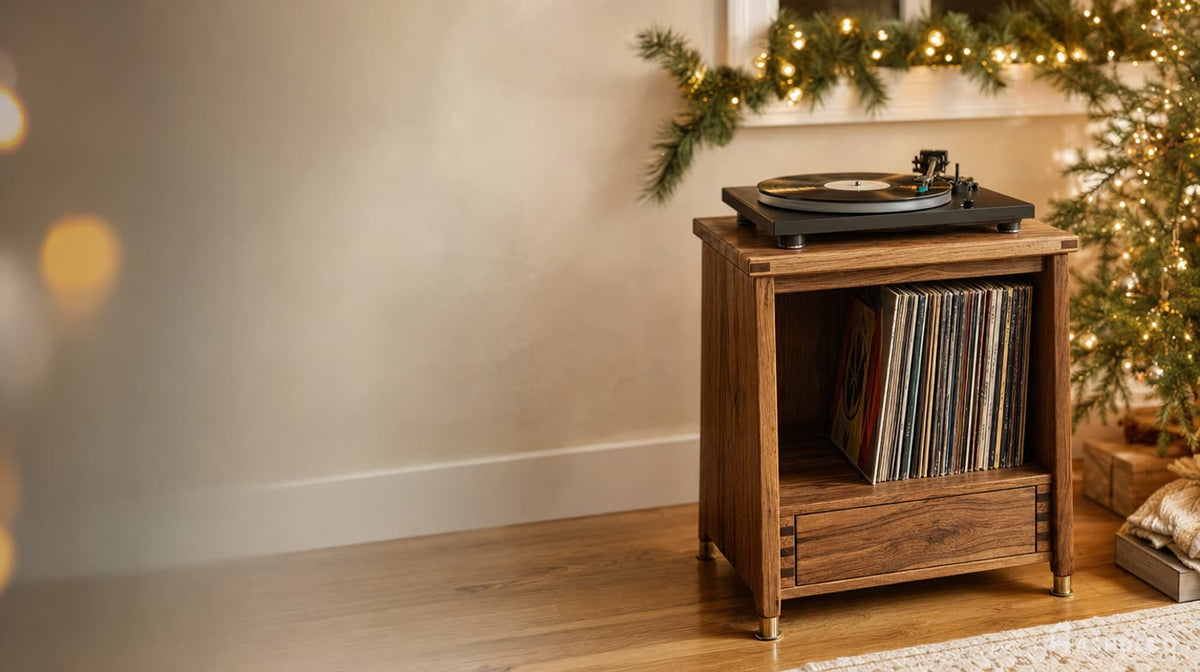


Solid Wood vs Particle Board: Why Material Choices Affect Sound

The material of your turntable stand is not just a durability consideration. It affects how the stand behaves acoustically.
Particle board and MDF are made from compressed wood fibers with resin binders. They are dense and relatively heavy for their cost, but they resonate at specific frequencies determined by the material composition. When vibrations enter a particle board surface, they ring like a bell at those frequencies and color the sound passing through.
Solid hardwood does not resonate the same way. The grain structure of real wood is inhomogeneous - it varies across the surface in ways that damp resonances rather than amplify them. The result is that solid wood stands feel and sound more neutral.
This is especially relevant for vinyl playback, where surface noise and resonance are part of what you hear between and under the notes. A turntable stand that adds resonance is adding noise. A stand that absorbs it is transparent.
The joints matter too. Cheap particle board stands use cam locks and dowels. These connections loosen over time as the particle board expands and contracts with humidity changes. Solid wood stands use mortise and tenon joints, dovetails, or bolt-through assembly. These stay rigid for decades, not years.
Ashdeco builds turntable stands from solid hardwood with bolted construction throughout. The result is a stand that does not add to the noise floor, does not loosen over time, and looks like furniture that belongs in a living room rather than a stereo store. For the broader picture on vibration isolation and material choices beyond just turntable stands, see our record player stand and vinyl storage guide.
No resonance, no cam locks, no compromise
Every Ashdeco turntable stand is solid hardwood with bolted or mortise-and-tenon construction - built to absorb vibration, not add to it. Handcrafted by Vietnamese artisans, each piece has its own grain.
Shop Record Player StandsVinyl Storage: How Much Record Space Does a Turntable Stand Need

Sculptural Solid Wood Vinyl Record Cabinet – Organic Turntable Stand with LP Storage
Most people who buy a turntable stand underestimate how much vinyl they will accumulate. The typical pattern: buy a turntable, start collecting records, realize within six months that storage is now a serious problem. Our guide to how much vinyl storage you actually need walks through this estimate by collection size in more depth.
Build your stand selection around the vinyl collection you have, not the one you think you will have. Estimate generously. If you own 100 records now, plan for 300. If you own 300, plan for 600.
Record storage options on turntable stands fall into three categories:
No storage - a turntable stand with only the top shelf. Works if you have a separate record shelf and want the turntable on a dedicated surface. Not recommended unless your vinyl collection is fully housed elsewhere.
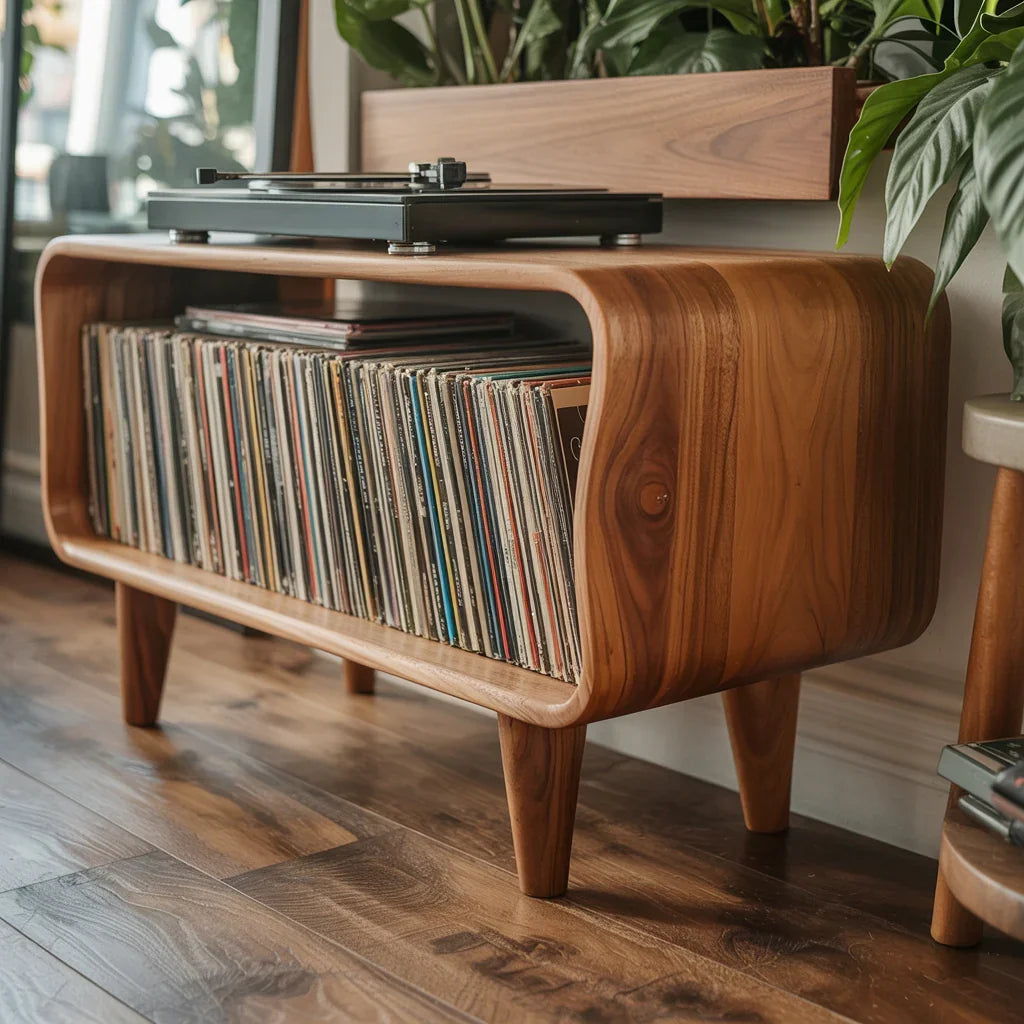
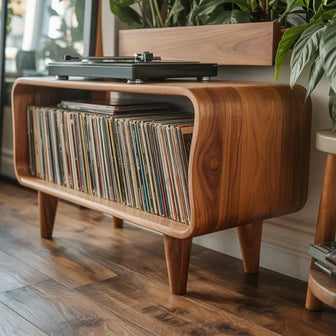
Under-shelf storage - a single shelf below the turntable platform. Provides room for 50 to 150 records depending on the stand depth and shelf spacing. This is the most common configuration and works for most growing collections. Our record player stand with storage guide covers every configuration - open, drawer, hybrid - in more detail.
Dedicated record shelf - a stand designed with a record shelf as the primary storage, with the turntable on top or at a separate level. Good for serious collectors who want one piece to handle both playback and storage.
Turntable stands with record storage typically dedicate 8 to 12 inches of height below the top shelf for record storage. That translates to roughly 150 to 250 records per shelf, assuming standard 12-inch records stored vertically. Do not pack records tightly - vertical storage with a bit of give prevents warping.
Ashdeco's turntable stands include under-shelf vinyl storage as standard, with the option for additional shelving in multi-tier configurations. Browse the record player stands collection to see the range. If your space is tight, our vinyl record storage ideas for small spaces guide covers configurations built specifically for smaller footprints.
Don't miss
These pieces qualify for 10% off orders over $2,000. Applied automatically at checkout.
10% off
Mid Century Stepped Solid Wood Record Player Stand with Vinyl Storage and Drawers
From $2,318.00
10% off at checkout
10% off
Biophilic Sculptural Solid Wood Vinyl Record Credenza - Handcrafted Turntable Console & Media Sideboard
From $2,743.00
10% off at checkout
10% off
Sculptural Handcrafted Solid Wood Vinyl Record Storage Console with Circular Tunnel Base
From $2,217.00
10% off at checkout
 10% off
Sculptural Handcrafted Live Edge Tree Trunk Solid Wood Vinyl Record Player Stand & Media Console
From $2,178.00
10% off at checkout
10% off
Sculptural Handcrafted Live Edge Tree Trunk Solid Wood Vinyl Record Player Stand & Media Console
From $2,178.00
10% off at checkout
Dimensions and Clearances: Getting the Math Right

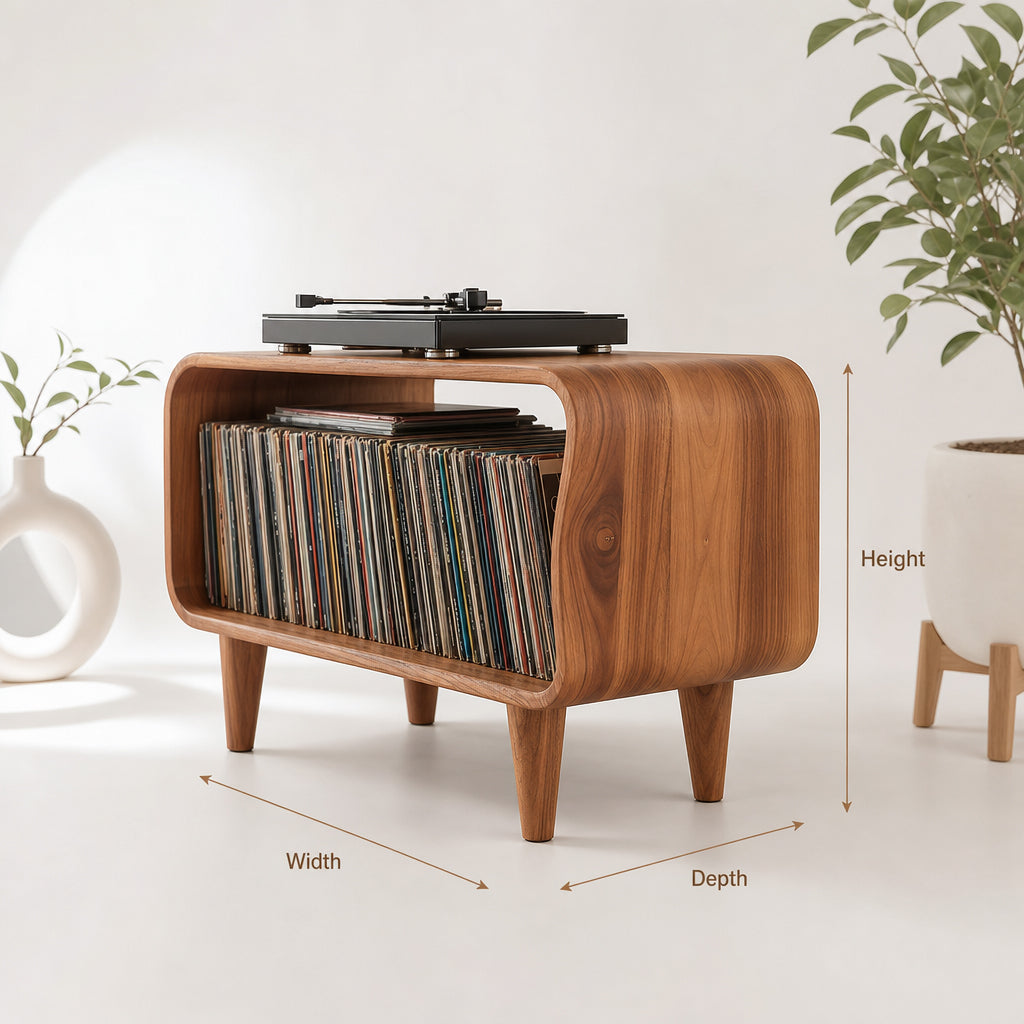
Turntable dimensions vary. Before buying a stand, measure your turntable and any accessories you plan to keep on the same surface. For a full step-by-step walkthrough of this measuring process, our wooden record player stand size guide covers it in more detail than we can fit here.
Turntable footprint is the primary measurement. Place your tape measure across the widest and deepest points of the turntable, including the platter and any tonearm that extends past the base. Write these numbers down. Your stand shelf needs to be at least 2 inches wider and 2 inches deeper than these measurements to allow for safe placement and minor repositioning.
Tonearm clearance matters for fully automatic and manually operated turntables. If you are lifting the cue lever and placing the arm by hand, you need enough surface area in front of the platter to rest your hand while the arm is over the record. This is not a concern on the base itself, but it affects where you can position the stand relative to your listening seat.
Clearance below the shelf is for records and any equipment you want to keep on the same stand. Measure the height of your tallest record box or equipment piece and add 2 inches minimum. The last thing you want is a record box that is slightly too tall to fit under the turntable shelf.
Speaker placement interacts with stand height. If your speakers are on stands at 30 inches, a turntable stand at the same height puts the platter at a comfortable viewing and operating angle when seated. If your speakers are on the same surface, give them at least 12 inches of separation from the turntable to minimize acoustic interference.
Standard turntable stand widths are 20 to 30 inches. Depths range from 14 to 20 inches. Heights are typically 26 to 30 inches for seated listening, or 36 to 42 inches for standing-height setups.
Design Styles That Work in Real Living Rooms
A turntable stand is furniture. It sits in your living room, listening room, or office. It should look like it belongs. Our modern record player stand ideas guide goes deeper into styling a clean setup room by room if you want more direction than the overview below.
The most common design styles for wood turntable stands are:

Mid Century Modern Wooden Record Player Stand with Vinyl Storage
Mid-century modern - Tapered legs, clean proportions, warm wood tones. Works with most contemporary interiors. The style that aged best because it was designed with restraint rather than ornamentation.
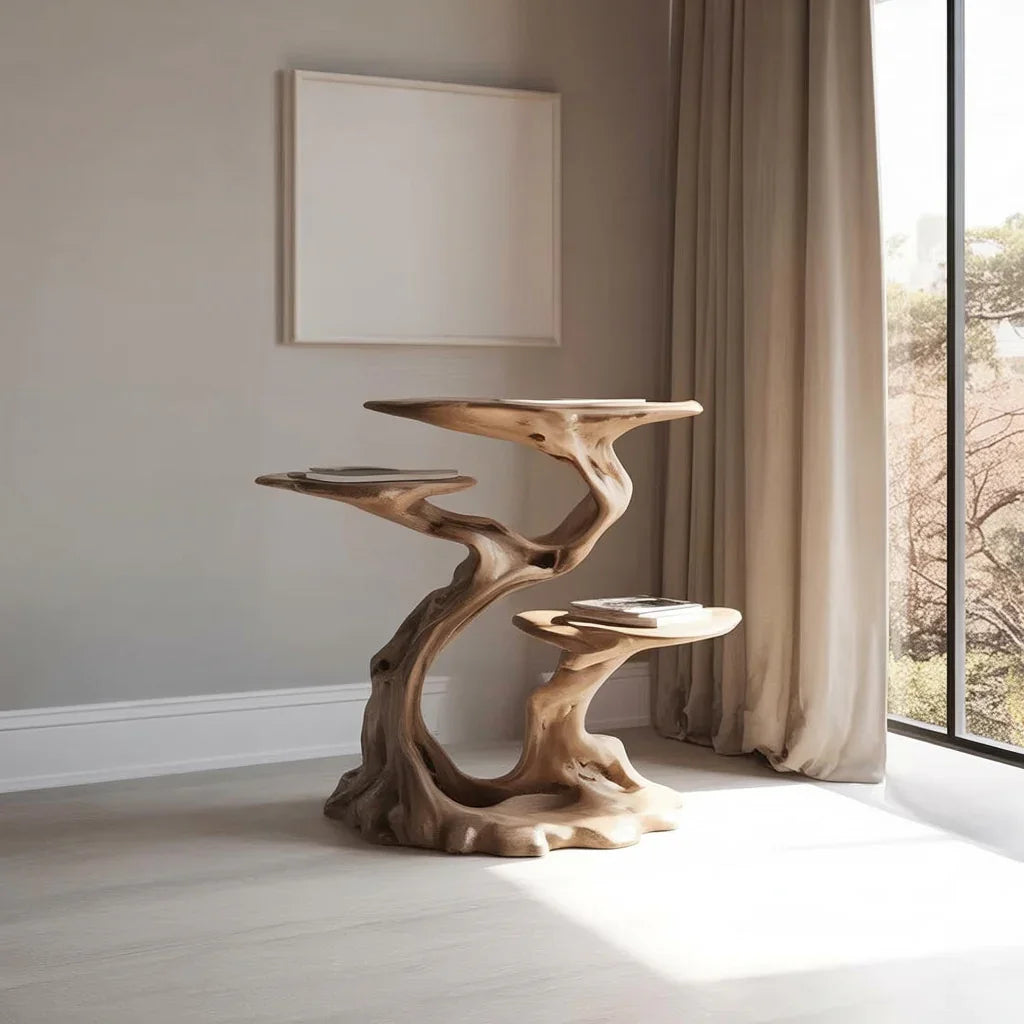
Solid Wood Record Player Stand with Vinyl Storage – Mid-Century Modern Turntable Console
Scandinavian minimal - Light wood, simple forms, functional design. Good for modern and Japandi interiors. Avoid if your room has a lot of dark furniture; the contrast can feel stark.

Solid Wood Vinyl Record Storage Cabinet – Modern Sculptural LP Shelf
Industrial - Darker wood tones, metal accents, utilitarian proportions. Works in lofts and modern industrial spaces. The metal components add resonance, so prioritize solid wood cores in industrial designs.

Organic Solid Wood Record Player Stand-Sculptural Vinyl Storage
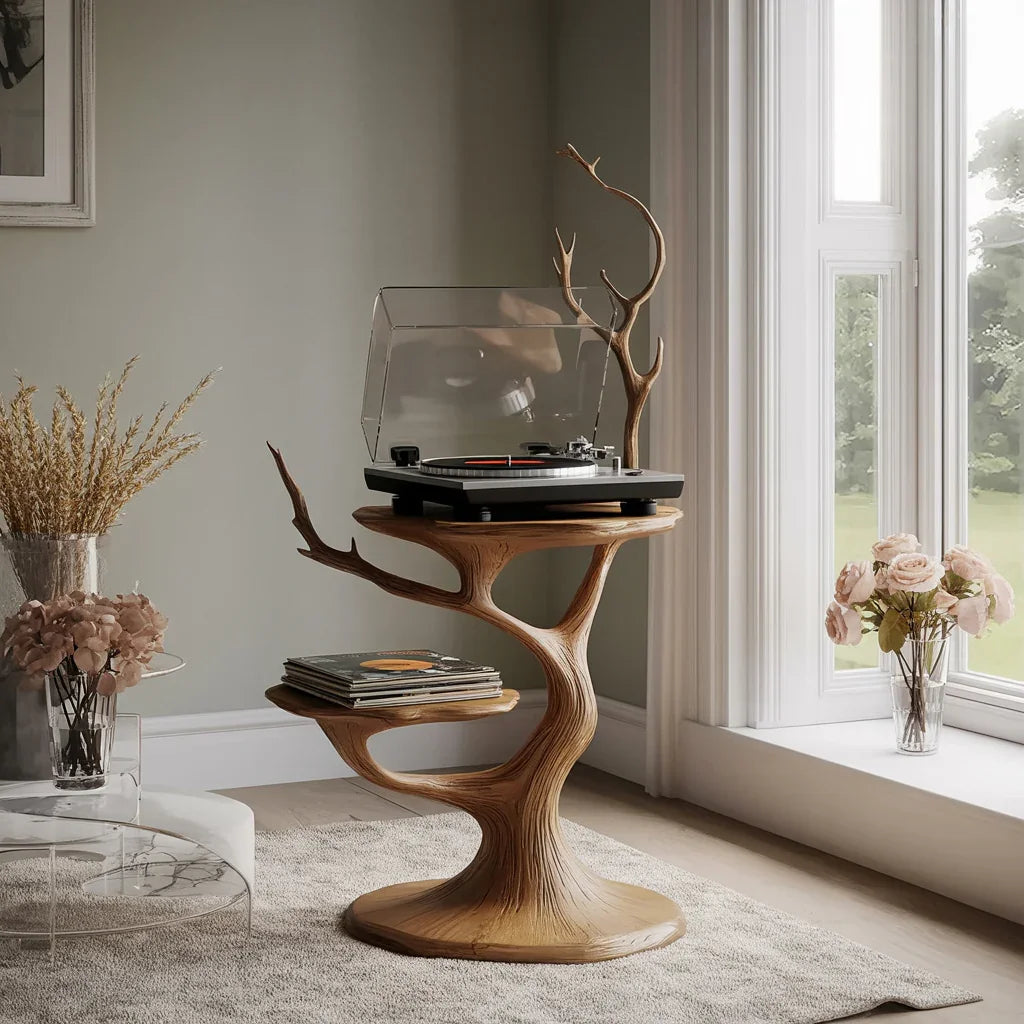
Organic modern - Sculpted or live-edge surfaces, natural forms, warm finishes. The style that most closely mimics handcrafted furniture. Ashdeco's turntable stands fall into this category, with handcarved details and natural wood finishes.
Avoid turntable stands that try to look like stereo equipment. Black metal racks with glass shelves and LED lighting are designed for a specific aesthetic that does not translate to most home environments. The turntable itself is the visual centerpiece. The stand should support that without competing.
Multi-Component Setups: Turntable, Receiver, and Speakers on One Stand

Sculptural Wooden Record Player Stand with Vinyl Storage – Organic Modern Turntable Console
Some turntable stands are designed to hold a complete system - turntable, receiver or amplifier, and speakers - on a single piece. This is practical for smaller spaces, but it introduces acoustic considerations. If you are planning the whole corner from scratch, our guide to building a vinyl listening station at home walks through gear, layout, and acoustics together.
When speakers and a turntable share a surface, vibration from the speakers can reach the turntable. This is not speculation - it is measurable. High-efficiency speakers or powerful amplifiers can excite a shared surface enough to add noise to the playback.
If you are running a turntable, receiver, and speakers on one stand, look for stands with isolated shelving sections - separate platforms for the turntable and the speakers that are not structurally connected. This eliminates the direct vibration path. Our wood record player cabinet vs open stand comparison covers this isolation question in more depth if you are also deciding between enclosed and open storage for the same setup.
If the stand does not have isolated sections, placing the speakers on sorbothane or similar isolation pads reduces the transmission. The cost is minimal and the difference is measurable.
For systems with a separate receiver or amplifier, ventilation matters. Tube amplifiers and some solid-state receivers run hot. If you are housing a receiver on a closed turntable stand shelf, make sure there is enough airflow to prevent heat buildup. Some stands incorporate ventilation slots or open-backed shelving for this reason.
The practical alternative for larger systems is a separate equipment stand for electronics and a dedicated turntable stand for the turntable. Two pieces of furniture solve the vibration and ventilation problems cleanly.
Common Questions About Wood Turntable Stands
Does a turntable stand really affect sound quality?
For turntables in the $200 to $800 range, a solid stand provides measurable improvement in background noise and stability. The improvement is most audible on quiet recordings - classical, acoustic jazz, vocal recordings - where the noise floor of a cheap stand becomes apparent.
What is the ideal height for a turntable stand?
For seated listening, the turntable platter should be at roughly chest height. For most people, this is 26 to 30 inches from the floor. The tonearm should be comfortable to operate without reaching or crouching.
How many records can a turntable stand hold?
Under-shelf storage on a typical turntable stand holds 100 to 200 records depending on the shelf height and depth. Multi-tier stands can hold 300 to 500 records. Plan for more than you own initially. Our 2026 record player stand guide covers capacity across every stand type if you want the fuller picture.
Should my turntable stand have spikes or feet?
Spikes couple the stand to the floor more directly, which can transmit vibrations both ways. Feet with some compliance absorb more vibration at the contact point. For apartments and shared floors, feet are generally better. For dedicated listening rooms with concrete floors, spikes provide a more rigid coupling that some listeners prefer.
Can I put my receiver on the same shelf as my turntable?
It is not recommended if the receiver produces significant heat or vibration. Keep electronics on a separate shelf from the turntable, ideally with structural isolation between the two surfaces.
What wood finish works best with most room styles?
Light oak and natural walnut finishes are the most versatile. Oak works with lighter room palettes; walnut works with darker palettes. Avoid high-gloss finishes on turntable stands - they look like coatings, not wood.
Are live-edge turntable stands practical?
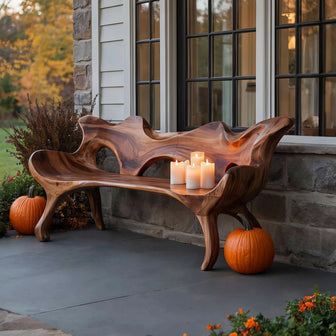
Live-edge surfaces are visually distinctive and have the same acoustic properties as flat-sawn solid wood. The only practical difference is that live-edge stands may have slight variations in the shelf width at different points, which you should account for when measuring your turntable footprint.
Choosing a Turntable Stand That Works for Your Setup
The right turntable stand depends on your turntable size, your vinyl collection, and your room layout. Start by measuring your turntable and your available space. Then count your current records and estimate where your collection will be in two years.
The stand needs to be wide enough for the turntable plus two inches on each side, deep enough for the arm travel and record access, and tall enough to be comfortable when seated. These three numbers narrow your options quickly.
Once you have the dimensions, evaluate the material. Solid hardwood over particle board. Bolted joints over cam locks. Adjustable feet for leveling. None of these are optional for a piece that is meant to last.
Finally, consider whether you need vinyl storage. If your collection is growing, build in more storage than you need today. A stand that fits 100 records today and is full in six months is the wrong stand.
Explore the record player stands collection to find the right dimensions, storage capacity, and finish for your setup.