



Quick view
- Why Custom Coat Racks Are Worth Considering Over Mass-Market Options
- What Makes a Coat Rack Actually Durable
- Custom Coat Rack Options: Wall Mounted vs Standing
- Sizing a Coat Rack: How Many Hooks, What Spacing
- Materials Matter: Hardwood vs Metal Racks
- Tree Coat Racks: When the Design Makes Sense
- Common Questions About Custom Coat Racks
- Choosing the Right Coat Rack for Your Entryway
Shop this guide
Handcrafted Coat Racks & Hangers, made to order in solid wood.
 Christmas edit
Custom Wood Coat Rack – Driftwood Wall Mount Clothes Rack with Unique Hooks
From $697.00
Christmas edit
Custom Wood Coat Rack – Driftwood Wall Mount Clothes Rack with Unique Hooks
From $697.00
 Christmas edit
Antler Coat Rack – Rustic Handmade Wall Hook for Home & Office
From $517.00
Christmas edit
Antler Coat Rack – Rustic Handmade Wall Hook for Home & Office
From $517.00
 Christmas edit
Natural Driftwood Coat Rack – Handcrafted Tree Branch Standing Hanger for Entryway or Bedroom
From $1,056.00
Christmas edit
Natural Driftwood Coat Rack – Handcrafted Tree Branch Standing Hanger for Entryway or Bedroom
From $1,056.00
 Christmas edit
Ashdeco Solid Wood Coat Rack – Vintage 10 Hooks Hat & Clothes Stand
$520.00
Christmas edit
Ashdeco Solid Wood Coat Rack – Vintage 10 Hooks Hat & Clothes Stand
$520.00
 Sculptural Hand-Carved Intertwined Solid Wood Tree Coat Rack & Freestanding Branch Garment Stand
From $1,245.00
Sculptural Hand-Carved Intertwined Solid Wood Tree Coat Rack & Freestanding Branch Garment Stand
From $1,245.00
 Christmas edit
Rustic Tree Branch Coat Rack – Solid Wood Standing Hanger for Home Decor
From $1,556.00
Christmas edit
Rustic Tree Branch Coat Rack – Solid Wood Standing Hanger for Home Decor
From $1,556.00
Why Custom Coat Racks Are Worth Considering Over Mass-Market Options
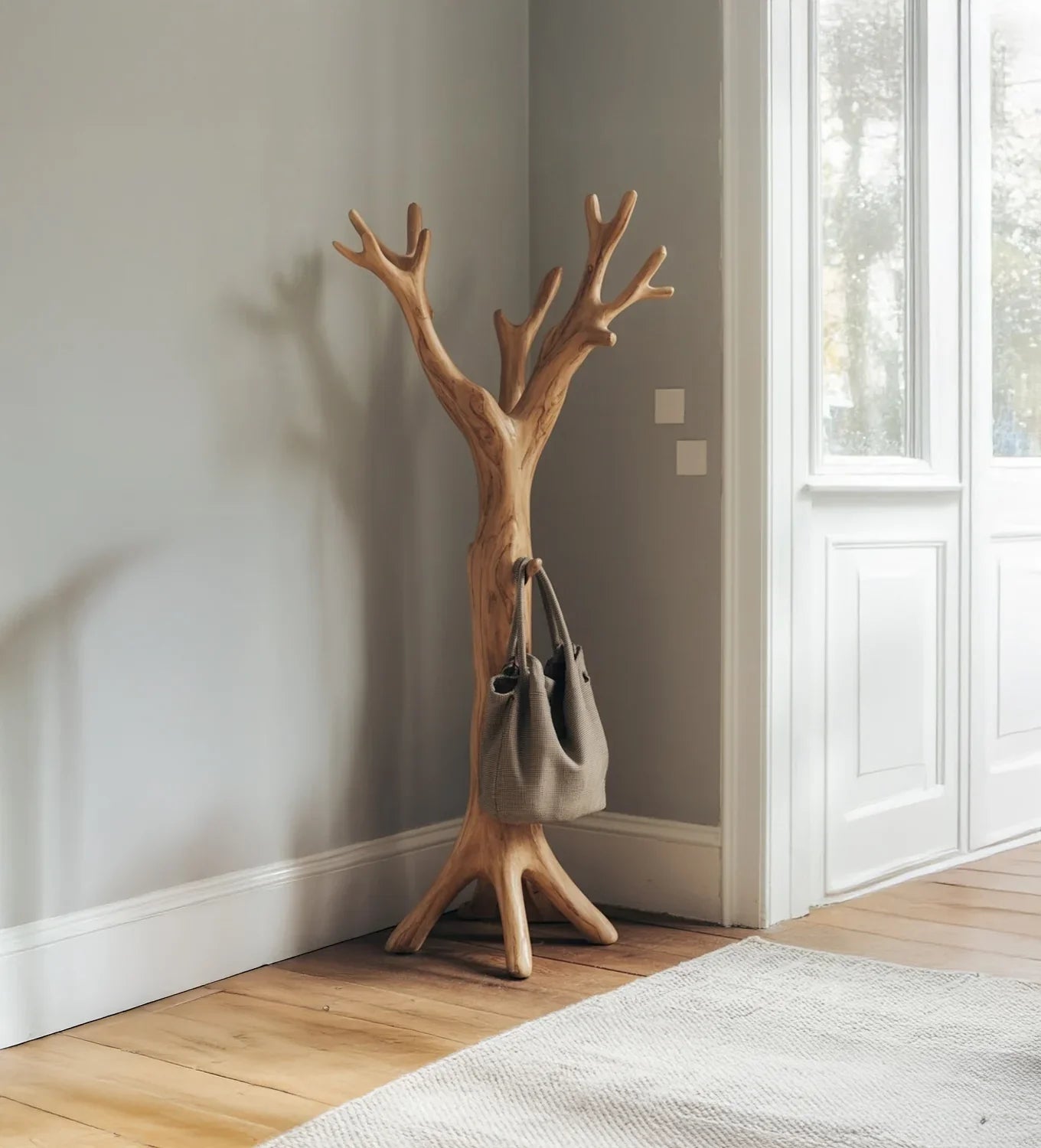
Rustic Wooden Standing Coat Rack – Handmade Tree Branch Hook Organizer
The coat rack aisle at most home stores has a specific selection: chrome tube racks, painted steel designs, thin wood with synthetic finishes, and MDF boards with painted hooks. They work. They are cheap. They also break in two to three years, look generic in any space with actual design intent, and do not hold up to daily use by multiple people.
A custom coat rack, built from solid wood by a craftsperson, solves those problems by starting with better material and building to a standard rather than a price point. The difference is not cosmetic. It is structural.
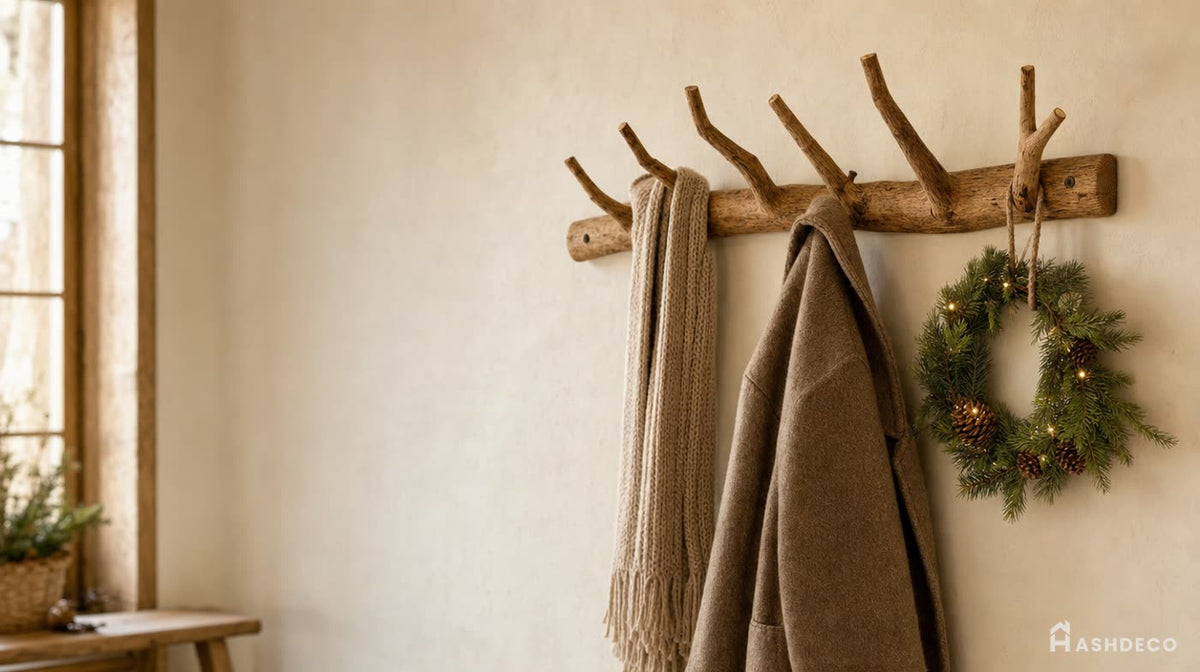
The hook question matters. On a mass-market rack, the hooks are either welded steel pieces stamped from thin metal, or molded plastic that cracks under load. On a handcrafted wood rack, the hooks are carved from the same piece of hardwood as the frame, or they are solid brass or iron fittings that are mortised into the wood and secured with bolts. Either approach produces a hook that does not fail under weight.
The wall mounting question matters equally. A thin particle board rack mounted with the included hollow wall anchors will pull out of the wall under the combined weight of coats and the leverage the hooks create. A solid wood rack with proper mounting into studs holds indefinitely.
The custom aspect is not just about aesthetics. It is about getting exactly what you need: the right number of hooks, the right spacing for your family, the right finish to match your entryway, and the right size for your wall space. Custom does not mean expensive in the sense of unaffordable. It means built to your specifications rather than to a manufacturer's minimum cost.
What Makes a Coat Rack Actually Durable

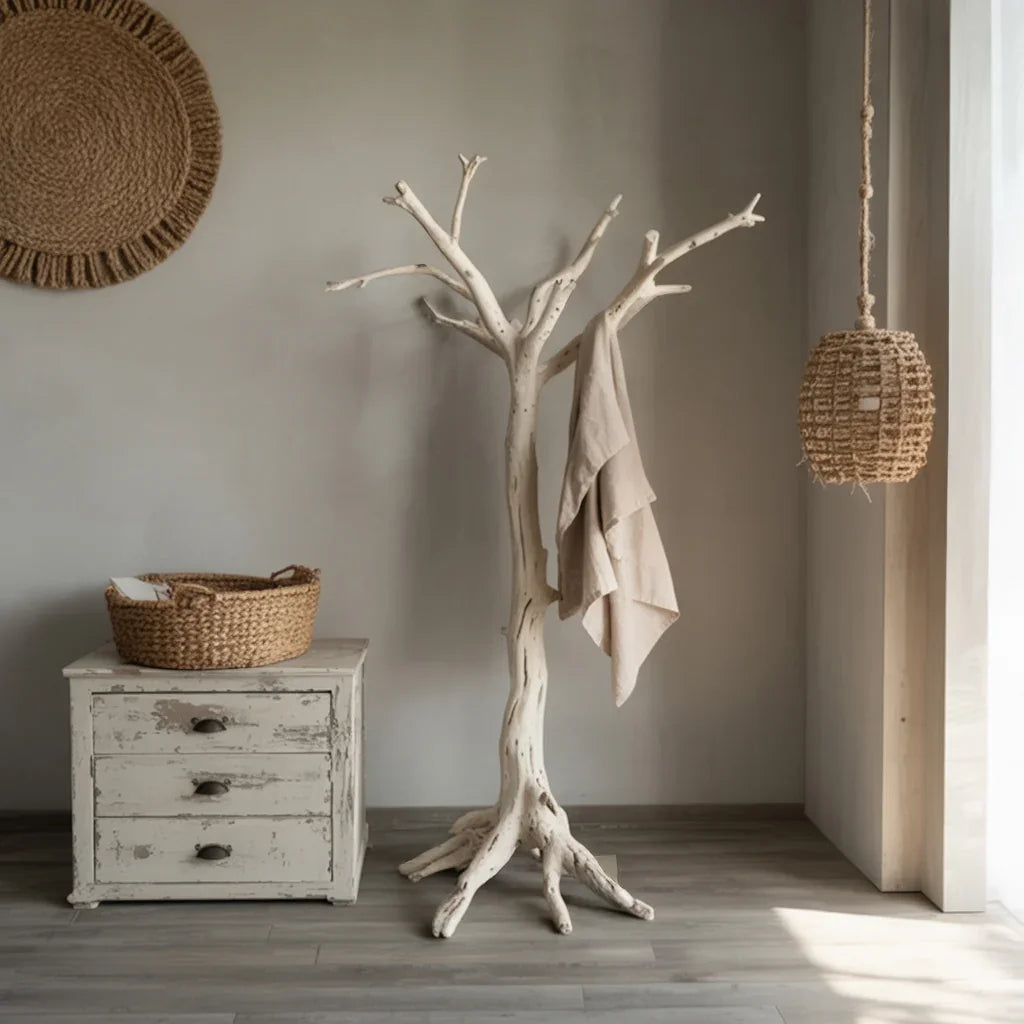
Natural Driftwood Coat Rack – Handcrafted Tree Branch Standing Hanger for Entryway or Bedroom
Three things determine how long a coat rack lasts: the material, the hook construction, and the wall mounting system.
Material quality is the foundation. Solid hardwood handles the load without bending or breaking. Oak, walnut, and hevea are common choices in handcrafted racks. Particle board and plywood may look acceptable initially, but they delaminate, sag, and fail under sustained load.
Hook type varies significantly. The strongest hooks are those carved from the same piece of wood as the rack body, meaning the hook is a continuation of the solid wood. These do not snap off because the grain runs continuously from the rack face through the hook curve. Metal hooks that are mortised and bolted into a wood rack are the second-best option. Welded steel hooks are acceptable if the weld quality is high. Stamped metal hooks or plastic hooks are the baseline minimum.
Mounting system is where most failures happen. The standard mounting hardware included with mass-market racks is two to four hollow wall anchors designed for lightweight loads. When you hang a winter coat on one of these, you are applying 5 to 15 pounds of load at the end of a lever arm that creates 30 to 50 pounds of force on the anchor. That is more than hollow wall anchors are designed to handle.
Proper mounting requires finding the wall studs. A solid wood coat rack should come with or accept a mounting system that uses #8 or #10 wood screws driven into studs, with the rack designed to spread the load across multiple anchor points. Three to four anchor points minimum for a rack wider than 24 inches.
Ashdeco coat racks are built from solid hardwood with carved hooks, and include a mounting system that requires stud mounting for safety. The racks are designed for real daily use by families, not decorative display.


Custom Coat Rack Options: Wall Mounted vs Standing
Custom coat racks come in two structural forms: wall mounted and free-standing. Both have specific use cases where one makes more sense than the other.

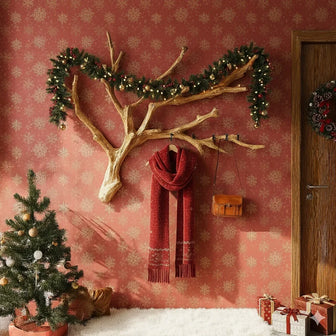
Custom Wood Coat Rack – Driftwood Wall Mount Clothes Rack with Unique Hooks
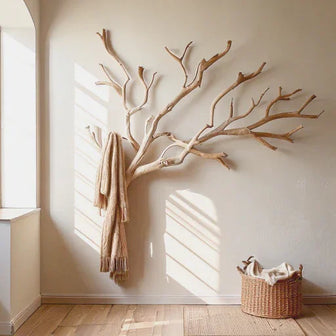
Wall mounted coat racks are the most common and most practical for entryways with limited floor space. A wall-mounted rack uses the wall as the structural element. The rack itself is a horizontal or curved piece of wood with hooks, mounted directly to wall studs. The weight of the coats pulls down and into the wall, which is the strongest direction for the mounting system.
Wall mounted racks work best for households of two to four people where the daily coat volume is manageable on a single rack. They take zero floor space and can be positioned at any height, including multiple racks at different heights for children and adults.
The disadvantage is that wall-mounted racks cannot hold as much total weight as standing racks, purely because the wall anchor is the limiting factor. Even with good stud mounting, a wall rack has a practical capacity of 50 to 80 pounds total across all hooks. For heavier loads or more coats, a standing rack is better.

Artisan Sculptural Hall Tree | Handcrafted Solid Wood Standing Coat Rack
Free-standing coat racks are floor-mounted pieces that handle heavier loads because the floor is the structural base. Standing racks work well in entryways with no wall space, or in larger households where the coat volume exceeds what a wall rack handles comfortably. Some families have a wall rack for regular coats and a standing rack near the door for boots, bags, and seasonal items.
The visual weight of a standing rack is significant. These pieces need floor space and they occupy visual space in the room. Before choosing a standing rack, make sure you have the square footage and that the rack fits the proportions of the entryway.
Ashdeco offers both wall-mounted and free-standing options, all in solid hardwood with handcrafted details. Browse the [coat rack collection](/collections/coat-racks-hangers) to see the full range.
Sizing a Coat Rack: How Many Hooks, What Spacing

The most common mistake in coat rack selection is getting too few hooks. A rack with four hooks for a four-person household creates a bottleneck twice a day when everyone is leaving or arriving simultaneously.
A practical minimum is four hooks for a two-person household, six to eight for a four-person household. If you have children, add two more hooks at a lower height.
Hook spacing matters as much as total hook count. Hooks spaced too close together make it hard to hang coats without sleeves overlapping and falling off. Standard hook spacing is 4 to 6 inches for lightweight items and 6 to 8 inches for coats.
If the rack has a dual-row design - hooks at two heights - make sure the spacing between the rows is at least 10 to 12 inches vertically. This keeps upper and lower hooks from interfering and lets you hang items at both heights without collision.
For entryway organization, consider adding a shelf or bench to the coat rack system. A wall-mounted rack with a shelf below gives you a place to set keys, mail, and bags as you come and go. A standing rack with a bench built in creates a full entryway station where you can sit to put on shoes while managing your coat.
Ashdeco's coat racks include options with integrated shelves and benches, all built from solid hardwood with the same construction standards as their furniture pieces.
Don't miss
These pieces qualify for 10% off orders over $2,000. Applied automatically at checkout.
 10% off
Sculptural Solid Wood Hall Tree - Artistic Branch Tree Hanger - Unique Live Edge Entryway Coat Rack
$2,234.00
10% off at checkout
10% off
Sculptural Solid Wood Hall Tree - Artistic Branch Tree Hanger - Unique Live Edge Entryway Coat Rack
$2,234.00
10% off at checkout
 10% off
Handcrafted Tree Branch Clothing Rack – Solid Wood Wardrobe Shelf Organizer for Home Décor
$2,333.00
10% off at checkout
10% off
Handcrafted Tree Branch Clothing Rack – Solid Wood Wardrobe Shelf Organizer for Home Décor
$2,333.00
10% off at checkout
 10% off
Sculptural Hand-Carved Solid Wood Tree Entryway Bench & Branch Coat Rack with Integrated Shoe Shelf
From $2,534.00
10% off at checkout
10% off
Sculptural Hand-Carved Solid Wood Tree Entryway Bench & Branch Coat Rack with Integrated Shoe Shelf
From $2,534.00
10% off at checkout
 10% off
Sculptural Hand-Carved Tree Solid Wood Open Wardrobe Closet System & Branch Wall Storage Bench
$3,876.00
10% off at checkout
10% off
Sculptural Hand-Carved Tree Solid Wood Open Wardrobe Closet System & Branch Wall Storage Bench
$3,876.00
10% off at checkout
Materials Matter: Hardwood vs Metal Racks

Metal coat racks are common and they have a legitimate application in industrial and commercial spaces. For a home entryway, wood offers more design flexibility and warmth.
Solid hardwood coat racks are the best choice for durability, appearance, and acoustic properties in a home. The wood is warm to the touch, it matches other furniture naturally, and it can be carved to create hooks that are visually integrated with the piece rather than added on.
Hardwood finishes range from light oak to dark walnut. A natural finish shows the wood grain and ages well. A painted or stained finish changes the visual character but does not affect the structural quality. Avoid any finish that feels plasticky or looks overly glossy.
Steel and metal coat racks work in specific contexts. Dark metal finishes complement industrial and modern spaces. But metal is cold in a way that wood is not, it can transfer rust if scratched, and the hooks are typically welded which creates a potential failure point if the weld is poorly done.
Mixed materials - wood with metal hooks or accents - can work well if the metal is properly finished and the wood is solid hardwood. A walnut rack with solid brass hooks is a legitimate design choice that combines warmth with durability. But be careful with products that have a wood veneer on a particle board core - the veneer looks right in photos but the core fails.
Ashdeco's coat racks are all-solid hardwood with either carved hooks or solid brass fittings. The combination of material quality and craftsmanship produces a piece that will outlast any metal rack from a home goods store by a decade or more.
Tree Coat Racks: When the Design Makes Sense

Solid Wood Coat Rack – Rustic Standing Clothes Hanger & Handmade Entryway Organizer
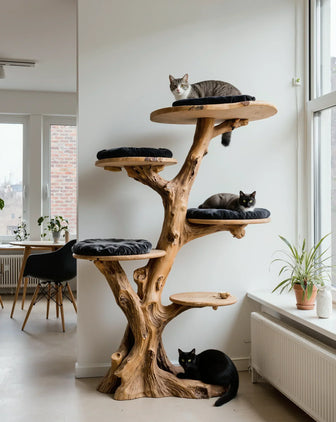
Tree coat racks are a category of handcrafted wood racks where the form is literally a tree - trunk and branches with hooks at the ends of the branches. They are visually distinctive, serve the same function as a wall-mounted rack, and add a sculptural element to the entryway.
The tree form works best in entryways with high walls or open floor plans where the full height of the rack is visible and the organic shape reads clearly. A tree rack in a small, crowded entryway loses its effect - the branches get hidden behind coats and the tree form disappears.
The practical advantage of a tree rack is that the branches naturally space the hooks, and the multiple contact points of the branches into the trunk distribute the load more evenly than a horizontal bar with hooks. A well-designed tree rack can hold more weight per square foot of floor space than a bar rack, because the branching form creates structural efficiency.
The disadvantage is the same as any standing rack: it requires floor space. A tree rack takes roughly 18 to 24 inches of floor footprint. Measure your entryway before committing.
Ashdeco builds tree coat racks in solid hardwood with the same construction as their tree bookshelves - carved trunk and branches, bolted assembly, weighted bases for stability. Browse the tree coat rack to see the available heights, finishes, and configurations.
Common Questions About Custom Coat Racks
How much weight can a wall-mounted coat rack hold?
With proper stud mounting and solid hardwood construction, a wall coat rack holds 50 to 80 pounds safely. The practical load is distributed across all hooks - not the full capacity on a single hook. Avoid hanging more than 15 to 20 pounds on any single hook.
What is the best height for coat rack hooks?
Standard hook height for adults is 60 to 66 inches from the floor. For dual-height family racks, add lower hooks at 48 to 52 inches for children. If you are mounting only one rack at a single height, 60 inches works for most households.
How many coats can a coat rack hold?
A coat rack with six hooks holds six to eight items if items are hung with space between them. Do not overload the rack by jamming multiple items on each hook - the weight compounds and the risk of overloading a single anchor point increases.
Can I install a coat rack myself?
Yes, with the right tools and mounting approach. You need a stud finder, a drill, and a level. The critical step is finding the wall studs - not using hollow wall anchors in drywall. If you do not have studs where you need them, use a stud finder to locate two studs minimum for a full-width rack and mount accordingly.
What is the difference between a coat rack and a hall tree?
A hall tree is a free-standing piece that typically includes a bench, a mirror, and coat storage. A coat rack is a wall-mounted or standing rack focused on coats and jackets. Some hall trees combine both functions. Ashdeco offers both coat racks and hall trees in solid hardwood.
Do coat rack hooks need to be a specific shape?
The most functional hook shape is a shallow curve - not a deep U - that keeps coats from sliding off while allowing easy placement and removal. Sharply angled hooks work too but they require more precision when hanging. The carved hooks on Ashdeco racks are shaped for ease of use and coat retention.
How do I maintain a solid wood coat rack?
Dust with a soft cloth. For deeper cleaning, use a barely damp cloth and dry immediately. Avoid harsh cleaners. Solid wood does not need periodic refinishing if it is kept away from direct sunlight and humidity extremes.
Choosing the Right Coat Rack for Your Entryway
The right coat rack starts with the number of people in your household. Four hooks minimum for two people. Six to eight for four people. Add two more for each additional family member.
Then consider the entryway layout. If you have high walls and open space, a standing tree coat rack is an option. If you are working with a narrow wall above a shoe storage area, a wall-mounted horizontal rack with a shelf makes more sense.
The material should be solid hardwood. The hooks should be carved or bolted, not glued. The mounting should be into wall studs. These are not optional for a piece that is going to be used daily by your whole family.
Finish choice is personal, but coordinate with the other wood in your entryway - your door trim, your shoe bench, your console table. A matching tone makes the entryway feel designed rather than accumulated.
Browse the coat rack collection to find the right configuration, material, and finish for your entryway.