
























Quick view
- Why Your Current TV Stand Is Too Small for a 75-Inch TV
- How to Choose a TV Stand for 75 Inch TV and Larger Screens
- Types of TV Stands for Large Screens (75 Inches and Up)
- What to Look for in a Large TV Stand
- Common Mistakes When Buying a TV Stand for Large Screens
- How Much Should You Spend on a TV Stand for a 75-Inch TV?
- 85-Inch and 100-Inch TV Stands: Special Considerations
- Large TV Stand with Storage: Organizing Your Media Setup
- TV Stand Placement and Viewing Distance for Large Screens
- Frequently Asked Questions
- Final Recommendation: Invest Once, Buy Right
Shop this guide
Handcrafted TV Cabinets, made to order in solid wood.
 Handcrafted Arched Solid Wood TV Stand & 2-Drawer Media Entertainment Console
From $2,314.0010% off at checkout
Handcrafted Arched Solid Wood TV Stand & 2-Drawer Media Entertainment Console
From $2,314.0010% off at checkout
 Mid-Century Handcrafted Curved Solid Wood TV Stand & Oval Media Entertainment Console
From $2,876.0010% off at checkout
Mid-Century Handcrafted Curved Solid Wood TV Stand & Oval Media Entertainment Console
From $2,876.0010% off at checkout
 Christmas edit
Sculptural Handcrafted Solid Wood Low-Profile TV Stand & 3-Drawer Media Console
From $3,145.0010% off at checkout
Christmas edit
Sculptural Handcrafted Solid Wood Low-Profile TV Stand & 3-Drawer Media Console
From $3,145.0010% off at checkout
 Sculptural Solid Wood Wave TV Stand & Low Media Console Table
From $2,829.0010% off at checkout
Sculptural Solid Wood Wave TV Stand & Low Media Console Table
From $2,829.0010% off at checkout
 Christmas edit
Modern Solid Wood TV Console For Christmas Entryway Living Room
From $2,660.0010% off at checkout
Christmas edit
Modern Solid Wood TV Console For Christmas Entryway Living Room
From $2,660.0010% off at checkout
 Christmas edit
Sculptural Christmas Solid Wood Live-Edge TV Stand
From $2,355.0010% off at checkout
Christmas edit
Sculptural Christmas Solid Wood Live-Edge TV Stand
From $2,355.0010% off at checkout
TV Stand for 75 Inch TV: Accurate Size Guide for 75, 85 & 100 Inch TVs
You bought a 75-inch TV. You unboxed it, set it on your old stand, and immediately noticed a problem: the TV overhangs the edges by a few inches on each side. It looks off-center. Worse, the stand creaks when you walk past it. If this sounds familiar, you are not alone, and it is the exact reason we wrote this guide.
A proper TV stand for a 75 inch TV setup is not just about width. It is about weight capacity, depth for your soundbar and media devices, structural rigidity, and cable management that actually works when you have six HDMI cables snaking behind the unit. This article covers everything you need to know to choose the right stand for a 75-inch, 85-inch, or even 100-inch television.
For detailed dimension charts covering 42 to 85 inch screens, see our TV cabinet dimensions by screen size guide.

Why Your Current TV Stand Is Too Small for a 75-Inch TV
The most common mistake people make is assuming a stand that held their old 55-inch TV will somehow work for the new one. It will not. Here is why.
The Wider-Than-Your-TV Rule
Interior designers and ergonomics experts generally recommend that a TV stand be noticeably wider than the TV itself - as a stability requirement, not an aesthetic preference. A stand that is narrower than the screen creates a top-heavy configuration where the center of gravity sits outside the base, increasing the risk of tipping.
Applied to real numbers, here is the practical minimum most makers build to (typically 7 to 10 percent wider than the screen, though exact minimums are often rounded to common commercial stand widths):
- 75-inch TV measures approximately 66 inches wide, so the stand should be at least 72 inches wide.
- 85-inch TV measures approximately 75 inches wide, so the stand should be at least 80 inches wide.
- 100-inch TV measures approximately 88 inches wide, so the stand should be at least 94 inches wide.
Most mass-produced TV stands top out at 60 to 65 inches wide. That is fine for a 55-inch screen, but it is genuinely inadequate for anything in the 75-inch and above category.
Weight: The Silent Problem
Weight scales dramatically with screen size. Here is what you are dealing with:
- 75-inch TVs typically weigh between 70 and 100 pounds, plus the weight of the stand itself.
- 85-inch TVs typically weigh between 90 and 130 pounds.
- 100-inch TVs can weigh between 130 and 180 pounds.
Add a soundbar (5 to 15 pounds), a game console, a streaming device, and a cable box, and a 75-inch setup can put well over 100 pounds on a single piece of furniture. Particle board and thin plywood stands that work fine at 50 pounds will sag, warp, or fail entirely at that load. This is not theoretical, it is the number one complaint in Amazon reviews for large TV furniture.
Depth: The Soundbar Problem
Soundbars have changed the depth equation entirely. A typical soundbar runs 4 to 6 inches front to back. A cable box adds another 8 to 10 inches. If your stand is only 12 inches deep, devices stick out the back or get crammed behind the TV, creating a fire hazard from blocked ventilation and making cable management nearly impossible.
A comfortable minimum depth for a large TV stand is 16 inches. For setups with multiple devices and a soundbar, 18 to 20 inches is ideal.

How to Choose a TV Stand for 75 Inch TV and Larger Screens
Finding the right TV stand for a 75 inch, 85 inch, or 100 inch setup starts with precise measurements. Here is the quick-reference size guide. These numbers assume a standard flat-screen TV without an unusually thick bezel.
| TV Size | TV Width (approx.) | Minimum Stand Width | Ideal Stand Width | TV Weight Range | Minimum Stand Depth |
|---|---|---|---|---|---|
| 75 inch | 66 inches | 72 inches | 78 to 84 inches | 70 to 100 lbs | 16 inches |
| 85 inch | 75 inches | 80 inches | 86 to 96 inches | 90 to 130 lbs | 16 inches |
| 100 inch | 88 inches | 94 inches | 100 to 110 inches | 130 to 180 lbs | 18 inches |
The "ideal stand width" column gives you the proportional look where the TV sits comfortably within the stand's footprint with a balanced visual margin on each side. This is especially important in larger rooms where a disproportionate setup is immediately noticeable.
If you want a deeper dive into dimensions across the full range of screen sizes, our TV cabinet dimensions guide covers 42 through 85 inches with precise measurements.



Types of TV Stands for Large Screens (75 Inches and Up)
Not all TV stands are created equal, especially when the TV itself costs more than most people's cars. Here are the main categories and how they perform with large, heavy screens.
Traditional Solid Wood TV Stands
This is the gold standard for large TVs. Solid hardwood construction (oak, walnut, mango, acacia) provides the structural integrity needed to support 100-plus pound screens without sagging or wobbling. A well-built solid wood stand rated at 200-plus pounds gives you real peace of mind.
The Rustic Reclaimed Oak TV Stand from Ashdeco is an example of this category. Handcrafted by artisan Chung Dai, it is built from reclaimed oak with substantial joinery designed to handle heavy loads. The storage compartments underneath keep media devices organized and off the floor.
Pros: Maximum durability, timeless aesthetics, excellent weight capacity, natural cable management through built-in compartments.
Cons: Higher price point, heavier to move, limited availability in very large widths (78+ inches) from most manufacturers.

Curved and Sculptural TV Stands
Curved TV stands have become a major design trend. They soften the sharp rectangular lines of a modern TV and create a striking organic aesthetic in the living room. The curved front also provides a deeper shelf area in the center for devices while maintaining a slimmer visual profile from certain angles.
Ashdeco's Organic Curved Solid Wood TV Stand with Drawers, crafted by LPh K, combines this organic curved silhouette with practical drawer storage. The 55-inch width variant works for smaller screens, and custom widths are available for larger setups.
Pros: Unique aesthetic, conversation piece, good depth for devices, solid wood construction.
Cons: May not be available off-the-shelf in widths needed for 85 or 100 inch TVs without custom ordering.

Live Edge TV Stands
Live edge stands feature the natural, uncut edge of the wood slab, creating a one-of-a-kind piece that bridges furniture and art. For a large TV room, a live edge stand makes a powerful design statement.
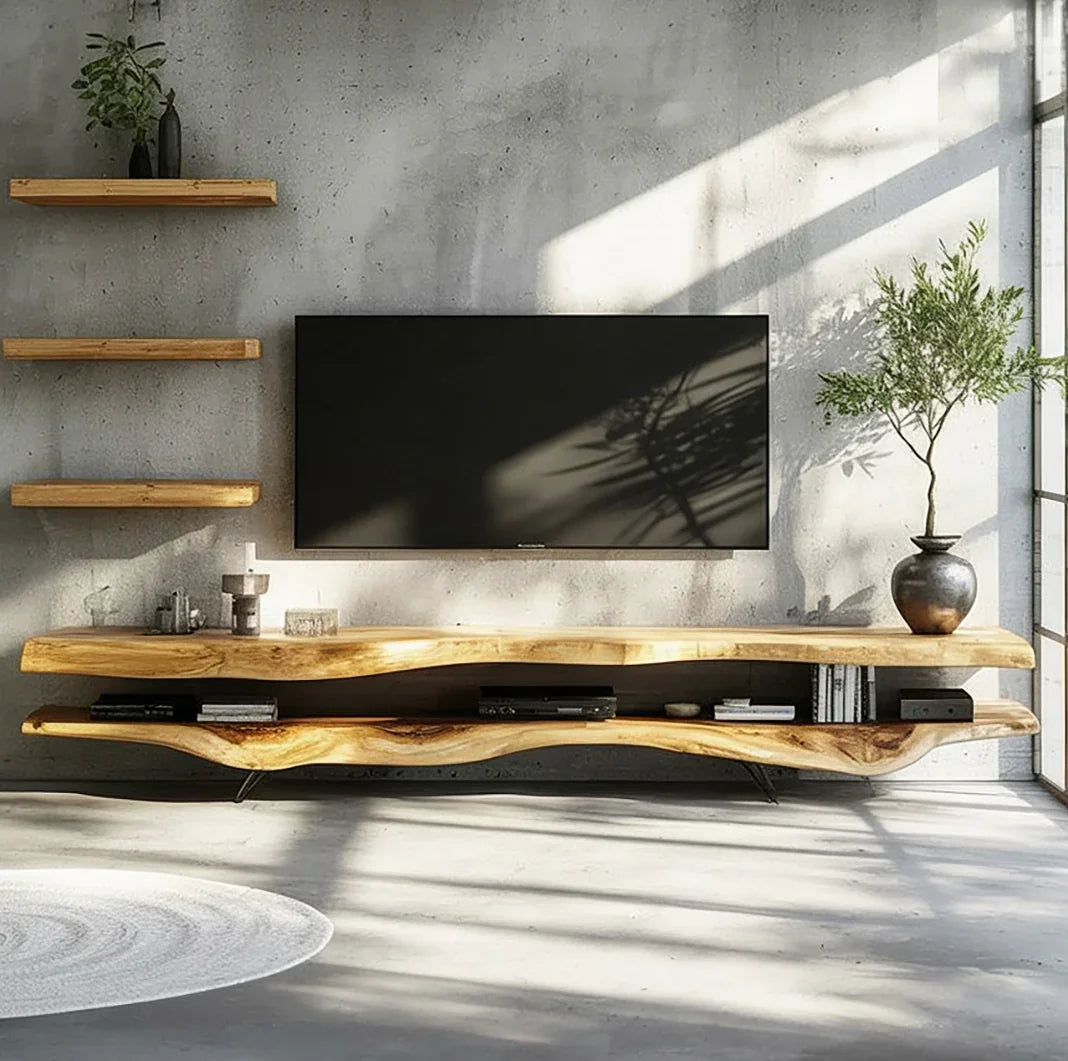
The Rustic Live Edge TV Stand in Solid Walnut, crafted by Tuan Tran - the workshop's live edge specialist - is a handcrafted floating console that can be wall-mounted or used as a standalone piece. The live edge walnut top provides both beauty and structural strength.
Pros: Each piece is unique, excellent visual weight for large rooms, solid wood construction, floating options save floor space.
Cons: Natural edge means dimensions vary by piece, premium pricing.

Sculptural and Artistic TV Stands
For the design-conscious homeowner, a TV stand that doubles as functional art is the ultimate choice. These pieces often incorporate hand-carved elements, unusual forms, or natural motifs that transform a utilitarian furniture piece into a focal point.
Ashdeco's Mushroom Tree Trunk TV Stand, hand-carved by artisan Nhan Kim, features carved mushroom handles and tree-trunk-inspired side shelves. At 63 inches wide, it approaches the minimum for a 75-inch TV, and custom wider versions are available.
Pros: Absolutely unique, handcrafted quality, solid wood throughout, turns the TV area into a design feature.
Cons: Standard widths may not cover the largest TVs without customization, artistic designs may not suit all decor styles.
Floating TV Consoles
Wall-mounted floating consoles are an excellent choice for large TVs because they eliminate the "wobble" problem entirely. A properly anchored floating console transfers weight directly to wall studs, which can handle far more than furniture legs on a floor that may not be perfectly level.
If you are interested in floating options, check out our guide to floating shelves under TVs for placement and mounting guidance.
Pros: Zero floor wobble, easy floor cleaning underneath, modern aesthetic, weight borne by wall structure.
Cons: Requires solid wall mounting, installation complexity, may not suit rental situations.

What to Look for in a Large TV Stand
Beyond width and weight capacity, here are the features that separate a great large TV stand from a mediocre one.
Weight Capacity Rating
Always check the manufacturer's stated weight capacity. For a 75-inch TV setup with accessories, you want a minimum of 200 pounds. For 85-inch setups, aim for 250 pounds or more. For 100-inch TVs, look for 300-plus pounds. If the manufacturer does not list a weight capacity, that is a red flag.
Material and Construction
The material matters enormously at these weights:
- Solid hardwood (oak, walnut, mango, acacia): Best option. Dense, strong, ages well. Handles 200 to 400+ pounds depending on thickness and joinery.
- Solid softwood (pine, cedar): Acceptable for 75-inch setups if the wood is thick enough (1 inch or more). Less ideal for 85-inch and above.
- Plywood (multi-layer): Good for shelving within the stand, but should not be the primary structural material for very large setups.
- Particle board / MDF: Avoid for 75-inch and larger TVs. These materials sag under sustained heavy loads and degrade over time, especially in humid environments.
The joinery technique also matters. Dovetail joints, mortise and tenon, and finger joints are all signs of quality construction that will hold up under heavy loads. Staples and glue alone are not sufficient for furniture supporting a 100-pound TV.
Cable Management
With a 75-inch or larger TV, you likely have multiple devices: soundbar, streaming box, game console, cable or satellite receiver, possibly a Blu-ray player. That is five to eight cables minimum. A good TV stand should have:
- Open-back compartments or cutouts for cable routing
- At least one enclosed compartment for unsightly boxes and power strips
- Enough depth behind the TV area for cables to bend without pinching
Adjustable Shelving
Devices come in different heights. A stand with adjustable internal shelves lets you accommodate a tall cable box alongside a slim Apple TV or Roku. Fixed shelves often leave awkward gaps or cannot fit taller devices.
Leveling Feet
Floors are rarely perfectly level. Adjustable leveling feet on the stand allow you to compensate for uneven floors, ensuring the TV sits perfectly horizontal. This is particularly important for 85-inch and 100-inch TVs where even a half-degree of tilt is visually distracting.

Don't miss
These pieces qualify for 10% off orders over $2,000. Applied automatically at checkout.
10% off
Handcrafted Arched Solid Wood TV Stand & 2-Drawer Media Entertainment Console
From $2,314.00
10% off at checkout
10% off
Mid-Century Handcrafted Curved Solid Wood TV Stand & Oval Media Entertainment Console
From $2,876.00
10% off at checkout
10% off
Sculptural Handcrafted Solid Wood Low-Profile TV Stand & 3-Drawer Media Console
From $3,145.00
10% off at checkout
10% off
Sculptural Solid Wood Wave TV Stand & Low Media Console Table
From $2,829.00
10% off at checkout
Common Mistakes When Buying a TV Stand for Large Screens
Mistake 1: Buying for the TV, Not the Whole Setup. You measure your 75-inch TV, find a 70-inch stand, and think "close enough." But you have not accounted for the soundbar that sits in front of the TV stand, the game console on the shelf, and the cable box behind the TV. The stand needs to accommodate all of this, not just the screen itself.
Mistake 2: Ignoring Weight Distribution. A TV is not a uniform weight. The screen itself is heaviest at the top (the panel), while the stand bears all of that weight at the base. If the stand's top surface is thin or unsupported in the middle, it will sag over time, creating a visible dip that is especially noticeable with large screens. Look for stands with reinforced top surfaces or thick solid wood tops (at least 1.5 inches thick for 75-inch setups).
Mistake 3: Forgetting About Ventilation. Electronic devices generate heat. When you cram a cable box, game console, and soundbar amplifier into an enclosed space with no airflow, you shorten the lifespan of every device. Make sure your stand has open areas or ventilation gaps for heat dissipation.
Mistake 4: Choosing Style Over Structure. A beautiful stand that cannot safely hold your TV is not beautiful, it is a hazard. Always verify structural integrity first, then consider aesthetics. The good news is that with handcrafted solid wood furniture like Ashdeco's collection, you do not have to choose. These pieces are built to handle heavy loads while looking exceptional.
Mistake 5: Not Planning for the Next Upgrade. If you are buying a stand for a 75-inch TV today, there is a reasonable chance your next TV will be 85 inches. If the stand is exactly 72 inches wide (the bare minimum for 75), it will not work for 85. Buying a stand in the 78 to 84-inch range gives you room to grow without replacing the furniture.

How Much Should You Spend on a TV Stand for a 75-Inch TV?
A 75-inch TV typically costs between $800 and $3,000. An 85-inch TV runs $1,200 to $5,000. A 100-inch TV can exceed $10,000. Spending $50 to $100 on a particle board stand for a $3,000 TV does not make sense.
A quality solid wood TV stand that will last 20 years and safely support your investment is worth $600 to $3,500 depending on the wood type, craftsmanship, and customization. When you break it down per year of use, a $2,456 stand that lasts 20 years costs about $122.80 per year. Compare that to replacing a $200 particle board stand every three to five years, and the math speaks for itself.
Ashdeco's approach to pricing reflects this philosophy: each piece is handcrafted from solid wood, designed to last decades, and comes with artisan provenance. The Curved TV Stand with Drawers at $2,456 breaks down to roughly $122.80 per year over a 20-year lifespan, making it an heirloom purchase rather than disposable furniture.
85-Inch and 100-Inch TV Stands: Special Considerations
Once you move past 75 inches, the requirements change qualitatively, not just quantitatively.
85-Inch TV Stand Requirements
At 85 inches, your TV is roughly 75 inches wide and weighs 90 to 130 pounds. Most off-the-shelf TV stands simply do not exist in the 80-plus inch width range from mainstream retailers. Your options narrow to:
- Custom-ordered solid wood stands
- Two-piece media console configurations
- Wall-mounted floating consoles
- DIY or contractor-built cabinetry
For the DIY or custom route, our general TV stand buying guide covers material selection, joinery types, and design principles that apply regardless of size.
100-Inch TV Stand Requirements
A 100-inch TV is in a completely different category. At 88 inches wide and 130 to 180 pounds, you are dealing with commercial-grade requirements. Very few furniture manufacturers produce stands in the 94-plus inch range. Your best options are:
- Custom-built solid wood consoles from artisan makers
- Two-piece or modular media wall systems
- Professional cabinetry installation
- Heavy-duty commercial AV furniture (functional but rarely attractive)
Ashdeco offers custom sizing on many of their handcrafted pieces, which means a stand can be built to your exact width requirements. Browse the full Ashdeco TV stand collection and contact them for custom dimensions on any TV stand design.

Large TV Stand with Storage: Organizing Your Media Setup
A large TV stand with storage is essential for a clean, functional entertainment area. Here is what to look for in storage configuration:
Drawers vs. Open Shelves vs. Cabinet Doors
- Drawers are best for small items: remote controls, gaming accessories, cables, and media. The Curved TV Stand with Drawers from Ashdeco exemplifies this approach with smooth-operating drawers that keep clutter hidden.
- Open shelves are best for devices that need ventilation and IR remote signals: streaming boxes, game consoles, cable receivers. They provide easy access but show everything.
- Cabinet doors offer a middle ground: devices are hidden when not in use but accessible when needed. Some designs incorporate ventilation slots or mesh panels for airflow.
The ideal large TV stand combines all three: drawers for small items, open shelves for active devices, and cabinet doors for less-frequently-used equipment.
Back Panel Design
A solid back panel looks clean but makes cable routing difficult. An open back or back panel with cutouts is more practical for large setups with many cables. Some Ashdeco pieces feature open-back designs that make cable management simple while maintaining a clean front-facing appearance.
TV Stand Placement and Viewing Distance for Large Screens
Once you have the right stand, placement matters. For large screens, sitting too close causes eye strain and makes individual pixels visible. Sitting too far defeats the purpose of a large display.
| TV Size | Optimal Viewing Distance | Minimum Distance |
|---|---|---|
| 75 inch | 9.4 to 15.6 feet | 7.8 feet |
| 85 inch | 10.6 to 17.7 feet | 8.9 feet |
| 100 inch | 12.5 to 20.8 feet | 10.4 feet |
The stand should be placed so the center of the TV is at or slightly below eye level when seated. For most people, this means the TV center should be about 42 inches from the floor. If your stand is 22 inches tall and your 75-inch TV is about 38 inches tall, the center of the TV sits at 22 + 19 = 41 inches, which is nearly perfect.
Frequently Asked Questions
Can I use a 65-inch TV stand for a 75-inch TV?
Technically yes, but it is not recommended. A 65-inch stand is narrower than a 75-inch TV (which is about 66 inches wide), meaning the TV will overhang the edges. This creates a visually unbalanced look and, more importantly, reduces stability. If the TV is bumped or if the stand is on an uneven surface, the overhang increases tipping risk. Aim for at least a 72-inch stand for a 75-inch TV.
How wide should a TV stand be for a 75-inch TV?
A 75-inch TV is approximately 66 inches wide. The stand should be at least 72 inches wide. For a more proportional and future-proof setup, 78 to 84 inches is ideal.
Is a 75-inch TV too heavy for a wood TV stand?
No, not for a properly constructed solid wood stand. A 75-inch TV weighs 70 to 100 pounds. A solid hardwood stand with adequate thickness (1.5 inches or more for the top surface) and proper joinery can easily support 200 to 400 pounds. The key is solid wood construction, not particle board or thin MDF.
What is the best material for a TV stand that holds a large TV?
Solid hardwood (oak, walnut, mango, acacia) is the best material. It is dense, strong, resists sagging under sustained heavy loads, and ages beautifully. Avoid particle board, MDF, and thin plywood for TVs 75 inches and larger.
Should I wall-mount my large TV or put it on a stand?
Both options have merits. A stand provides storage, is easier to relocate, and does not require wall modifications. Wall mounting saves floor space and eliminates wobble concerns but requires proper wall anchors and offers no built-in storage. A floating console combines both approaches: wall-mounted with integrated storage. See our floating shelf under TV guide for more on this hybrid approach.
Can I get a custom-width TV stand for a 100-inch TV?
Yes. Artisan makers like Ashdeco offer custom sizing on their handcrafted TV stands. Browse the Ashdeco collection and request a custom width for your specific TV and room requirements. This is often the only way to find a stand in the 94+ inch range with quality construction.
Final Recommendation: Invest Once, Buy Right
A 75-inch, 85-inch, or 100-inch TV is a significant investment. The stand that holds it should be treated with the same consideration. A quality solid wood TV stand from a handcrafted furniture maker will outlast multiple TV upgrades, provide reliable support, and elevate the entire room's aesthetic.
Whether you choose the organic curves of the Curved TV Stand with Drawers, the character of the Reclaimed Oak Console with Storage, the artistry of the Mushroom Tree TV Stand, or the natural beauty of the Rustic Live Edge Walnut Console, you are getting furniture built to handle the weight and width of modern large-screen TVs.
Ready to find the right stand for your large TV?
Explore Ashdeco's handcrafted solid wood TV stand collection - reclaimed oak, live edge walnut, curved, and sculptural designs, each built to handle 75-inch, 85-inch, and 100-inch screens with custom sizing available.
Shop TV Stands →