






















Quick view
- How Much Weight Are You Actually Putting on That Shelf?
- What Makes a Floating Shelf Strong Enough for a TV?
- Size Requirements: Choosing the Right Width & Depth for Your TV
- Installation: The 3 Non-Negotiables
- Red Flags: Signs a Floating Shelf Is NOT Safe for Your TV
- So, When Is a Floating Shelf Actually Safe for a TV?
- Frequently Asked Questions
- Conclusion
Shop this guide
Handcrafted Floating Shelves, made to order in solid wood.
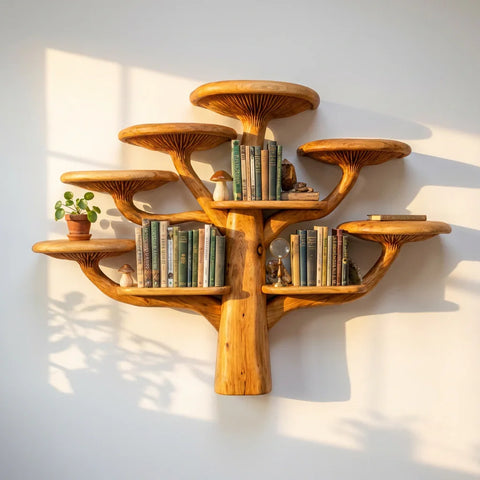
 Sculptural Overlapping Circular Solid Wood Wall Shelf with Multi Tier Display
From $1,354.00
Sculptural Overlapping Circular Solid Wood Wall Shelf with Multi Tier Display
From $1,354.00
 Mountain Landscape Relief Solid Wood Floating Shelf Live Edge Display Ledge
From $1,154.00
Mountain Landscape Relief Solid Wood Floating Shelf Live Edge Display Ledge
From $1,154.00
 Enchanted Forest Circular Wall Shelf - Round Carved Timber Mushroom Portal
From $1,023.00
Enchanted Forest Circular Wall Shelf - Round Carved Timber Mushroom Portal
From $1,023.00
 Cottagecore Arched Wood Wall Niche - Hand-Carved Fairy Mushroom Alcove Shelf
From $1,356.00
Cottagecore Arched Wood Wall Niche - Hand-Carved Fairy Mushroom Alcove Shelf
From $1,356.00
 Sculptural Hand-Carved Mushroom Solid Wood Corner Floating Shelf & Biomorphic Wall Display Ledge
From $345.00
Sculptural Hand-Carved Mushroom Solid Wood Corner Floating Shelf & Biomorphic Wall Display Ledge
From $345.00
 Sculptural Hand-Carved Mushroom Solid Wood Floating Shelves & Biomorphic Wall Display Ledges
From $345.00
Sculptural Hand-Carved Mushroom Solid Wood Floating Shelves & Biomorphic Wall Display Ledges
From $345.00
Is It Safe to Place a TV on a Floating Shelf? Here's What You Need to Know
Floating shelf under TV setups have become one of the cleanest alternatives to bulky media consoles. You wall-mounted your TV, it looks clean — but then you look down and there's a problem: a traditional media console eating up floor space, or worse, an empty void that makes the whole wall feel unfinished.
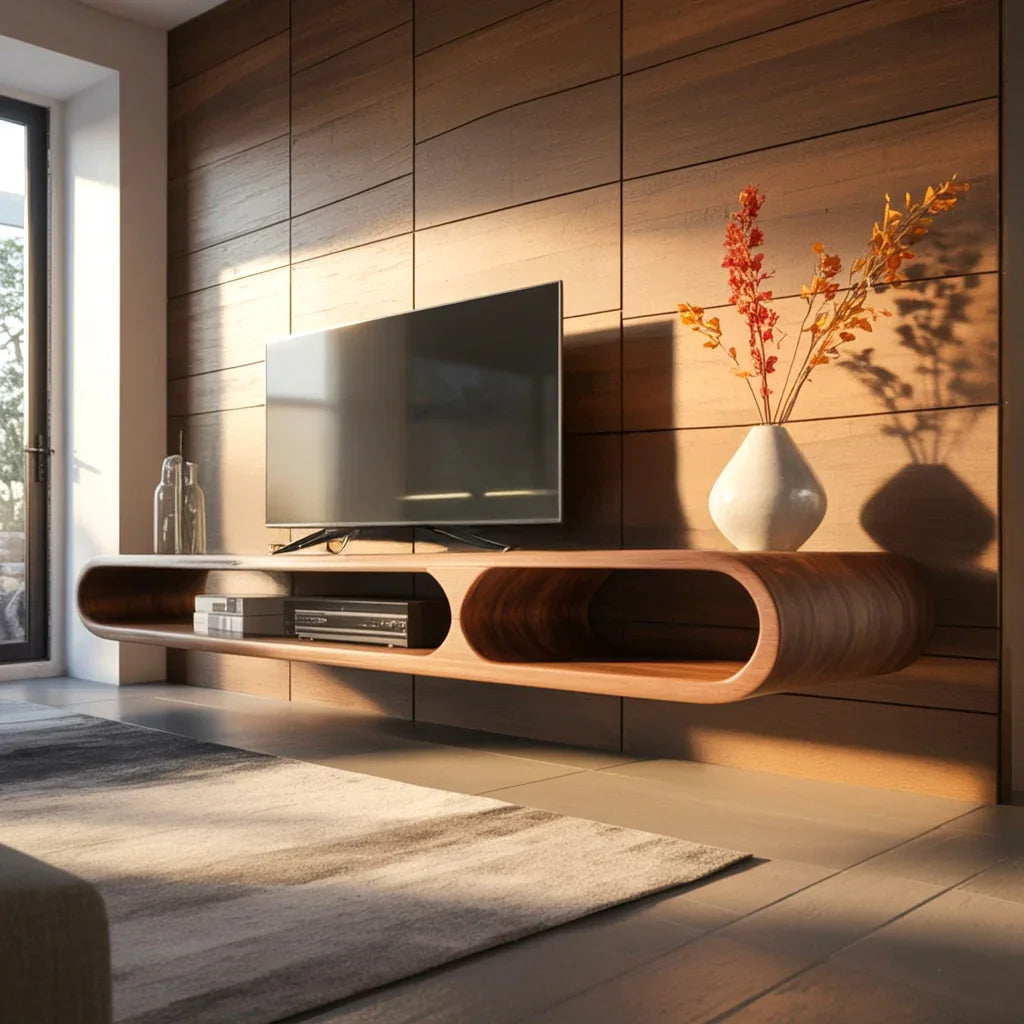
A floating shelf under TV fixes that. No legs, no bulky cabinet, just a solid wood floating shelf that holds your soundbar, streaming box, and a few decorative pieces while keeping the floor completely clear. It acts as a minimalist floating shelf TV stand without crowding your living room.
But there's one question that stops most homeowners from pulling the trigger: is it safe to place a TV on a floating shelf, or can I put a TV on a floating shelf without risking a disaster?
The short answer is yes — a properly mounted solid wood floating shelf can safely hold a TV. However, this is only true when the shelf material, the brackets, and the wall anchoring all meet a strict safety threshold. Unlike a standard TV cabinet that has four legs distributing weight down into the floor, a floating shelf transfers 100% of its load into the wall. If any single element in that setup fails, your expensive electronics come crashing down. This article breaks down the hard physics of floating shelf weight capacity for TV setups so you can audit your space with absolute confidence.

How Much Weight Are You Actually Putting on That Shelf?
Most people guess their TV weight and guess low. A floating media shelf doesn't just hold the screen - it bears the weight of the entire entertainment ecosystem. When calculating your required floating shelf weight capacity for TV usage, you must account for the cumulative weight of all components, decor, and structural leverage:
| Item Type | Weight Range |
|---|---|
| 43" to 50" TV | 18 – 30 lbs |
| 55" TV | 30 – 45 lbs |
| 65" TV | 50 – 70 lbs |
| 75" to 85" TV | 75 – 110 lbs |
| Soundbar | 5 – 12 lbs |
| Streaming box / Game console (PS5, Xbox) | 2 – 8 lbs |
| Decor (plants, books, frames) | 3 – 10 lbs |
| Typical Total for a 55" TV Setup | 50 – 75 lbs |
| Typical Total for a 75" TV Setup | 90 – 130 lbs |
As the data shows, a standard 55-inch media setup lands easily at 50 to 75 pounds, while a larger screen setup pushes past 90 to 130 pounds. This benchmark weight is the foundation you must use when selecting your shelf and hardware. Your setup should never live right at the edge of its maximum rating.
What Makes a Floating Shelf Strong Enough for a TV?
A floating media shelf setup relies on a three-tier safety chain. If any link is weak, the system fails.
A. Material & Thickness - Why MDF and Softwoods Are a Danger Zone
For a high-load environment like a floating shelf under TV setup, your core material must be structural. This is where cheap MDF (Medium-Density Fiberboard) and particle board shelves fail. Under a continuous, heavy weight load, MDF suffers from a physical phenomenon called "creep" - it slowly and permanently sags over months until the internal screw channels strip and the shelf collapses forward.
Furthermore, electronics generate ambient heat. Solid wood can withstand continuous temperature fluctuations, whereas MDF expands and contracts unevenly in response to thermal stress and humidity, rapidly degrading its structural integrity.
To safely hold a television setup, your shelf should be built from high-density, live-edge hardwood (such as walnut, oak, or acacia) and measure at least 1.5 inches thick. Dense natural wood fibers grip internal mounting hardware tightly, providing the rigid foundation necessary to eliminate long-term warping and sagging. Ashdeco's handcrafted floating shelves are built from solid premium timbers specifically to handle these sustained load demands.

B. Bracket Weight Rating - The Hidden Strength
Your mounting hardware must be rated for at least 1.5x to 2x the actual total weight of your setup to provide a safe engineering margin. If your combined TV and media components weigh 75 pounds, your bracket system must be rated for 150 pounds minimum. For a clean, minimalist aesthetic beneath a television, a heavy-duty, concealed rod-style bracket system is highly recommended. It completely hides the metal supports inside the core of the wood while providing excellent leverage resistance. Avoid generic keyhole brackets or unrated, mass-produced loose hardware, as they are strictly designed for light decorative objects, not electronics.
C. Wall Anchoring - The Absolute Non-Negotiable
You must anchor your floating media brackets into wood wall studs. Drywall anchors - regardless of how heavy-duty they claim to be on the packaging - are fundamentally incapable of handling the continuous forward-leveraging force of a deep television shelf. You need a minimum of two wall studs for a TV up to 65 inches, and at least three studs for any setup over 75 inches. Because standard North American wall studs are spaced 16 or 24 inches apart, your shelf must be long enough to span across multiple studs to anchor safely.
Engineered for High Tonnage · Solid Hardwood · Professional Hardware Included
Explore Ashdeco Heavy-Duty Media Shelves →


Size Requirements: Choosing the Right Width & Depth for Your TV
Sizing isn't just an aesthetic choice; it directly governs the physics of wall leverage and stable component placement.
1. Width Requirements
To look balanced and provide enough length to catch multiple wall studs, your shelf should be wider than the actual physical width of your television by at least 4 to 6 inches on each side.
| TV Size | Actual TV Width (Avg.) | Minimum Shelf Width | Safe Recommendation |
|---|---|---|---|
| 43" - 50" | 38" - 44" | 44" | 48" - 54" |
| 55" | 48" | 54" | 58" - 64" |
| 65" | 57" | 62" | 66" - 72" |
| 75" - 85" | 66" - 75" | 80" | 86" - 94" |
*Note: For a deep dive into media furniture proportions, consult our comprehensive TV cabinet dimensions guide; the scale logic remains identical for wall-mounted shelving.
2. Depth and Height Requirements
- Depth: A floating shelf TV stand requires a minimum depth of 14 inches for screens under 65 inches, and 16 to 18 inches for large 75-inch+ setups. This provides enough clearance for the TV stand legs or base, media wiring connections, and your soundbar without anything overhanging the front edge.
- Height: The shelf surface should generally be positioned 22 to 26 inches from the floor. This placement keeps the center of your television screen at the standard seated eye level (roughly 42 inches from the floor).
Installation: The 3 Non-Negotiables
Proper execution during mounting is critical. When setting up a heavy media shelf, you must follow these rules without compromise:
- Use a stud finder accurately: Mark both the left and right outer edges of your studs, not just a single center point. Your mounting screws must sink directly into the meat of the wood framing.
- Ensure absolute level: A minor 1-degree tilt on a display shelf might pass unnoticed, but under a wide television screen, it will look instantly warped. Check your leveling twice after hand-tightening your structural screws.
- Pre-drill with precision: Use a drill bit that matches the inner shank diameter of your heavy lag screw rather than its outer threads. If your pilot hole is too tight, you risk splitting the wall stud; if it is too wide, the threads won't bite securely.
*For a complete manual on tools and techniques, read our step-by-step floating shelf installation guide.

Don't miss
These pieces qualify for 10% off orders over $2,000. Applied automatically at checkout.
Red Flags: Signs a Floating Shelf Is NOT Safe for Your TV
If your shelf setup displays any of the following characteristics, it is a structural hazard:
- Manual flex: The shelf noticeably bends or dips when you apply downward hand pressure before loading it with electronics. Solid timber does not flex; composite fiberboards do.
- Unrated hardware: The manufacturer does not state a certified load capacity for the brackets on the packaging.
- Drywall mounting: The hardware relies entirely on hollow-wall toggle bolts or plastic anchors without sinking into timber studs.
- Shallow depth: The shelf profile is under 12 inches deep, forcing your TV stand base or electronic cords to crowd over the leading edge.
- Long MDF spans: An MDF or particle board shelf spans wider than 40 inches without mid-point vertical bracing. It will inevitably buckle under weight and thermal stress from your electronics.
- Acoustic straining: You hear structural creaking, popping, or fiber-snapping noises when you place your media components onto the shelf for the first time.
So, When Is a Floating Shelf Actually Safe for a TV?
Run through this quick safety checklist before leaving your television unattended:
- The shelf is crafted from 100% solid hardwood (at least 1.5 inches thick).
- The shelf width extends beyond your TV frame, allowing you to hit a minimum of 2 to 3 studs.
- Your bracket hardware is certified for at least twice your actual equipment load.
- Every primary load-bearing screw is anchored squarely into solid wood wall studs.
- The shelf depth measures at least 14 inches to allow for safe component positioning.
- There is zero deflection, shaking, or wall movement when fully loaded.
Frequently Asked Questions
Can I put a 65-inch TV on a floating shelf?
Yes, provided the shelf is made of solid hardwood, spans at least 62 inches in width to anchor into multiple wall studs, and utilizes heavy-duty concealed rod brackets rated for 150+ lbs. A typical 65-inch setup weighs between 60 to 85 pounds combined, which demands an engineered, structural solid wood foundation.
How much weight can a floating shelf hold for a TV?
A stud-mounted solid wood shelf paired with professional-grade concealed steel rod hardware can reliably hold 100 to over 200 pounds. The primary bottleneck is almost never the solid wood itself; it is the load rating of your hardware and whether your installation screws hit the structural studs inside your wall.
Is MDF safe for a floating TV shelf?
No, MDF is highly susceptible to structural "creep" and will gradually warp under sustained weight. Additionally, the localized heat emitted from media components weakens the synthetic binders within MDF, which can lead to catastrophic hardware failure along long spans.
Do I really need a stud for a floating shelf under a TV?
Yes. This is non-negotiable. Sheetrock and drywall cannot support a heavy, forward-leveraged cantilevered load over time. Sinking your hardware deep into structural wall studs is mandatory to ensure safety.
How high should a floating shelf be under a wall-mounted TV?
The top surface of the shelf should sit between 22 to 26 inches above your floor. Ensure you maintain a clean 4 to 6-inch vertical gap between the top of the shelf surface and the bottom frame of your mounted TV to allow room for a soundbar and easy wiring access.
Conclusion
A floating shelf under TV setup is a brilliant architectural alternative to bulky media consoles, keeping your floor open and your living space modern. However, safety depends entirely on execution. By choosing premium solid hardwood, verifying your structural stud anchors, and respecting weight limitations, you create an entertainment centerpiece that is as sturdy as it is beautiful.
Ready to upgrade your entertainment space? Browse Ashdeco's collection of handcrafted solid wood floating shelves, precision-cut from selected premium timbers by skilled artisans. For high-load media systems requiring maximum thickness and depth, explore our industrial-grade live edge mantel shelves. To learn more about structural limits across various wall types, read our master Floating Shelf Weight Limit Guide before beginning your installation.