
























Quick view
- How is a tree-shaped coat rack different from a traditional coat rack?
- Hand-Carved vs. Mass-Produced: Why Craftsmanship Matters
- Standing vs. Wall-Mounted Tree Coat Racks
- Branch Count and Hook Placement: A Practical Guide
- Bedroom Clothes Rack: Beyond the Entryway
- Entryway Layout: Combining a Tree Coat Rack and a Shoe Bench
- Size Guide: Height, Base Diameter, and Canopy Width
- Choosing the Right Wood for Your Tree Coat Rack
- Rustic Standing Coat Racks: Finding Your Aesthetic
- Care, Maintenance, and Seasonal Decoration Ideas
- How to Choose a Tree Coat Rack: What to Check Before Buying
- Frequently Asked Questions About Tree Coat Racks
- Make Your Entryway Unforgettable
Shop this guide
Handcrafted Coat Racks & Hangers, made to order in solid wood.
 Christmas edit
Custom Wood Coat Rack – Driftwood Wall Mount Clothes Rack with Unique Hooks
From $697.00
Christmas edit
Custom Wood Coat Rack – Driftwood Wall Mount Clothes Rack with Unique Hooks
From $697.00
 Christmas edit
Antler Coat Rack – Rustic Handmade Wall Hook for Home & Office
From $517.00
Christmas edit
Antler Coat Rack – Rustic Handmade Wall Hook for Home & Office
From $517.00
 Christmas edit
Natural Driftwood Coat Rack – Handcrafted Tree Branch Standing Hanger for Entryway or Bedroom
From $1,056.00
Christmas edit
Natural Driftwood Coat Rack – Handcrafted Tree Branch Standing Hanger for Entryway or Bedroom
From $1,056.00
 Christmas edit
Ashdeco Solid Wood Coat Rack – Vintage 10 Hooks Hat & Clothes Stand
$520.00
Christmas edit
Ashdeco Solid Wood Coat Rack – Vintage 10 Hooks Hat & Clothes Stand
$520.00
 Christmas edit
Rustic Tree Branch Coat Rack – Solid Wood Standing Hanger for Home Decor
From $1,556.00
Christmas edit
Rustic Tree Branch Coat Rack – Solid Wood Standing Hanger for Home Decor
From $1,556.00
 Rustic Wooden Standing Coat Rack – Handmade Tree Branch Hook Organizer
From $1,056.00
Rustic Wooden Standing Coat Rack – Handmade Tree Branch Hook Organizer
From $1,056.00

The tree-shaped coat rack is not just a place to hang your coats - it transforms a dull entryway into a vibrant piece of functional art. Unlike the mass-produced metal or molded plastic “tree coat racks” flooding Amazon, Ashdeco’s solid wood tree-shaped coat rack is a handcrafted work of art: each branch is carved by Vietnamese artisans who have spent decades mastering wood carving. In this guide, you will learn exactly how to choose the right tree coat rack for your space, how the number of branches affects its capacity, how much weight each branch can hold, and why handcrafted hardwood is more durable than all mass-produced products on the market.
How is a tree-shaped coat rack different from a traditional coat rack?
A tree-shaped coat rack mimics the natural branching structure of a real tree, providing multiple hanging points at different heights and angles - unlike a traditional rack that has a single row of identical hooks. This design distributes weight over a wider area, prevents clothes from bunching up, and turns a practical item into a visual focal point.
Standard coat racks usually have 4-6 hooks at the same height. This means your winter coats will overlap your guests’ jackets, and scarves will slide off smooth identical hooks onto the floor. A tree-shaped coat rack solves this problem with staggered branches - typically spaced 18-48 inches from the lowest to the highest branch - so kids’ backpacks can hang underneath adults’ coats without obstruction.
There’s also a visual aspect. A metal pole with hooks blends into the background. A tree-shaped coat rack becomes a statement piece. It bridges interior design and art, which is why interior designers have increasingly favored them for entryways, mudrooms, and bedrooms since 2023.

Structure of a tree-shaped coat rack
Every tree coat rack has four key components: the base (stability platform, typically 14-20 inches in diameter for freestanding models), the trunk (central column, 2-4 inches thick), the branches (your hanging points, usually 6-12 per rack), and the crown (the top cluster of branches, sometimes purely decorative). On Ashdeco's handcrafted pieces, each of these components is carved separately from solid hardwood, then assembled using mortise-and-tenon joinery - no screws visible, no wobbly press-fit connections.
Why "Tree-Shaped" Isn't the Same as "Tree-Carved"
Here's the distinction most buyers miss. The majority of tree coat racks sold online are tree-shaped - metal tubes bent to suggest branches, or plastic molded to look vaguely organic. They have the silhouette but none of the texture, grain, or warmth of real wood. A wooden tree coat rack that's actually hand-carved from solid timber has visible grain lines flowing along each branch, subtle irregularities that prove a human hand shaped it, and the kind of heft that tells you it won't tip over when you hang a wet wool coat on it.
At Ashdeco, our Vietnamese artisans carve each branch individually from seasoned hardwood - mahogany, teak, or acacia depending on the design - then assemble the full tree using traditional joinery. The result is a piece where no two branches are identical, because no two cuts from the same log are identical. That's not a flaw. That's the point.
Hand-Carved vs. Mass-Produced: Why Craftsmanship Matters
The single biggest differentiator between an Ashdeco tree coat rack and the mass-produced alternatives is how it's made. Hand-carved solid wood construction means greater strength, longer lifespan, and a one-of-a-kind aesthetic that factory stamping can't replicate - and the price difference is smaller than you'd think.

How Ashdeco Artisans Build Each Tree Coat Rack
The process starts with wood selection. Our artisans in Vietnam's central highlands choose logs that have been air-dried for 12-18 months - kiln-drying is used as a final step, but slow air-drying first reduces internal stress and prevents the hairline cracks that plague rushed production. Each log is evaluated for grain direction, knot placement, and color consistency.
From there, the trunk is turned on a lathe for roundness, then hand-shaped with chisels and gouges to add organic texture - bark-like ridges, subtle taper, the slight asymmetry of a living tree. Branches are carved individually: roughed out with a bandsaw, then shaped entirely by hand. The artisan follows the wood's natural grain, which means each branch curves slightly differently. Finally, mortise-and-tenon joints lock every branch into the trunk with no visible hardware.
Total build time for a single tree coat rack: 3-5 days of skilled labor. Compare that to a factory in Guangzhou stamping out 500 metal tree racks per shift.
Material Comparison: Solid Wood vs. Metal vs. Plastic
| Feature | Hand-Carved Solid Wood (Ashdeco) | Mass-Produced Metal | Injection-Molded Plastic |
|---|---|---|---|
| Weight capacity per branch | 12-18 lbs | 8-12 lbs | 3-5 lbs |
| Overall weight capacity | 60-100+ lbs | 30-50 lbs | 15-25 lbs |
| Lifespan | 20-50+ years | 5-10 years | 1-3 years |
| Stability | Weighted solid base, 15-25 lbs | Lightweight, tips easily | Very light, tips with 2+ coats |
| Aesthetic | Unique grain, one-of-a-kind | Uniform, industrial | Artificial, shows seams |
| Eco-friendly | Sustainably harvested hardwood | Recyclable but energy-intensive | Petroleum-based, landfill-bound |
| Price range | $150-$400 | $40-$120 | $15-$50 |
The upfront cost difference narrows fast when you factor in replacement cycles. A $40 metal tree rack that lasts 5 years costs $8/year. An Ashdeco hand-carved tree coat rack at $250 that lasts 30 years costs $8.33/year - virtually identical - but delivers decades of beauty and holds three times the weight without wobbling.
Joinery That Outlasts Hardware
Screws loosen. Bolts strip. Press-fit plastic tabs snap. Mortise-and-tenon joints - the same joinery technique used in Japanese temples that have stood for 1,300 years - actually tighten with age as wood fibers interlock under natural expansion and contraction. Every branch on an Ashdeco tree coat rack is joined this way, which means it gets sturdier over time, not wobblier.


Standing vs. Wall-Mounted Tree Coat Racks
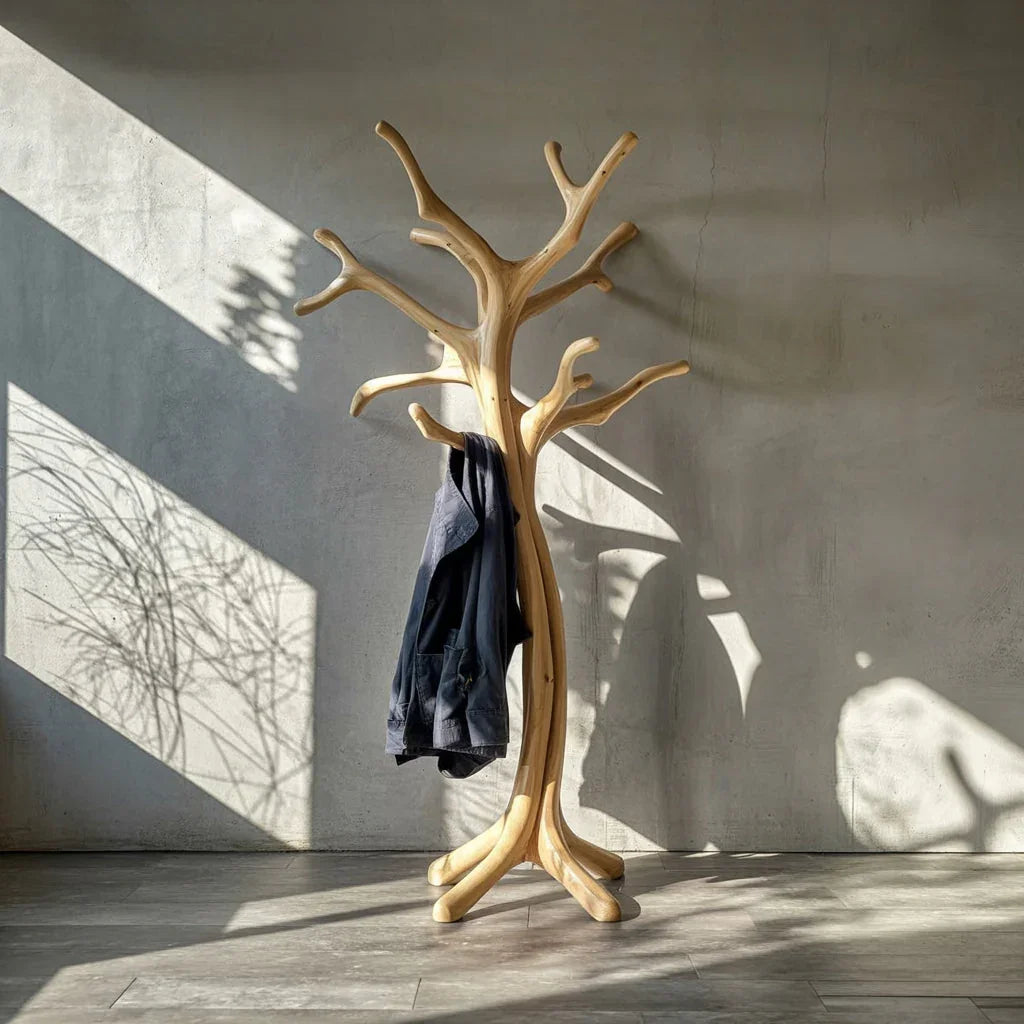
Freestanding tree coat racks offer maximum flexibility - place them anywhere, move them seasonally, no wall damage. Wall-mounted tree coat racks save floor space and create dramatic wall art. The right choice depends on your entryway layout, wall construction, and how many coats you need to hang daily.

Freestanding Tree Coat Stands: Pros and Placement
A freestanding tree coat stand works best when you have at least a 24×24-inch floor footprint available. The weighted base (Ashdeco's range from 14 to 20 inches in diameter) needs clearance so branches don't press against walls or block doorways. The major advantage: zero installation. Unbox it, place it, start hanging coats.
Best placements for standing models include beside the front door (the classic), in a bedroom corner as a bedroom clothes tree, at the end of a hallway, or in a mudroom. Avoid placing freestanding tree racks on thick carpet - the soft surface reduces stability. If carpet is unavoidable, place a 16-inch hardwood disc under the base for a firm foundation.
Wall-Mounted Tree Coat Racks: When Walls Are Better
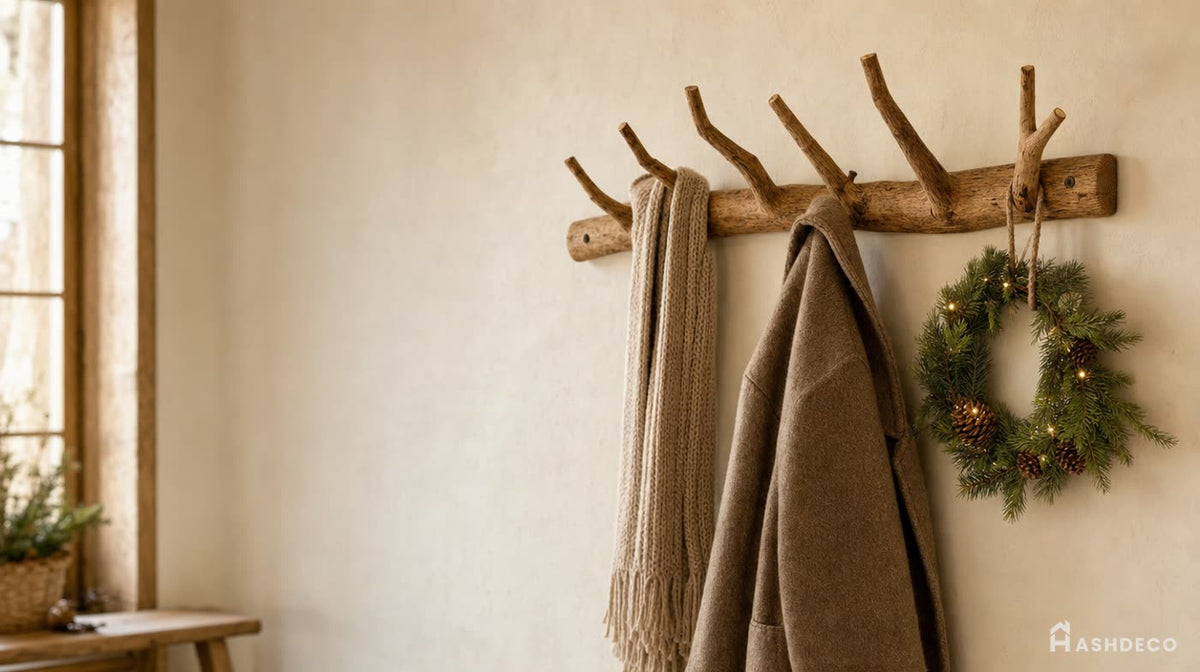
Wall-mounted designs are ideal for narrow entryways under 36 inches wide, apartments where floor space is precious, and renters who want to make a statement without buying large furniture (though you will need wall anchors). A wall-mounted tree rack typically holds 4-8 coats and can span 24-36 inches of wall width.
Installation requires finding studs or using heavy-duty drywall anchors rated for at least 50 lbs. Ashdeco's wall-mounted tree designs come with French cleat mounting systems - a beveled wooden rail that locks into a matching wall rail - so the rack sits flush and can be removed without damage beyond two screw holes.
Hybrid Approach: Tree Rack + Wall Hooks
For families with 4+ members, we recommend a hybrid setup: a freestanding wooden tree coat rack for daily-use jackets and bags, plus 2-3 wall-mounted branch hooks at child height (36-42 inches) for kids' coats and backpacks. This distributes the load, teaches kids to hang their own things, and keeps the main tree rack from overcrowding.
Branch Count and Hook Placement: A Practical Guide
The number of branches on a tree coat rack directly determines its capacity, visual density, and suitability for different household sizes. A 6-branch tree suits a couple or studio apartment; a 12-branch tree handles a family of five with guests. Here's how to match branch count to your actual needs.

How Many Branches Do You Actually Need?
Count the items you hang daily - not occasionally, but every single day. Most people underestimate. A typical daily hang for one person: coat, bag, scarf (winter), hat (sometimes). That's 2-4 branches per person. For a household:
- 1-2 people: 6-8 branches is plenty. Leaves room for a guest's coat and your umbrella.
- 3-4 people: 8-10 branches. Allows dedicated spots for each person plus 2 spare.
- 5+ people or frequent entertaining: 12+ branches. Ashdeco's largest freestanding models offer up to 14 branches at varied heights.
Branch Angle and Height Zones
Not all branches are equal. The angle determines what stays put and what slides off. Branches angled upward at 15-30° from horizontal are ideal for coat collars and bag straps - items with openings that hook over the branch tip. Branches angled at 30-45° work better for scarves, belts, and items draped over rather than hooked.
Ashdeco's artisans carve branches in three height zones:
- Lower zone (18-30 inches): 2-3 shorter, sturdier branches for heavy bags, umbrellas, and kids' items.
- Mid zone (30-48 inches): 4-6 main branches for coats, jackets, and blazers. This is the workhorse zone.
- Upper zone (48-72 inches): 3-4 lighter branches for hats, scarves, and lightweight accessories. These also fill out the tree's silhouette.
Weight Capacity Per Branch: Real Numbers
This is where solid wood handcrafted pieces truly outshine the competition. A single branch on Ashdeco’s tree-shaped coat rack, carved from solid mahogany or teak with a base diameter of 1.5-2 inches, can hold 12-18 lbs - enough for a heavy winter coat (4-6 lbs) plus a fully loaded crossbody bag (8-10 lbs) on the same branch. The mortise-and-tenon joints and dowels distribute the weight into the central trunk, not onto a thin weld or fragile plastic peg.
By comparison, a standard metal tree branch (hollow pipe, 0.5-inch diameter, welded) can only hold 8-12 lbs before permanently bending. And a plastic branch? It can only handle 3-5 lbs before stress cracks appear at the base. If you regularly hang heavy winter wear or loaded bags, solid wood is not a luxury-it’s a necessity.
Don't miss
These pieces qualify for 10% off orders over $2,000. Applied automatically at checkout.
 10% off
Sculptural Solid Wood Hall Tree - Artistic Branch Tree Hanger - Unique Live Edge Entryway Coat Rack
$2,234.00
10% off at checkout
10% off
Sculptural Solid Wood Hall Tree - Artistic Branch Tree Hanger - Unique Live Edge Entryway Coat Rack
$2,234.00
10% off at checkout
 10% off
Handcrafted Tree Branch Clothing Rack – Solid Wood Wardrobe Shelf Organizer for Home Décor
$2,333.00
10% off at checkout
10% off
Handcrafted Tree Branch Clothing Rack – Solid Wood Wardrobe Shelf Organizer for Home Décor
$2,333.00
10% off at checkout
 10% off
Sculptural Hand-Carved Solid Wood Tree Entryway Bench & Branch Coat Rack with Integrated Shoe Shelf
From $2,534.00
10% off at checkout
10% off
Sculptural Hand-Carved Solid Wood Tree Entryway Bench & Branch Coat Rack with Integrated Shoe Shelf
From $2,534.00
10% off at checkout
 10% off
Sculptural Hand-Carved Tree Solid Wood Open Wardrobe Closet System & Branch Wall Storage Bench
$3,876.00
10% off at checkout
10% off
Sculptural Hand-Carved Tree Solid Wood Open Wardrobe Closet System & Branch Wall Storage Bench
$3,876.00
10% off at checkout
Bedroom Clothes Rack: Beyond the Entryway
A bedroom clothes rack serves a completely different purpose than an entryway coat rack. It displays “worn once, not ready to put away” clothes-an item that prevents bedroom chairs from becoming clothes mountains. A well-placed bedroom rack keeps outfits organized, visible, and wrinkle-free.

Why every bedroom needs a clothes rack
The “chair in the bedroom” problem is common. You wear a pair of jeans for a few hours-they’re not dirty, but not clean enough to fold into a drawer. So they end up on the chair. Then a sweater joins them. Then a coat. Within a week, the chair is buried, and each morning you have to dig wrinkled clothes out of a pile.
A bedroom clothes rack gives each “off-season” item its own branch. Tomorrow’s outfit hangs at eye level. Robes hang on lower branches. The cozy sweater you wear each night has its own spot. This arrangement gives every item a designated place-vertically, saving space, and looking beautiful at the same time.
Decorating a tree-shaped rack in the bedroom
In the bedroom, a rustic coat rack functions both as furniture and decor. Here’s how to style it without making the space feel cluttered:
- 60% Rule: Never fill more than 60% of the branches. Leave some branches empty to show the tree’s silhouette. A fully loaded rack looks messy; a partially filled one looks intentional.
- Group by Color: Hang items with similar tones together. Dark clothes on one side, light on the other. This creates visual order even with multiple items hanging at once.
- A Unique Accent: Drape a patterned scarf or woven throw over an upper branch. This turns the rack from a storage spot into a decorative piece.
- Base Decor: Place a small woven basket at the trunk to hold slippers or folded blankets. It anchors the tree visually and adds functionality.
Best bedroom placement
Corners are ideal-the tree fills empty space and receives natural light from nearby windows, highlighting the wood grain beautifully. Avoid placing the rack directly behind the bedroom door (it blocks the swing) or next to a wardrobe (it competes for hanging space). Optimal placement: the corner between a window and wardrobe, or next to your reading chair.
Entryway Layout: Combining a Tree Coat Rack and a Shoe Bench
The most functional entryway combines a tree-shaped coat rack with a shoe bench at its base, creating a complete storage area for coats, bags, shoes, and keys. This setup eliminates the “everything on the floor” problem and keeps the entryway tidy even during hectic moments with kids, groceries, and wet umbrellas.

Perfect Drop Zone Design
A convenient drop zone is a place where every item has a designated spot, within easy reach of anyone entering the home. Here’s the layout we recommend:
- Tree-shaped coat rack: Place it 12-18 inches (30-45 cm) from the door, angled so that branches extend outward (not toward the wall). This is the spot for hanging coats, bags, scarves, and hats.
- Shoe bench: Place it directly in front of or beside the base of the tree rack. A sturdy wooden bench with storage can hold 4-6 pairs of shoes and provides seating for putting on boots.
- Small tray or bowl: Place on a tabletop to hold keys, wallets, sunglasses-convenient for everyday items.
- Wall mirror: Place next to or above the console table for a final check before heading out.
Coordinate Wood Tones Across Pieces
When pairing a tree-shaped coat rack with a shoe bench, choosing matching wood types creates a harmonious set. Ashdeco’s handcrafted collections use consistent wood batches, so a mahogany tree rack and mahogany bench will share the same grain and finish. If combining different woods, select colors from the same family: warm reds (mahogany, cherry), golden browns (teak, oak), or dark tones (walnut, dark-stained woods). Avoid pairing raw pine with dark walnut-the contrast looks unnatural, not by design.
Entryway Dimensions: How Much Space Do You Need?
Measure your entryway before purchasing. A freestanding tree-shaped coat rack, when fully loaded, requires more space than the base diameter suggests-the coats add an extra 6-10 inches of “hanging radius” beyond the branch tips. Here’s how to calculate actual space:
- Base diameter: 14-20 inches
- Canopy reach: 20-30 inches from trunk center to branch tip
- Coat overhang: Add 8-10 inches beyond the branch tip
- Required floor space: Circular area with 44-60 inches diameter
If your entryway is narrower than 40 inches, a wall-mounted tree rack or tree hanger is a better choice. Reserve large freestanding racks for wider spaces.
Size Guide: Height, Base Diameter, and Canopy Width
Choosing the right tree coat rack size means considering three measurements for your space: overall height, base diameter, and canopy width. Pick correctly, and the rack looks balanced and functions perfectly. Pick incorrectly, and you end up with a beautiful sculpture that blocks traffic or feels out of place in a large entryway.

Height: Choosing the Right Rack for Your Ceiling and Users
Tree-shaped coat racks typically range from 60 to 78 inches tall. Here’s how to choose:
| Rack Height | Best For | Ceiling Height | Top Branch Reach |
|---|---|---|---|
| 60-65 in (5'-5'5") | Apartments, low ceilings, shorter users | Minimum 8 ft | Suitable for most adults |
| 66-72 in (5'6"-6') | Standard homes, most families | 8-9 ft | Fits average-height adults comfortably |
| 73-78 in (6'1"-6'6") | Large entryways, high ceilings, tall users | 9-10 ft | Upper branches mostly decorative; accessible for shorter users |
General rule: the top branch should be at least 12 inches below the ceiling. Any closer and the rack looks cramped. In rooms with standard 8-foot ceilings, we recommend keeping the total height under 72 inches.
Base Diameter: The Stability Equation
The base is a crucial yet often overlooked part of any freestanding tree rack. Too small, and it may tip; too large, and it takes up too much floor space. Ashdeco’s handcrafted bases are carved from solid hardwood-usually 3-4 inches thick-ensuring excellent stability.
- 14-inch base: Suitable for light items like hats, scarves, or thin coats. Ideal for tight bedroom corners.
- 16-inch base: Most common size. Holds 3-4 medium-weight coats comfortably. Strikes a balance between stability and footprint.
- 18-20-inch base: High-load option. Perfect for multiple heavy winter coats, bags, or use in entryways. Almost impossible to tip, even with uneven loads.
Branch Spread: Planning for Real Use
The canopy width-the distance from the trunk center to the furthest branch tip-determines the horizontal footprint and how efficiently you can distribute hanging items. Ashdeco designs usually have a branch reach of 10-15 inches per side, giving a total canopy diameter of 20-30 inches.
Most size guides overlook this: the width of the coat hanging over the branch. A heavy coat pulls downward-the shoulders extend 4-6 inches past the branch tip, and the hem can swing 8-10 inches from the trunk. Always add about 10 inches to the listed canopy width when planning actual spacing.
Choosing the Right Wood for Your Tree Coat Rack
Wood type affects everything: color, grain, weight, hardness, and how the rack changes over time. Ashdeco artisans primarily use three hardwood species, each with characteristics suited to different interior styles and usage needs.

Mahogany: The Classic Choice
Mahogany is the gold standard for carved furniture. Its straight, fine grain allows detailed carving without splintering, creating smooth branches and sharp details that look refined rather than bulky. Colors range from reddish-brown to deep crimson and improve with age. Janka hardness: 800-900 lbf-hard enough to resist dents from keys or belt buckles, yet soft enough for intricate bark carvings.
Best for: Traditional, transitional, and mid-century modern interiors. Perfect with warm wood floors or leather furniture.
Teak: The Timeless Choice
Teak is the go-to hardwood when durability is essential. Its natural oils resist moisture, warping, and insect damage-ideal for mudrooms or covered porches where racks may encounter humidity. Color is golden-brown with darker grain streaks. Janka hardness: 1,000-1,155 lbf. Heavier than mahogany, which improves stability in freestanding designs.
Best suited for: Entryways with heavy foot traffic, homes with children or pets (teak wood resists scratches), and anyone who wants the beauty of wood without maintenance.
Acacia: Bold Wood Grain, Modern Style
Acacia wood offers the most striking grain patterns - wide, flowing lines with strong contrast between the heartwood and sapwood. This is a unique type of wood. Janka hardness: 1,100-1,700 lbf (varies by species), making it extremely hard and scratch-resistant. The varied grain means each carved branch has its own unique shape, highlighting the one-of-a-kind nature of handcrafted products.
Best suited for: Modern and free-spirited interiors where the tree-shaped coat rack serves as a focal point rather than just a decorative piece.
Rustic Standing Coat Racks: Finding Your Aesthetic
Rustic coat racks don’t mean "rough and unfinished." They celebrate the natural beauty of wood - visible grain, soft curves, and warmth close to nature. Within rustic style, there are variations from farmhouse to modern rustic and Scandinavian minimalism, and the right choice depends on your existing interior.

Farmhouse Rustic Style: Bark texture and raw charm
The farmhouse style keeps everything rustic and unpolished. Ashdeco’s farmhouse-style tree coat racks have hand-carved trunks with bark grain, slightly rough branch surfaces, and matte or glossy finishes that reveal the wood’s texture. They pair beautifully with shiplap walls, woven baskets, and iron accessories. Key detail: the base usually retains its natural edge rather than being perfectly rounded.
Modern Rustic Style: Clean lines, warm wood
Modern rustic balances natural shapes with refined craftsmanship. Trunks are smooth, branches taper elegantly, and finishes are satin or matte, highlighting the grain without being overly glossy. This style suits most homes - giving a "deliberate" feel in modern apartments and "warmth" in traditional houses. Most Ashdeco tree coat racks fall into this category.
Scandinavian Minimalist Style: Less is more
Scandinavian style strips the tree down to its essentials: slim trunk, 6-8 widely spaced branches, light-colored wood (natural acacia or bleached), and a geometrically perfect base. The overall shape evokes a tree without trying to replicate it precisely. Ideal for minimalist interiors where visual clutter is the enemy - fewer branches mean fewer items hung, keeping the space tidy.
Care, Maintenance, and Seasonal Decoration Ideas
Solid wood tree coat racks are hand-carved and require minimal maintenance - far less than metal (which rusts if scratched) or plastic (which discolors and becomes brittle). A five-minute seasonal routine is enough to protect the wood, keep finishes fresh, and maintain branch strength for decades.

Routine Care: 5-Minute Quarterly Process
Every three months - or whenever the wood looks dry or faded - follow this process:
- Dust: Use a microfiber cloth or feather duster to remove dust from branches, trunk, and base. Pay attention to nooks where dust gathers.
- Wipe: Slightly dampen a cloth with warm water and a drop of mild dish soap. Wipe all surfaces, then dry immediately with a clean cloth.
- Oil: Apply a thin layer of specialized tung oil or Danish oil with a lint-free cloth along the wood grain. Let it soak for 15 minutes, then wipe off excess. This nourishes the wood, restores color depth, and provides light moisture protection.
No special products, no professional restoration, no rust treatment, no plastic polish - just oil, cloth, and five minutes.
Handling Scratches and Dents
Scratches are inevitable - keys, belt buckles, zippers. On solid wood, scratches are repairable. For shallow surface scratches, rub the meat of a walnut along the scratch - the natural oil fills and darkens the mark. For deeper dents, lightly sand with 220-grit sandpaper, smooth with 320-grit, and reapply oil. On plastic or metal racks, scratches are permanent. On solid wood, fixing a scratch takes just 3 minutes.
Seasonal Decoration Ideas
The branch structure of tree coat racks is perfect for seasonal decor. Unlike flat surfaces needing stands, branches naturally hold ornaments, lights, and seasonal items:
- Spring: Hang small fabric or paper flowers from upper branches. A bird nest ornament on the top adds charm.
- Summer: Keep it simple and clean - let the wood be the highlight. Maybe a straw hat on a branch.
- Autumn: Hang a wreath of dried leaves or small gourds across branches. Wrap warm-colored LED string lights around the trunk.
- Winter/Holidays: Hang ornaments, wrap LED lights, add a small star or decoration at the top. It doubles as a mini Christmas tree while holding coats.
Decorating tip: Keep it simple - 5-8 items max. The handcrafted tree itself remains the focal point.

How to Choose a Tree Coat Rack: What to Check Before Buying
Not all tree coat racks are equal, and online descriptions often hide key details. Before adding any tree coat rack to your cart, check this list to ensure you get real quality - not just a pretty photo that disappoints in person.

7-Point Quality Checklist
- Material Information: Does the product description specify the exact type of wood? Phrases like "wood-like material" or "composite wood" are red flags for MDF or particleboard with veneer. Ashdeco products clearly list the wood type - mahogany, teak, or acacia - because they have nothing to hide.
- Weight: A solid wood coat rack truly weighs 15-30 lbs depending on size and wood type. If the description lists under 10 lbs for a 70-inch rack, it’s probably hollow metal or plastic. Weight equals sturdiness, which equals quality.
- Joinery Type: Look for mortise-and-tenon, wooden dowels, or at least wood screws. "Assembly required with included hex key" often signals cam locks and particleboard.
- Finish Type: Oil, lacquer, or polyurethane on solid wood. "Coated finish" on a Christmas tree rack usually means cheap materials are hidden underneath.
- Number and Size of Branches: Specific numbers (8 branches, 72 inches tall, 18-inch base diameter) indicate a properly engineered product. Vague descriptions ("many branches," "tall design") suggest generic suppliers with inconsistent quality.
- Load Capacity: Listed per branch AND total. If only total capacity is listed, it may average strong and weak points.
- Origin and Craftsmanship: Handcrafted by named artisans (like Ashdeco’s Vietnamese woodworkers) versus "imported" from unknown factories. The former ensures transparency; the latter guarantees nothing.
What You See vs. What You Get: Online Shopping Pitfalls
The most common complaint about buying tree coat racks online? "It looked like wood in the photos but was plastic when it arrived." Photography can make any material look good. Here’s how to spot the truth behind staged photos:
- Check close-up photos of the wood grain: Real wood grain has depth - you can see the fibers. Printed grain (on MDF or plastic) is flat and repetitive. If there are no close-up grain photos, be cautious.
- Read one-star reviews: Ignore five-star reviews (often incentivized). One- and two-star reviews reveal the actual material, true dimensions, and real stability of the product.
- Shipping weight: This information doesn’t lie. If the product weighs 8 lbs in shipping, it’s not solid hardwood. Period.
Price Ranges and What They Mean
Understanding what each price segment offers helps you make an informed choice:
- Under $50: Plastic or hollow metal. Suitable for dorm rooms. Needs replacement in 1-3 years.
- $50-$120: Solid metal or engineered wood (MDF core with veneer). A decent mid-range choice if solid wood is out of budget. Lifespan: 3-7 years.
- $120-$250: This is where you start finding real solid wood - but inspect carefully. Some products in this range use softwoods (pine, birch) that dent easily. Ashdeco tree coat racks fall into this range, using the same hardwoods as their premium items but in smaller sizes.
- $250-$400: Premium hardwood, handcrafted. Full-size, multiple branches, furniture-grade quality, built to last decades. This is the ideal price range for a tree coat rack that you’ll never need to replace.
Frequently Asked Questions About Tree Coat Racks
How much weight can a tree coat rack hold?
Hand-carved hardwood tree coat racks can hold 12-18 lbs per branch and 60-100+ lbs total, depending on wood type and branch count. Ashdeco’s mortise-and-tenon joinery distributes weight from the trunk to the base, preventing the warping and wobbling often seen in metal or plastic racks.
Can a freestanding tree coat rack tip over?
No, if the base is properly reinforced. Ashdeco’s freestanding models have sturdy hardwood bases weighing 5-8 lbs, with diameters from 12-20 inches. On a hard floor, they are almost impossible to tip. On thick carpets, place a round hardwood pad under the base. Apply finish evenly on branches to avoid uneven loading.
What’s the difference between a tree coat rack and a hall tree?
A tree coat rack is a standalone sculptural piece shaped like tree branches, designed mainly for hanging clothes. A hall tree is a larger furniture piece that combines coat hooks, mirror, seating, and sometimes storage compartments into one unit. Tree racks are space-saving and versatile; hall trees are better for areas with ample wall space.
Can I use a tree coat rack in my bedroom?
Absolutely - and we recommend it. A bedroom tree coat rack helps solve the “clothes pile on the chair” problem by separating lightly worn garments onto individual branches. Place it in a corner near the wardrobe or next to a dressing table. Follow the 60% rule: leave 40% of the branches empty so it looks decorative rather than cluttered.
How should I clean and maintain a wooden tree coat rack?
Maintenance takes just five minutes: dust with a microfiber cloth, wipe with a damp cloth and mild soap, then apply a thin layer of tung oil or Danish oil. Buff excess oil after 15 minutes. For scratches, rub with walnut meat (for shallow scratches) or lightly sand and reapply oil (for deeper scratches). Solid wood is the easiest material to maintain for coat racks.
What height should I choose for a tree coat rack?
For standard 8-foot ceilings (2.4 m), choose a rack 18-22 inches tall. The top branch should be at least 12 inches below the ceiling. For taller ceilings (2.7-3 m), racks up to 24 inches are suitable. If the primary user is under 5’4” (1.63 m), choose 18-19 inches so all branches are within easy reach without stretching.
Are tree coat racks suitable for small spaces?
Freestanding tree racks need a diameter of 44-60 inches when fully loaded. For very small entryways under 40 inches, a wall-mounted or tree hanger is a better choice. They offer similar aesthetics while taking up less space - branches extend from the wall, and coats hang flat against the surface.
Do tree coat racks come pre-assembled?
Ashdeco’s hand-carved tree coat racks ship with branches pre-inserted into the trunk using mortise-and-tenon joints. Assembly simply involves slotting branches into marked positions and tightening by hand - no tools or screws required, taking less than 10 minutes. The base is attached to the trunk with a single hidden bolt to ensure stability during shipping. This is far simpler than a 47-step flat-pack assembly.
Make Your Entryway Unforgettable
A tree coat rack is one of the rare items that is both truly functional and truly beautiful - a functional art piece worthy of daily presence in your home. When hand-carved from solid hardwood by skilled Vietnamese artisans, it’s not just “a place to hang coats,” it becomes a statement about the values you cherish: craftsmanship over convenience, durability over disposable items, and natural beauty over factory uniformity.
Explore Ashdeco’s full collection of wooden coat racks to find the right size, wood type, and style for your space - or browse our complete range of coat racks and hangers for more handcrafted options.
For more detailed guidance, read our tree coat rack buying guide or see our selections of the best wooden coat racks of 2026.