





























Quick view
- What Is a Floating Bathroom Vanity?
- Floating Vanity Height: What's Standard (and How to Choose Yours)
- Floating vs Traditional Vanity: The Real Differences
- 5 Reasons People Love Floating Vanities
- The Downsides Nobody Talks About
- How to Choose the Right Floating Vanity (Step by Step)
- Solid Wood vs MDF: Why It Matters More for Floating Vanities
- Installation Cost Breakdown
- Frequently Asked Questions
Shop this guide
Handcrafted Bathroom Vanities, made to order in solid wood.
 Sculpted Tree Trunk Solid Wood Bathroom Vanity with Integrated Circular Mirror Frame and Dual Drawers
From $3,276.0010% off at checkout
Sculpted Tree Trunk Solid Wood Bathroom Vanity with Integrated Circular Mirror Frame and Dual Drawers
From $3,276.0010% off at checkout
 Curved Floating Solid Wood Bathroom Vanity Sculptural Wall Mounted Washstand
From $1,843.00
Curved Floating Solid Wood Bathroom Vanity Sculptural Wall Mounted Washstand
From $1,843.00
 Curved Arch Solid Wood Bathroom Vanity Freestanding Four Drawer Washstand
From $2,365.0010% off at checkout
Curved Arch Solid Wood Bathroom Vanity Freestanding Four Drawer Washstand
From $2,365.0010% off at checkout
 Sculptural Tree Trunk Solid Wood Bathroom Vanity Organic Live Edge Storage Console
From $2,154.0010% off at checkout
Sculptural Tree Trunk Solid Wood Bathroom Vanity Organic Live Edge Storage Console
From $2,154.0010% off at checkout
 Sculpted Branch Pedestal Solid Wood Bathroom Vanity Organic Live Edge Washstand
From $1,432.00
Sculpted Branch Pedestal Solid Wood Bathroom Vanity Organic Live Edge Washstand
From $1,432.00
 Floating Live Edge Solid Wood Bathroom Vanity Wall Mounted Storage Cabinet
From $2,316.0010% off at checkout
Floating Live Edge Solid Wood Bathroom Vanity Wall Mounted Storage Cabinet
From $2,316.0010% off at checkout
What Is a Floating Bathroom Vanity?
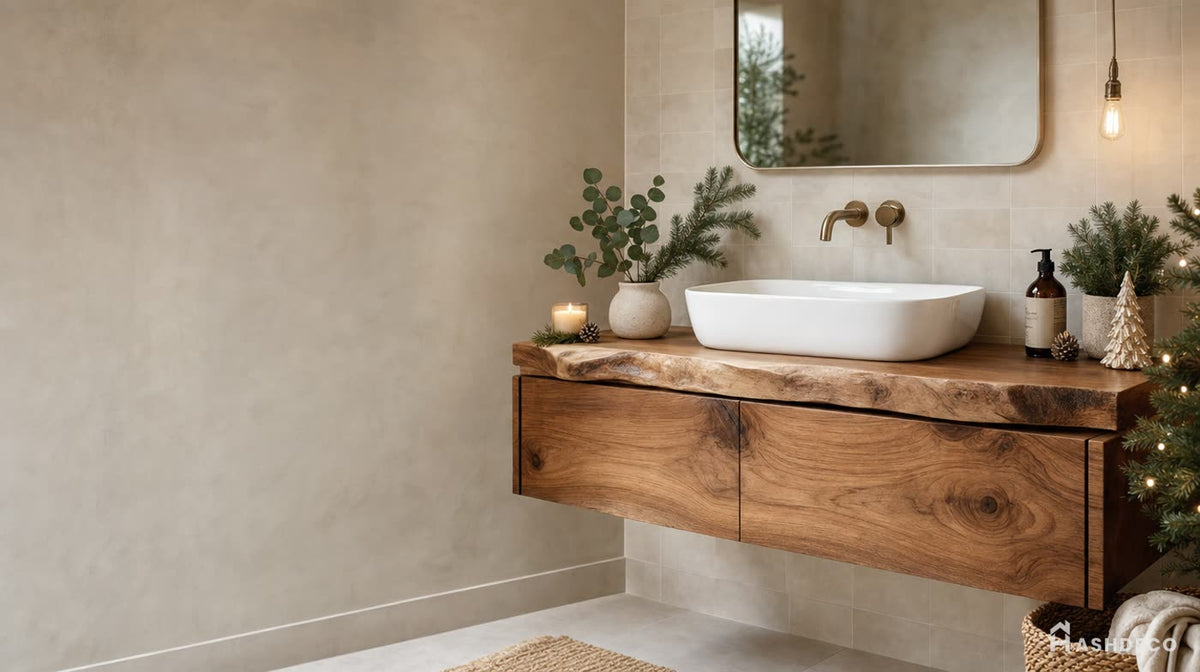
A floating vanity is a bathroom cabinet that mounts directly to the wall with no legs or base touching the floor. The gap underneath - usually 4 to 8 inches creates the "floating" look.
Most floating vanities use a French cleat or heavy-duty bracket system hidden behind the unit. The vanity hangs on metal rails screwed into wall studs, and the whole thing holds anywhere from 100 to 300 pounds depending on installation quality and wall construction.
They come in the same materials as traditional vanities: solid wood, plywood, MDF, engineered stone. The difference is entirely structural - everything hangs from the wall instead of sitting on the floor.
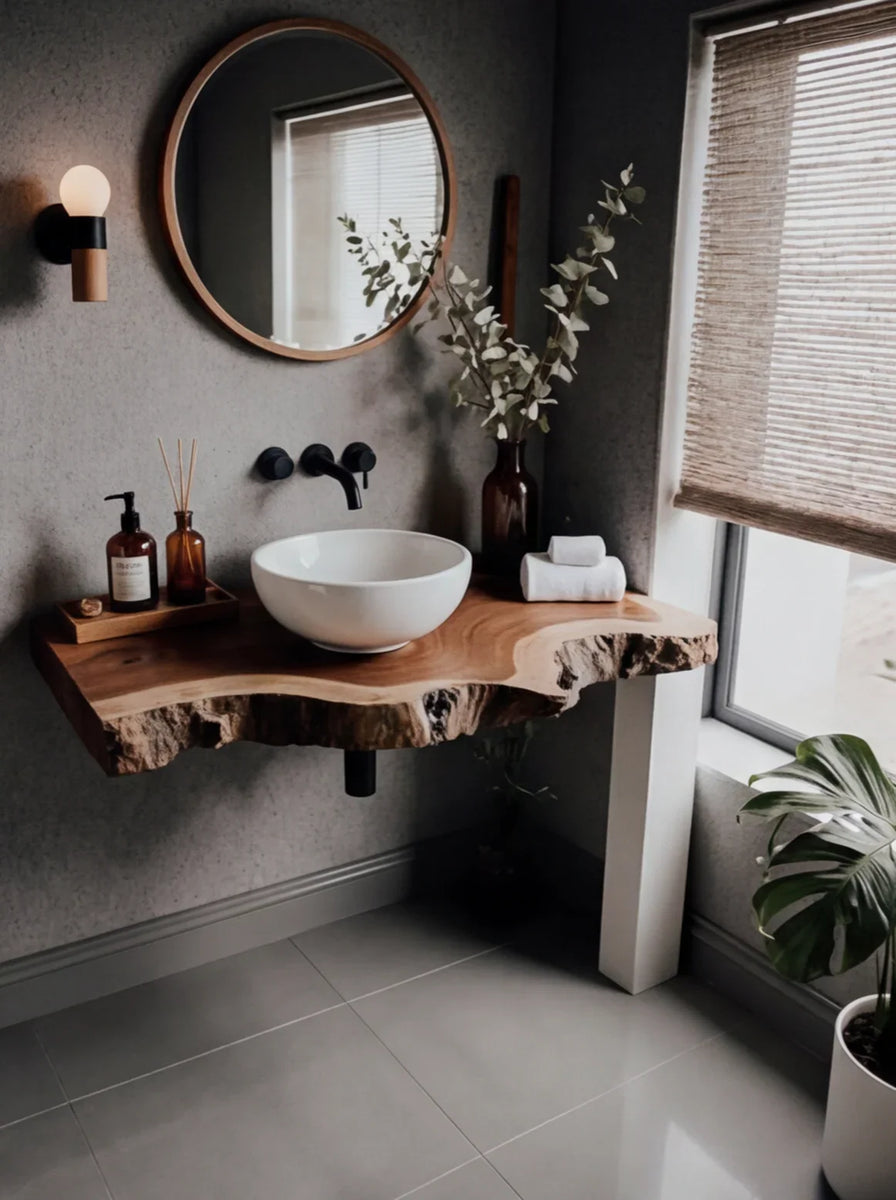
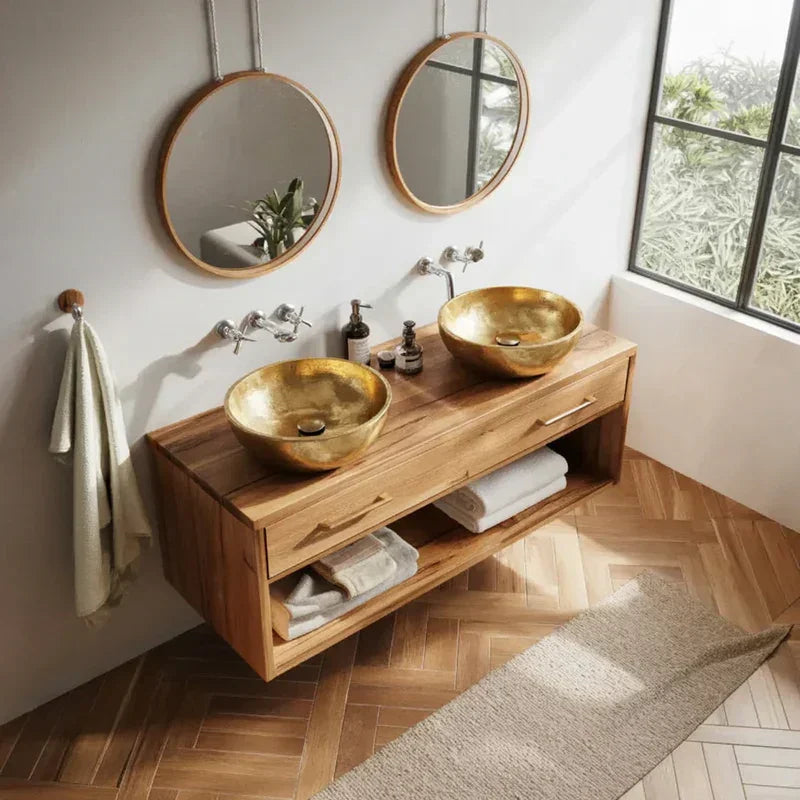
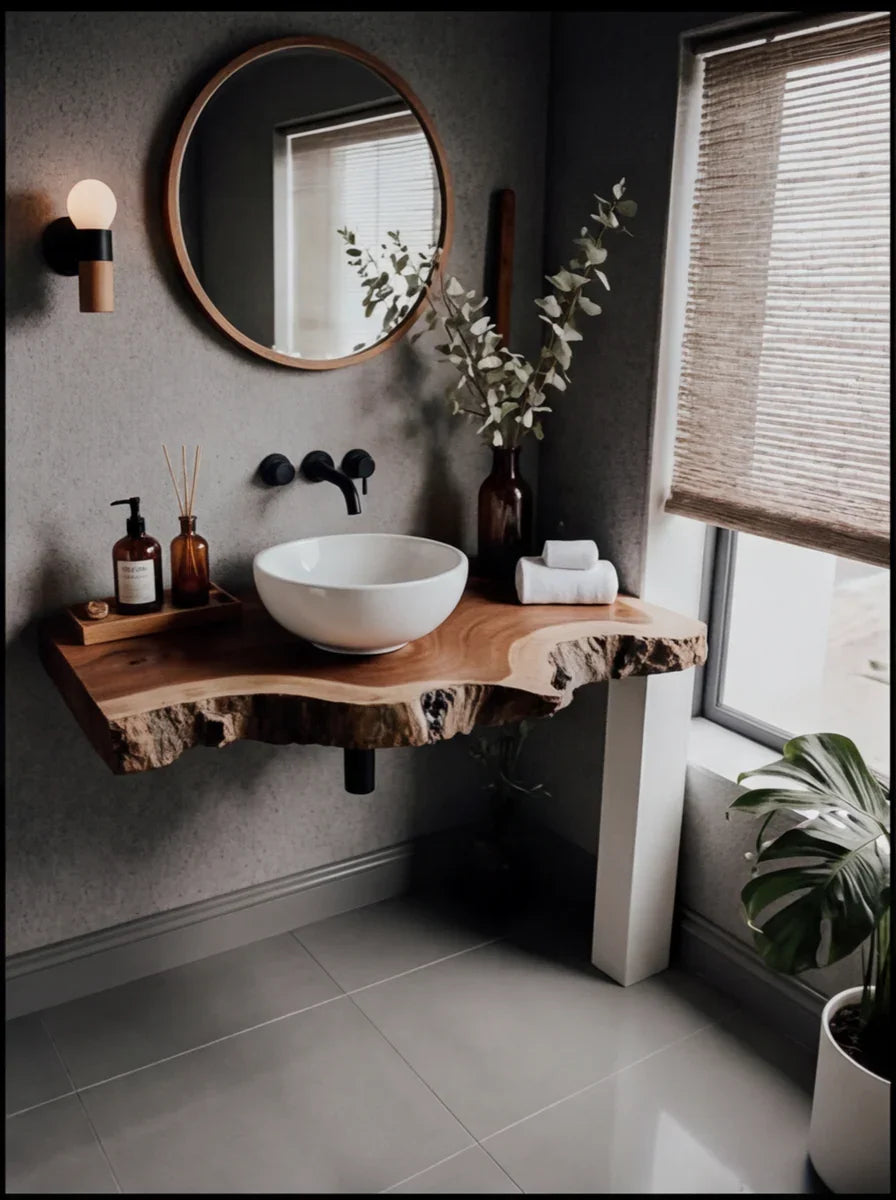
A handcrafted live edge floating vanity - the visible floor space underneath makes small bathrooms feel more open. View this vanity
Floating Vanity Height: What's Standard (and How to Choose Yours)
Height is the single most common question people have about floating vanities - and it's also the one thing a floating vanity lets you control that a traditional vanity doesn't. Since the unit mounts to the wall rather than sitting on the floor, you're not locked into a fixed height. Here's how to pick the right one.
| Height | Best For |
|---|---|
| 27-29 inches (to underside of vanity) | Wheelchair accessibility, knee clearance underneath |
| 32-36 inches (standard) | Most households - matches traditional vanity height |
| 36-38 inches | Taller household members, more comfortable standing posture |
The standard floating vanity height is 32-36 inches from the floor to the countertop, matching the height of a traditional vanity. This is the safest default if multiple people of different heights share the bathroom.
The floor-to-vanity gap - the visible "floating" space underneath - is typically 4-8 inches, regardless of where you mount the counter height. That gap is what creates the open, airy look and makes cleaning easier.
For wheelchair-accessible bathrooms, mount the vanity so the underside sits at least 27 inches from the floor, leaving open knee space beneath. For households with taller users, 36-38 inches feels more natural than the standard height. Because there's no fixed base, you can also lower a floating vanity for a kids' bathroom now and remount it later as they grow.


Floating vs Traditional Vanity: The Real Differences
Forget the surface-level "modern vs classic" comparisons. Here's what actually matters day-to-day:
| Feature | Floating Vanity | Traditional Vanity |
|---|---|---|
| Floor cleaning | Mop goes right under - no awkward corners | Dust and hair collect around the base |
| Storage | Typically 30-40% less cabinet space | More drawers, deeper storage |
| Installation | Must mount into studs or blocking - $200-600 labor | Sits on floor, simpler install |
| Height | Adjustable - mount at any height you want | Fixed at standard 32-36 inches |
| Weight capacity | Limited by wall strength (needs studs) | Sits on floor, no weight concern |
| Plumbing | Pipes often visible or need in-wall routing | Hidden behind the cabinet base |
| Best for | Small bathrooms, modern style, wheelchair access | Large bathrooms, heavy storage needs |
The storage gap is the biggest practical difference. If you have a family of four sharing one bathroom, a floating vanity with a single drawer probably won't cut it. But if you have a guest bathroom or a master bath with a separate linen closet, storage matters less.
5 Reasons People Love Floating Vanities
1. Small Bathrooms Feel Bigger
This is the number one reason floating vanities exist. A 5x8 foot bathroom with a traditional vanity feels cramped. Replace it with a floating model and the visible floor space underneath tricks your brain into perceiving a larger room.
The effect is real. Interior designers call it "visual weight reduction" - less furniture touching the ground means the room reads as more open.
2. Cleaning Is Actually Easier
Anyone who's tried to clean around the base of a traditional vanity knows the struggle. Hair, dust, and water collect in that impossible gap between cabinet and floor.
With a floating vanity, you run a mop straight underneath. No bending, no moving things, no mystery gunk behind the toilet brush holder you wedged in the corner.
3. You Control the Height
Standard vanity height is 32 to 36 inches. But "standard" doesn't mean comfortable for everyone. A floating vanity installs at whatever height works for you.
Tall household? Mount it at 38 inches. Wheelchair accessible bathroom? Drop it to 29 inches with knee clearance underneath. Kids' bathroom? Go lower now, move it later. This flexibility is something traditional vanities simply can't match.

Mount your floating vanity at exactly the height that works for your household. View this vanity
4. Undervanity Lighting Changes the Room
LED strip lights under a floating vanity create a soft glow that functions as both nightlight and ambient lighting. It's a small upgrade that makes a bathroom look like a high-end hotel.
The practical benefit: you can use the bathroom at 3 AM without turning on the overhead light and blinding yourself.
5. They Work With Any Style (Not Just Modern)
There's a misconception that floating vanities only suit sleek, minimalist bathrooms. That was true ten years ago. Now you can find floating vanities in live edge wood, reclaimed barn wood, driftwood, and farmhouse styles.
A solid wood floating vanity with visible wood grain and natural edges looks just as at home in a rustic cabin bathroom as a contemporary apartment. The mounting style is modern - the material and finish determine the actual vibe.
Don't miss
These pieces qualify for 10% off orders over $2,000. Applied automatically at checkout.
10% off
Sculpted Tree Trunk Solid Wood Bathroom Vanity with Integrated Circular Mirror Frame and Dual Drawers
From $3,276.00
10% off at checkout
10% off
Curved Arch Solid Wood Bathroom Vanity Freestanding Four Drawer Washstand
From $2,365.00
10% off at checkout
10% off
Sculptural Tree Trunk Solid Wood Bathroom Vanity Organic Live Edge Storage Console
From $2,154.00
10% off at checkout
10% off
Floating Live Edge Solid Wood Bathroom Vanity Wall Mounted Storage Cabinet
From $2,316.00
10% off at checkout
The Downsides Nobody Talks About
Limited Storage (The Big One)
A 36-inch traditional vanity might have two drawers, a cabinet, and a shelf. A 36-inch floating vanity typically has one shallow drawer, maybe two. You lose the under-cabinet storage entirely.
The fix: Pair your floating vanity with a wall-mounted medicine cabinet, a recessed niche in the shower, or a small freestanding shelf tower. Plan your storage before you buy, not after.
Installation Is Not a Weekend DIY Project
Floating vanities need to anchor into wall studs or solid blocking behind the drywall. If your studs don't line up with the vanity bracket holes, you need a contractor to add blocking - which means opening the wall, adding lumber, and patching it back up.
Budget $200-600 for professional installation on top of the vanity price. If your bathroom has a tile backsplash, add more for tile removal and repair.
Plumbing Can Get Complicated
Traditional vanities hide all the plumbing behind the cabinet. With a floating vanity, the drain pipe and supply lines are either visible underneath or need to be routed inside the wall.
In-wall plumbing looks cleaner but costs more ($300-800 for a plumber to reroute). Exposed plumbing works too - chrome or brushed brass P-traps can actually look intentional. Just make sure you decide before installation, not during.
Weight Limits Are Real
A solid wood floating vanity with a stone countertop and undermount sink can easily weigh 150-200 pounds. Add a full drawer of toiletries and you're pushing 250.
Your wall needs to handle all of that. Drywall alone holds almost nothing - you need 2x6 studs or dedicated blocking. If you have an older home with plaster walls, get a contractor to assess before committing.

How to Choose the Right Floating Vanity (Step by Step)
Step 1: Measure Your Space
Width matters most. Common floating vanity sizes:
- 24 inches: Powder rooms, half baths
- 30-36 inches: Standard single-sink bathrooms
- 48 inches: Larger bathrooms, his-and-hers setup
- 60-72 inches: Master bathrooms, double sink
Leave at least 4 inches of clearance on each side for comfortable use. And measure the depth - most floating vanities are 18-22 inches deep, but some live edge or organic designs run wider.
Step 2: Check Your Walls (Support Requirements)
Before you fall in love with a specific vanity, figure out what's behind your bathroom wall. This is the core support requirement for any floating vanity - the wall, not the bracket, is what determines whether it holds:
- Wood studs (most common): Standard mounting, straightforward
- Metal studs: Need special toggle bolts or additional blocking
- Concrete/brick: Need concrete anchors - very strong once installed
- Plaster over lath: May need blocking added behind
If you're not sure, a $20 stud finder from any hardware store will tell you what you're working with.
Step 3: Pick Your Material
This is where most buyers make their biggest mistake. Bathroom vanities live in the most humid room in your house. Material choice determines whether your vanity looks great in 10 years or falls apart in 2.
| Material | Durability in Bathrooms | Price Range | Maintenance |
|---|---|---|---|
| Solid hardwood (teak, walnut, acacia) | Excellent - naturally moisture resistant | $800-3,000 | Re-seal every 2-3 years |
| Plywood with veneer | Good - if edges are sealed | $300-1,200 | Watch for edge peeling |
| MDF / particle board | Poor - swells with humidity | $150-600 | Replace when it swells |
| Engineered stone top | Excellent - waterproof | $400-1,500 (top only) | Wipe clean |
Solid wood costs more upfront but lasts decades. MDF vanities from big retailers often look identical to wood for the first year - then the edges swell, the laminate peels, and you're shopping again.
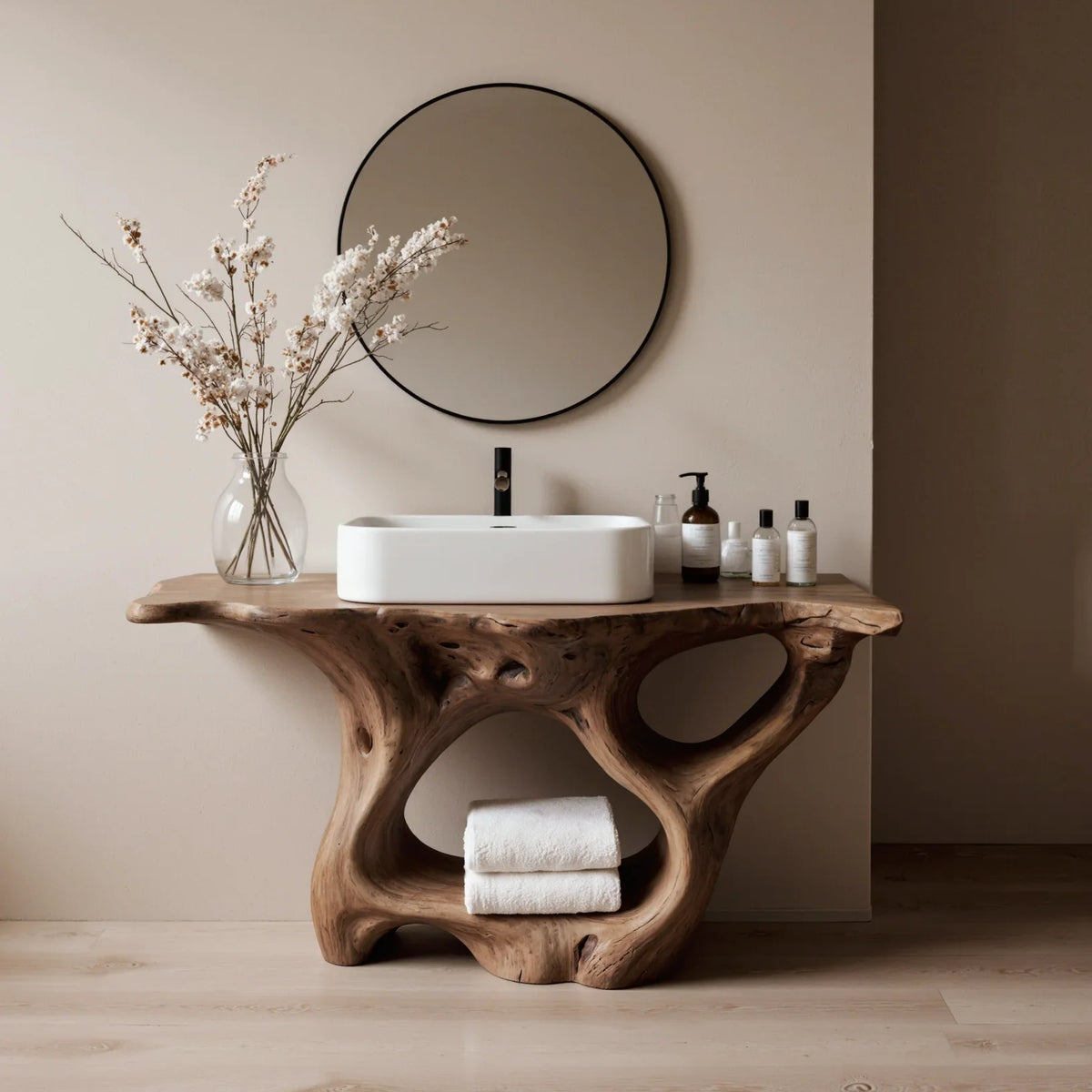
Solid hardwood resists bathroom humidity where MDF and particle board fail. Each Ashdeco vanity is handcrafted from a single piece of wood. View this vanity
Step 4: Decide on Sink Style
Your sink choice affects the countertop, plumbing, and overall look:
- Undermount sink: Clean look, water wipes directly into the sink, requires solid countertop material
- Vessel sink (sits on top): Bold statement piece, needs a shorter vanity to maintain comfortable height
- Integrated sink: Countertop and sink are one piece, easiest to clean, most expensive
For floating vanities, vessel sinks work particularly well because you can mount the vanity lower and let the vessel sink bring you to comfortable washing height.
Step 5: Plan Your Storage Strategy
Since floating vanities have less built-in storage, plan where everything goes:
- Toothbrushes, soap, daily items → vanity drawer or countertop tray
- Towels → wall hooks, towel bar, or a separate floating shelf
- Cleaning supplies → under-vanity basket (the open space is useful)
- Medications, first aid → wall-mounted medicine cabinet
- Backup supplies → linen closet or bedroom closet
Solid Wood vs MDF: Why It Matters More for Floating Vanities
Here's something that doesn't get discussed enough: material quality matters more for floating vanities than traditional ones.
A traditional vanity sits on the floor. If the bottom gets a little moisture damage, the structure still holds because the floor supports the weight. A floating vanity transfers all its weight through the mounting brackets into the wall. If the mounting area weakens from moisture absorption - which happens with MDF and particle board - the vanity can actually pull away from the wall.
Solid hardwoods like teak, walnut, and acacia don't have this problem. They resist moisture naturally and maintain structural integrity at the mounting points for decades. The wood grain also provides natural resistance to the micro-cracks that let humidity seep in.
At Ashdeco, every floating bathroom vanity is built from solid hardwood by Vietnamese artisans who hand-select and shape each piece. There's no MDF core, no veneer that peels, no particle board that swells. When you mount one of these to your wall, the wood itself is stronger than the brackets holding it.
Installation Cost Breakdown
Real numbers, because "it depends" isn't helpful:
| Component | DIY Cost | Professional Cost |
|---|---|---|
| Vanity unit | $300-3,000+ | Same |
| Wall blocking (if needed) | $50 materials | $150-300 |
| Mounting hardware | Included or $30-50 | Included in labor |
| Installation labor | $0 (your time) | $200-600 |
| Plumbing reroute (if needed) | Not recommended DIY | $300-800 |
| Tile repair (if needed) | $50-100 materials | $200-400 |
| Total range | $400-3,200 | $1,000-5,100 |
If your walls already have studs in the right spots and your plumbing lines up, installation can be straightforward - a confident DIYer with a drill and a level can do it in an afternoon. But if you need wall blocking or plumbing changes, hire a professional. A vanity that falls off the wall is not a fun insurance claim.
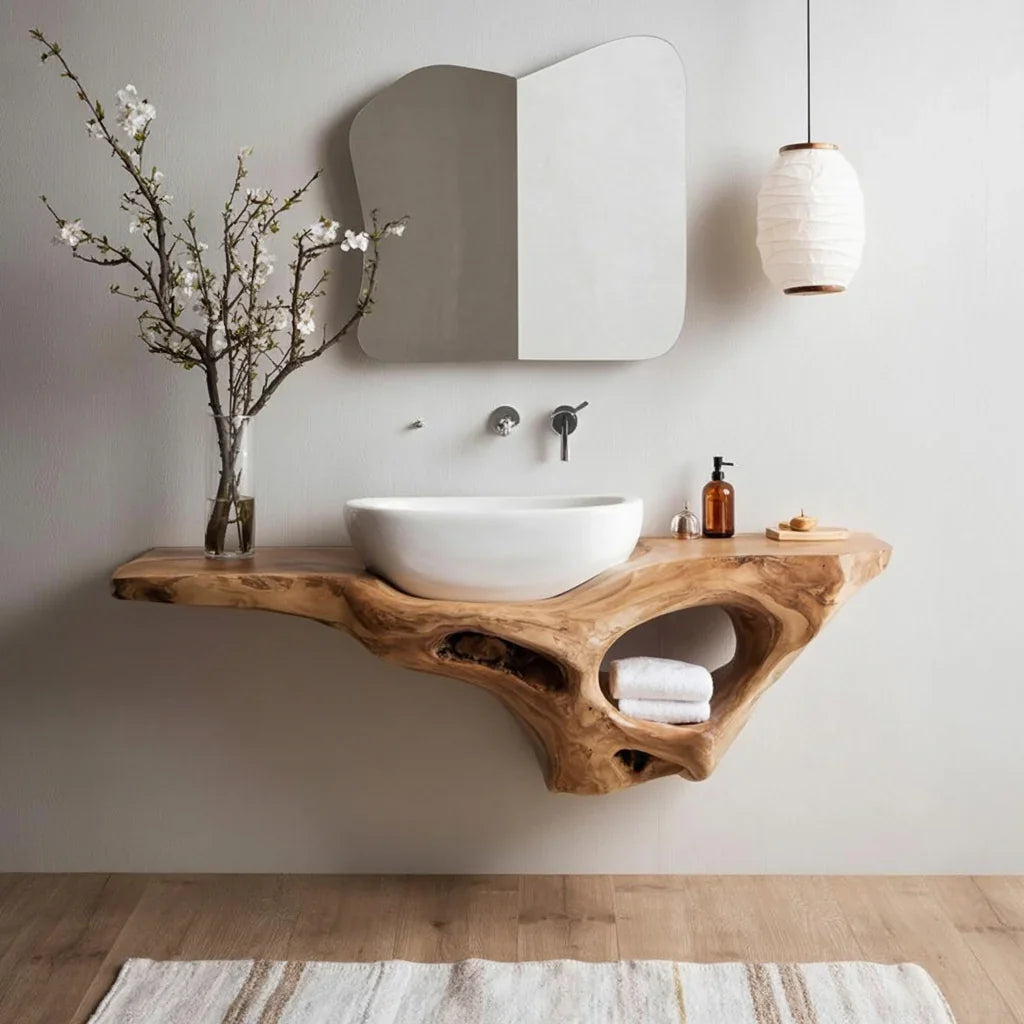
Professional installation ensures your solid wood vanity stays secure for decades. View this vanity
Frequently Asked Questions
How much weight can a floating bathroom vanity hold?
A properly installed floating vanity mounted into wood studs or concrete can hold 200-400 pounds. The limiting factor is usually the wall, not the vanity. Always install into at least two studs using lag bolts or a French cleat rated for the vanity weight plus 50% safety margin.
Are floating vanities good for small bathrooms?
Floating vanities are one of the best choices for small bathrooms. The visible floor space underneath makes the room feel larger, and you can mount the vanity at your ideal height instead of accepting the standard 32-36 inch fixed height of traditional models. For bathrooms under 40 square feet, a 24-30 inch floating vanity keeps the space functional without feeling cramped.
How high should a floating bathroom vanity be from the floor?
Most people mount floating vanities so the countertop sits 32-36 inches from the floor, matching standard vanity height. For taller users, 36-38 inches is more comfortable. For wheelchair accessibility, mount it so the bottom of the vanity is at least 27 inches from the floor with knee space underneath. The gap between the bottom of the vanity and the floor is typically 4-8 inches.
What is the standard height for a floating vanity?
The standard floating vanity height is 32-36 inches from the floor to the countertop - the same range used for traditional vanities. This works for most households. Adjust up to 36-38 inches for taller users, or down to around 27-29 inches for wheelchair accessibility.
Do floating vanities damage walls?
Properly installed floating vanities don't damage walls any more than heavy shelving or wall-mounted TVs. The key is mounting into studs or solid blocking - never drywall alone. If you ever remove the vanity, you'll have screw holes to patch, similar to removing any wall-mounted furniture. Using a French cleat system makes future removal cleaner.
Can I install a floating vanity on a plaster wall?
Yes, but plaster walls require more care. Use toggle bolts or add wood blocking behind the plaster for the strongest hold. Old plaster can crumble around screws, so spreading the load across a mounting rail or French cleat is safer than individual screws. Have a contractor assess your specific wall before committing.
Is solid wood or MDF better for a floating bathroom vanity?
Solid wood is significantly better for floating vanities. Because all the vanity's weight transfers through the mounting points, the material around those brackets must stay structurally sound despite constant bathroom humidity. MDF absorbs moisture over time, weakening at exactly the points that matter most. Solid hardwoods like teak, walnut, and acacia naturally resist moisture and maintain strength at mounting points for decades.