Best Wooden Coat Racks 2026 - Standing, Wall & Tree Options
Your entryway needs a coat rack that does more than hold jackets it needs one that anchors the room, handles real weight, and doesn't end up in a landfill in three years. The market in 2026 is flooded with flimsy metal tubes and particle-board stands disguised as "wood," and sorting the genuine from the junk takes work most buyers don't have time for. If you'd rather start with the fundamentals - types, sizing, cost - our Coat Rack Buying Guide 2026 covers that ground first.
This guide does that work. We compare every major type of wooden coat rack standing hall trees, wall-mounted boards, tree-shaped freestanding designs, bentwood classics, and over-door hooks with real dimensions, weight capacity data by material, hook-count recommendations by household size, and a height guide so your coats actually hang right. We also explain why solid wood coat racks outperform everything else long-term, and how Ashdeco's artisans hand-carve tree coat racks that work as both functional furniture and sculptural art.

Every Type of Coat Rack Compared: Which Design Fits Your Space?
A coat rack isn't one-size-fits-all. The right type depends on your entryway width, wall condition, how many people live in your home, and whether you rent or own. Here's a side-by-side comparison of the five main categories available in 2026, with honest pros and cons for each.
| Type | Floor Space | Capacity | Installation | Wall Damage | Best For | Price Range |
|---|---|---|---|---|---|---|
| Standing (Hall Tree) | 18-24" diameter | 30-60 lbs | None place and use | Zero | Foyers, open entries, renters | $60-$350 |
| Wall-Mounted Board | Zero | 40-80 lbs (stud-mounted) | Drill + stud anchoring | 2-4 screw holes | Narrow hallways, small apartments | $25-$180 |
| Tree-Shaped (Freestanding) | 20-28" branch spread | 40-60 lbs | None | Zero | Statement entryways, families | $120-$500+ |
| Bentwood | 16-22" diameter | 25-45 lbs | None | Zero | Classic interiors, lighter loads | $50-$250 |
| Over-Door | Zero | 10-18 lbs | Hook over door frame | Zero (may scratch door) | Dorms, temporary setups | $10-$40 |
The quick verdict: For permanent homes with space, a solid wood tree coat rack offers the best combination of capacity, aesthetics, and zero installation. For tight hallways, a wall-mounted board maximizes capacity without stealing floor space. For rentals, any freestanding option avoids wall damage entirely - see our coat rack for renters guide for more on that.
A few notes on the table above. The over-door category exists as a stopgap it handles light loads in dorm rooms, guest bedrooms, and bathrooms, but it's not a real entryway solution. The weight limit (10-18 lbs) means one heavy coat and a bag is already pushing it. Over-door hooks also stress the door hinges over time, causing alignment issues that make the door stick or fail to latch properly.
The sweet spot for most households is the middle three options: standing, wall-mounted, or tree-shaped. Your entryway dimensions and living situation narrow the choice to one or two options quickly the sections below give you the specifics for each. For our hands-on ranking of specific standing models, see Best Standing Coat Racks 2026.

Natural Driftwood Coat Rack – Handcrafted Tree Branch Standing Hanger for Entryway or Bedroom

Custom Wood Coat Rack – Driftwood Wall Mount Clothes Rack with Unique Hooks
Standing Coat Racks (Hall Trees): The Classic Workhorse
A standing coat rack sometimes called a hall tree when it includes a seat or shelf is the most versatile option for homes with adequate entryway space. It requires zero installation, moves freely for cleaning or rearranging, and causes no wall damage. Standard heights range from 60 to 72 inches with base diameters between 18 and 24 inches.
What to Look for in a Standing Coat Rack
Three factors separate a standing coat rack that lasts from one that tips over within a month:
Base weight and diameter. The base should weigh at least 8 lbs and spread to a minimum of 40% of the rack's total height. A 72-inch rack needs a base that spans at least 29 inches. Solid wood bases inherently provide this weight a hardwood disc base weighs 8-15 lbs. Metal tube bases typically weigh 3-6 lbs, which is why budget metal racks tip so easily. We break this exact 40% rule down by household size - including kid-safety adjustments - in our family coat rack guide.
Hook construction. Hooks carved from the same piece of wood (integral hooks) hold 8-12 lbs each and never loosen. Screw-attached hooks hold 4-7 lbs initially but the screw holes enlarge over time, leading to wobble and eventually failure. If you can see a screw head where the hook meets the post, expect it to loosen within a year of daily use.
Material density. Hardwoods like acacia (1,750 Janka), white oak (1,360 Janka), and walnut (1,010 Janka) absorb impact and resist denting. Softwoods like pine (380-690 Janka) dent from belt buckles, zipper pulls, and keys within weeks.
Standing Coat Rack Sizing by Ceiling Height
Match your rack height to your ceiling for proportional aesthetics:
- 8-foot ceilings: 60-66 inch rack. Leaves 30-36 inches of visual breathing room above.
- 9-foot ceilings: 66-72 inch rack. Taller racks look balanced here.
- 10+ foot ceilings: 72-84 inch rack. Short racks look lost in tall rooms go big.
One detail often overlooked: the shape of the hooks themselves. Straight pegs let items slide off easily especially silky scarf fabric and bags with thin straps. Curved or upturned hook tips hold items securely without requiring a bulky knob. The best standing racks feature hooks with a 1.5-2 inch upward curve at the tip, which creates a natural cradle for coat collars and bag handles.
Browse the full range of standing coat racks and hangers at Ashdeco to find proportions that match your entryway.

Rustic Tree Branch Coat Rack – Solid Wood Standing Hanger for Home Decor
Wall-Mounted Coat Racks: Maximum Capacity, Minimum Footprint
A wall-mounted coat rack uses exactly zero square inches of floor space, making it the undisputed winner for narrow hallways and small apartments - see our wall-mounted coat rack ideas for small spaces for layout-specific picks. When anchored into wall studs (standard 16-inch spacing in US homes), a wall-mounted wooden board holds 50-80 lbs more than most standing racks.
Mounting Height: The 5'6" Rule
The standard mounting height for adult coat hooks is 60-66 inches from the floor, measured to the center of the hook. This height is calibrated for the average American adult (5'4" to 6'0" tall) and ensures that a standard 42-inch coat hangs with 18 inches of floor clearance.
Adjust for your household:
- Adults only (5'4"-6'0"): Mount hooks at 60-65 inches.
- Tall household (6'0"+): Mount hooks at 65-70 inches.
- Kids' hooks (ages 5-11): Add a second lower row at 36-42 inches.
- ADA accessible: Maximum 48 inches per ADA Standards §603.4.
For a more detailed breakdown by room and user type, see our complete coat hook height guide it covers entryways, mudrooms, bedrooms, and commercial spaces.
The Wall Damage Reality Check
Wall-mounted racks require drilling into studs, which leaves 3/16-inch screw holes. Most standard leases allow small picture-hanging nail holes but explicitly prohibit larger wall modifications. If you're renting, check your lease before drilling those holes will need patching with spackle and touch-up paint at move-out.
Drywall-only mounting is a bad idea. Drywall anchors hold 15-25 lbs each in theory, but the dynamic loading of grabbing and pulling coats reduces effective capacity to 20-35 lbs total. One guest hanging a wet overcoat can exceed that limit. Always hit studs.
Stud-finding tip: Standard US construction places wall studs 16 inches on center. Find one stud with a magnet (it sticks to the drywall screws beneath the surface), then measure 16 inches in each direction to locate adjacent studs. For maximum holding power, anchor your rack into at least two studs this distributes the load and prevents the board from pivoting when heavy coats are pulled off one end.
Best Wall-Mounted Rack Styles
Wall-mounted coat racks come in three main configurations:
- Horizontal board with hooks: A solid plank (typically 24-48 inches long) with hooks screwed or integrated along its length. The most common and most versatile design. Look for boards at least 3/4 inch thick thinner boards flex under load.
- Individual wall hooks: Separate hooks mounted independently at custom spacing. Offers the most flexibility in layout but requires multiple sets of screw holes. Best for decorative entryways where you want hooks at varying heights.
- Wall-mounted tree silhouette: A flat tree shape cut from thick hardwood, with branch tips serving as hooks. Combines the floor-space savings of wall mounting with the organic aesthetic of a tree coat rack. These are harder to find in solid wood most are MDF laser-cut reproductions.

Tree Coat Racks: Where Function Meets Sculpture
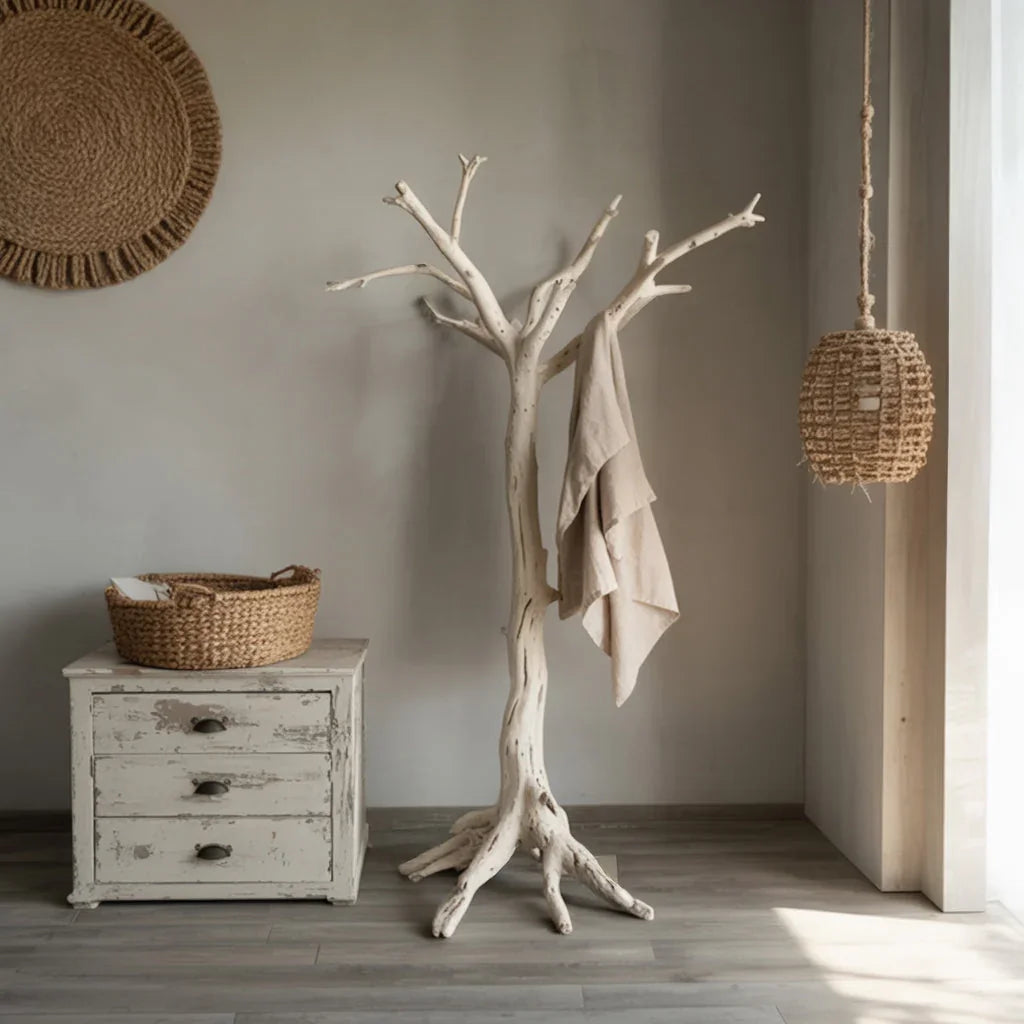
A tree coat rack is the most visually striking option on the market and when hand-carved from solid wood, it's also one of the strongest. Shaped like a bare tree with branches fanning out at multiple heights, these racks hold coats, bags, hats, and scarves while functioning as standalone entryway art. No other coat rack style generates as many compliments from guests.
Why the Tree Shape Actually Works Better
The tree form isn't just decorative. It solves three practical problems that conventional racks can't:
Natural height variation. Branches extend at different levels, so a full-length overcoat hangs freely on a lower branch while a scarf sits on a higher one. Linear hook strips force everything to the same height, which means long coats bunch at the floor.
360-degree access. A freestanding tree rack lets you approach from any direction. Wall-mounted racks require facing the wall every time awkward in narrow entries when you're juggling grocery bags.
Load distribution. Branches radiating outward distribute weight across multiple angles, lowering the center of gravity when items are spread around the trunk. This is the same physics that keeps actual trees standing in wind and it's why a well-designed tree coat rack resists tipping better than a straight-post design with uniform hooks.
Tree Coat Rack vs. Regular Standing Rack
| Feature | Tree Coat Rack | Regular Standing Rack |
|---|---|---|
| Hook heights | Multiple levels (branches at 40-68") | Single level (all hooks at same height) |
| Access | 360 degrees | 360 degrees |
| Capacity | 8-15 items / 40-60 lbs | 6-10 items / 25-50 lbs |
| Aesthetic | Sculptural, organic | Utilitarian, simple |
| Kid-friendly | Yes low branches for small hands | Usually no hooks are all at adult height |
| Price | $120-$500+ (solid wood) | $40-$200 |
The price premium for a tree-shaped rack reflects the handwork involved. A straight-post rack can be lathed from a single dowel in 20 minutes. A hand-carved tree rack takes 8-12 hours of skilled carving across 3-4 days. The structural and visual difference is immediately obvious.

Branch Coat Racks and Bentwood Designs: Two Classic Alternatives
Not every wooden coat rack follows the standing post or wall-mount template. Two historically significant designs the branch coat rack and the bentwood coat rack offer distinct aesthetics worth considering if the tree shape isn't your style.
Branch Coat Racks
A branch coat rack uses actual tree branches (or hand-carved replicas) mounted horizontally on a wall or vertically as a freestanding piece. The appeal is raw, organic beauty twisted forms, natural bark, and unpredictable curves that make each piece unique.
The practical concern is consistency. Real branches vary wildly in strength. A branch with hidden internal rot can snap under a 3-lb jacket. Branches that have been kiln-dried, bark-stripped, and sealed are significantly more reliable than raw, untreated branches. Our artisans at Ashdeco solve this by hand-carving branch forms from solid planks giving you the organic visual of natural branches with the structural reliability of properly selected hardwood.
Bentwood Coat Racks
The bentwood coat rack originated with Thonet's iconic No. 1 design in the 1850s steam-bent beech wood curved into an elegant standing form. The bentwood technique produces graceful curves that machined or carved designs can't replicate exactly.
Classic bentwood racks use beech (1,300 Janka hardness), which bends well when steamed and holds its shape permanently once dried. The typical bentwood design features a central pole with 6-8 curved hooks radiating from the top and a four-legged base.
Modern reproductions of bentwood designs are everywhere, but quality varies wildly. Authentic bentwood uses solid steam-bent beech or ash the continuous grain follows the curve, providing strength through the bend. Cheap copies use laminated strips or even molded plastic shaped to look like bentwood. The tell: flex a hook gently. Genuine bentwood has a slight natural spring. Laminated or plastic copies feel rigid or spongy, respectively.
The Thonet-style bentwood coat rack remains one of the most recognizable furniture designs in history, and quality originals from the early 20th century sell for hundreds at antiques markets. Modern solid beech reproductions start around $80 and deliver the same elegant form factor, though they sacrifice the patina and provenance of true vintage pieces.
Weight capacity: Traditional bentwood racks hold 25-45 lbs total. The curved hooks are thinner than carved branches, which limits per-hook capacity to 4-6 lbs. Fine for light jackets and hats, but heavy winter parkas can stress the bent joints over time. For heavy-duty use, a solid wood tree rack with integral branches outperforms bentwood by 30-50% in load capacity.

Weight Capacity by Material: The Numbers That Actually Matter
Every coat rack listing claims "sturdy" or "heavy-duty." These words mean nothing without data. Here's what different materials actually hold when tested as freestanding units on a flat floor, loaded incrementally until instability occurs - the same methodology we used in our dedicated Coat Rack Weight Test.
| Material | Typical Total Capacity | Per-Hook Capacity | Failure Mode | Recoverable? |
|---|---|---|---|---|
| Solid hardwood (acacia, oak, walnut) | 40-60 lbs | 8-12 lbs (integral hooks) | Base lifts on one side | Yes reposition and rebalance |
| Solid softwood (pine, rubberwood) | 25-40 lbs | 5-8 lbs | Hook bends or grain splits | Sometimes depends on damage |
| Bentwood (steamed beech) | 25-45 lbs | 4-6 lbs | Bent joint separates | Repairable with glue + clamp |
| Metal tube (hollow steel) | 15-25 lbs | 3-5 lbs | Weld joint bends permanently | No permanent deformation |
| Plastic / resin | 5-10 lbs | 1-3 lbs | Hook snaps, base cracks | No unrepairable |
Why Solid Wood Outperforms Metal
This surprises most people. How does wood beat metal?
The answer is structural, not about raw material strength. Solid wood has a fibrous grain structure where thousands of parallel fibers share the load. When you hang a 10-lb coat on a wooden hook, the force distributes across the entire grain pathway from hook tip to base. No single point bears the full stress.
Metal tube coat racks concentrate all stress at welded joints the junction between hook and pole. The tube itself is strong, but the weld is a single-point failure. When that weld gives, it bends permanently and the rack is ruined. According to the USDA Forest Products Laboratory, solid wood's compressive strength parallel to grain ranges from 4,000-8,000 psi depending on species comparable to mild steel on a per-weight basis, but without the single-point failure risk.
Real-World Weight Translation
What does "40-60 lbs capacity" actually mean in coats and bags? Here's the math for common items:
- Light jacket (denim, windbreaker): 1.5-2.5 lbs
- Heavy winter parka: 3-5 lbs
- Wool overcoat: 4-6 lbs
- Rain jacket: 1-1.5 lbs
- Loaded backpack: 8-15 lbs
- Loaded tote bag: 5-10 lbs
- Umbrella: 0.5-1 lb
- Scarf or hat: 0.25-0.5 lb
A solid wood coat rack at 45 lbs capacity comfortably holds: 4 winter parkas (16 lbs) + 2 loaded backpacks (20 lbs) + 2 scarves (1 lb) = 37 lbs with headroom to spare. A metal tube rack at 20 lbs? Two parkas and one backpack, and you're at the limit. For a family of four, only solid wood consistently meets real-world demands.
Hook Position Matters More Than Total Capacity
Where you hang items on the rack affects stability as much as total weight. Heavy items placed on the highest hooks create maximum leverage like holding a bowling ball at arm's length versus close to your chest. The practical rules:
- Heaviest items (parkas, backpacks): Hang on the lowest available hooks. This keeps the center of gravity low and maximizes tipping resistance.
- Medium items (jackets, tote bags): Middle hooks. The sweet spot for both access and stability.
- Lightest items (scarves, hats, umbrellas): Top hooks. Minimal leverage, easy to reach on the way out.
Following this order increases effective capacity by 15-20% compared to random hook placement. It also means the rack looks naturally balanced heavy at the bottom, light at the top which mimics how actual trees distribute weight.

How Many Hooks Do You Actually Need? A Household Size Guide
Most people underestimate how many hooks they need. The standard formula is simple but effective: count daily users, multiply by the items each person typically hangs, then add 50% for guests. For the full math and kid-safety notes by household size, see our family coat rack guide.
| Household Size | Daily Items | Guest Buffer (+50%) | Minimum Hooks | Recommended Rack Type |
|---|---|---|---|---|
| 1 person | 2-3 items | 3-5 total | 5-6 hooks | Wall-mounted board or small standing rack |
| 2 people | 4-6 items | 6-9 total | 8-10 hooks | Medium standing rack or tree coat rack |
| 3-4 people (family) | 8-12 items | 12-18 total | 12-15 hooks | Large tree coat rack or dual rack setup |
| 5+ people | 12-18 items | 18-27 total | 18+ hooks | Multiple racks or wall-mounted system + standing |
Items per Person: What Most Guides Miss
The "coat rack" name is misleading nobody hangs just coats. A realistic per-person count in cold climates includes: one coat or jacket, one bag or backpack, one scarf or hat, and sometimes an umbrella. That's 3-4 hooks per person minimum, not the one hook that marketers assume.
In warm climates, the per-person count drops to 1-2 items (light jacket, bag). Adjust accordingly but always keep the 50% guest buffer. Nothing exposes an under-equipped entryway faster than three dinner guests arriving simultaneously with nowhere to hang their coats.
Why Tree Coat Racks Excel for Families
Families with children benefit most from a tree coat rack's staggered branch heights. Adults use upper branches (58-68 inches), while kids reach lower branches (36-48 inches) independently no stepping stools, no parent assistance. This encourages kids to hang up their own coats, which is one of those small parenting wins that adds up.
Explore Ashdeco's tree coat rack collection to see designs with naturally staggered branches built for multi-generational households.
Seasonal Rotation Strategy
In homes with distinct seasons, your coat rack load changes dramatically between July and January. A strategic rotation prevents overloading in winter and underutilization in summer:
- Winter: Coat rack handles heavy daily jackets, scarves, and hats. Store off-season items in closets. This is when the rack works hardest if it can handle your peak winter load comfortably, it's the right rack.
- Spring/Fall: Light jackets, umbrellas, and transitional layers. This is the rack's sweet spot moderate load, easy access.
- Summer: The rack may hold only sunhats, light bags, and a rain jacket. Some households repurpose extra hooks for bags, dog leashes, or plant hangers during warm months. A beautiful wooden tree rack looks good even nearly empty it works as sculptural decor year-round.

Coat Hook Height Guide: Getting the Measurements Right
Whether you're choosing a standing rack or mounting hooks on a wall, the height of your hooks determines whether coats hang properly or drag on the floor. The magic number for most homes is 60-66 inches from the floor to the hook center here's why that range works, and when to deviate.
The Standard 5'6" Hook Height Explained
The 60-66 inch standard (roughly 5'0" to 5'6" above the floor) is calculated backward from coat length. A standard adult coat measures 38-44 inches from collar to hem. Hung from a hook at 62 inches, the coat's bottom edge sits at 18-24 inches above the floor well clear of shoes, baseboards, and door swings.
The test: Have the tallest daily user stand at the rack and reach to a comfortable, relaxed position (not stretched overhead). Mark that point. Then verify the shortest daily user can still reach it without tiptoeing. For most mixed-height households, 62 inches is the sweet spot.
Adjusting by Room and Situation
- Entryway (adults only): 60-66 inches. Standard range.
- Mudroom (family): Two rows adult hooks at 60-64 inches, kid hooks at 36-42 inches.
- Bedroom closet area: 64-68 inches. Slightly higher because bedroom items (robes, lightweight jackets) are shorter.
- Accessible spaces: Maximum 48 inches per ADA Standards §603.4.
Standing Racks: Height Is Already Decided
One advantage of freestanding racks: the manufacturer already optimized hook height. Most quality standing racks place their highest hooks at 62-68 inches and lowest hooks at 40-50 inches. You just set it on the floor and everything is pre-positioned. This eliminates the measuring, leveling, and drilling that wall mounting requires and the risk of getting it wrong.
For tree-shaped racks specifically, the branch heights aren't arbitrary they're determined by the wood's grain direction and the artisan's design judgment. The result is a naturally staggered arrangement where adults instinctively reach for upper branches and children gravitate toward lower ones. This organic height distribution is something straight-post racks with uniform hook placement can't replicate.

Freestanding vs. Wall-Mounted: The Wall Damage Comparison
If you own your home, wall damage from mounting a coat rack is a minor concern a few screw holes, easily patched if you redecorate. If you rent, those same holes can cost you part of your security deposit. Here's the full picture.
Wall-Mounted Damage Profile
A typical wall-mounted coat rack requires 2-4 screws (#10 or #12 wood screws) driven into wall studs. Each screw leaves a 3/16-inch hole. Removing the rack later means patching with spackle, sanding, and touch-up painting. Total repair cost: $5-$10 in materials and 15 minutes of labor.
The risk escalates if you miss the studs. Drywall anchor failures pull out chunks of drywall, leaving ragged holes 1-2 inches across that require a drywall patch kit ($8-$15) and visible repair work. This is the most common cause of security deposit deductions related to wall-mounted furniture.
Freestanding Damage Profile
A standing coat rack touches only the floor. With adhesive felt pads on the base (replace every 6-12 months), damage to hardwood, laminate, or tile is effectively zero. Without felt pads, wood-on-wood contact can leave scuff marks over time, and rubber feet can leave black marks on light flooring.
The hidden risk: A tipping coat rack can scratch walls, dent baseboards, or crack floor tiles on impact. This is exclusively a problem with lightweight, top-heavy racks. A solid wood rack with a properly weighted base (8-15 lbs of base weight, 40%+ base-to-height ratio) doesn't tip under normal use including the accidental bump from a toddler or dog.
The Verdict by Living Situation
- Renters: Freestanding, period. Zero wall modifications, zero deposit risk. A tree coat rack gives you maximum hooks without touching a wall.
- Homeowners with narrow hallways: Wall-mounted saves critical floor space. The screw holes are trivially repairable.
- Homeowners with open foyers: Either works. A freestanding tree rack makes a stronger design statement.

Why Solid Wood Coat Racks Are the Best Long-Term Investment
Solid wood coat racks cost more upfront than metal tube or particle-board alternatives but they're the only option that genuinely lasts 10-30 years without structural failure, finish degradation, or aesthetic decline. Here's the cost-per-year math that proves it.
The Cost-Per-Year Calculation
| Material | Average Price | Expected Lifespan | Cost Per Year |
|---|---|---|---|
| Solid hardwood (oak, acacia, walnut) | $180-$400 | 15-30+ years | $6-$27/year |
| Bentwood (steamed beech) | $80-$250 | 10-20 years | $8-$25/year |
| Metal tube (hollow steel) | $30-$80 | 2-5 years | $6-$40/year |
| MDF / particle board | $25-$60 | 1-3 years | $8-$60/year |
| Plastic / resin | $10-$30 | 1-2 years | $5-$30/year |
At the low end, cheap plastic and MDF racks seem like bargains. But replace them two or three times and you've spent the same amount as a single solid wood rack plus the accumulated landfill waste. A hardwood coat rack bought in 2026 will still be holding coats in 2046. A $30 metal tube rack will be at the curb by 2028.
What "Solid Wood" Actually Means (and What It Doesn't)
The term "wood" in product listings is deliberately vague. Here's how to decode it:
- Solid wood / solid hardwood: The entire piece is cut from real timber. This is what you want.
- Engineered wood: Layers of real wood veneer over a plywood or MDF core. Stronger than particle board, but the veneer can chip and can't be refinished.
- Wood composite / MDF: Sawdust and resin pressed into shape. Zero grain, swells when exposed to moisture, and crumbles at stress points. This is what most sub-$50 "wooden" coat racks actually are.
- "Wood finish" / "wood-look": Plastic or metal with a printed wood-grain film. Not wood in any meaningful sense.
When Ashdeco says "solid wood," we mean it literally. Every coat rack is hand-carved from solid planks of acacia or teak no veneer, no filler, no composite core. The grain runs continuously through each branch, which is what gives them their 40-60 lb weight capacity.
The Sustainability Angle
Buying a solid wood coat rack isn't just a durability decision it's an environmental one. A single hardwood coat rack that lasts 20 years replaces 4-7 cheap racks that each spend 2-5 years in your home before ending up in a landfill. MDF and particle board can't be recycled or composted they contain formaldehyde-based resins that classify them as non-recyclable waste in most municipalities.
Solid wood, by contrast, is biodegradable, recyclable, and often repurposable. A well-made wooden coat rack can be refinished, repaired, gifted, or resold. When it eventually does reach end of life (decades from now), it breaks down naturally. The carbon stored in the wood during the tree's growth remains sequestered for the entire service life of the piece which is the opposite of what happens when you cycle through disposable furniture every few years.
Ashdeco sources acacia from managed plantations in Vietnam where trees are replanted on harvest cycles. The wood is processed locally by the same artisans who carve the final products, minimizing transportation waste between harvest, milling, and workshop.

How Ashdeco Artisans Hand-Carve Tree Coat Racks
Every Ashdeco tree coat rack starts as a rough plank of solid hardwood and ends as a functional sculpture. The process takes 8-12 hours of skilled handwork spread across 3-4 days, and it's the reason our racks hold more weight, look more natural, and last longer than anything produced by a factory or CNC machine.
The 8-Step Workshop Process
- Wood selection (30-60 min): Each plank is hand-evaluated for grain direction, knot placement, moisture content, and species character. Approximately 30% of planks are rejected for hidden cracks, excess sapwood, or grain that won't align with branch angles.
- Layout (1-2 hrs): The tree design is drawn directly onto the wood with pencil, adjusting branch positions to work with the grain. No two layouts are identical because no two planks have identical grain patterns.
- Rough carving (3-4 hrs): Large gouges and a mallet shape the trunk, branch junctions, and individual branches. Branch junctions are left at least 2 inches thick for structural integrity the same graduated thickness that keeps real tree branches from breaking.
- Drying (12-24 hrs, passive): The piece rests in a climate-controlled workshop (65-75°F, 45-55% humidity) to equalize moisture. Skipping this step causes cracks months after delivery which is exactly what factory-speed production does.
- Detail carving (3-4 hrs): Small gouges and V-tools create bark texture, define branch taper, and shape the natural curves. Bark texture is carved freehand no template, no stencil.
- Progressive sanding (1.5-2 hrs): Four grits (80, 120, 220, 400) with a grain-raising step between final passes. Branch hooks are sanded to 400 grit for a silky feel; bark areas stay at 120 grit for texture contrast.
- Oil finishing (1 hr active + overnight dry): Tung oil or Danish oil penetrates the wood fibers rather than sitting on top. Two coats produce a satin sheen that's repairable unlike polyurethane, which requires full stripping when scratched.
- Assembly and quality check (30-60 min): Modular sections connect via 1-inch hardwood dowels. Every piece is inspected against a checklist: branch hook radius, bark consistency, finish evenness, and level standing.
This process produces a custom coat rack in the truest sense adapted to the wood's individual grain, carved by a single artisan's hands, and inspected before it ships. No CNC machine reads the grain. No factory line adjusts branch angles to follow a knot. This is what separates handcrafted from manufactured.
See the finished results in Ashdeco's tree hanger collection each piece reflects this exact process.

Entryway Styling With a Wooden Coat Rack
A wooden coat rack especially a tree-shaped one is a natural focal point. Style around it rather than competing with it. These three entryway configurations work consistently across different home styles and room sizes.
The Minimalist Entry
Tree coat rack + narrow console table (under 12 inches deep) + single potted plant. Place a catchall tray on the console for keys and wallets. White walls, natural wood tones, nothing else. This works in entryways as small as 4 × 3 feet because the rack is the only vertical element and the console hugs the wall.
The Family Mudroom
Tree coat rack at the end of a storage bench with cubbies underneath for shoes. Add a shelf above for baskets. Every item has a designated spot: coats on the rack, shoes in cubbies, hats and gloves in baskets. The tree rack adds organic texture to what would otherwise be a purely utilitarian space.
Pair the rack with an Ashdeco shoe bench or entryway organizer for a complete drop zone that handles everything from school backpacks to winter boots.
The Statement Foyer
For larger entryways (6+ feet wide), let the tree coat rack stand alone with nothing competing within 3 feet. A dramatic rack in dark walnut or rich acacia against a light wall becomes gallery-level art. Add a floor-level puck light to cast branch shadows on the wall a trick borrowed from gallery lighting that transforms a functional piece into a conversation starter.
Material and Color Coordination
Match the wood tone of your coat rack to one other element in the entryway the door frame, a bench, or a mirror frame. This creates visual cohesion without being matchy-matchy. Acacia's warm amber tones pair with mid-century and bohemian interiors. Walnut's deep brown suits traditional and transitional spaces. Light oak or maple works in Scandinavian and coastal entryways.
Beyond the Entryway: Other Rooms That Benefit From a Coat Rack
Coat racks aren't just for entryways. A well-placed wooden rack works in several rooms people rarely consider:
- Bedroom corner: Hold robes, tomorrow's outfit, bags, and scarves. A tree coat rack in the corner eliminates the "chair pile" problem where clothes accumulate on the nearest surface.
- Home office: Hang a jacket, headphones, bag, and hat near the desk. Keeps the workspace clean and items accessible.
- Kids' room: A lower tree rack (48-54 inches) teaches children to hang up their own things. The tree shape makes it feel playful rather than chore-like.
- Bathroom: A wall-mounted rack holds robes and towels. Use a moisture-resistant species like teak or oil-finished acacia to handle humidity.
Driftwood Tree Branch Coat Rack – Standing Solid Wood Clothes Rack with Shelves
Maintenance: Keeping a Wooden Coat Rack Looking New
Solid wood coat racks require remarkably little maintenance compared to metal (which scratches, chips, and rusts) or painted finishes (which peel and yellow). A few minutes per month keeps a hardwood rack looking sharp for decades.
Weekly and Monthly Care
- Dust weekly with a dry microfiber cloth. Tree-shaped racks collect dust in branch crevices and bark texture grooves hit these with a soft brush attachment on your vacuum if microfiber doesn't reach.
- Wipe monthly with a barely damp cloth followed immediately by a dry cloth. Never leave moisture sitting on wood it raises the grain and can cause water spots on oil-finished surfaces.
Annual Care
- Re-oil annually. Apply a thin coat of tung oil or Danish oil with a soft cloth. Let it soak for 15 minutes, wipe off excess, and allow 8-12 hours to dry. This replenishes the finish and protects against oils transferred from hands and coats.
- Tighten the base. Standing racks with bolt-together bases can loosen from the lateral forces of hanging and removing coats. A quarter-turn on each bolt every 6-12 months prevents wobble before it starts. Dowel-joined modular racks (like Ashdeco's) are friction-fit and typically don't require tightening.
Scratch Repair
Minor scratches on dark wood: rub a walnut (the nut) over the scratch the natural oils fill and darken the mark. For deeper scratches: touch up with a matching wood stain marker and seal with a dab of paste wax. Oil-finished wood is far easier to repair than polyurethane or lacquer, which require sanding and full re-coating.

Frequently Asked Questions
How much weight can a wooden coat rack hold?
A freestanding solid hardwood coat rack holds 40-60 lbs total, depending on size and construction. Racks with integral hooks (carved from the same wood as the post) hold 8-12 lbs per hook. Softwood racks hold 25-40 lbs. Metal tube racks hold only 15-25 lbs because stress concentrates at welded joints rather than distributing across wood grain fibers. See our Coat Rack Weight Test for the full load-testing data.
What is the best height for coat rack hooks?
Mount coat hooks at 60-66 inches from the floor for adult use. This allows a standard 42-inch coat to hang with 18-24 inches of floor clearance. For children ages 5-11, add a second row at 36-42 inches. For ADA-accessible spaces, maximum hook height is 48 inches. Standing tree coat racks solve this automatically with branches at multiple heights. See our coat hook height guide for room-by-room specifics.
Are tree coat racks stable enough for heavy coats?
Yes when built from solid wood with a properly weighted base. A quality tree coat rack with a base diameter at least 40% of its height and a base weight of 8-15 lbs holds 40-60 lbs without tipping. Distribute weight evenly across branches and place the heaviest items on lower hooks to keep the center of gravity low. Ashdeco's tree racks use solid hardwood bases specifically engineered for stability.
How many hooks do I need on a coat rack?
Count the daily items each household member hangs (coat, bag, scarf typically 2-4 items per person) and add 50% for guests. A couple needs 8-10 hooks. A family of four needs 12-15 hooks. A large household of five or more needs 18+ hooks, often split across multiple racks or a wall-mounted system paired with a standing rack. See our family coat rack guide for the household-by-household breakdown.
Will a standing coat rack damage my hardwood floors?
Not if you use adhesive felt pads on every base contact point. Replace felt pads every 6-12 months they compress and collect grit that acts like sandpaper. Without felt pads, wood-on-wood contact leaves scuff marks and rubber feet can leave black marks on light flooring. A tipping rack can scratch floors or dent baseboards, which is why a heavy, wide base matters.
What's the difference between solid wood and "wood" coat racks?
"Wood" in product listings can mean anything from solid hardwood to MDF sawdust-and-resin composite with a printed grain film. Look for "solid wood" or "solid hardwood" specifically. MDF swells with moisture, crumbles at stress points, and can't be refinished. Solid wood has continuous grain that distributes load, develops patina with age, and lasts 15-30+ years.
Is a wall-mounted or freestanding coat rack better for renters?
Freestanding is better for renters. Wall-mounted racks require screw holes (3/16" minimum for stud mounting) that need patching at move-out. Many leases restrict wall modifications beyond small picture-hanging nails. Freestanding racks cause zero wall damage, move with you when you relocate, and require no tools to set up. A solid wood tree coat rack is the best freestanding option for capacity and style. See our coat rack for renters guide for more no-drill options.
How are Ashdeco tree coat racks different from factory-made ones?
Each Ashdeco tree coat rack is hand-carved by Vietnamese artisans from solid hardwood over 8-12 hours across 3-4 days. The design adapts to each plank's natural grain branches follow the wood's curves and avoid weak grain patterns. Factory-made racks are CNC-cut in under an hour using a fixed digital template regardless of grain direction. The result: Ashdeco racks hold 40-60 lbs (vs. 15-25 lbs for typical factory racks), feature unique bark texture, and no two pieces are identical.
Finding Your Perfect Coat Rack
The right coat rack depends on three things: your space (narrow hallway vs. open foyer), your household size (hook count matters more than most people realize), and how long you want it to last. For renters or anyone who values flexibility, a freestanding tree coat rack in solid wood delivers maximum hooks, zero wall damage, and the kind of sculptural beauty that makes guests stop and comment.
For a deeper look at tree-shaped designs specifically, read our complete tree coat rack guide it covers wood species, branch geometry, and styling in more detail.
Browse Ashdeco's full coat rack and hanger collection to find handcrafted solid wood racks built by Vietnamese artisans each piece carved to follow the wood's natural grain, finished with penetrating oil, and built to hold your family's coats for decades.