Building your own bookshelf sounds appealing. You pick the design, choose the materials, and end up with something uniquely yours. Pinterest boards and YouTube tutorials make it look straightforward - a weekend project, a few trips to the hardware store, and a sense of accomplishment when you are done.
But how much does a DIY bookshelf actually cost when you factor in everything? lumber and screws, but tools, finishes, time, mistakes, and the gap between what you imagined and what you built? If you choose the DIY route, Family Handyman offers excellent beginner-friendly woodworking guides. Compare wood species properties at The Wood Database before selecting your materials.
This article breaks down the real cost of building a bookshelf yourself compared to buying a handcrafted one. The numbers might surprise you.
The DIY Bookshelf Fantasy vs. Reality
Social media has created a distorted picture of DIY furniture building. The posts you see are the success stories - the ones that turned out well enough to photograph. You do not see the warped boards that got returned, the crooked cuts that required starting over, or the projects that took three weekends instead of one.
For experienced woodworkers with a fully equipped workshop, building a bookshelf is genuinely straightforward. For everyone else, it is a learning experience with a price tag.
Let us look at the real numbers.
Cost Breakdown: DIY Bookshelf
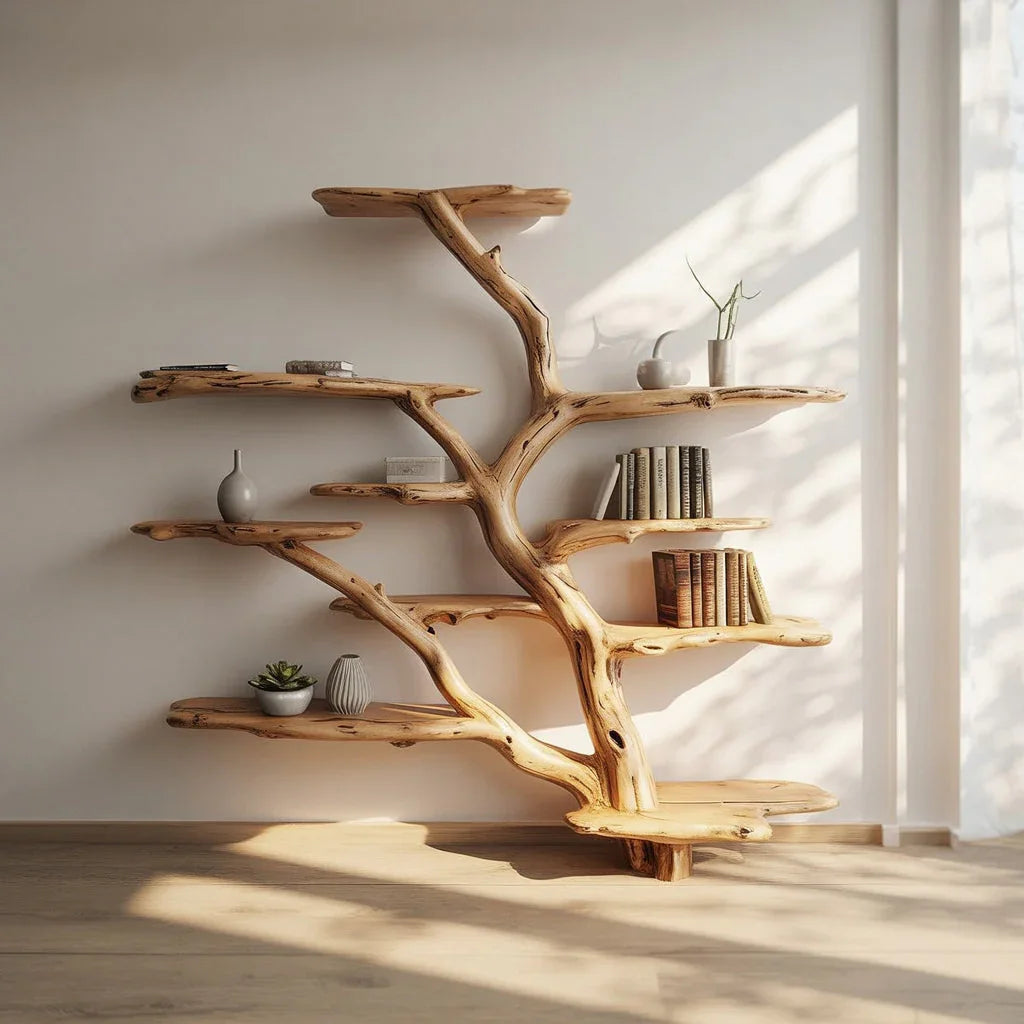
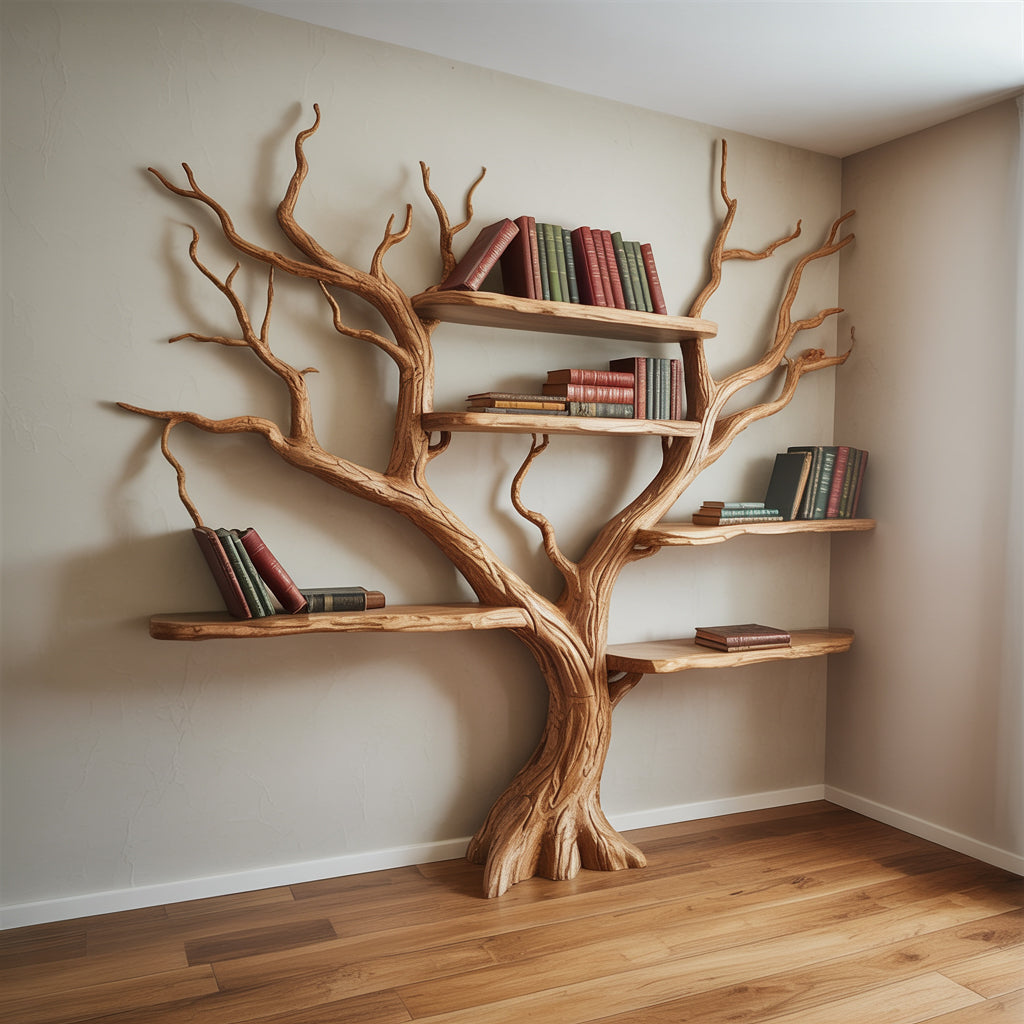
We will use a simple tree-shaped bookshelf as our example - a popular design that requires cutting branches and assembling them into a tree silhouette mounted on the wall. This is a mid-complexity project that most DIY enthusiasts would attempt.

Materials
| Item | Cost Range |
|---|---|
| Lumber (hardwood boards for tree shape) | $80 - $200 |
| Wood screws, dowels, or pocket hole screws | $15 - $30 |
| Wood glue (exterior grade) | $8 - $15 |
| Sandpaper (multiple grits: 80, 120, 220) | $10 - $20 |
| Wood stain or paint | $15 - $35 |
| Polyurethane or sealant | $15 - $25 |
| Mounting hardware (brackets, wall anchors) | $15 - $30 |
| Miscellaneous (painter's tape, drop cloths, brushes) | $15 - $25 |
| Materials subtotal | $173 - $380 |
Tools (If You Do Not Already Own Them)
This is where DIY costs escalate quickly. Most people who decide to build their first piece of furniture do not have a full workshop.
| Tool | Cost Range |
|---|---|
| Circular saw or miter saw | $100 - $300 |
| Drill/driver | $50 - $150 |
| Jigsaw (for cutting curves and branch shapes) | $40 - $120 |
| Orbital sander | $40 - $80 |
| Clamps (minimum 4) | $30 - $60 |
| Level | $10 - $25 |
| Measuring tape, square, pencils | $15 - $30 |
| Stud finder | $15 - $30 |
| Safety equipment (goggles, ear protection, dust mask) | $20 - $40 |
| Tools subtotal | $320 - $835 |
If you already own these tools, your incremental cost is zero. But for a first-time builder, the tool investment is significant.
Time Investment
Time is the hidden cost that most DIY calculations ignore. Here is a realistic time breakdown for a first-time builder making a tree-shaped bookshelf:
| Task | Hours |
|---|---|
| Research, planning, and sketching the design | 3 - 5 |
| Shopping for materials (including return trips) | 2 - 4 |
| Measuring and marking cuts | 1 - 2 |
| Cutting pieces (including re-cuts for mistakes) | 3 - 5 |
| Sanding (all pieces, multiple grits) | 2 - 4 |
| Assembly and gluing | 3 - 5 |
| Staining or painting (including drying time) | 3 - 6 |
| Sealing (including drying time) | 2 - 3 |
| Mounting on wall | 1 - 2 |
| Total time | 20 - 36 hours |
If you value your time at even $15/hour (well below most people's actual earning rate), that is $300 - $540 worth of labor.
The Mistake Tax
First-time builders make mistakes. It is part of the learning process, and it is nothing to be ashamed of. But mistakes cost money:
- Miscut lumber: $20-$60 in wasted wood that needs to be replaced
- Wrong stain color: $15-$35 for a do-over (plus sanding time)
- Stripped screws or split wood: $10-$30 in hardware and replacement pieces
- Uneven cuts requiring filler or recutting: $10-$20
A conservative estimate for first-project mistakes: $50-$150.
Total DIY Cost
| Category | First-Time Builder | Experienced (Owns Tools) |
|---|---|---|
| Materials | $173 - $380 | $173 - $380 |
| Tools | $320 - $835 | $0 |
| Time (at $15/hr) | $300 - $540 | $150 - $270 |
| Mistakes | $50 - $150 | $0 - $25 |
| Total | $843 - $1,905 | $323 - $675 |
For a first-time builder, the total cost of a DIY tree bookshelf , including tools, time, and mistakes , ranges from roughly $843 to $1,905.
Even an experienced builder with a full workshop spends $323-$675 in materials and time.
Cost of Buying a Handcrafted Tree Bookshelf
Now let us compare. A handcrafted solid wood tree bookshelf from a quality maker like Ashdeco typically costs:
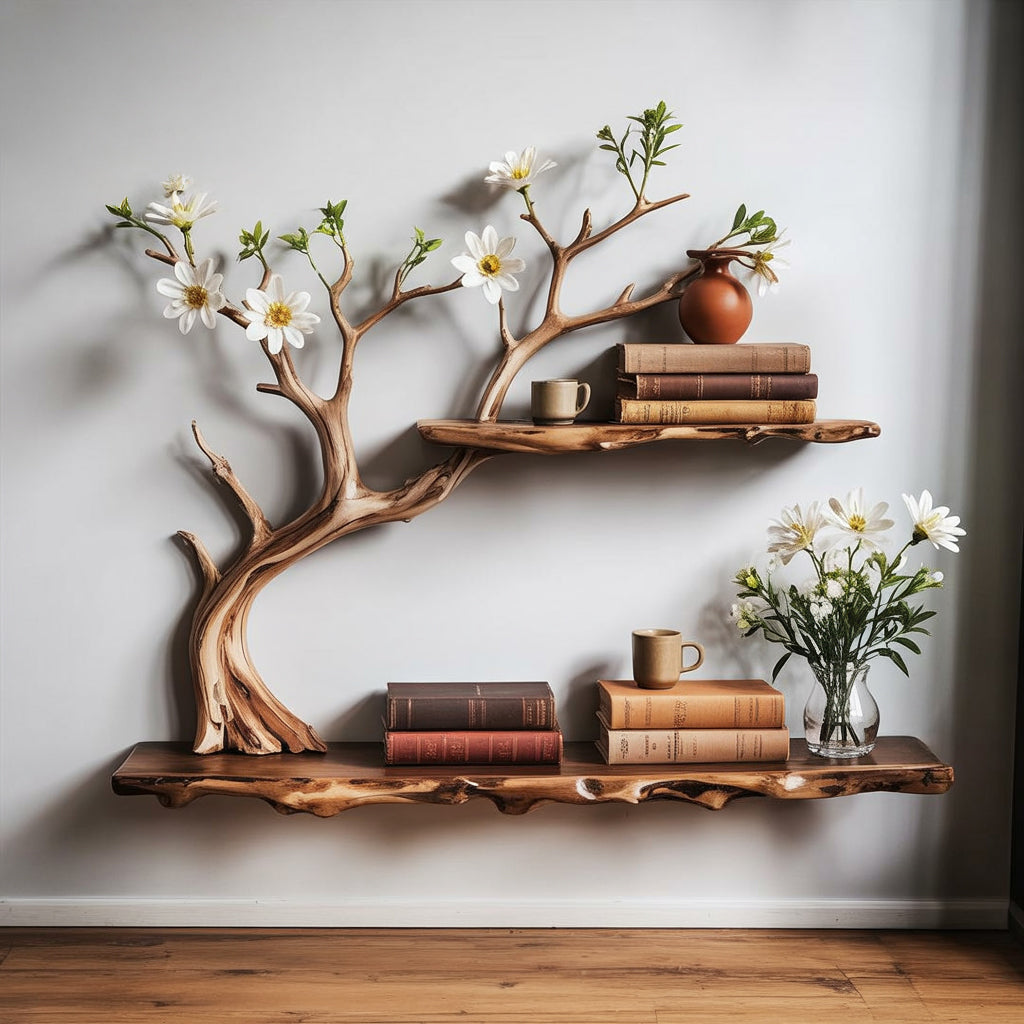
- Small to medium (40" wide): $500 - $1,100
- Large (50-70" wide): $1,000 - $2,200
- Custom sizes: Varies by specification
This price includes:
- Premium solid wood (teak, walnut, acacia)
- Professional craftsmanship by skilled artisans
- Protective finish applied in a controlled environment
- All mounting hardware included
- Free shipping to your door
- 30-day return guarantee
Installation time: 15-30 minutes.
The Real Comparison
Here is where the analysis gets interesting:

| Factor | DIY (First-Timer) | DIY (Experienced) | Buy Handcrafted |
|---|---|---|---|
| Out-of-pocket cost | $543 - $1,365 | $173 - $380 | $500 - $2,200 |
| Time invested | 20 - 36 hours | 10 - 18 hours | 15 - 30 minutes |
| Quality of finish | Beginner level | Good | Professional |
| Material quality | Varies (often construction-grade lumber) | Good | Premium hardwood |
| Structural integrity | Uncertain | Reliable | Guaranteed |
| Consistency with design vision | 50-70% match | 80-90% match | 95-100% match |
| Warranty/guarantee | None | None | 30-day guarantee |
The first-time DIY builder often spends close to what a handcrafted bookshelf costs , but gets a lower-quality result that took 20+ hours of work. The experienced builder saves money on the shelf itself but invests significant time.
Beyond the Numbers: What DIY Cannot Replicate
Professional Wood Selection
Artisan furniture makers spend years developing relationships with wood suppliers and learning to select the right piece of lumber for each project. They know how to read grain direction, identify potential weak points, and choose boards that will remain stable over decades.
A first-time DIYer picking boards at Home Depot is working with construction-grade lumber that was never intended for fine furniture. The wood may warp, crack, or behave unpredictably after assembly.
Controlled Finishing Environment
Applying stain and sealant in a garage or backyard exposes the finish to dust, temperature swings, humidity, and insects. Professional workshops have dust-free finishing rooms with controlled temperature and humidity. The result is a smooth, even finish that is nearly impossible to achieve in a home setting.
Joinery Expertise
The structural integrity of a bookshelf depends on how its pieces are joined. Professional woodworkers use mortise and tenon joints, dovetails, and precision doweling that create bonds stronger than the wood itself. DIY projects typically rely on screws and wood glue , functional but less elegant and less durable.
The Handcrafted Advantage
When you buy from a maker like Ashdeco, you are getting furniture built by Vietnamese artisans who have spent years mastering their craft. These are not factory workers pressing buttons on CNC machines. They are skilled hands shaping real wood into functional art, using techniques passed down through generations.
The result is a bookshelf that has character, integrity, and warmth that a weekend project , no matter how enthusiastic , cannot match.
When DIY Actually Makes Sense
DIY is not always the wrong choice. It makes sense when:
You already have tools and experience. If you have a workshop and have completed similar projects, your marginal cost is just materials , and you might genuinely enjoy the process.
The project is simple. A basic rectangular bookshelf from dimensional lumber is a great beginner project. A tree-shaped bookshelf with curved branches is not.
You want to learn. If your primary goal is learning woodworking rather than getting a bookshelf, the project cost is really tuition for a new skill. That is a valid reason to build.
Budget is extremely tight. If you can source free or cheap reclaimed wood and already own tools, DIY can produce a functional shelf for under $50 in materials.
When Buying Handcrafted Is the Better Choice
Buying makes more sense when:
You want a guaranteed result. A handcrafted bookshelf arrives ready to mount, professionally finished, and backed by a return policy.
Your time is valuable. If you would rather spend 20-36 hours with your family, on your career, or pursuing hobbies than building furniture, buying is the rational economic choice.
You want premium materials. Access to teak, walnut, and exotic hardwoods at retail lumber prices is difficult. Furniture makers buy in volume and pass the material quality advantage to you.
The design is complex. Tree-shaped bookshelves with organic curves, branch details, and live edges require skills and tools that take years to develop. This is not a beginner-friendly project.
You want something that lasts. A professionally built solid wood bookshelf lasts 50+ years. A DIY project from construction lumber might last 5-15 years depending on the joinery and wood quality.
Frequently Asked Questions
Is it really cheaper to build a bookshelf yourself?
Only if you already own the necessary tools and have woodworking experience. For a first-time builder purchasing tools, the total cost (materials + tools + time + mistakes) often equals or exceeds the price of a quality handcrafted bookshelf. Even experienced builders spend significant time that has real economic value.
How long does it take to build a tree-shaped bookshelf from scratch?
For a first-time builder, expect 20-36 hours spread over 2-4 weekends, including planning, shopping, cutting, assembly, finishing, and drying time. Experienced woodworkers can complete a similar project in 10-18 hours. Buying a handcrafted bookshelf and mounting it takes about 15-30 minutes.
What tools do I need to build a bookshelf?
At minimum: a saw (circular or miter), drill/driver, sander, clamps, measuring tools, and a level. For a tree-shaped design with curves, you will also need a jigsaw. Safety equipment (goggles, ear protection, dust mask) is essential. The total tool investment for a first-time builder runs $320-$835.
Can I build a bookshelf that looks as good as a handcrafted one?
With significant practice, yes. But not on your first project. Professional furniture makers have years of experience selecting wood, cutting joints, and applying finishes. The gap between a first-time DIY piece and a professionally handcrafted one is substantial in terms of finish quality, structural integrity, and design execution.
What is the best wood for a DIY bookshelf?
For beginners, pine and poplar are easy to work with and affordable. For a more durable result, oak, maple, or birch plywood are good options. Avoid using MDF for structural components. If you want the rich grain and character of premium hardwoods (teak, walnut, acacia), buying handcrafted is usually more practical because these woods are expensive at retail and difficult to work with for beginners.
Does Ashdeco offer custom sizes for their tree bookshelves?
Yes. Ashdeco offers custom design services where you can specify dimensions, wood type, number of branches, finish color, and overall shape. Each piece is handcrafted to your specifications by skilled artisans in Vietnam.
The Honest Answer
DIY bookshelf building is a wonderful hobby. The satisfaction of creating something with your own hands is real and valuable. But it is not a money-saving shortcut , especially for complex designs like tree-shaped bookshelves.
When you add up materials, tools, time, and the inevitable first-project mistakes, DIY often costs as much as buying handcrafted. And the handcrafted piece arrives with a professional finish, premium materials, and a guarantee that your weekend project does not come with.
If your goal is a beautiful, durable tree bookshelf in your home , and not a woodworking education , buying handcrafted is the smarter investment. Browse Ashdeco's handcrafted tree bookshelf collection to see what skilled artisans can build from real solid wood.