Small Bathrooms Need Vanities That Work Harder
A small bathroom - anything under 40 square feet - doesn't have room for mistakes. Every inch of counter space, every cabinet, and every design decision either makes the room functional or makes it feel cramped. The vanity is the largest piece of furniture in most bathrooms, which makes it the biggest opportunity to either waste space or optimize it.
The challenge with a small bathroom vanity isn't just finding something that fits physically. It's finding something that fits while still providing useful counter space, adequate storage, and a sink large enough to actually use. Many small vanities solve the size problem by sacrificing function - a 12-inch-deep vanity that barely fits a soap dish, or a 18-inch-wide cabinet with no internal storage. That's not a solution; it's a different problem.
This guide covers the vanity types, dimensions, and strategies that actually work in compact bathrooms - from narrow vanities to corner installations to floating designs that create the illusion of more space than exists.

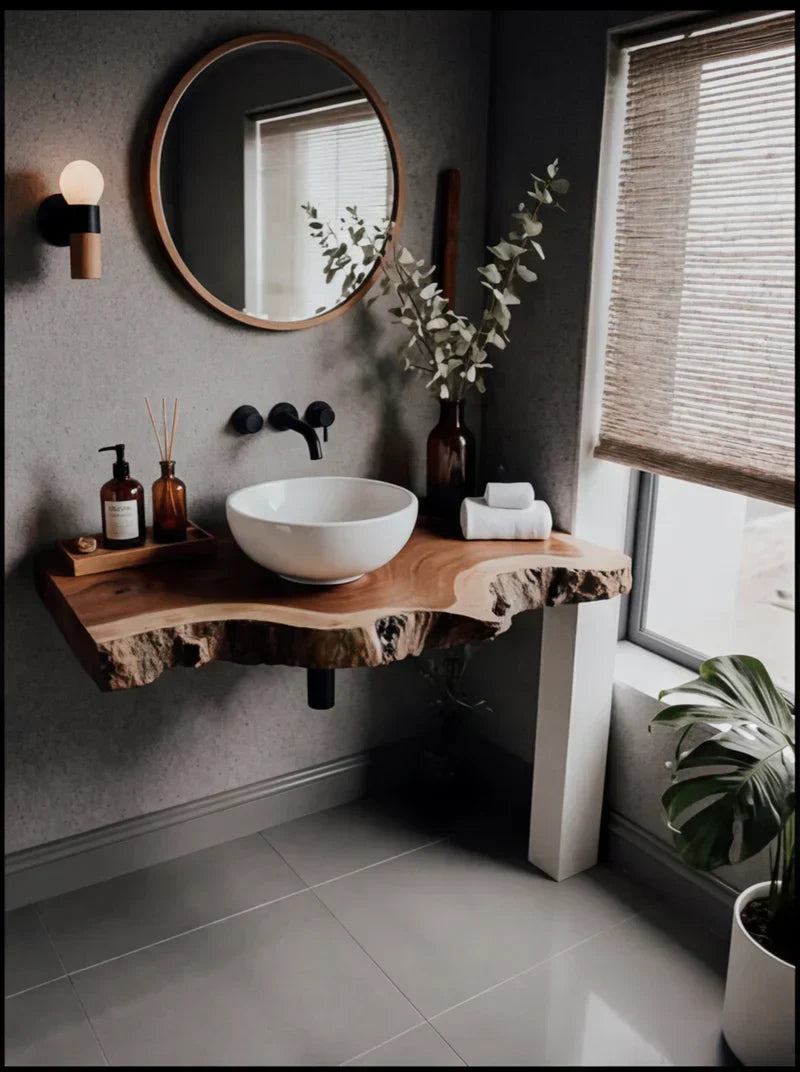
Rustic Solid Wood Bathroom Vanity with Storage Shelf & Drawers
Narrow Vanity Options: Under 24 Inches Wide
In tight bathrooms , powder rooms, half baths, or converted closets , a standard 30-36 inch vanity won't fit. Narrow vanities in the 18-24 inch range provide the essentials without overwhelming the room.
18-Inch Wide Vanities
The minimum width that still functions as a proper vanity with a sink. At 18 inches, you get a small basin, minimal counter space, and one or two small drawers or a single door cabinet. These work in powder rooms where hand-washing is the primary use.
- Counter space: Barely enough for a soap dispenser
- Storage: 1-2 small shelves or a single drawer
- Sink size: 12-15 inch basins (round or rectangular)
- Best for: Powder rooms, guest half-baths
20-24 Inch Wide Vanities
The sweet spot for small full bathrooms. You get a usable sink, some counter space for toiletries, and enough cabinet depth for storing cleaning supplies, towels, or personal care items. At 24 inches, most standard under-mount sinks fit comfortably.
- Counter space: Room for soap, a toothbrush holder, and a small plant
- Storage: 2-3 shelves, or drawers, or combination
- Sink size: 16-20 inch basins with multiple shape options
- Best for: Small full bathrooms, studio apartment bathrooms
Depth Matters as Much as Width
Standard vanity depth is 20-22 inches. In a small bathroom, consider reducing depth to 16-18 inches. This gives you 2-4 extra inches of walking space , which in a 5-foot-wide bathroom is the difference between being able to stand comfortably at the vanity and bumping into the toilet or tub behind you.
Corner Vanities: Using Wasted Space
Corners are dead space in most bathrooms , too deep for a towel bar, too shallow for anything else. A corner vanity turns this unused area into a functional sink station, freeing the main walls for the toilet, tub, or shower.
Advantages of corner placement:
- Uses space that's otherwise empty
- Opens the main walls for larger fixtures or more walking room
- Creates a diagonal approach angle that feels less cramped than facing a wall
- Triangle footprint provides surprisingly good counter space
Limitations:
- Plumbing may need rerouting to the corner , additional installation cost
- Mirror placement above a corner vanity requires careful angling
- Limited cabinet depth behind the sink due to the triangular shape
- Fewer ready-made options compared to straight vanities , custom or semi-custom is often necessary
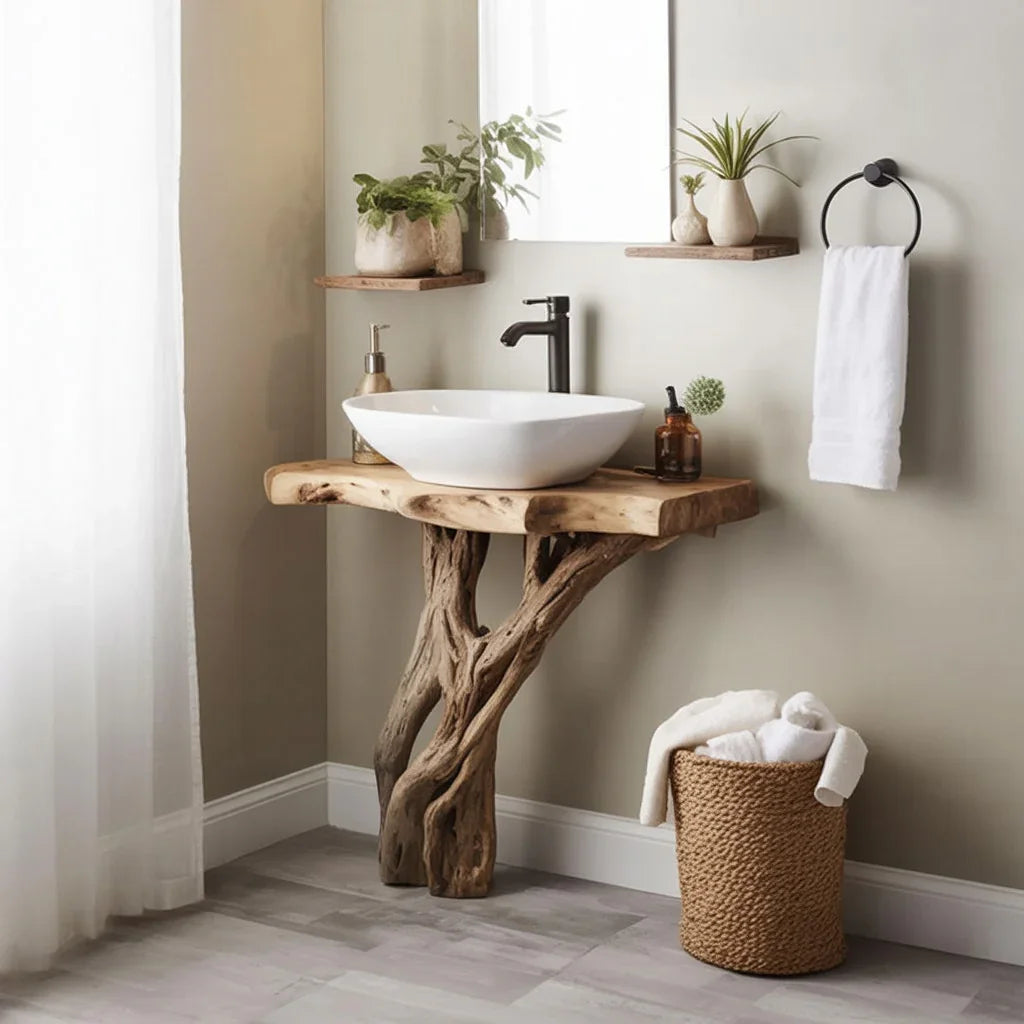
Ashdeco Solid Wood Bathroom Vanity – Rustic Spa Style with Natural Tree Root Base
Floating Vanities: The Small Bathroom's Best Friend
Wall-mounted (floating) vanities are disproportionately effective in small bathrooms because they create visible floor space below the cabinet. In a room where every inch matters, seeing an extra 8-10 inches of floor beneath the vanity makes the room feel significantly larger than a freestanding vanity in the same position.
Additional benefits in small spaces:
- Cleaning: You can mop the entire floor without moving anything , essential in a small bathroom where dust and moisture collect quickly
- Height customization: Mount it at any height to accommodate different users without buying a different vanity
- Under-vanity storage: The open space below can hold a small basket, scale, or step stool , items that would otherwise take up cabinet space
- Visual lightness: The room feels less cluttered because the vanity doesn't visually "fill" its footprint from floor to counter
For small bathroom installations, explore our floating bathroom vanity guide for mounting requirements and weight considerations.
Storage Optimization: Fitting More Into Less Space
A small vanity needs smarter storage because there's less of it. Here's how to maximize what you have:
Inside the Vanity Cabinet
- Pull-out trays: Instead of fixed shelves where items get pushed to the back and forgotten, use pull-out trays that bring everything forward. One pull-out tray is worth three fixed shelves in terms of actual usability.
- Door-mounted organizers: The inside of the cabinet door is wasted space on most vanities. Small mounted racks hold hair dryers, brushes, or cleaning supplies without using shelf space.
- Stackable containers: Clear stackable bins let you use the full vertical space inside the cabinet. Most vanity cabinets have 18+ inches of internal height but only one shelf at the midpoint , stacking containers fills the unused vertical space.
Around the Vanity
- Above-vanity shelving: A narrow shelf or medicine cabinet above the vanity adds 2-4 sq ft of storage without using any floor space
- Side-of-vanity towel bars: Mount a towel bar or hooks on the side of the vanity cabinet to keep hand towels within reach without taking wall space
- Recessed niches: If you're renovating, a recessed niche (built into the wall between studs) provides 3.5 inches of depth for toiletries without protruding into the room
Sink Selection for Small Vanities
The sink determines how much counter space you keep. In a small vanity, every inch of counter around the sink matters.
Undermount Sinks
Mounted beneath the countertop, leaving the entire counter surface usable up to the sink edge. This is the best option for maximizing counter space in small vanities. Water wipes directly from the counter into the sink with no rim to catch debris.
Vessel Sinks
Sit on top of the counter, which means the counter surface is the base of the sink. This can work in small vanities because you don't need a sink cutout , the entire countertop becomes the "landing zone." But vessel sinks add 4-6 inches of height, so your vanity cabinet needs to be proportionally shorter.
Integrated Sinks
The counter and sink are one piece , usually molded from a single material. No seams, no separate sink installation, and the smooth design looks clean and is easy to maintain. The tradeoff is fewer material and style options.
Material Matters More in Small Bathrooms
Small bathrooms concentrate moisture in less space. Shower steam, sink splashes, and limited ventilation create a humidity environment that's tougher on furniture than a larger, better-ventilated bathroom.
This is where the material of your small bathroom vanity becomes critical. MDF and particle board , the materials in most budget vanities , absorb moisture and swell. In a small bathroom with poor ventilation, this process accelerates. Bottom shelves warp first, then cabinet sides, then the structure fails.
Solid wood vanities from craftspeople like Ashdeco resist this moisture cycling when properly finished. The natural wood grain doesn't absorb moisture the way compressed fibers do. Vietnamese artisans apply multiple finish coats specifically designed for bathroom environments , a detail that factory-made vanities skip in favor of speed.
In a larger bathroom, you might get away with MDF because humidity dissipates across more volume. In a small bathroom, there's no margin for material weakness.
Layout Strategies for Different Small Bathroom Shapes
Long and Narrow (3×8 or 3×10 feet)
Place the vanity at the far end, facing the door. This creates a focal point that draws the eye through the length of the room. Use a wall-mounted vanity to keep the floor visible along the full length. A 20-24 inch wide vanity leaves clearance on both sides for toilet and shower access.
Square (5×5 or 6×6 feet)
Place the vanity on the wall opposite the door, with the toilet beside it. In a square room, a corner vanity can be particularly effective , it angles into the unused corner and frees the adjacent walls for shower entry and towel storage.
Under-Stair or Irregular Shape
Bathrooms under stairs or in converted closets often have angled ceilings or irregular walls. A floating vanity mounted at the right height works under a sloped ceiling because there's nothing above the counter to interfere with the ceiling angle. The vanity handles the functional needs; the ceiling angle happens above head height.
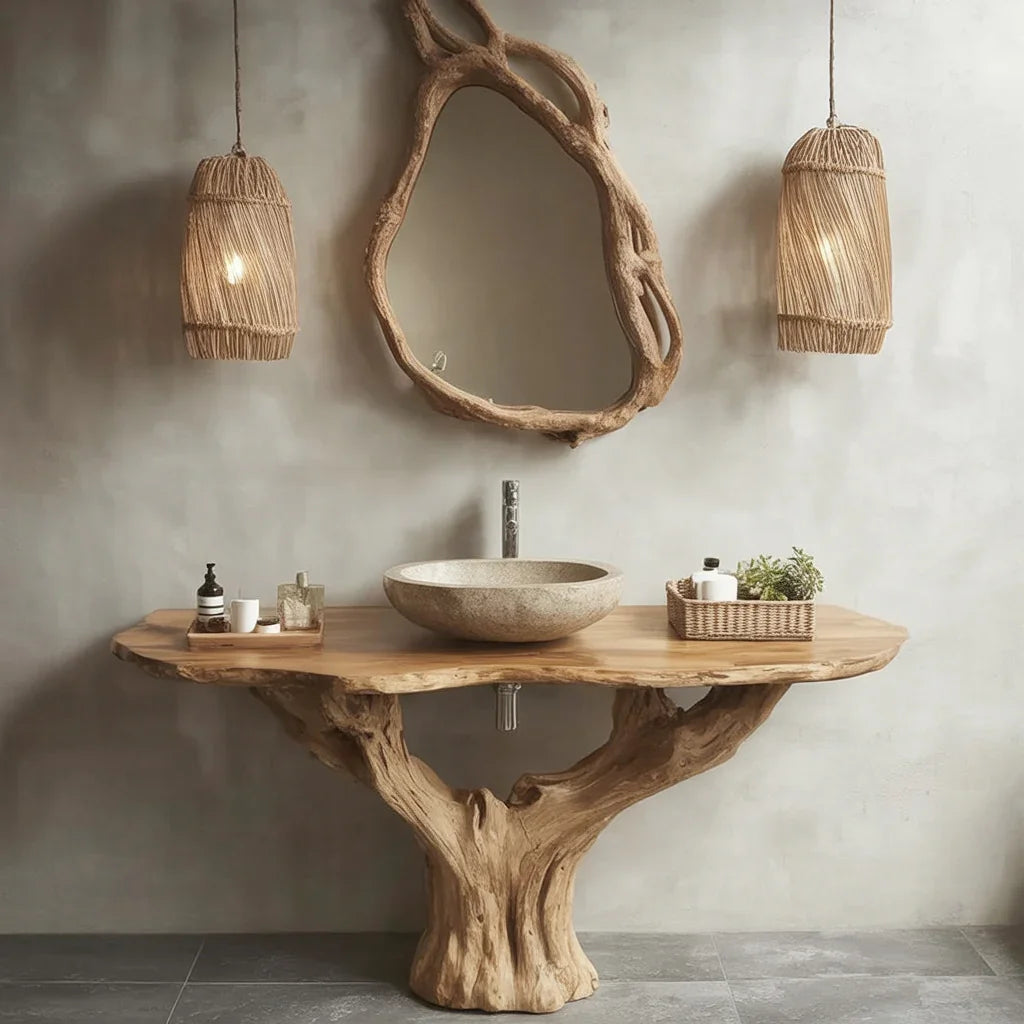
Handcrafted Solid Wood Bathroom Vanity – Live Edge Sculptural Sink Table
Frequently Asked Questions
What's the smallest vanity you can get?
The smallest commercially available vanities are 15-18 inches wide with a depth of 10-12 inches. These are wall-mounted units with a small basin , essentially a wall-hung sink with a tiny cabinet underneath. They work in powder rooms and half-baths where only hand-washing is needed. For a full bathroom where you also brush teeth, wash face, and store toiletries, 20 inches wide is the practical minimum.
Is a floating vanity better for a small bathroom?
In most cases, yes. The visible floor beneath a floating vanity makes a small bathroom feel larger. The cleaning advantage is also more impactful in small spaces where you can't maneuver a mop around a freestanding vanity's base. The main consideration is wall structure , your wall needs to support the vanity weight.
How do I add storage to a small bathroom vanity?
Use the vertical space: mount shelves or a medicine cabinet above the vanity. Use the door interior: attach small organizer racks to the inside of cabinet doors. Use pull-out trays instead of fixed shelves to access items without reaching deep into the cabinet. And use the wall beside the vanity for hooks, towel bars, or a narrow open shelf.
What sink style works best with a small vanity?
Undermount sinks maximize counter space because the full countertop surface is usable. Integrated (one-piece) sinks are smooth and easy to clean but offer fewer design options. Vessel sinks work if you lower the vanity cabinet height to compensate , but they do reduce counter space around the sink bowl.
Can a small vanity have drawers?
Vanities 20 inches and wider can include one or two drawers. Below 20 inches, most designs use a single-door cabinet because the internal width is too narrow for functional drawers. If drawer storage is important to you, prioritize vanity width over depth , a 24-inch-wide, 16-inch-deep vanity with drawers is more useful than a 20-inch-wide, 20-inch-deep vanity with a door.
How much clearance do I need around a small bathroom vanity?
Allow at least 21 inches of clearance in front of the vanity for standing comfortably. Between the vanity and toilet, 15 inches of clear space is the minimum (though 18+ is more comfortable). And if the vanity door or drawers swing open, ensure they don't hit the toilet, shower, or opposite wall when fully extended.