









Quick view
- Why Laundry Room Shelving Deserves More Thought Than You'd Expect
- Open Shelving: Visibility and Access
- Closed Shelving: Concealment and Protection
- Above the Washer and Dryer: The Most Important Shelf Location
- Organization Systems: Making Shelves Actually Work
- Moisture Considerations: The Silent Shelf Killer
- Frequently Asked Questions
Shop this guide
Handcrafted Floating Shelves, made to order in solid wood.
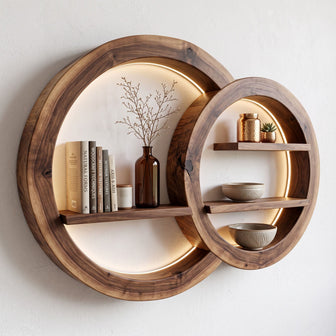
 Sculptural Overlapping Circular Solid Wood Wall Shelf with Multi Tier Display
From $1,354.00
Sculptural Overlapping Circular Solid Wood Wall Shelf with Multi Tier Display
From $1,354.00
 Mountain Landscape Relief Solid Wood Floating Shelf Live Edge Display Ledge
From $1,154.00
Mountain Landscape Relief Solid Wood Floating Shelf Live Edge Display Ledge
From $1,154.00
 Enchanted Forest Circular Wall Shelf - Round Carved Timber Mushroom Portal
From $1,023.00
Enchanted Forest Circular Wall Shelf - Round Carved Timber Mushroom Portal
From $1,023.00
 Cottagecore Arched Wood Wall Niche - Hand-Carved Fairy Mushroom Alcove Shelf
From $1,356.00
Cottagecore Arched Wood Wall Niche - Hand-Carved Fairy Mushroom Alcove Shelf
From $1,356.00
 Sculptural Hand-Carved Mushroom Solid Wood Corner Floating Shelf & Biomorphic Wall Display Ledge
From $345.00
Sculptural Hand-Carved Mushroom Solid Wood Corner Floating Shelf & Biomorphic Wall Display Ledge
From $345.00
 Sculptural Hand-Carved Mushroom Solid Wood Floating Shelves & Biomorphic Wall Display Ledges
From $345.00
Sculptural Hand-Carved Mushroom Solid Wood Floating Shelves & Biomorphic Wall Display Ledges
From $345.00
Why Laundry Room Shelving Deserves More Thought Than You'd Expect
The laundry room is a workspace. Detergent, softener, stain removers, dryer sheets, clothespins, drying racks, hampers, folding supplies - the amount of stuff that needs to live in a laundry room is disproportionate to the room's size. Most laundry rooms are small (40-60 sq ft), and without proper shelving, they devolve into cluttered chaos where bottles fall over and nothing has a home.
Shelving turns a chaotic laundry room into a functional one. But not all shelving works in this environment. Laundry rooms are humid - washer and dryer cycles release moisture into the air. Some shelving materials can't handle that humidity long-term. The type of shelving you choose (open vs closed, wood vs wire vs composite) determines whether your organized laundry room stays organized or deteriorates within a couple of years.
Open Shelving: Visibility and Access
Open shelves give you immediate visual access to everything stored on them. You see every bottle, every container, and every folded towel at a glance. There's no door to open, no effort to find what you need - reach and grab.
Types of Open Shelving for Laundry Rooms
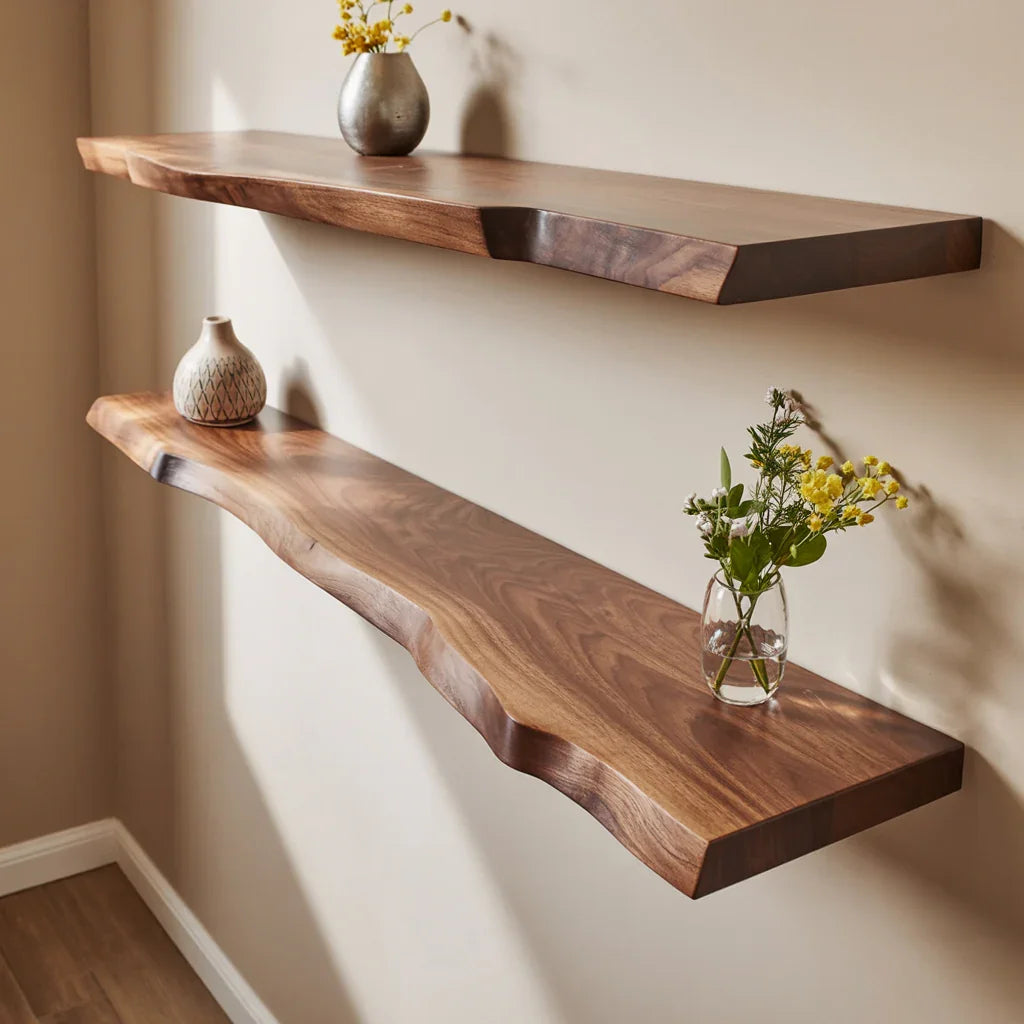
Floating Shelves: Wall-mounted with hidden brackets, floating shelves create a clean, modern look. They work especially well above the washer and dryer where you need easy access to frequently used items. Depth of 10-12 inches fits most detergent bottles and laundry supplies.
Bracket Shelves: Supported by visible L-brackets or decorative brackets screwed into wall studs. More load capacity than most floating shelf systems because the brackets provide direct support from below. They're also easier to install and adjust - you can reposition brackets if you need to change shelf height.
Slatted Shelves: Open slatted designs allow air circulation through and around stored items. This matters in laundry rooms where damp items (freshly washed cloths, sponges) sometimes sit on shelves. Air circulation prevents moisture from pooling.
When Open Shelving Works Best
- Above washer/dryer where you need quick access to detergent, softener, and dryer sheets
- In laundry rooms that double as mudrooms , visible storage reminds household members where things go
- When you prefer a decorative look with matching containers or labeled jars
- For lightweight items: dryer balls, clothespins, small supplies
When Open Shelving Doesn't Work
- If household chemicals need to be out of children's or pets' reach (though high-mounted shelves solve this)
- When the laundry room is visible from main living areas , open shelves display clutter as readily as organization
- For heavy items: large detergent containers (12+ lbs), stacks of towels. Open shelves without a back rail risk items falling during vibrations from the washer's spin cycle.



Closed Shelving: Concealment and Protection
Closed shelving , cabinets with doors , hides everything behind a uniform surface. The laundry room looks tidy regardless of what's stashed inside. This is the better choice when the laundry area is visible from hallways or shared with other functions.
Types of Closed Shelving
Wall Cabinets: Standard kitchen-style upper cabinets work in laundry rooms. They're available in standard widths (12, 15, 18, 24, 30, 36 inches), mount to wall studs, and provide fully enclosed storage. The downside: they're deeper than most laundry items require (12 inches of depth when most bottles only need 4-6 inches), which means wasted space at the back of each shelf.
Over-Washer Cabinets: Purpose-built cabinets that span the width above a washer and dryer (typically 54-60 inches). These are designed specifically for laundry room placement and often include pull-down shelves for accessing high storage without a step stool.
Closet-Style Systems: Enclosed shelving systems with doors that cover the full wall, floor to ceiling. These maximize storage density and completely conceal the contents. Best for dedicated laundry rooms rather than closet or hallway laundry setups.
Moisture Considerations for Closed Shelving
Closed cabinets trap moisture that open shelves allow to dissipate. In a laundry room, this means:
- Don't store damp items in closed cabinets , let them dry on open shelves or a rack first
- Leave cabinet doors slightly ajar periodically to allow air circulation
- Choose materials that resist humidity (solid wood with sealed finish, marine-grade plywood) over materials that absorb it (MDF, particle board)
- Consider cabinets with ventilation slots or mesh panels for humid climates

Above the Washer and Dryer: The Most Important Shelf Location
The wall space above your washer and dryer is the prime real estate of laundry room shelving. It's the most accessible location, the most used, and the one that makes the biggest difference in daily convenience.
Spacing and Dimensions
- First shelf height: 16-18 inches above the top of the washer/dryer. This provides clearance for loading and unloading while keeping supplies within arm's reach.
- Shelf depth: 10-12 inches. Most detergent bottles are 4-5 inches deep; 10-12 inches provides room for bottles plus a few inches of clearance so nothing sits right at the edge.
- Shelf spacing: 12-14 inches between shelves. Standard detergent bottles are 10-11 inches tall. Leave 2-3 inches above the tallest bottle for easy lifting.
- Number of shelves: 2-3 shelves above the machines is typical. More than 3 and the top shelf becomes too high to reach without a step stool (unless you're over 6 feet tall).
What to Store Where
- Lowest shelf (most accessible): Detergent, fabric softener, stain remover , items used every load
- Middle shelf: Dryer sheets, specialty detergent (wool, delicates), laundry bags
- Top shelf: Rarely used items , extra supplies, seasonal items, cleaning products not used daily
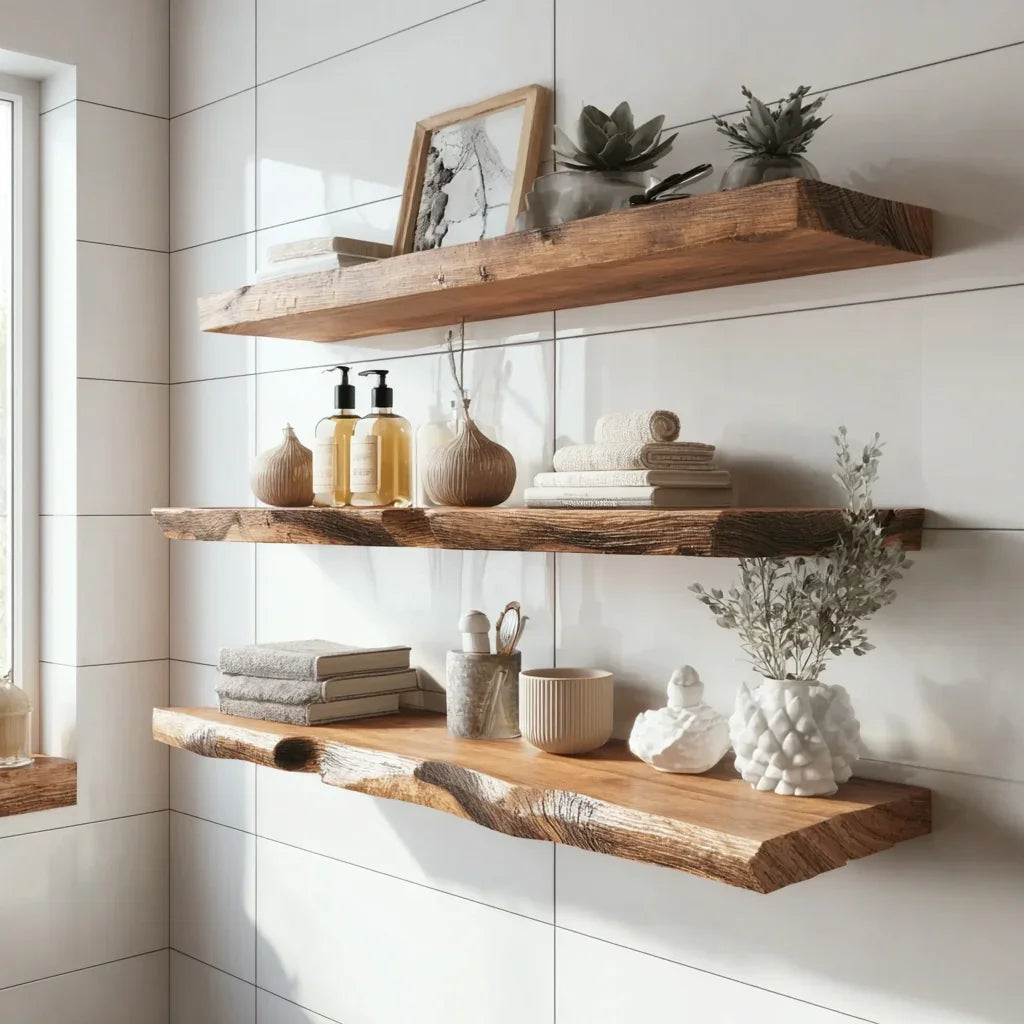
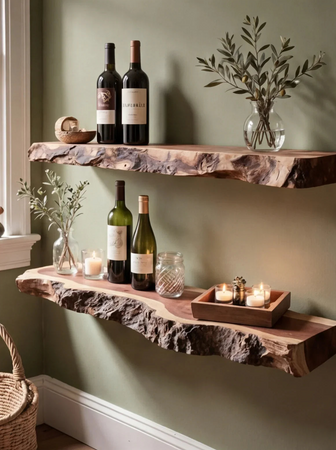
Live Edge Floating Shelves – Solid Wood Bathroom or Kitchen Wall Shelf Decor
Don't miss
These pieces qualify for 10% off orders over $2,000. Applied automatically at checkout.


Organization Systems: Making Shelves Actually Work
Shelves without an organization system become horizontal clutter surfaces within weeks. Here's how to make shelving functional long-term:
Container Strategy
Transfer liquids from oversized manufacturer bottles into uniform, labeled containers. This isn't just aesthetic , standardized containers fit shelves more efficiently than a random collection of different-shaped bottles. Clear containers let you monitor levels without opening lids.
Zone Organization
Divide your laundry room shelving into functional zones:
- Washing zone: Detergent, softener, bleach, stain treatments
- Drying zone: Dryer sheets, dryer balls, wrinkle spray
- Ironing zone: Iron, starch, pressing cloths (if applicable)
- Cleaning zone: Household cleaners, sponges, gloves (if the laundry room doubles as a cleaning supply closet)
Basket and Bin Strategy
For open floating shelves, baskets and bins contain small items that would otherwise scatter across the shelf surface. Woven baskets add texture to the look. Plastic bins handle moisture better but look industrial. Wooden bins split the difference , they look warm and handle moderate humidity when finished properly.
Moisture Considerations: The Silent Shelf Killer
Every laundry cycle releases moisture into the room. A clothes dryer vented indoors (or a condenser dryer) can add 1-2 gallons of moisture per load to the room's air. Even well-vented dryers release some moisture. Over time, this sustained humidity attacks shelving materials.
Materials that resist laundry room humidity:
- Solid wood with sealed finish (polyurethane, marine varnish, tung oil)
- Stainless steel or powder-coated metal
- Marine-grade plywood (exterior-rated adhesive)
Materials that fail in laundry room humidity:
- MDF (swells and warps from moisture absorption)
- Particle board (disintegrates with humidity exposure)
- Unfinished wood (absorbs moisture without protection, eventually warps)
- Standard plywood (interior-grade adhesive can delaminate)
This is where Ashdeco's solid wood floating shelves have an inherent advantage. Built from real hardwood by Vietnamese artisans and properly sealed, they handle the humidity cycling in laundry rooms without the swelling and warping that plague engineered wood products. The solid grain structure doesn't absorb moisture the way compressed fibers do , and even after years of laundry room use, the shelves maintain their shape.
Frequently Asked Questions
What type of shelving is best above a washer and dryer?
Open floating shelves or bracket shelves are the most practical choice above washers and dryers. They provide quick access to supplies used every load and don't require opening doors (which would swing into the space above the machines). Mount the first shelf 16-18 inches above the top of the machines for clearance.
How deep should laundry room shelves be?
10-12 inches is ideal for most laundry supplies. This depth fits standard detergent bottles, fabric softener, and cleaning supplies without items sitting so deep that they're hard to reach. Above 12 inches, items get pushed to the back and forgotten.
Can I use MDF shelves in a laundry room?
MDF is a poor choice for laundry rooms due to humidity. MDF absorbs moisture, causing it to swell, warp, and eventually crumble. If budget requires MDF, seal all surfaces (including edges and bottom) with waterproof paint or polyurethane. Even sealed, MDF won't last as long as solid wood in a humid environment.
How many shelves do I need in a laundry room?
For a basic laundry room setup: 2-3 shelves above the washer/dryer for frequently used supplies, plus 1-2 additional shelves or a cabinet for reserve supplies and less-used items. If the room also stores cleaning supplies, add shelving accordingly. Total: 3-6 shelves covers most household needs.
Should laundry room shelves be open or closed?
A combination works best. Open shelves above the washer/dryer for daily-use items (fast access matters here). Closed cabinets for chemicals, cleaning supplies you want out of sight, or spaces visible from hallways. If you prefer a clean look, closed storage everywhere with quick-access for detergent is the way to go.
How do I prevent shelves from warping in a humid laundry room?
Choose moisture-resistant materials (solid wood with sealed finish, stainless steel, or marine-grade plywood). Ensure the room has adequate ventilation , an exhaust fan running during and 15 minutes after dryer use removes most moisture. Avoid storing damp items on shelves (use a drying rack instead). And check that your dryer vent is functioning properly , a blocked vent pushes all moisture into the room.