Quick view
- Why mushroom decor appeals to people in the first place
- What kinds of homes support this look best
- Why it feels forced in the wrong room
- Where mushroom decor usually works best
- Why restraint matters more than theme commitment
- How handcrafted solid wood changes the effect
- Example of where the look works best
- When to skip mushroom decor entirely
- Honest downsides
- My recommendation
- FAQ
Shop this guide
Handcrafted Lamps for Modern Homes, made to order in solid wood.
 Christmas edit
Rustic Driftwood Floor Lamp – Handmade Solid Wood Standing Light for Home Décor
From $1,220.00
Christmas edit
Rustic Driftwood Floor Lamp – Handmade Solid Wood Standing Light for Home Décor
From $1,220.00
 Christmas edit
Driftwood Wall Sconce - Handcrafted Rustic Wooden Wall Lamp
From $650.00
Christmas edit
Driftwood Wall Sconce - Handcrafted Rustic Wooden Wall Lamp
From $650.00
 Christmas edit
Rustic Driftwood Floor Lamp with Shelves – Handmade Wooden Standing Light
From $2,350.0010% off at checkout
Christmas edit
Rustic Driftwood Floor Lamp with Shelves – Handmade Wooden Standing Light
From $2,350.0010% off at checkout
 Sculptural Twisted Solid Wood Floor Lamp - Organic Modern Statement Lamp
From $1,780.00
Sculptural Twisted Solid Wood Floor Lamp - Organic Modern Statement Lamp
From $1,780.00
 Christmas edit
Twisted Vine Wooden Floor Lamp - Handcrafted Driftwood Standing Light With Leaf Shade
From $1,280.00
Christmas edit
Twisted Vine Wooden Floor Lamp - Handcrafted Driftwood Standing Light With Leaf Shade
From $1,280.00
 Christmas edit
S-Curve Wooden Floor Lamp - Driftwood Standing Light With Dual Glow Openings
From $1,480.00
Christmas edit
S-Curve Wooden Floor Lamp - Driftwood Standing Light With Dual Glow Openings
From $1,480.00
Mushroom decor has a look that people tend to react to immediately. Some see it as warm, playful, and oddly calming. Others see it and think the room is trying too hard. That split usually has less to do with the object itself than with whether the room already supports the style language around it.
This guide looks at why mushroom decor works in some homes, where it fits naturally, and when it starts to feel forced instead of charming.
Why mushroom decor appeals to people in the first place
Mushroom decor appeals because it softens a room. The rounded forms feel less strict than straight-line decor, and the visual reference to the natural world adds warmth without relying on overtly rustic furniture. In the right space, that can make a room feel more personal and less generic.
But the appeal disappears quickly when the room has no visual context for that softness.
What kinds of homes support this look best
Mushroom decor works best in homes that already lean toward softness, texture, or organic shapes. Cottagecore, whimsical interiors, softer eclectic rooms, nature-inspired bedrooms, reading nooks, and children's spaces are all stronger fits. In those settings, the form feels coherent rather than random.
| Home style | Does mushroom decor fit? | Why |
|---|---|---|
| Cottagecore or soft rustic | Yes | The natural shape feels aligned with the room |
| Whimsical eclectic | Yes | Playful forms already make sense there |
| Nature-inspired bedroom | Often yes | Adds warmth without harsh geometry |
| Minimal modern space | Sometimes | Needs careful restraint to avoid clash |
| Formal traditional room | Usually no | Can feel stylistically disconnected |


Why it feels forced in the wrong room
Mushroom decor feels forced when it is dropped into a room that has no supporting shapes, textures, or mood around it. One whimsical object cannot create coherence by itself. If the rest of the room is sharp-lined, formal, or highly polished, the mushroom shape can start feeling like a novelty insert instead of part of the design language.
This is why trend analysis often misses the real issue. Room fit matters more than trend status.
Where mushroom decor usually works best
Bedrooms, reading corners, kids' rooms, soft-styled living areas, and smaller decorative wall zones are usually the strongest fit. These spaces allow mushroom decor to act as an accent, not the entire identity of the room. That keeps the look from becoming too literal or overly themed.
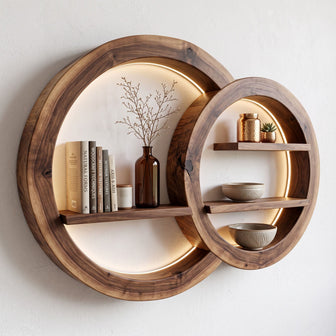
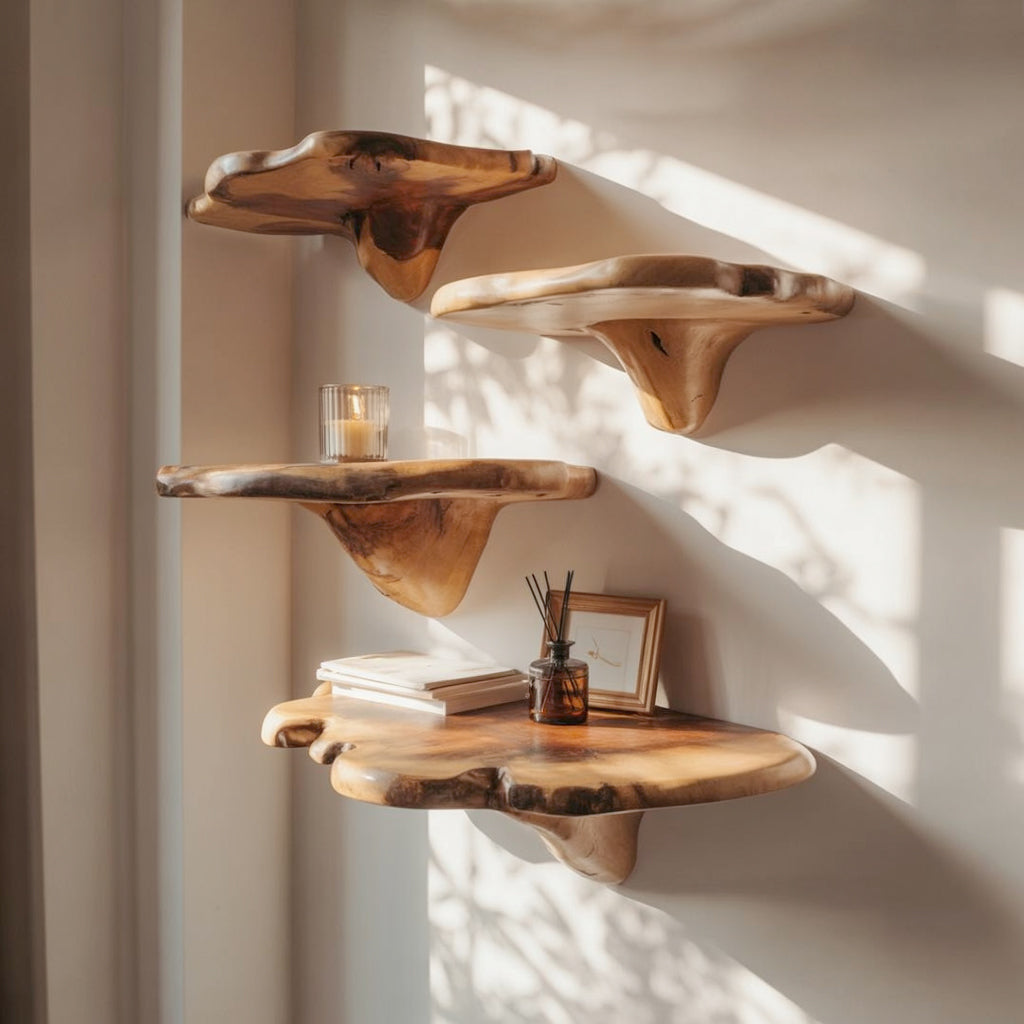
If the room needs an object with both personality and light function, the mushroom floating shelf collection is a stronger direction than generic themed accessories.
Don't miss
These pieces qualify for 10% off orders over $2,000. Applied automatically at checkout.
10% off
Rustic Driftwood Floor Lamp with Shelves – Handmade Wooden Standing Light
From $2,350.00
10% off at checkout
 10% off
Rustic Driftwood Floor Lamp with Side Table – Solid Wood Standing Light with Rattan Shade
From $2,350.00
10% off at checkout
10% off
Rustic Driftwood Floor Lamp with Side Table – Solid Wood Standing Light with Rattan Shade
From $2,350.00
10% off at checkout
 10% off
Sculpted Spiral Twist Floor Lamp Handcrafted Solid Timber Standing Light with Linen Drum Shade
From $2,280.00
10% off at checkout
10% off
Sculpted Spiral Twist Floor Lamp Handcrafted Solid Timber Standing Light with Linen Drum Shade
From $2,280.00
10% off at checkout
 10% off
Biomorphic Sculpted Hollow Floor Sculpture Organic Timber Art Piece Hand Carved in Solid Wood
From $2,280.00
10% off at checkout
10% off
Biomorphic Sculpted Hollow Floor Sculpture Organic Timber Art Piece Hand Carved in Solid Wood
From $2,280.00
10% off at checkout
Why restraint matters more than theme commitment
The best mushroom decor setups usually rely on restraint. One shelf, one lamp, or one well-placed accent can carry the mood better than repeating the same motif across the whole room. Buyers often get the worst result when they commit too hard and turn an accent idea into a theme.
A room should still feel like a room first. The mushroom shape should support the atmosphere, not dominate it.
How handcrafted solid wood changes the effect
Material quality matters a lot with mushroom decor because the form is already expressive. If the object is made from cheap material, the result can feel decorative in a disposable way. Handcrafted solid wood makes the same shape feel more grounded, more sculptural, and less novelty-driven.
Ashdeco's mushroom pieces are handcrafted by Vietnamese artisans, which helps the carved form read as a real design choice rather than a passing themed accessory.
Example of where the look works best
A mushroom shelf or related accent usually works best in a reading nook, bedside wall, or small decorative corner where the room already benefits from softness and visual warmth. The goal is to add one note of character, not to prove devotion to a trend.

If the room needs broader utility with less style risk, more standard floating shelves may be the safer choice.
When to skip mushroom decor entirely
Skip mushroom decor when the room is already visually busy, highly formal, or built around clean architectural lines with no organic counterbalance. Also skip it when the real need is storage, not style. In those cases, the mushroom form becomes a distraction rather than an improvement.
That is especially true when buyers are choosing it because they heard it was trending rather than because the room is asking for that mood.
Honest downsides
Mushroom decor is more style-specific than neutral decor, so it is easier to get wrong. Buyers are making a stronger visual choice, and that means room context matters more. The look can also tip into theme decor fast if repeated too often.
That does not make it a bad category. It just makes it a category that needs editing, not enthusiasm alone.
My recommendation
Use mushroom decor where the room already has softness, texture, or a little whimsy to support it. Keep it to one or two accents and let the rest of the room stay grounded. If the room needs practical storage or cleaner lines, stop there and choose something less style-specific.
That is the cleanest filter. Not whether mushroom decor is still trending, but whether the room can carry it naturally.
FAQ
Why does mushroom decor work in some homes and not others?
Because it depends on room context. The shape works best in spaces that already support softness, texture, or playful forms. Without that context, it can feel forced.
What rooms are best for mushroom decor?
Bedrooms, reading corners, kids' rooms, and softer-styled living spaces are usually the strongest fit because the look adds warmth without fighting the room.
Can mushroom decor work in modern homes?
Sometimes, but it needs restraint. One carefully chosen piece can work. Too much can clash with a cleaner, more architectural interior.
Why does material matter so much?
Because the shape already stands out. Better material helps the piece feel intentional and grounded instead of novelty-driven.
How much mushroom decor is too much?
Usually more than one or two accents per room. The strongest results come from selective use, not repeating the motif everywhere.