



















Quick view
Shop this guide
Handcrafted Lamps for Modern Homes, made to order in solid wood.
 Christmas edit
Rustic Driftwood Floor Lamp – Handmade Solid Wood Standing Light for Home Décor
From $1,220.00
Christmas edit
Rustic Driftwood Floor Lamp – Handmade Solid Wood Standing Light for Home Décor
From $1,220.00
 Christmas edit
Driftwood Wall Sconce - Handcrafted Rustic Wooden Wall Lamp
From $650.00
Christmas edit
Driftwood Wall Sconce - Handcrafted Rustic Wooden Wall Lamp
From $650.00
 Christmas edit
Rustic Driftwood Floor Lamp with Shelves – Handmade Wooden Standing Light
From $2,350.0010% off at checkout
Christmas edit
Rustic Driftwood Floor Lamp with Shelves – Handmade Wooden Standing Light
From $2,350.0010% off at checkout
 Christmas edit
Twisted Vine Wooden Floor Lamp - Handcrafted Driftwood Standing Light With Leaf Shade
From $1,280.00
Christmas edit
Twisted Vine Wooden Floor Lamp - Handcrafted Driftwood Standing Light With Leaf Shade
From $1,280.00
 Christmas edit
S-Curve Wooden Floor Lamp - Driftwood Standing Light With Dual Glow Openings
From $1,480.00
Christmas edit
S-Curve Wooden Floor Lamp - Driftwood Standing Light With Dual Glow Openings
From $1,480.00
 Christmas edit
Dual Nursery Mushroom Floor Lamp with Gill Glow Caps
From $1,680.00
Christmas edit
Dual Nursery Mushroom Floor Lamp with Gill Glow Caps
From $1,680.00
Mushroom decor and cottagecore often get paired together so automatically that buyers stop asking the important question. Does the mushroom shape actually fit the room, or is it being added just because the style label says it should? In a good cottagecore interior, mushroom decor can feel soft, natural, and right at home. In a weaker one, it can start looking too literal or too themed.
This guide focuses on where mushroom decor fits naturally in cottagecore rooms and how to keep the result from feeling overdone.
Why mushroom decor makes sense in cottagecore rooms
Mushroom decor works in cottagecore rooms because the style already leans on softness, natural references, handmade texture, and a slightly storybook atmosphere. The rounded mushroom form fits that language better than it fits stricter or more formal interiors. That is why the pairing can feel effortless when the room already has the right foundation.
The key point is that the room has to carry the mood first. The mushroom shape should support it, not create it alone.
Where it fits most naturally
Mushroom decor fits most naturally in bedrooms, reading corners, bedside walls, children's spaces, and small decorative zones where cottagecore already shows up through textiles, natural wood, softer color palettes, and layered objects. In those places, the mushroom shape feels like an extension of the room instead of a theme announcement.
| Room zone | Strong fit? | Why |
|---|---|---|
| Bedroom | Yes | Supports softness and calm visual texture |
| Reading nook | Yes | Pairs well with layered, cozy styling |
| Kids' room | Yes | Natural playfulness already fits |
| Living room vignette | Sometimes | Works if the room already has gentle warmth |
| Formal dining room | Usually no | Can feel thematically disconnected |


What mushroom decor should do in the room
In a cottagecore room, mushroom decor should add one note of personality, softness, or handmade character. It should not carry the entire identity of the space. If the room needs warmth, a mushroom shelf or small accent can help. If the room already has enough visual storytelling, adding more themed elements can push it too far.
This is why good cottagecore styling relies on editing. Not every charming object needs to be in the same room.
How to keep it from feeling overdone
The easiest way to keep mushroom decor from feeling overdone is to combine it with calmer materials and simpler surrounding objects. Natural wood, woven textures, quiet bedding, botanical tones, and soft lighting all help. One mushroom-shaped shelf or object can feel beautiful in that context. A cluster of heavily themed pieces usually feels less thoughtful.
Cottagecore works best when it feels lived-in and gentle, not when it starts performing its own aesthetic too loudly.
Don't miss
These pieces qualify for 10% off orders over $2,000. Applied automatically at checkout.
10% off
Rustic Driftwood Floor Lamp with Shelves – Handmade Wooden Standing Light
From $2,350.00
10% off at checkout
 10% off
Rustic Driftwood Floor Lamp with Side Table – Solid Wood Standing Light with Rattan Shade
From $2,350.00
10% off at checkout
10% off
Rustic Driftwood Floor Lamp with Side Table – Solid Wood Standing Light with Rattan Shade
From $2,350.00
10% off at checkout
 10% off
Authentic Hand-Carved Solid Wood Twisted Floor Lamp - Sculptural Timber Column with Fabric Shade
From $2,280.00
10% off at checkout
10% off
Authentic Hand-Carved Solid Wood Twisted Floor Lamp - Sculptural Timber Column with Fabric Shade
From $2,280.00
10% off at checkout
 10% off
Authentic Hand-Carved Solid Wood Abstract Floor Lamp - Sculptural Biomorphic Accent Light
From $2,280.00
10% off at checkout
10% off
Authentic Hand-Carved Solid Wood Abstract Floor Lamp - Sculptural Biomorphic Accent Light
From $2,280.00
10% off at checkout
Why handcrafted solid wood helps
Material quality matters because cottagecore depends heavily on texture and authenticity. A mushroom-shaped object made from cheap material can make the whole room feel costume-like. Handcrafted solid wood gives the form more credibility and more warmth, which helps the decor feel integrated rather than novelty-driven.
Ashdeco's mushroom pieces are handcrafted by Vietnamese artisans, and that carved, solid construction fits cottagecore far better than lightweight mass-produced themed decor.
Example of the right kind of use
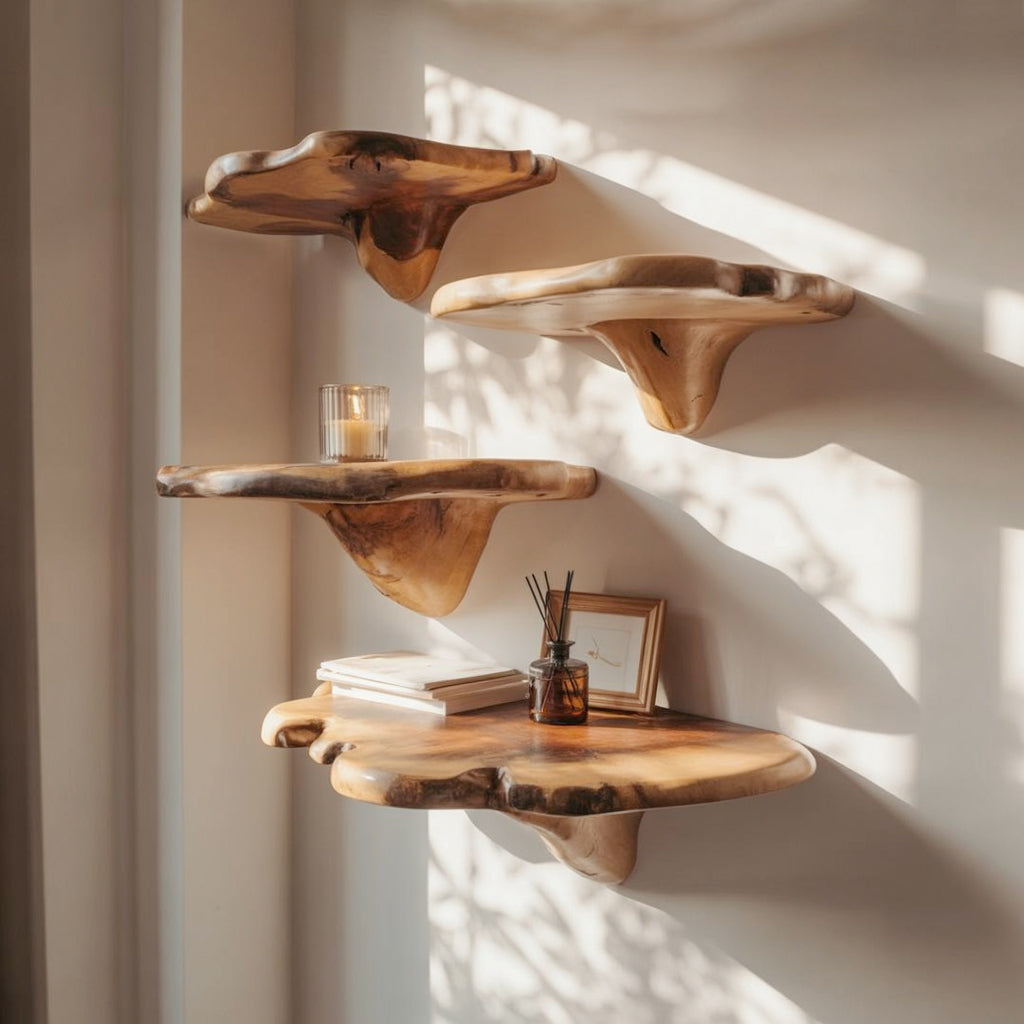
The mushroom floating shelf collection works best in cottagecore rooms when used as a small accent with real function. A bedside corner, reading nook, or decorative wall zone are usually stronger placements than a main wall that needs broad storage.

If the room needs calmer utility, standard floating shelves may still be the more flexible choice.
What buyers usually get wrong
The biggest mistake is confusing cottagecore with heavy theming. Cottagecore does not need every object to prove the point. Another mistake is adding mushroom decor into a room that has none of the other supporting elements, then wondering why the object feels out of place. The room needs softness and texture first.
Buyers also overdo repetition. One thoughtful mushroom accent usually has more impact than several trying to say the same thing.
Honest downsides
Mushroom decor is more style-specific than neutral decor, so it can limit flexibility if your taste shifts. It also depends more on surrounding context than plain functional objects do. In a room that is not already leaning soft, natural, or storybook, the look can feel forced.
That does not mean it is fragile. It just means it needs the right company.
My recommendation
Use mushroom decor in cottagecore rooms where softness, natural texture, and a little whimsy are already present. Keep it to one or two accents and let the rest of the room stay calm. If the room needs more storage or more neutrality, choose simpler forms and use the cottagecore mood through textiles and wood tones instead.
That is the cleaner approach. Let the room lead, then let the mushroom shape support it.
FAQ
Does mushroom decor always work in cottagecore rooms?
No. It works best when the room already has soft textures, natural materials, and a gentle atmosphere. Without that context, it can feel too literal.
What room is best for mushroom decor in cottagecore style?
Bedrooms, reading corners, and small decorative wall zones are usually the strongest fit because the shape can add personality without overwhelming the space.
How much mushroom decor is too much?
Usually more than one or two accents per room. Cottagecore works better when the room feels layered and natural, not heavily themed.
Why does solid wood matter in this look?
Because texture and authenticity matter in cottagecore. Solid wood helps the decor feel warm and integrated instead of novelty-driven.
Should I use mushroom decor if I need practical storage?
Only if the storage need is light. For broader utility, simpler shelf forms are usually the better choice.