

Quick view
- Why the Modern Floating Desk Is the Small Space MVP of 2026
- 5 Modern Floating Desk Ideas by Room Type
- Minimalist vs. Live Edge: Two Design Languages for the Modern Floating Desk
- Room-by-Room Dimension Guide for Modern Floating Desks
- Before and After: Small Rooms Transformed by a Modern Floating Desk
- Wall Mounted Floating Desk with Storage: What Actually Works
- Material Matters: Why Solid Wood Beats Everything Else for Floating Desks
- How to Style a Modern Floating Desk for Different Aesthetics
- Installation Essentials: Mounting a Modern Floating Desk Safely
- Small Floating Desk Setups That Punch Above Their Weight
- Common Mistakes with Modern Floating Desks (and How to Avoid Them)
- Modern Floating Desk Ideas for Dual-Use Spaces
- Frequently Asked Questions About Modern Floating Desks
- Your Space Is Already Big Enough - You Just Need the Right Desk
- A wall you already have. A desk that will outlast the apartment.
Shop this guide
Handcrafted Floating Desk, made to order in solid wood.
 Curved Floating Wall Mounted Secretary Desk Solid Timber Workstation with Built in Hutch and Drawers
From $1,876.00
Curved Floating Wall Mounted Secretary Desk Solid Timber Workstation with Built in Hutch and Drawers
From $1,876.00
 Floating Executive Desk with Curved Tree Bookshelf and Storage Drawers in Solid Wood
From $1,365.00
Floating Executive Desk with Curved Tree Bookshelf and Storage Drawers in Solid Wood
From $1,365.00
 Wall Mounted Live Edge Study Table with Floating Drawers Handcrafted in Solid Wood
From $2,165.0010% off at checkout
Wall Mounted Live Edge Study Table with Floating Drawers Handcrafted in Solid Wood
From $2,165.0010% off at checkout
 Floating Live Edge Desk with Tree Branch Wall Shelf & Dual Drawers
From $1,800.00
Floating Live Edge Desk with Tree Branch Wall Shelf & Dual Drawers
From $1,800.00
 Modern Handcrafted Solid Wood Floating L-Shaped Corner Desk with Integrated Storage Cubbies & Drawer
From $1,621.00
Modern Handcrafted Solid Wood Floating L-Shaped Corner Desk with Integrated Storage Cubbies & Drawer
From $1,621.00
 Modern Handcrafted Solid Wood Floating L-Shaped Corner Desk with Integrated Pull-Out Drawer & Open Storage Cubby
From $1,643.00
Modern Handcrafted Solid Wood Floating L-Shaped Corner Desk with Integrated Pull-Out Drawer & Open Storage Cubby
From $1,643.00
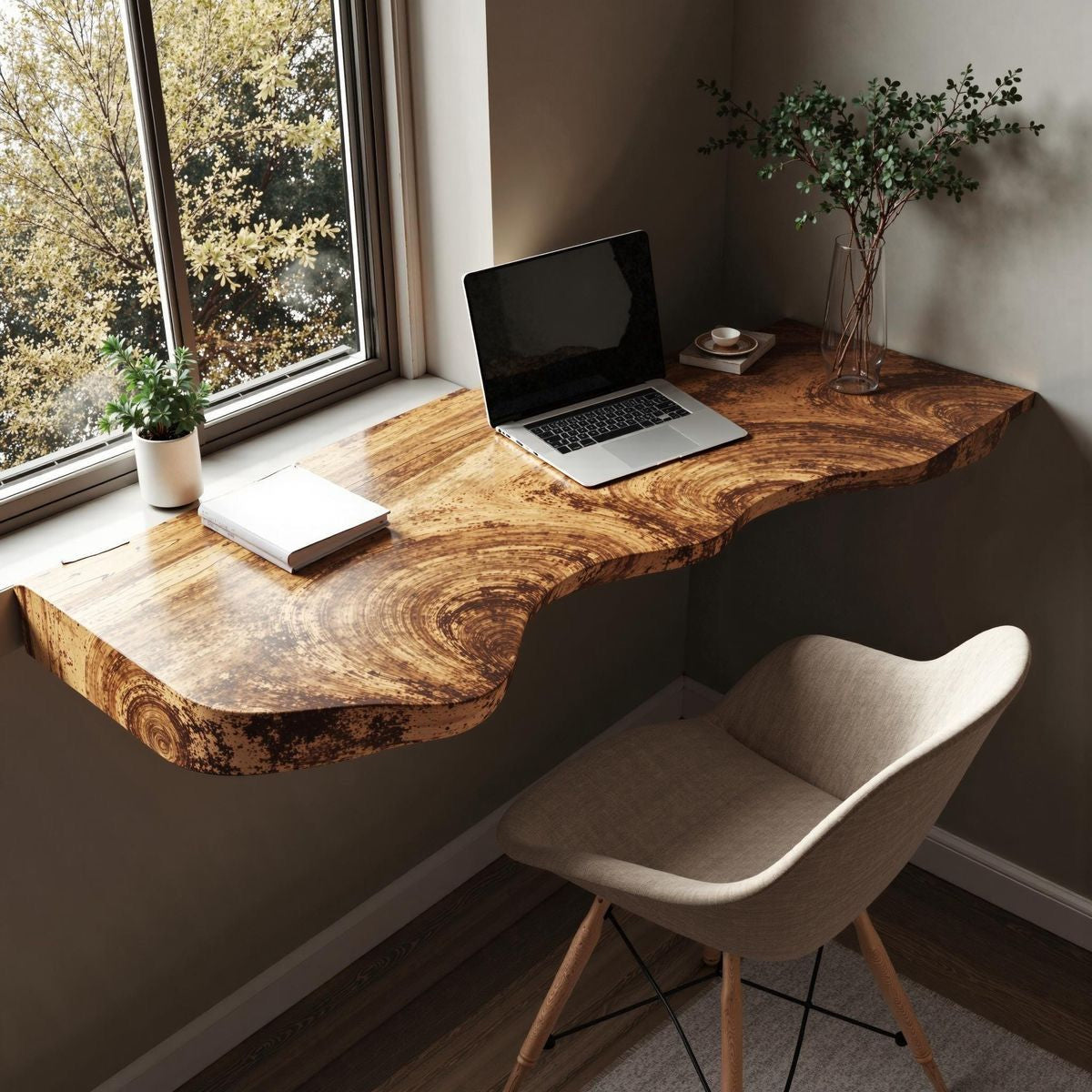
A modern floating desk does something no other piece of furniture can: it turns a blank wall into a full workstation without stealing a single square foot of floor space. In a 400-square-foot studio or a bedroom that's already fighting for breathing room, that's not a style choice - it's a survival strategy. This guide covers twelve modern floating desk ideas that actually work in small spaces, complete with room dimensions, layout plans, style pairings, and the solid wood options that separate a real desk from a flimsy shelf pretending to be one.

Live Edge Floating Desk - Handmade Solid Wood Wall Mounted Desk for Home Office
Why the Modern Floating Desk Is the Small Space MVP of 2026
A modern floating desk eliminates legs, frames, and floor contact entirely, creating usable workspace in rooms as small as 80 square feet while maintaining the clean-lined aesthetic that defines contemporary interior design. It's the only desk type that gets better as rooms get smaller.
American apartments are still tight by historical standards. RentCafe's rental market data puts the average U.S. one-bedroom apartment at roughly 700-735 square feet, and studio apartments in dense cities like Seattle, Manhattan, and Chicago average closer to 450-550 square feet. Meanwhile, remote work isn't going anywhere: Census Bureau survey data show the national telework rate held around 21-22% through 2025, even as return-to-office mandates spread across the corporate world.
Those two trends are on a collision course. Millions of people need a real workspace inside homes that barely fit a couch and a bed. A traditional desk - even a "compact" one - eats 8-15 square feet of floor space once you account for the chair's swing radius and legroom. A modern floating desk uses zero floor space for the desk itself. The only floor contact is your chair.
But function alone doesn't explain why floating desks have dominated Pinterest and Instagram design boards. The aesthetic matters. A floating slab of solid walnut or acacia - mounted at precise height with invisible hardware - reads as architecture, not furniture. It looks intentional, built-in, permanent. In a small room, that visual lightness is the difference between "cozy workspace" and "cramped corner."
Here's the math that makes the case:
| Desk Type | Floor Footprint | Visual Weight | Best Room Size | Price Range (Solid Wood) |
|---|---|---|---|---|
| Traditional 4-leg desk | 12-18 sq ft | Heavy | 120+ sq ft office | $400-$1,200 |
| Standing desk (adjustable) | 10-15 sq ft | Heavy (motor base) | 100+ sq ft | $500-$1,500 |
| Small writing desk | 6-10 sq ft | Medium | 80+ sq ft | $250-$700 |
| Modern floating desk | 0 sq ft | Minimal | Any size | $200-$800 |
Zero floor footprint isn't marketing spin. When nothing touches the ground, you can vacuum under the workspace in seconds, tuck a storage ottoman or file box beneath it, or roll your chair completely away to reclaim the space for yoga, guests, or just walking through your apartment without obstacle courses.

5 Modern Floating Desk Ideas by Room Type
The best floating desk setup depends on the room it lives in - a studio apartment wall demands different dimensions and styling than a bedroom nook or a hallway pass-through. Here are the first five ideas, organized by the rooms where they work hardest - seven more small-space and dual-use setups follow later in this guide.
Every layout below includes specific wall dimensions, desk size recommendations, and style notes. These aren't vague "inspiration" pins - they're buildable plans.
1. The Studio Apartment Command Center (Room: 400-550 sq ft)
In a studio, your desk shares space with your bed, kitchen, and living area. The goal is a workstation that performs like a dedicated office but disappears visually when you're off the clock.
Mount a long floating desk - 60 to 72 inches - along the wall opposite your sleeping area. This length gives you a dual-zone setup: one side for your monitor and keyboard, the other for a lamp, notebook, or morning coffee. A 20-inch depth is plenty for a single monitor; go 24 inches if you use dual screens.
The key to making this feel intentional: match the wood tone to one other element in the room. If your bed frame is warm walnut, a walnut floating desk ties the space together. If you're working with lighter Scandinavian tones, an ash or light acacia slab keeps the palette consistent.
Add two floating wall shelves above the desk - one at 22 inches above the surface for books and speakers, another at 40 inches for plants and art. This creates a "workspace column" that reads as one designed zone, not random furniture scattered along a wall.

Live Edge Floating Desk - Solid Wood Wall Mounted Shelves for Home Office
2. The Bedroom Desk Nook (Room: 100-150 sq ft bedroom)
Bedrooms under 150 square feet can't handle a separate desk and nightstand and dresser. A small floating desk mounted between the closet and the window - or in the corner beside the bed - turns an 18-inch strip of unused wall into a legitimate workspace.
For bedroom nooks, keep the desk narrow: 36-48 inches wide, 16-20 inches deep. This is a laptop-and-notebook zone, not a dual-monitor battlestation. Mount it at 29 inches high (standard ergonomic height) and pair it with a slim, armless chair that tucks completely beneath when not in use.
The design trick: treat the desk like a floating nightstand's bigger sibling. Same height, same wood species, continuous visual line. When your floating desk echoes your side table, the room feels curated, not crowded.

Handcrafted Floating Live Edge Wooden Desk - Solid Wood Wall-Mounted Home Office Desk
3. The Dual-Use Desk-Vanity (Room: 90-130 sq ft bedroom)
Here's an idea that gets overlooked: a modern floating desk that serves as a workspace by day and a vanity by night. Same surface, different function - just swap a laptop for a mirror and a desk lamp for ring light.
This works best at 42-48 inches wide and 18-20 inches deep. That's enough for a laptop or for a tabletop mirror, makeup organizer, and a small tray of products. Mount a round or arched mirror on the wall above, and during work hours, it reflects natural light into the room. After hours, it's your vanity mirror.
Storage matters here. A wall mounted floating desk with storage - one with a shallow drawer or a small cubby beneath the desktop - lets you stash either office supplies or beauty products out of sight. No clutter on the surface, regardless of which role the desk is playing.
Choose a warm-toned wood like acacia or mango for the vanity angle. Cool, sterile materials (white laminate, metal) feel like an office that moonlights as a vanity. Warm solid wood feels like a vanity that happens to be great for working.

4. The Hallway Pass-Through Office (Wall: 4-8 ft wide)
That dead stretch of hallway between the bedroom and living area? It's a desk. A 48-60 inch floating slab mounted at desk height turns a pass-through zone into a work nook without blocking foot traffic - as long as you keep the depth at 14-16 inches.
Shallow depth is non-negotiable here. You need at least 36 inches of clear hallway width for comfortable walking, so measure your hall and subtract. In a 52-inch-wide hallway, a 14-inch-deep desk leaves 38 inches of clearance - enough for two people to pass comfortably.
Use a stool instead of a chair. A backless stool tucks flush under the desk, maintaining full hallway width when you're not working. This setup is ideal for quick email checks, bill paying, and 30-minute work sprints - not 8-hour marathon sessions.

Handmade Live Edge Floating Desk - Rustic Wall Shelf Office Setup
5. The Living Room Wall Workstation (Wall: 6-10 ft wide)
When your living room doubles as your office, the desk needs to blend into the room's design language. A modern floating desk in the living room should look like a console table, not a cubicle.
Mount a 54-72 inch slab behind the sofa or along the TV wall at 30 inches high. Keep it clean: just a laptop, a small plant, and a desk lamp. When you're not working, it functions as a display surface - books, a candle, a framed photo.
This is where material choice dominates. A solid wood floating desk in a living room needs to match the room's energy. For mid-century modern spaces, go with walnut or teak tones. For boho/eclectic, live edge surfaces with natural bark lines bring organic texture. For Scandinavian minimalism, light ash or blonde acacia.

Handmade Live Edge Wood Desk - Floating Wall Shelves for Modern Office
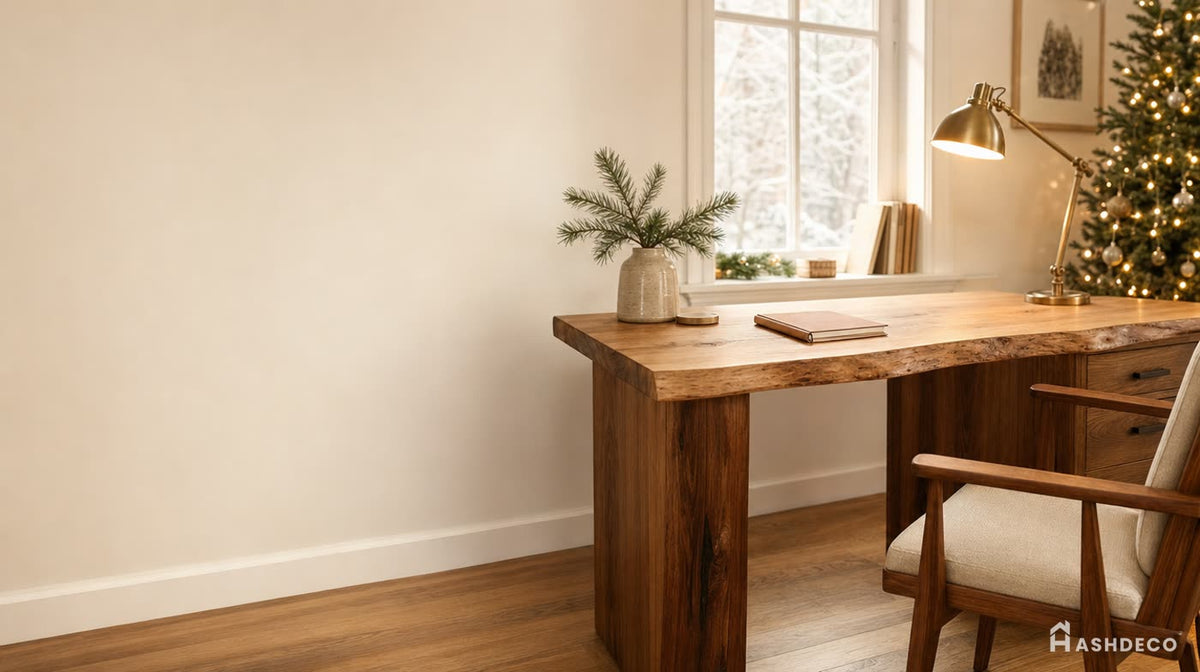


Minimalist vs. Live Edge: Two Design Languages for the Modern Floating Desk
Modern floating desks split into two dominant aesthetics - geometric minimalism and organic live edge - and choosing between them shapes the entire feel of your room. Both qualify as "modern," but they speak different design dialects.
The Minimalist Floating Desk
Clean lines. Straight edges. Uniform thickness. A minimalist floating desk is a rectangle of solid wood with no visible hardware, no ornamentation, and no fuss. It's the choice for rooms where everything else is equally restrained - white walls, simple lighting, Scandinavian or Japanese-inspired decor.
A solid wood minimalist desk differs from an IKEA shelf in one critical way: grain. A slab of real walnut or acacia has grain patterns, mineral streaks, and tonal variation that give the surface visual depth even without any decorative shaping. MDF and particle board are flat in every sense - visually dead surfaces that reveal themselves as cheap the moment you look closely.
For minimalist setups, choose wood species with strong linear grain: walnut, white oak, or ash. Avoid highly figured or burl-heavy slabs - their visual chaos fights the minimalist ethic.
Dimensions for the minimalist look: keep thickness at 1.5-2 inches. Thinner looks flimsy; thicker starts to feel rustic. A clean 1.75-inch slab is the sweet spot.
The Live Edge Floating Desk
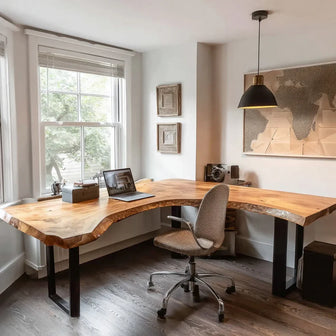
A live edge floating desk keeps the tree's natural edge - bark line, curves, irregularities and all - along one or both sides of the slab. Where the minimalist desk says "human precision," the live edge desk says "nature sculpted this."
This style works in rooms with some organic element: exposed wood beams, stone accents, plants, woven textiles. It's the centerpiece approach - the desk isn't blending in; it's the room's statement piece.
Ashdeco's live edge desks are handcrafted by Vietnamese artisans who work with each slab's unique shape rather than forcing it into a template. The natural edge is preserved, bark removed and sealed, curves followed rather than corrected. No two pieces are identical because no two trees grow the same way.
Live edge floating desks pair surprisingly well with modern rooms. The contrast between organic wood and clean white walls, concrete floors, or steel lighting creates tension that makes both elements stronger. It's the same principle behind putting a raw stone sculpture in a minimalist gallery.
For a live edge floating desk in a small space, keep the slab's widest point at 22-24 inches and the narrow end at 16-18 inches. The natural taper actually helps in tight rooms because it reduces the desk's visual mass at one end.

Modern Floating Wall Desk with Drawers - Minimalist Solid Wood Home Office Desk

Handmade Floating Desk - Rustic Live Edge Shelf, Farmhouse Wall-Mounted Desk with Brackets
| Feature | Minimalist Floating Desk | Live Edge Floating Desk |
|---|---|---|
| Edge treatment | Straight, machine-cut | Natural bark line, hand-finished |
| Best room style | Scandinavian, Japandi, modern | Bohemian, rustic-modern, eclectic |
| Visual impact | Blends into the room | Statement piece |
| Surface uniformity | Consistent width | Varies 2-6 inches across length |
| Best for dual-use | Yes (vanity, console, desk) | Less versatile (organic shape limits uses) |
| Ideal slab thickness | 1.5-2 inches | 2-3 inches |
| Uniqueness | Moderate (grain varies) | High (every slab one-of-a-kind) |
Room-by-Room Dimension Guide for Modern Floating Desks
Desk dimensions should be dictated by the room, not the other way around. A 72-inch slab that looks perfect in a living room will overwhelm a 9×10 bedroom. Here's a specific sizing guide for every common room type where a floating desk makes sense.
Studio Apartments (350-600 sq ft)
Wall allocation for desk: 5-6 linear feet. Recommended desk size: 54-72 inches wide × 20-24 inches deep × 1.75 inches thick. Mount height: 29 inches from floor to desk surface.
In studios, the long floating desk approach works best because you're creating a designated zone along one wall. Shorter desks (under 48 inches) look like afterthoughts in open-plan studios - they float visually, but not in a good way. A longer slab anchors the workspace and gives it presence.
Critical detail: leave at least 6 inches of empty wall on each side of the desk. A slab that runs wall-to-wall with zero margin looks like a shelf, not a desk.
Small Bedrooms (80-120 sq ft)
Wall allocation for desk: 3-4 linear feet. Recommended desk size: 36-48 inches wide × 16-20 inches deep × 1.5 inches thick. Mount height: 29 inches.
In bedrooms under 120 square feet, every inch of depth matters more than width. A 16-inch-deep small floating desk is enough for a laptop and a notebook side by side. It projects less than a standard nightstand from the wall, which preserves walking paths and keeps the room from feeling boxed in.
Best wall locations in small bedrooms: the stretch between the closet door and the corner, or the wall directly opposite the bed's foot. Avoid mounting next to the bed's headboard wall - you'll associate the workspace with sleep, and sleep research shows that's bad for both productivity and rest.
Spare Rooms/Guest Rooms (100-150 sq ft)
Wall allocation for desk: 4-5 linear feet. Recommended desk size: 48-60 inches wide × 20-22 inches deep × 1.75 inches thick. Mount height: 29 inches.
Guest rooms are ideal for floating desks because the desk doesn't compete with a permanent daily setup. It sits quietly on the wall, available for visiting guests who need to check email or for you to use as a secondary workspace. A wall mounted floating desk with storage works especially well here - a small drawer beneath holds pens, a charger, and a notepad for guests.
Living Room Side Walls (6-10 ft available)
Wall allocation: 4.5-6 linear feet. Recommended desk size: 54-72 inches wide × 18-22 inches deep × 2 inches thick. Mount height: 30 inches (slightly higher than standard, so it reads as a console table when not in use).
In the living room, a floating desk needs to pass the "non-office" test. When guests walk in, they shouldn't immediately think "home office." They should see a clean, solid wood surface that could be a display shelf, a bar surface, or a console table. This means: no monitor mounted permanently, no visible cable nests, and no office chair parked in front.
Use a task chair you can roll to a closet or a stool that fits beneath the desk. A permanent office chair in the living room kills the dual-use illusion.
Closet Conversions (Closet: 24-48 inches wide)
Recommended desk size: closet width minus 1 inch × 20-22 inches deep. Mount height: 29 inches.
Removing closet doors and mounting a floating desk inside the closet frame creates a built-in office nook. The closet walls provide visual separation from the rest of the room - when you're done working, you can add a curtain or barn door to hide the workspace entirely.
This only works if the closet is at least 24 inches deep. Shallower closets don't give enough desk depth for comfortable typing. Also check for electrical - you'll want an outlet inside the closet, or you'll need to run a power strip from outside.

Don't miss
These pieces qualify for 10% off orders over $2,000. Applied automatically at checkout.
10% off
Wall Mounted Live Edge Study Table with Floating Drawers Handcrafted in Solid Wood
From $2,165.00
10% off at checkout
 10% off
Sculptural Floating Live Edge Solid Wood Desk with Carved Blossom Branch Wall Unit
From $2,359.00
10% off at checkout
10% off
Sculptural Floating Live Edge Solid Wood Desk with Carved Blossom Branch Wall Unit
From $2,359.00
10% off at checkout
 10% off
Modern Floating Wall Desk with Drawers – Minimalist Solid Wood Home Office Desk
From $2,534.00
10% off at checkout
10% off
Modern Floating Wall Desk with Drawers – Minimalist Solid Wood Home Office Desk
From $2,534.00
10% off at checkout
 10% off
Floating Wooden Desk with Wall Shelves – Minimalist Solid Wood Workstation
From $2,345.00
10% off at checkout
10% off
Floating Wooden Desk with Wall Shelves – Minimalist Solid Wood Workstation
From $2,345.00
10% off at checkout
Before and After: Small Rooms Transformed by a Modern Floating Desk
Floating desk transformations are dramatic in small spaces because they solve two problems at once: they add function (a real workspace) while reducing visual clutter (no legs, no bulk, no floor footprint). Here are four transformation scenarios with specific before-and-after breakdowns.
Transformation 1: The 9×11 Bedroom
Before: A 99-square-foot bedroom with a queen bed, a nightstand, and a small 4-leg desk crammed into the corner. The desk ate 8 square feet of floor space and required 12 square feet total when you included the chair's pull-out zone. Walking path between the bed and desk: 19 inches - barely passable.
After: Remove the legged desk. Mount a 42-inch × 18-inch floating desk on the wall opposite the bed's foot. Walking path now: 37 inches - comfortable two-person passing width. Floor gained: 8 square feet. That's enough for a small storage bench at the foot of the bed or simply a room that no longer feels like a furniture maze.
The visual shift is even bigger than the functional one. Without desk legs blocking sightlines, you can see the floor continuously from the door to the far wall. The room reads as 15-20% larger than before, even though the furniture count didn't change.
Transformation 2: The 450 sq ft Studio
Before: A studio apartment with the classic layout problem - bed, couch, TV, kitchen, and a folding table doubling as both dining and desk surface. The folding table lives permanently open because folding and unfolding twice a day got old in week two. It blocks 10 square feet of usable space and looks temporary even after 6 months.
After: Mount a 60-inch modern floating desk along the wall between the kitchen area and the sleeping zone. Retire the folding table. The floating desk creates a clear visual boundary between zones - kitchen behind you, bedroom in front - while providing a permanent workstation that looks like it was designed into the apartment. The folding table's 10 square feet return to open floor for a proper dining situation (a small round table and two chairs) or extra living space.
Transformation 3: The Guest Room Nobody Uses
Before: A 120-square-foot spare room with a guest bed and nothing else. Used maybe 10 nights per year. The other 355 days, it's dead space.
After: Add a 54-inch floating desk along the longest wall, with two floating wall shelves above for books and decor. The room is now a home office 355 days a year and still a guest room when needed. The floating desk doesn't interfere with the bed's footprint - it uses wall space the bed doesn't touch. Total investment: one desk, two shelves, a task chair. Total floor space sacrificed: zero.
Transformation 4: The Closed-Off Closet
Before: A 4-foot-wide, 28-inch-deep coat closet in the hallway, holding jackets that could just as easily live on a wall hook. Bifold doors that haven't been attractive since 1994.
After: Remove the bifold doors. Remove the closet rod. Mount a 46-inch × 22-inch floating desk at 29 inches. Add a small shelf above for books. Install a wall-mount light. You now have a built-in office nook that disappears when you add a curtain. Coats relocate to a wall-mounted shelf with hooks in the entryway - an upgrade in itself.

Wall Mounted Floating Desk with Storage: What Actually Works
A wall mounted floating desk with storage combines your work surface and organization into one wall-mounted unit, keeping supplies accessible without adding separate shelving or drawer carts. The key is choosing storage that doesn't undermine the "floating" aesthetic.
The entire point of a floating desk is visual lightness. Bolt a chunky drawer unit to the underside and you've killed the effect - now it's just a wall-mounted desk that happens to have a heavy box hanging from it. Effective floating desk storage stays slim, stays hidden, and stays proportional.
Under-Desk Storage Options
Slim drawers (2-3 inches deep): The best option for maintaining clean lines. A single shallow drawer beneath the desktop holds pens, notebooks, chargers, and small supplies. From across the room, it looks like the desk's bottom edge is slightly thicker - not like a drawer is attached.
Open cubbies: A row of open compartments beneath the desk holds items you need quick access to - headphones, a tablet, a book. Open cubbies keep the desk from looking bottom-heavy because you can see through the gaps.
Cable management trays: A hidden tray mounted to the desk's underside corrals power strips and charging cables. Not technically "storage," but it solves the biggest visual problem with desk setups: cable spaghetti hanging from a clean surface down to the floor.
Above-Desk Storage Pairings
The smartest storage approach for a modern floating desk isn't building storage into the desk itself - it's pairing the desk with floating shelves above. We covered this approach in depth in our guide to building a desk with floating shelves workspace, but the short version: two shelves mounted 22 and 40 inches above the desk surface give you 6-12 linear feet of storage without adding a gram of weight to the desk bracket system.
This separation matters for structural reasons too. A floating desk carrying its own weight plus a laptop, monitor, and your forearms is already asking the wall brackets to handle 40-80 pounds. Adding 15 pounds of stored items to the desk's own brackets pushes the load toward the upper limits of standard hardware. Separate shelf brackets distribute the weight across more mounting points.
Live Edge Floating Desk - Solid Wood Wall Mounted Shelves for Home Office
Material Matters: Why Solid Wood Beats Everything Else for Floating Desks
Floating desks face a unique structural challenge: the entire load transfers through wall brackets with no leg support. The desk material needs to resist bending (deflection) under load while cantilevering from the wall. Solid hardwood outperforms every alternative material in this specific application.
The Deflection Problem
When you lean on a floating desk, press down while typing, or set a heavy monitor on it, the unsupported front edge wants to droop. This is called deflection, and it's measured in fractions of an inch per foot of overhang.
Materials ranked by deflection resistance (lower is better) for a 20-inch-deep floating desk under 50 pounds of distributed load:
| Material | Thickness Required | Deflection at Front Edge | Long-Term Sag Risk |
|---|---|---|---|
| Solid walnut (hardwood) | 1.5 inches | <1/32 inch | None |
| Solid acacia (hardwood) | 1.5 inches | <1/32 inch | None |
| Baltic birch plywood | 1.5 inches | 1/16 inch | Low |
| MDF (medium-density fiberboard) | 1.5 inches | 3/16 inch | High (creep failure) |
| Particle board | 1.5 inches | 1/4 inch | Very high |
| Hollow-core (IKEA-style) | 1.5 inches | 3/8+ inch | Guaranteed |
MDF and particle board suffer from "creep" - they continue to bend slowly under constant load, even loads well below their breaking point. A floating desk that holds fine on day one can develop a visible sag within 6-12 months. Solid hardwood doesn't creep. The wood's long-grain cellular structure resists sustained loads essentially forever, which is why 200-year-old solid wood shelves in libraries still hold flat.
The Weight Paradox
Solid wood is heavier than MDF - seems like a disadvantage for a wall-mounted desk, right? Actually, the opposite. The weight of solid hardwood (3.5-4.5 lbs per board foot for acacia and walnut) comes from density, and density is what resists deflection. A 60-inch solid walnut desk weighs about 30-35 pounds. That weight is the reason it doesn't flex.
The mounting hardware holds the desk; the desk's own rigidity holds everything on top of it. Cheap materials transfer that "everything on top" load directly to the brackets as leverage, which is why MDF floating desks eventually pull away from the wall at the top bracket while sagging at the front edge. Solid wood absorbs and distributes the load through its own structure.
Why Ashdeco's Solid Wood Matters for Floating Desks Specifically
Ashdeco's floating desks are handcrafted by Vietnamese artisans from solid hardwoods - primarily acacia, mango, and walnut. Each slab is carved and finished as a modular component: the desktop, the bracket housing, and any storage elements are shaped separately, then assembled. This modular approach means the grain direction can be optimized in each component for maximum strength.
Compare that to a flat-pack "floating desk" from Amazon or IKEA. Those are typically hollow-core or particle board with a vinyl wrap printed to look like wood grain. They're designed to be lightweight for shipping, which is the exact opposite of what you want in a cantilevered structure. Light means flexible. Flexible means sag. Sag means your $80 "deal" ends up in the trash in under a year.
Investing in a solid wood floating desk isn't just an aesthetic choice. It's the only material that can handle the physics of wall-mounted cantilevered furniture for the long term.
Handmade Floating Desk - Rustic Live Edge Shelf, Farmhouse Wall-Mounted Desk with Brackets
How to Style a Modern Floating Desk for Different Aesthetics
A modern floating desk is a neutral canvas - the styling you add determines whether it reads as minimalist, bohemian, industrial, or mid-century. Here are five specific styling formulas with exact item suggestions for each look.
Scandinavian Minimalist
Desk: Light-toned solid wood (ash, blonde acacia), straight edges, 1.5-inch thickness. On the desk: Laptop (closed, in a vertical stand), one small succulent in a white ceramic pot, a single framed print leaning against the wall. Above: One floating shelf with 3-5 books stacked horizontally, one small object (a ceramic vase, a wooden figurine). Chair: White or light gray, no arms, Scandi-style wood legs.
The rule: if you can remove something without losing function, remove it. Scandinavian minimalism is aggressive editing. The desk surface should be at least 60% empty at all times.
Warm Bohemian
Desk: Live edge or richly figured wood (mango, dark acacia), natural bark edges, 2-2.5 inch thickness. On the desk: A woven desk mat, a clay mug holding pens, a small potted trailing plant (pothos or string of pearls), a brass desk lamp. Above: Two floating shelves with an eclectic mix - books both vertical and horizontal, a macramé plant hanger, crystals, a small framed print, a rattan basket.
Bohemian styling is layered and personal. The desk should look like someone creative actually works there, not like a catalog shoot. Asymmetry is your friend - don't center everything.
Industrial Modern
Desk: Dark walnut or reclaimed-look wood, straight edges, paired with visible metal bracket supports (matte black). On the desk: A monitor on a black metal arm mount, a mechanical keyboard, exposed Edison-bulb desk lamp. Above: Metal-and-wood floating shelves, a vintage clock, raw concrete or brick wall as backdrop.
Industrial floating desks work best when the brackets are visible, not hidden. Black steel L-brackets or pipe brackets become part of the aesthetic. This is one case where the hardware is a feature, not something to conceal.
Mid-Century Modern
Desk: Walnut or teak-toned wood, slightly tapered edges, clean grain, 1.75-inch thickness. On the desk: A retro-styled desk lamp (arc or mushroom shape), a leather desk pad, a single piece of art leaning against the wall. Above: One shelf at 24 inches with a mix of vintage objects and books. Chair: An Eames-style molded shell on a swivel base.
Mid-century is about clean curves and warm wood tones. The floating desk itself does most of the work - a well-grained walnut slab at the right height needs very little styling to look Mid-Century. Less is more, but warmer than Scandinavian.
Japandi (Japanese + Scandinavian Fusion)
Desk: Light or medium-toned solid wood, perfectly straight edges, 1.5-inch thickness, rounded edge profile (not sharp). On the desk: A single bonsai or ikebana arrangement, a minimal notebook, a ceramic tea cup. Above: A single floating shelf with 2-3 carefully chosen objects, spaced widely apart. Wall-mounted task light instead of desk lamp.
Japandi takes Scandinavian minimalism and adds Japanese concepts of wabi-sabi (beauty in imperfection) and ma (negative space). The wood grain is the decoration. Leave generous empty space on and around the desk.

Handmade Live Edge Floating Desk - Rustic Wall Shelf Office Setup
Installation Essentials: Mounting a Modern Floating Desk Safely
A modern floating desk must carry 50-100 pounds (its own weight plus everything on it plus your forearms leaning on it) without any floor support. Proper installation isn't optional - it's the difference between a desk that lasts decades and one that rips out of the wall at 2 AM.
Find the Studs - No Exceptions
Every floating desk bracket must hit a wall stud. Toggle bolts, drywall anchors, and "heavy duty" plastic anchors are not acceptable for floating desks. Period. Drywall alone holds 15-25 pounds per anchor point. A loaded floating desk needs 75+ pounds of holding power per bracket, and that leverage is pulling outward (trying to rotate away from the wall), not straight down.
Standard stud spacing in U.S. homes is 16 inches on center. A 48-inch desk will hit 3-4 studs. A 60-inch desk hits 4-5 studs. Use a stud finder with deep-scan capability - cheap magnetic stud finders miss studs behind plaster or thick drywall.
Bracket Types for Floating Desks
Concealed bracket (floating shelf hardware): Metal rods or a steel plate that inserts into drilled holes in the desk's back edge, then screws into studs. The desk slides onto the rods and appears to float with no visible hardware. Best for minimalist and Japandi aesthetics.
French cleat: A beveled strip screwed to the wall engages with a matching strip on the desk's back. Extremely strong - French cleats are used for kitchen cabinets and can hold hundreds of pounds. The desk is removable (lift and unhook), which is useful in rentals.
L-brackets: Visible metal brackets screwed to the wall and the desk's underside. Strongest option and easiest to install. Best for industrial or rustic aesthetics where exposed hardware looks intentional.
Weight Capacity Math
Add up these numbers for your total load:
- Desk weight: Solid wood, 5-7 lbs per linear foot (e.g., a 60-inch desk = 25-35 lbs)
- Monitor: 8-20 lbs depending on size
- Laptop + accessories: 5-10 lbs
- Books, decor, supplies: 5-15 lbs
- Forearm load (leaning while working): 15-25 lbs
Total typical load: 58-105 lbs. Your bracket system should be rated for at least 1.5× your expected load. For a 75-pound expected load, use hardware rated for 115+ pounds.
With solid wood desks from Ashdeco, the mounting hardware is designed for the desk's specific weight and dimensions. Each piece ships with hardware rated for the slab's load requirements - not generic hardware that might work.

Small Floating Desk Setups That Punch Above Their Weight
A small floating desk - 36 to 48 inches wide and 14 to 20 inches deep - can run a full workday when you optimize every inch. The secret isn't a bigger desk; it's smarter arrangement of what goes on and around it. These are ideas 6 through 8 of this guide.
6. The Laptop-Only Setup (36 × 16 inches)
The minimum viable floating desk. A 36-inch slab at 16 inches deep holds a laptop and nothing else on the surface. That's the point - constraints force clarity.
Pair it with a wall-mounted magnetic strip above the desk for holding metal pens, clips, and small tools. Use a single floating shelf at 24 inches above for a closed laptop stand (dock the laptop to an external monitor wall-mounted above the desk) or for books and a small speaker.
This setup works in bedrooms, hallways, and closet conversions where every inch is contested. Total wall space used: 36 × 40 inches (desk plus one shelf). That's barely more than a framed poster.
7. The Monitor + Keyboard Setup (48 × 20 inches)
A 48-inch small floating desk at 20 inches deep is the sweet spot for a single external monitor, keyboard, mouse, and a small plant or lamp. The monitor should be on an arm clamped to the desk or wall-mounted above it - a monitor stand on the desk wastes 8 inches of precious depth.
Wall-mount the monitor if possible. This frees the entire desk surface for working and means you can adjust the monitor's position independently of the desk. The desk becomes purely a keyboard-and-mouse surface, and 20 inches of depth suddenly feels spacious.
8. The Corner Small Desk (Two 36-inch slabs, L-shaped)
Two small floating desk slabs meeting in a corner create an L-shaped workspace using two walls that were doing nothing. Each slab is only 36 inches wide and 16 inches deep - tiny individually - but the combined surface gives you 72 linear inches of workspace with a corner for your monitor.
This is ideal for bedrooms where the corner between the closet and window is too narrow for a standard L-desk (which needs 48+ inches per side). Two small slabs at 36 inches each fit where nothing else will.

Mid-Century Modern Solid Wood Desk - Handcrafted Writing Desk
Common Mistakes with Modern Floating Desks (and How to Avoid Them)
Floating desks are straightforward in concept but easy to get wrong in execution. These are the mistakes we see most often - and every one of them is avoidable with 5 minutes of planning.
Mistake 1: Mounting Too High or Too Low
The desk surface should be 28-30 inches from the floor for seated work. Sounds obvious, but people eyeball it and end up at 32 inches ("that looks about right") and wonder why their shoulders hurt after an hour. Measure. Mark. Check with a chair in position before drilling.
If multiple people will use the desk (a shared apartment, for instance), mount at 29 inches - the universal median - and adjust the chair height instead.
Mistake 2: Ignoring Depth in Favor of Width
People prioritize a long floating desk (width) and neglect depth. A 72-inch-wide desk that's only 12 inches deep is a shelf, not a desk. Your keyboard alone needs 6-7 inches of depth, and your monitor needs to sit 20+ inches from your eyes. At 12 inches deep, the math doesn't work.
Minimum functional depth: 16 inches (laptop only). Minimum for a monitor: 20 inches. Preferred for serious work: 22-24 inches.
Mistake 3: Cheap Materials for a Cantilevered Application
We covered the deflection science above, but it bears repeating: MDF and particle board will sag on a floating desk. It's not a question of "if" but "when." If you're investing in wall-mounted furniture that you expect to use daily for years, solid wood is the only material that delivers consistent performance over time.
Mistake 4: No Cable Management Plan
A floating desk amplifies cable problems. On a legged desk, cables disappear behind the desk and down the legs. On a floating desk, cables hang in open air between the desk and the floor outlet - fully visible. Plan your cable route before installation.
Solutions: mount a power strip to the desk's underside (out of sight), run cables through a wall-mounted cable raceway (paintable to match wall color), or drill a small grommet hole in the desk for cables to pass through internally to a raceway behind the desk.
Mistake 5: Forgetting Lighting
Floating desks don't have hutches or overhead cabinets to attach task lights to. And the desk itself shades the wall beneath it, making under-desk items hard to see. Plan for a wall-mounted swing-arm lamp above the desk or a clip-on desk lamp that doesn't eat surface space.

Modern Floating Desk Ideas for Dual-Use Spaces
A modern floating desk excels in rooms that serve more than one purpose - spaces where the desk needs to perform during work hours and vanish (or transform) during off hours. Here are the final four ideas of this guide - specific dual-use configurations that work.
9. Desk by Day, Vanity by Night
We touched on this in the room ideas above, but here's the full blueprint. Use a 42-48 inch desk with one slim drawer. During work hours: laptop, external keyboard, small lamp. After hours: close laptop and stow in drawer, place a tabletop mirror where the laptop was, arrange cosmetics on a small tray.
The transition takes 60 seconds. The desk never looks "wrong" in either role because solid wood reads as both professional and personal. This dual-use setup is especially powerful in 1-bedroom apartments where the bedroom is the only private space.
10. Kids' Homework Station/Craft Surface
Mount a 48-inch floating desk at 24-26 inches (lower than adult height, appropriate for kids aged 6-12). During the school year, it's a homework station. During breaks, cover the surface with a silicone craft mat and it's a painting, building, or crafting zone. The floating design means kids can't kick desk legs, and cleanup involves wiping one surface and sweeping underneath - no crumbs trapped behind desk legs.
Raise the desk to 29 inches when the kids grow. A solid wood slab mounted on French cleats can be repositioned in 20 minutes.
11. Guest Room Office/Bedside Console
Mount the desk at nightstand height (24-26 inches) or at standard desk height (29 inches) depending on whether you use the room more as an office or a guest room. At 26 inches, it serves as a bedside console table when guests visit - place a lamp, a water carafe, and a small clock on it. At 29 inches, it's primarily a desk with a lamp guests can use as a reading light from bed.
12. Entryway Drop Zone/Standing Desk
A 36-inch small floating desk mounted at 40-42 inches in the entryway serves as a standing-height work surface for quick tasks (checking mail, signing packages, a 10-minute email sprint) and a drop zone for keys, wallet, and sunglasses the rest of the time. Add a small bowl or tray and a wall hook above, and the zone is complete.

Frequently Asked Questions About Modern Floating Desks
How much weight can a modern floating desk hold?
A properly mounted solid wood floating desk holds 80-150 pounds depending on the bracket system, wood species, and number of studs engaged. A 48-inch desk hitting 3 studs with concealed steel brackets typically supports 100+ pounds - enough for a monitor, laptop, books, and full forearm leaning pressure.
Can you install a floating desk in an apartment with plaster walls?
Yes, but you must find the studs behind the plaster and lath. Plaster walls have wooden lath strips that can give false positives with stud finders. Use a strong magnet to locate the nails or screws in the lath, which indicate stud positions. Then use screws long enough to penetrate the plaster, lath, and at least 1.5 inches into the stud.
What is the best depth for a small floating desk?
For laptop-only use, 16 inches is the minimum functional depth. For a single monitor setup, go 20 inches. For dual monitors or a monitor plus notebook space side-by-side, 22-24 inches is ideal. In tight spaces, even 14 inches works for a tablet or writing station, though it's too narrow for typing comfort.
Is a floating desk sturdy enough for daily work-from-home use?
A solid hardwood floating desk mounted into studs is as sturdy as any legged desk for daily use. The critical factors are material (solid wood, not MDF or particle board), bracket quality (steel, not plastic), and installation (studs, not drywall anchors). Solid wood desks from Ashdeco are specifically designed for full-time use - not decorative display.
Can I install a floating desk without damaging walls (for rentals)?
French cleat mounting creates the smallest footprint - typically 4-6 screw holes total. When you move, fill the holes with spackle, sand, and touch up with paint. The damage is less than what a large picture frame leaves behind. Some rental-friendly options include removable adhesive systems rated for heavy loads, but for daily desk use, screws into studs are the only reliable method.
What's the difference between a floating desk and a floating shelf?
Depth and structural rating. Floating shelves are typically 6-12 inches deep and rated for 15-40 pounds. A floating desk is 16-24 inches deep and rated for 80-150 pounds. The bracket systems are different - desk brackets use longer support arms or steel plates to handle the greater cantilever distance and heavier loads. A floating shelf repurposed as a desk will flex and eventually fail.
How do I hide cables on a floating desk?
Three methods: (1) Mount a power strip to the desk's underside and run a single cord to the wall outlet through a paintable cable raceway. (2) Drill a 1.5-inch grommet hole in the desk near the back edge and route cables through it to a wall-mounted channel. (3) Use wireless peripherals (keyboard, mouse, charger) to eliminate 2-3 cables at the source.
What wood species works best for a modern floating desk?
Acacia and walnut are the top choices. Acacia offers rich grain patterns with excellent hardness (Janka rating 1,700-2,300 lbf) at a moderate price point. Walnut provides a warm, dark tone with strong linear grain and a Janka rating of 1,010 lbf - slightly softer but still well above the threshold for desk use. Both resist deflection better than any engineered material.

Your Space Is Already Big Enough - You Just Need the Right Desk
Every floating desk idea in this guide shares one truth: small rooms don't need more space; they need furniture that respects the space they have. A modern floating desk handcrafted from solid wood turns any wall - in a studio, a bedroom, a hallway, even a closet - into a workspace that looks deliberate, works reliably, and lasts for years without sagging, wobbling, or looking cheap.
Ashdeco's floating desks are carved by Vietnamese artisans from solid acacia, mango, and walnut - no MDF, no particle board, no veneer. Each piece is modular, hand-finished, and built to handle the specific demands of wall-mounted cantilevered furniture. Browse the full floating desk collection and find the slab that fits your wall, your room, and your work style.
Handcrafted in Vietnam
A wall you already have. A desk that will outlast the apartment.
Ashdeco's solid wood floating desks are carved by Vietnamese artisans and built to hold real daily work - no sag, no wobble, no MDF.
Shop floating desks →