Quick view
- What a mushroom bookshelf is actually good at
- Mushroom bookshelf vs regular bookcase
- Freestanding mushroom bookshelf: best all-around option
- Wall-mounted mushroom bookshelf: when it works
- Real storage capacity: what to expect
- Best rooms for a mushroom bookshelf
- Why handcrafted matters more in this category
- Honest downsides
- My recommendation
- FAQ
Shop this guide
Handcrafted Tree Bookshelf, made to order in solid wood.
 Christmas edit
Corner Tree Floating Bookshelf – Driftwood Branch Wall Mounted Hanging Shelf, Artistic Corner Furniture Decoration
From $901.00
Christmas edit
Corner Tree Floating Bookshelf – Driftwood Branch Wall Mounted Hanging Shelf, Artistic Corner Furniture Decoration
From $901.00
 Christmas edit
Handcrafted Solid Wood Nursery Decor & Kids' Library
$2,834.0010% off at checkout
Christmas edit
Handcrafted Solid Wood Nursery Decor & Kids' Library
$2,834.0010% off at checkout
 Christmas edit
Handcrafted Wooden Tree Wall Shelf – Rustic Branch Bookshelf
From $1,087.00
Christmas edit
Handcrafted Wooden Tree Wall Shelf – Rustic Branch Bookshelf
From $1,087.00
 Christmas edit
Solid Wood Floating Corner Shelf – Driftwood Branch Wall Shelf
From $789.00
Christmas edit
Solid Wood Floating Corner Shelf – Driftwood Branch Wall Shelf
From $789.00
 Christmas edit
Tree Bookshelf – Rustic Wooden Book Tree Shelf, Wall-Mounted Natural Wood Décor
$2,099.0010% off at checkout
Christmas edit
Tree Bookshelf – Rustic Wooden Book Tree Shelf, Wall-Mounted Natural Wood Décor
$2,099.0010% off at checkout
 Christmas edit
Floating Bookshelf – Tree Branch Wall-Mounted Bookcase for Rustic Home Decor
From $1,000.00
Christmas edit
Floating Bookshelf – Tree Branch Wall-Mounted Bookcase for Rustic Home Decor
From $1,000.00
A mushroom bookshelf sounds fun and decorative, but the real buying question is whether it can handle everyday storage or if it is mostly a statement piece. Some mushroom designs are closer to wall art with ledges. Others actually work as bookshelves with repeat daily use. If you are deciding between a mushroom bookshelf and a regular bookcase, you need to look at usable shelf area, access, stability, and how you plan to store books.
The short answer is this: a mushroom bookshelf can beat a regular bookcase when you want visible personality, lighter visual weight, and selective display storage. A regular bookcase still wins for maximum volume, straight-line organization, and heavy book collections. The best mushroom bookshelf sits in the middle. It stores enough to be useful, but it also changes the look of the room.
What a mushroom bookshelf is actually good at
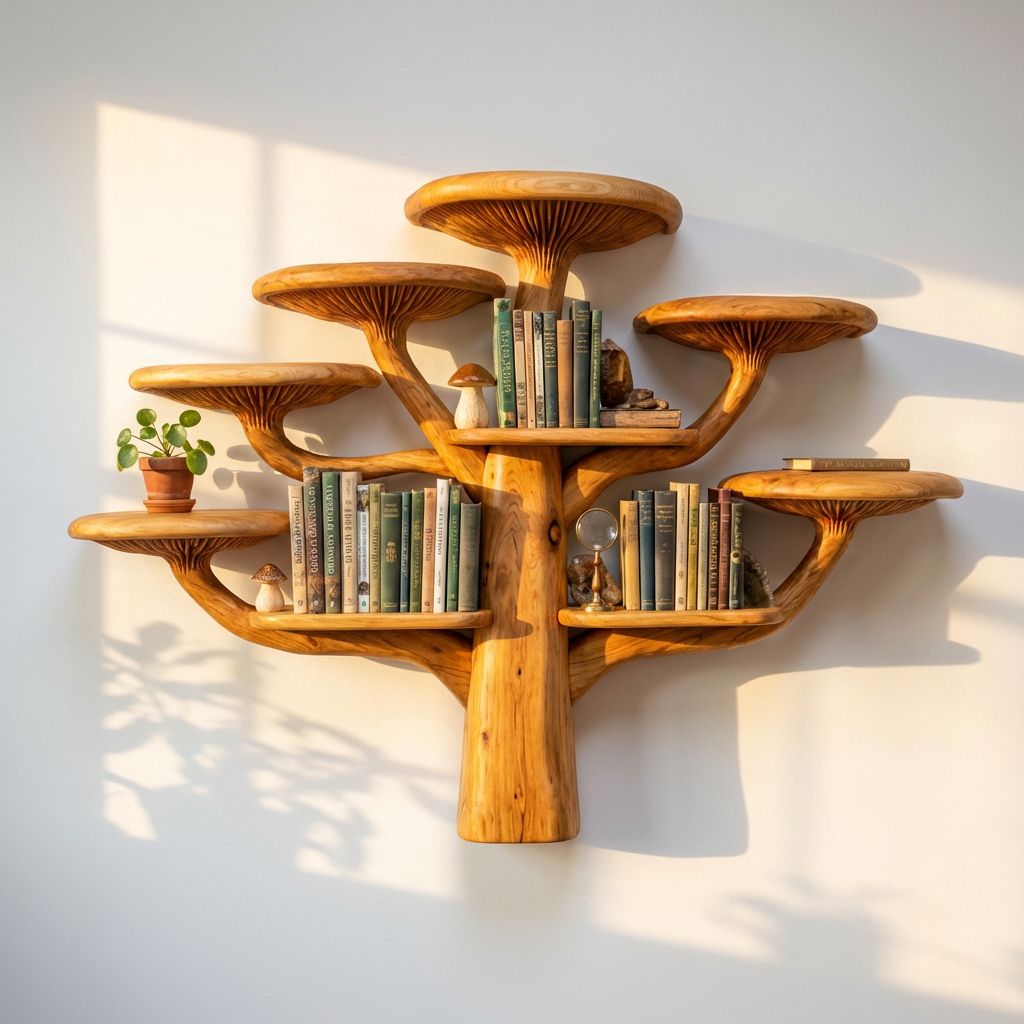
A mushroom bookshelf is best when you want a shelf that stores books and decor without looking generic. It works especially well in reading nooks, bedrooms, kids rooms, and small living areas where the storage piece also needs to carry visual identity. The strongest designs give you enough shelf variety to hold books, but they still feel lighter and more sculptural than a normal rectangular bookcase.
That is the key tradeoff. You are not buying one because it is the most efficient way to store fifty hardcovers. You are buying one because it stores what you actually use while adding character that a standard boxy bookcase usually cannot.
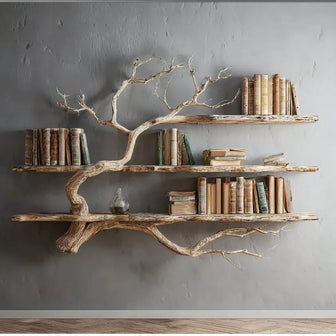
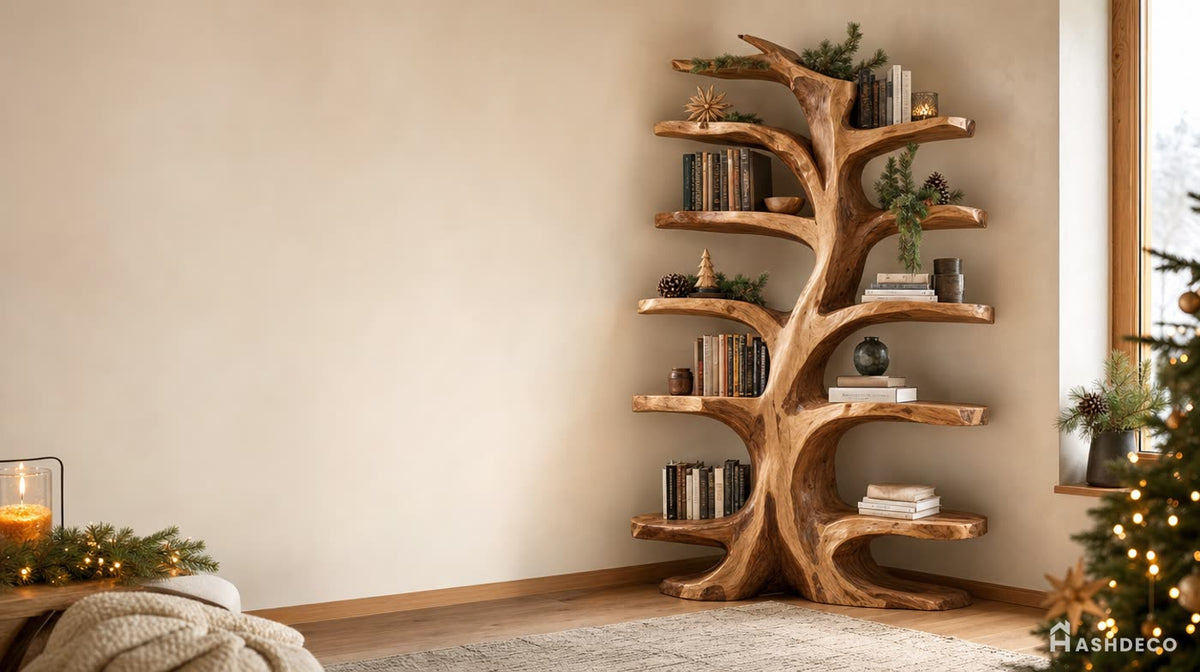
If you want more conventional capacity, the tree bookshelf collection is the more practical side of this category. If you want something more wall-oriented and decorative, the floating shelves collection gives that lighter look.
Mushroom bookshelf vs regular bookcase
A regular bookcase is built around straight lines, repeat shelf heights, and maximum continuous surface area. That makes it easy to line up dozens of books. A mushroom bookshelf uses shaped platforms, carved caps, and more sculptural spacing. That usually reduces raw storage volume, but it improves how the piece looks in the room.
Here is the honest comparison.
| Factor | Mushroom bookshelf | Regular bookcase |
|---|---|---|
| Visual personality | High | Usually low to moderate |
| Straight-line book capacity | Lower | Higher |
| Decor display impact | Higher | Moderate |
| Best for mixed styling | Strong | Basic |
| Small room visual weight | Often lighter | Often heavier |
| Easy organization | Moderate | Strong |
| Statement value | High | Usually low |
So if the room needs maximum storage first, buy the regular bookcase. If the room needs a functional focal point and you do not have a huge library, a mushroom bookshelf can make more sense.


Freestanding mushroom bookshelf: best all-around option
If your goal is real bookshelf function, freestanding mushroom designs are usually the best place to start. They are easier to place, easier to access, and generally more forgiving than wall-mounted options when you want to mix books with decor.
The clearest example is the Standing Mushroom Tower Bookshelf With Tiered Round Shelves, priced at $980-$1,880. This is one of the stronger choices if you actually want the object to behave like furniture instead of just wall decor.

Why this format works better than many decorative wall shelves is simple. The lower levels can take visual weight. You can place paperbacks, a short stack of hardcovers, a basket, and a plant without asking one small wall bracket to do all the work.
For buyers who want vertical impact in a corner, the Mushroom Tree Corner Shelf Floor to Ceiling at $1,535-$3,035 is another strong option. It behaves more like a sculptural bookcase than a simple novelty shelf.

Mushroom Tree Corner Shelf Floor to Ceiling | $1,535-$3,035
Wall-mounted mushroom bookshelf: when it works
A wall-mounted mushroom bookshelf works best when you want the bookshelf effect without using floor area. This is useful in narrow rooms, kids rooms, or styled reading corners where every inch of floor matters. But wall-mounted bookshelf forms need better planning because the wall and hardware become part of the storage system.
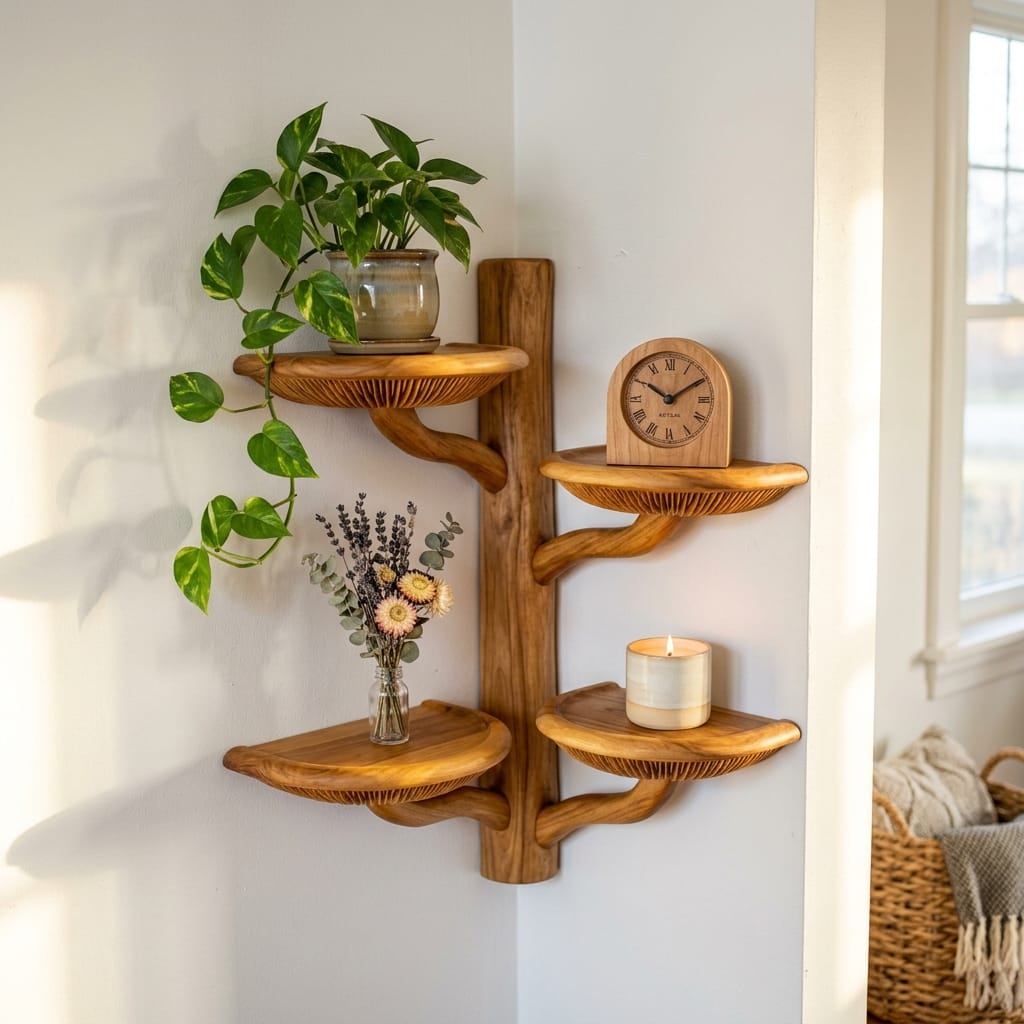
The Wall Mounted Mushroom Gill Tree Bookshelf With Curved Branch Shelves starts at $1,180-$2,280 and sits in that middle ground between shelf sculpture and daily-use bookshelf.

If you want a little more shelf platform and a more graphic silhouette, the Wall Mounted Mushroom Cap Tree Bookshelf With Half Moon Gill Shelves runs $1,480-$2,780 and gives more obvious book-display potential.

These pieces are more space-efficient than freestanding bookcases, but they ask more from the wall. If you plan to store books regularly, I would treat good mounting as non-negotiable.
Don't miss
These pieces qualify for 10% off orders over $2,000. Applied automatically at checkout.
10% off
Handcrafted Solid Wood Nursery Decor & Kids' Library
$2,834.00
10% off at checkout
10% off
Tree Bookshelf – Rustic Wooden Book Tree Shelf, Wall-Mounted Natural Wood Décor
$2,099.00
10% off at checkout
 10% off
Authentic Hand-Carved Solid Wood Tree Bookshelf Daybed - Sculptural Lounge Library
From $4,087.00
10% off at checkout
10% off
Authentic Hand-Carved Solid Wood Tree Bookshelf Daybed - Sculptural Lounge Library
From $4,087.00
10% off at checkout
 10% off
Rustic Tree Shaped Wooden Bookshelf with Branch Design for Living Room or Home Library
$2,145.00
10% off at checkout
10% off
Rustic Tree Shaped Wooden Bookshelf with Branch Design for Living Room or Home Library
$2,145.00
10% off at checkout
Real storage capacity: what to expect
This is where buyers usually get too optimistic. Mushroom bookshelves almost never match the clean linear capacity of a standard five-shelf bookcase. The shaped platforms and visual gaps reduce how many books you can line up edge to edge.
What they do better is selective storage. You can mix books with objects in a way that feels intentional. A few favorite hardcovers, a plant, a framed print, a ceramic piece, and a basket. That kind of arrangement looks better on a mushroom bookshelf than on a normal case, because the sculptural form gives each item more presence.
A good working rule is this:
- use lower and wider platforms for heavier books
- use upper and smaller caps for decorative items
- do not expect every cap to behave like a standard rectangular shelf
- treat the design as mixed storage, not archive storage
That is why I would not recommend a mushroom bookshelf as the only storage piece for someone with a large serious library. I would recommend it for someone who wants their active books visible and their room to feel more alive.
Best rooms for a mushroom bookshelf
A mushroom bookshelf tends to work best in rooms where function and mood need to cooperate.
Reading nook: probably the strongest match. You do not need maximum storage, but you do want a focal piece.
Bedroom: good if you want a shelf for current reads, small objects, and softer styling.
Kids room: works if the scale suits the child and the design is not overloaded with hard-to-reach storage.
Small living room: useful when a regular bookcase would feel too boxy or visually heavy.
If the room is already busy, though, a mushroom bookshelf can be too much. This is not neutral furniture. It wants attention.
Why handcrafted matters more in this category
On a mushroom bookshelf, bad craftsmanship shows immediately. Because the shapes are organic and the shelves are part sculpture, a factory-made version can look cheap fast. Uneven finishing, awkward cap proportions, and flat-looking carving all make the piece feel gimmicky.
That is why handcrafted by Vietnamese artisans matters here more than it does on a plain rectangular shelf. The carving depth, shelf transitions, and balance between art and function are what make the piece feel collectible rather than novelty-driven. With made to order solid wood pieces, each form also has a little individuality, which suits this style.
Honest downsides
The first downside is obvious. A mushroom bookshelf does not hold books as efficiently as a regular bookcase.
The second downside is price. Once you move into larger freestanding or wall-mounted bookshelf designs, you are paying for shape complexity and handwork, not just storage volume.
The third downside is organization. If you like your books lined up by height, author, or genre in long uninterrupted rows, a mushroom bookshelf may frustrate you.
The fourth downside is that it can dominate the room. In the right room that is great. In the wrong room it can feel overdesigned.
My recommendation
If you want the best balance between bookshelf function and visual personality, start with a freestanding mushroom bookshelf. It is more forgiving, more flexible, and easier to live with than a wall-mounted version.
If floor space is tight, a wall-mounted mushroom bookshelf can still be a strong choice, but only if you know the wall can support it and you are realistic about what you will store.
If your main goal is pure storage, buy a regular bookcase. If your goal is selective book storage with stronger room character, a mushroom bookshelf is worth it.
FAQ
Can a mushroom bookshelf replace a regular bookcase?
Sometimes, but only for smaller collections or mixed storage. If you need long uninterrupted rows for a large number of books, a regular bookcase is still more efficient. A mushroom bookshelf works better for curated storage.
Is a freestanding or wall-mounted mushroom bookshelf better?
Freestanding is usually better for everyday use because it is easier to place, easier to load, and does not depend on wall structure as much. Wall-mounted is better when floor space is limited and the stored items are more selective.
Are mushroom bookshelves good for hardcovers?
Yes, some are, especially larger freestanding pieces and well-mounted wall bookshelf forms. Still, I would keep heavier books on lower or wider platforms rather than assuming every shelf level handles weight equally well.
Why are mushroom bookshelves more expensive than basic bookcases?
Because you are paying for more than storage volume. The carving, shaped platforms, handmade finish work, and sculptural design all add labor. In better pieces, that extra cost is visible in the form and finish quality.
Where should I put a mushroom bookshelf?
Usually in a reading nook, bedroom, kids room, or smaller living room where it can act as both storage and a focal point. It works best when the rest of the room is not already overloaded with visually loud furniture.