















Quick view
- Why a record player stand affects sound in the first place
- What acoustic feedback means in plain English
- How vibrations travel from your room to the stylus
- Does turntable stand matter for sound if your turntable already has feet?
- The best material for a record player stand
- Why density and rigidity matter so much
- What isolation feet and pads actually do
- A simple at-home test for record player vibration damping
- Stand design details people often miss
- When the stand matters less
- Why solid wood stands tend to work well
- So, does your record player stand affect sound quality?
- Final takeaway
Shop this guide
Handcrafted Record Player Stand, made to order in solid wood.
 Mid Century Stepped Solid Wood Record Player Stand with Vinyl Storage and Drawers
From $2,318.0010% off at checkout
Mid Century Stepped Solid Wood Record Player Stand with Vinyl Storage and Drawers
From $2,318.0010% off at checkout
 Sculptural Wavy Solid Wood Record Player Stand with Vinyl Storage and Drawers
From $1,536.00
Sculptural Wavy Solid Wood Record Player Stand with Vinyl Storage and Drawers
From $1,536.00
 Biophilic Sculptural Solid Wood Vinyl Record Credenza - Handcrafted Turntable Console & Media Sideboard
From $2,743.0010% off at checkout
Biophilic Sculptural Solid Wood Vinyl Record Credenza - Handcrafted Turntable Console & Media Sideboard
From $2,743.0010% off at checkout
 Sculptural Handcrafted Solid Wood Vinyl Record Storage Console with Circular Tunnel Base
From $2,217.0010% off at checkout
Sculptural Handcrafted Solid Wood Vinyl Record Storage Console with Circular Tunnel Base
From $2,217.0010% off at checkout
 Sculptural Handcrafted Z-Shape Solid Wood Turntable Stand & 2-Tier Vinyl Record Storage Rack
From $1,564.00
Sculptural Handcrafted Z-Shape Solid Wood Turntable Stand & 2-Tier Vinyl Record Storage Rack
From $1,564.00
 Sculptural Handcrafted Wave Solid Wood Turntable Stand & Low-Profile Audio Console
From $1,543.00
Sculptural Handcrafted Wave Solid Wood Turntable Stand & Low-Profile Audio Console
From $1,543.00
If you have ever wondered whether a record player stand really changes what you hear, the short answer is yes.
A turntable is a mechanical playback device. The stylus sits in a groove that is tiny and easy to disturb. When the stand under your turntable moves, flexes, rings, or passes along vibration from the floor plus nearby speakers, that motion can reach the cartridge. Once that happens, your system may add rumble, muddy bass, smeared detail, or a low howl called acoustic feedback.
That does not mean you need an extreme audiophile shrine in your living room. It does mean the furniture under your turntable matters more than many people think.

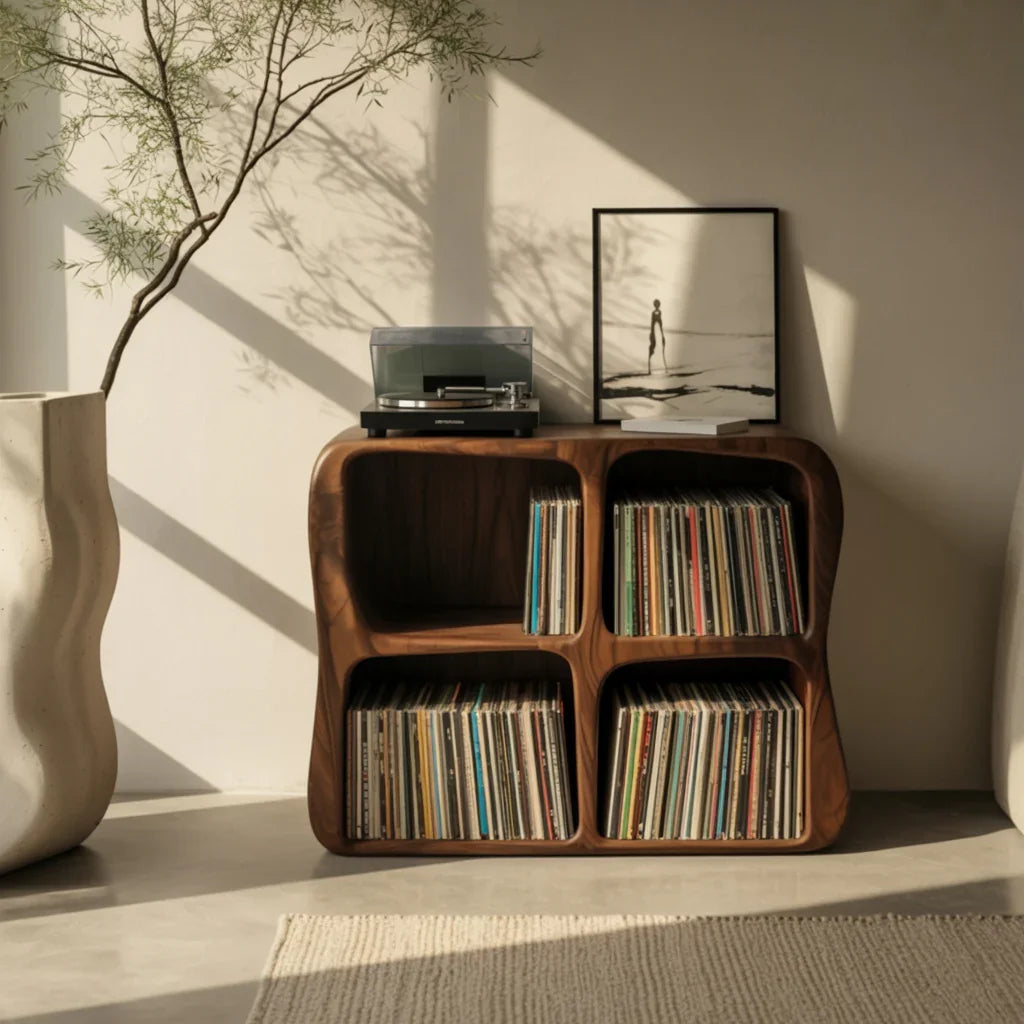
Handcrafted Record Stand Artisan Living Room Decor
In this guide, I’ll walk through how vibration gets into a turntable, why stand material matters, what isolation feet actually do, and a simple test you can try at home today. If you are shopping for a new record player stand, this will help you understand what to look for beyond looks alone.
Why a record player stand affects sound in the first place
A turntable has one job: keep the record spinning at a steady speed while the stylus reads the groove as cleanly as possible. Anything that shakes the plinth, platter, tonearm, or cartridge can interfere with that job.
The main trouble comes from a few common vibration paths:
- Footsteps traveling through a springy floor
- Bass energy from speakers entering the furniture
- Stand panels that flex or ring when music gets loud
- Small movements caused by an uneven or wobbly surface
When those vibrations reach the stylus, the cartridge cannot tell the difference between music cut into the groove and unwanted motion coming from the room. It simply turns movement into signal. That is why the stand can affect record player furniture sound quality even when the turntable itself is perfectly good.
This is also why people sometimes upgrade cartridges, amps, or speakers and still feel like something is off. The weak point may be sitting right under the turntable.
What acoustic feedback means in plain English
“Acoustic feedback loop” sounds technical, though the idea is simple.
Your speakers make sound. Some of that sound, especially bass, shakes the floor and the stand. The shaking reaches the turntable. The cartridge picks up that extra motion and sends it back through the amp and speakers. Then the speakers shake the room again, and the cycle keeps feeding itself.
At low levels, this can show up as bloated bass or a faint haze over the music. At higher volume, it can turn into a rumble, a hollow boom, a deep howling sound, or an obvious loss of control. If you want a plain-language overview of the feedback principle itself, Wikipedia has a straightforward page on acoustic feedback.
If you have ever walked near your turntable and heard the speakers react, or turned the volume up and noticed the bass getting loose, there is a good chance vibration and feedback are part of the problem.


How vibrations travel from your room to the stylus

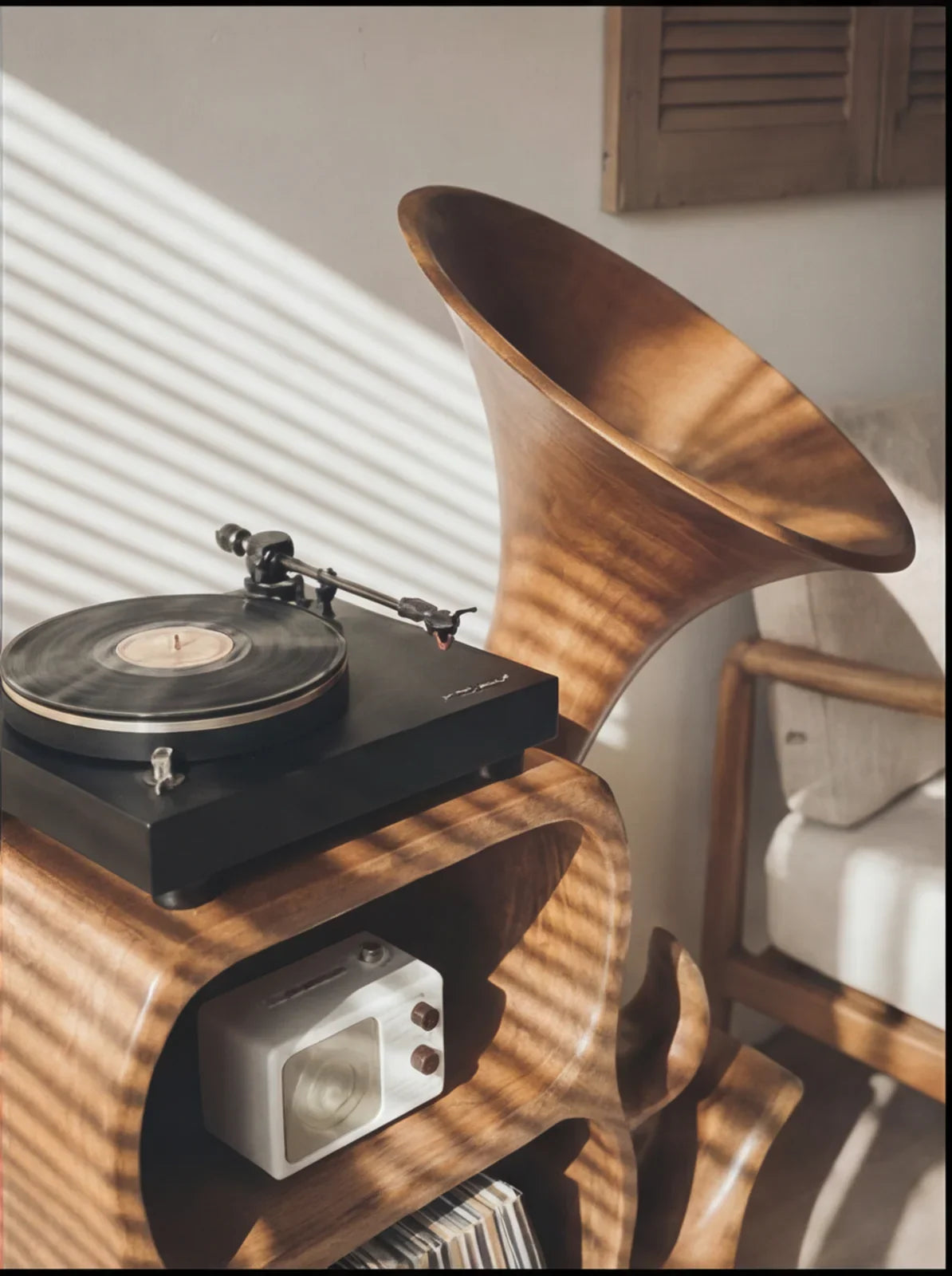
Farmhouse Turntable Station with Storage - Handcrafted Solid Wood Record Player Stand
Most people picture vibration as one big issue, though it usually comes from several sources at once.
1. Floor-borne vibration
This is the classic apartment or old-house problem. Wood floors can bounce a little when someone walks by. That energy moves into the legs of the stand, then into the turntable. Suspended floors are often worse than concrete slabs.
2. Air-borne vibration from speakers
Low frequencies carry a lot of energy. If your speakers sit close to the turntable stand, bass waves can excite the stand directly. Shelves, thin panels, hollow cabinets, and lightweight frames often respond the most.
3. Self-generated vibration inside the furniture
Some stands have large unsupported panels, loose joints, or lightweight construction that lets parts vibrate with the music. The stand becomes a little instrument of its own, and that is not what you want.
4. Poor leveling and instability
A stand that rocks even a little can affect tracking. A turntable needs a stable and level surface so the stylus sits in the groove correctly. If the surface is off, anti-skate and tracking force may not behave as intended.
Does turntable stand matter for sound if your turntable already has feet?
Yes. Built-in feet help, though they are only one layer of defense.
Turntable feet are designed to reduce some vibration before it reaches the plinth. Still, they can only do so much if the surface underneath is shaky, hollow, or resonant. Think of them as part of a system. A solid stand plus decent turntable feet usually works better than soft feet on a flimsy table.
This is why turntable isolation is often about stacking small improvements:
- A stable stand
- A dense top surface
- Good leveling
- Isolation feet or pads
Each part helps cut down the amount of motion that reaches the stylus.
Don't miss
These pieces qualify for 10% off orders over $2,000. Applied automatically at checkout.
10% off
Mid Century Stepped Solid Wood Record Player Stand with Vinyl Storage and Drawers
From $2,318.00
10% off at checkout
10% off
Biophilic Sculptural Solid Wood Vinyl Record Credenza - Handcrafted Turntable Console & Media Sideboard
From $2,743.00
10% off at checkout
10% off
Sculptural Handcrafted Solid Wood Vinyl Record Storage Console with Circular Tunnel Base
From $2,217.00
10% off at checkout
 10% off
Sculptural Handcrafted Live Edge Tree Trunk Solid Wood Vinyl Record Player Stand & Media Console
From $2,178.00
10% off at checkout
10% off
Sculptural Handcrafted Live Edge Tree Trunk Solid Wood Vinyl Record Player Stand & Media Console
From $2,178.00
10% off at checkout
The best material for a record player stand
Material changes how a stand stores vibration, passes it along, or damps it. There is no single magic answer for every room, though some materials are more forgiving than others.
MDF
MDF is common because it is flat and fairly dense, with more acoustically dead properties than cheap hollow furniture. It usually performs better than very light particle board. Many solid audio racks use MDF shelves for that reason.
The downside is long-term durability and character. MDF can sag over time under heavy loads, and it does not have the same structural life or natural grain strength as solid wood.
Particle board
This is usually the weakest option for a serious setup. It tends to be lighter and less rigid. It is also more prone to loosening or swelling if it gets damp. In lower-cost furniture, particle board often comes with thin veneers plus simple cam-lock construction, which can leave the whole piece less stable.
Can it work? Sure, in a light system at modest volume. Is it the best material for turntable stand use? Usually no.
Solid wood
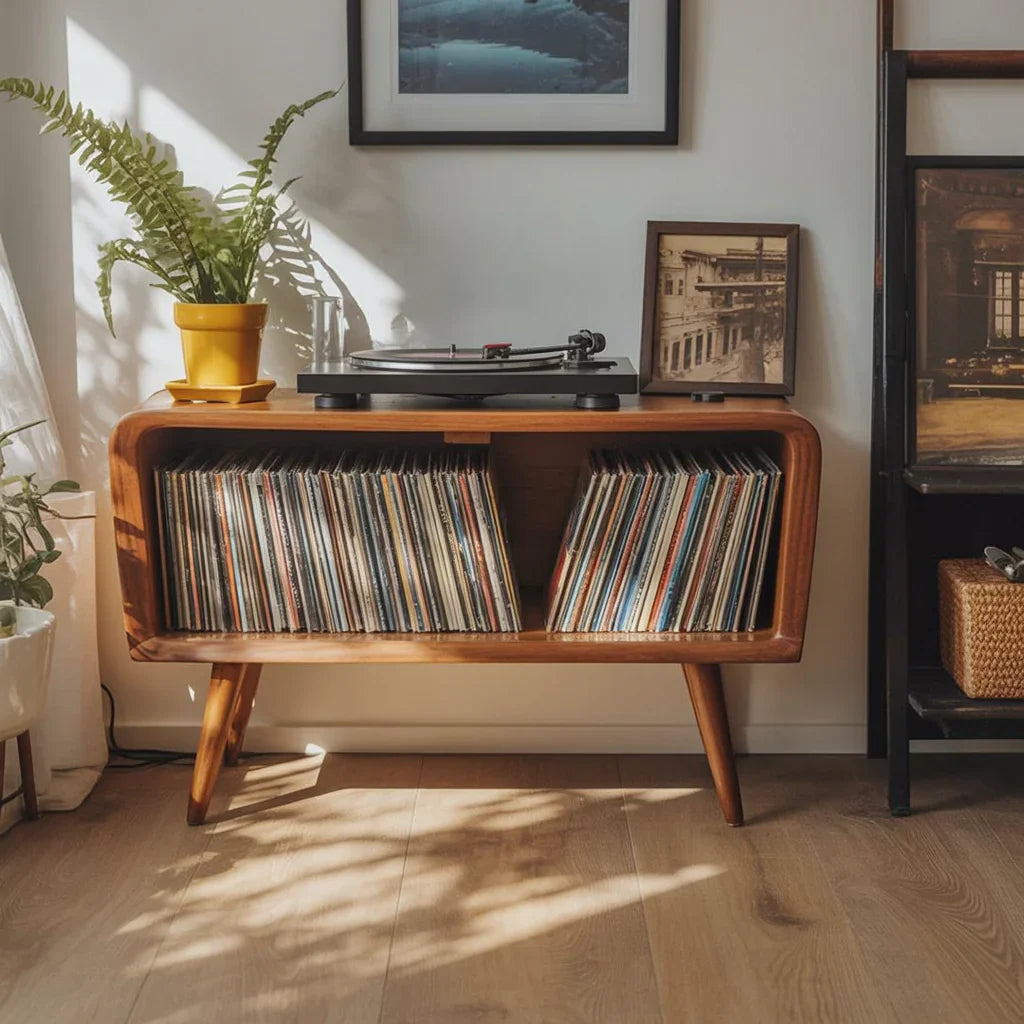
Solid wood has a lot going for it. It is strong and naturally dense. It can also be built with thick sections plus sturdy joinery. A well-made solid wood stand can feel planted in a way many flat-pack units never do.
Wood also has internal damping. It does not behave like a bell. Species, thickness, grain direction, and joinery all matter, though good solid wood tends to avoid the papery and hollow character you get from cheaper furniture.
This is one reason many vinyl fans like solid wood stands. They can provide mass and stiffness with a more controlled response without feeling cold or industrial.
Metal
Metal frames can work very well when they are heavy and rigid with proper damping. The catch is that metal can ring if the design is too light or the shelves are poorly chosen. A thin steel frame with a resonant top can sound worse than a thicker wood piece.
A strong metal rack with good shelf material plus proper isolation can be excellent. It just depends on execution.
Why density and rigidity matter so much
Two words come up again and again in turntable stand vibration discussions: mass and rigidity.
A heavier stand usually resists small movement better than a very light one. A rigid stand also flexes less when bass hits or someone walks nearby. That helps keep the platform under the turntable more stable.
At the same time, mass alone is not enough. A heavy object that rings or wobbles is still a problem. What you want is a stand that feels stable and quiet when you touch it.
Here is a simple real-world check:
- Push lightly on the stand from the side
- Press on the top panel near each corner
- Knock gently on the shelf plus side panels
- Notice whether it rocks, flexes, feels loose, or sounds hollow
If a piece of furniture feels lively under your hand, your cartridge may hear that too.
If you want more background on the broader engineering idea, Wikipedia also has a useful primer on vibration isolation.
What isolation feet and pads actually do
Isolation feet do not “improve the music” in some mystical way. Their job is more practical. They reduce how much vibration passes from the stand into the turntable, and in some cases they help drain energy or disperse it depending on the design.
Common options include rubber, sorbothane-type materials, cork-rubber blends, springs, and layered platforms. Each has strengths and tradeoffs. Soft materials can help with high-frequency buzz and small impacts. More advanced systems can help with footfall issues, though they must be matched to the weight of the turntable.
The main point is this: isolation works best when the stand underneath is already competent. Putting fancy feet on a shaky table is like buying expensive tires for a car with loose suspension.
A simple at-home test for record player vibration damping
You do not need lab gear to hear whether your stand matters.
Try this:
1. Put on a record you know well.
2. Set the volume to a normal listening level.
3. While the music plays, tap the stand lightly with a fingertip or knuckle.
4. Listen through the speakers.
If you hear a clear thump, a rumble, ringing, or a sharp knock through the system, the stand is passing vibration into the turntable.
You can also repeat the test in a few spots:
- The top surface under the turntable
- A side panel or leg
- The floor right beside the stand
- The shelf holding records or gear
Then try one change at a time. Move the speakers farther away. Add isolation feet. Level the stand. Place the turntable on a denser platform. The point is to learn which path is causing the trouble.
Another easy check is the footstep test. Walk normally around the room while a record is playing. If you hear the sound shift, skip, lose focus in the bass, or bloom at low frequencies, your setup is sensitive to floor-borne vibration.
Stand design details people often miss
Material matters, though design matters too.
A good record player stand usually has:
- Wide stance and solid footing
- Thick top surface with low flex
- Tight joinery and strong overall stiffness
- Enough mass to stay settled during playback
Shelf layout matters as well. If the stand stores records, that added weight can help stability when the structure is built well. If the storage section rattles or the dividers are thin, it can add noise instead.
Dimensions matter too. A turntable should sit with breathing room around it and stay fully supported. It should also be easy to level. Cramming it onto a narrow top is asking for trouble.
When the stand matters less
There are setups where the stand is less of a bottleneck.
If your turntable sits on a concrete floor, far from speakers, with strong built-in isolation plus moderate listening levels, furniture differences may be smaller. In that case, you may hear only subtle gains from changing stands.
Still, subtle is not the same as irrelevant. Vinyl playback is full of small mechanical factors that add up.
Why solid wood stands tend to work well
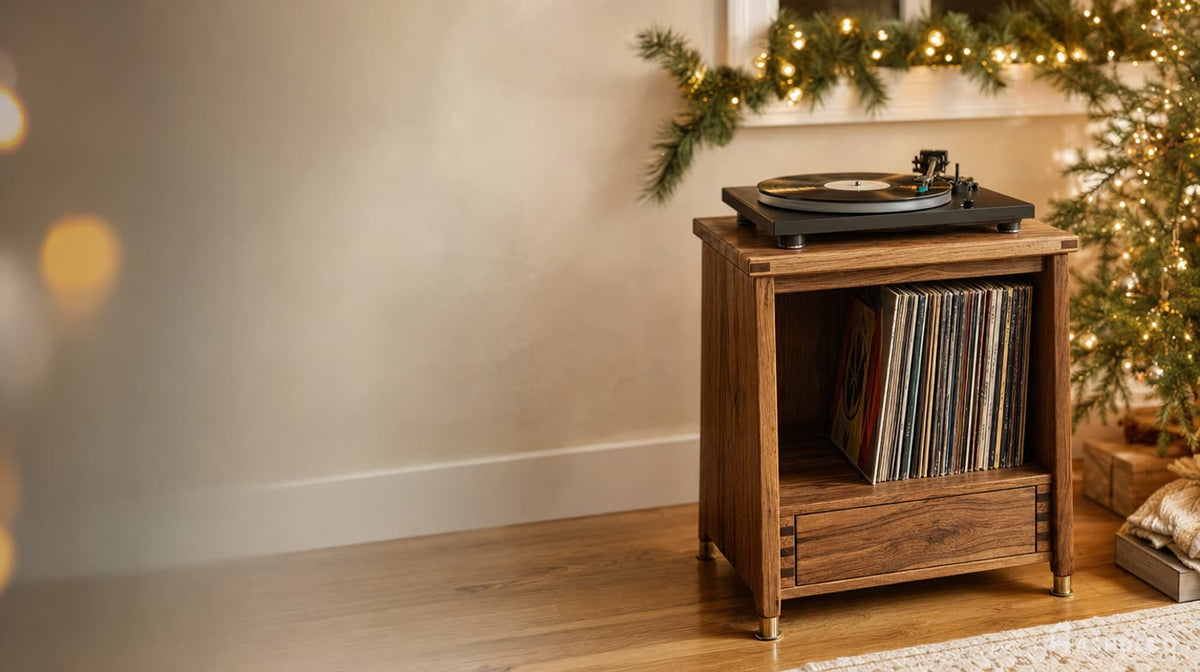
Solid wood is popular for good reason. In a well-built stand, it brings useful weight and stiffness along with natural damping. It can also hold joinery firmly over time, which helps the stand stay quiet instead of loosening into squeaks and wobble.
For people who want furniture that sounds good and looks like it belongs in a home, solid wood is a very sensible middle ground. You get acoustic benefits without ending up with something that looks like lab equipment.

Sculptural Wooden Record Player Stand with Vinyl Storage - Organic Modern Turntable Console
That is part of the appeal of Ashdeco’s approach. Their record player stands collection focuses on handcrafted solid wood pieces made by Vietnamese artisans, with each piece carrying its own grain and character. The brand also has strong customer feedback at 4.9 stars across 387 reviews, which says a lot about consistency.
If you want more shopping guidance, Ashdeco already has a product-focused roundup at Best Record Player Stands 2026 and a separate comparison on DIY vs Handcrafted Record Player Stand. This article is the science side of the conversation.
So, does your record player stand affect sound quality?
Yes. It can affect bass clarity, background noise, tracking stability, resistance to feedback, and the overall calmness of the platform under your deck.
The biggest gains usually come when you fix obvious problems:
- A wobbly stand
- Thin and hollow furniture
- Speakers too close to the turntable
- Springy floors with poor isolation
If your current setup already feels solid and quiet, you may hear a smaller change. If your furniture is light and shaky, the difference can be easy to hear.
The good news is that this is one of the more understandable parts of vinyl setup. You do not need magic tweaks. You need stable support, sensible isolation, enough mass, and furniture made with care to stay out of the music.
That is what a good record player stand is supposed to do.
Final takeaway
A turntable is reading microscopic information from a spinning groove. That process is sensitive by nature. The stand under it becomes part of the playback chain whether you planned for it or not.
If you want cleaner sound, start with the basics. Check stability. Check vibration paths. Try the tap test. Then look at the furniture itself. In many rooms, a well-built solid wood stand is a smart answer because it offers density and rigidity plus the day-to-day durability people actually live with.
Simple and very real.