Quick view
Shop this guide
Handcrafted Lamps for Modern Homes, made to order in solid wood.
 Christmas edit
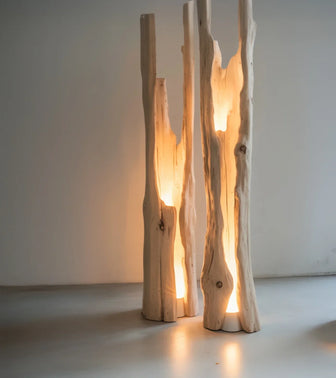
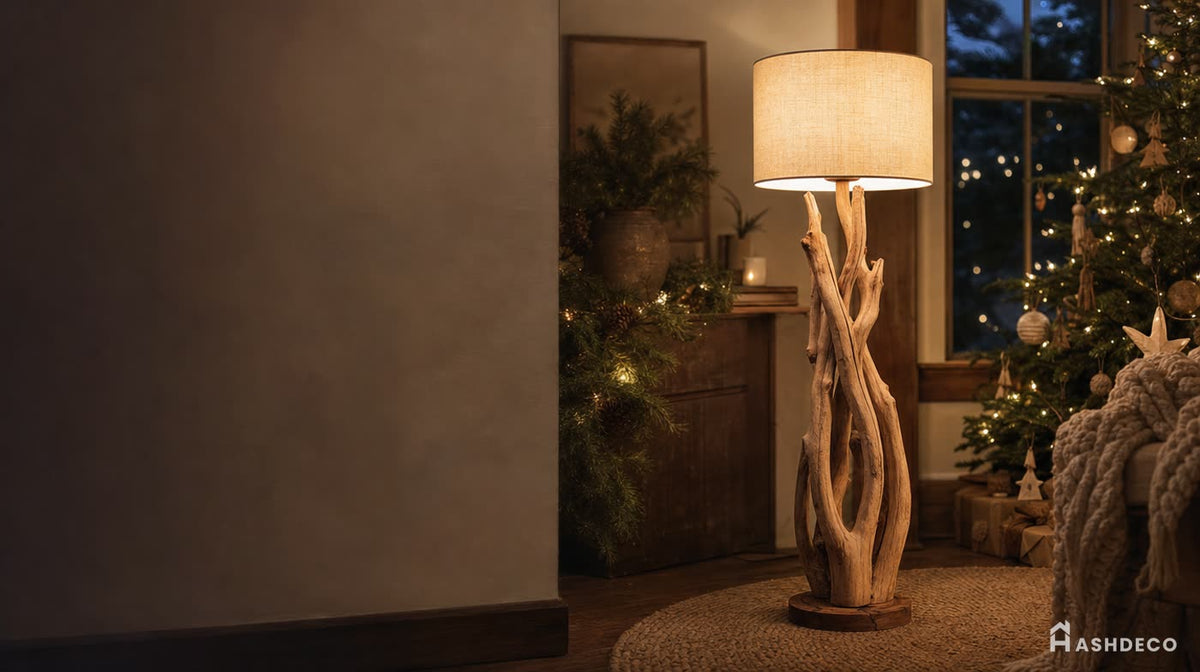
Rustic Driftwood Floor Lamp – Handmade Solid Wood Standing Light for Home Décor
From $1,220.00
Christmas edit
Rustic Driftwood Floor Lamp – Handmade Solid Wood Standing Light for Home Décor
From $1,220.00
 Christmas edit
Driftwood Wall Sconce - Handcrafted Rustic Wooden Wall Lamp
From $650.00
Christmas edit
Driftwood Wall Sconce - Handcrafted Rustic Wooden Wall Lamp
From $650.00
 Christmas edit
Rustic Driftwood Floor Lamp with Shelves – Handmade Wooden Standing Light
From $2,350.0010% off at checkout
Christmas edit
Rustic Driftwood Floor Lamp with Shelves – Handmade Wooden Standing Light
From $2,350.0010% off at checkout
 Sculptural Twisted Solid Wood Floor Lamp - Organic Modern Statement Lamp
From $1,780.00
Sculptural Twisted Solid Wood Floor Lamp - Organic Modern Statement Lamp
From $1,780.00
 Christmas edit
Twisted Vine Wooden Floor Lamp - Handcrafted Driftwood Standing Light With Leaf Shade
From $1,280.00
Christmas edit
Twisted Vine Wooden Floor Lamp - Handcrafted Driftwood Standing Light With Leaf Shade
From $1,280.00
 Christmas edit
S-Curve Wooden Floor Lamp - Driftwood Standing Light With Dual Glow Openings
From $1,480.00
Christmas edit
S-Curve Wooden Floor Lamp - Driftwood Standing Light With Dual Glow Openings
From $1,480.00
A carved mushroom shelf should look carved, not merely shaped and stained. That sounds obvious, but it is exactly where many shoppers get fooled. A lot of mushroom shelves borrow the silhouette of a cap or trunk, yet the surface treatment is flat, the underside has no real depth, and the whole piece reads more like themed decor than actual craftsmanship.
The difference usually comes down to carving. Real carving creates shadows, edge variation, and texture you can see before you even touch the shelf. On a good solid wood piece, the cap underside has dimension, the gill lines look worked by hand, and the shelf feels like sculpted furniture instead of a novelty item. That is the angle buyers should care about.
What makes a carved mushroom shelf look real
A carved mushroom shelf looks real when the carving changes the form, not just the outline. You should see depth under the cap, believable transitions from trunk to shelf platform, and irregular detail that feels shaped by hand rather than repeated by a machine. The best pieces use carving to define the shelf from multiple angles, especially around the gill detail and cap edges.
That matters because mushroom shelves live or die by their sculptural quality. If the carving is weak, the shelf stops feeling special and starts feeling gimmicky.
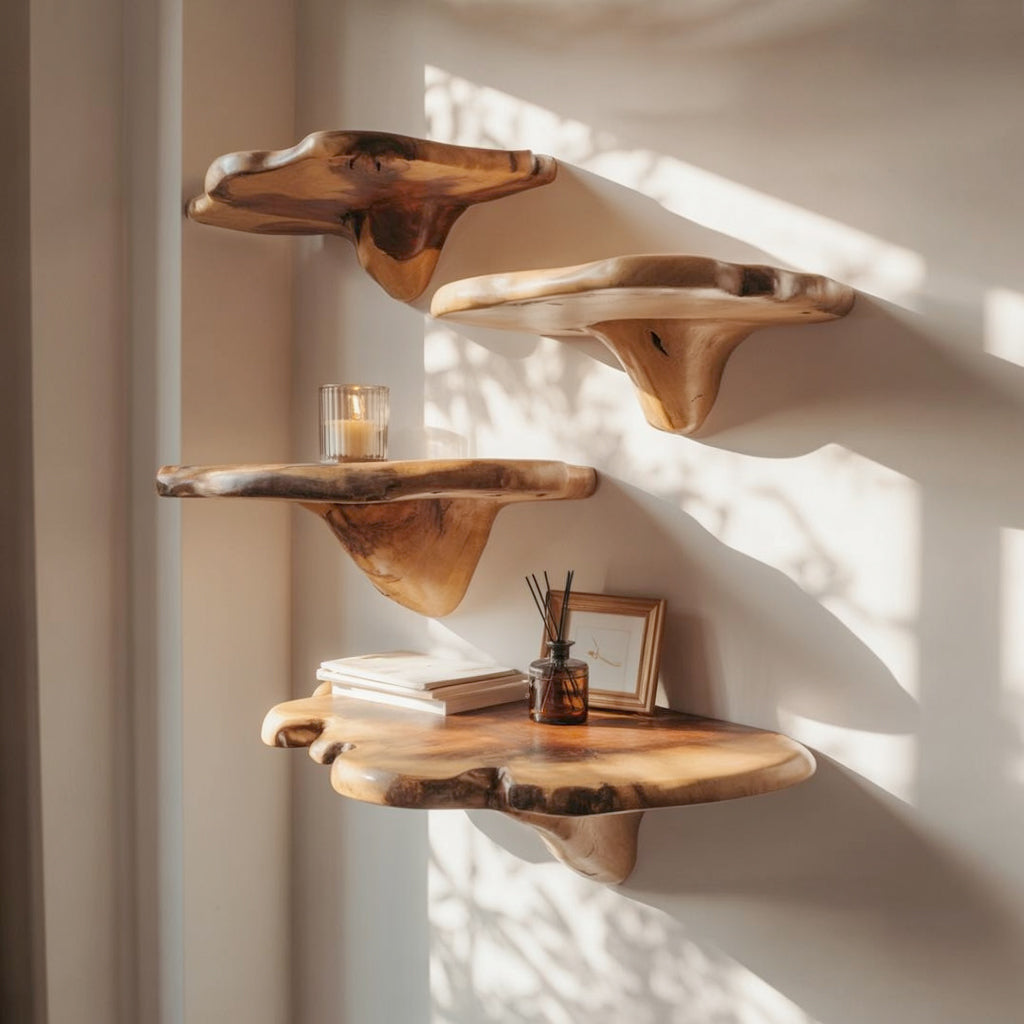
A strong entry point into this category is the Sculpted Mushroom Floating Shelf With Carved Gill Detail, priced at $260-$380. It is compact, clear in its intent, and easy to read as carved rather than simply cut into a rounded shape.

If you compare that type of shelf to generic mushroom decor, the difference is immediate. The carved underside is doing real work. It adds shadow, shape, and a sense of material depth.
Why gill carving matters more than most shoppers realize
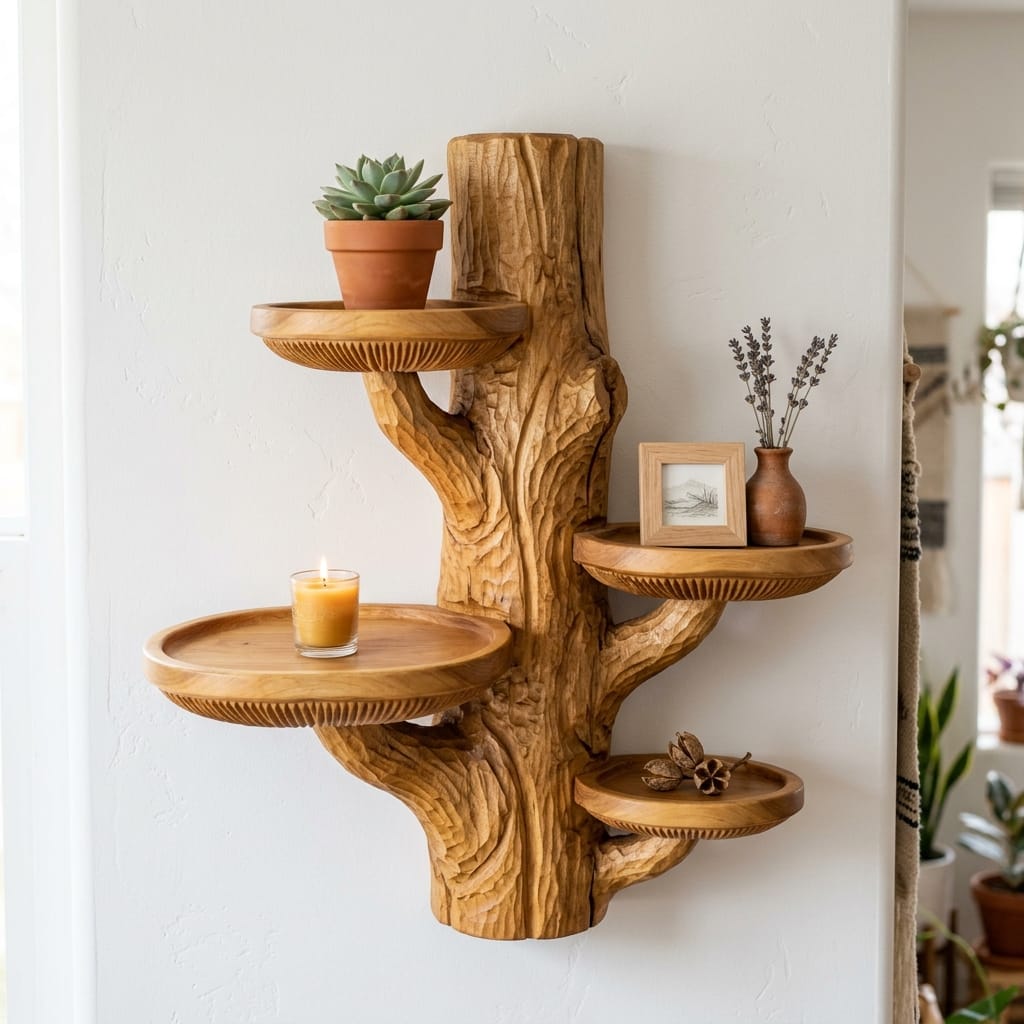
Gill carving is one of the clearest signals that a mushroom shelf was actually sculpted, not just designed around a mushroom theme. The carved lines under the cap create light and shadow, which is what makes the form feel botanical instead of cartoonish. On stronger pieces, the gill detail is not an afterthought. It is one of the main reasons the shelf looks convincing.
This is where many product listings stay vague. They say "mushroom shelf" or "woodland shelf" without showing whether the shelf has any meaningful under-cap detail. Buyers should not ignore that. On this category, the underside is half the design.
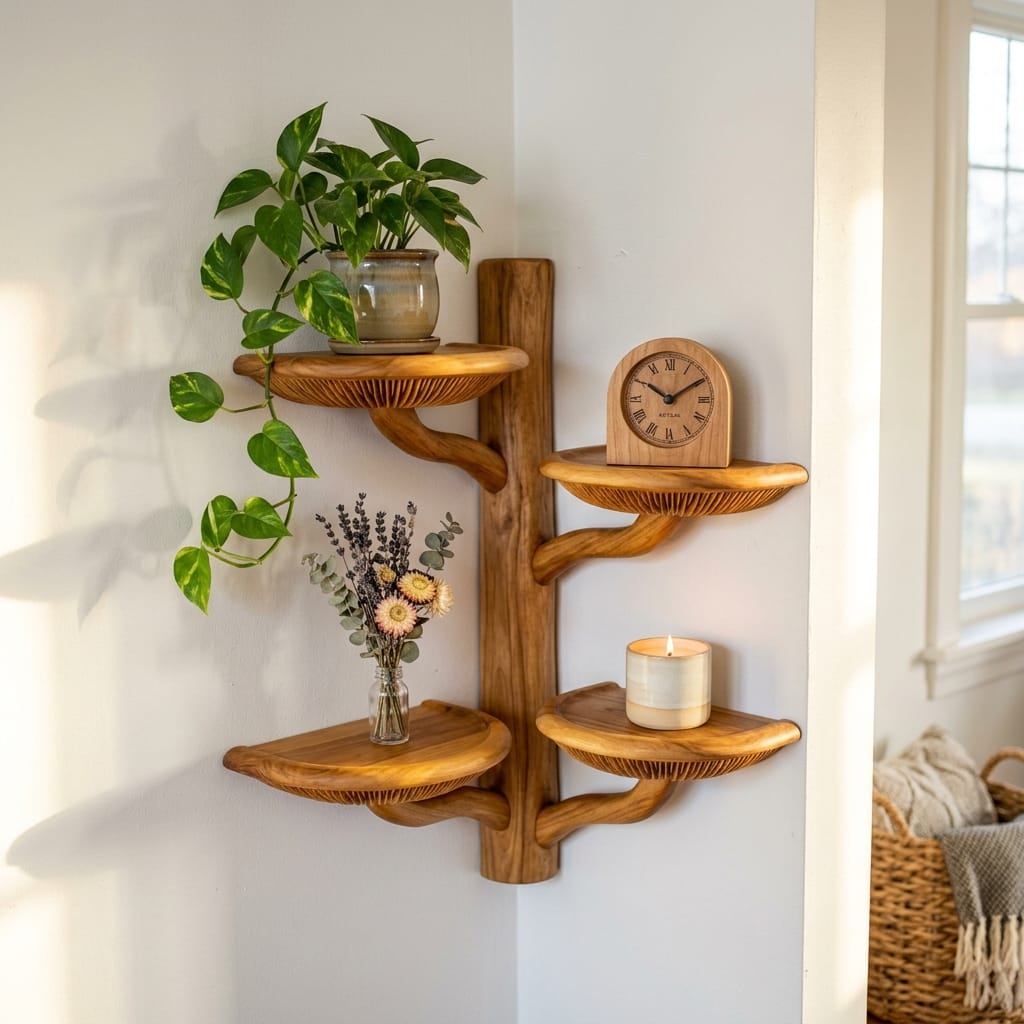
The Tree Branch Mushroom Wall Shelf with 4 Wide Dished Platforms at $1,080-$2,880 shows why. Its carved gill detail is not limited to one tiny accent. It helps define the entire shelf structure.

Tree Branch Mushroom Wall Shelf with 4 Wide Dished Platforms | $1,080-$2,880
Because Ashdeco pieces are handcrafted by Vietnamese artisans, the gill carving also has slight variation that works in the shelf's favor. It does not feel stamped or identical from edge to edge. That human irregularity is part of what makes the piece believable.


Real carving vs fake detail: how to tell the difference
A real carved mushroom shelf will show depth changes in the wood itself. A fake one usually depends on paint, shallow grooves, or surface patterning that looks decorative from the front but falls flat from side angles. The fastest way to judge the difference is to stop looking only at the silhouette and start looking at the transitions.
Here is what to check.
| Detail | Real carved shelf | Weak or fake carved look |
|---|---|---|
| Cap underside | Visible depth and shadow | Mostly flat |
| Gill lines | Irregular, hand-worked, dimensional | Shallow, repetitive, decorative only |
| Edge transitions | Soft but sculpted | Abrupt or cut-looking |
| Trunk connection | Feels grown into the form | Feels attached on |
| Overall read | Furniture-sculpture hybrid | Themed decor |
This is why the phrase carved mushroom shelf matters more than the generic phrase mushroom shelf. The buyer is not just shopping for shape. They are shopping for whether the wood has actually been worked into something that feels substantial.
If you want a more dramatic example, the Oyster Mushroom Tiered Wall Shelf with 4 Wide Caps runs $1,480-$4,080 and pushes the exposed carving much further.

Oyster Mushroom Tiered Wall Shelf with 4 Wide Caps | $1,480-$4,080
That kind of shelf does not rely on mushroom branding language to feel unique. The carving already proves the point.
Small carved mushroom shelf vs large sculptural wall shelf
Not every buyer needs a large statement piece. In fact, many rooms benefit more from one compact carved shelf than from a huge wall installation. Small carved mushroom shelves work best when you want one accent with strong detail. Larger shelves make sense when the wall itself is supposed to become part of the decor story.
If you are decorating a bedroom, powder room, nursery wall, or small reading corner, compact pieces often feel easier to live with. They cost less, mount more easily, and still deliver the carved look.
If the goal is a statement wall, though, something like the Helical Mushroom Wall Shelf with 4 Graduated Round Platforms at $1,275-$2,450 starts acting less like a shelf and more like wall sculpture that happens to hold objects.

Helical Mushroom Wall Shelf with 4 Graduated Round Platforms | $1,275-$2,450
That is why buyers should think in terms of role, not just price. Do you want a carved accent shelf, or do you want a carved focal piece? Those are different purchases.
If you need cleaner wall storage without losing natural character, the floating shelves collection is still useful for comparison. If you want more storage structure with similar organic personality, the tree bookshelf collection can be the next step.
Don't miss
These pieces qualify for 10% off orders over $2,000. Applied automatically at checkout.
10% off
Rustic Driftwood Floor Lamp with Shelves – Handmade Wooden Standing Light
From $2,350.00
10% off at checkout
 10% off
Rustic Driftwood Floor Lamp with Side Table – Solid Wood Standing Light with Rattan Shade
From $2,350.00
10% off at checkout
10% off
Rustic Driftwood Floor Lamp with Side Table – Solid Wood Standing Light with Rattan Shade
From $2,350.00
10% off at checkout
 10% off
Sculpted Spiral Twist Floor Lamp Handcrafted Solid Timber Standing Light with Linen Drum Shade
From $2,280.00
10% off at checkout
10% off
Sculpted Spiral Twist Floor Lamp Handcrafted Solid Timber Standing Light with Linen Drum Shade
From $2,280.00
10% off at checkout
 10% off
Biomorphic Sculpted Hollow Floor Sculpture Organic Timber Art Piece Hand Carved in Solid Wood
From $2,280.00
10% off at checkout
10% off
Biomorphic Sculpted Hollow Floor Sculpture Organic Timber Art Piece Hand Carved in Solid Wood
From $2,280.00
10% off at checkout
Where carved mushroom shelves look best
Carved mushroom shelves look strongest in rooms that benefit from a single organic focal point. Bedrooms, reading nooks, nursery walls, powder rooms, and small living room corners are all strong candidates. The reason is simple. In those spaces, you do not need the shelf to solve every storage problem. You need it to add texture and shape.
They usually work less well in busy utility rooms or spaces that already have a lot of visual competition. A carved mushroom shelf wants some breathing room. If every other object in the room is loud, the shelf loses impact.
My blunt take is this: if the room needs efficient storage, buy something more straightforward. If the room needs warmth and one memorable object, a carved mushroom shelf makes sense.
Honest downsides
The first downside is price. Real carving takes labor, and labor costs money. That is why a genuinely carved shelf often costs more than a simpler themed shelf.
The second downside is storage efficiency. Carved mushroom shelves are usually better at selective display than at brute storage. The more sculptural the shelf, the less it behaves like a basic rectangular ledge.
The third downside is placement. A strong carved form can dominate a small wall if the room is already full of decor.
The fourth downside is expectation. Some buyers see "mushroom shelf" and expect either a cheap novelty or a full bookcase. A carved mushroom shelf is often neither. It sits somewhere between art object and furniture.
My recommendation
If you are buying your first carved mushroom shelf, start with a compact piece that clearly shows gill carving. It lets you see whether you actually want the carved look in your space without jumping straight into a large statement shelf.
If you already know you want one-of-a-kind pieces and the wall can support them, move up to a larger carved design like the tree branch, oyster, or helical forms. Those are the products that justify the category.
If the shelf does not show meaningful under-cap detail, I would skip it. In this product family, carving is not a bonus. It is the reason the shelf exists.
FAQ
What is a carved mushroom shelf?
A carved mushroom shelf is a shelf shaped and sculpted to resemble mushroom forms, usually with carved cap edges, under-cap texture, or visible gill detail. The carving should affect the depth and silhouette of the piece, not just add a shallow decorative pattern.
How can I tell if mushroom shelf carving is real?
Look for visible depth under the cap, irregular carved lines, and transitions that feel worked into the wood rather than stamped onto the surface. If the underside looks flat in side-angle photos, the carving is probably weak.
Is gill carving worth paying more for?
Yes, when it is actually visible and dimensional. Gill carving changes the shelf from themed decor into something closer to sculptural furniture. On strong solid wood pieces, it is one of the main factors that makes the shelf look handcrafted.
Are carved mushroom shelves good for storage?
They are usually best for selective storage and display. Smaller shelves hold lighter objects well. Larger carved wall shelves can hold more, but this category still prioritizes form and visual character over maximum storage efficiency.
Where should I put a carved mushroom shelf?
The best spots are bedrooms, reading nooks, nursery walls, powder rooms, or any quiet wall that needs one strong focal object. They work best where the carving can be seen clearly and not get visually crowded out.