Most cat trees are ugly. That's not controversial. Walk into any pet store and you'll find carpet-wrapped particle board towers in beige and brown that look like they belong in a veterinary waiting room, not a living room. They work fine for cats, but they make the room worse.
Wooden cat trees exist as the alternative. Real wood, actual design, furniture you don't have to hide when guests come over. The category has grown fast over the past two years, and the options in 2026 range from simple branch-style perches to full sculptural climbing towers carved from solid wood.
Here's what's worth knowing before you buy one.
Why wooden cat trees are replacing carpet towers
Three reasons keep coming up from people who've made the switch:
They look like furniture. A solid wood cat tree with natural branch shapes or a mid-century silhouette reads as a room accent, not as pet equipment you're tolerating. You place it in the living room because it adds to the space, not in spite of how it looks.
They last longer. Carpet-wrapped cat trees shed, stain, and start smelling within a year. The sisal rope frays. The particle board wobbles. A solid wood cat tree doesn't have those problems. The wood surface is easy to clean, doesn't absorb odors, and won't degrade from daily climbing.
Cats prefer them. This surprises some people. Cats like gripping real wood. The bark texture and natural branch angles give them better purchase when climbing than smooth carpet over flat surfaces. Watch a cat on a real wood tree vs a carpet tower and the difference in confidence is visible.

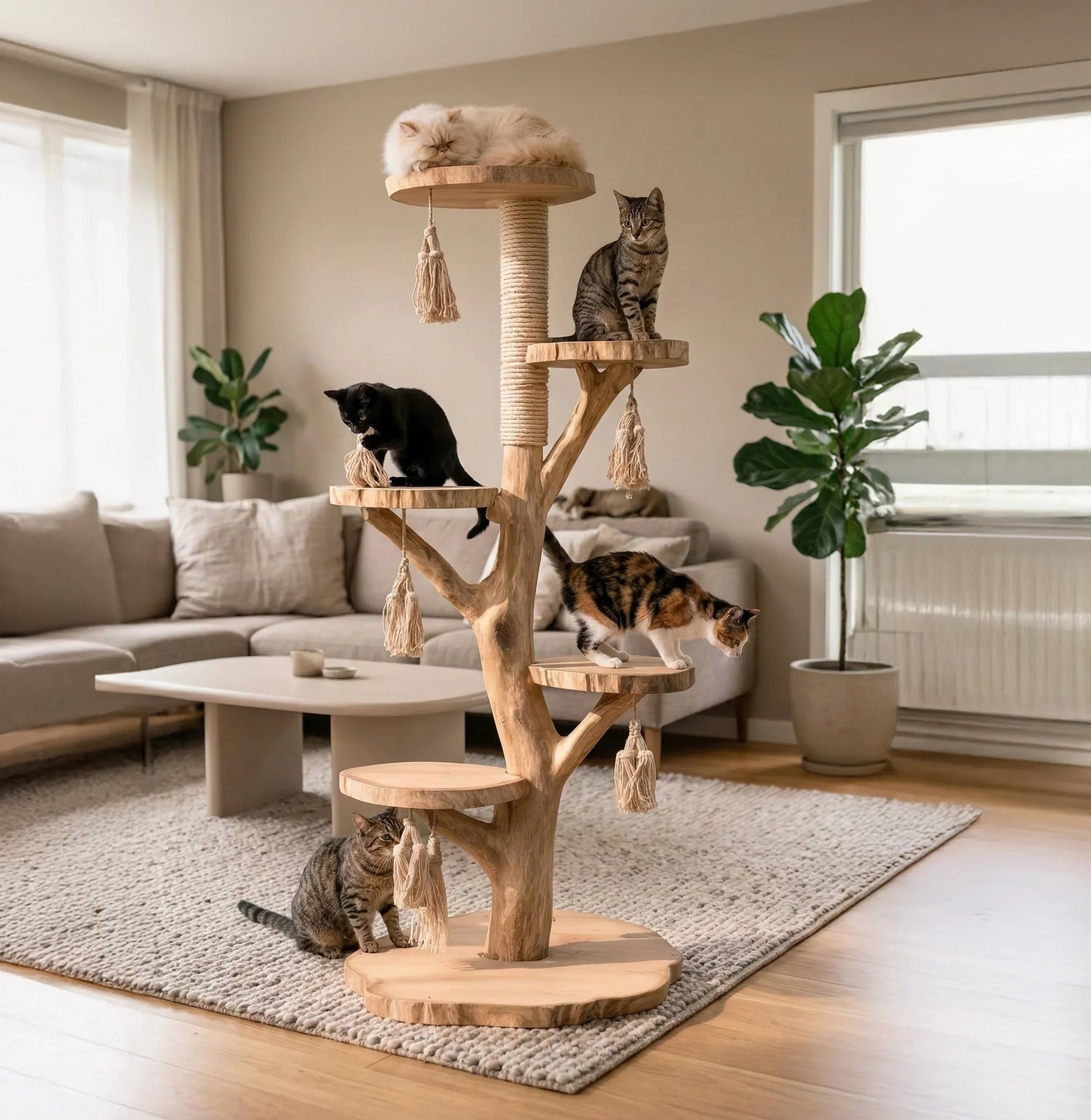
The Rustic Solid Wood Cat Tree with natural branch structure. Real wood branches give cats better grip and more interesting climbing paths than flat carpet platforms.
Types of wooden cat trees
The category covers a wide range. Knowing what's out there helps narrow down what fits your space and your cat.
Natural branch cat trees. Built around actual tree branches or carved to look like them. The branches serve as climbing paths and perching spots. These have the most organic look and give cats the most varied climbing experience. Heights range from 3 feet to floor-to-ceiling.
Mid-century style cat trees. Clean lines, angled legs, geometric platforms. These look like a piece of 1960s furniture that happens to have platforms at cat-friendly heights. Good for modern or minimal interiors where a rustic branch tree would feel out of place.

The Mid Century Cat Tree Tower. Designed to fit modern living rooms without looking like pet furniture.
Sculptural climbing towers. Carved solid wood pieces that function as both cat furniture and room sculpture. These blur the line between art and pet accessory. The shapes are organic, with hollows for hiding, platforms for perching, and textured surfaces for scratching.
Wall-mounted wooden cat shelves. Not a tower, but worth mentioning. Individual wooden platforms, bridges, and perches mounted on the wall create a climbing system without any floor footprint. Good for small apartments or as a complement to a main cat tree.
What to look for in a solid wood cat tree
Stability. The most important factor. A cat launching off a 5-foot tower generates significant force. The base needs to be heavy and wide enough to handle that. Solid wood helps here because the weight of the material itself adds stability. Carpet towers use light particle board and rely on the wide footprint of the base. Solid wood towers are inherently heavier and more stable.
Platform spacing. Cats need to be able to jump between platforms comfortably. 12-18 inches of vertical spacing between perches works for most adult cats. Larger breeds (Maine Coons, Ragdolls) need more space. Kittens can handle closer spacing.
Surface texture. Cats scratch wood. That's a feature, not a bug. Raw or lightly finished wood gives cats a satisfying scratching surface and develops character over time as claw marks blend into the natural texture. High-gloss finishes look nice but offer less grip.
Enclosed spaces. Cats want at least one hiding spot. Look for a hollow, a nook, or a condo-style enclosure built into the structure. Carved wooden cat trees sometimes include these as natural-looking hollows in the trunk, which looks much better than the carpet-box condos on standard towers.

The Solid Wood Sculptural Cat Climbing Condo. Includes an enclosed space for hiding, with carved openings and solid wood throughout.
Solid wood vs engineered wood cat trees
Not all "wooden" cat trees are solid wood. Some use plywood, MDF, or particle board with a wood veneer or wood-print laminate. The label "wooden cat tree" can mean any of these.
How to tell the difference:
- Weight. Solid wood is heavy. If a 4-foot cat tree weighs under 20 lbs, it's probably not solid wood.
- Edges. Solid wood shows continuous grain on edges. Engineered wood shows layers or a different material at the edge.
- Price. Solid wood cat trees start around $300-400 for small ones and go well above $1,000 for large sculptural pieces. If a "solid wood" cat tree costs $150, check the materials list carefully.
- Sound. Knock on it. Solid wood sounds dense and resonant. Hollow or engineered construction sounds thin and echoey.
Engineered wood cat trees aren't bad. They're lighter, cheaper, and some are well-designed. But they don't have the stability, longevity, or feel of solid wood. And they definitely don't develop the same patina over time.
Do cats actually care about the material?
Yes, but not the way you might think. Cats don't care if their tree is "handcrafted" or "artisanal." They care about grip, height, stability, and hiding spots.
Solid wood delivers on all four. Natural bark or textured wood surfaces give excellent grip. The weight provides stability that doesn't wobble when they jump. And carved hollows in solid wood feel more enclosed and secure than fabric-covered boxes.
The biggest difference cats notice: stability. A wobbling cat tree makes cats hesitant to use the upper platforms. A heavy solid wood tree stays planted. Cats figure this out fast and use the stable tree more.
Fitting a wooden cat tree into your room
The whole point of a wooden cat tree is that it belongs in the room visually. A few placement tips:
Near a window. Cats want to watch outside. Place the tree where the top platform has a window view and you'll find your cat using it constantly.
In a corner but not hidden. Cat trees work well in corners for stability, but don't bury them behind furniture. Cats use trees more when they're in the social area of the room where they can watch the household.
Match the wood tone. If your other furniture is walnut or dark wood, a light pine cat tree will stick out. Match the general tone. Natural, rustic cat trees pair well with farmhouse or cottagecore rooms. Clean-lined mid-century cat trees pair with modern interiors.
Browse Ashdeco's cat tree collection to see solid wood options ranging from rustic natural branch trees to mid-century towers. Each one is handcrafted from real wood, designed to work as both cat furniture and living room decor.
Frequently asked questions
Are solid wood cat trees safe for cats?
Yes. Solid wood with a non-toxic finish is one of the safest cat tree materials. There's no carpet fiber for cats to ingest, no particle board dust, and no adhesive-covered sisal that can fray into swallowable strings. Make sure any finish is pet-safe (water-based polyurethane or natural oil finishes are standard for quality wooden cat trees).
Can cats scratch solid wood cat trees?
Cats will scratch them, and that's fine. Solid wood absorbs claw marks into its natural texture over time. The marks blend with the grain rather than destroying the surface the way they do with carpet or laminate. Some owners see the scratch marks as added character.
How heavy are solid wood cat trees?
Significantly heavier than carpet towers. A medium solid wood cat tree (4-5 feet) typically weighs 40-80 lbs depending on the wood species and design. That weight is the main reason they're more stable. Plan for two people when moving or positioning one.
What makes Ashdeco cat trees different from other wooden cat trees?
Ashdeco cat trees are hand-carved from solid wood by Vietnamese artisans. The branch structures, platforms, and any hollows or condos are shaped from real timber, not assembled from flat panels or wrapped in veneer. Each piece has natural grain variation and is shaped individually, so no two trees are identical. They're built as furniture first, pet equipment second.