

























Quick view
Shop this guide
Handcrafted Coat Racks & Hangers, made to order in solid wood.
 Christmas edit
Custom Wood Coat Rack – Driftwood Wall Mount Clothes Rack with Unique Hooks
From $697.00
Christmas edit
Custom Wood Coat Rack – Driftwood Wall Mount Clothes Rack with Unique Hooks
From $697.00
 Christmas edit
Antler Coat Rack – Rustic Handmade Wall Hook for Home & Office
From $517.00
Christmas edit
Antler Coat Rack – Rustic Handmade Wall Hook for Home & Office
From $517.00
 Christmas edit
Natural Driftwood Coat Rack – Handcrafted Tree Branch Standing Hanger for Entryway or Bedroom
From $1,056.00
Christmas edit
Natural Driftwood Coat Rack – Handcrafted Tree Branch Standing Hanger for Entryway or Bedroom
From $1,056.00
 Christmas edit
Ashdeco Solid Wood Coat Rack – Vintage 10 Hooks Hat & Clothes Stand
$520.00
Christmas edit
Ashdeco Solid Wood Coat Rack – Vintage 10 Hooks Hat & Clothes Stand
$520.00
 Christmas edit
Rustic Tree Branch Coat Rack – Solid Wood Standing Hanger for Home Decor
From $1,556.00
Christmas edit
Rustic Tree Branch Coat Rack – Solid Wood Standing Hanger for Home Decor
From $1,556.00
 Rustic Wooden Standing Coat Rack – Handmade Tree Branch Hook Organizer
From $1,056.00
Rustic Wooden Standing Coat Rack – Handmade Tree Branch Hook Organizer
From $1,056.00
Tree Coat Rack vs Wall-Mounted Coat Rack: Which One Actually Fits Your Entryway?
A tree coat rack is the kind of thing you don't think about until you need one - and then you really need one. Every time you walk in the door with a wet jacket and nowhere to put it, the problem gets harder to ignore. But the choice between a freestanding tree and a wall-mounted rack isn't just about style. It's about your space, your habits, and who else is living in the house.
Think about the feeling of coming home: you drop your bag, hang your coat, and the entry either feels like a space that's yours - warm, lived-in, organized - or it feels like a hotel hallway. A coat rack full of jackets is actually a good thing. It means people live here. There's life in this house. But you need the right type to make that happen without creating a tripping hazard or punching holes in a wall you don't own.

What a Tree Coat Rack Actually Does Better (And Where It Falls Short)
The standalone coat tree - the kind with a central pole and branches reaching out in every direction - has been around for over a century for a reason. It works.
It holds more than people expect. A typical tree coat rack has 6 to 8 branches, and each one can handle a jacket, a scarf, or a tote bag. For a family of four, that's enough capacity that nobody's fighting over the last hook at 7:45 AM. You can spread things out by person - top branches for adults, lower ones for kids - and the 360-degree layout means everyone can reach their stuff from any angle.
It moves with you. Renters, this is the big one. You set it down, you load it up, you take it with you when you move. No drilling, no landlord permission, no patching drywall before you hand back the keys. If you rearrange your furniture seasonally, the coat rack goes wherever the entry needs it.
It looks like a home, not a showroom. There's something about a wooden coat tree with a few jackets hanging off it that instantly makes an entry feel occupied and welcoming. It's a visual cue: people live here, this is a real space. Minimalist is great until it starts looking like nobody actually lives in the apartment.
Where it falls short: it takes up floor space - not a lot, but enough to notice in a narrow entry. And if you overload one side with heavy winter coats, it can lean. The base needs to be wide enough and heavy enough to counterbalance, which we'll get to in the buying section below.

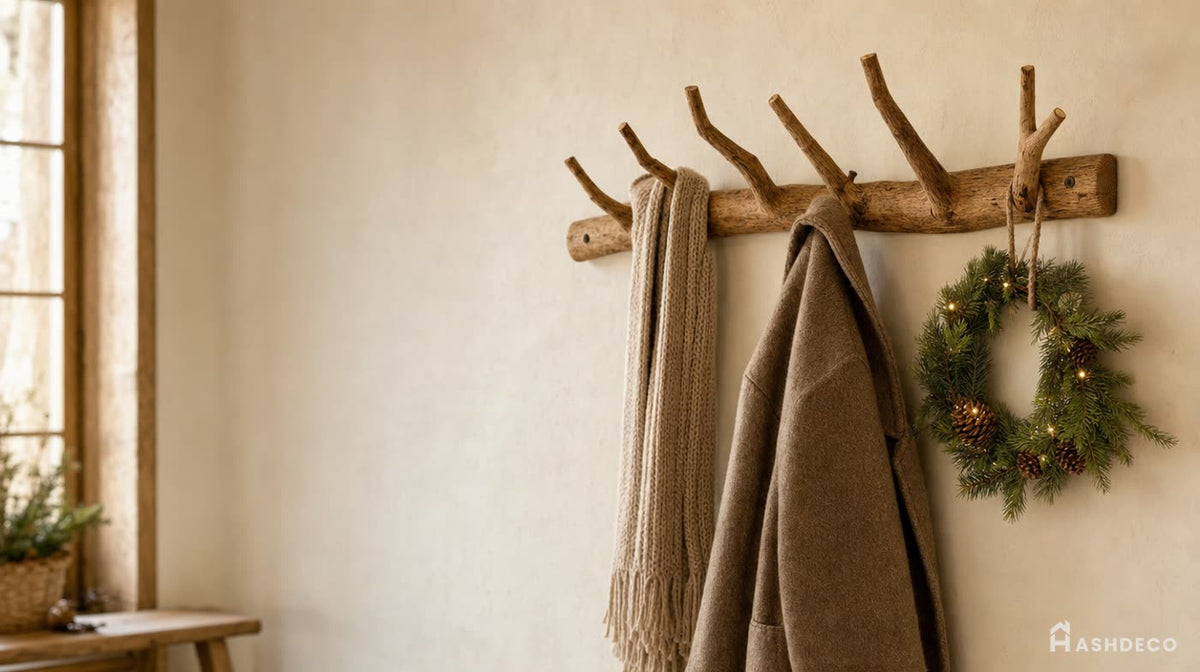
When a Wall-Mounted Coat Rack Is the Smarter Choice
The wall-mounted version - hooks or a bar bolted directly to the wall - is the other end of the spectrum. It's not better or worse; it's just solving for different constraints.
Zero floor footprint. This is the number one reason people go wall-mounted. In an entry that's barely wider than the door itself, every inch of floor matters. Mount the rack on the wall and you can sweep, run a robot vacuum, or set a shoe bin underneath without navigating around legs and a base.
It looks clean by default. A well-placed wall rack with evenly spaced hooks reads as intentional design, not a functional afterthought. Pair it with a small bench or a floating shelf and you've got a coordinated entry vignette without buying matching furniture.
It can handle heavy coats - if installed right. Each hook on a quality wall-mounted rack typically holds 3 to 5 kilograms. That's enough for a soaked winter jacket plus a wet umbrella on the same hook. But you need to anchor into a wall stud, not just drywall. Drywall anchors work for light jackets and scarves; they will pull out under the weight of a waterlogged parka.
Where it falls short: you're drilling holes. If you rent, that's a conversation with your landlord. If you change your mind about placement, you're left with anchor holes to fill. And capacity is lower - most wall racks have 4 to 6 hooks, which works fine for one or two people but gets tight when the whole family walks in at once.



What to Look for in a Tree Coat Rack
Not all coat trees are built the same. Here's what actually matters when you're comparing options online.
Base diameter: 14 to 16 inches minimum (35 cm = 13.8", 40 cm = 15.7"). Anything narrower and the rack will tip when you hang a heavy coat on one side. The base is your insurance policy against a toppled coat rack at the worst possible moment - like when you're rushing out the door with your arms full.
Total weight: at least 4 to 5 kg. Heavier base = more stable. A lightweight metal tree might look sleek, but it needs a wider base to compensate. Solid wood trees naturally have the weight advantage - the material works for you, not against you.
Height: 67 to 71 inches (about 5'7"–5'11") for adults. This puts the top branches at a comfortable reach for most people. If you have kids, look for a tree that also has lower branches around 39 to 47 inches so they can hang their own stuff without asking for help.
Branch count: 6 to 8 for a family. Two people can get by with 4 or 5. Four or more? You want at least 6, ideally 8. More branches also mean you can spread heavy items across different sides, which keeps the center of gravity balanced.
Smooth finish on every branch. Rough wood edges or sharp metal tips will snag sweaters, scarves, and silk linings. Run your hand along a branch before buying (or check reviews if ordering online). If it catches on your skin, it'll catch on your clothes.

What to Look for in a Wall-Mounted Coat Rack
Same idea - here's what to check when the rack goes on the wall instead of the floor.
Mounting method: stud vs. anchor. If you're hanging winter coats, find the stud and bolt into it. A single wood screw into a 2x4 stud holds far more than any drywall anchor. For light everyday use - a cardigan, a tote bag - a quality toggle anchor in drywall is fine. But know the difference before you load it up.
Hook spacing: 6 to 8 inches apart. Less than that and coats will overlap, bunch up, and wrinkle. More than 10 inches (25 cm ≈ 9.8") and you're wasting wall space between hooks. The sweet spot gives each garment room to hang straight without touching its neighbor.
Bar length: 24 to 36 inches for small entries, 36 to 48 inches for families. A short bar with 4 hooks fits nicely beside a door. A longer bar with 6 to 8 hooks gives the whole family a spot. Measure your wall before ordering - the last thing you want is a rack that extends past the wall edge into the adjacent room.
Material near the door matters. If your entry gets rain splash or humidity from wet coats coming in off the street, metal hooks with a powder-coated finish resist moisture better than raw wood. Wood can work too if it's sealed, but check the finish quality.
Install height: 60 to 67 inches from the floor. This keeps coat hems off the ground and puts the hooks at a natural reach for most adults. If the tallest person in your house is under 5'5" (165 cm), aim for the lower end of that range. Kids' hooks can go separately at 39 to 43 inches.

Don't miss
These pieces qualify for 10% off orders over $2,000. Applied automatically at checkout.
 10% off
Sculptural Solid Wood Hall Tree - Artistic Branch Tree Hanger - Unique Live Edge Entryway Coat Rack
$2,234.00
10% off at checkout
10% off
Sculptural Solid Wood Hall Tree - Artistic Branch Tree Hanger - Unique Live Edge Entryway Coat Rack
$2,234.00
10% off at checkout
 10% off
Handcrafted Tree Branch Clothing Rack – Solid Wood Wardrobe Shelf Organizer for Home Décor
$2,333.00
10% off at checkout
10% off
Handcrafted Tree Branch Clothing Rack – Solid Wood Wardrobe Shelf Organizer for Home Décor
$2,333.00
10% off at checkout
 10% off
Sculptural Hand-Carved Solid Wood Tree Entryway Bench & Branch Coat Rack with Integrated Shoe Shelf
From $2,534.00
10% off at checkout
10% off
Sculptural Hand-Carved Solid Wood Tree Entryway Bench & Branch Coat Rack with Integrated Shoe Shelf
From $2,534.00
10% off at checkout
 10% off
Sculptural Hand-Carved Tree Solid Wood Open Wardrobe Closet System & Branch Wall Storage Bench
$3,876.00
10% off at checkout
10% off
Sculptural Hand-Carved Tree Solid Wood Open Wardrobe Closet System & Branch Wall Storage Bench
$3,876.00
10% off at checkout
How to Decide - 4 Questions to Ask Before You Buy
Run through these quickly. They'll point you in the right direction faster than comparing twenty product pages.
1. How wide is your entry? If it's under 1 square meter - door opens, you're in the living room - go wall-mounted. Every inch of floor counts. If you've got 1.5 square meters or more, a tree coat rack fits comfortably without blocking anything.
2. Do you rent or own? Renters almost always benefit from a freestanding tree. No holes, no deposit risk, and you take it with you. Homeowners can drill without consequences - wall-mounted is a non-issue.
3. How many people are using it? Three or more regular users → tree coat rack. The extra capacity and 360-degree access matter when multiple people are grabbing and hanging coats at the same time. One or two people → wall-mounted is plenty.
4. Do you hang heavy items regularly? Soaked winter coats, loaded backpacks, grocery totes - if your coat rack doubles as a catch-all for heavy things, you need either a tree with a wide, heavy base or a wall-mounted rack anchored into studs. Drywall anchors alone won't cut it over time.

Frequently Asked Questions
How tall should a tree coat rack be?
67 to 71 inches is standard for adult use. This puts the highest branch at roughly shoulder-to-head height for most people, which is the natural reach zone. If children in your household will use it too, look for a model with staggered branches - some at adult height, others at 39 to 47 inches for kids.
Can a wall-mounted coat rack hold heavy winter coats?
Yes, but only if it's anchored into a wall stud. A single #10 wood screw driven about 1½ inches into a stud (4 cm = 1.57") can hold 15 to 20 kg - more than enough for several winter coats on adjacent hooks. Drywall anchors are rated for 5 to 10 kg each, which sounds fine until a wet coat adds 3–4 kg of water weight and the anchor slowly pulls out over a few months.
Is a tree coat rack stable enough for a busy family?
It is, provided the base is at least 14 to 16 inches in diameter and the total weight of the unit is 4 to 5 kg or more. The other trick is to distribute weight evenly - don't hang three heavy jackets on the same side. With a quality tree, a family of four can use it daily with zero issues. If kids are climbing on it, that's a different conversation.
Do you need to drill into a stud for a wall-mounted coat rack?
For everyday light use - a light jacket, a scarf, a small bag - quality drywall anchors are sufficient. But if you plan to hang heavy winter coats, wet rain gear, or anything over 5 kg per hook, yes: find the stud. Use a stud finder (they're cheap) and drive your screws directly into it. It takes an extra five minutes and saves you from a rack that slowly pulls out of the wall.
Where should you place a coat rack in a small entryway?
For entries under 1 meter wide, place the coat rack against the wall with at least 24 inches of clearance in front - that's the minimum comfortable passage width when you're carrying something. A tree coat rack should sit within 36 inches of the door so you naturally reach it before walking further into the house. Wall-mounted hooks should install at 60 to 67 inches high on the door-side wall, not the wall opposite - every extra step with a wet coat leaves drips on the floor before you hang it. If the door swings inward toward the wall, leave at least 4 inches between the door edge and the nearest hook so the door doesn't hit hanging sleeves.
Final Thoughts
The coat rack you pick is the first thing you interact with when you come home and the last thing you touch before you leave. It's small, but it sets the tone for everything after.
A tree coat rack full of jackets, scarves, and the occasional tote bag tells you something: this house is alive. There are people here, lives intersecting, comings and goings. It's warmth you can see. A wall-mounted rack, clean and flush against the wall, tells a different story - everything in its place, nothing wasted, no visual noise. Both are right. The question is which story you want your entry to tell.
Figure out what matters more - the flexibility and capacity of a standing tree, or the space-saving precision of a wall mount - and the choice becomes obvious. Browse Ashdeco's handcrafted coat racks and entryway storage to find the one that fits your space and your style.