
Quick view
Shop this guide
Handcrafted Dining Tables, made to order in solid wood.
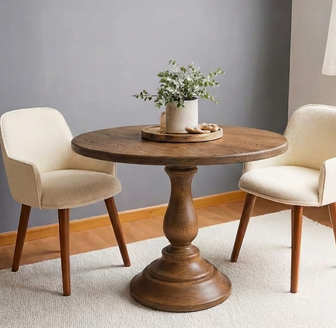
 Round Solid Wood Pedestal Dining Table Handcrafted Solid Wood Center Table
From $1,345.00
Round Solid Wood Pedestal Dining Table Handcrafted Solid Wood Center Table
From $1,345.00
 Round Bistro Dining Table, Small Kitchen Breakfast Table, Compact Circular Dining Table
From $1,022.00
Round Bistro Dining Table, Small Kitchen Breakfast Table, Compact Circular Dining Table
From $1,022.00
 Organic Modern Live Edge Solid Wood Dining Table - Handcrafted Slab Table with Dual Storage Pedestals
From $6,800.0010% off at checkout
Organic Modern Live Edge Solid Wood Dining Table - Handcrafted Slab Table with Dual Storage Pedestals
From $6,800.0010% off at checkout
 Round Solid Wood Dining Table with Architectural Spider Pedestal Base
From $1,254.00
Round Solid Wood Dining Table with Architectural Spider Pedestal Base
From $1,254.00
 Flowing Pedestal Solid Wood Round Dining Table - Japandi Living Sculpture
From $5,850.0010% off at checkout
Flowing Pedestal Solid Wood Round Dining Table - Japandi Living Sculpture
From $5,850.0010% off at checkout
 Sculptural Pedestal Solid Wood Round Dining Table - Organic Modern Centerpiece
From $5,850.0010% off at checkout
Sculptural Pedestal Solid Wood Round Dining Table - Organic Modern Centerpiece
From $5,850.0010% off at checkout
How Table Base Type Actually Changes Your Seat Count (The Real Math)
Quick Answer - The Seat Loss by Table Base Type
The table base you choose can cost you 1 to 3 seats compared to a four-leg baseline on the same table size - or gain you 1 to 2. Here's the breakdown:
| Base Type | Typical Intrusion | Seat Impact vs Four-Leg |
|---|---|---|
| Four-Leg (corner) | 0" on edges; corner leg diameter only | Baseline (0) |
| Single Pedestal | Minimal edge intrusion; central column doesn't reach the rim | +1 to +2 seats (frees all 4 edges) |
| Double Pedestal | 2 dead zones, typically 14"–20" each | 0 to +1 (depends on pedestal spacing) |
| Trestle | 12"–24" at each end (single trestle) | −1 to −2 (kills end-cap seats) |
| X-Base / Cross-Base | Diagonal + edge intersection, typically 6"–12" per intrusion point | −2 to −3 (corner + sometimes edge seats) |
| Hairpin / Slim Legs | <1" (negligible) | ≈0 (same as four-leg, but limited to smaller tables) |
Key formula: seats = floor(usable_edge ÷ 24") - where usable edge = total edge length minus any leg, pedestal, or apron intrusion along that edge.
Want the full room-size math? See our Dining Table Shapes & Sizes Guide for the 36" clearance-per-side rule and room-fit formulas.

The Usable Edge Formula
Not every inch of table edge can actually seat someone. A 72" table with a trestle base doesn't seat the same as a 72" table with corner legs - because usable edge differs.
Usable edge = total edge length − leg/pedestal/apron intrusion along that edge
Seat width standards:
- 24" per person - comfortable dining (standard side chair)
- 20" per person - minimum (tight, short meals only)
- 28" per person - armchairs or formal seating
The formula:
seats per edge = floor(usable_edge ÷ 24)
Corner seating rule: When two edges meet at a corner, you can't simply add both edges and divide. The corner itself is shared - one person sits at the corner, not two. And if a leg or apron sits more than ~4" from the corner, that corner seat effectively disappears because the chair can't angle in properly.
For a deeper walkthrough of how table shape affects seating, check our guide on dining table shapes and seating capacity.


Intrusion Measurements by Base Type
The numbers below are based on common dining table specs found in most commercial designs. Actual measurements vary by manufacturer - always check the product's dimension diagram before finalizing your seat count.
Four-Leg (Corner) - Intrusion: 0" on Edges
Corner legs sit at or near the table corners, so the long edges remain fully usable. The intrusion happens only at corners:
- Typical leg thickness: 2"–4" square or 2"–3" diameter round
- Each corner leg removes roughly 3"–5" of usable edge from each adjacent side (the zone where a chair can't angle in)
- Apron tables: When legs are set inward from the corner (common in handmade tables with thick aprons), the corner seat zone shifts inward too - reducing usable corner space by an additional 2"–4"
Net effect: On a standard rectangular table, four-leg seating ≈ total perimeter ÷ 24" minus ~1 seat per corner with leg/apron obstruction.

Single Pedestal - Intrusion: Minimal, Central Only
A single central pedestal (typically 14"–22" in diameter on most dining tables) sits in the middle of the table - well inside the rim. Because the column doesn't extend to the edge, it typically creates little to no edge intrusion and frees all four sides for seating.
- Round pedestal: On most designs, the base and any spread-arm feet stay close to the center, so nearly the full circumference remains usable. Some wider spread-arm bases extend further out and can block a narrow strip (roughly 10"–14" of arc) near the floor - but this rarely interferes with chair placement at the tabletop level.
- Square pedestal: Similar math, but the flat sides create slightly different intrusion patterns near the base - the corners of a square pedestal can block marginally more floor space than a round one of the same width, though again this is mostly a floor-level (not seating-level) consideration.
Net effect: Single pedestal typically gains +1 to +2 seats vs four-leg on the same table size, because no edge is partially blocked by legs.

Double Pedestal - Intrusion: Two Dead Zones
Double pedestal tables (common on 84"+ rectangular tables) have two support columns. The math depends entirely on the spacing between them:
- Typical pedestal spacing: 30"–48" apart (center to center), with each pedestal ~14"–20" wide
- Usable segments = gaps between pedestals + overhang beyond each pedestal
- If spacing is too tight (<30"), you lose the ability to seat anyone between the pedestals on the long edges
| Pedestal Spacing | Seats per Long Edge (84" table) | Total (2 long edges + 2 ends) |
|---|---|---|
| 48"+ apart | 3 per edge | 8 |
| 36"–48" apart | 2–3 per edge | 6–8 |
| <36" apart | 2 per edge | 6 |
Net effect: Double pedestal ranges from 0 to +1 seats vs four-leg - good spacing matches four-leg, tight spacing loses 1.

Trestle - Intrusion: End Zones
Trestle bases place supports near the ends of the table. In most commercial trestle designs, each trestle support is typically 12"–24" wide:
- Single trestle (center): One support block under the middle. Minimal edge intrusion, but the trestle beam running between the feet can limit leg room for anyone sitting near the center on long tables.
- Single trestle (end-mounted): Each trestle at the ends kills ~12"–24" of end-cap seating. On a 72" table, that means the "head" seats are gone or severely compromised.
- Double trestle: Two supports along the length. Better weight distribution but creates two intrusion zones - each trestle typically removes 12"–20" of usable edge on the nearest side.
Net effect: Trestle typically costs −1 to −2 seats vs four-leg, primarily at the table ends. On very long tables (96"+), the loss may be just −1 since the middle edge space compensates.

X-Base / Cross-Base - Intrusion: Diagonal + Edge
X-base and cross-base designs create intrusion at multiple points - where the diagonal beams intersect the table edges and at the center crossing:
- Each diagonal beam intersection with an edge typically blocks 6"–12" of seating (depending on beam thickness and angle)
- The center crossing point creates a central dead zone similar to a small pedestal (~8"–14" diameter equivalent)
- On rectangular tables, the X pattern often kills both corner seats on at least one pair of corners, and sometimes 1 edge seat where the beam crosses
Net effect: X-base typically costs −2 to −3 seats vs four-leg. The aesthetic payoff is high, but the seating penalty is real - especially on tables under 72".

Hairpin / Slim Legs - Intrusion: Negligible (<1")
Hairpin legs and similar slim-profile supports (typically ½"–¾" diameter rod) create essentially zero seating intrusion.
- Mathematically: ~0" lost per leg - negligible at dining scale
- But: Stability limits apply. The span-to-leg ratio in most hairpin designs makes them unsuitable for tables over ~72"–84" without sag or wobble - so while the seat math is perfect, the table size is capped.
Net effect: ≈0 seat loss vs four-leg, but restricted to smaller tables. For dining tables up to ~60"–72", hairpin legs are mathematically optimal for seating.

Real Seat Count Matrix
This matrix applies the usable edge formula to common table sizes across base types. Numbers assume 24" per person (comfortable side chair seating):
| Table Size | Four-Leg | Single Pedestal | Double Pedestal | Trestle | X-Base | Hairpin |
|---|---|---|---|---|---|---|
| 48" Round | 4 | 4 | — | — | 4 | 4 |
| 60" Round | 5–6 | 6–7 | — | — | 5 | 6 |
| 60" × 36" Rect | 4 | 4–6 | — | 4 | 4 | 4 |
| 72" × 36" Rect | 6 | 6–8 | 6 | 5–6 | 4–5 | 6 |
| 84" × 40" Rect | 8 | 8 | 6–8 | 6–7 | 6 | —* |
| 96" × 42" Rect | 10 | 10 | 8–10 | 8–9 | 7–8 | —* |
* Hairpin legs not recommended for tables this size due to stability constraints.
Note: the 84" and 96" figures reflect a slightly tighter (but still workable) spacing than the 24"-comfortable standard used elsewhere in this table - treat them as the upper end of the comfortable range, not the absolute maximum.
Biggest takeaway: On a 72" rectangular table, switching from X-base to single pedestal can mean the difference between seating 4 and seating 8 - a 100% increase without changing the table size at all.

Don't miss
These pieces qualify for 10% off orders over $2,000. Applied automatically at checkout.
10% off
Organic Modern Live Edge Solid Wood Dining Table - Handcrafted Slab Table with Dual Storage Pedestals
From $6,800.00
10% off at checkout
10% off
Flowing Pedestal Solid Wood Round Dining Table - Japandi Living Sculpture
From $5,850.00
10% off at checkout
10% off
Sculptural Pedestal Solid Wood Round Dining Table - Organic Modern Centerpiece
From $5,850.00
10% off at checkout
 10% off
Organic Live Edge Solid Wood Dining Table with Sculptural River Legs
From $4,180.00
10% off at checkout
10% off
Organic Live Edge Solid Wood Dining Table with Sculptural River Legs
From $4,180.00
10% off at checkout
The Corner Seat Problem
Corners are where seat math gets tricky. Two edges meet, but you can't put one person on each edge at the corner - they'd be sitting on top of each other.
Here's the issue:
- One person sits at the corner, using space from both edges
- If a leg or apron sits >4" from the corner, the corner seat effectively disappears - there's not enough room to angle a chair in
- On apron tables (legs set inward from the edge), the apron itself can block the corner seat zone even if the legs are out of the way
Rule of thumb: Never count a full corner seat if the nearest leg or apron is more than 4" from the corner. Treat that corner as 0 seats and recalculate using only the straight-edge segments.
On a four-leg table with 3" corner legs, you typically lose about 3"–5" of usable edge per corner on each adjacent side. On an apron table with legs set 4" inward, the corner loss can reach 6"–8" per side.

Round & Oval Table Seat Math
Round and oval tables use circumference-based math rather than linear edge measurements:
Round table formula:
seats = floor((π × diameter − base_intrusion_arc) ÷ 24)
For a 60" round table on a single pedestal base:
- Total circumference: π × 60 ≈ 188.5"
- Because the pedestal sits well inside the rim, edge intrusion is minimal - at most a narrow strip (~12"–15") near any wide spread-arm feet
- Usable circumference: ~174"–177"
- Seats at 24": floor(174 ÷ 24) = 7 seats at minimum-comfortable spacing, though most people plan for 6 to leave a little extra elbow room
Compare this to a four-leg round table of the same size, where legs typically sit closer to the rim: intrusion is smaller per-leg but happens at four separate points, each removing a few inches of usable arc near that leg - netting out to roughly 5–6 seats. This is why the matrix above shows single pedestal (6–7) outseating four-leg (5–6) on a 60" round table.
Oval table formula: Split into 2 half-circle arcs + 2 straight sections. Calculate each segment separately, subtracting any pedestal or leg intrusion from the relevant segment.
For a 72" × 36" oval (approximation):
- Two half-circles: π × 36" ≈ 113" total arc
- Two straight sections: 72" − 36" = 36" each → 72" total
- Total approximate circumference: ~185"
- Subtract any base intrusion → divide by 24 → seat count

Armchair Adjustment - Delta by Base Type
Using the 24" / 28" split already established in our Seating Capacity Guide, here's what actually changes when you switch from side chairs to armchairs - calculated per base type:
| Base Type | Side Chairs (24") | Armchairs (28") | Seats Lost |
|---|---|---|---|
| Four-Leg (72" rect) | 6 | 5 | −1 |
| Single Pedestal (72" rect) | 6–8 | 5–6 | −1 to −2 |
| Double Pedestal (84" rect) | 6–8 | 5–7 | −1 |
| Trestle (72" rect) | 5–6 | 4–5 | −1 |
| X-Base (72" rect) | 4–5 | 3–4 | −1 |
| 60" Round (single pedestal) | 6–7 | 5–6 | −1 |
Why the loss varies by base type: On a pedestal table, the extra 4" per person compounds across all edges freely - you lose seats uniformly. On a trestle or X-base, the intrusion zones already limit your edge space, so the armchair switch hits harder on already-constrained edges. A trestle table that barely fits 6 at 24" drops to a tight 4 at 28" because the end seats disappear entirely.
Mixed seating tip: If you want armchairs at the heads but side chairs along the edges, calculate each edge separately. On a 72" four-leg table: heads at 28" = 2 seats, long edges at 24" = 4 seats → 6 total (same as all side chairs, but with 2 armchair heads).

Common Seat Count Calculation Mistakes
- Using total table length instead of usable edge. A 72" trestle table doesn't have 72" of usable seating on the ends - subtract the trestle width first.
- Not subtracting corner intrusion. Corner legs or aprons can silently kill 1–2 seats if you don't account for them.
- Counting armchairs like side chairs. See the armchair delta table above - 28" vs 24" changes the math on every base type. (More detail in our Seating Capacity Guide.)
- Forgetting chair pull-out clearance. The table might seat 8 mathematically, but if your room doesn't have 36" behind each chair, those seats aren't functional. See the Shapes & Sizes Guide for room clearance formulas.
- Counting the corner twice. One person at the corner, not two. This is the most common error on rectangular tables.
FAQs
How many inches per person at a dining table?
24" for comfortable side chair seating, 20" minimum (tight), 28" for armchairs. These standards apply regardless of table shape - what changes by base type is how much of the table's total edge actually meets these widths.
Can I add a seat at the head of a trestle table?
Usually no or at least not comfortably. A typical trestle support is 12"–24" wide and sits near the table end, leaving insufficient space for a chair to pull up at the head. On some trestle designs with narrower supports (<12"), a single head seat may work, but check the actual product dimensions first.
Does a 72" table really seat 6?
It depends on the base type. A 72" four-leg table seats 6 comfortably. A 72" single pedestal can seat 6–8. A 72" trestle seats 5–6. A 72" X-base seats 4–5. The table length alone doesn't determine seating - the base does. See the seat count matrix above for the full breakdown.
How to maximize seats on a 60" round table?
A 60" round table with a single pedestal seats 6–7 at 24" per person. To maximize: use a single pedestal (not legs) to free all edge space, choose slim-profile chairs, and consider 20"–22" per person for short meals to squeeze in an extra seat - though it'll be tight.
What's the minimum table length for 8 people?
For rectangular tables: 72" with a single pedestal (6 on long edges + 1 at each end = 8), or 84" with a trestle or four-leg base (4 on each long edge, or 3 + 2 ends = 8). A 60" round table can also seat close to 8 at 20" minimum spacing, but it's very tight. See our Shapes & Sizes Guide for more size-to-seat mappings.
More Dining Table Guides
- Dining Table Shapes & Sizes Guide - Room clearance math, shape comparisons, and space planning
- Dining Table Seating Capacity - Seating capacity deep dive with armchair vs side chair calculations
- Pedestal vs Leg Base Dining Table - Structural and aesthetic comparison of base types
- Solid Wood Dining Table: The Complete Buyer's Guide - Wood species, joinery, and pricing
- How to Check if a Dining Table Is Real Solid Wood - Spotting veneer before you buy
Not sure which table base fits your space?
Share your room dimensions and guest count - we'll calculate the optimal table size and base type for your needs.
Get a Free Seating Consultation →