Quick view
- Quick Answer - Mushroom Shelf Weight Capacity by Type
- What Determines a Mushroom Shelf's Weight Capacity
- Where You Put the Weight Matters More Than How Much
- Mushroom Shelf vs Regular Floating Shelf - Why the Numbers Differ
- How to Maximize Your Mushroom Floating Shelf's Weight Capacity
- Real-World Examples - What Actually Fits
- When a Mushroom Floating Shelf Will Fail - Warning Signs
- FAQ
- The Bottom Line
Shop this guide
Handcrafted Lamps for Modern Homes, made to order in solid wood.
 Christmas edit
Rustic Driftwood Floor Lamp – Handmade Solid Wood Standing Light for Home Décor
From $1,220.00
Christmas edit
Rustic Driftwood Floor Lamp – Handmade Solid Wood Standing Light for Home Décor
From $1,220.00
 Christmas edit
Driftwood Wall Sconce - Handcrafted Rustic Wooden Wall Lamp
From $650.00
Christmas edit
Driftwood Wall Sconce - Handcrafted Rustic Wooden Wall Lamp
From $650.00
 Christmas edit
Rustic Driftwood Floor Lamp with Shelves – Handmade Wooden Standing Light
From $2,350.0010% off at checkout
Christmas edit
Rustic Driftwood Floor Lamp with Shelves – Handmade Wooden Standing Light
From $2,350.0010% off at checkout
 Sculptural Twisted Solid Wood Floor Lamp - Organic Modern Statement Lamp
From $1,780.00
Sculptural Twisted Solid Wood Floor Lamp - Organic Modern Statement Lamp
From $1,780.00
 Christmas edit
Twisted Vine Wooden Floor Lamp - Handcrafted Driftwood Standing Light With Leaf Shade
From $1,280.00
Christmas edit
Twisted Vine Wooden Floor Lamp - Handcrafted Driftwood Standing Light With Leaf Shade
From $1,280.00
 Christmas edit
S-Curve Wooden Floor Lamp - Driftwood Standing Light With Dual Glow Openings
From $1,480.00
Christmas edit
S-Curve Wooden Floor Lamp - Driftwood Standing Light With Dual Glow Openings
From $1,480.00
Mushroom Shelf Weight Capacity: How Much Each Type Can Actually Hold
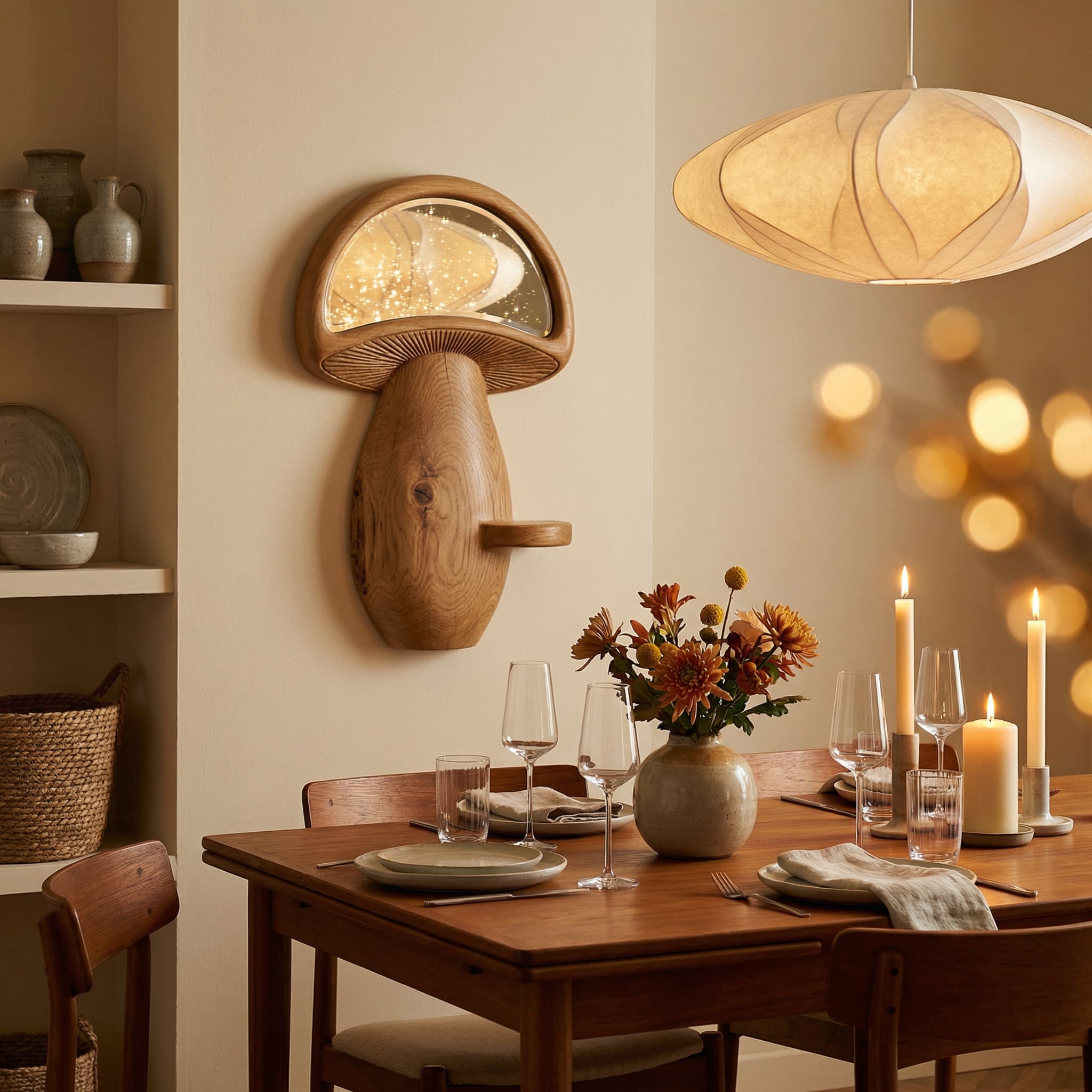
A mushroom shelf looks delicate. The rounded cap, the carved stem, the way it seems to float off the wall - it reads as a cute decor piece first, a functional shelf second.
But it's solid wood. Handcrafted. Bolted into your wall. And the question most buyers ask (but rarely get a straight answer on) is: how much weight can it actually hold?
The honest answer isn't one number. A mushroom shelf's weight capacity depends on the shelf type, how it's mounted, what your wall is made of, and - this one matters more than people think - where on the cap you put the weight.
This guide breaks it all down with real numbers. No guessing.

Quick Answer - Mushroom Shelf Weight Capacity by Type
If you just want the numbers, here they are. These come from Ashdeco product specifications, our floating shelf weight limit guide, and real-world styling data from our team.
| Mushroom shelf type | Weight capacity | Notes |
|---|---|---|
| Single cap floating shelf | 8–15 lbs | Smallest type, carved detail on cap |
| Multi-cap cluster (per cap) | 5–10 lbs each | Total capacity = per-cap × number of caps |
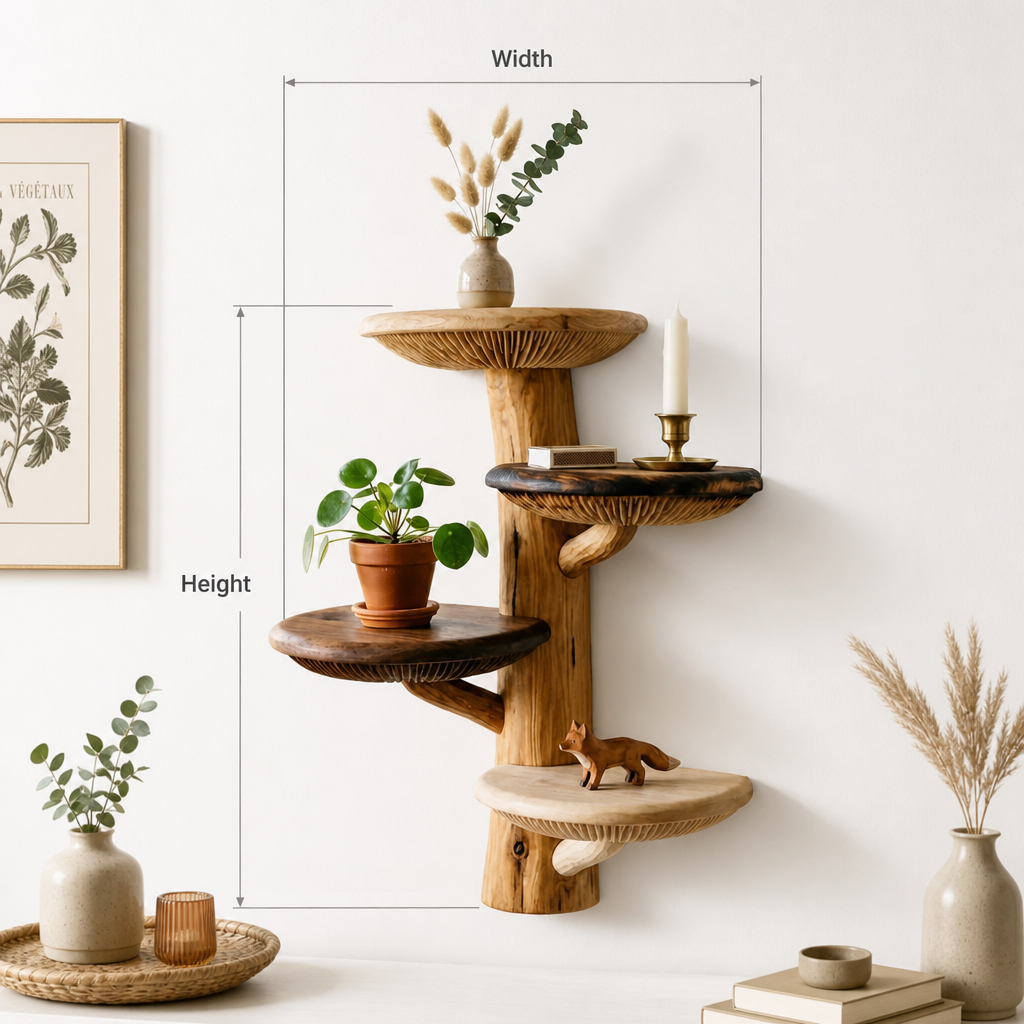
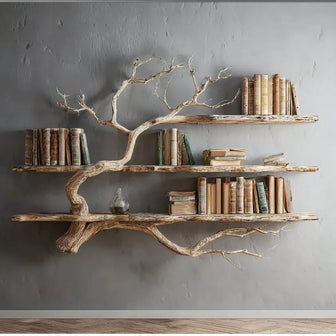
| Mushroom tree bookshelf (per shelf/branch) | 12–18 lbs | Example: wall-mounted mushroom cap tree |
| Mushroom tree bookshelf (total) | 40–80 lbs | Depends on number of caps and mounting points |
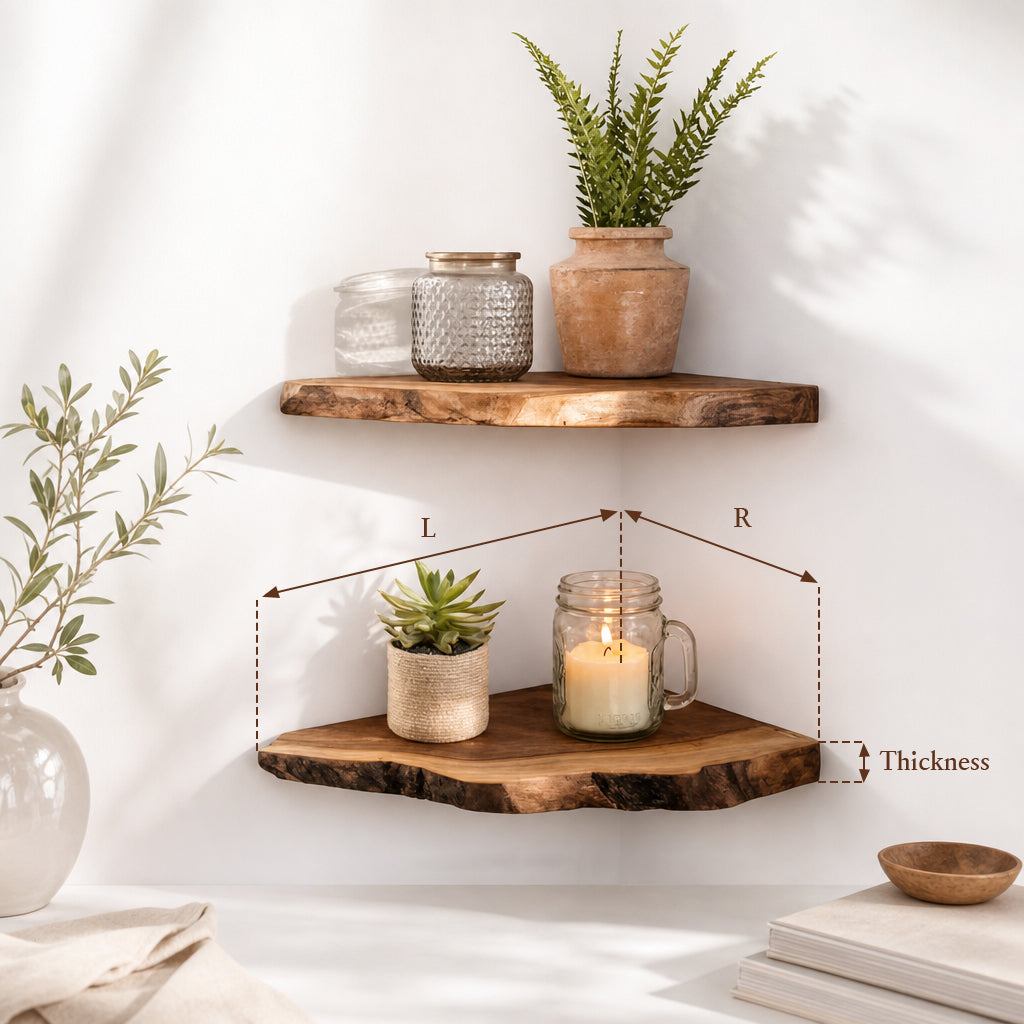
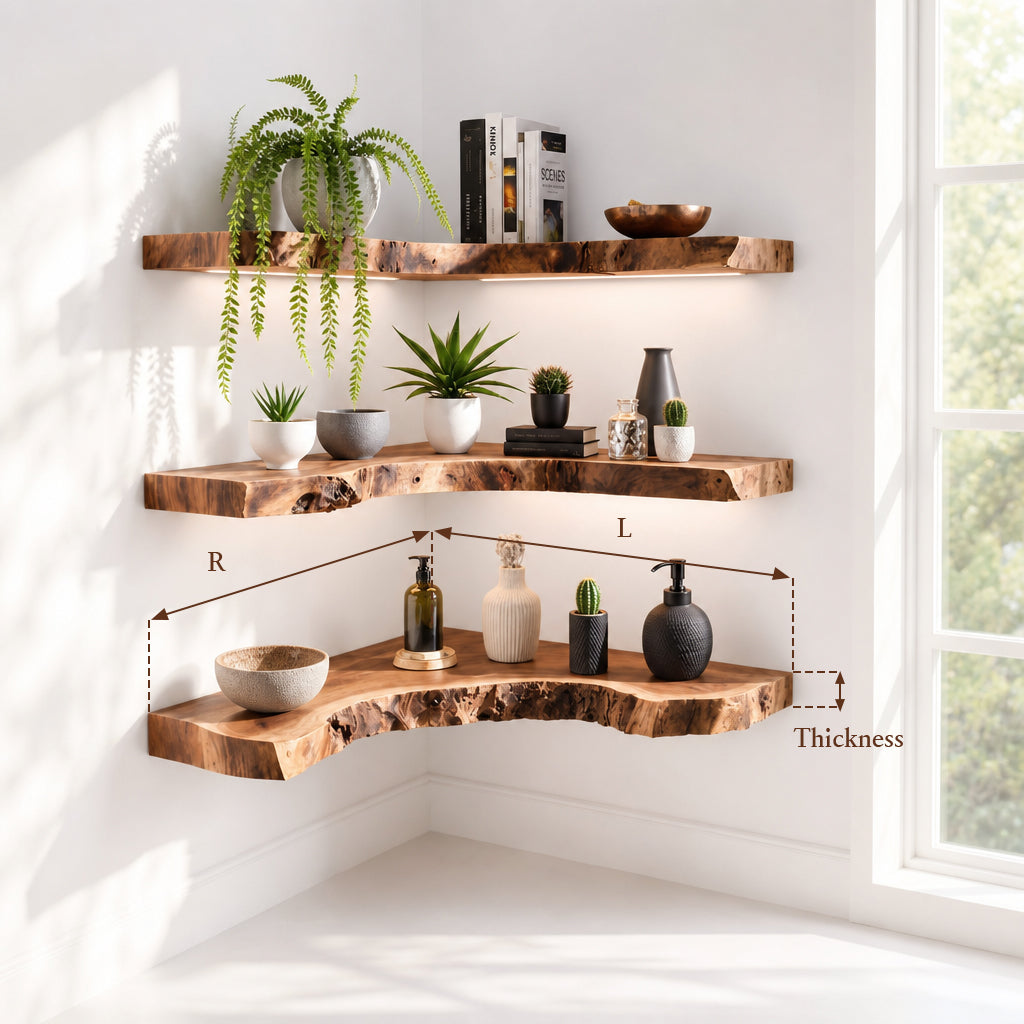
| Corner mushroom shelf | 15–30 lbs | Two-wall mounting adds stability |
| Floor-to-ceiling mushroom column | 60–100+ lbs | Floor support + multiple wall anchors |
Every one of these assumes the shelf is mounted correctly into a wall stud. Mount into drywall alone with plastic anchors and those numbers drop to 10–15 lbs max. We'll cover that below.

What Determines a Mushroom Shelf's Weight Capacity
Four factors, ranked by how much they matter.
1. Mounting Method - The Biggest Factor
The mounting system is the difference between a shelf that holds 15 lbs and one that holds 50 lbs. Here's how the common methods compare:
| Mounting type | Capacity | Notes |
|---|---|---|
| French cleat (into stud) | 30–50 lbs | Ashdeco's standard mounting system. Strongest option. |
| Hidden steel rod/bracket (into stud) | 15–30 lbs | Common for smaller mushroom caps |
| Keyhole hangers (into stud) | 10–20 lbs | Easy install, moderate strength |
| Toggle bolt (drywall, no stud) | 15–25 lbs | Decent, but inconsistent |
| Plastic anchor (drywall, no stud) | 10–15 lbs | Danger zone - only for very light items |
| Adhesive strips | 5–10 lbs | Not recommended for mushroom shelves |
If you take one thing from this guide: mount into a stud. A French cleat anchored into one wall stud can hold 30–50 lbs. The same cleat in drywall with a plastic anchor might fail at 12 lbs. That's a 4x difference for the exact same shelf.
For a deeper dive into floating shelf mounting, see our guide on how to mount floating shelves without damaging walls.
2. Wall Type
Even if you hit a stud, the wall itself matters.
- Wood stud (standard 16" or 24" OC): full capacity. A French cleat into one stud handles 30–50 lbs. Two studs? ~60–100 lbs.
- Drywall with toggle bolt (no stud): 15–25 lbs max. Toggle bolts spread the load across a wider area of drywall, but drywall itself is gypsum - it crumbles.
- Drywall with plastic anchor: 10–15 lbs. These anchors expand inside the drywall hole. They work for picture frames. They do not work for a solid wood shelf with books on it.
- Plaster over lath: 15–25 lbs. Older homes. Plaster is brittle and lath spacing is inconsistent. Find the stud if you can.
- Concrete/brick (with masonry anchors): 40–80 lbs. Actually one of the strongest options - if you have the right anchors and drill bits.
3. Wood Type & Construction
Not all mushroom shelves are built the same.
- Solid hardwood (oak, walnut, acacia): highest capacity. Dense grain structure handles both compression and shear forces well. This is what Ashdeco uses for all mushroom floating shelves.
- Softwood (pine, cedar): 20–30% less capacity than hardwood. Fine for light display, not ideal for books or plants.
- MDF/particle board: not recommended for mushroom shapes. The carved edges and curved cap create stress points that MDF doesn't handle well. Hollow-core MDF mushroom shelves are purely decorative.
- Resin/3D printed: varies wildly. Most are lighter than they look and cap out around 5–10 lbs. More on this in our wood vs resin mushroom shelf comparison.
Thickness matters too. A 1.5" thick solid wood cap holds significantly more than a 0.75" cap - but carving depth (gill detail, dish shape) removes material and reduces effective thickness.
4. Cap Diameter and Shape
The physical size of the mushroom cap determines how weight distributes.
| Cap size | Approx capacity | Best for |
|---|---|---|
| Small (4–6" diameter) | 8–12 lbs | Candles, small decor, single framed photo |
| Medium (8–12" diameter) | 12–18 lbs | Books, small plants, multiple light items |
| Large/dished (14"+ diameter) | 15–25 lbs | Larger displays, wider distribution |
Carved gill detail (the ridges underneath the cap) removes material from the underside. It looks beautiful, but it means there's slightly less wood between the cap surface and the stem. The effect is small - maybe 10–15% less capacity than a flat cap of the same size - but it's real.



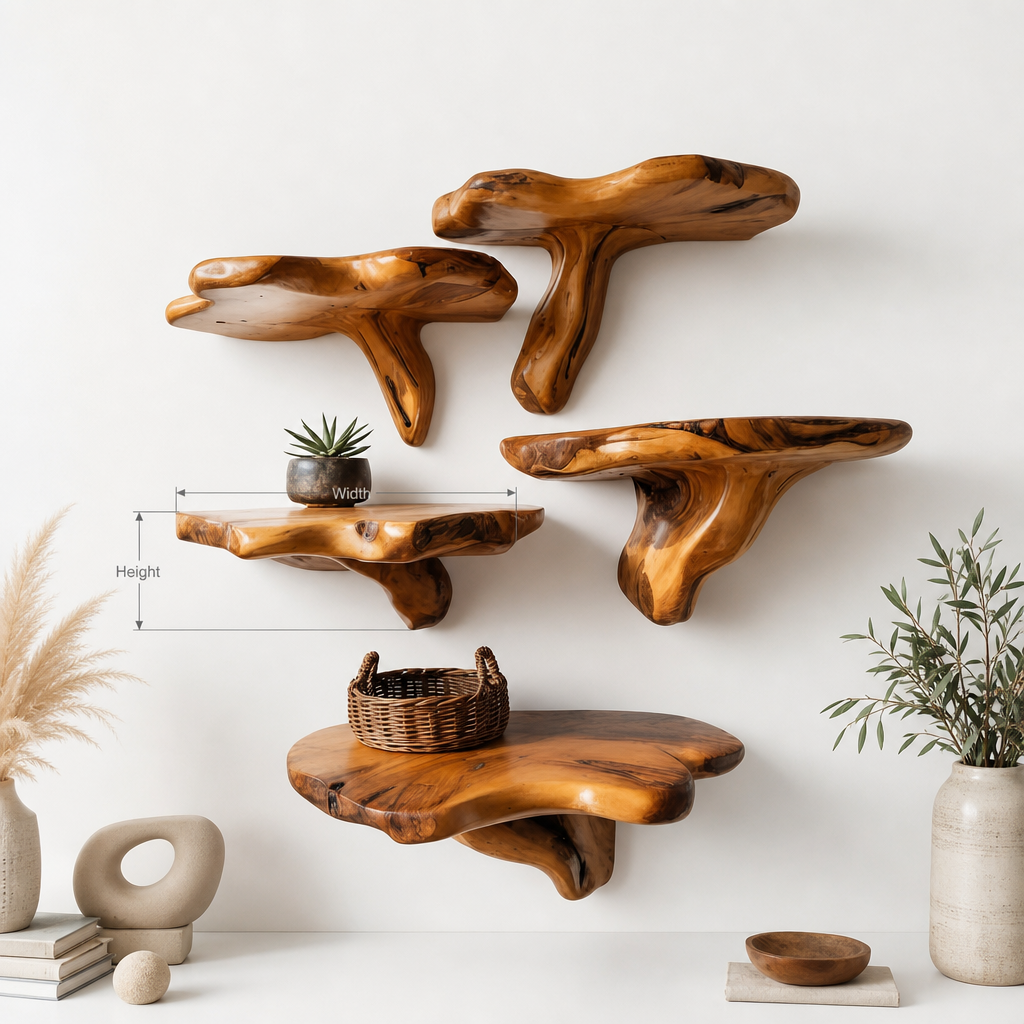
Where You Put the Weight Matters More Than How Much
This is what makes mushroom shelves different from regular rectangular shelves.
On a flat 24" floating shelf, weight distributes across the full width of the bracket. On a mushroom shelf, all the load funnels through a single point: the stem.
Think of it like this:
- Center of the cap (closest to the stem): strongest point. Weight transfers straight down through the stem into the wall mount. Minimal leverage stress.
- Middle of the cap: moderate stress. Some leverage, but the cap thickness handles it.
- Edge of the cap (farthest from the stem): weakest point. Creates torque/leverage on the mount. Heavy items here can reduce effective capacity by 30–40%.
Practical rule: the heaviest item goes closest to the stem. Lighter items (candles, small framed photos, thin books) can go toward the edge.
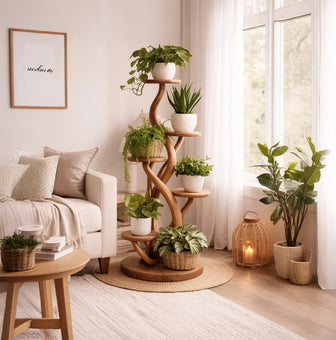
This is especially important for the larger mushroom tree bookshelves where you have multiple caps at different heights. A heavy book on the outer edge of the top cap creates far more stress than the same book placed near the center of the bottom cap.

Built to hold what you actually put on it
Every Ashdeco mushroom shelf is hand-carved from a single block of solid hardwood and ships with proper mounting hardware - rated for real display use, not just for looks.
Shop Mushroom Shelves →Mushroom Shelf vs Regular Floating Shelf - Why the Numbers Differ
If a regular 24" floating shelf mounted with a French cleat into two studs can hold 60–100 lbs - that's 30–50 lbs per stud, doubled when you hit both (see our real weight test data) - why does a mushroom shelf cap out at 8–15 lbs?
Three reasons:
1. Load concentration. A flat shelf distributes weight across its full width. A mushroom cap concentrates it through a single stem. Same total weight, completely different stress pattern.
2. Material removal. Carving the mushroom shape - the cap curve, the gill detail, the tapered stem - removes wood that would otherwise add structural strength. A rectangular shelf of the same starting dimensions has no carved voids.
3. Purpose. Mushroom shelves aren't designed to be utility shelves. They're display pieces that happen to be functional. They're optimized for visual impact, not maximum load.
This doesn't mean mushroom shelves are weak. It means they're different. A well-made solid wood mushroom shelf mounted into a stud will comfortably hold everything you'd reasonably want to display on it - books, plants, candles, framed art. It just won't hold your entire book collection.

Don't miss
These pieces qualify for 10% off orders over $2,000. Applied automatically at checkout.
10% off
Rustic Driftwood Floor Lamp with Shelves – Handmade Wooden Standing Light
From $2,350.00
10% off at checkout
 10% off
Rustic Driftwood Floor Lamp with Side Table – Solid Wood Standing Light with Rattan Shade
From $2,350.00
10% off at checkout
10% off
Rustic Driftwood Floor Lamp with Side Table – Solid Wood Standing Light with Rattan Shade
From $2,350.00
10% off at checkout
 10% off
Sculpted Spiral Twist Floor Lamp Handcrafted Solid Timber Standing Light with Linen Drum Shade
From $2,280.00
10% off at checkout
10% off
Sculpted Spiral Twist Floor Lamp Handcrafted Solid Timber Standing Light with Linen Drum Shade
From $2,280.00
10% off at checkout
 10% off
Biomorphic Sculpted Hollow Floor Sculpture Organic Timber Art Piece Hand Carved in Solid Wood
From $2,280.00
10% off at checkout
10% off
Biomorphic Sculpted Hollow Floor Sculpture Organic Timber Art Piece Hand Carved in Solid Wood
From $2,280.00
10% off at checkout
How to Maximize Your Mushroom Floating Shelf's Weight Capacity
1. Mount into a stud. We've said it three times now. It's that important. Use a stud finder. If your shelf falls between studs, use a horizontal mounting board that spans two studs, then mount the shelf to that board.
2. Distribute weight across multiple caps. If you have a mushroom tree with 4 caps, don't load 15 lbs onto one cap. Put 4–5 lbs on each. A distributed 20 lbs across 4 caps is safer than 15 lbs concentrated on one.
3. Heavy items near the stem. Already covered above. Repeat it anyway - it's the most common mistake.
4. Don't creep up on capacity slowly. Wood has a property called "creep" - slow, permanent deformation under sustained load. A shelf holding 12 lbs (just under its 15 lb limit) might look fine on day one. After 6 months, the cap could sag 1/4" or more. If you're near capacity, reduce the load.
5. Check mounting hardware every few months. Solid wood shelves can work their mounting screws loose over time, especially in drywall. A shelf that was tight at install might have a visible gap at the wall by month three. Tighten it before it becomes a problem.
6. Keep moisture away from the cap. Plants leak water. Bathrooms generate humidity. Moisture softens wood fibers and reduces capacity over time. If you're putting a potted plant on a mushroom shelf, use a saucer and check for water damage regularly.
For more on what to display, check out our guide on what a mushroom shelf can actually hold.

Real-World Examples - What Actually Fits
Here's a practical weight reference for common items people put on mushroom shelves:
| Item | Approx weight | Fits on single cap (8–15 lbs)? |
|---|---|---|
| Small pillar candle | 0.3–0.5 lbs | ✅ Easy - lightest option |
| Small potted succulent (2" pot) | 0.5–1 lbs | ✅ Easy |
| Paperback book | 0.5–1 lbs | ✅ 5–10 books max |
| Hardcover book | 1–2 lbs | ✅ 3–5 books |
| 6" ceramic planter (with soil) | 2–4 lbs | ✅ 1 max - soil + water adds weight fast |
| Small framed photo (5×7) | 0.5–1 lbs | ✅ Easy |
| Vinyl record | 0.3–0.4 lbs each | ✅ 10–15, but odd choice for a mushroom shelf |
| Small Bluetooth speaker | 1–3 lbs | ⚠️ Center only, never at edge |
| Cast iron bookend | 3–5 lbs | ❌ Too heavy and awkwardly shaped |
| Large potted plant (8"+ pot) | 5–10 lbs | ❌ Too heavy for single cap, okay on tree shelf |
When a Mushroom Floating Shelf Will Fail - Warning Signs
A mushroom floating shelf doesn't usually fail catastrophically. It gives warnings first.
Watch for:
- Visible gap between the shelf back and the wall. The mount is pulling away. Reduce weight immediately.
- Creaking or flexing when you lightly touch the cap. The shelf is near or past capacity.
- The cap tilting downward at the front edge. This means the mount is failing or the wood is creeping.
- Screw heads pulling out of the wall. If you can see the screw head emerging from the drywall, the anchor is failing.
- Wood cracking near the carved stem. Rare with solid hardwood, but serious if it happens. This means the structural integrity is compromised.
If you see any of these signs, remove everything from the shelf, inspect the mounting, and either re-mount into a stud or switch to lighter items.
FAQ
How much weight can a single mushroom cap shelf hold?
A single solid wood mushroom cap mounted into a wall stud typically holds 8–15 lbs. The exact number depends on cap size, wood type, and mounting method. A larger cap (12"+) with a French cleat into a stud can handle the upper end of that range. A small cap with keyhole hangers is closer to 8 lbs.
Can I mount a mushroom shelf without hitting a stud?
You can, but capacity drops significantly. A toggle bolt in drywall gives you 15–25 lbs max. Plastic anchors give you 10–15 lbs. If you can't find a stud, consider mounting a horizontal wood cleat across two studs and then attaching the shelf to that cleat.
Are mushroom shelves stronger than regular floating shelves?
No - they hold less weight than a flat rectangular shelf of the same wood. The carved shape removes material and concentrates load through a single point (the stem) rather than distributing it across a full-width bracket. But they're strong enough for display purposes, which is what they're designed for.
Does the wood type affect weight capacity?
Yes. Solid hardwood (oak, walnut, acacia) holds 20–30% more than softwood (pine). MDF mushroom shelves should be treated as decorative only - their carved edges are structural weak points. Ashdeco's handcrafted solid wood mushroom shelves use hardwood for this reason.
How many mushroom shelves can I put on one wall?
As many as you want, aesthetically speaking. Structurally, each shelf is independent - they don't share load. Just make sure each one is mounted into its own stud (or a shared horizontal cleat that spans multiple studs).
Can a mushroom floating shelf hold a TV?
No. Even a small 24" TV weighs 8–15 lbs - the absolute max for a single mushroom cap - and the weight distribution is wrong (TVs are wide and flat, creating edge leverage). Use a proper TV mount.
How do I test if my mushroom floating shelf is overloaded?
Remove everything, then add items back one at a time. After each item, press gently on the cap near the edge. If it flexes or creaks, you're near capacity. For a more thorough test, check our real weight test methodology for floating shelves.
The Bottom Line
A mushroom shelf's weight capacity isn't mysterious - it's physics. Solid wood, proper mounting, sensible loading. Mount into a stud, keep heavy stuff near the center, don't slowly creep up to the limit, and your shelf will hold everything you want to display on it for years.
The biggest mistake people make isn't overloading - it's under-mounting. A $300 handcrafted mushroom shelf mounted into drywall with a plastic anchor will fail at 10 lbs. The same shelf into a stud with a French cleat holds 30–50 lbs. The shelf didn't change. The mounting did.
Get the mount right first. Everything else follows.
Looking for a handcrafted solid wood mushroom shelf? Browse our full mushroom floating shelf collection - every piece is carved from hardwood, includes proper mounting hardware, and is rated for real display use. For sizing help, see our mushroom shelf size guide and mushroom wall shelf buying guide. Want styling ideas? Check out 3 mushroom shelf looks in under 10 minutes.