Quick view
- What Makes a Good Mushroom Wall Shelf?
- What makes a mushroom shelf worth buying
- What Makes a True Mushroom Floating Shelf?
- How Much Weight Can a Mushroom Floating Shelf Hold?
- Solid wood matters more on a mushroom shelf than on a plain shelf
- Which type of mushroom wall shelf fits your room
- Where mushroom shelves work best
- Mushroom Shelf Decor Ideas That Look Sophisticated
- What to watch for before buying
- Honest downsides of mushroom floating shelves
- FAQ
Shop this guide
Handcrafted Lamps for Modern Homes, made to order in solid wood.
 Christmas edit
Rustic Driftwood Floor Lamp – Handmade Solid Wood Standing Light for Home Décor
From $1,220.00
Christmas edit
Rustic Driftwood Floor Lamp – Handmade Solid Wood Standing Light for Home Décor
From $1,220.00
 Christmas edit
Driftwood Wall Sconce - Handcrafted Rustic Wooden Wall Lamp
From $650.00
Christmas edit
Driftwood Wall Sconce - Handcrafted Rustic Wooden Wall Lamp
From $650.00
 Christmas edit
Rustic Driftwood Floor Lamp with Shelves – Handmade Wooden Standing Light
From $2,350.0010% off at checkout
Christmas edit
Rustic Driftwood Floor Lamp with Shelves – Handmade Wooden Standing Light
From $2,350.0010% off at checkout
 Sculptural Twisted Solid Wood Floor Lamp - Organic Modern Statement Lamp
From $1,780.00
Sculptural Twisted Solid Wood Floor Lamp - Organic Modern Statement Lamp
From $1,780.00
 Christmas edit
Twisted Vine Wooden Floor Lamp - Handcrafted Driftwood Standing Light With Leaf Shade
From $1,280.00
Christmas edit
Twisted Vine Wooden Floor Lamp - Handcrafted Driftwood Standing Light With Leaf Shade
From $1,280.00
 Christmas edit
S-Curve Wooden Floor Lamp - Driftwood Standing Light With Dual Glow Openings
From $1,480.00
Christmas edit
S-Curve Wooden Floor Lamp - Driftwood Standing Light With Dual Glow Openings
From $1,480.00
A mushroom wall shelf can look like a clever decor find at first glance. Then the real questions show up. Does it actually hold anything useful, or is it mostly wall art. Is solid wood worth paying for. And how do you tell the difference between a shelf with real sculptural value and one that only looks interesting in a photo. If you want the full landscape of types and prices before narrowing down, our mushroom shelf buying guide breaks down single-cap, multi-bracket, corner, and bookshelf styles side by side.
That's what matters with this category. Whether you call it a mushroom wall shelf, a mushroom floating shelf, or a wooden mushroom floating shelf - a good one should add shape, warmth, and display space to the room. The weak versions lean too hard on novelty and fall apart once you ask them to do real work.

What Makes a Good Mushroom Wall Shelf?
A mushroom wall shelf - or mushroom wall shelves if you're planning more than one - should do two jobs at once. It needs to look intentional on the wall, and it needs to hold a small set of real objects without feeling like prop decor. The best mushroom floating shelves create visual interest through form, material, and placement, while still giving you usable display space for a plant, candle, framed art, compact books, or daily small items.
That balance is what separates a mushroom shelf worth buying from one that only rides the shape trend. If the shelf is all silhouette and no substance, the appeal fades fast. If the shelf is too bulky or awkward, the room starts working around it instead of the other way around.
A standard floating shelf usually wins on pure utility. A mushroom wall shelf - especially a well-made wooden mushroom floating shelf - wins when you want the shelf itself to contribute to the room. That makes it a more style-specific purchase, but also a more distinctive one when done well.
This is also why mushroom shelves as a category tend to attract buyers who want more than just storage - our mushroom decor trend analysis digs into why this shape has caught on the way it has.

What makes a mushroom shelf worth buying
A mushroom shelf is worth buying when the material, shape, and mounting all support the concept. That sounds obvious, but this category gets crowded with shelves that focus on the mushroom idea without solving the basic furniture part. Buyers end up with something cute on the screen and underwhelming in the room.
There are three material and design elements worth checking when evaluating any mushroom floating shelf or wall-mounted design.
1. Real material presence
A mushroom wall shelf depends on shape more than a plain ledge does. That means material quality shows immediately. Solid wood mushroom floating shelves have grain variation, edge depth, and a carved feel that make the mushroom form believable. Thin material or vague wood-look finishes flatten the whole idea. This is especially true for a wooden mushroom floating shelf where the wood grain is part of the visual appeal.
2. A shape that looks intentional from more than one angle
Good mushroom shelves design starts with the understanding that the shelf will be seen from multiple angles. A well-designed mushroom floating shelf should still look convincing from the side and from below, not only from the front. If the underside, edge transition, or stem detail looks like an afterthought, the shelf reads more like themed decor than furniture. This is one of the clearest markers separating serious mushroom shelves design work from novelty imitations.
3. Usable top surface
This sounds basic, but it matters more than buyers expect. Some mushroom floating shelves have so much visual emphasis on the cap shape that the actual usable area becomes tiny. That's fine if you want a small display accent for mushroom shelf wall decor purposes. It's not fine if you expect it to work like normal wall storage. Our mushroom shelf size guide covers real usable dimensions across the different styles so you can check this before ordering.

Handcrafted Solid Wood
Explore Our Mushroom Floating Shelves Collection
Artisan-carved mushroom wall shelves made from genuine solid wood. Designed to function as both display storage and sculptural wall decor.
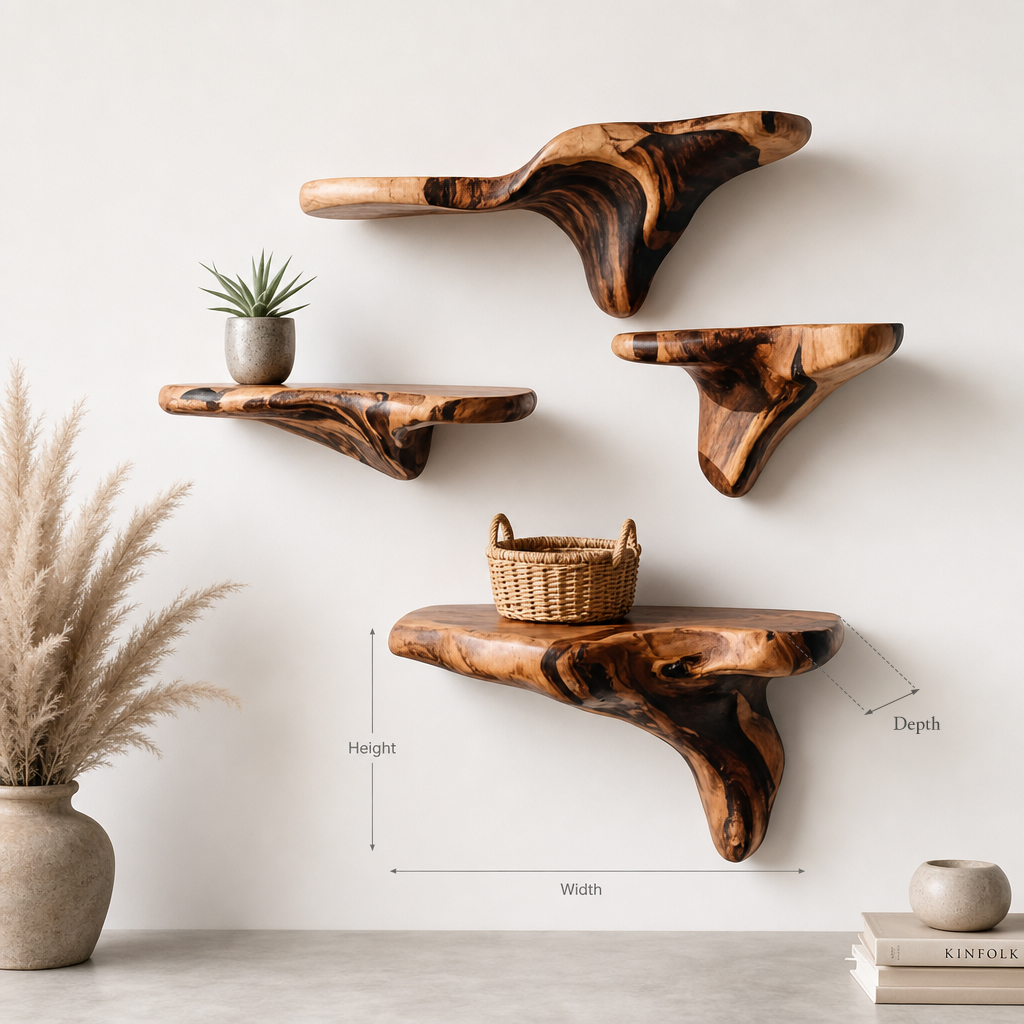
Shop Mushroom Shelves →


What Makes a True Mushroom Floating Shelf?
A true mushroom floating shelf should appear to grow naturally from the wall, with no visible brackets, screws, or exposed mounting hardware. For a floating mushroom shelf to look like it is genuinely growing from your drywall, fully concealed hardware is a non-negotiable requirement. Our mushroom wall shelf mounting guide walks through exactly what that hardware should look like and how to check for it before you buy.
Cheap novelty versions often rely on visible metal brackets or flimsy teeth hangers that leave a gap between the wooden stem and the wall. A serious solid wood design requires deep-drilled internal rod systems. This ensures that even with its unique front-heavy architectural depth, the shelf mounts flush and sits rock-solid. If the organic concept is strong but the engineering is weak, the hanging experience will quickly fall apart.

How Much Weight Can a Mushroom Floating Shelf Hold?
One of the most common questions buyers ask about a mushroom floating shelf is how much weight it can safely hold. Weight capacity depends on three things: the mounting hardware, the wall type, and the shelf material. A properly installed solid wood mushroom floating shelf mounted into wall studs can typically support far more weight than most decorative items require. For a full breakdown by shelf type, our guide to what a mushroom shelf can actually hold covers specific weight ratings you can check against.
For everyday use, mushroom floating shelves work best with books, candles, framed photos, small plants, and collectible decor. While exact capacity varies by design, buyers should focus less on the advertised weight number and more on whether the shelf uses concealed steel rod mounting and solid wood construction.
Many decorative shelves fail not because the shelf breaks, but because the mounting system loosens over time. A well-engineered mushroom wall shelf should feel stable, sit flush against the wall, and distribute weight evenly across the mounting points.

Don't miss
These pieces qualify for 10% off orders over $2,000. Applied automatically at checkout.
10% off
Rustic Driftwood Floor Lamp with Shelves – Handmade Wooden Standing Light
From $2,350.00
10% off at checkout
 10% off
Rustic Driftwood Floor Lamp with Side Table – Solid Wood Standing Light with Rattan Shade
From $2,350.00
10% off at checkout
10% off
Rustic Driftwood Floor Lamp with Side Table – Solid Wood Standing Light with Rattan Shade
From $2,350.00
10% off at checkout
 10% off
Sculpted Spiral Twist Floor Lamp Handcrafted Solid Timber Standing Light with Linen Drum Shade
From $2,280.00
10% off at checkout
10% off
Sculpted Spiral Twist Floor Lamp Handcrafted Solid Timber Standing Light with Linen Drum Shade
From $2,280.00
10% off at checkout
 10% off
Biomorphic Sculpted Hollow Floor Sculpture Organic Timber Art Piece Hand Carved in Solid Wood
From $2,280.00
10% off at checkout
10% off
Biomorphic Sculpted Hollow Floor Sculpture Organic Timber Art Piece Hand Carved in Solid Wood
From $2,280.00
10% off at checkout
Solid wood matters more on a mushroom shelf than on a plain shelf
A mushroom shelf relies on form, edge work, and visible depth. That's exactly why solid wood matters more on these mushroom shelves than it might on a plain rectangular shelf. The shelf is not only storing objects. It is asking the material to create character.
When solid wood is used well - as it is on a quality wood mushroom floating shelf - the grain gives the cap more movement, the curves read more naturally, and the whole piece has visual weight even before you place anything on it. That's hard to fake. It's also why the category can split so sharply between mushroom shelves that feel substantial and those that feel temporary.
The Horizontal Log Mushroom Wall Shelf with 5 Upright Mushroom Stands is a good example of what a proper wooden mushroom floating shelf looks like in practice. The underside is doing real visual work, not just the top profile. The radial carving makes the shelf more convincing because the mushroom logic carries through the full object.
That's also where handcrafted work matters most. Mushroom shelf design depends on transitions - the curve from stem to cap, the underside detail, the way the edges catch light. These things are much harder to make feel rich if the product is treated like a generic shelf with a themed outline.
Which type of mushroom wall shelf fits your room
Mushroom shelves generally fall into a few distinct categories - single-cap accents, multi-bracket wall displays, corner-mounted trees, and full bookshelf designs - each suited to a different role and price range. Our mushroom shelf buying guide breaks all four down with sizing and pricing so you can match one to your wall before deciding.
Different rooms often call for different sizes and forms, which is why many homeowners browse the full collection of mushroom floating wall shelves before deciding on a specific design.

Where mushroom shelves work best
Mushroom wall shelves work best in rooms that benefit from a softer, more organic shape. Bedrooms, reading nooks, nurseries, powder rooms, and calm living room corners are usually better fits than highly utilitarian zones. A floating mushroom shelf in the right room adds both storage and sculptural value. If a nursery or kids' room is the actual use case, our nursery mushroom shelf material and finish guide and mushroom shelf for kids' rooms guide both cover the safety and finish details worth checking first.
That doesn't mean the shelf is impractical. A mushroom floating shelf earns its keep partly through atmosphere. A plain shelf disappears. A mushroom wall shelf - or a set of mushroom floating shelves arranged together - contributes mood, texture, and rhythm to the wall. That's its advantage over standard shelving.
Placement matters more with mushroom shelves than with generic floating shelves. Above a side table, near a reading chair, next to a bed, or on a narrow wall that needs a focal object are all strong placements. In a room that's already visually busy, the same mushroom wall shelf can feel like one more shape fighting for attention.
If the wall needs broad, neutral storage, standard floating shelves will usually do the job better. If the goal is a more sculptural wall moment, mushroom floating wall shelves make more sense. For a deeper dive into what sets these apart, see our mushroom shelves design page. For more styling inspiration, see our mushroom decor ideas guide.
Mushroom Shelf Decor Ideas That Look Sophisticated
Mushroom shelf decor is a growing search topic for good reason - these shelves have personality, and that personality can go wrong fast. One reason mushroom floating shelves have become popular is that they add character without taking up floor space. The challenge is that mushroom shelf wall decor can easily lean too whimsical if everything displayed on them follows the same theme.
A better approach to mushroom shelf decor is to treat the shelf as a sculptural accent and pair it with objects that add contrast - not more mushrooms.
The most successful mushroom shelf wall decor combines organic shapes with simple everyday objects. A handcrafted wood mushroom shelf already provides visual interest, so there's rarely a need to overcrowd it with accessories.
Styling ideas by room
- Bedroom: Keep it minimal so the shelf itself stays the focal point. To make a blank wall pop, group a set of 3 mushroom floating shelves in staggered cluster positions rather than hanging just a single lone piece. Place a small trailing plant, a candle, or a tiny jewelry dish on top.
- Reading nook: Favorite books, dried flowers, and a warm accent light nearby - the mushroom floating shelf becomes part of the reading atmosphere.
- Living room: Ceramic objects, artwork, or collected travel pieces - let the mushroom wall shelf anchor a small vignette. Arraying multiple sizes together creates a striking, nature-inspired focal point.
- Nursery: Storybooks, keepsakes, and a few decorative items with soft colors - mushroom shelves add warmth without needing overt theming.
- Powder room: Small greenery, rolled hand towels, or a scented candle - a floating mushroom shelf adds an unexpected organic shape.
Whether used as mushroom shelf wall decor or light storage, mushroom floating shelves tend to look best when they have space to breathe. Leaving part of the shelf empty often creates a stronger visual impact than filling every inch of available space.
For more inspiration on styling mushroom shelves in real spaces, see our mushroom decor ideas guide covering bedrooms, reading nooks, living rooms, and other nature-inspired interiors.
What to watch for before buying
This category is more style-sensitive than buyers expect. That's not a flaw in mushroom shelves design - it just means you should buy with clearer standards.
Watch the underside
A mushroom wall shelf is one of the few shelf styles where the underside matters almost as much as the top. If the lower side is flat and unresolved, the mushroom floating shelf can lose half its character once mounted. Good mushroom shelves design always addresses the underside.
Check the actual usable surface
The front shape may look broad while the real display area is narrow. Especially with smaller mushroom wall shelves, make sure the top can hold what you want to place on it.
Match the scale to the wall
A small mushroom floating shelf on a large empty wall can look lost. A large sculptural mushroom wall shelf on a tight wall can feel crowded. Scale matters a lot with mushroom shelves - perhaps more than with any other shelf category.
Treat material honesty seriously
If the listing is vague about what the mushroom wall shelf is made from, there's usually a reason. A mushroom shelf depends too much on form to tolerate material ambiguity well. A genuine wood mushroom floating shelf will always specify the wood species.
The Mushroom Tree Column Wall Shelf with Two Bird Nest Hollows is the kind of piece that only works when the room has enough visual space for it. When it does, it becomes a focal display object. When it doesn't, it can feel too active for the wall.

Honest downsides of mushroom floating shelves
Mushroom floating shelves and mushroom wall shelves are not the right answer for every room.
The first downside is price. A handcrafted wooden mushroom floating shelf costs more than a standard floating shelf because the shelf is doing more visual and material work. If you only need neutral storage, that premium is hard to justify - standard floating shelves will serve you better at a lower cost.
The second downside is style specificity. A mushroom shelf has more personality than a plain ledge. That's the appeal, but it also means mushroom shelves are harder to place in rooms that demand visual neutrality.
The third downside is what sellers rarely say out loud: the more expressive the mushroom shelves design, the more the room needs to cooperate. A mushroom wall mount shelf is not a one-size-fits-all wall solution. It works best when the room and the mushroom floating shelf share a design language.
FAQ
Can mushroom shelves hold heavy items?
Mushroom shelves are best suited for light to moderate display - books, candles, small plants, framed photos. If you need heavy-duty storage, a standard floating shelf with a thicker bracket system is the better call. A solid wood mushroom wall shelf can hold more weight than MDF versions, but the sculptural shape still limits the practical load compared to a plain rectangular shelf. Our guide to what a mushroom shelf can hold has specific weight ratings by style.
What's the difference between a mushroom wall shelf and a mushroom floating shelf?
A mushroom floating shelf is simply a mushroom wall shelf mounted with concealed hardware so it appears to float on the wall. The terms are often used interchangeably. Most quality mushroom wall shelves use floating mounts for a cleaner look.
Are wooden mushroom floating shelves better than MDF ones?
Yes - a wooden mushroom floating shelf will outlast and outperform an MDF version in almost every way. Solid wood handles the carved transitions better, holds hardware more securely, and develops character over time rather than degrading. This is especially important for a mushroom floating shelf where the form itself is the selling point. Browse our full mushroom floating shelves collection to see the difference handcrafted solid wood makes.
Are mushroom floating shelves still in style?
Yes. Mushroom floating shelves continue to grow in popularity because they combine functional storage with sculptural wall decor. A well-crafted solid wood mushroom shelf adds warmth, texture, and visual interest that works across rustic, cottagecore, organic modern, and nature-inspired interiors.
Do mushroom shelves look better alone or in a set?
Both can work, but many homeowners prefer a set of mushroom floating shelves because varying heights and sizes create a more natural, sculptural look on the wall. A single shelf works best as a small accent, while grouped shelves create a stronger focal point.
Free US shipping · Made to order · 30-day returns · 1-year warranty
Explore Our Handcrafted Mushroom Shelves Collection →