Quick view
Shop this guide
Handcrafted Lamps for Modern Homes, made to order in solid wood.
 Christmas edit
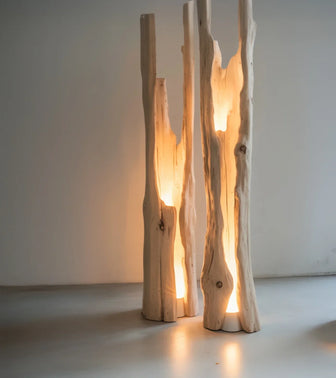
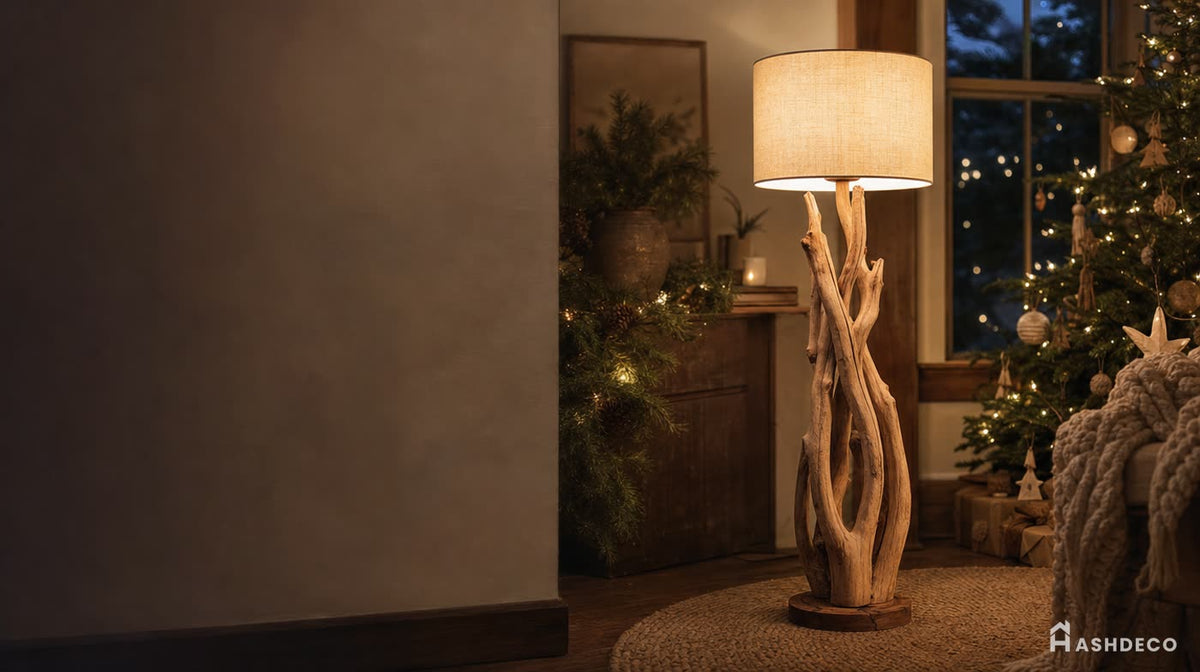
Rustic Driftwood Floor Lamp – Handmade Solid Wood Standing Light for Home Décor
From $1,220.00
Christmas edit
Rustic Driftwood Floor Lamp – Handmade Solid Wood Standing Light for Home Décor
From $1,220.00
 Christmas edit
Driftwood Wall Sconce - Handcrafted Rustic Wooden Wall Lamp
From $650.00
Christmas edit
Driftwood Wall Sconce - Handcrafted Rustic Wooden Wall Lamp
From $650.00
 Christmas edit
Rustic Driftwood Floor Lamp with Shelves – Handmade Wooden Standing Light
From $2,350.0010% off at checkout
Christmas edit
Rustic Driftwood Floor Lamp with Shelves – Handmade Wooden Standing Light
From $2,350.0010% off at checkout
 Sculptural Twisted Solid Wood Floor Lamp - Organic Modern Statement Lamp
From $1,780.00
Sculptural Twisted Solid Wood Floor Lamp - Organic Modern Statement Lamp
From $1,780.00
 Christmas edit
Twisted Vine Wooden Floor Lamp - Handcrafted Driftwood Standing Light With Leaf Shade
From $1,280.00
Christmas edit
Twisted Vine Wooden Floor Lamp - Handcrafted Driftwood Standing Light With Leaf Shade
From $1,280.00
 Christmas edit
S-Curve Wooden Floor Lamp - Driftwood Standing Light With Dual Glow Openings
From $1,480.00
Christmas edit
S-Curve Wooden Floor Lamp - Driftwood Standing Light With Dual Glow Openings
From $1,480.00
If you're shopping for a mushroom shelf right now, you've probably noticed the price gap. On one side: $15-30 mushroom shelves made from resin, PLA plastic, or MDF. On the other: $150-400+ mushroom shelves carved from solid wood. That's a 10x difference for something that goes on the same wall.
The question isn't which is "better" in some absolute sense. It's which one makes sense for what you're doing with it and how long you want it to last.
What each material actually is
Resin mushroom shelves are cast in silicone molds from polyester or epoxy resin. The shape is poured, not carved. They come out smooth, uniform, and identical to every other shelf from the same mold. Paint or pigment is mixed into the resin before pouring, so the color goes all the way through. Weight varies, but most are lighter than they look.
3D-printed PLA shelves are made from polylactic acid, a biodegradable plastic derived from corn starch. A printer builds them layer by layer. If you look closely, you can see the print lines running horizontally across the surface. They're the lightest option and come in the widest range of colors. Most mushroom shelves on Etsy under $30 are PLA.
Solid wood mushroom shelves are carved from actual timber. An artisan starts with a block or slab of hardwood and shapes the mushroom form using chisels, rotary tools, and sanders. The grain, color, and texture come from the wood itself. No two pieces are identical because the material varies naturally.
How they look up close
From across the room, all three can look decent in photos. The differences show up when you're standing next to them.
Resin: Smooth, uniform surface. The cap edge is the same thickness all the way around. Color is even. No texture variation. Looks clean but flat. The underside is usually hollow or has a visible seam line from the mold.
PLA: Visible horizontal print lines unless heavily sanded and painted. Surface feels slightly ridged under your fingers. The shape can be very detailed (3D printers handle complex geometry well), but the material reads as plastic no matter the color. Thin walls mean it sounds hollow when tapped.
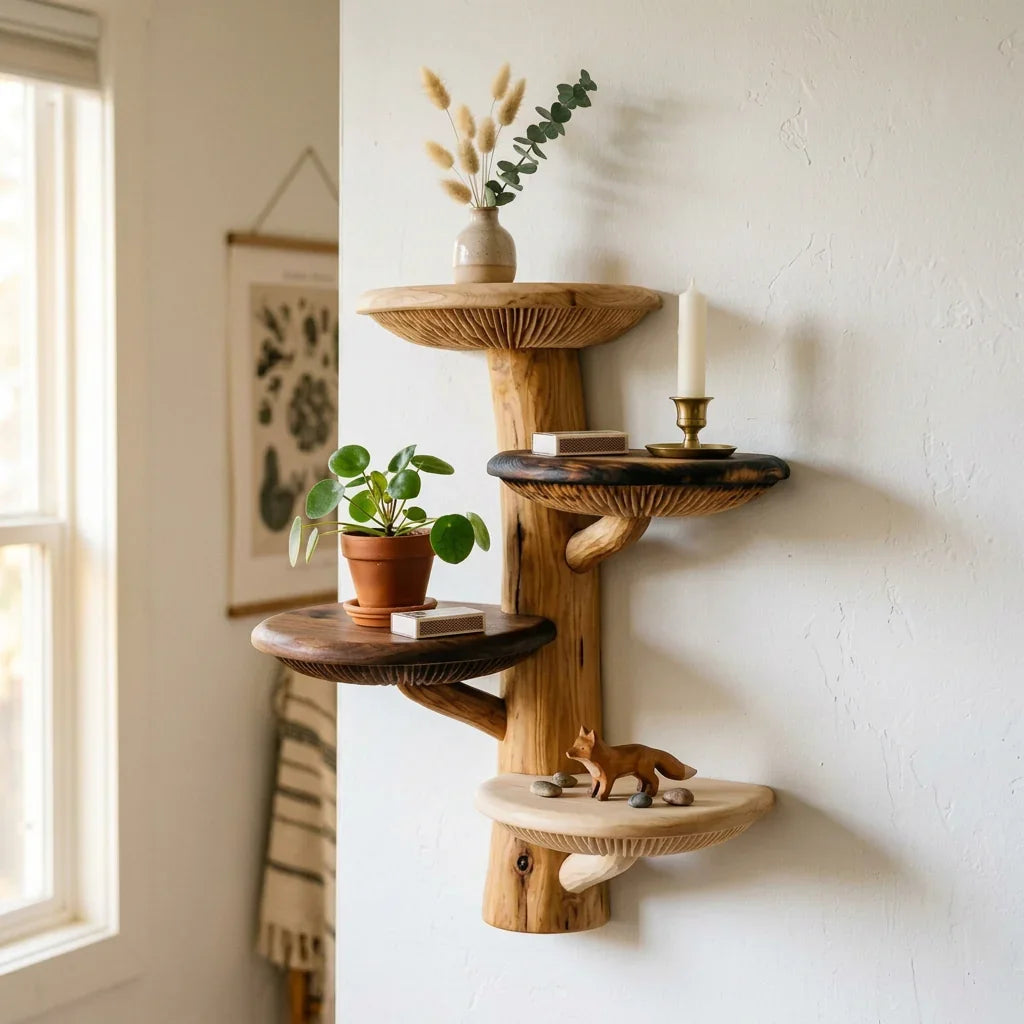
Solid wood: Grain visible on every surface. Color varies across the piece, from heartwood to sapwood, with natural gradients the wood grew over decades. The cap edge has irregular thickness following the natural form. The underside shows tool marks or carved gill detail. Feels warm and substantial. Sounds solid when tapped.

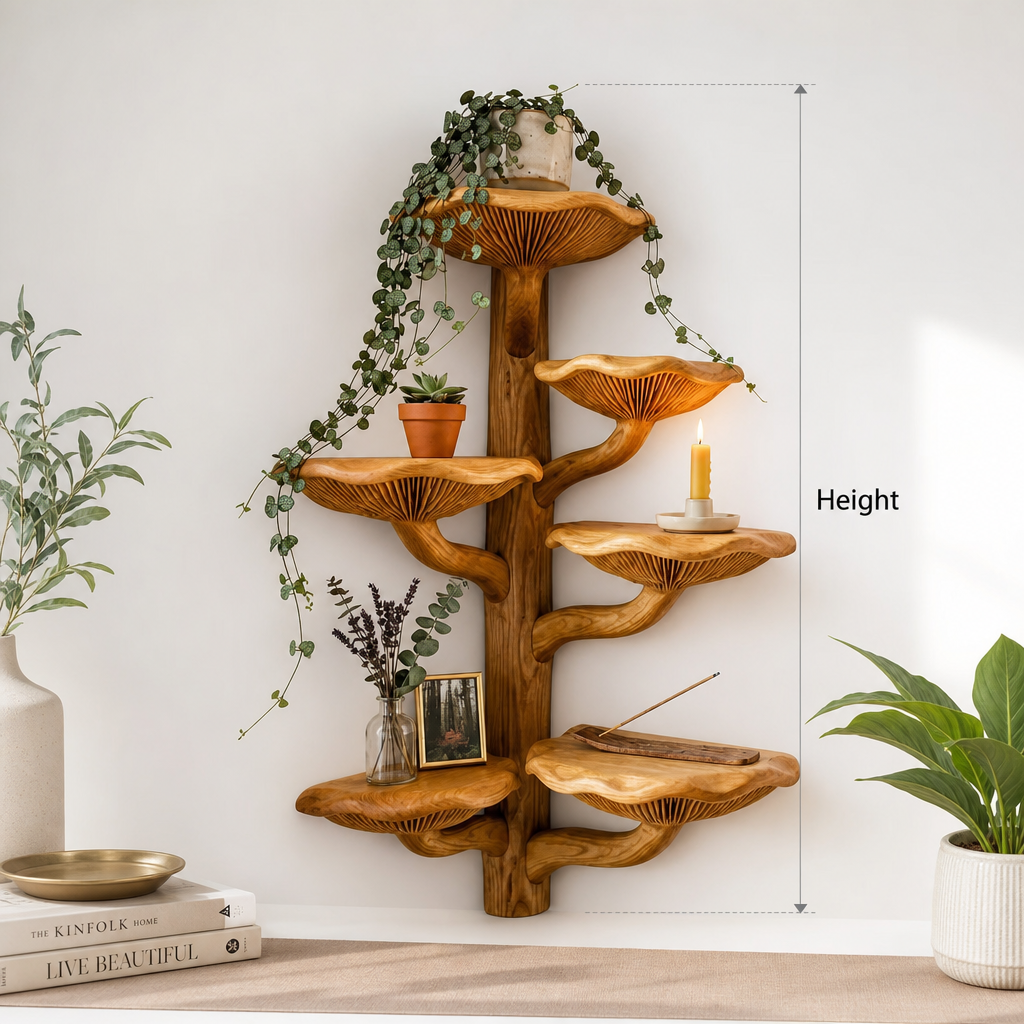
The Sculpted Mushroom Floating Shelf in solid wood. Grain runs through the entire form. The gill carving underneath is done by hand.


Weight capacity
This is where the gap gets practical.
PLA shelves are designed for display. Small crystals, a tiny succulent, lightweight trinkets. Stack a few books on one and the mounting point starts pulling away from the wall within months. The material itself can flex under sustained load.
Resin shelves handle slightly more. A candle, a small framed photo, a coffee mug. But they're still limited by the mounting hardware, which is usually a small adhesive strip or a single screw hole. The resin holds, but the connection to the wall is the weak link.
Solid wood shelves with hidden bracket systems anchored into wall studs hold real weight. Books, potted plants, ceramic objects. The bracket is concealed inside the shelf and distributes load across the mounting points. You're limited by the bracket rating, not the shelf material.
How they age
This matters more than most people think when buying, because a shelf stays on your wall for years.
PLA after 1-2 years: Yellows in direct sunlight. Can warp slightly in warm rooms (PLA softens around 60C/140F, which a sun-facing wall can approach in summer). Print lines become more visible as dust settles into the grooves. Still functional, but looks noticeably older than when new.
Resin after 1-2 years: More stable than PLA. Won't warp. Can yellow slightly depending on the resin type and UV exposure. Dust settles into the smooth surface evenly, which is easy to wipe. Chips and scratches show as white marks against the colored surface and can't be repaired without repainting.
Solid wood after 1-2 years: Develops a patina. The color deepens slightly as the finish ages. Small surface marks blend into the grain and add character rather than looking like damage. Can be refinished if needed. A solid wood shelf from 10 years ago looks better than a new one, not worse. That's the nature of real wood.

The Sculptural Root Mushroom Shelf with a glossy amber finish. Wood patina deepens over time. Resin and PLA don't do this.
Don't miss
These pieces qualify for 10% off orders over $2,000. Applied automatically at checkout.
10% off
Rustic Driftwood Floor Lamp with Shelves – Handmade Wooden Standing Light
From $2,350.00
10% off at checkout
 10% off
Rustic Driftwood Floor Lamp with Side Table – Solid Wood Standing Light with Rattan Shade
From $2,350.00
10% off at checkout
10% off
Rustic Driftwood Floor Lamp with Side Table – Solid Wood Standing Light with Rattan Shade
From $2,350.00
10% off at checkout
 10% off
Sculpted Spiral Twist Floor Lamp Handcrafted Solid Timber Standing Light with Linen Drum Shade
From $2,280.00
10% off at checkout
10% off
Sculpted Spiral Twist Floor Lamp Handcrafted Solid Timber Standing Light with Linen Drum Shade
From $2,280.00
10% off at checkout
 10% off
Biomorphic Sculpted Hollow Floor Sculpture Organic Timber Art Piece Hand Carved in Solid Wood
From $2,280.00
10% off at checkout
10% off
Biomorphic Sculpted Hollow Floor Sculpture Organic Timber Art Piece Hand Carved in Solid Wood
From $2,280.00
10% off at checkout
The price question
A 3D-printed mushroom shelf costs $15-30. A resin one runs $25-60. A solid wood hand-carved mushroom shelf starts around $150-200 and goes up from there depending on size and complexity.
Where does that money go?
Material cost is part of it. A few dollars of PLA filament vs a slab of hardwood. But the bigger factor is labor. A 3D printer runs unattended for hours and produces identical copies. A mold can be poured repeatedly. Hand-carving a mushroom shelf from solid wood takes an artisan hours of focused work with chisels and rotary tools. Each curve, each gill line, each surface transition is shaped individually.
The question is what you're buying. If you want a colorful accent piece for a dorm room or rental apartment that you'll replace in a year or two, $20 for PLA makes complete sense. If you want a piece that functions as both storage and wall art, feels substantial when you touch it, ages well, and you plan to keep it for a decade or more, solid wood is the material that does that.
Which should you buy?
Buy PLA or resin if:
- You want a specific color that doesn't exist in natural wood
- You're decorating a rental or temporary space
- The shelf is purely decorative (no real weight on it)
- Budget is the primary constraint
- You like changing your decor frequently
Buy solid wood if:
- You want the shelf to hold books, plants, or heavier objects
- You care about how the shelf looks from the side and underneath, not just straight on
- You want something that ages well and develops character
- The shelf is going in a room you look at every day (bedroom, living room)
- You prefer handmade with natural variation over factory-identical
Browse Ashdeco's mushroom floating shelf collection to see what hand-carved solid wood versions look like. Each one is shaped by a Vietnamese artisan from a single piece of timber, with natural grain patterns and carved gill detail that molded materials can't replicate.
Frequently asked questions
Do resin mushroom shelves break easily?
Resin is fairly durable for its weight. It won't shatter from a light bump, but it can chip on the edges if knocked hard. The main failure point is the wall mounting, not the shelf itself. Resin shelves usually come with adhesive strips or small screws that aren't designed for heavy loads.
Can I paint a PLA mushroom shelf to look like wood?
You can paint it, but it won't look like wood up close. Paint sits on the surface and covers the print lines, but you lose the translucency and depth that real wood grain has. From a distance it can pass, but anyone who touches it or looks at the edge will know. If you want the wood look, buy wood.
How can I tell if a mushroom shelf is solid wood or something else?
Check the weight first. Solid wood is noticeably heavier than PLA or thin resin. Look at the underside and edges for visible grain running continuously through the form. If the color is perfectly uniform with no variation, it's not real wood. And if the listing says "wood-look," "wood-tone," or "wood-finish" instead of "solid wood," it almost certainly isn't.
Is solid wood sustainable compared to PLA or resin?
PLA is marketed as biodegradable, but it only breaks down in industrial composting facilities, not in landfills or home compost. Resin is petroleum-based and not biodegradable. Solid wood from responsibly managed sources is renewable, biodegradable, and locks carbon for its lifetime. At end of life, wood breaks down naturally. The other two don't, despite marketing claims.