You need something for coats by the front door. You've narrowed it down to two options: a hall tree or a coat rack. They look similar in photos, and some stores even use the names interchangeably. But they solve different problems, take up different amounts of space, and cost very different amounts.
If you pick the wrong one, you end up either wasting money on features you don't use, or wishing you'd gotten the version with shoe storage. This comparison lays out exactly where each one makes sense.
The Core Difference
A coat rack gives you hooks. That's it. Hooks on a pole, hooks on a wall mount, hooks on a tree-shaped stand. Its entire job is holding things that hang: coats, hats, bags, scarves, dog leashes.
A hall tree gives you hooks plus storage. A shelf on top for keys and sunglasses. A bench or shoe rack at the bottom for footwear. Some have cubbies, mirror panels, or enclosed storage compartments. It's trying to organize your entire entryway with one piece of furniture.
The question isn't which one is "better." It's which one matches what your entryway actually needs.
Space Requirements
This is usually the deciding factor before everything else.
| Type | Floor Footprint | Wall Space Needed | Best For |
|---|---|---|---|
| Standing coat rack | 12 by 12 inch base | None (freestanding) | Corners, behind doors, small apartments |
| Wall-mounted coat rack | Zero floor space | 24"-48" wide | Narrow hallways, rentals with stud access |
| Standing hall tree | 24 by 18 inches or wider | None (freestanding) | Wide entryways, mudrooms |
| Wall-mounted hall tree | 6"-12" deep (shelf depth) | 30"-48" wide | Medium hallways with stud access |
A standing coat rack fits where nothing else will. Behind a door. In a 12-inch corner. Next to a shoe rack without competing for space. If your entryway is under 36 inches wide, a coat rack keeps the walkway clear.
A hall tree needs room. The piece itself is wider, and hanging coats add another 12 inches on each side. You need at least 48 inches of entryway width for a standing hall tree to work without making the space feel cramped.

Custom Driftwood Wall Mount Coat Rack | $697 - $997
Price Comparison
Coat racks cost less because they have fewer parts. A handcrafted solid wood coat rack starts at $520 for a wall-mounted version and goes up to $1,587 for a large standing tree coat rack with multiple branches.
Hall trees cost more because they combine hooks with shelving, shoe storage, and sometimes bench seating. At Ashdeco, hall trees range from $1,056 for a compact standing model to $3,250 for a large wall-mounted unit with personalized hooks and shelf.
| Feature | Coat Rack (Ashdeco) | Hall Tree (Ashdeco) |
|---|---|---|
| Price range | $520 - $1,587 | $1,056 - $3,250 |
| Hooks | 4-6 | 4-8 |
| Shoe storage | No | Yes (most models) |
| Shelf | No (wall racks) / Sometimes (standing) | Yes |
| Weight | 8-25 lbs | 40-80 lbs |
If your budget is under $1,000 and you just need hooks, a coat rack is the straightforward choice. If you're spending $1,000+ anyway and your entryway needs more organization, the extra $500 to $1,000 for a hall tree gets you shoe storage and a shelf that would cost more to buy separately.
When a Coat Rack Is the Right Call
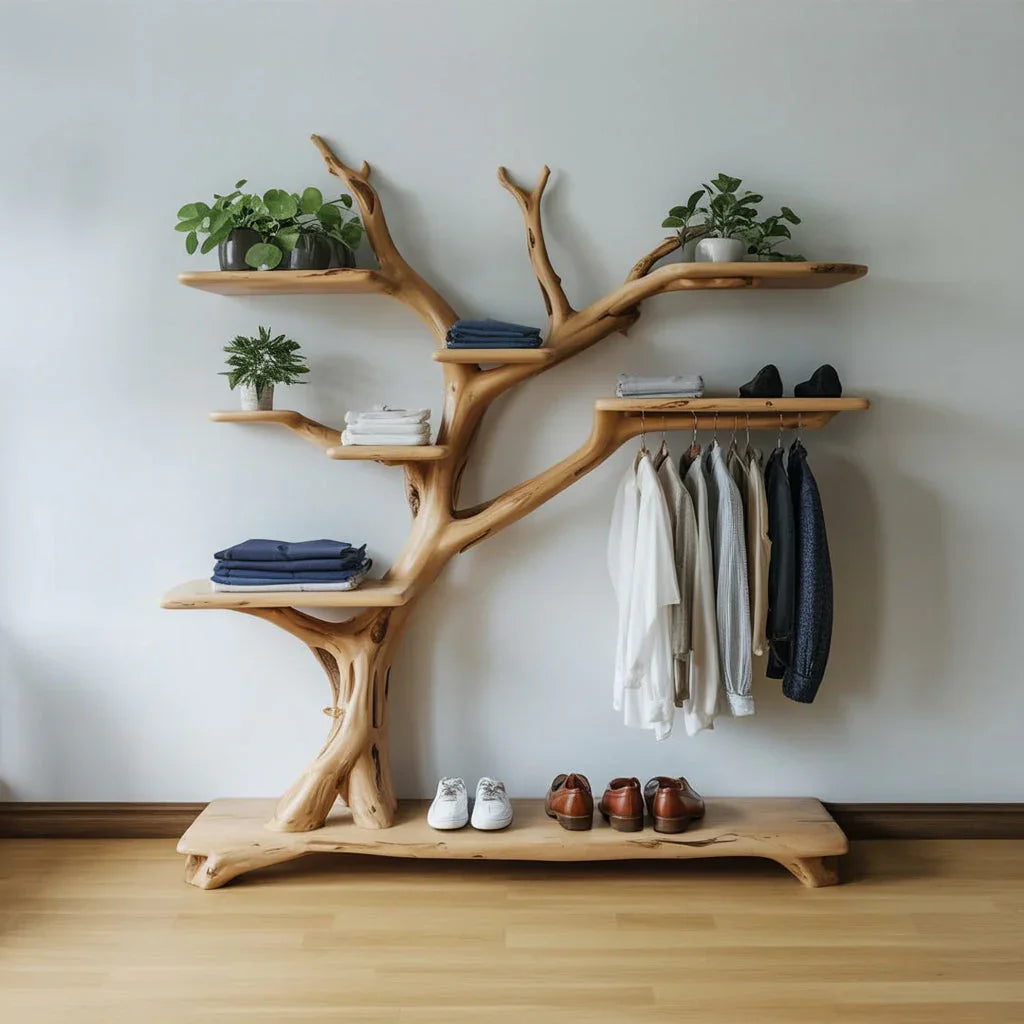
Small entryway, narrow hallway. You don't have room for a hall tree. A wall-mounted coat rack at 24 inches wide handles four coats without taking floor space. You already have shoe storage. If there's a shoe bench or a mat by the door, adding a hall tree gives you duplicate shoe storage you don't need. A coat rack fills the one gap. Minimalist space. You want one functional piece, not a furniture system. A tree-shaped coat rack works as both decor and functional storage without dominating the entryway. Guest room or secondary entrance. The back door, the garage entry, a guest bedroom closet. These spots need hooks, not a full entryway system. Budget. A handcrafted coat rack at $697 gets you the same artisan quality and solid wood construction as a $2,300 hall tree, just without the storage components.

Rustic Wall Coat Rack | $1,056 - $1,587
When a Hall Tree Makes More Sense
Wide entryway with no other furniture. If the hall tree is the only piece by the front door, it does the job of a coat rack, shoe bench, and entry shelf combined. One purchase instead of buying each separately. Mudroom. The entry-from-garage room where everything gets dumped. A hall tree handles coats, bags, shoes, and keys in one organized unit. Without it, mudrooms turn into pile-on-the-floor situations within a week. Families with kids. Kids drop backpacks, coats, shoes, and sports gear in a heap by the door. A hall tree with hooks at different heights and a shoe shelf gives everything a designated spot. It doesn't guarantee kids will use it, but at least the system exists. You want a statement piece. A handcrafted hall tree with natural wood branches, carved hooks, and integrated storage is furniture that people notice. It sets the tone for the rest of the house before anyone gets past the entryway.

Can You Start With a Coat Rack and Add Storage Later?
Yes, and some people prefer this approach. Buy a coat rack now, add a shoe bench later, add a wall shelf later. You build the system piece by piece.
The upside: you spread the cost over time and customize each component. The downside: separate pieces rarely look as cohesive as a single hall tree designed as one unit. You also end up spending more total because each piece has its own manufacturing and shipping cost.
If you know you'll want shoe storage within the next year, buying a hall tree upfront costs less than buying a coat rack plus a shoe bench separately. If you're unsure about shoe storage, start with the coat rack and see how your entryway functions before committing.
Honest Downsides of Each
Coat rack downsides:
- No shoe storage. Shoes still end up on the floor.
- Standing coat racks can tip if you hang heavy bags on one side. Weight needs to be distributed evenly.
- Wall-mounted versions require drilling into studs. Drywall-only mounting will fail.
- Limited capacity. Four hooks fill up fast in a household with more than two people.
Hall tree downsides:
- Takes up more space than most people expect. Measure your entryway before buying.
- Heavier. A solid wood hall tree weighs 40 to 80 pounds. Moving it means getting help.
- Higher price. Starting at $1,056 for handcrafted, most models run $2,000+.
- Lead time. Made to order means 4 to 8 weeks. Not a same-day solution.
- Shoe storage shelf needs occasional cleaning. Shoes track in dirt, mud, salt.
FAQ
Can I use a coat rack as a hall tree by adding a shelf below it?
You can mount a coat rack above a separate shelf or shoe bench to create a hall tree effect. Many people do this. The result works functionally, but visually it looks like two separate pieces rather than one designed unit. If that doesn't bother you, it's a practical solution that costs less than a single hall tree.
How many coats can a hall tree hold?
Most hall trees have 4 to 8 hooks, and each hook holds one heavy coat or two lighter items (scarf + hat). A 6-hook hall tree comfortably handles a household of two adults and one child with room for guest coats. For families of four or more, look for models with 8 hooks or supplement with a separate coat rack nearby.
Do I need a hall tree if I have a closet by the front door?
Probably not for coats. But hall trees still help with daily grab-and-go items: keys, sunglasses, dog leashes, the bag you take to work. A closet hides things. A hall tree keeps frequently used items visible and accessible. Many homes have a coat closet and a hall tree working together.
Which one is better for apartments?
Coat racks, specifically standing ones. Apartments usually mean smaller entryways, landlords who don't allow wall drilling, and moves every few years. A standing coat rack is portable, needs no installation, and fits corners that hall trees can't. Wall-mounted coat racks work if your lease allows it and you can patch the holes when you leave.
What's the best placement for a hall tree?
Against the wall closest to the front door, positioned so you can reach it immediately when walking in. Leave at least 24 inches of clearance in front for hanging and removing coats. Avoid placing it behind the door (the door will hit it) or in a spot where it blocks natural traffic flow. If your entryway opens directly into the living room, the hall tree creates a visual boundary between entry and living space.