You've measured your entryway. You know you need something that holds coats, bags, maybe shoes. You've searched "hall tree" and found hundreds of options between $80 and $5,000. Most look the same. The difference is what happens 18 months after you buy one.
This guide covers what actually matters when choosing a hall tree, what separates one that lasts from one that doesn't, and how much you should expect to spend based on the material and construction.
What a Hall Tree Actually Does
A hall tree combines coat hooks, shoe storage, and sometimes a bench or shelf into one freestanding or wall-mounted unit. It's designed for entryways, mudrooms, and hallways where you need organized storage in a narrow footprint. The best hall trees keep daily-use items accessible without cluttering the floor, while acting as the first piece of furniture guests see when they walk in.
Most factory-made hall trees use manufactured wood (MDF or particle board) with laminate coating. They cost $80 to $250, weigh around 25 to 35 pounds, and hold up reasonably well for 12 to 18 months. After that, the hooks start loosening because screws pull out of soft material, the laminate peels at edges, and the shoe shelf bows from moisture.
Solid wood hall trees skip those problems entirely. Real wood doesn't delaminate. Screws grip better and hold longer in hardwood. And the whole unit is heavier, which means more stable. The trade-off is price and lead time.

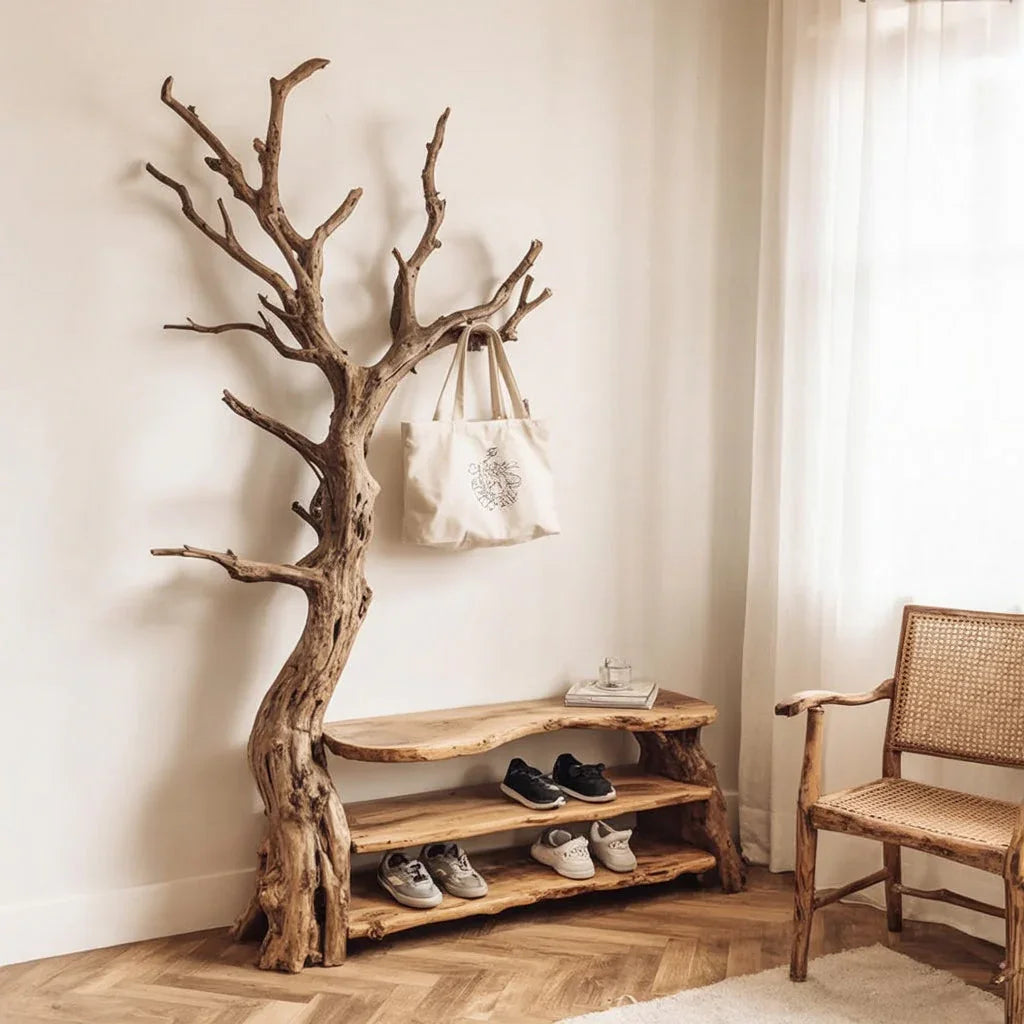
Handmade Wooden Tree Hall Tree Coat Rack | $1,056 - $1,587
Standing vs Wall-Mounted: Which Layout Fits Your Entryway?
Standing hall trees sit on the floor and don't require drilling into walls. Wall-mounted hall trees bolt to studs and free up floor space underneath. The right pick depends on your entryway layout, your walls, and whether you rent or own.
If your entryway is wider than 4 feet, a standing hall tree works. It anchors the space visually and doesn't need wall support. If your entryway is narrow (under 3 feet), a wall-mounted unit keeps the floor clear for shoes and foot traffic. Renters who can't drill into walls should go standing.
Standing models are heavier. A solid wood standing hall tree from Ashdeco weighs 40 to 80 pounds depending on the design. That weight is actually a feature: it won't tip forward when you hang a heavy winter coat. Wall-mounted models need to hit studs. Drywall anchors alone won't hold the weight of a solid wood unit plus six coats.
Hook Count and Weight Capacity
Most hall trees come with 4 to 8 hooks. The number matters less than the weight each hook can hold. Factory metal hooks screwed into MDF might hold 10 pounds each before the screw starts pulling. Hooks carved from the same wood as the tree, or forged metal hooks bolted through solid hardwood, handle 15 to 25 pounds each without issue.
Think about what you actually hang. A winter parka weighs 3 to 5 pounds. A loaded backpack hits 10 to 15. An umbrella, a couple of scarves, dog leashes. If two people live in the house and each hangs a coat, a bag, and a couple of accessories, you need hooks that hold 15 to 20 pounds each. Four to six hooks is enough for most households. Eight hooks work for families with kids.

Wall Mounted Driftwood Hall Tree | $2,333
Shoe Storage: Built-In or Separate?
Some hall trees have a built-in shoe bench or shelf at the bottom. Others are just hooks on a frame. Whether you need integrated shoe storage depends on what else is in your entryway.
If your entryway already has a shoe bench or a mat, you don't need shoe storage built into the hall tree. But if the hall tree is the only piece of furniture in the entry, built-in shoe storage saves you from buying a second piece. It also keeps shoes off the floor, which helps in wet climates where boots track in mud and snow.
Ashdeco's hall trees with shoe storage range from $2,233 to $2,833. The shoe shelf is part of the structure, carved or assembled from the same wood. It's not a wire rack bolted to the bottom.
What Solid Wood Hall Trees Actually Cost
Hall tree prices break into three tiers. Knowing which tier you're shopping in helps set expectations.
| Tier | Material | Price Range | Lifespan |
|---|---|---|---|
| Budget | MDF, particle board, laminate | $80 - $250 | 1-2 years before visible wear |
| Mid-range | Pine, rubberwood, some solid wood | $250 - $800 | 3-7 years |
| Handcrafted solid wood | Sustainably sourced hardwood, hand-carved | $1,056 - $3,250 | 15-30+ years |
At Ashdeco, hall trees start at $1,056 for a compact standing tree coat rack with hooks. The most popular models fall between $2,100 and $2,500 for wall-mounted designs with integrated shelf and shoe storage. The top of the range is $3,250 for the largest solid wood hall tree with personalized wall hooks.
The math on cost-per-year usually favors solid wood. A $150 MDF hall tree that lasts 18 months costs $100/year. A $2,134 handcrafted hall tree that lasts 20 years costs $107/year. Nearly the same annual cost, but you stop buying replacements and the piece actually looks better with age as the wood develops patina.

How Handcrafted Hall Trees Are Different
A factory hall tree is cut by CNC machines from a sheet of manufactured wood, painted or laminated, and assembled in a warehouse. Every unit looks identical. The process takes minutes per piece.
A handcrafted solid wood hall tree starts with a real piece of wood. At Ashdeco, Vietnamese artisans with 5+ years of experience select, carve, and assemble each piece by hand. The branches that serve as hooks are carved individually, shaped to follow the wood's natural grain. Parts are carved separately and assembled modular, so a piece that looks like a single tree is actually multiple components fitted together.
That process takes days, not minutes. And because no two pieces of wood grow identically, no two hall trees look exactly the same. The branch angles, bark texture, grain patterns, coloring differ from piece to piece. For some buyers that's the whole point. For others who want matching pairs, it's worth knowing upfront.
Honest Downsides
Price. The entry point for a handcrafted solid wood hall tree is $1,056. Most models cost $2,000+. That's 8 to 10 times more than an MDF hall tree from a big box store. If you're furnishing a rental you'll leave in a year, the premium is hard to justify. Lead time. These are made to order. Expect 4 to 8 weeks for delivery. You can't walk into a store and take one home today. Weight. Standing models weigh 40 to 80 pounds. Wall-mounted models are lighter but still require stud mounting. Installation isn't difficult, but you might need a second person to hold the piece while you drill. Variation. The photos show the general form, but your specific piece will have its own grain, color, and branch angles. If you need furniture that matches an existing set exactly, handcrafted wood is unpredictable by nature. Entryway size. Standing hall trees need floor space. A tree-shaped hall tree has an irregular footprint, so measure not just the base but the widest point where branches extend. Give it 6 to 8 inches of clearance on each side.
FAQ
How wide does my entryway need to be for a standing hall tree?
Most standing hall trees need 18 to 30 inches of floor width, plus clearance for hanging coats. Add 12 inches on each side for coats to hang without pressing against walls. So you need at least 42 to 54 inches of total entryway width for comfortable use. Narrow hallways under 36 inches work better with wall-mounted designs.
Can a hall tree go in a mudroom?
Yes. Mudrooms are actually the best placement. The combination of hooks, shelf, and shoe storage handles the exact flow of a mudroom: walk in, hang coat, drop shoes, place keys. Solid wood handles humidity and temperature swings better than MDF. Just avoid placing it where standing water collects. If your mudroom floods, raise the base off the ground or go wall-mounted.
How do I anchor a wall-mounted hall tree to the wall?
Find studs with a stud finder. Mark two or more stud locations. Use lag bolts (not drywall anchors) rated for the weight of the unit plus whatever you plan to hang on it. For a 50-pound unit with 60 pounds of coats and bags, you need anchoring rated for at least 150 pounds (use 2x safety margin). Most Ashdeco wall-mounted hall trees include mounting hardware and a template.
Is $2,000 too much for a hall tree?
Compare it to what you'd spend otherwise. A $150 MDF hall tree every 18 months adds up to $2,000 over 20 years, and you go through 13 units. A $2,134 handcrafted hall tree lasts the same 20 years (or longer) with zero replacements. You also get a piece that actually looks like furniture, not a dorm room accessory. Whether that trade-off makes sense depends on how long you'll stay in your home.
Do kids break hall trees?
Kids are hard on entryway furniture. They yank backpacks off hooks sideways, slam shoe cubbies, and kick the base. MDF hall trees fail faster under kid use because the soft material can't handle lateral force on hooks. Solid hardwood handles this better. The hooks are carved from the same material as the frame, so there's no weak screw-into-soft-board connection. That said, teach kids to hang bags straight down rather than yanking sideways.
What's the difference between a hall tree and a coat rack?
A coat rack is just hooks. A hall tree adds storage: shelves, shoe benches, cubbies, sometimes a mirror. Think of a coat rack as one function (hanging) and a hall tree as a mini-entryway system (hanging + storing + organizing). If all you need is hook space, a coat rack is simpler and cheaper. If you want one piece to organize your whole entry, a hall tree does more.