






















Quick view
- The "branches" on most cat trees aren't what you think
- Three types of "branch" cat trees (and what's really inside them)
- How a solid wood cat tree actually gets made
- Why cats actually prefer real wood (it's not just aesthetics)
- Real branches. Real grain. Real weight.
- Sizing it right: matching the tree to your cat
- The honest downsides of solid wood cat trees
- How to spot real wood vs "wood-look" online
- Frequently asked questions
Shop this guide
Handcrafted Cat Tree Tower, made to order in solid wood.
 Sculptural Spiral Solid Wood Cat Tree Tiered Modern Feline Lounger
From $2,217.0010% off at checkout
Sculptural Spiral Solid Wood Cat Tree Tiered Modern Feline Lounger
From $2,217.0010% off at checkout
 Nature Inspired Branch Solid Wood Corner Cat Tree Tower Condo
From $1,854.00
Nature Inspired Branch Solid Wood Corner Cat Tree Tower Condo
From $1,854.00
 Live Edge Slice Tiered Solid Wood Cat Tree Freestanding Multi Level Perch
From $1,732.00
Live Edge Slice Tiered Solid Wood Cat Tree Freestanding Multi Level Perch
From $1,732.00
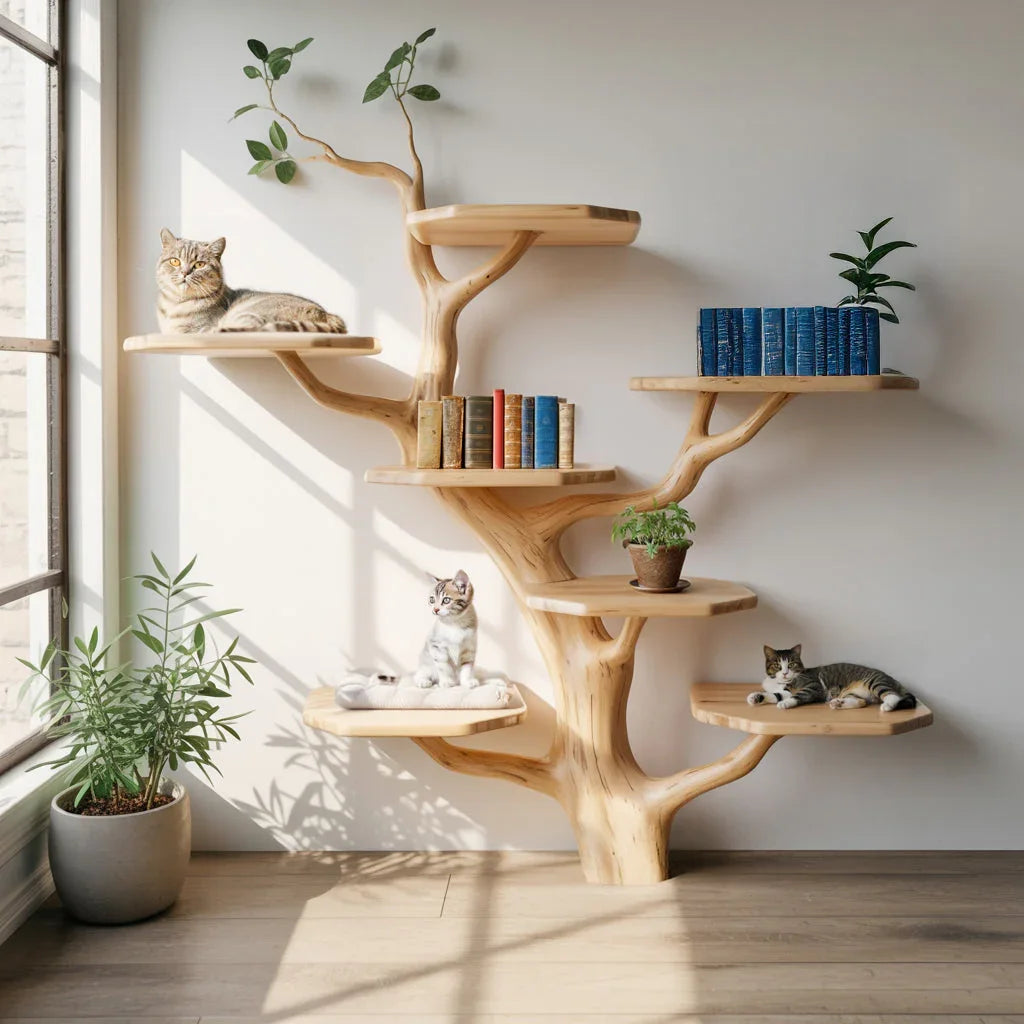
 Artisanal Solid Wood Sculptural Tree Cat Tower & Multi-Tier Botanical Display Perch Stand
From $2,076.0010% off at checkout
Artisanal Solid Wood Sculptural Tree Cat Tower & Multi-Tier Botanical Display Perch Stand
From $2,076.0010% off at checkout
 Sculptural Hand-Carved Tree Solid Wood Wall-Mounted Cat Climbing Tower with Dual House Condos & Display Shelves
$3,012.0010% off at checkout
Sculptural Hand-Carved Tree Solid Wood Wall-Mounted Cat Climbing Tower with Dual House Condos & Display Shelves
$3,012.0010% off at checkout
 Sculptural Hand-Carved Tree Solid Wood Cat Tower & Multi-Tier Luxury Feline Climbing Tree with Tunnel Condo Base
From $2,654.0010% off at checkout
Sculptural Hand-Carved Tree Solid Wood Cat Tower & Multi-Tier Luxury Feline Climbing Tree with Tunnel Condo Base
From $2,654.0010% off at checkout
The "branches" on most cat trees aren't what you think
A cat tree that looks like a real tree is harder to find than it should be. Every pet furniture brand uses the word "natural" now - scroll through Amazon and you'll see dozens of cat trees with branch-shaped posts, bark-textured wraps, and leaf-shaped platforms. We've broken down what actually makes cat trees that look like trees different from the ones that just photograph well.
But pick one up at the store (or unbox one from shipping) and you'll notice something right away: it barely weighs anything. The "branches" flex when you push them. The bark is printed vinyl glued over cardboard tubes.
Your cat notices too. Cats are 8-pound quality inspectors with roughly 14 times your sense of smell and paw pads sensitive enough to read surface textures. They know the difference between a hollow tube wrapped in printed vinyl and a piece of solid wood that still smells faintly like a forest.
This guide breaks down the three types of "branch" cat trees on the market right now, what each one is actually made of, and what that means for your cat's safety, behavior, and long-term use.

Custom Wooden Tree Shaped Cat Tree - from $2,160
Three types of "branch" cat trees (and what's really inside them)
Not all branch-style cat trees are built the same way. The differences are hidden inside the structure, where product photos can't reach. Here's what you're actually buying in each category.

Faux branch: printed bark over hollow tubes
The most affordable option. Manufacturers shape PVC pipe or cardboard tubes into branch-like forms, then wrap them in printed vinyl or textured paper that mimics bark. Some even use spray-painted foam.
From a distance, they look decent. Up close, the illusion breaks. The surface is smooth and uniform. No grain variation, no natural imperfections. Because the core is hollow or filled with compressed cardboard, these structures are light. A 5-foot model might weigh 12 to 15 pounds total.
That low weight is the real problem. A 12-pound cat launching from the top platform generates enough force to shift or topple a 15-pound structure. You'll hear it wobble. Your cat will feel it wobble. After a few wobbles, most cats stop using the upper levels entirely.
Typical lifespan: 6 to 12 months before the vinyl peels or the structure leans permanently.
Sisal-wrapped posts shaped like branches
The middle ground. These use engineered wood (particle board or MDF) shaped into angular branch forms, then wrapped in sisal rope. The sisal gives cats something to scratch, and the particle board core is heavier than hollow PVC.
This is what most cat trees in the $150 to $300 range are made of. The construction holds up better than faux branch models, and cats generally use the scratching surfaces well. But the internal material is still pressed wood fiber held together with adhesive. Moisture, repeated impact from jumping, and temperature changes cause particle board to swell, crack, and eventually crumble at the joints.
Sisal also has a lifespan. Heavy scratchers can shred through a sisal wrap in 3 to 6 months. Some owners re-wrap the posts themselves, which extends the life of the tree but adds ongoing maintenance.
Typical lifespan: 1 to 3 years, depending on how aggressively your cat scratches.
Solid wood, carved and shaped by hand
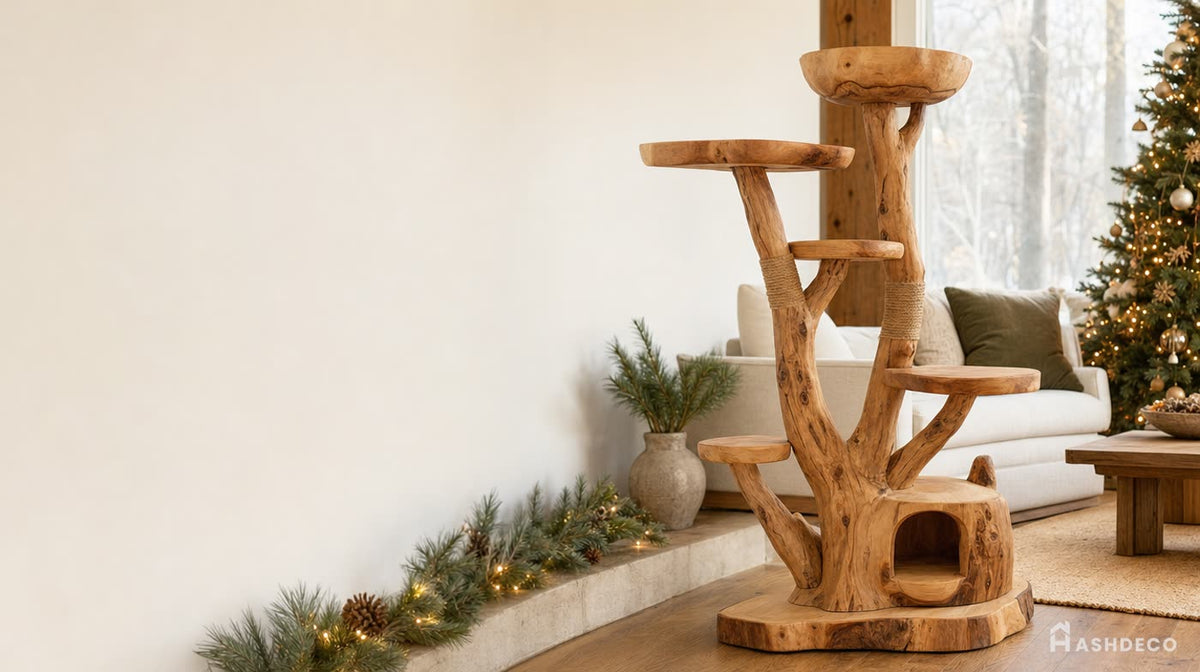
This is the category most people don't know exists. Instead of wrapping a synthetic material to look like wood, the structure is actual wood. A craftsman selects timber, sketches the branch layout based on the grain and natural curves of the piece, then carves the shape by hand. Branches are shaped individually, sanded to remove splinters while preserving surface texture, treated for moisture and pest resistance, then assembled.
The result weighs 25 to 60 pounds depending on the model. That weight is the single biggest functional difference. A 40-pound cat tree doesn't move when a 20-pound Maine Coon throws himself at it from across the room. No wobble, no sliding, no tip risk. Cats respond to that stability by actually using every level of the tree, including the highest platforms that get ignored on lighter structures.
The wood grain creates a natural scratching texture without needing sisal wraps. Cats grip and pull against the grain the same way they would on an outdoor tree trunk. The surface wears slowly over years, developing a patina rather than falling apart.
Typical lifespan: 5 to 10+ years. Some solid wood cat furniture outlasts the cat. If budget is the deciding factor, our natural branch cat tree collection starts under $1,100.

Handcrafted Rustic Tree Cat Tower - from $2,239
Why Does a Solid Wood Cat Tree Look Like a Real Tree?
Because the branch layout follows the timber's actual grain instead of a fixed mold. A carved solid wood cat tree mimics how a real tree grows - irregular curves, varying branch thickness, natural taper - which is exactly what separates it from PVC or particle board shaped to merely resemble bark.
Side-by-side comparison
| Feature | Faux branch (PVC/foam) | Sisal-wrapped (particle board) | Solid wood (hand-carved) |
|---|---|---|---|
| Core material | Hollow PVC, cardboard, foam | Particle board, MDF | Hardwood timber |
| Total weight (5ft model) | 12-18 lbs | 20-35 lbs | 30-60 lbs |
| Stability for large cats | Poor, tips easily | Moderate | Excellent |
| Surface texture | Smooth vinyl or paint | Sisal rope (replaceable) | Natural wood grain |
| Scratch durability | Low, vinyl peels | Medium, sisal shreds in 3-6 months | High, wood wears slowly |
| Moisture resistance | Low | Low (particle board swells) | High (treated hardwood) |
| Lifespan | 6-12 months | 1-3 years | 5-10+ years |
| Price range | $40-$120 | $150-$350 | $800-$2,500 |
| Two identical units possible? | Yes (factory molded) | Yes (factory produced) | No (each piece unique) |


How a solid wood cat tree actually gets made

Most brands that say "handcrafted" don't explain what that means. Here's the actual process behind a carved wood cat tree, step by step.
Wood selection. It starts with choosing the right piece of timber. The craftsman looks for wood with interesting natural curves, strong grain patterns, and no hidden rot or insect damage. Not every piece of wood qualifies. Many get rejected at this stage.
Sketching the layout. Rather than imposing a fixed design on the wood, the artisan works with what the grain suggests. A natural curve becomes a branch. A thick section becomes a platform support. This is why no two finished pieces look the same, and it's the opposite of factory production where the design stays fixed and the material gets cut to fit.
Rough carving. Power tools remove the bulk material to form the trunk and main branches. This stage is messy and fast. It sets the overall proportions.
Detail shaping. Hand tools refine the branch forms, taper the ends, and create the organic curves that make the structure look like it grew rather than got built. This is where the craftsmanship shows. A good carver makes the transitions between trunk and branch look seamless, with no visible joints or hard angles.
Sanding. Not to make it smooth, but to remove splinters and loose fibers while keeping the texture that cats need for grip. Over-sanding would create a surface too slick for climbing. The goal is safe but textured.
Treatment. The wood gets sealed against moisture and treated to prevent insect infestation. No toxic finishes. Cats lick and bite surfaces they climb on, so the treatment has to be food-safe.
Assembly. The carved sections join together with internal hardware. Platforms mount to the branch structure. The whole thing gets tested for weight capacity and stability before shipping.
This process takes 2 to 4 weeks per piece. That's the tradeoff: you wait longer, and you pay more, but you get something that won't end up in a landfill next year.

Cat Tree Tower - Tall Cat Scratcher - $1,339
Why cats actually prefer real wood (it's not just aesthetics)

There's a practical reason cats behave differently on solid wood versus synthetic materials. Three practical reasons, actually.
Texture. Wood grain runs in irregular patterns. When a cat digs their claws into real wood, they get resistance that varies across the surface. Some spots grip harder, some softer. This variety is what they experience on outdoor trees, and it satisfies the scratching instinct more completely than uniform sisal or smooth vinyl. For more on how branch shape influences climbing behavior, see our tree branch cat tree design guide.
Scent. Cats have roughly 200 million scent receptors compared to a human's roughly 5 million. They smell the adhesives, dyes, and chemical treatments in synthetic materials. Wood, especially after the initial finish cures, smells like... wood. Cats scent-mark their territory by rubbing their cheeks against surfaces, and they prefer to mark materials that hold and blend with their own scent. Wood absorbs scent better than plastic or vinyl.
Vibration. When a cat jumps onto a platform, the platform vibrates. On a light, hollow structure, that vibration is significant. Cats feel it through their paw pads and interpret it as instability. On solid wood, the vibration is dampened by mass. The platform feels dead under their paws, like solid ground. This is why cats on heavy wood cat trees will confidently sprint up to the top level, while cats on lighter structures creep cautiously and often abandon the upper platforms altogether.
None of this means a synthetic cat tree is useless. Plenty of cats use them happily, especially lighter-weight cats who don't generate enough force to destabilize the structure. But if you've ever watched your cat avoid a cat tree you spent good money on, the material and weight might be the reason.
Sizing it right: matching the tree to your cat

A cat tree that's wrong size for your cat won't get used, no matter how well it's built. Here's how to match the specs.
| Cat weight | Minimum platform width | Minimum base weight | Recommended height |
|---|---|---|---|
| Under 10 lbs | 14 inches | 20 lbs | 3-5 feet |
| 10-15 lbs | 16 inches | 30 lbs | 4-6 feet |
| 15-25 lbs (Maine Coon, Ragdoll) | 18+ inches | 40 lbs | 5-6 feet |
| Multi-cat household (2-3 cats) | 18+ inches | 50 lbs | 5-7 feet |
The weight rule: The cat tree should weigh at least twice your heaviest cat. A 15-pound Ragdoll needs a tree that weighs 30 pounds minimum. That rules out most faux branch and many sisal-wrapped models. Most solid wood cat trees start at 30 pounds and go up from there.
Platform spacing: Leave 12 to 16 inches between platforms vertically. Too close and your cat can't stretch while climbing. Too far and older or less agile cats won't make the jump.
Ceiling clearance: A 6-foot cat tree in a room with 8-foot ceilings gives your cat 2 feet of headroom on the top platform. That's usually enough. If you have lower ceilings, go with a wider, shorter model that offers horizontal variety instead of extreme height.
For large breeds specifically, we've covered this in detail in our cat trees for large cats guide.

Wood Cat Tree Tower House - from $2,145
The honest downsides of solid wood cat trees
Real wood cat trees aren't for everyone. Here's what you should know before deciding.
They're heavy. A 40- to 60-pound cat tree isn't something you casually reposition. Moving it to vacuum behind requires effort. If you rearrange furniture frequently, that weight becomes a real inconvenience.
They cost more. A hand-carved solid wood cat tree runs $800 to $2,500 depending on the size and complexity. A decent sisal-wrapped model from Amazon costs $150 to $300. If budget is your priority, particle board with sisal does a reasonable job for lighter cats.
Lead time. Because each piece is made by hand, expect 2 to 4 weeks for production. There's no warehouse full of identical units ready to ship tomorrow. If you need a cat tree this weekend, this isn't the right option.
No two are identical. The natural variation in wood means your cat tree will look similar to the product photos but not exactly the same. Branch positions, grain patterns, and coloring will differ. Most people consider this a feature. If you need exact uniformity, it's a limitation.
You can't return it to Amazon. Most handcrafted furniture makers, including us, offer returns and guarantees, but the process is different from one-click retail returns. Check the return policy before ordering.
How to spot real wood vs "wood-look" online
Shopping online makes it harder to judge materials. A few things to look for:
Check the weight in the specs. If a 5-foot cat tree weighs under 25 pounds, it's not made from solid wood. Real wood structures are heavy. If the listing doesn't mention weight at all, assume it's lightweight construction.
Look at the photos. Real carved wood shows grain variation that's never perfectly symmetrical. Faux branch surfaces repeat patterns. Zoom into product photos and look for unique imperfections. If every branch looks identical, it's a mold.
Read the materials section. "Wood-effect," "wood-style," "natural-look" are marketing terms for not-wood. Look for "solid wood," "hardwood," or specific wood species names (oak, acacia, teak, ash). If they name the actual wood, it's more likely real.
Check the price. A 5-foot cat tree made from real hardwood by a human being cannot realistically cost $89. Material costs alone would exceed that. If the price seems too good for real wood, it probably isn't.
Browse our solid wood cat tree collection to see what actual hand-carved wood cat trees look like, with weights and dimensions listed for each model.
Frequently asked questions
Can cats scratch solid wood branches without damaging them?
Yes. Hardwood is dense enough to withstand scratching without splintering or breaking down the way sisal and carpet do. Cats scratch wood the same way they scratch outdoor trees. Over months and years, scratched areas develop a worn texture that cats actually prefer over fresh surfaces. You don't need to replace parts or re-wrap anything.
Is a real wood cat tree safe for kittens?
Yes, as long as you choose a model with appropriate platform spacing (10 to 12 inches for kittens). The wood itself is safe. Reputable makers use food-safe finishes with no toxic coatings. Kittens are lighter than adult cats, so stability is less of a concern at that age, but they grow fast, and a solid wood tree will still be the right size when they're full-grown adults.
Does Ashdeco make a cat tree that looks like a real tree?
Yes - the hand-carved branch structure is shaped to follow the wood's natural grain, not molded from a fixed template. Leaves, bark texture, and branch placement vary piece to piece, the same way no two real trees look identical.
How do I clean a solid wood cat tree?
Wipe it with a damp cloth. That's the main advantage over carpet-covered cat trees, which trap hair, dander, and odor in the fibers and need vacuuming or eventual replacement. Wood doesn't absorb odors the way fabric does. For deeper cleaning, use a mild soap solution and dry completely. Any removable cushions or wicker baskets can be washed separately.
Will a branch-style cat tree fit in a small apartment?
Many branch designs are vertical rather than wide, which means they take up less floor space than traditional multi-platform cat towers. A wall-leaning or wall-mounted branch cat tree can occupy as little as 2 square feet of floor space while offering 5 to 6 feet of vertical climbing room. Measure your space and check the base dimensions before ordering.
How long does it take to receive a handcrafted cat tree?
Typically 2 to 4 weeks from order to delivery. Each piece is made after you order it. This is different from mass-produced cat trees that ship from a warehouse in 2 to 3 days. The wait is the tradeoff for getting something built specifically rather than pulled off a shelf.