






























Quick view
- Step 1: Wood Selection (Day 1, 30-60 Minutes)
- Step 2: Rough Dimensioning and Layout (Day 1, 1-2 Hours)
- Step 3: Rough Carving (Day 1-2, 3-4 Hours)
- Step 4: Drying and Stabilization (Day 2, Passive)
- Step 5: Detail Carving (Day 2-3, 3-4 Hours)
- Step 6: Sanding (Day 3, 1.5-2 Hours)
- Step 7: Finishing (Day 3-4, 1 Hour Active + 8-12 Hours Drying)
- Step 8: Assembly and Quality Check (Day 4, 30-60 Minutes)
- Why This Process Can't Be Dropshipped
- FAQ
Shop this guide
Handcrafted Coat Racks & Hangers, made to order in solid wood.
 Christmas edit
Custom Wood Coat Rack – Driftwood Wall Mount Clothes Rack with Unique Hooks
From $697.00
Christmas edit
Custom Wood Coat Rack – Driftwood Wall Mount Clothes Rack with Unique Hooks
From $697.00
 Christmas edit
Antler Coat Rack – Rustic Handmade Wall Hook for Home & Office
From $517.00
Christmas edit
Antler Coat Rack – Rustic Handmade Wall Hook for Home & Office
From $517.00
 Christmas edit
Natural Driftwood Coat Rack – Handcrafted Tree Branch Standing Hanger for Entryway or Bedroom
From $1,056.00
Christmas edit
Natural Driftwood Coat Rack – Handcrafted Tree Branch Standing Hanger for Entryway or Bedroom
From $1,056.00
 Christmas edit
Ashdeco Solid Wood Coat Rack – Vintage 10 Hooks Hat & Clothes Stand
$520.00
Christmas edit
Ashdeco Solid Wood Coat Rack – Vintage 10 Hooks Hat & Clothes Stand
$520.00
 Christmas edit
Rustic Tree Branch Coat Rack – Solid Wood Standing Hanger for Home Decor
From $1,556.00
Christmas edit
Rustic Tree Branch Coat Rack – Solid Wood Standing Hanger for Home Decor
From $1,556.00
 Rustic Wooden Standing Coat Rack – Handmade Tree Branch Hook Organizer
From $1,056.00
Rustic Wooden Standing Coat Rack – Handmade Tree Branch Hook Organizer
From $1,056.00
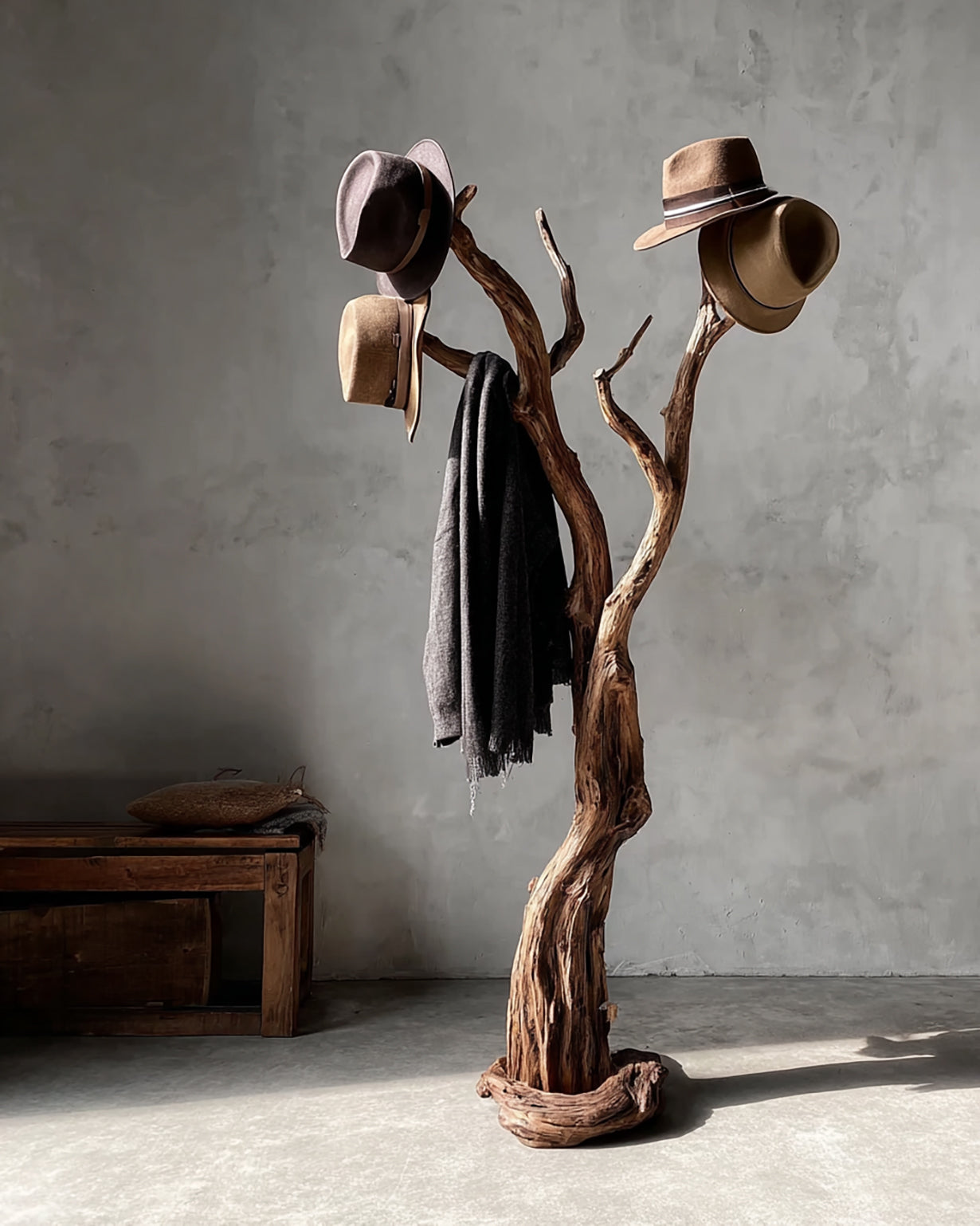
A tree coat rack starts as a rough plank of solid wood and ends as a functional sculpture that holds your family's coats, bags, and hats for decades. The process takes our artisans 8-12 hours of hands-on work spread across 3-4 days (with drying time between steps). Every branch is carved, not assembled from pre-made parts. Every curve follows the wood's natural grain. This is how a unique coat rack goes from raw material to finished furniture - step by step, from our workshop in Vietnam.
No factory line produces these. No CNC machine cuts these branches. Our artisans use hand chisels, rasps, and sandpaper in grits from 80 to 400. Here's the complete process, and why it creates a modern coat rack that mass production can't replicate.
Step 1: Wood Selection (Day 1, 30-60 Minutes)
Every tree coat rack begins with selecting the right board. Our artisans choose each plank by hand, evaluating four criteria: grain direction, knot placement, moisture content, and species character. The wood must have straight, continuous grain through the sections that will become branches - any grain runout (where fibers change direction) creates a weak point that could snap under the weight of a heavy coat.

For our tree coat racks, we primarily work with acacia (1,750 Janka hardness) and teak (1,070 Janka). Acacia's interlocked grain produces dramatic visual patterns and exceptional strength. Teak's natural oil content makes it moisture-resistant without applied finish.
Our artisans reject approximately 30% of planks at this stage. Common disqualifiers: hidden checks (internal cracks from drying), excessive sapwood on the face side, or grain patterns that won't align with the design's branch angles. This selectivity matters - a coat rack with a branch carved against the grain is a coat rack that breaks under load.
Species-specific consideration: Acacia planks are heavier (3.5 lbs per board foot) and harder to carve, but the finished branches are nearly unbreakable. Teak planks are lighter and carve more smoothly, but the branches have slightly less tensile strength. Both species far exceed the strength needed for coat-hanging loads.
Step 2: Rough Dimensioning and Layout (Day 1, 1-2 Hours)
The selected plank is cut to rough dimensions using a bandsaw - the only power tool in the process. For a standard 72-inch tree coat rack, we start with a plank approximately 78 × 8 × 3 inches (extra length and width for waste). The trunk section requires the full 3-inch thickness. Branch sections are roughed from separate blocks of the same plank. If you're weighing your options, our guide on tree coat rack guide breaks it down further.
Our artisan draws the tree design directly onto the wood with pencil, adjusting the branch positions to work with the grain. This is the step where craft diverges from manufacturing. A CNC machine follows a fixed digital pattern regardless of the wood. Our artisan reads the grain and adapts - moving a branch 2 inches left to avoid a knot, angling another branch 5 degrees steeper to follow a grain line.
The layout determines the final character of each rack. No two layouts are identical because no two planks have identical grain. This is why every Ashdeco tree coat rack is genuinely unique - not marketing-unique, but structurally and visually one-of-a-kind.



Step 3: Rough Carving (Day 1-2, 3-4 Hours)
Rough carving transforms the squared plank into the basic tree silhouette. Our artisans use a combination of large gouges (curved chisels) and a mallet, removing wood in controlled chips. The trunk takes shape first, then the branch junctions, then each individual branch.
The branch junctions are the most structurally critical area of the entire piece. Where a branch meets the trunk, the wood must be thick enough to support 8-12 lbs of hanging weight without flexing. Our artisans leave the junction at least 2 inches thick in all directions, even when the branch itself tapers to 1 inch at the tip. This graduated thickness mimics how real tree branches grow - thick at the base, thin at the end - and it's what gives solid wood coat racks their superior weight capacity compared to assembled alternatives. We cover this in more detail in our coat rack weight test guide.
During rough carving, the artisan constantly checks grain direction by splitting small test chips from waste areas. If the grain shifts unexpectedly, the branch angle adjusts. Forcing a branch against the grain is the fastest way to create a weak coat rack that fails after six months. Working with the grain, even when it means changing the design, is what separates handcraft from mass production.
The rough-carved piece looks blocky at this stage - recognizably tree-shaped but angular, with visible chisel marks and squared-off branches. It weighs approximately 30% more than the finished piece because material is still being removed.
Step 4: Drying and Stabilization (Day 2, Passive)
After rough carving, the piece rests for 12-24 hours in our workshop's controlled environment (65-75°F, 45-55% relative humidity). Carving exposes interior wood that was previously sealed by the plank's outer surface. This freshly exposed wood needs to equalize its moisture content with the surrounding air before detail carving begins.
Skipping this step causes problems. Wood that's detail-carved while the interior is still wet will shrink unevenly as it dries, potentially opening hairline cracks along branch junctions. Our workshop humidity is maintained year-round to match the target range for US homes (the American Society of Heating Engineers (ASHRAE) recommends 30-60% indoor relative humidity).
This is a detail that factory production skips. Machine-carved pieces go directly from CNC to finishing, often shipping before the wood has fully stabilized. The result: cracks that appear 2-6 months after delivery, when the wood finally equalizes in the customer's home.
Don't miss
These pieces qualify for 10% off orders over $2,000. Applied automatically at checkout.
 10% off
Sculptural Solid Wood Hall Tree - Artistic Branch Tree Hanger - Unique Live Edge Entryway Coat Rack
$2,234.00
10% off at checkout
10% off
Sculptural Solid Wood Hall Tree - Artistic Branch Tree Hanger - Unique Live Edge Entryway Coat Rack
$2,234.00
10% off at checkout
 10% off
Handcrafted Tree Branch Clothing Rack – Solid Wood Wardrobe Shelf Organizer for Home Décor
$2,333.00
10% off at checkout
10% off
Handcrafted Tree Branch Clothing Rack – Solid Wood Wardrobe Shelf Organizer for Home Décor
$2,333.00
10% off at checkout
 10% off
Sculptural Hand-Carved Solid Wood Tree Entryway Bench & Branch Coat Rack with Integrated Shoe Shelf
From $2,534.00
10% off at checkout
10% off
Sculptural Hand-Carved Solid Wood Tree Entryway Bench & Branch Coat Rack with Integrated Shoe Shelf
From $2,534.00
10% off at checkout
 10% off
Sculptural Hand-Carved Tree Solid Wood Open Wardrobe Closet System & Branch Wall Storage Bench
$3,876.00
10% off at checkout
10% off
Sculptural Hand-Carved Tree Solid Wood Open Wardrobe Closet System & Branch Wall Storage Bench
$3,876.00
10% off at checkout
Step 5: Detail Carving (Day 2-3, 3-4 Hours)
Detail carving is where the tree comes to life. Our artisans use small gouges, V-tools, and flat chisels to shape the bark texture on the trunk, define each branch's taper, and create the natural curves that make the piece look organic rather than manufactured.
The bark texture is carved freehand - no template, no stencil. Each artisan has a personal approach. Some create deep, furrowed bark inspired by oak trees. Others prefer the smoother, peeling texture of birch. The customer never specifies this detail; it emerges from the artisan's instinct and the wood's response.
Branch tips receive special attention. Each tip curves slightly upward (the "hook" that holds coats) and is rounded to prevent snags on fabric. The curve radius matters: too tight, and coat collars don't slide on easily. Too open, and lightweight scarves slide off. Our artisans aim for a 1.5-2 inch radius at each hook tip - refined over years of customer feedback from our 387 reviews (4.9-star average).
Detail carving on acacia takes roughly 30% longer than on softer species because the dense interlocked grain resists the chisel more aggressively. The tradeoff: the finished detail is sharper and more durable. Acacia holds fine carved lines for decades. Pine loses them within years as the soft surface compresses.
Step 6: Sanding (Day 3, 1.5-2 Hours)
Sanding progresses through four grits: 80, 120, 220, and 400. Each grit removes the scratch marks of the previous one while smoothing the surface progressively. Total sanding time for a 72-inch tree coat rack: 90-120 minutes of hand sanding.
- 80 grit: Removes remaining chisel marks and rough surfaces. Establishes final shape.
- 120 grit: Smooths the surface enough to reveal the full grain pattern. This is where the artisan first sees how the finished piece will look.
- 220 grit: Produces a surface smooth enough for finishing. Standard stopping point for rustic or bark-textured areas.
- 400 grit: Used only on branch hooks and trunk highlights. Creates a polished feel where hands and coats make contact.
Our artisans sand bark-textured areas only to 120 grit - preserving the carved texture. Smooth branches are sanded to 400 grit. This contrast (rough trunk, smooth branches) is intentional - it creates a tactile difference that makes the piece feel alive, not machine-made.
After final sanding, the piece is wiped with a damp cloth to raise the grain. This causes any compressed fibers to swell upward. A final light pass with 400 grit knocks down these raised fibers, producing a surface that stays smooth even in humid conditions. Skipping the grain-raising step (as most factories do) results in a surface that feels rough after the first humid week in the customer's home.
Step 7: Finishing (Day 3-4, 1 Hour Active + 8-12 Hours Drying)
Finishing protects the wood and enhances its natural color. We apply a natural oil finish (tung oil or Danish oil) by hand, working the oil into the grain with a cloth. Oil finish penetrates the wood fibers rather than sitting on top - it becomes part of the wood rather than a separate coating.
The first coat soaks in within 15 minutes on acacia and 30 minutes on teak (teak's natural oils slow absorption). We wipe off any excess and allow 8-12 hours of drying before applying a second, thinner coat. Two coats provide a satin sheen that shows the grain clearly without a glossy "plastic" appearance.
Why oil instead of polyurethane or lacquer? Because a tree coat rack should look and feel like wood, not plastic. Oil finish is also repairable - a scratched area can be re-oiled without stripping the entire piece. Polyurethane scratches require sanding and re-coating the whole surface, which is impractical on a carved piece with bark texture.
Step 8: Assembly and Quality Check (Day 4, 30-60 Minutes)
Tree coat racks ship in modular sections for safe transport: the trunk base, trunk mid-section (if the design includes one), and the upper branch section. These sections connect via heavy hardwood dowels - 1-inch diameter, glued and friction-fit. The customer receives the piece ready to assemble in 5 minutes with no tools required.
Before packing, our workshop lead inspects every piece against a checklist:
- Branch hooks curve to 1.5-2 inch radius ✓
- All bark texture areas are consistent ✓
- No visible glue squeeze-out at dowel joints ✓
- Oil finish is even with no dry spots ✓
- Piece stands level on a flat surface ✓
- Total weight within spec (varies by species and height) ✓
Pieces that fail any checkpoint go back for correction. We don't sell seconds or "as-is" pieces. The tree bookshelf and cat tree collections follow this same quality process - same artisans, same standards, same hands-on inspection.
Why This Process Can't Be Dropshipped
Dropship furniture sellers source from factories that optimize for speed and cost. A factory-produced "tree coat rack" is CNC-routed from a plank in 20 minutes, sanded by orbital sander in 10 minutes, sprayed with lacquer in 5 minutes, and shipped the same day. Total hands-on time: under 1 hour.
Our process takes 8-12 hours of skilled handwork across 3-4 days. The difference shows in the weight capacity (40-60 lbs vs. 15-25 lbs for machine-made), the surface feel (hand-sanded silk vs. machine-sanded uniformity), and the visual character (unique grain-adapted design vs. identical copies).
This is the E-E-A-T advantage of real craftsmanship: Experience, Expertise, Authoritativeness, and Trustworthiness aren't marketing claims - they're visible in every chisel mark and grain-following branch. Browse our full coat rack collection to see the finished results of this process.
FAQ
How long does it take to make a tree coat rack by hand?
A single tree coat rack takes 8-12 hours of active handwork spread across 3-4 days. The process includes wood selection, rough carving, drying, detail carving, progressive sanding through 4 grits, oil finishing with overnight drying, and final assembly with quality inspection.
Are tree coat racks strong enough for heavy coats?
Yes. A hand-carved solid wood tree coat rack with integral branches (carved from the same piece, not attached with screws) holds 40-60 lbs total. Each branch supports 8-12 lbs individually. This comfortably handles winter parkas (3-5 lbs each), loaded backpacks (8-15 lbs), and multiple lighter items.
What kind of wood is used for tree coat racks?
The best woods for tree coat racks are acacia (1,750 Janka hardness, interlocked grain, dramatic patterns) and teak (1,070 Janka, natural oils, moisture resistant). Both species are strong enough for functional coat hooks and dense enough to hold carved detail for decades.
How can I tell if a coat rack is handmade vs machine-made?
Look at the branch bases: hand-carved branches have slightly irregular junctions that follow the grain - no two are identical. Machine-made branches have uniform, symmetrical junctions. Check the bark texture: hand-carved texture varies across the piece. Machine-routed texture repeats in a pattern. Feel the hooks: hand-sanded hooks have a silky, warm feel. Machine-sanded hooks feel uniformly smooth but lack warmth.
Do tree coat racks come assembled?
Most tree coat racks ship in modular sections (2-3 pieces) for safe transport and connect via dowel joints that require no tools. Assembly takes approximately 5 minutes. The modular design also makes the piece easier to move through narrow doorways and up staircases.