
Why Every Home Has at Least 3 Corners Going to Waste
That bare corner where two walls meet? It's stealing 4-9 square feet of usable display space from every room in your house. A rustic corner shelf turns that dead zone into a focal point - somewhere to stage plants, books, candles, or the kind of handcrafted decor that actually makes a room feel lived-in.
This guide covers room-by-room ideas, specific dimensions for different corner sizes, installation how-tos, and why solid wood beats MDF every time when you're going for an authentic rustic look. Whether you're working with a tight bathroom corner or a wide-open living room, there's a corner shelf approach that fits.
We'll walk through 30+ ideas, compare shelf styles, and give you the exact measurements and mounting methods professional installers use. No filler, no fluff - just the stuff you need to transform forgotten corners into display space worth looking at.
The Math on Wasted Corner Space
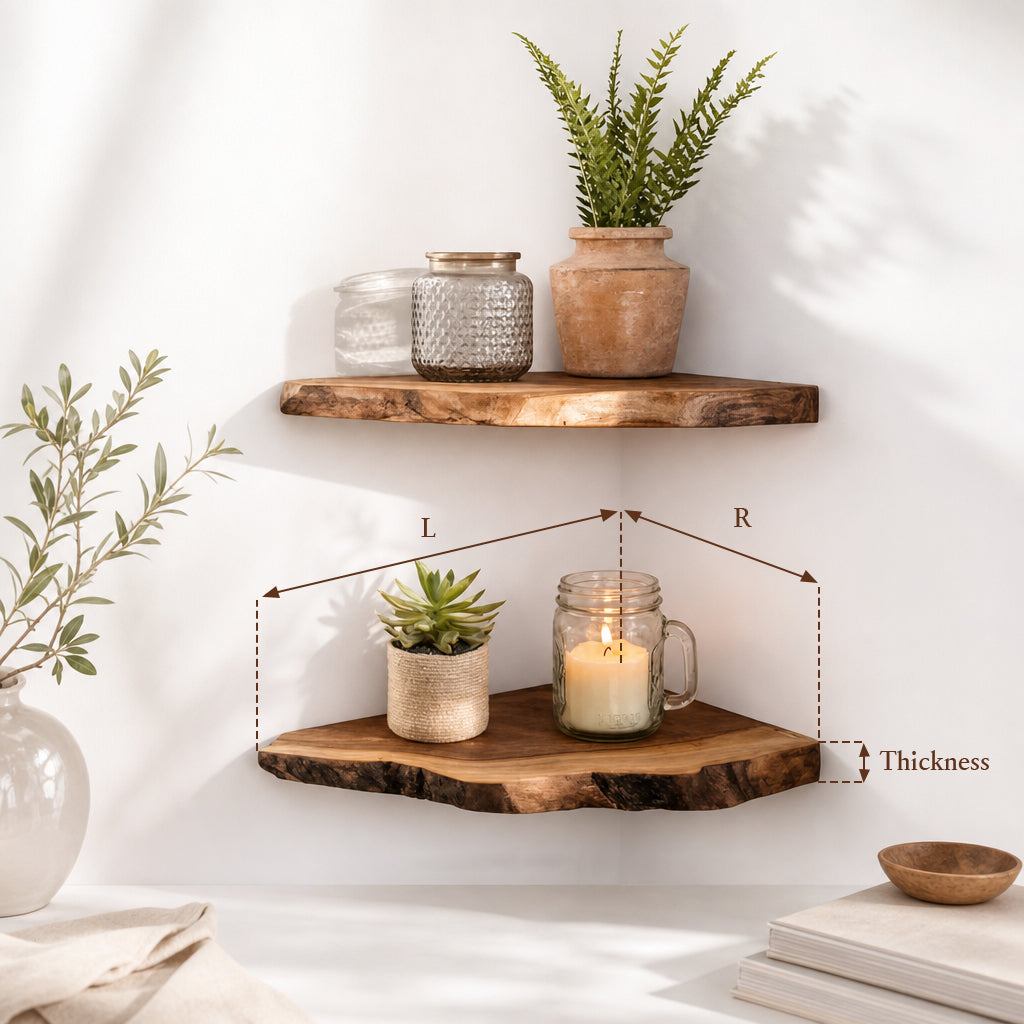
An average US home has 8-12 interior wall corners per floor. Most sit completely empty. A standard 90-degree corner with 12-inch shelf arms yields roughly 72 square inches of display surface - enough for a small plant, a framed photo, and a candle. Stack three shelves vertically and you've created over 200 square inches of storage from literally nothing.
Corner shelves work because they exploit space that furniture can't reach. A bookcase needs a flat wall. A console table juts out 14-18 inches. But a floating corner shelf tucks into the junction and extends only 8-12 inches along each wall, leaving walkways clear and rooms feeling open.
Why Rustic Styling Wins in Corners
Corners are inherently imperfect spaces - odd angles, shadow pockets, sometimes uneven drywall. Rustic design embraces those imperfections instead of fighting them. A corner wood wall shelf with visible grain, natural edge variations, and hand-rubbed finish doesn't need to look machine-precise. It should look like it belongs in a real home, not a showroom.
That's the core appeal: rustic shelves turn architectural awkwardness into character. The slight unevenness of handcrafted wood matches the slight unevenness of a real corner. Mass-produced shelves, by contrast, highlight every gap and imperfection because they're too uniform for an inherently non-uniform space.

Rustic Corner Shelf Ideas for the Living Room
The living room is where a rustic corner shelf makes the biggest visual impact. With higher ceilings, more natural light, and frequent foot traffic, living room corners are prime real estate for displaying art, plants, and curated collections on handcrafted solid wood shelves.
The Stacked Gallery Corner
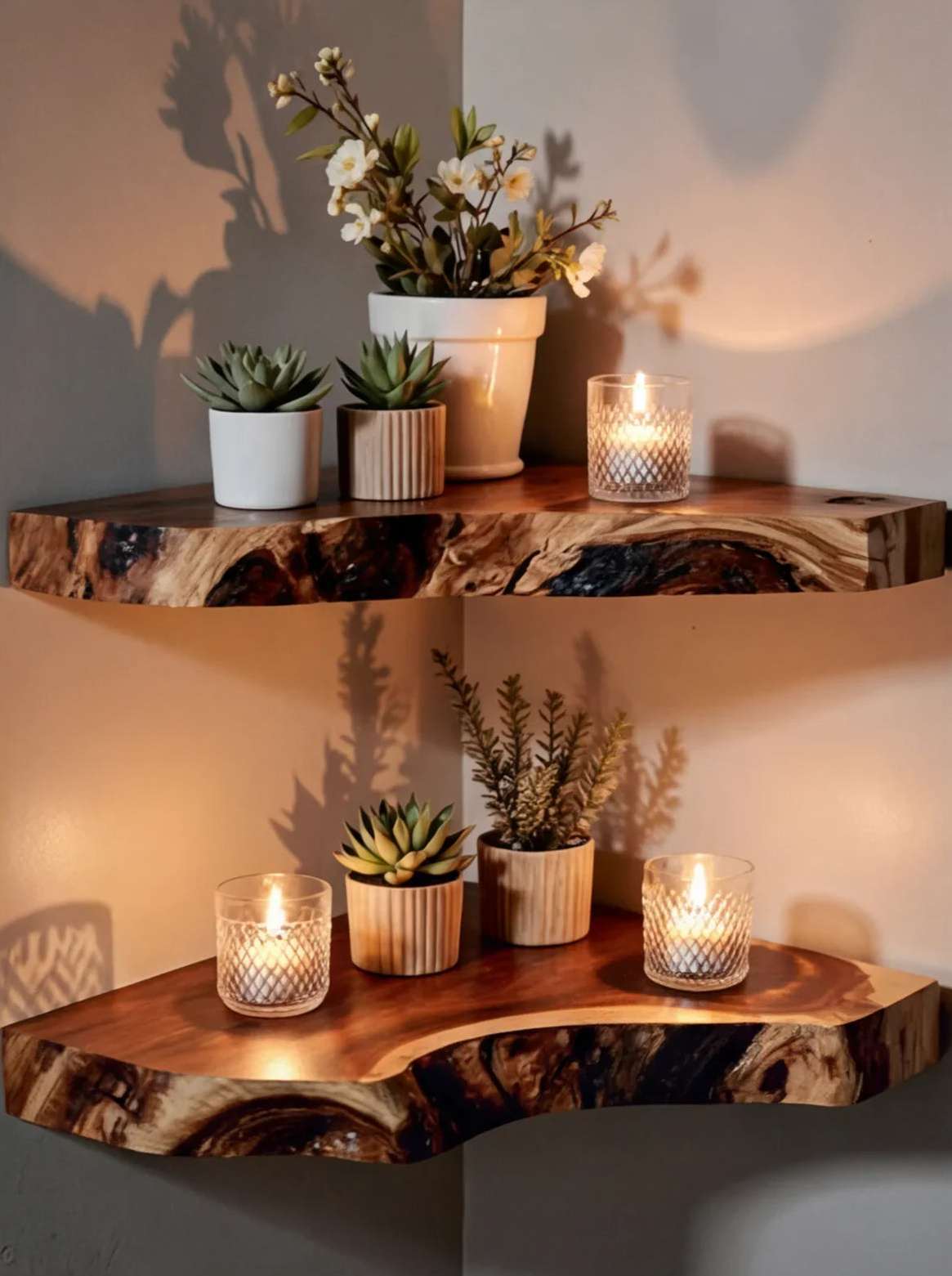
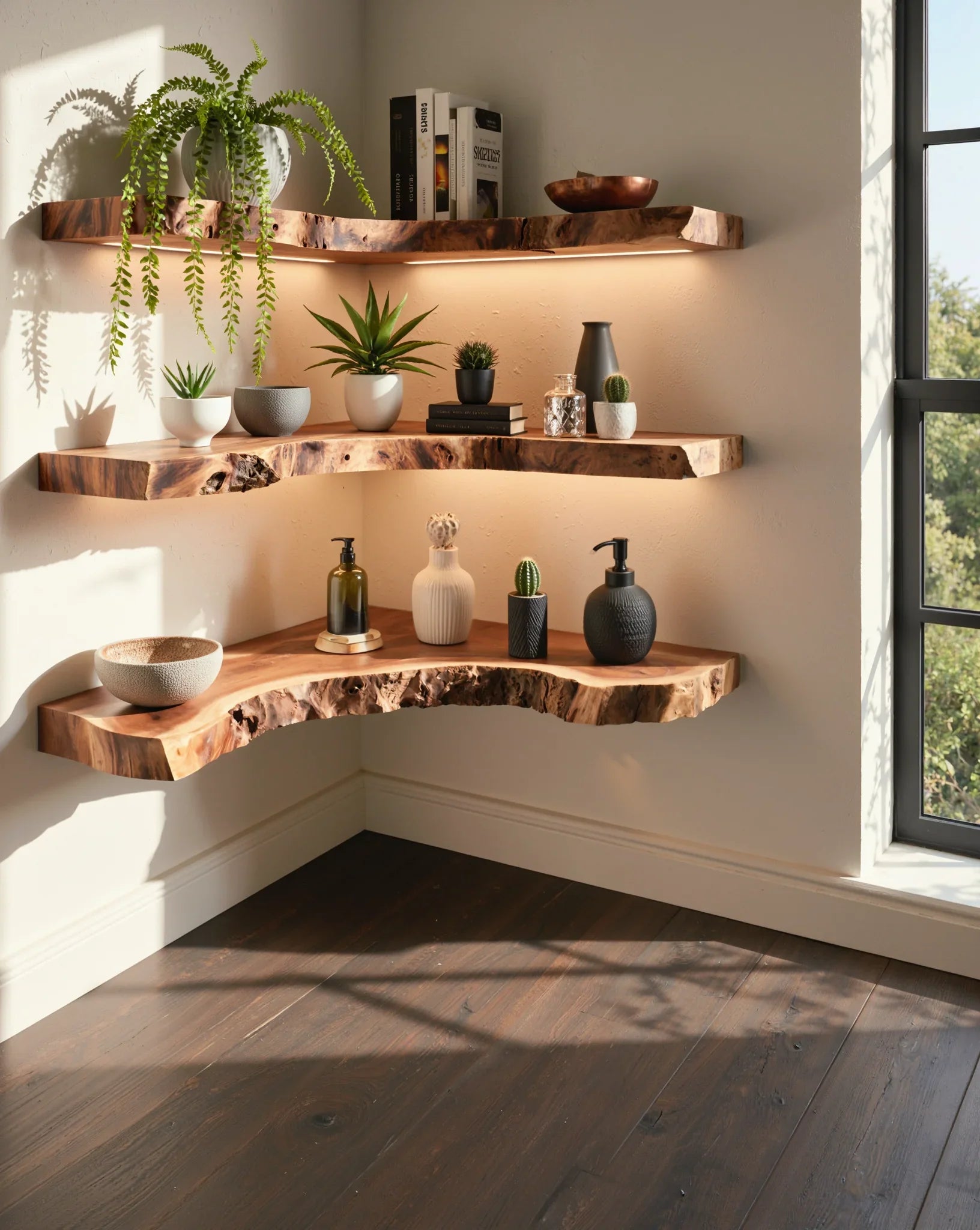
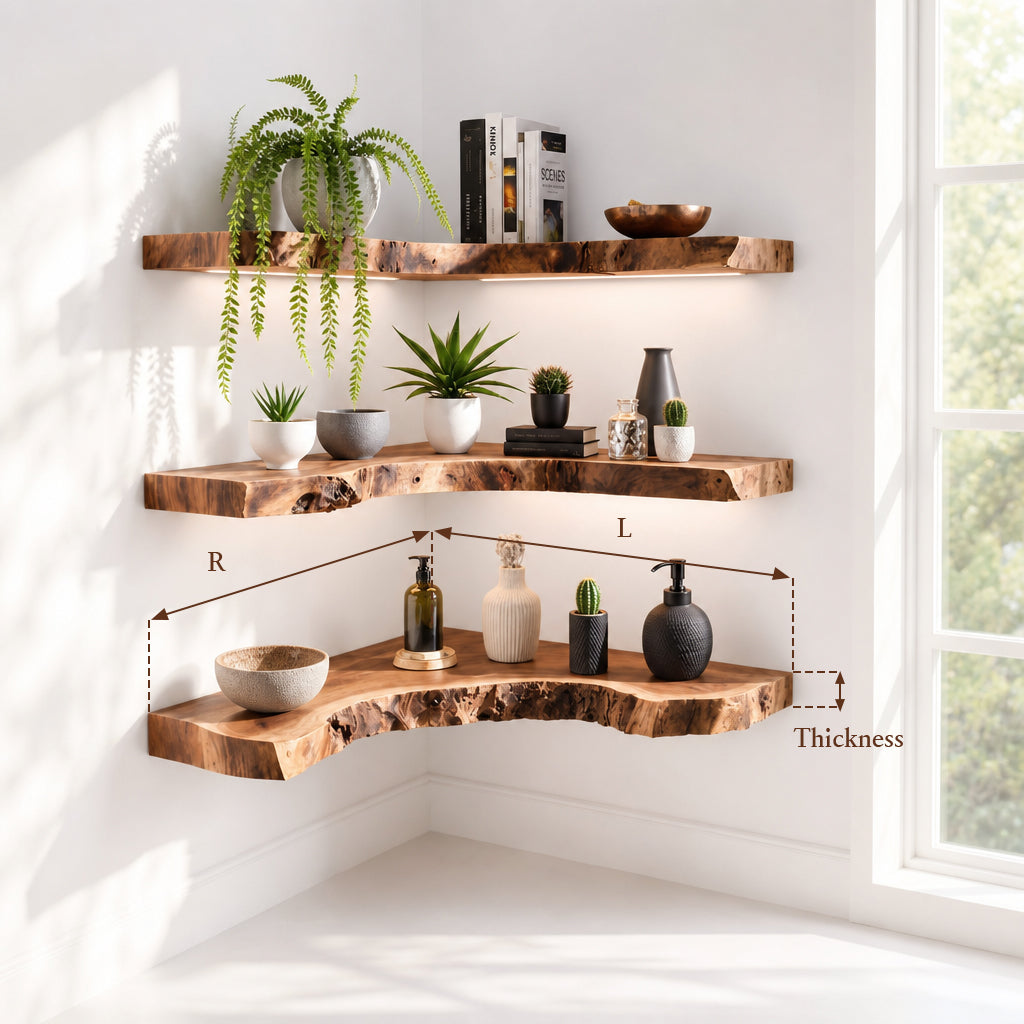
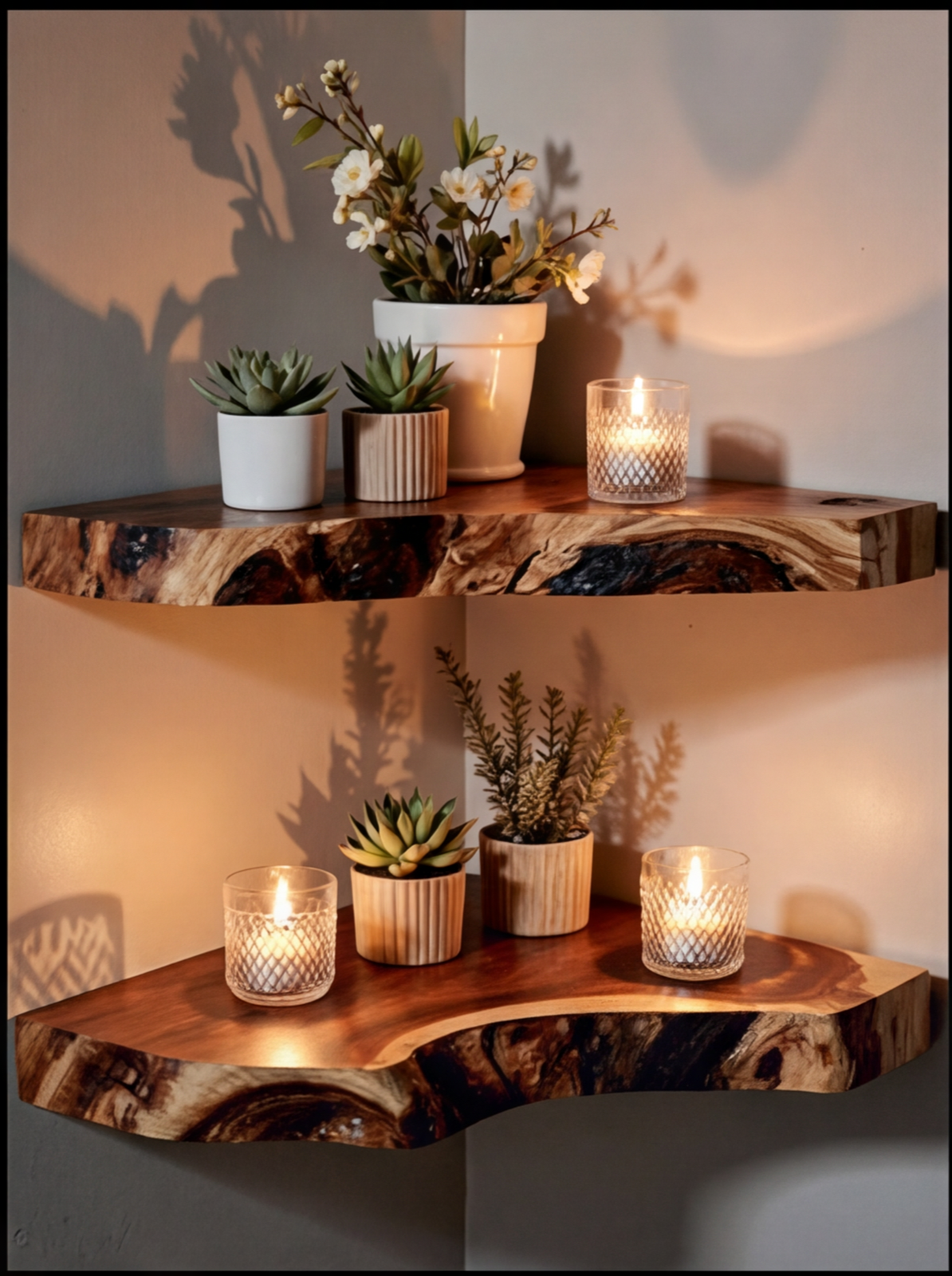
Install three to five corner floating shelves in a vertical column, spaced 10-14 inches apart. Start 24 inches above the floor and work upward. Use the bottom shelf for heavier items (a stack of hardcovers, a ceramic vase) and the top shelves for lighter pieces (small succulents, framed prints, candle holders).
For a genuine rustic feel, choose shelves with a live-edge profile or a hand-distressed finish. Handcrafted by Vietnamese artisans, solid wood corner shelves bring warmth that pressed-board alternatives simply can't replicate. The natural variation between pieces means your gallery wall will look curated, not catalog-ordered.
Dimension guide: For a standard 90-degree living room corner, 10-inch to 14-inch shelf arms work best. This gives enough surface area for display without overwhelming the sightline.
The Reading Nook Anchor
Pair a corner shelf with a small armchair to create an instant reading nook. Mount a single wide shelf (16-20 inch arms) at seated eye level - about 42-48 inches from the floor - to hold your current reads, a reading lamp, and a mug. Below the shelf, the chair tucks neatly into the corner.
This works especially well in living rooms that don't have a dedicated library space. A wood corner shelf floating above an armchair signals "this is the quiet corner" without needing a full bookcase or side table.
The Plant Corner Tower
Dedicate one corner entirely to greenery. Install four shelves at staggered heights (18, 32, 46, and 60 inches from the floor) and fill them with trailing plants on the upper shelves (pothos, string of pearls) and compact varieties below (succulents, small ferns). The cascading effect turns a flat corner into a vertical garden.
Solid wood handles the moisture from plant care far better than MDF, which swells and warps at the first sign of a water spill. A hand-finished hardwood shelf develops a richer patina over time - the occasional water ring or soil mark adds to the rustic story rather than ruining it.

Bathroom Corner Shelf Ideas That Handle Humidity
Bathrooms are where most cheap corner shelves fail within a year. Humidity warps MDF, peels veneer, and rusts low-grade hardware. A rustic corner shelf built from solid hardwood with proper sealing thrives in bathroom conditions and actually looks better as it ages.
Above-the-Toilet Corner Display
The corner behind or beside the toilet is one of the most underused spots in any bathroom. Mount two shelves with 8-10 inch arms, positioning the lower shelf at 60 inches and the upper at 72 inches from the floor. Use them for rolled hand towels, a small plant (air plants love bathroom humidity), and a decorative candle.
Choose a corner wooden floating shelves setup with a sealed or oiled finish rather than painted. In humid environments, paint traps moisture underneath and causes bubbling. An oil-finished hardwood lets the wood breathe while still resisting water damage - the same principle that keeps teak outdoor furniture lasting decades.
Shower-Adjacent Corners
For corners just outside the shower (not inside the splash zone), a compact 6-8 inch shelf arm holds daily essentials: a small succulent, a diffuser, or a folded washcloth. Keep these shelves at least 24 inches from the showerhead to avoid direct water contact.
The key is proper wood selection. Vietnamese artisans working with Ashdeco use hardwoods with naturally tight grain that resist moisture absorption - a night-and-day difference from the particle board "wood-look" shelves common on Amazon that dissolve within months of bathroom use.
Vanity Corner Storage
If your vanity sits near a corner, a small floating shelf at vanity height (32-36 inches) creates extra counter space for items that don't fit on the vanity surface. Perfume bottles, a jewelry dish, or a small makeup organizer - things that need to be accessible but not cluttering the sink area.
Install with stainless steel or brass-coated mounting hardware (never plain iron) to prevent rust streaks on the wall and shelf. More on hardware selection in the installation section below.

Kitchen Corner Shelves - From Spice Racks to Display
Kitchen corners are functional gold mines. A well-placed rustic corner shelf handles spice storage, coffee station overflow, cookbook display, and decorative items - reclaiming space that upper cabinets often waste with dead corner zones.
The Open Spice Corner
Replace a cluttered spice cabinet with two or three narrow corner shelves (6-8 inch arms, 8-10 inches apart vertically). Mount them between the countertop backsplash and the upper cabinets - typically a 15-18 inch window. This puts your most-used spices at arm's reach while cooking.
Rustic wood shelves in a kitchen do double duty: they're functional storage and a design statement. The warm tones of handcrafted solid wood break up the hard surfaces (granite, tile, stainless steel) that dominate most kitchen designs. If your kitchen skews modern, the contrast of natural grain against clean lines creates that popular "modern rustic" hybrid look.
The Coffee Station Corner
Dedicate a corner near the coffee maker to mugs and supplies. A single wide shelf (12-14 inch arms) at 18 inches above the countertop holds 4-6 mugs hung from small hooks screwed into the shelf's underside. Above that, a second shelf holds a sugar bowl, canisters, or a small French press.
This setup works beautifully with floating shelves that use concealed mounting brackets. The "floating" illusion - no visible brackets or supports - makes even a small kitchen corner feel intentional and designed rather than cluttered.
The Cookbook and Display Corner
For wider kitchen corners (near dining areas or breakfast nooks), use deeper shelves (10-12 inch arms) to prop up cookbooks face-out. Lean one or two books against the wall with a small stand or plate easel, and flank them with olive oil bottles, a small herb pot, or stacked ceramic bowls.
This transforms a forgotten corner into the kind of curated kitchen display you see in food magazines - except it's functional. You actually use those cookbooks. The rustic wood shelf just makes the whole arrangement feel warmer and more personal than a steel wire rack would.

Bedroom Corner Ideas - Cozy and Practical
Bedroom corners call for a softer approach. A rustic corner shelf in the bedroom serves as a nightstand alternative, a display for personal items, or a subtle storage solution that keeps surfaces clear without adding bulky furniture.
The Floating Nightstand Alternative
No room for a traditional nightstand? Mount a single rustic corner shelf at mattress height (22-26 inches, depending on your bed frame) in the corner closest to your pillow. A 10-12 inch shelf arm provides enough space for a phone, a book, a glass of water, and a small lamp or wall-mounted reading light above.
This approach saves 2-3 square feet of floor space compared to a standard nightstand - significant in bedrooms under 120 square feet. And a solid wood shelf with a rich, hand-rubbed finish feels far more intimate and warm than a mass-produced melamine cube from a big-box store.
The Memory Corner
Use a vertical stack of 3 shelves (8-10 inch arms, spaced 12 inches apart) for personal items: framed family photos, travel souvenirs, a jewelry tray, a scented candle. Position this stack in the corner you see first when entering the room so it becomes a personal display that greets you daily.
Handcrafted shelves from Vietnamese artisans add a layer of meaning to a memory display. Each shelf carries its own story - the wood grain, the subtle tool marks from hand-finishing, the slight variations that prove a human shaped it. That craftsmanship echoes the personal nature of the items you're displaying.
The Kids' Room Trophy Corner
For children's rooms, corner shelves at kid-reachable heights (24-36 inches) let them display trophies, art projects, stuffed animals, and favorite books. Use wider arms (12-14 inches) and consider a set of three shelves to give them room to grow their collection.
Solid wood handles the abuse of a kids' room - bumps, toy collisions, the occasional Sharpie - better than any laminated surface. Scratches on real wood can be sanded and refinished. Scratches on MDF expose the compressed fiber core, and there's no fixing that.

Dimension Guide - Choosing the Right Size for Your Corner
The right shelf dimensions depend on your corner's location, the wall lengths on either side, and what you plan to display. Here's a specific breakdown to take the guesswork out of sizing your corner wood wall shelf.
Shelf Arm Lengths by Room
| Room | Recommended Arm Length | Best For | Weight Capacity (solid wood) |
|---|---|---|---|
| Bathroom | 6-10 inches | Toiletries, small plants, candles | 10-15 lbs per shelf |
| Kitchen | 6-12 inches | Spices, mugs, small cookbooks | 15-25 lbs per shelf |
| Bedroom | 10-14 inches | Nightstand items, photos, decor | 15-25 lbs per shelf |
| Living Room | 10-16 inches | Books, plants, art, display items | 20-35 lbs per shelf |
| Hallway/Entryway | 8-12 inches | Keys, mail, small vase | 10-20 lbs per shelf |
Vertical Spacing Between Stacked Shelves
The gap between shelves matters as much as the shelf size. Too tight and items feel cramped; too wide and the arrangement looks disconnected.
- Small items (candles, succulents, photos): 8-10 inches between shelves
- Medium items (books, vases, small plants): 10-14 inches between shelves
- Tall items (large plants, cookbooks propped up, sculptures): 14-18 inches between shelves
A good rule of thumb: leave at least 2 inches of clearance above your tallest item on each shelf. This prevents the display from looking stuffed and gives each piece room to breathe visually.
Corner Angles That Aren't 90 Degrees
Not every corner is a perfect right angle. Older homes, renovated spaces, and angled walls can create 80-100 degree corners. For non-standard angles, custom-cut shelves or flexible V-shaped designs work best. Measure the actual angle with a digital angle finder (under $15 at any hardware store) before ordering.
Handcrafted shelves have an advantage here: artisans can adjust the angle during carving. Mass-produced shelves are stamped at exactly 90 degrees, which means visible gaps if your corner is even slightly off. With Ashdeco's handcrafted approach, each piece is shaped to fit real-world conditions, not factory assumptions.

Why Solid Wood Beats MDF for Rustic Corner Shelves
For a genuine rustic look, material matters more than finish, more than color, and more than price. Solid hardwood delivers the grain depth, weight, and aging characteristics that make rustic style work. MDF - no matter how well it's painted - can't replicate what real wood does naturally.
The Visual Difference
| Feature | Solid Hardwood | MDF / Particle Board |
|---|---|---|
| Grain pattern | Natural, unique to each piece | Printed or absent |
| Edge profile | Can be live-edge, hand-shaped | Machine-cut, uniform |
| Color depth | Multi-tonal, varies with light | Flat, single-tone |
| Touch/feel | Warm, textured, substantial | Smooth, plasticky, lightweight |
| Aging | Develops patina, looks better | Chips, peels, looks worse |
| Weight capacity (12" arm) | 20-35 lbs | 8-15 lbs |
| Lifespan | 20+ years | 2-5 years |
The Aging Factor
This is where solid wood pulls away from every alternative. MDF shelves look their best on day one and decline from there - chipped edges, water stains that can't be sanded out, sagging under weight. Solid wood does the opposite. It develops a patina. Oil finishes deepen. Minor scratches blend into the grain story. A 5-year-old solid wood shelf looks better than a new one.
For rustic styling specifically, this aging characteristic is essential. "Rustic" literally implies age, history, and natural wear. You can't fake that with a printed wood-grain veneer over compressed sawdust. The material itself needs to be capable of aging gracefully, and only solid wood does that.
The Weight and Durability Gap
A solid hardwood corner shelf with 12-inch arms comfortably holds 20-35 pounds depending on the wood species and mounting method. An equivalent MDF shelf? 8-15 pounds before you risk sagging or bracket failure. If you're displaying books, ceramic pots, or anything heavier than a candle, the structural difference matters.
Handcrafted solid wood shelves from Ashdeco are built from hardwoods selected for both beauty and strength. Each piece is carved and assembled by Vietnamese artisans who understand how wood grain direction affects load-bearing capacity - the kind of material knowledge that factory stamping simply can't replicate.

Styling Your Rustic Corner Shelf - Display Principles That Work
A beautiful shelf with a random pile of stuff on it still looks like a random pile of stuff. The shelf is the foundation; styling is what turns it into a display. Here are specific techniques that work consistently with rustic corner wooden floating shelves.
The Rule of Three (and Why It Works in Corners)
Group items in odd numbers - three is ideal for corner shelves. A tall item (vase, candle holder), a medium item (framed photo, small plant), and a low item (decorative stone, coaster stack). The triangle shape this creates mirrors the triangular footprint of the corner shelf itself, making the arrangement feel intentional.
Vary textures within each group: something smooth (ceramic), something organic (wood or plant), something metallic or glass. This contrast plays beautifully against the natural wood grain of a rustic shelf, creating visual layers without clutter.
Height Variation Across Stacked Shelves
When you have multiple shelves stacked vertically, don't put the same height items on every shelf. Alternate: tall items on the first shelf, short items on the second, medium on the third. This creates a visual rhythm that draws the eye upward through the entire arrangement.
For living room corners especially, consider placing a trailing plant on the top shelf and letting it cascade downward. The organic, imperfect drape of a trailing pothos against handcrafted wood is about as "rustic" as a display gets - no styling tricks needed.
Negative Space Is Your Friend
Resist the urge to fill every inch. A rustic corner shelf with two carefully chosen items and some breathing room looks more intentional (and more expensive) than one crammed with ten small items. Aim for 40-60% coverage on each shelf - the remaining space lets the wood grain show through and keeps the display from looking like a clearance shelf.

Installation Guide - How to Mount Corner Floating Shelves
Proper mounting is the difference between a shelf that holds for decades and one that pulls out of the wall in six months. Corner installations have unique challenges - you're anchoring into two walls, dealing with corner studs (or lack thereof), and managing weight distribution across an angled joint.
Tools and Hardware You'll Need
- Stud finder - electronic, not magnetic (electronic models detect edges more reliably)
- Level - 12-inch torpedo level or a smartphone level app works for shelves under 16 inches
- Drill and drill bits - 3/16" for pilot holes in studs, 1/4" for drywall anchor pre-holes
-
Mounting hardware:
- Into studs: 2.5-3 inch #10 wood screws (holds 50+ lbs per screw)
- Into drywall only: Toggle bolts (holds 30-50 lbs each) or heavy-duty snap toggles
- Avoid: Plastic drywall anchors for anything heavier than 10 lbs
- Pencil and painter's tape - for marking positions without damaging walls
Step-by-Step Corner Shelf Installation
- Locate studs on both walls. In corners, studs are typically 1-2 inches from the corner on each side (the corner stud assembly). Run your stud finder along both walls and mark the stud edges with painter's tape.
- Determine shelf height. Hold the shelf in position and mark the bottom edge on both walls with a pencil. Use a level to ensure the marks are even. For stacked shelves, measure all positions from the floor (not from each other) to avoid compounding errors.
- Install the mounting bracket or cleat. Most floating corner shelves use a hidden French cleat or rod-and-sleeve system. Screw the wall-mounted portion into studs where possible. If studs don't align with your desired position, use toggle bolts rated for your shelf's loaded weight.
- Check level before committing. After mounting the bracket, set the shelf on it and check level front-to-back and side-to-side. Adjust before drilling final screws.
- Slide or set the shelf onto the mount. For rod systems, slide the shelf over the protruding rods. For cleats, hook the shelf cleat onto the wall cleat. Secure with any set screws included.
- Test with weight. Before displaying your items, press down firmly on the shelf with 20-30 lbs of distributed weight (a stack of books works). Check for any movement, tilting, or wall flex. If anything shifts, remove the shelf and reinforce the mounting points.
Common Mistakes to Avoid
Mistake #1: Relying on one wall. A corner shelf must be anchored to both walls to distribute weight properly. Mounting to only one side creates a lever arm that will eventually pull the shelf loose.
Mistake #2: Using plastic anchors for heavy loads. Those white plastic drywall anchors included with cheap shelf kits are rated for 10-15 lbs in ideal conditions. Real-world holding power is often less. For solid wood shelves loaded with books or ceramics, use toggle bolts or, better yet, find the studs.
Mistake #3: Not accounting for shelf weight. A solid hardwood corner shelf weighs 3-8 lbs by itself. Factor this into your anchor's weight rating. If a toggle bolt is rated for 30 lbs and your shelf weighs 5 lbs, you have 25 lbs of display capacity - not 30.
Mistake #4: Ignoring wall material. Plaster-over-lath walls (common in pre-1950 homes) need different anchors than drywall. If you hit resistance while drilling and find thin wood strips behind the plaster, use longer screws (3-3.5 inches) that bite through the lath and into the stud behind it.

Room-by-Room Corner Shelf Arrangement Ideas
Beyond the basics covered in each room section above, here are specific arrangements - shelf counts, heights, and item combinations - that you can replicate exactly in your own home using corner floating shelves.
The Entryway Drop Zone (2 Shelves)
Mount a lower shelf at 36 inches (for keys, sunglasses, a small tray) and an upper shelf at 52 inches (for a small mirror, a decorative piece, or a welcome sign). Keep arm length to 8-10 inches so it doesn't block foot traffic.
This two-shelf setup solves the "where do I put my keys" problem while adding warmth to the first corner guests see. A wood corner shelf floating near the entryway signals that you've thought about your space - it's a small detail with outsized impact on first impressions.
The Home Office Focus Corner (3 Shelves)
For corners near a desk: bottom shelf at desk height (28-30 inches) for reference books, middle shelf at 42 inches for a small plant or desk lamp extension, top shelf at 56 inches for decorative items or awards. This vertical stack keeps functional items accessible while maintaining a clean desk surface.
Solid wood shelves in a workspace add visual warmth that combats the clinical feel of monitors, cables, and fluorescent lighting. If you're on video calls regularly, a styled corner shelf in the background reads as thoughtful and professional - much better than a blank wall or a cluttered bookcase.
The Dining Room Accent Corner (4 Shelves)
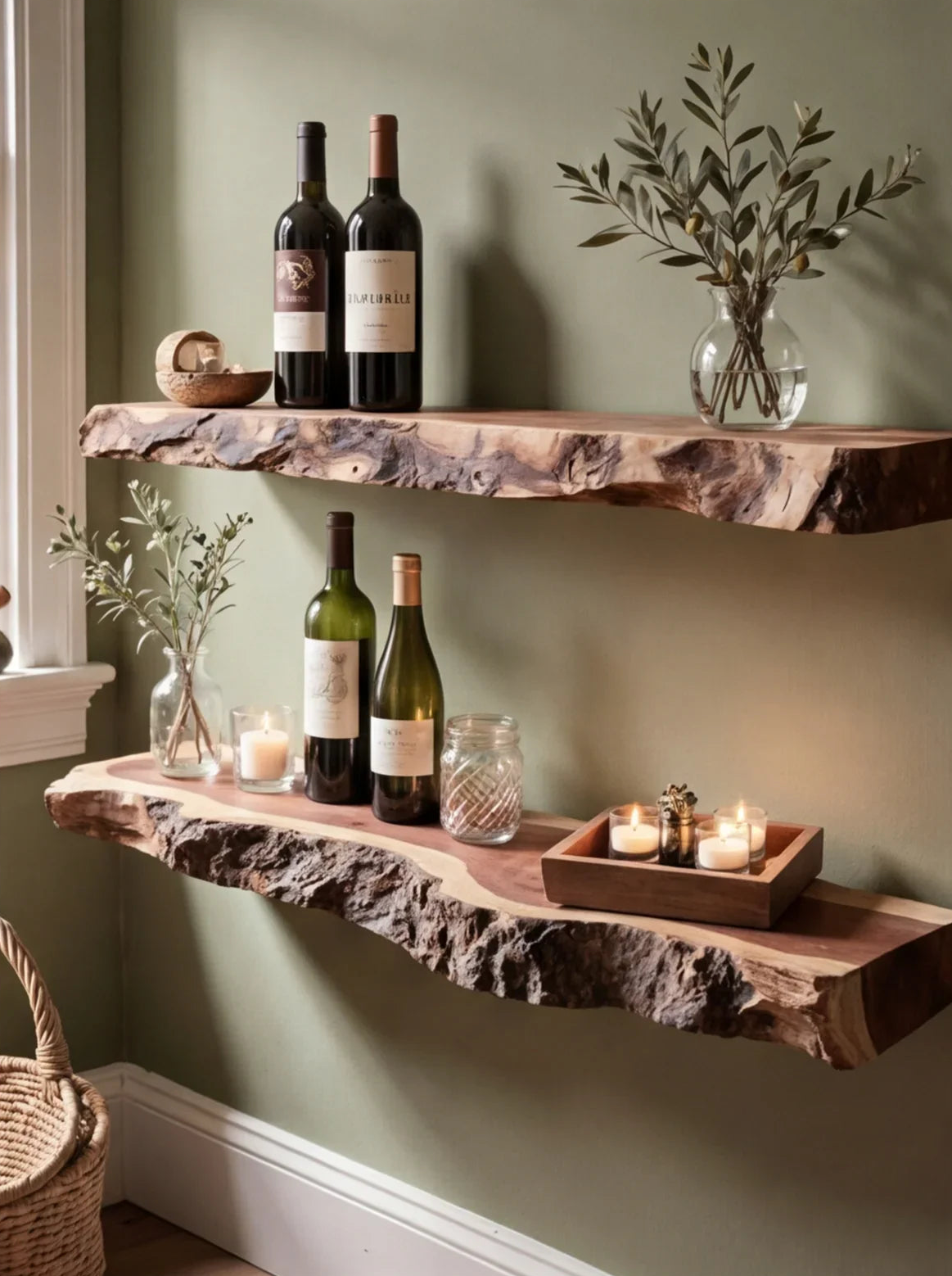
Create a mini wine-and-dine display: bottom shelf for a small wine rack or two bottles laid horizontal, second shelf for wine glasses (hung from hooks or displayed upright), third shelf for a candle and small plant, top shelf for a decorative plate or artwork leaned against the wall.
This arrangement turns a dead dining room corner into a conversation piece. The rustic wood pairs naturally with wine, glass, and candlelight - it's the kind of vignette that restaurants spend thousands designing. If you're exploring shelf options for this kind of display, Ashdeco's mushroom floating shelves bring a unique nature-sculpted element that makes the arrangement unforgettable.

Rustic Corner Shelf Styles - Which Look Fits Your Home?
Not all rustic is the same. The word covers a spectrum from "weathered farmhouse" to "modern cabin" to "industrial-organic." Here's how to match your corner shelf style to your existing decor without creating a visual clash.
Farmhouse Rustic
Characteristics: lighter wood tones (pine, light walnut), distressed or whitewashed finish, simple rounded edges. Pairs with shiplap walls, neutral palettes, and cotton textiles. For corner shelves in a farmhouse-style home, choose pieces with visible wood grain but softer coloring - nothing too dark or heavy.
Item styling: white ceramics, dried lavender bundles, vintage mason jars, and small galvanized metal accents. Keep it airy and light.
Cabin/Lodge Rustic
Characteristics: darker, richer wood tones (walnut, mahogany), heavier visual weight, sometimes with bark-edge or live-edge profiles. Pairs with stone walls, leather furniture, and deep jewel-tone textiles. Corner shelves in this style should feel substantial - thicker cuts (1.5-2 inches) with prominent grain.
Item styling: antler-inspired decor, thick candles in earth tones, stacked leather-bound books, small bronze or copper accents. If you want a corner display that feels like a Colorado lodge, corner floating shelf ideas in darker wood tones are your starting point.
Modern Rustic (The Hybrid)
Characteristics: clean lines and minimal profile combined with natural wood material. Think floating shelves with no visible bracket, sharp 90-degree cuts, but in warm walnut or honey oak instead of white lacquer. This is the most popular style for 2025-2026 interiors because it bridges traditional warmth and contemporary clean lines.
Item styling: one large item per shelf (a single vase, one framed print, a sculptural plant), lots of negative space, monochromatic color palette with the wood as the warm accent. This approach works especially well with Ashdeco's handcrafted shelves - the subtle artisan details (hand-smoothed edges, natural grain variations) provide warmth without competing with a minimalist room design.

Small Space Strategies - Corner Shelves in Apartments and Tiny Rooms
Corner shelves were practically invented for small spaces. When you can't extend outward, go vertical - and corners are the most efficient place to do it because they use space that literally nothing else can occupy.
Apartments Under 600 Square Feet
In a studio or one-bedroom, every corner shelf should serve double duty - display and storage. Use the bottom shelf of a stack for functional items (a small basket with mail, a tray for keys) and the upper shelves for decor. This eliminates the need for a console table or entry cabinet that would eat 4-6 square feet of floor space.
For ideas on maximizing small spaces specifically, our guide on corner shelves for small spaces goes deeper into layout strategies for tight quarters.
Utilizing the Vertical Extreme
Don't stop at eye level. In rooms with 8-foot ceilings, you have roughly 6 feet of usable wall height (starting from 18 inches above the floor). That's room for 4-5 shelves at comfortable spacing. In rooms with 9-10 foot ceilings, you can fit 6-7 shelves - creating a true floor-to-ceiling corner gallery that draws the eye upward and makes the room feel taller.
The top 1-2 shelves in a tall stack are "set and forget" displays - items you won't touch often (a decorative sculpture, a plant that needs minimal care). Below that, keep functional items within arm's reach.
Corner Shelf vs. Corner Cabinet - When to Use Each
Corner shelves win when: you want visual openness, your items are decorative, and the corner is in a social space (living room, dining room). Corner cabinets win when: you need to hide clutter, store functional items (cleaning supplies, toiletries), or the corner is in a utilitarian space.
In most homes, the answer is both - open shelving in public spaces, closed storage in private ones. A rustic corner shelf in the living room displays your taste. A corner cabinet in the laundry room hides detergent. Different tools for different jobs.

Frequently Asked Questions About Rustic Corner Shelves
How much weight can a rustic corner shelf hold?
A solid hardwood corner shelf with 10-14 inch arms, properly mounted into studs on both walls, holds 20-35 pounds per shelf. MDF alternatives max out at 8-15 pounds. Weight capacity depends on wood species, shelf thickness (1-2 inches is standard), mounting method, and whether you hit studs or used drywall anchors.
Can I install corner floating shelves on drywall without studs?
Yes, but use toggle bolts rated for at least twice your expected load. A pair of heavy-duty toggle bolts per wall (four total for a corner shelf) can hold 30-50 pounds in standard 1/2-inch drywall. Avoid plastic expansion anchors for anything heavier than 10 pounds - they fail gradually and without warning.
What's the best wood for bathroom corner shelves?
Teak and walnut are the top choices for humid environments due to their naturally tight grain and high oil content, which resist moisture absorption. Whatever species you choose, apply a food-safe oil finish or marine-grade sealant rather than paint or polyurethane, which can trap moisture underneath and cause the wood to deteriorate from within.
How do I style a rustic corner shelf without it looking cluttered?
Follow the rule of three: group items in sets of three with varied heights and textures. Keep shelf coverage at 40-60% - the empty space is part of the design. Avoid matching sets (three identical vases looks like a store display, not a home). Mix organic items (plants, wood) with manufactured ones (ceramics, frames) for visual contrast.
What size corner shelf should I choose for a small bathroom?
For bathrooms under 40 square feet, choose corner shelves with 6-8 inch arms. This provides enough surface for toiletries, a small plant, and a candle without protruding into the walkway. Mount them at 60-72 inches high to keep the floor-level area clear and make the room feel larger.
Are handcrafted wood shelves worth the extra cost over mass-produced options?
For rustic styling, absolutely. Handcrafted shelves from artisans deliver natural grain variation, hand-finished edges, and solid wood construction that mass-produced MDF can't replicate. They last 20+ years versus 2-5 for MDF. The upfront cost difference ($40-80 for MDF vs. $80-180 for handcrafted solid wood) disappears when you factor in replacement cycles and the visual quality gap.
Can corner shelves work in non-90-degree corners?
Yes. Handcrafted shelves can be shaped to fit angles from 80 to 100 degrees. Measure your corner's exact angle with a digital angle finder before ordering. Mass-produced shelves are stamped at exactly 90 degrees, leaving visible gaps in non-standard corners - one more reason custom handcrafted options outperform factory alternatives.
How far apart should I space stacked corner shelves?
Space depends on what you're displaying: 8-10 inches for small items (candles, photos), 10-14 inches for medium items (books, small plants), and 14-18 inches for tall items (large vases, propped cookbooks). Always leave at least 2 inches of clearance above your tallest item on each shelf for visual breathing room.

Turn Your Corners into the Best Part of the Room
Every home has corners doing nothing. A rustic corner shelf - crafted from solid wood, mounted properly, and styled with intention - transforms those dead zones into the kind of display space that makes a room feel finished. Whether it's a single shelf nightstand in the bedroom, a stacked spice display in the kitchen, or a floor-to-ceiling plant gallery in the living room, the approach is the same: use what's wasted, display what matters, and let natural wood bring the warmth.
Ready to put your corners to work? Browse Ashdeco's handcrafted corner floating shelves - each piece carved by Vietnamese artisans from solid hardwood, built to hold weight, and designed to look better with every year on the wall.