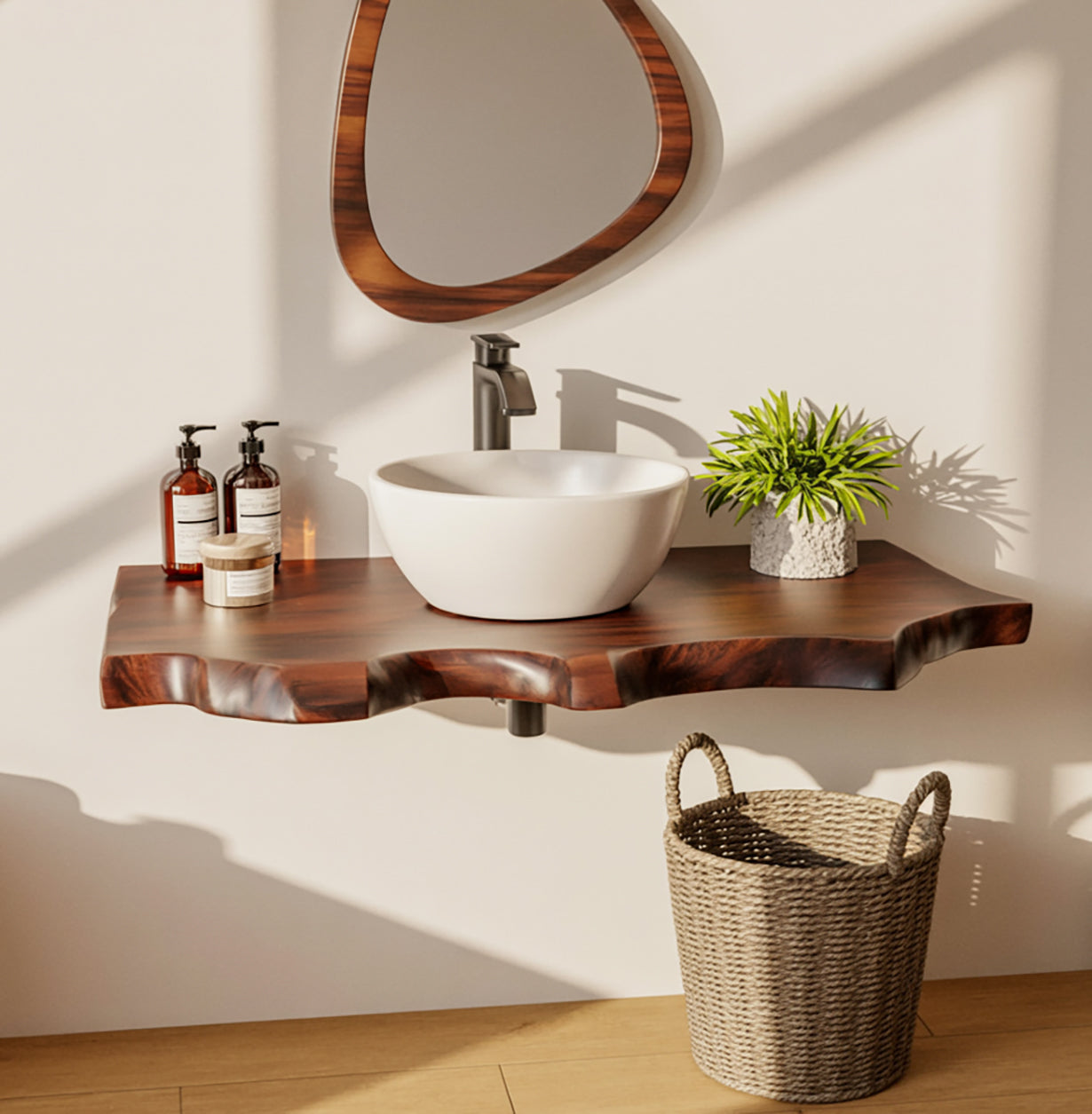




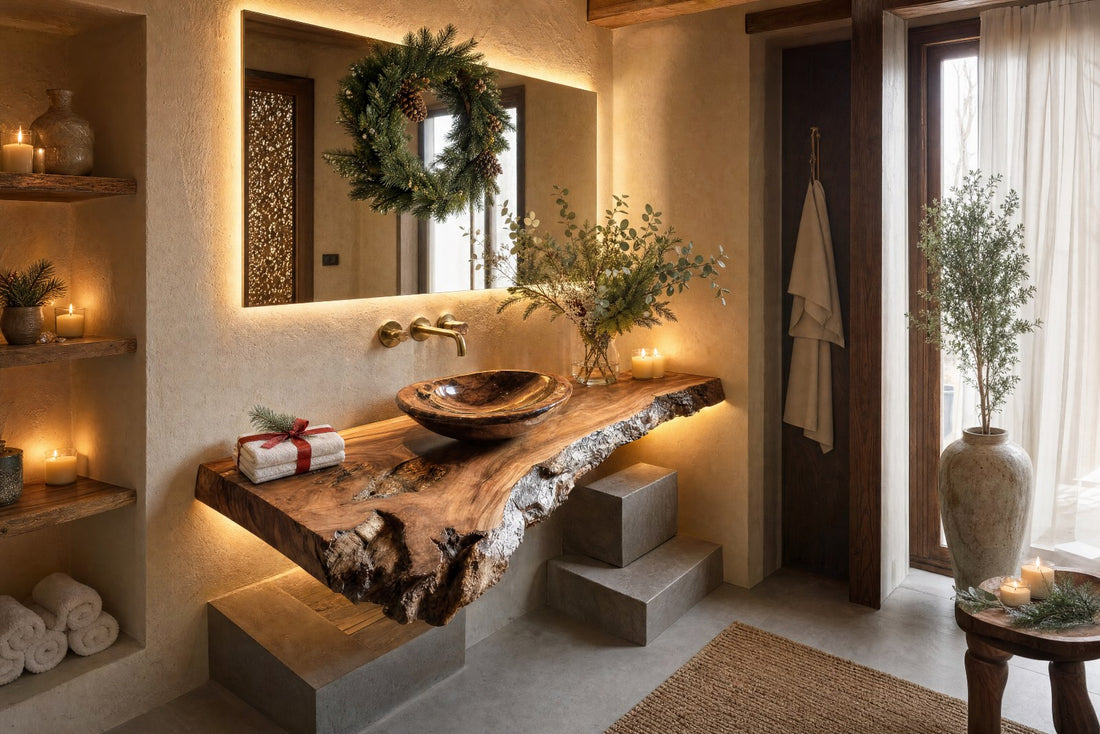
bathroom shelves

Mushroom Floating Shelves - The 2026 Decor Trend Guide

Mushroom Floating Shelves - The 2026 Decor Trend Guide

Mushroom floating shelves have gone from niche cottagecore accent to one of the most-searched decorative shelf styles in 2026 - up over 40% year-over-year on Google Trends. If your Instagram explore page has been flooded with hand-carved mushroom caps mounted on minimalist white walls, you're not imagining it. This is a real design movement, and it's backed by numbers. In this guide, we break down why mushroom shelves are trending, the different styles available, how to choose the right one for each room, and why a solid wood mushroom shelf outlasts the resin and MDF versions flooding Amazon by decades.

At Ashdeco, our Vietnamese artisans have been hand-carving mushroom shelves from solid hardwood since before the trend hit mainstream retail. Every cap, every stem, every bracket is sculpted by hand - no molds, no injection plastic, no two pieces exactly alike. Here's everything you need to know before buying one.

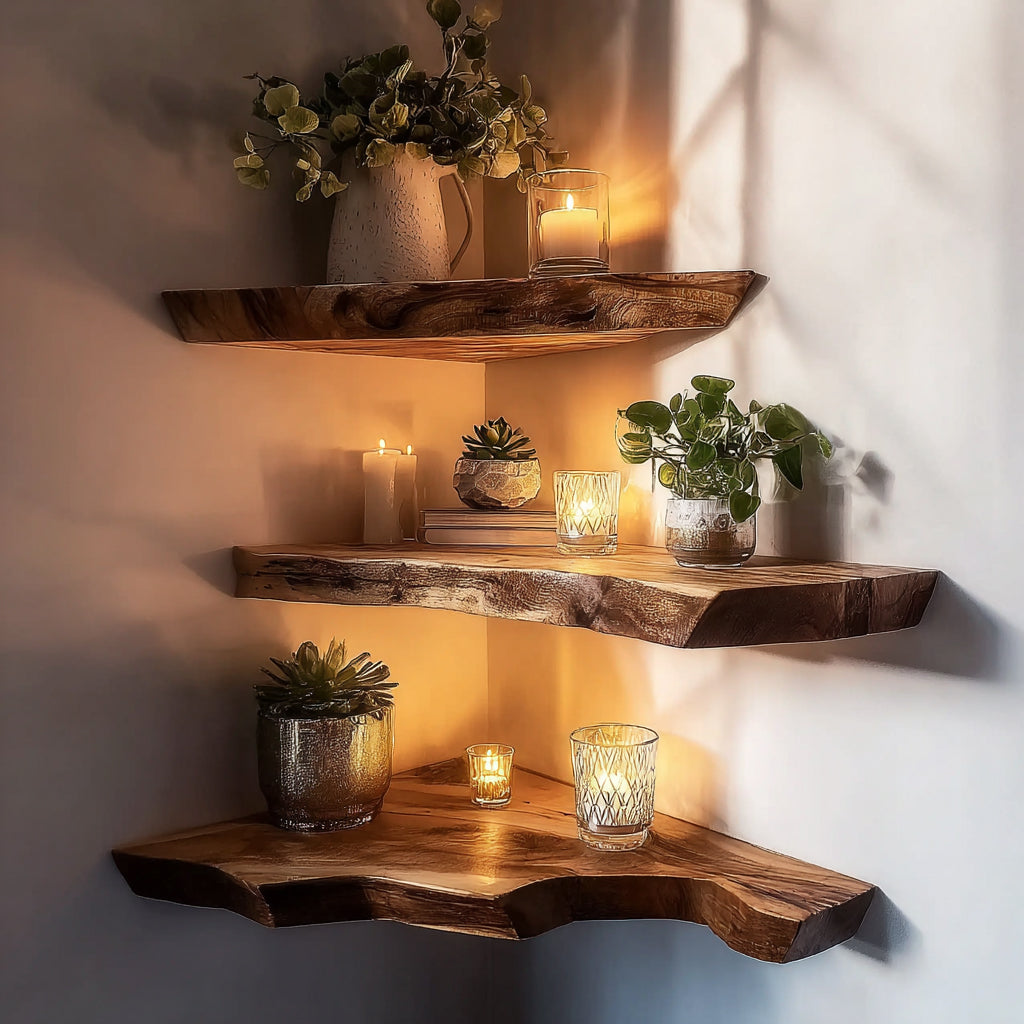
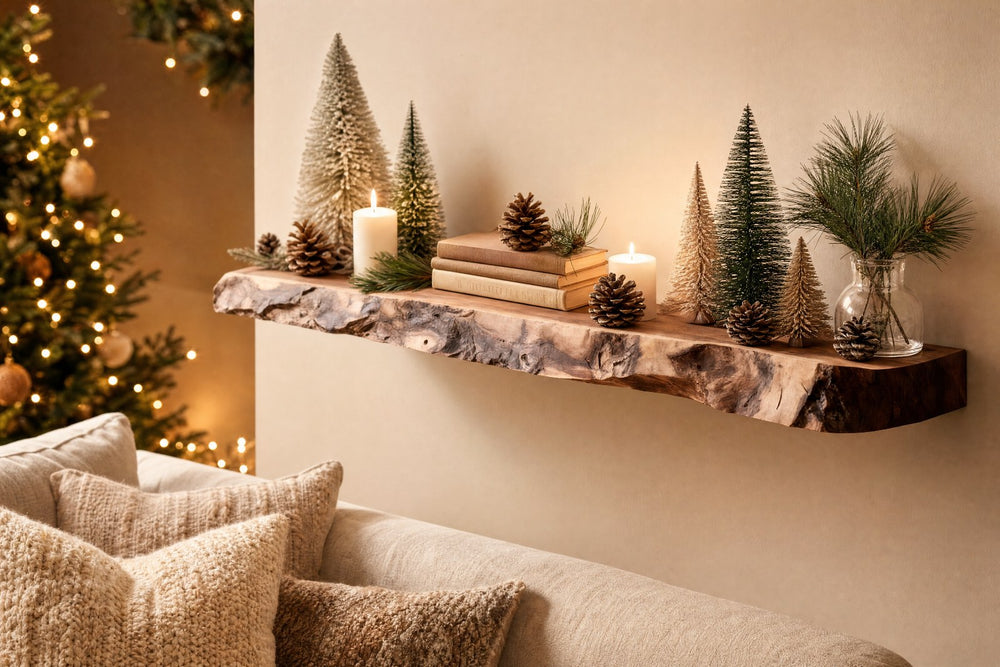
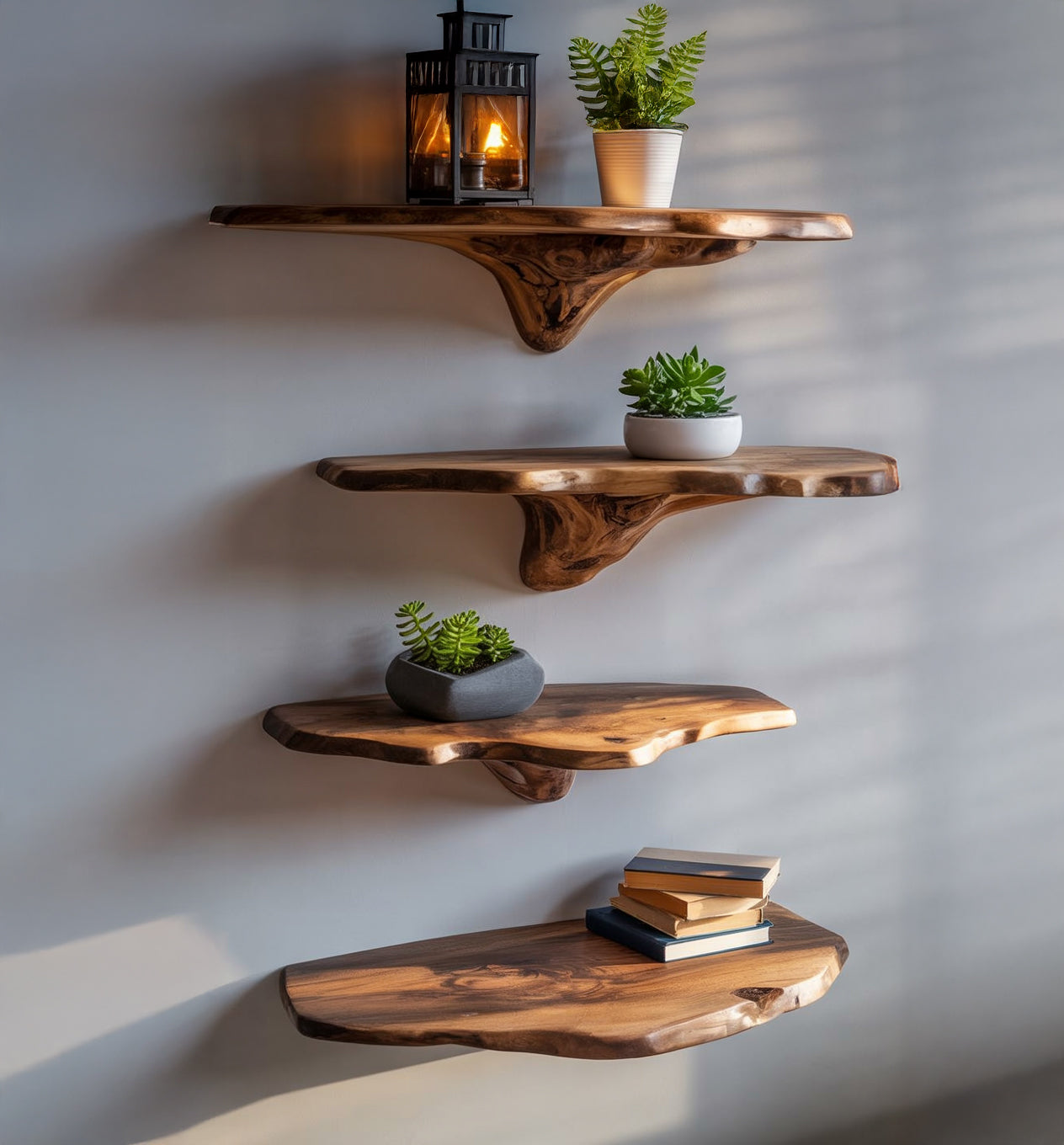
Three live edge floating wood shelves on a white wall, displaying minimalist decor.

Why Mushroom Floating Shelves Are Trending in 2026

Mushroom floating shelves have moved beyond trend cycle territory and into permanent design vocabulary. Google Trends data shows "mushroom shelf" searches holding steady above their 2022 peak - a pattern that signals mainstream adoption, not a fad about to collapse. Pinterest searches for "mushroom home decor" grew over 340% between 2021 and 2024, and the growth hasn't slowed.

Three forces are driving this. First, the cottagecore-to-mainstream pipeline: an aesthetic that started as TikTok escapism during lockdown has matured into a legitimate interior design category covered by Architectural Digest, Elle Decor, and House Beautiful. Second, the functionality jump - mushroom shelves aren't decor you place on furniture; they are the furniture. That functional permanence prevents trend fatigue. You can donate a mushroom-print throw pillow. You don't casually remove a shelf that's holding your plants and books.

Third, and most importantly for 2026: visual social media rewards organic shapes. Instagram's algorithm favors high-engagement content, and posts tagged #mushroomdecor average 4.2% engagement - more than double the 1.9% home decor category average. A mushroom shelf on a clean wall photographs better than a standard rectangular shelf because it breaks the grid. Every wall in your home is already rectangles: windows, frames, TVs, mirrors. A curved mushroom cap introduces the organic asymmetry that stops a scroll.

mushroom shelf vs rectangular floating shelf comparison on living room wall

The Numbers Behind the Trend

Here's what the data actually shows across platforms:

  • Google Trends: "Mushroom shelf" interest score has maintained above 65 (out of 100) since its October 2022 peak - well above the sub-20 scores from 2019. Year-over-year growth for 2025-2026 is approximately 40%.
  • Pinterest: "Mushroom home decor" saves increased 340% from Q1 2021 to Q4 2024. Pinterest named "enchanted forest aesthetics" a top home trend in both 2023 and 2024.
  • Instagram: Posts tagged #mushroomdecor exceeded 850,000 by early 2025, with engagement rates averaging 4.2%.
  • Etsy: "Mushroom shelf" ranked among the top 100 home decor searches through 2023-2025, with a 280% increase in listings featuring mushroom-themed furniture.
  • Retail adoption: Target, West Elm, and CB2 now carry permanent mushroom decor lines - a signal of long-term commercial viability.

Cottagecore to Mainstream: How We Got Here

The mushroom decor trend followed a three-phase trajectory. Phase one (2020-2021) was pure decoration - ceramic mushroom figurines, mushroom candles, mushroom-print textiles. Phase two (2022-2023) was the functionality jump, when designers realized the mushroom shape itself could become the furniture. Phase three (2024-present) is mainstream adoption, where mass retailers sell the silhouette and discerning buyers seek out handcrafted originals.

We're now firmly in phase three, and that's actually good news for anyone shopping. Mass retail exposure introduces millions of people to mushroom shelving. The percentage who care about material quality, craftsmanship, and longevity - that's who gravitates toward solid wood versions from workshops like ours. Our sales of mushroom floating shelves increased after major retailers launched their own versions, not before.

Mushroom Shelf Styles: Single Cap, Cluster, Bracket & Shelf-With-Stem

Not all mushroom floating shelves look the same. The four main styles each serve different functions, fit different spaces, and carry different amounts of weight. Understanding the differences helps you buy the right one instead of returning the wrong one.

Single Cap Mushroom Shelf

The single cap is the most compact mushroom shelf design. One rounded cap form with a flat or slightly concave top surface, mounted flush to the wall. Typical dimensions: 6-10 inches wide, 5-8 inches deep, 2-3 inches thick. Weight capacity: 8-15 lbs depending on wood species (walnut holds more than pine).

This is your entry point. A single cap mushroom shelf works as an accent piece - a small plant, a candle, a tiny ceramic figure. It's also the most affordable style and the easiest to install (one stud or two drywall anchors). Best for bathrooms, bedrooms, narrow hallways, and spaces where you want a touch of whimsy without overwhelming the room.

Cluster Mushroom Shelf

Cluster designs group two to four caps of varying sizes into a single wall-mounted composition. The staggered heights mimic how mushrooms actually grow on a fallen log - organic, asymmetric, layered. A typical 3-cap cluster spans 14-20 inches wide and 10-16 inches tall, with 80-150 square inches of total usable surface. Weight capacity: 5-10 lbs per individual cap, 15-25 lbs total.

Clusters are the most popular style in our mushroom floating shelves collection. They work as a display vignette - crystal collections, small succulents, curated trinkets. One customer mounted a 3-cap cluster above a reading nook with a small lamp on the largest cap. The key with clusters: mount into 2-3 anchor points, with at least one hitting a stud.

Shelf-With-Stem Design

The shelf-with-stem adds a visible carved stem beneath the cap, creating a more literal mushroom silhouette. But the stem isn't just decorative - it's structural. It transfers weight to the wall mount and adds rigidity, which means higher capacity: 15-25 lbs. Cap width ranges from 8-14 inches, with the stem adding 4-8 inches of vertical height.

This is the workhorse style. A 12-inch walnut shelf-with-stem comfortably holds 4-5 hardcover books plus a small plant. It suits living rooms, home offices, and kitchens where you want your floating shelf to do real work, not just look interesting.

Bracket Style Mushroom Shelf

The bracket style reimagines the traditional shelf bracket as a mushroom form. Instead of a plain metal L-bracket, you get a carved mushroom - cap, stem, and gills - that serves as the structural support beneath a flat shelf surface. This gives you the aesthetic of mushroom decor with the full functionality of a standard shelf.

Bracket-style mushroom shelves offer the most usable surface area because the shelf top is flat and typically 12-24 inches wide. Weight capacity depends on the bracket wood and shelf width, but 20-35 lbs is common. Best for kitchens (spice display, mug storage) and living rooms (books, photo frames) where you need serious shelf space wrapped in whimsical design.

Room-by-Room Styling Guide for Mushroom Shelves

A mushroom shelf can work in nearly any room, but the ideal style, size, and placement differ by space. Here's how to choose - with specific mounting heights, item suggestions, and shelf styles for each room in your home.

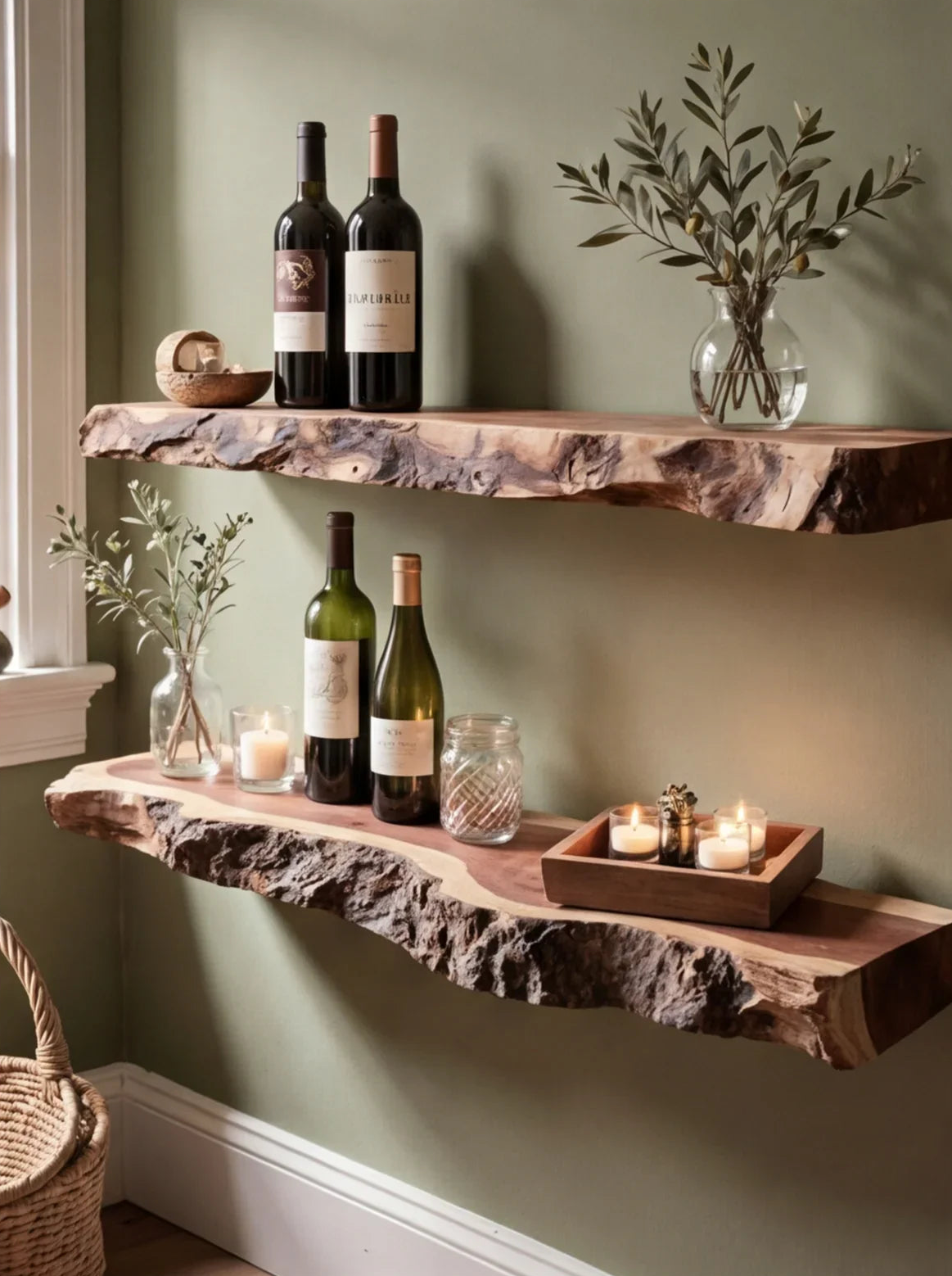
Set of live edge floating wood shelves with decorative vases on modern interior wall

Nursery & Kids' Rooms

Mushroom shelves are a natural fit for nurseries - they match the storybook aesthetic that parents gravitate toward without looking juvenile as the child grows. A cluster of 2-3 mushroom caps in light wood (ash or maple) at 48-54 inches from the floor keeps items out of toddler reach while creating a whimsical focal wall.

Style with: a small stuffed animal on the largest cap, a tiny succulent (real or artificial) on the medium cap, and a baby name initial or small framed print on the smallest. Total weight stays under 5 lbs. The organic shapes stimulate visual development without the overstimulation of bright plastic.

As the child grows, mushroom shelves transition seamlessly into a display for trophies, small collectibles, and artwork. Unlike themed nursery decor that you replace at age 3, a solid wood mushroom shelf carved from walnut or ash remains relevant through childhood, teen years, and beyond. That's 15+ years of use from one purchase.

Kitchen

Kitchen mushroom shelves serve double duty: they store spices, mugs, or small herb pots while adding warmth to a room dominated by cold surfaces (stainless steel, tile, granite). A shelf-with-stem design in walnut mounted at 54-60 inches from the floor, near the stove or above a coffee station, puts frequently used items within arm's reach.

We recommend walnut or ash for kitchen mushroom shelves - hardwoods with a Janka rating above 1,000 lbf resist the dings and scratches that softwoods can't handle in high-traffic spaces. Pair a single mushroom shelf with standard floating shelves for a mixed display that balances function and personality. A kitchen with nothing but mushroom shelves risks looking like a theme restaurant. One or two mushroom accents among standard shelves hits the right note.

Bathroom

Bathrooms are the sleeper hit for mushroom shelf placement. A single cap mushroom shelf at 6-8 inches wide is the perfect size for a rolled hand towel, a candle, or a small potted plant. Mount it at 60-66 inches from the floor - above splash zones but below the ceiling line.

The critical factor in bathrooms is moisture. MDF and particle board mushroom shelves from Amazon will swell and delaminate within 6-12 months in a humid bathroom. Solid wood - especially when finished with moisture-resistant natural oils - handles bathroom humidity for decades. Our artisans apply a penetrating oil finish that seals the wood without hiding the grain. The mushroom cap keeps its shape and color in environments where cheaper materials fail.

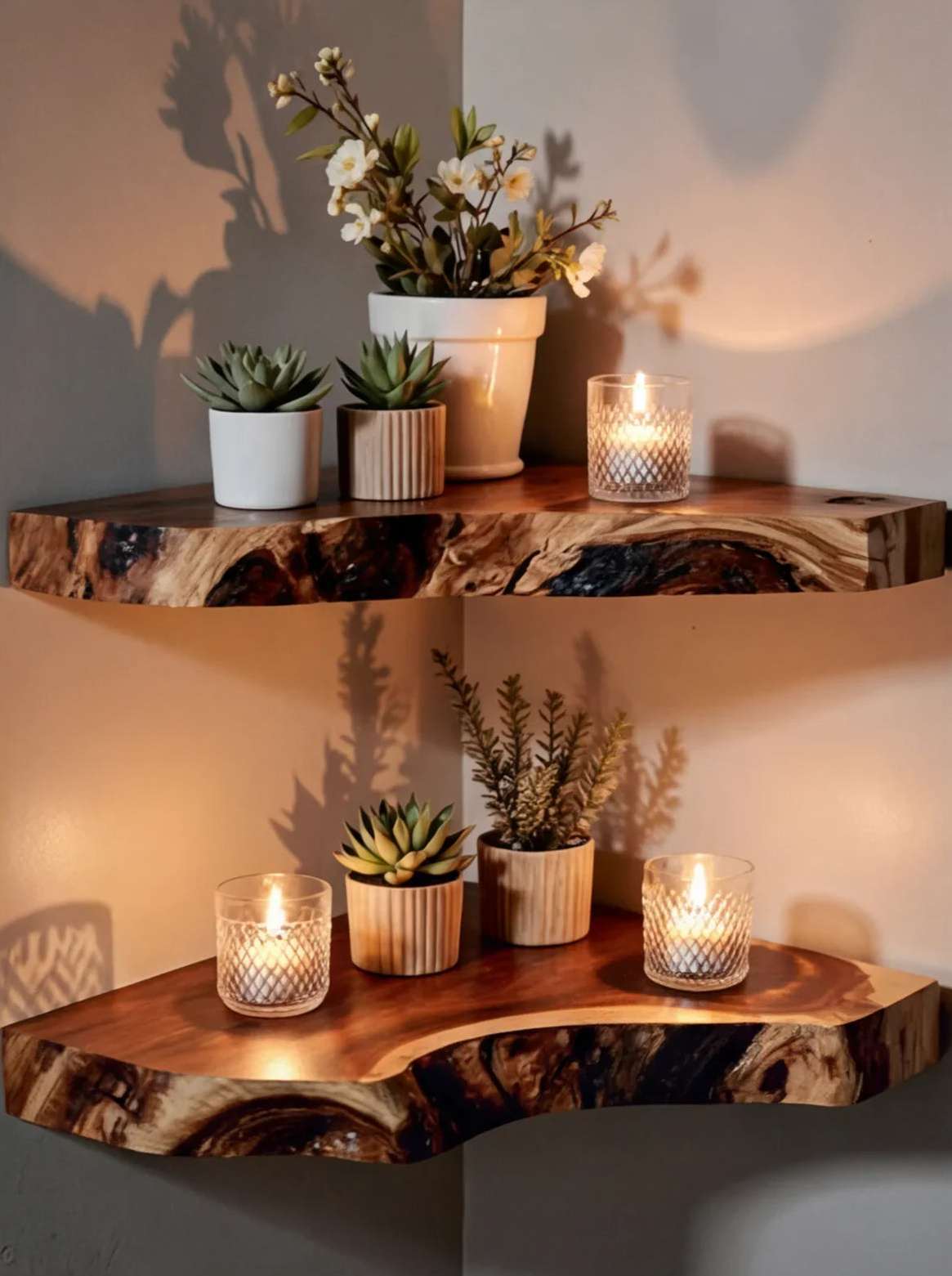
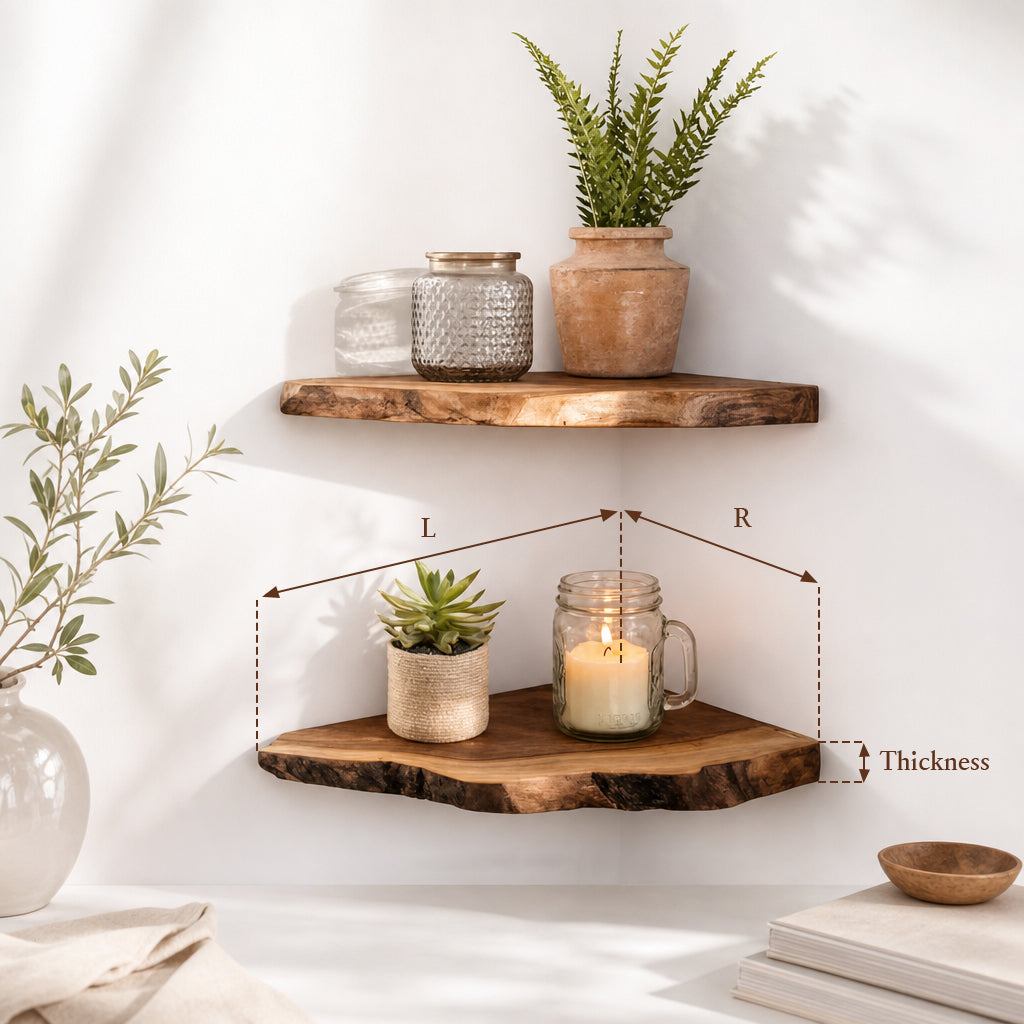
For powder rooms with limited wall space, corner floating shelves in mushroom shapes maximize dead corners. A single mushroom corner shelf above the toilet provides storage for a small plant or reed diffuser without protruding into the walkway.

Living Room

The living room is where mushroom shelves get the most attention - from guests and from Instagram. A cluster arrangement flanking a piece of wall art, or a pair of shelf-with-stem designs above a sofa, creates a focal wall that photographs beautifully.

Mount living room mushroom shelves at 54-66 inches from the floor (eye level when standing or slightly above). Style with a mix of functional and decorative items: a small plant on one shelf, a candle and matchbook on another, a single framed photo or art print on a third. The odd-number rule applies - display 1, 3, or 5 items per shelf grouping. Odd numbers feel organic; even numbers feel curated-to-death.

For living rooms with existing shelving, the mixed approach works best. Pair 1-2 mushroom shelves with standard rectangular shelves - the curves of the mushroom caps contrast with clean lines to create visual tension that keeps the arrangement interesting. This approach prevents the "themed room" feeling while still introducing whimsy.

How Ashdeco Artisans Hand-Carve Each Mushroom Shelf

Every mushroom floating shelf in our collection starts as a block of solid hardwood - not a mold, not a CNC file, not a factory template. Our Vietnamese artisans shape each mushroom by hand using traditional woodcarving techniques passed through generations in craft villages across central Vietnam.


The Carving Process: From Block to Mushroom

The process begins with wood selection. Each piece of walnut, ash, or acacia is inspected for grain direction, knot placement, and moisture content (target: 8-12%). Grain direction matters because the mushroom cap curves across the wood - if the grain fights the curve, the cap can develop stress cracks over years. Our artisans select pieces where the grain flows with the intended mushroom profile.

Rough shaping takes 2-4 hours per shelf using hand chisels and gouges. The artisan carves the cap profile first, establishing the dome curvature and edge roll. Then the underside - the "gills" area - gets carved with radiating grooves that mimic real mushroom anatomy. This isn't just decoration. The gill carving reduces weight without sacrificing cap thickness, and it creates shadow lines that make the shelf look alive on the wall.

Final shaping uses finer tools: rasps, rifflers, and curved scrapers that smooth the surface to a hand-rubbed finish before any oil or lacquer touches the wood. Total hands-on carving time per single cap shelf: 6-10 hours. Cluster shelves take 15-25 hours. A shelf-with-stem piece runs 12-18 hours. This isn't a product that comes off an assembly line.

Modular Assembly: Why It Matters

Ashdeco products are modular by design. The mushroom cap, stem (if applicable), and mounting bracket are carved separately, then assembled. This approach has three advantages over carving from a single block:

  • Stronger joints: Each component's grain runs in its optimal direction for strength. A one-piece mushroom where the grain runs through both cap and stem has a weak cross-grain point at the transition. Separate components with proper joinery eliminate this.
  • Better wood utilization: A mushroom cap cut from one direction uses wider, flat-sawn boards. A stem uses narrower, quarter-sawn stock. Carving both from one block wastes 40-60% of the wood.
  • Easier repair: If a cap gets damaged in 10 years, you can replace or refinish the cap without removing the entire shelf. Modular means maintainable.

Finishing: Oil vs. Lacquer for Mushroom Shelves

Our standard finish is a penetrating natural oil (tung oil or linseed-based) that soaks into the wood fibers rather than sitting on top as a film. This matters for mushroom shelves because the curved surfaces show every imperfection in a film finish - drips, brush marks, orange peel texture. Oil finishes are forgiving on curves and enhance the natural grain rather than glazing over it.

For bathroom applications, we apply an additional wax layer over the oil for extra moisture resistance. The wax is reapplicable - every 6-12 months, a quick buff with paste wax keeps a bathroom mushroom shelf looking new. Try doing that with a sprayed lacquer finish.

Mushroom Floating Shelf Size Comparison Table

Choosing the right mushroom shelf starts with knowing the dimensions, weight capacity, and best use case for each style. This table compares every style we carry so you can match your wall space, storage needs, and aesthetic goals.

Style Width Depth Height Weight Capacity Best Room Mounting
Single Cap 6-10 in 5-8 in 2-3 in 8-15 lbs Bathroom, bedroom, hallway 1 stud or 2 drywall anchors
Cluster (3-cap) 14-20 in 4-7 in per cap 10-16 in overall 15-25 lbs total Living room, reading nook 2-3 anchors (stud preferred)
Shelf-With-Stem 8-14 in 6-10 in 6-11 in 15-25 lbs Office, living room, kitchen 1-2 studs required
Bracket Style 12-24 in 6-10 in 8-14 in 20-35 lbs Kitchen, living room 2 studs required

How Wood Species Affects Capacity and Appearance

The wood species determines both how much weight a mushroom shelf can carry and how it looks on your wall. Here's the breakdown for the three most common species we work with:

Wood Species Janka Hardness Color / Grain Best For Capacity Modifier
Walnut 1,010 lbf Rich dark brown, flowing grain Living rooms, offices, dark/warm interiors Baseline (reference)
Ash 1,320 lbf Light blonde, prominent grain Nurseries, Scandinavian interiors, bathrooms +10-15% vs walnut
Acacia 1,750 lbf Golden-brown, dramatic figuring Kitchens, high-traffic areas, statement pieces +25-30% vs walnut

Walnut is our most-requested wood for mushroom shelves because the dark grain creates dramatic shadow lines in the carved gill detail. Ash is the best performer in lighter interiors - the blonde color complements white and gray walls without disappearing. Acacia is the hardest and most durable, making it ideal for kitchens and bathrooms where impact resistance matters.

Choosing the Right Size for Your Wall

Here's a practical framework: measure the empty wall space where you want the shelf. Then apply these rules.

  • Under 12 inches of wall space: Single cap. Anything bigger crowds the area and makes the wall feel smaller.
  • 12-24 inches of wall space: Cluster or shelf-with-stem. Clusters fill vertical space; shelf-with-stem fills horizontal space. Choose based on your wall's orientation.
  • Over 24 inches of wall space: Bracket style or a mixed arrangement combining mushroom shelves with standard floating shelves. Larger spaces can handle the visual weight of bigger pieces.
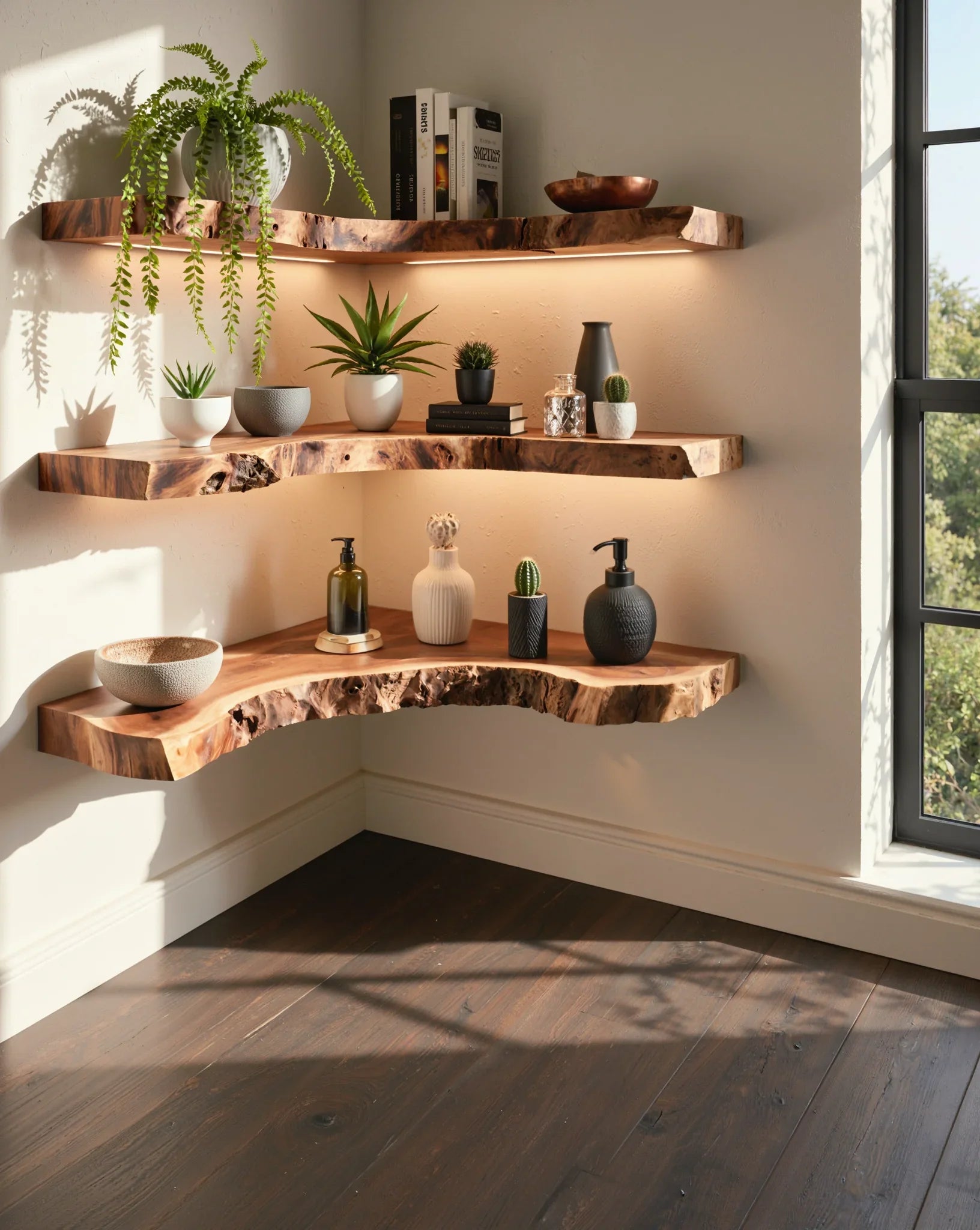
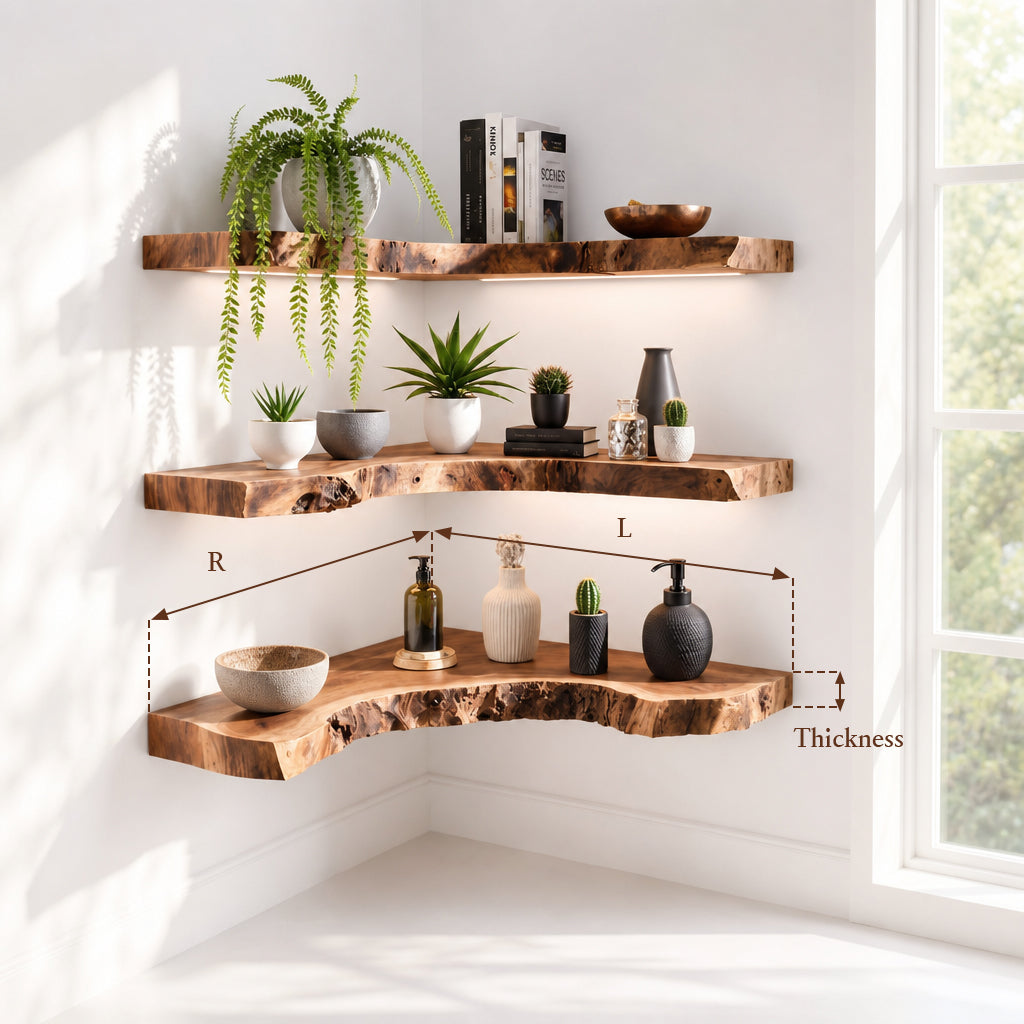
  • Corner placement: Our corner floating shelves in mushroom profiles fit dead corners that flat-wall shelves can't reach. A corner mushroom shelf turns wasted space into a conversation piece.

How to Install Mushroom Floating Shelves: Step-by-Step

Installing a mushroom floating shelf takes 15-30 minutes with basic tools. The process is similar to standard floating shelves but with a few extra considerations for curved and asymmetric designs. For a deeper dive on mounting techniques and wall types, see our full guide on how to mount floating shelves.


Tools You'll Need

  • Stud finder (electronic or magnetic)
  • Level (12-inch minimum)
  • Drill with 3/16-inch and 1/4-inch bits
  • Tape measure
  • Pencil
  • Screwdriver or drill with driver bit
  • Mounting hardware (included with Ashdeco shelves): French cleat, keyhole brackets, or rod system depending on style

Installation Steps

  1. Find your studs. Run the stud finder horizontally across the wall at your target height. Mark stud centers with pencil. For single cap shelves under 10 lbs, heavy-duty drywall anchors (rated 50+ lbs each) work if you can't hit a stud. For clusters and shelf-with-stem designs, at least one stud connection is mandatory.
  2. Mark your height. Standard mounting height for decorative shelves is 57-60 inches from the floor (gallery hanging height). For functional shelves you'll access daily - kitchen, entryway - mount at 48-54 inches. In nurseries, 48-54 inches keeps items above toddler reach.
  3. Level your mount. Hold the cleat or bracket against the wall at your marked height. Place the level on top. Adjust until perfectly level, then mark the screw holes through the bracket slots. This step is critical for mushroom shelves because asymmetric shapes make visual leveling unreliable - trust the tool, not your eye.
  4. Pre-drill and mount. Drill pilot holes at your marks. Into studs: use 3/16-inch bit, drive 2.5-inch screws. Into drywall: drill 1/4-inch holes, tap in anchors, drive screws. Attach the wall-side bracket or cleat.
  5. Hang the shelf. Slide the mushroom shelf onto the cleat or bracket. For French cleats, lower the shelf at a slight angle until the shelf-side cleat hooks onto the wall-side cleat. For keyhole brackets, align the keyhole slots with the screw heads and slide down to lock.
  6. Level check. Place the level on the shelf surface. Minor adjustments can be made by shimming behind the wall-side cleat with thin cardboard or folded paper. Once level, your shelf is ready to style.

Mounting Tips for Cluster Arrangements

When mounting multiple mushroom shelves as a cluster, install the largest shelf first - it's the anchor of your arrangement. Then mount smaller shelves at 6-12 inches from the nearest edge of the large shelf, with both vertical and horizontal offset. Never align mushroom shelves in a grid. The whole point is organic asymmetry - slightly random, slightly clustered, like mushrooms on a tree.

Use painter's tape to mock up the arrangement before drilling. Cut tape pieces to match each shelf's footprint, stick them to the wall, and step back 8-10 feet. Adjust until the grouping looks natural. This 5-minute step prevents re-drilling holes and patching drywall.

Handcrafted Solid Wood vs. Resin & MDF: What You're Actually Buying

Search "mushroom shelf" on Amazon and you'll find options starting at $15-$25. Search on Etsy or at a craft furniture maker and prices start at $60-$150+. The price gap reflects a material and craftsmanship gap that directly affects how long the shelf lasts, how it looks in person, and whether you'll still want it on your wall in five years.

solid wood mushroom shelf vs resin MDF mushroom shelf comparison close up grain detail

Material Comparison: What Lasts and What Doesn't

Feature Hand-Carved Solid Wood MDF (Molded) Resin / Plastic
Lifespan 20-50+ years 3-7 years 2-5 years
Moisture resistance High (with oil finish) Very low - swells and delaminates Waterproof but yellows/cracks
Refinishable Yes - sand and re-oil indefinitely No - paint chips reveal brown fiberboard No - color is baked in
Weight capacity 8-35 lbs (by style) 5-15 lbs (glue joints fail under load) 3-10 lbs (brittle under point loads)
Grain / texture Natural grain wraps around the form Smooth, uniform, no grain Smooth or faux-texture mold
Uniqueness Every piece one-of-a-kind Identical factory copies Identical factory copies
Environmental impact Renewable hardwood, low waste Formaldehyde-based resins, not recyclable Petroleum-based, not biodegradable
Price range $60-$180+ $15-$40 $12-$35

Why Cheap Mushroom Shelves Fail in Bathrooms and Kitchens

MDF (medium-density fiberboard) is the default material for mass-market mushroom shelves. It molds into shape easily and takes paint well - which is why your $20 Amazon mushroom shelf looks fine in the listing photo. The problem is what happens after month six.

MDF absorbs moisture through any unsealed edge or paint chip. In a bathroom, ambient humidity alone is enough to cause swelling at the mounting holes within 6-12 months. The paint bubbles. The edges soften. The shelf sags. In a kitchen near steam from cooking, the timeline accelerates. We've seen customer photos of MDF mushroom shelves that looked like damp cardboard after one year of bathroom use.

Solid wood, finished with penetrating oil, handles moisture by absorbing and releasing it without structural damage - the way wood has worked for centuries. A walnut mushroom shelf in a bathroom won't swell, delaminate, or lose its shape. It develops a patina. In 10 years, it looks better than it did on day one. That's not marketing language - it's wood science.

The Grain Makes the Mushroom

Here's the difference you feel but might not articulate: on a hand-carved solid wood mushroom shelf, the grain runs continuously through the mushroom form. You see walnut's flowing lines wrap around the cap curve and follow through the stem. The wood was shaped to follow its own natural patterns. That's what makes it look alive.

On an MDF mushroom shelf, the surface is uniform. It's painted to look like "wood" - sometimes with a printed grain pattern - but there's no actual grain direction. On a resin mushroom shelf, the surface might have an intentional texture, but it repeats. Your eye registers the repetition unconsciously, and the object reads as "manufactured" rather than "natural."

This distinction matters most for mushroom shapes specifically. The whole appeal of a mushroom shelf is its organic, nature-inspired form. Making that form from synthetic materials is like printing a photo of a sunset and calling it a window. The shape is right, but the soul is missing.

Mushroom Shelf Design Variations: Beyond the Basic Cap

The mushroom floating shelf category has expanded far beyond a single cap on a wall. Today's designs range from realistic botanical reproductions to abstract interpretations that barely reference the mushroom form. Understanding the spectrum helps you choose a design that fits your interior style - whether that's cottagecore, Scandinavian, modern, or eclectic.

Realistic / Botanical Style

These shelves replicate the look of actual mushroom species - complete with gill detail on the underside, natural cap curvature, and proportionally accurate stems. Our artisans reference real specimens when carving. The caps might feature the slight irregularity of a wild oyster mushroom or the smooth dome of a porcini. Realistic mushroom shelves appeal to nature lovers, mycology enthusiasts, and anyone who wants their decor to feel like it grew out of the wall.

Stylized / Whimsical

Whimsical mushroom shelves exaggerate the mushroom form for personality. The caps might be wider and flatter than any real mushroom, the stems cartoon-thick, the proportions playful. This is the dominant style in nurseries and kids' rooms, but it works in any space that welcomes personality. Think fairy-tale cottage, not botanical illustration.

Abstract / Sculptural

At the most artistic end of the spectrum, abstract mushroom shelves reduce the mushroom form to its essential curves - a dome, a taper, an organic overhang. These pieces read as sculptural wall art that happens to hold objects. They suit modern and minimalist interiors where a realistic mushroom might feel out of place. The cap becomes a curved shelf; the stem becomes a wall-mounted pedestal.

Combination & Multi-Level

Some designs combine multiple mushroom elements into a single mounted unit - a vertical stack of overlapping caps, like bracket fungi growing up a tree trunk. These multi-level pieces provide 2-4 distinct shelf surfaces in one installation. They make a dramatic statement and work particularly well on tall, narrow walls or in stairwells where you have vertical space to fill.

3 Ways to Style a Mushroom Shelf (With Exact Item Counts)

A mushroom shelf is already a statement. Styling it well is the difference between "interesting shelf" and "everyone asks where I got it." Here are three proven approaches with specific instructions so you can replicate them in under 10 minutes.

Three live edge floating wood shelves on a white wall, displaying minimalist decor.

Look 1: The Minimalist (1 Shelf, 3 Items, 5 Minutes)

One single-cap mushroom shelf. Three items. Nothing else.

  1. Mount the shelf at 57-60 inches from the floor (gallery height).
  2. Place a small potted plant (3-inch pot, ~1 lb) at the back-center of the shelf.
  3. Set a candle or votive (2-3 inches tall) to the left, about 2 inches from the edge.
  4. Place a tiny personal object - a crystal, small ceramic, or figurine - to the right of the plant, slightly forward.

This triangular arrangement is the strongest composition in display design. The mushroom cap shape is sculptural enough to carry a wall on its own - three items activate the shelf without competing with it. Total weight: under 3 lbs. Best for bedrooms, bathrooms, and narrow hallways.

Look 2: The Woodland Cluster (3 Shelves, Nature Theme, 8 Minutes)

Three mushroom shelves - large (10-12 in), medium (7-9 in), small (5-7 in) - staggered on the wall like fungi growing on a tree trunk.

  1. Mount the large shelf at 54-58 inches, slightly left of center.
  2. Mount the medium shelf 6-8 inches higher and 8-12 inches to the right.
  3. Mount the small shelf 4-6 inches below and 5-8 inches to the right of the medium, forming a loose triangle.
  4. Add a trailing plant (string of pearls, pothos) on the large shelf - let it drape over the cap edge.
  5. Place a small terrarium or glass sphere on the medium shelf.
  6. Set one woodland figurine and a tiny succulent on the small shelf.

The asymmetric mounting mirrors natural mushroom growth. Total weight across all three shelves: 6-10 lbs. Best for living rooms, reading nooks, and kids' rooms.

Look 3: The Mixed Display (Mushroom + Standard Shelves, 10 Minutes)

Combine 1-2 mushroom shelves with 2 standard rectangular floating shelves. The curves of the mushroom caps contrast with clean lines - creating visual tension that keeps the arrangement interesting without going full woodland theme.

  1. Mount rectangular shelves at 48-52 inches and 62-68 inches from the floor, level.
  2. Mount a mushroom shelf to the left or right of the rectangles, between their heights (56-60 inches).
  3. Style rectangular shelves first: lean books, add a plant, place a framed photo.
  4. Style the mushroom shelf with 1-2 items only: a small plant, a candle, or a ceramic piece.

This approach prevents the "themed room" feeling while introducing whimsy. The practical storage lives on the rectangular shelves; the personality lives on the mushroom caps. Best for living rooms, offices, and dining areas.

Why Mushroom Shelves Outlast Every Other Decor Trend

Most home decor trends follow a predictable lifecycle: niche discovery → viral spike → mass adoption → oversaturation → decline. Fidget spinners. Galaxy-print everything. Farmhouse signs. The pattern repeats every 18-24 months. Mushroom shelves have broken this cycle, and there are structural reasons why.

The Functional Anchor Effect

Trends that make the jump from decorative to functional persist. A mushroom shelf isn't just an aesthetic choice - it's holding your plants, books, and candles. Removing it means finding a replacement shelf, patching screw holes, and rearranging the items it held. The switching cost keeps mushroom shelves on walls long after the initial trend excitement fades.

Compare this to mushroom candles, mushroom-print pillows, or ceramic mushroom figurines. Those items have zero switching cost - you toss them in a donation bag and replace them in 30 seconds. Functional mushroom decor doesn't work that way. It earns its wall space by doing a job, and it stays because removing it creates a gap.

The Mid-Century Modern Parallel

Mushroom shelves are following the trajectory of mid-century modern furniture. MCM started as a niche 1950s-60s movement, hit peak popularity, seemed like it might fade, and instead became a permanent fixture in the design vocabulary. Today, 70+ years later, Eames chairs and tulip tables are standard furnishings, not retro curiosities.

The common thread: both movements prioritize organic curves derived from natural forms, both are rooted in craftsmanship traditions, and both made the functional jump from decoration to furniture. When a shape is useful and beautiful, it doesn't go out of style. It just stops being called a "trend" and starts being called "design."

Material Matters for Longevity

A hand-carved solid wood mushroom shelf doesn't just outlast trends - it physically outlasts the alternatives. While a resin mushroom shelf from Amazon yellows and cracks in 2-5 years, and an MDF version swells in any humid room, a walnut or ash mushroom shelf can last 20-50+ years with basic care. Oil it once a year. Wipe it down occasionally. That's it.

Your grandkids could inherit a mushroom shelf you buy today. That's not hyperbole - it's what solid hardwood does when it's properly crafted and finished. The $20 Amazon mushroom shelf will be in a landfill before your next lease renewal. The hand-carved one will still be on someone's wall.

Where to Place Mushroom Shelves: Unexpected Spots That Work

Most mushroom shelf inspiration focuses on living rooms and bedrooms - and those rooms work. But some of the best placements are spots you wouldn't initially consider. These unconventional locations get the most compliments and solve specific functional problems.

Live edge floating wood shelves with plants in a modern living room above a grey sofa.

Stairwell Walls

Stairwell walls are typically the largest uninterrupted wall surfaces in a home - and the most neglected. A vertical cluster of 3-5 mushroom shelves ascending the stairwell at intervals matching the stair rise creates a dynamic display that you see differently from every step. Mount the lowest shelf at the same height as the banister and ascend from there. The organic shapes complement the diagonal lines of the staircase beautifully.

Above a Doorway

The space above a doorframe is almost always empty. A single-cap mushroom shelf mounted 4-6 inches above the frame and centered over the door adds an unexpected focal point. Display a trailing plant that cascades partway down the frame - the combination of carved mushroom cap and living greenery creates a portal effect that makes walking through the doorway feel intentional.

Home Bar / Coffee Station

Mount a bracket-style or shelf-with-stem mushroom shelf above a bar cart or coffee corner. Use it to hold cocktail glasses, a small bottle of bitters, or espresso cups. The whimsy of the mushroom shape contrasts with the sophistication of the bar setup - and contrast is what makes a display interesting.

Home Office - Above the Monitor

A single mushroom shelf mounted 6-8 inches above your monitor provides a spot for a small plant, a desk toy, or a photo - items that add personality to your workspace without cluttering your desk. The curved cap softens the hard lines of monitors and desk edges, reducing the "corporate cubicle" feel of many home offices.

Mushroom Shelves vs. Standard Floating Shelves: When to Choose What

Not every wall needs a mushroom shelf, and not every purpose is best served by one. Here's an honest comparison to help you decide when a mushroom shelf is the right call - and when a standard floating shelf does the job better.

Choose a Mushroom Shelf When:

  • You want the shelf itself to be decorative. A mushroom shelf is wall art and storage combined. It eliminates the need to hang separate art near your shelf.
  • You're displaying lightweight items (under 15 lbs). Plants, candles, small ceramics, and photo frames are perfect mushroom shelf items.
  • You want conversation-starting decor. Nobody asks about a standard white shelf. Mushroom shelves get comments.
  • You're decorating a nursery, reading nook, or whimsical space. The organic shape sets a mood that rectangles can't.

Choose a Standard Floating Shelf When:

  • You need maximum storage per linear foot. Standard shelves offer edge-to-edge usable surface. Mushroom caps have curved edges that reduce usable area by 15-25%.
  • You're storing heavy items (books, records, heavy electronics). While bracket-style mushroom shelves handle 20-35 lbs, a 36-inch hardwood floating shelf can handle 40-60 lbs.
  • You're doing a full shelving system (3+ shelves in a row). Multiple mushroom shelves in a straight line looks odd. Standard shelves align naturally.
  • You want a recessed or seamless look. Mushroom shelves project from the wall; that projection is their appeal but also their limitation in tight hallways or above headboards where clearance matters.

The Best Approach: Mix Both

The smartest move for most rooms is combining 1-2 mushroom shelves with standard floating shelves. The rectangles handle practical storage while the mushroom caps inject personality. It's the design equivalent of a well-dressed outfit: mostly structured, with one statement piece. Our mounting guide covers hardware for both styles if you're combining them on the same wall.

Caring for Your Mushroom Floating Shelf

Solid wood mushroom shelves require minimal maintenance - far less than most people expect. The carved surfaces aren't fragile, and the oil finish is designed to be reapplied, not babied. Here's the complete care routine.

Weekly: Dust and Wipe

Dust with a dry microfiber cloth, following the grain direction. The carved gill detail on the underside collects dust in the grooves - a soft brush (paintbrush or makeup brush) cleans those channels without scratching. For spills or kitchen grease, wipe with a slightly damp cloth and dry immediately.

Every 6-12 Months: Re-Oil

Apply a thin coat of the same oil used in the original finish (tung oil or linseed-based). Pour a small amount onto a lint-free cloth and rub into the wood, working with the grain. Let it soak for 15-20 minutes, then buff off any excess with a clean dry cloth. Total time: 10 minutes per shelf.

Re-oiling serves two purposes: it replenishes the moisture barrier that protects the wood, and it deepens the grain color. A walnut mushroom shelf that looks slightly faded after 6 months of sun exposure will look richer and darker after an oil application. This is the advantage of oil finish over lacquer - you're renewing the finish, not covering up deterioration.

As Needed: Minor Scratch Repair

Small scratches on solid wood mushroom shelves are easy to fix. For surface scratches, rubbing a walnut meat (the nut, not the oil) over the scratch fills it with natural oils and color. For deeper scratches, lightly sand with 220-grit sandpaper along the grain, then re-oil that area. Try that with an MDF or resin shelf - you'll expose the fiberboard core or create a matte spot in the plastic that can't be repaired.

Frequently Asked Questions About Mushroom Floating Shelves

Are mushroom floating shelves strong enough for everyday use?

Yes. A hand-carved solid wood mushroom shelf holds 8-35 lbs depending on style - single cap designs hold 8-15 lbs, shelf-with-stem models hold 15-25 lbs, and bracket styles hold 20-35 lbs. That's more than enough for plants, books, candles, ceramics, and small lamps. Mount into studs for loads over 10 lbs.

Do mushroom shelves work in modern or minimalist interiors?

Absolutely. A single walnut mushroom shelf on a white wall becomes a focal point in minimalist spaces specifically because it contrasts with surrounding clean lines. The key is restraint - one or two pieces maximum, in a wood tone that complements your palette. Abstract mushroom shelf designs work especially well in modern interiors.

How do I clean the carved details on a mushroom shelf?

Use a soft-bristle brush (like a clean paintbrush) to dust the carved gill grooves on the underside. For the top surface, a dry or slightly damp microfiber cloth works. Avoid furniture sprays containing silicone - they build up in carved details and attract more dust over time.

Can I use mushroom shelves in a bathroom?

Solid wood mushroom shelves with an oil finish handle bathroom humidity without issue. The wood absorbs and releases moisture naturally. MDF and resin versions will fail - MDF swells and delaminates within 6-12 months in humid environments. Apply paste wax over the oil finish every 6-12 months for extra protection in high-moisture bathrooms.

What's the difference between single cap and cluster mushroom shelves?

A single cap is one rounded shelf surface, typically 6-10 inches wide, holding 8-15 lbs. A cluster groups 2-4 caps of varying sizes into one arrangement, spanning 14-20 inches with 15-25 lbs total capacity. Single caps are accent pieces; clusters are focal points. Choose based on wall space and how much display area you need.

Are handcrafted mushroom shelves worth the price over Amazon options?

Hand-carved solid wood mushroom shelves cost $60-$180+ compared to $15-$35 for MDF/resin versions. The trade-off: solid wood lasts 20-50+ years vs. 2-7 years for synthetic materials, can be refinished indefinitely, holds 2-3× more weight, and shows natural grain that makes each piece one-of-a-kind. Per year of use, the handcrafted option costs less.

How far apart should mushroom shelves be in a cluster arrangement?

Space mushroom shelves 6-12 inches apart (measuring from nearest edges) with both vertical and horizontal offset. Never align them in a grid - the organic asymmetry is the whole point. Mock up placement with painter's tape before drilling to visualize the arrangement at full room distance.

Will mushroom shelves go out of style?

Based on trend data, mushroom shelves have transitioned from niche trend to established design category. Trends that make the functional jump - from decorative to structural - tend to persist. The 40% YoY growth in 2025-2026 indicates acceleration, not decline. And a solid wood shelf that holds your things never really goes "out of style" regardless of trends.

Find Your Mushroom Floating Shelf

Mushroom floating shelves are one of those rare decor pieces that look beautiful, do useful work, and last long enough to become heirlooms. Whether you start with a single cap in the bathroom or a full cluster arrangement in your living room, choose solid wood over synthetic - it's the difference between decor that lasts two years and decor that lasts two decades.

Browse Ashdeco's full mushroom floating shelves collection to find hand-carved designs in walnut, ash, and acacia. Every piece is sculpted by Vietnamese artisans from solid hardwood - no MDF, no resin, no two alike.

Reading next

Bathroom Storage Ideas: Shelves, Vanities, and More
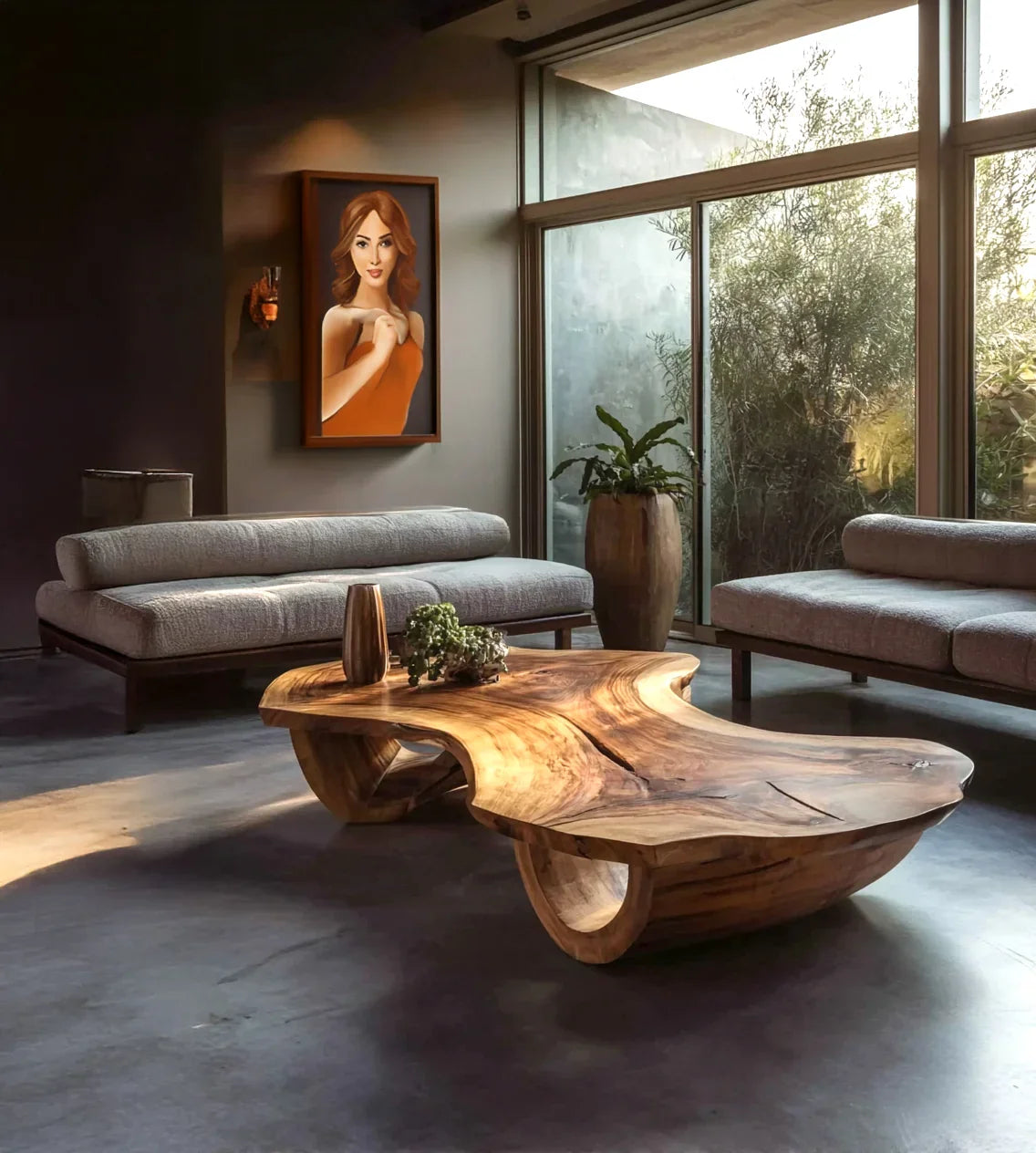
Live edge solid wood coffee table in modern living room with grey sofa and large window

Leave a comment

This site is protected by hCaptcha and the hCaptcha Privacy Policy and Terms of Service apply.